Home Blog Page 643

SEC flags 3 firms for unregistered investment schemes

BW FILE PHOTO

THE Securities and Exchange Commission (SEC) has warned the public against investing with Recson Land Ventures and Realty Development Corp., Dual Fuel Petroleum Corp. and Legends Petroleum, Inc., which it said are offering unregistered investment contracts promising high returns.

The regulator said the entities have been soliciting funds through co-ownership and investment schemes tied to gasoline stations, hostels and petroleum franchises. Promoters encouraged contributions of as much as P500,000 for gas station co-ownership and P30,000 per slot in hostels, promising passive income, profit sharing and other benefits.

“On their social media accounts, Dual Fuel and Legends Petroleum explained the co-ownership program along with the benefits and privileges included in each package,” the commission said.

“A review of their Facebook page shows that Recson Land Ventures and Realty Development Corp. is inviting the public to invest in and co-own a Recson Hostel with a minimum capital of P30,000 per slot/share, promising passive income over 30 years,” it added.

The SEC classified these arrangements as investment contracts, which under the Securities Regulation Code (SRC) require registration and authorization. The entities lack the licenses to solicit investments, it said.

Dual Fuel’s CEO, in particular, has not been registered as an associated person, compliance officer, salesman or certified investment solicitor under any authorized securities entity, it pointed out.

Recson Land did not immediately reply to an e-mail and Facebook message seeking comment. Dual Fuel also did not reply to a message on its Facebook page, while Legends Petroleum’s contact was not publicly available. — Alexandria Grace C. Magno

Peso gains as weak US data boost Fed cut bets

BW FILE PHOTO

THE PESO climbed against the dollar on Wednesday as weak US data fueled bets of a US Federal Reserve cut next month.

The local unit rose by seven centavos to close at P58.84 per dollar from its P58.91 finish on Tuesday, Bankers Association of the Philippines data showed.

The peso opened Wednesday’s session stronger at P58.83 against the greenback. It rose to as high as P58.75, while its worst showing was at P58.875 versus the dollar.

Dollars traded fell to $944 million from $1.169 billion on Tuesday.

“The dollar-peso closed higher as the market responded to US retail sales released overnight, coupled with comments from various Fed officials favoring a rate cut in December,” a trader said in a phone interview.

The peso also followed the yen’s sideways movement on Wednesday as signals from the Bank of Japan of a possible rate hike next month offset the pressure from possible intervention in the foreign exchange market by the Japanese government, Rizal Commercial Banking Corp. Chief Economist Michael L. Ricafort said in a Viber message.

For Thursday, the trader sees the peso trading at P58.65 to P58.95 per dollar, while Mr. Ricafort expects it to move between P58.75 and P58.95.

In the broader market, the dollar eased on Wednesday after benign US economic data reinforced expectations of a December rate cut, and as investors wagered that the leading candidate for the next Federal Reserve chair may guide policy in a more dovish direction, Reuters reported.

Data on Tuesday showed US retail sales rose less than expected in September while producer prices were in line with expectations.

US consumer confidence also sagged in November as households worried about jobs and their financial situation.

All of that left traders adding to bets of a Fed cut next month, with markets now pricing in an 85% chance of a 25-basis-point move, according to the CME FedWatch tool.

The yen was supported on Wednesday by expectations the Bank of Japan (BoJ) could deliver a rate hike as soon as December.

The BoJ is preparing markets for a possible interest rate hike as soon as next month, sources told Reuters, reviving previous hawkish language as worries about sharp yen declines return and political pressure for the bank to keep rates low fades.

The yen initially rose on the back of the reports, before paring some of those gains over the course of the trading session. It was last marginally lower at ¥156.07 per dollar, having earlier hit an intraday high of ¥155.66.

The Japanese currency has come under pressure from mounting worries about the country’s worsening fiscal position and a central bank that has been cautious over further rate hikes, with traders on alert to the risk of an intervention from Tokyo to stem the yen’s decline.

Some analysts have said the US Thanksgiving holiday on Thursday could open a possible window for authorities to step in. — A.M.C. Sy with Reuters

Taxing plastic bags

STOCK PHOTO | Image from Freepik

In August, the Senate revived the plastic bag tax discussion by introducing two new measures now pending in committee. Senate Bill No. 811 proposes an excise tax on a wide range of single-use plastic packaging materials, not just bags. Senate Bill No. 865, meanwhile, limits the tax to single-use plastic shopping bags.

These bills follow the House of Representatives’ move in late 2022, when it passed a bill on a P100 per kilogram excise tax on single-use plastic bags, with a 4% annual indexation beginning in 2026. The House bill also earmarked the tax proceeds for municipal solid waste (garbage) management programs.

The two Senate bills mark the latest chapter in a debate that has been ongoing for some time, and one that I have written about several times before. The questions I raised as early as 2019, about six years ago, about tax design, enforcement, and impact remain just as urgent today.

I support the tax. Revenues earmarked for solid waste management, or simply proper garbage disposal, will be a big help. Plastic pollution can also be better mitigated by improving collection, disposal, and recycling, rather than by an outright ban on plastic production and use.

But any plastic tax must be designed with all stakeholders in mind, particularly consumers or end-users. Plastic has long been the practical and economical alternative to glass, cardboard, paper, and styrofoam packaging. It is highly unlikely that we will abandon it.

The Department of Finance (DoF) has consistently argued that an excise tax on single-use plastic bags will not only raise money for LGUs to implement waste management programs but also change consumer behavior by making plastic bags more expensive. It will also address the negative externalities of plastic bag use such as plastic waste clogging drains, worsening flooding, polluting rivers and seas, and contributing to climate risks.

The DoF previously projected more than P30 billion in revenues between 2025 and 2028, assuming a P100 per kilogram excise tax on single-use plastic bags. Other estimates suggest revenues closer to P50 billion over the same period, based on current usage patterns and forecasts.

The retail impact is where estimates often differ, since bags come in different sizes and thicknesses. Retail cost per bag matters more, in my view, because while producers will pay the tax at the source, they will ultimately recoup the cost from buyers or bag users.

Estimates range from 45 centavos to P1.50 per plastic bag, depending on size and thickness, the latter assuming a higher P150 tax per kilogram. Available data indicate that “T-shirt” plastic bags, or sando bags, typically weigh three, five, or 10 grams each.

At that price range, bag costs may still be manageable for many households. But the poorest of the poor, and marginalized sectors, may think otherwise. However, a P1.50 tax per bag is still modest compared to the taxes charged in Ireland, Wales, England, and Denmark, at around P9-P13 per bag.

The first design question in my mind is whether the tax should be levied by weight or per piece. The House bill in the 19th Congress, and the Senate bills now pending in the 20th Congress, all propose a per kilogram tax collected at the manufacturing or importation stage, at P150 per kilogram.

The risk with this method is that manufacturers might produce thinner, flimsier bags to reduce their tax bill. The thinner the bag, the lighter it is, and the lower the tax on a per-bag basis. But thinner bags can be reused fewer times and may thus be discarded faster. Also, retailers may opt to double-bag purchases, to avoid breakage. Thus, more bags might enter circulation.

Using weight as a tax basis is probably easier, especially if the tax is collected at the manufacturing or importation stage. Plastic bags are usually sold per piece, not by weight. Thus, it might be more consistent, and more effective, to tax bags per piece as well.

The secondary aim of the tax is to change consumer behavior and address externalities. This might be better achieved also by charging the tax per piece. In Ireland, for instance, a tax equivalent to about P9 per bag was introduced in 2002. It reportedly cut usage by 90% in one year. In 2007, the tax was even raised to the equivalent of P13 per bag.

These experiences show that a per-piece tax creates a direct signal at the checkout counter. A shopper will not want to pay more for every bag. In Denmark’s case, the government taxed plastic bag manufacturers by weight, and the reduction in usage was not as high as Ireland’s.

This brings us to the central question: are we taxing plastic bags to raise revenue, or to change behavior? Obviously, the government targets both. But the goals of changing behavior and addressing negative externalities may be better served by a per-piece tax rather than by per kilogram.

There is also the issue that an excise tax like the plastic bag tax, as a form of consumption tax, will hit lower-income households harder. A few pesos more at checkout may mean little to a supermarket shopper, but not to a street market patron. The poor and marginalized can get hit the hardest.

Also, at a time of high food inflation, policymakers should be careful with any measure that adds to prices. This is not an argument to delay or avoid the tax altogether. It is urgently necessary, but the rate must be calibrated. A schedule can be used, allowing gradual increases over time, on top of indexation.

Admittedly, enforcement will be difficult if bags are taxed per piece at retail rather than at source. Excise taxes on beer, tobacco, motor vehicles, oil and fuel, or jewelry are all collected from only a handful of manufacturers and importers, at the point of production or importation.

Single-use plastic bags, on the other hand, flow through millions of sari-sari (sundry) stores and wet markets. Policing every outlet is nearly impossible. Taxing at the point of production may therefore be more practical. Doing so, however, may create a smuggling problem. How can authorities check at the retail level whether a bag was taxed or smuggled?

Fuel marking was implemented in the past to check fuel smuggling. Tests can determine if fuel being sold was unmarked or smuggled. Cigarettes and liquor have tax seals on their packaging or cases. But what about plastic bags? How can authorities determine if bags sold in the market have been taxed or not?

Revenue use is another concern. Assuming a tax take of roughly P50 billion over several years, is this enough to offset the environmental damage caused by the country’s annual plastic waste? To what extent can that amount improve solid waste management, move us beyond landfills, and support recycling and other initiatives?

How will that money be spent, and by whom, and for what projects? What will be the process for accessing this special waste management fund? What safeguards will prevent abuse, and how will the fund be used efficiently, transparently, and accountably? We need to learn from our experiences with the Special Road Fund and the Special Education Fund.

There is little incentive for substitution, given the convenience and relatively low cost of plastic bags. Alternatives such as paper, cloth, or so-called biodegradable plastics can be more expensive and also carry environmental costs. The tax may also just shift the problem from plastic waste to paper or cloth waste.

I agree with the DoF that the tax measure can be a win-win for climate and revenue. It is worth pursuing. Pollution costs are real. Clogged drains worsen flooding, destroy livelihoods, and cost billions in damage. Our problems are made worse by corruption in flood control projects.

Earmarking revenues for waste management is also a step in the right direction. A dedicated revenue stream for garbage disposal guarantees regular funding, and can make it easier to plan and implement waste management programs. Any tax on plastic bags will also surely influence consumer behavior.

But plastic shopping bags are only part of the problem. Plastic sachets, plastic bottles, plastic packaging such as bubble wrap, and microplastics also contribute to pollution. With the tax, a gray market for untaxed bags is also likely to arise.

Global evidence shows a plastic bag tax can reduce usage even at modest levels. But design is everything. The tax should be high enough to bite, yet low enough to remain tolerable for the poor. And taxing at source may be more practical, ideally on a per piece basis instead of by weight.

Government should also consider incentives for recycling and repurposing, and efforts to prolong the life cycle of plastic bags, whether by producers or end-users. Safeguards against smuggling must be part of the package. And bags should be just the start. Sachets, bottles, and microplastics should be next.

The Senate now holds the key. The question is no longer whether the Philippines should tax plastic bags. It is whether the tax will be effective, fair, and timely. Also, will the tax be used efficiently, on projects that are effective, and in a manner that is transparent, accountable, and free from abuse and corruption?


Marvin Tort is a former managing editor of BusinessWorld, and a former chairman of the Philippine Press Council

matort@yahoo.com

Four further suspects arrested in Louvre heist probe

LOUVRE Museum — WIKIPEDIA

PARIS — French police arrested four further suspects on Tuesday as part of the investigation into the audacious Louvre jewel heist last month, Paris prosecutor Laure Beccuau said in a statement.

The suspects are two men aged 38 and 39 and two women aged 31 and 40, and were being interrogated by police, the statement said.

It did not disclose what role the four are suspected of playing in the daylight robbery, in which four thieves made off with jewels worth $102 million.

Four other people were arrested and placed under formal investigation on Oct. 29 and Nov. 1.

The Paris prosecutor had previously said the robbery appeared to be the work of small-time criminals rather than professional gangsters.

The heist raised doubts over the credibility of the world’s most-visited museum as a guardian for its myriad works.

Two men parked a movers’ lift outside the Louvre one Sunday morning last month. They rode up to the second story, smashed a window, cracked open display cases with angle grinders, and then fled on the back of scooters driven by two accomplices in a heist lasting less than seven minutes.

So far, no trace has been found of the stolen jewels. — Reuters

Google, the sleeping giant in global AI race, now ‘fully awake’

SINCE the launch of ChatGPT three years ago, analysts and technologists — even a Google engineer and the company’s former chief executive officer — have declared Google behind in the high-stakes race to develop artificial intelligence (AI).

Not anymore.

The internet giant has released new AI software and struck deals, such as a chip tie-up with Anthropic PBC, that have reassured investors the company won’t easily lose to ChatGPT creator OpenAI and other rivals. Google’s newest multipurpose model, Gemini 3, won immediate praise for its capabilities in reasoning and coding, as well as niche tasks that have tripped up AI chatbots. Google’s cloud business, once an also-ran, is growing steadily, thanks in part to the global rush to develop AI services and demand for compute.

And there are signs of rising demand for Google’s specialized AI chips, one of the few viable alternatives to Nvidia Corp.’s dominant gear. A report on Monday that Meta Platforms, Inc. is in talks to use Google’s chips sent shares of its parent Alphabet Inc. climbing. The stock has added nearly $1 trillion in market capitalization since mid-October, helped by Warren Buffett taking a $4.9-billion stake during the third quarter and broader Wall Street enthusiasm for its AI efforts.

Alphabet shares rose 1.5% to $323.44 in New York on Tuesday, sending the company’s market capitalization near $4 trillion.

SoftBank Group Corp., one of OpenAI’s biggest backers, fell 10% on Tuesday on worries about the competition from Google’s Gemini. Nvidia shares dropped 2.6%, erasing $115 billion in market value.

“Google has arguably always been the dark horse in this AI race,” said Neil Shah, analyst and cofounder at Counterpoint Research. It’s “a sleeping giant that is now fully awake.”

For years, Google executives have argued that deep, costly research would help the company fend off rivals, defend its turf as the leading search engine and invent the computing platforms of tomorrow. Then ChatGPT came along, presenting the first real threat to Google search in years, even though Google pioneered the tech underpinning OpenAI’s chatbot. Still, Google has plenty of resources that OpenAI doesn’t: a corpus of ready data to train and refine AI models; flowing profits; and its own computing infrastructure.

“We’ve taken a full, deep, full-stack approach to AI,” Sundar Pichai, chief executive officer (CEO) of Google and Alphabet, told investors last quarter. “And that really plays out.”

Any concerns that Google might be held back by regulators are dying away. The company recently avoided the most severe outcome from a US anti-monopoly case — a breakup of its business — in part because of the perceived threat from AI newcomers. And the search giant has shown some progress in the longtime effort to diversify beyond its core business. Waymo, Alphabet’s driverless car unit, is coming to several new cities and just added freeway driving to its taxi service, a feat made possible by the company’s enormous research and investment.

Some of Google’s edge comes from its economics. It’s one of the few companies that produces what the industry calls the full stack in computing. Google makes the AI apps people use, like its popular Nano Banana image generator, as well as the software models, the cloud computing architecture and the chips underneath. The company also has a data goldmine for constructing AI models from its search index, Android phones and YouTube — data that Google often keeps for itself. That means, in theory, Google has more control over the technical direction of AI products and doesn’t necessarily have to pay suppliers, unlike OpenAI.

Several tech companies, including Microsoft Corp. and OpenAI, have plotted ways to develop their own semiconductors or forge ties that make them less reliant on Nvidia’s bestsellers. For years, Google was effectively its own sole customer for its homegrown processors, called tensor processing units, or TPUs, which the company first designed more than a decade ago to speed up the generation of search results and has since adapted to handle complex AI tasks. That’s changing. AI startup Anthropic said in October said it would use as many as 1 million Google TPUs in a deal worth tens of billions of dollars.

On Monday, tech publication the Information reported that Meta planned to use Google’s chips in its data centers in 2027. Google declined to address the specific plans, but said that its cloud business is “accelerating demand” for both its custom TPUs and Nvidia’s graphics processing units. “We are committed to supporting both, as we have for years,” a spokesperson wrote in a statement.

Meta declined to comment on the report on Monday night.

“We’re delighted by Google’s success,” a spokesperson for Nvidia said in a statement on Tuesday. “They’ve made great advances in AI, and we continue to supply to Google.” The spokesperson added: “Nvidia is a generation ahead of the industry — it’s the only platform that runs every AI model and does it everywhere computing is done.”

Analysts read the Meta news as a signal of Google’s success. “Many others have failed in their quest to build custom chips, but Google can clearly add another string to its bow here,” Ben Barringer, head of technology research for Quilter Cheviot, wrote in an e-mail.

Google has taken risks to get here. In early 2023, Google consolidated its AI efforts under Demis Hassabis, the leader of its London AI lab DeepMind. The reshuffle had some bumps, most notably a botched rollout of an image-generation product. For several years, DeepMind pursued research in areas like protein-folding that led to new commercial strategies (and a Nobel Prize) but contributed little to Google’s bottom line. Under the reorganization, the AI unit is focused almost squarely on foundational models that keep pace with OpenAI, Microsoft and others.

Mr. Hassabis, a renowned computer scientist, has helped retain key AI engineers despite multimillion-dollar offers from rivals. His boss, Mr. Pichai, has been willing to splurge on talent.

Gemini 3 Pro has risen to the top of closely watched AI leaderboards on LMArena and Humanity’s Last Exam. Andrej Karpathy, a founding member of OpenAI, said it’s “clearly a tier 1 LLM,” referring to large language models. Google pitched the model as one that can solve complex science and math problems, and address nagging issues — such as generating images and overlaid text with incorrect spelling — that might deter enterprise customers from adopting AI services more widely.

Consumer interest is harder to gauge. Google said last week that 650 million people use its Gemini app. OpenAI recently said ChatGPT hit 800 million weekly users. As of October, Gemini’s app had 73 million monthly downloads, well shy of ChatGPT’s 93 million monthly downloads, according to research firm Sensor Tower.

Google is an advertising behemoth, but it has historically struggled to find other commercial models. Its cloud business reported third-quarter revenue of $15.2 billion, up 34% from the prior year. Still, that remains in third place behind Microsoft and Amazon Web Services, which posted more than double Google’s cloud sales in the most recent quarter. Counterpoint Research’s Shah said Google’s AI adoption with enterprises lags Microsoft and Anthropic.

Meanwhile, OpenAI is targeting profits by selling a premium version of ChatGPT and adjacent software to companies. It’s cutting deals with chipmakers from Broadcom Inc. to Advanced Micro Devices Inc. to Nvidia to support its AI ambitions.

Google’s TPUs are mostly attractive to a handful of companies with big computing bills, like Meta and Anthropic, said Meryem Arik, CEO of the AI startup Doubleword.

And the chip industry is “not a zero-sum game with just one winner,” said Mr. Barringer.

For one, AI developers can only access Google’s chips through the company’s own cloud service. They can use Nvidia’s graphics processing units, or GPUs, more flexibly. “As soon as you use TPUs, you’re locked into” the Google cloud ecosystem, said Arik.

Being tied to a single supplier might have been something companies avoided. That’s no longer the case for Google, thanks to its advances in AI.

“It’s definitely fair to say that Google is back in the game with Gemini 3,” said Thomas Husson, analyst at Forrester. “In fact, to paraphrase a quote attributed to Mark Twain, reports of Google’s death have been widely exaggerated, not to say irrelevant.” Bloomberg

Benilde to open campus in Aseana City

FACEBOOK.COM/DLSCSB.OFFICIAL

DE LA SALLE-COLLEGE OF SAINT BENILDE will open a campus in Parañaque’s Aseana City to ease space constraints at its Manila campus, the school said on Wednesday.

The state-of-the-art facility will rise on a 3,845-square-meter lot within the 204-hectare mixed-use development and will be named after Delfin J. Wenceslao, Jr., former president and chairman of listed developer D.M. Wenceslao & Associates, Inc., it said in a statement.

Designed by architect Ed Calma, the campus will feature multi-tiered lecture halls, classrooms, laboratories, workshops, sewing and weaving rooms and a theater. The building will also integrate wind turbines and solar panels in line with Leadership in Energy and Environmental Design (LEED) standards, the school said.

Benilde Vice-President for Administration Michael Luis Fernando D. Tecson III said the campus would become a “living, breathing hub of creativity and connection,” with learning spaces interwoven with gardens, open-air lounges, collaborative zones and light-filled studios.

The Delfin J. Wenceslao, Jr. campus will house the School of Environment and Design, offering programs in architecture, interior and industrial design and fashion design and merchandising.

It will also host the School of Management and Information Technology’s Analytics, Computing, and Infotech division, covering courses in cybersecurity, game design and information systems.

Freshmen classes under the School of Multidisciplinary Studies and Business Administration majors in Business Intelligence and Analytics, and Business Solutions and Applications will also be based at the new facility. — B.M.D. Cruz

BSP easing bets pull down term deposit yields

BW FILE PHOTO

THE Bangko Sentral ng Pilipinas’ (BSP) seven-day term deposits fetched a lower average yield on Wednesday as the offer was oversubscribed.

Bids for the central bank’s term deposit facility (TDF) reached P128.312 billion, exceeding the P80 billion auctioned off but lower than the P162.089 billion in tenders for the same offer volume a week ago. The BSP fully awarded P80 billion in seven-day deposits.

Accepted yields were from 4.6% to 4.7497%, narrower than the 4.6% to 4.7515% band recorded in the previous auction. This caused the average rate of the one-week papers to go down by 0.61 basis point (bp) to 4.7374% from 4.7435%.

This was the fourth week in a row that the central bank did not offer 14-day deposits. It has likewise not auctioned off 28-day term deposits for five years to give way to its weekly offerings of securities with the same tenor.

Both the TDF and BSP bills are used by the central bank to mop up excess liquidity in the financial system and better guide market rates towards the policy rate.

Term deposit yields continued to go down on expectations of further BSP rate cuts due to weakening economic prospects, Rizal Commercial Banking Corp. Chief Economist Michael L. Ricafort said in a Viber message.

“The policy priority is boosting economic growth through monetary easing measures, particularly through BSP rate cuts to reduce borrowing costs to increase demand for credit that increase investments, employment, and other economic activities that lead to faster economic growth,” he said.

BSP Governor Eli M. Remolona, Jr. last week said they could deliver a fifth straight 25-bp cut at the Monetary Board’s Dec. 11 meeting to support the economy following the slower growth seen last quarter as a corruption mess involving state infrastructure projects hit consumer and investor confidence.

The central bank has lowered benchmark borrowing costs by a total of 175 bps since it kicked off its easing cycle in August 2024, with the policy rate now at 4.75%. — Katherine K. Chan

Japan’s gas power and lessons for the Philippines

NAGOYA, Japan — I am in Japan’s fourth largest city by population size. Our route was Manila-Narita-Nagoya and our domestic flight from Narita took off in the evening and I saw from the plane how bright Japan is at night, especially Tokyo — so wide, so bright, so modern.

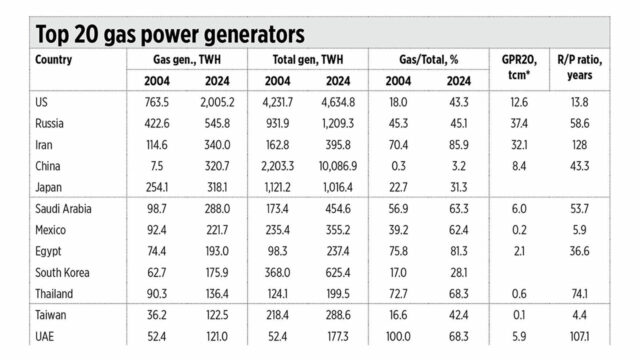
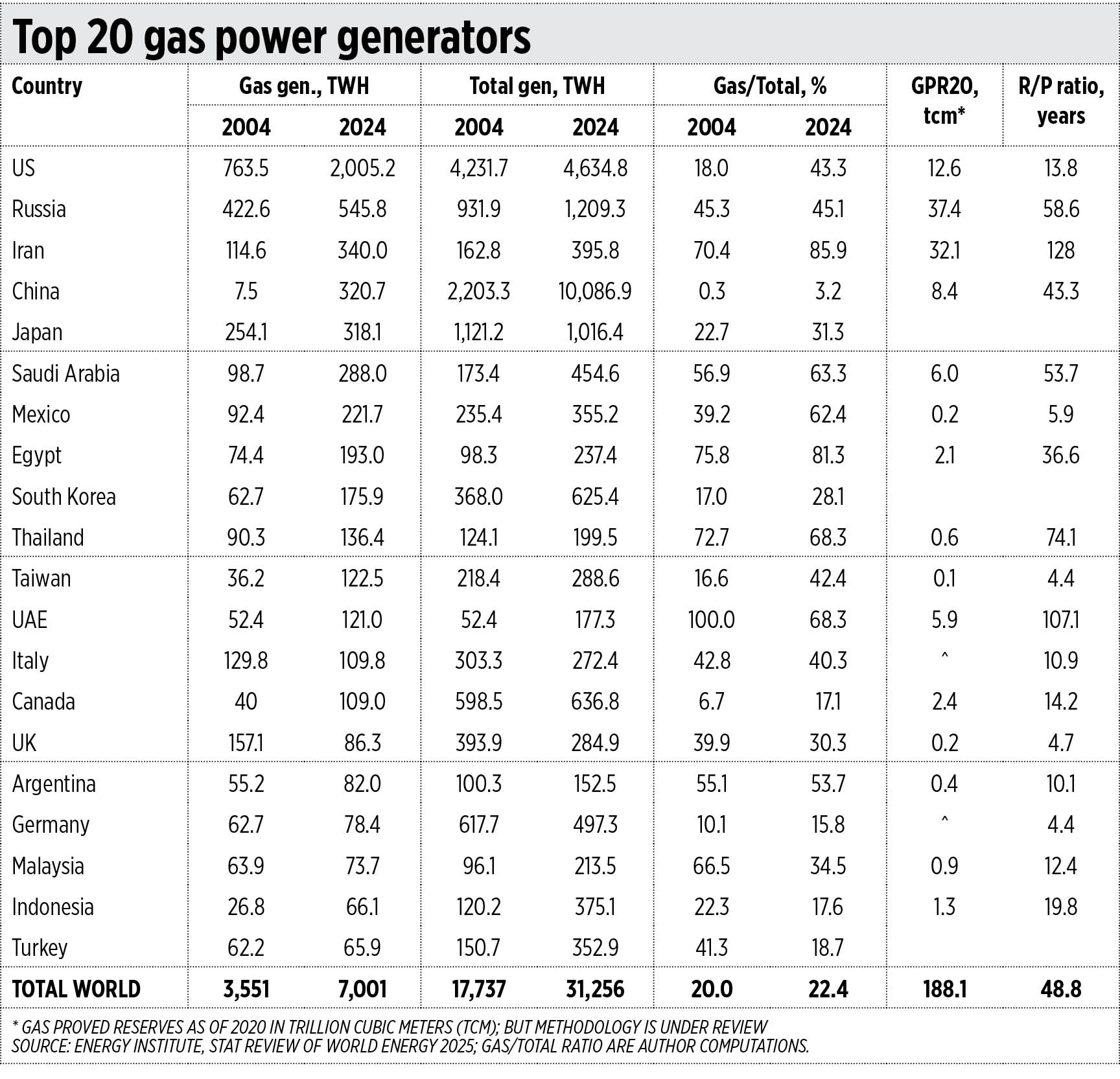
Japan’s total power generation in 2024 was 1,016 terawatt-hours (TWh), 7.8 times more than the Philippines’ 130 TWh. Of that 1,016 TWh, natural gas contributed 31.3%, coal 29.6%, nuclear 8.4%, hydro 7.8%, other renewables (solar, wind, biomass) 15%, and oil and others contribute 8%.

Japan is fifth in the world when it comes to gas power generation with 318 TWh, after the US, Russia, Iran, and China. But when it comes to gas Reserves/Production (R/P) ratio, among the largest are Iran with 128 years of R/P, Saudi Arabia with 54 years, and Russia with 59 years (see the table).

The largest electricity company in Japan is JERA Co., Inc., contributing one-third of total power generation. They own the largest gas plants in Japan, and they are one of the largest LNG buyers in the world. Meaning JERA supplies the energy for those bright lights in Tokyo, Nagoya, Osaka, etc.

The most gas-dependent countries in the world when it comes to power generation would be Qatar and Singapore with 95% to 99% gas contribution to total. Gas used to power 100% of the United Arab Emirates’ energy needs, but since they built many nuclear power plants, the share of nuclear power in 2024 was 23% of the total.

For purposes of brevity, I did not include the following countries that also have high gas R/P ratios as of 2020 (the latest available data): Venezuela has 334 years, Iraq 337 years, Turkmenistan 231 years, Qatar 144 years, Kuwait 113 years, Nigeria 111 years, Libya 107 years, and Syria 90 years.

In contrast, the gas R/P ratio of the US is only 14 years, that of the UK only five years, and Germany’s is four years. I think this partly (or largely) explains why the US has embarked on invasions and/or regime change projects (mostly failures) in Venezuela, Iran, Iraq, Syria, Libya, and other oil-gas rich countries.

The Philippines gets only 18 TWh of energy from the Malampaya gas field plus imported LNG. That is equivalent to only seven weeks of gas generation in Thailand, five weeks in South Korea, three weeks in Japan or China, and only three days in the US. I hope that the Philippines’ energy companies with coal and gas plants — AboitizPower, Meralco Power Gen (MGEN), and San Miguel Global Power — will continue their LNG partnership in Batangas and further expand the Philippines’ gas capacity.

Finally, I take a look at the recently concluded UN COP-30 climate conference in Brazil. The climate activists there persisted in lobbying for a “transition away from fossil fuels,” referring to oil, gas, and coal. They are pushing for a world of degrowth, deindustrialization, and backwardness.

The climate activists, UN and multilaterals officials persistently attack fossil fuels then frequently jet set to many countries and continents on fossil fuels. They lambast hydrocarbons, then use lots of hydrocarbon/petrochem products like paint on their bicycles and houses, nylon for their bicycle jerseys and shorts, asphalt for the roads their bicycles and cars traverse.

Higher global food production will require higher use of fertilizers like ammonia, urea, and NPK (nitrogen, phosphorus, potassium). Hydrocarbons are the raw materials for these fertilizers and related products. Needless to say, more hydrocarbons mean more food production, resulting in less hunger in the world.

The Philippines will need more hydrocarbons and fossil fuels, not less. We need more bright lights at night as dark streets mean more crime and more road accidents. We need more electricity, regardless of sources, double the 130 TWh that we have now in 10-15 years. Then we can energize more manufacturing companies, more houses, offices, and schools. Then we can aim for more economic prosperity.


Bienvenido S. Oplas, Jr. is the president of Bienvenido S. Oplas, Jr. Research Consultancy Services, and Minimal Government Thinkers. He is an international fellow of the Tholos Foundation.

minimalgovernment@gmail.com

Exit door

STOCK PHOTO | Image from Freepik

MUCH ATTENTION is given to where the entrance to a mall or office is located. Usually, the main entrance is at a drop-off point that is conveniently located. But what about the exits? These may be in the same area as the entrance, except in case of a fire or earthquake. Looking for the emergency exit door does not seem to be a priority when thinking of how to get to a meeting place.

The exit is an architectural metaphor for an ending. Emergency exits are designed to allow safe passage out of a building or room. Theme parks have an elaborate system of managing crowds for popular rides by having separate entrances and exits. The latter allows large groups to empty into a street outside to allow a fresh line of customers to be seated. (Screaming during the ride is encouraged.)

Exit strategies are also used in managing investment portfolios and retirement plans.

Savers are advised to have an exit plan when they set up their investments. At first, it is the yields and risk appetites that get evaluated. Afterwards, it is the liquidity of the investment and the market for the portfolio holdings that are considered. The exit strategy evaluates the timing and the price points targeted in terminating or replacing investments.

An exit strategy is clear with projects which have definite beginnings and endings, like a movie production. A temporary organization is established with clear goals and definite exit points. Each segment has a role. There are the cast, production designers, camera crews, directors, and the catering company. Each one has an exit point.

Once the movie is wrapped up and shown in theaters or streamed online with the video rights secure, the project is done.

And the job of the CEO or Producer is over. Did the movie make money? Should there be a sequel?

Elected officials too have a definite tenure in office. They are elected for a specific term and may be allowed to run for reelection, though not guaranteed to keep their position.

Thieves benefiting from some illegal activity rarely consider getting caught or thinking of how to get out of the mess when caught. Only when exposed in investigations and posts in social media for unexplained (or easily explained) wealth, do the perpetrators look for an exit strategy. Usually, this is located abroad.

Does corporate culture also embrace an exit strategy?

A CEO recruited by a search committee of the board negotiates the terms of his employment and the targets he must achieve within a timeframe. Once on top of the organization, he sets a game plan to achieve his deliverables, connects with his direct reports, and sometimes even brings in a new team he can trust. The exercise of setting the mission and vision of the company is meant to instill a revitalized corporate culture.

Is there even any mention of possible failure? Does the executive himself need an exit strategy when things don’t fall into place? As the pressure to deliver mounts, so does the need for an exit, after all the excuses are set aside.

With all the management talk of succession planning, exit plans are often taboo topics with CEOs. They’re only discussed for “others.”

Successions are implemented effectively at the lower management levels even when the incumbent is just out for lunch.

In family corporations, the patriarch may step down and leave the “day-to-day” operations in the hands of the next generation. This type of exit seems to work well as the position and moral authority of the “patriarch” remain. This status of ownership belongs to a particular individual and is only given up in a horizontal exit. Thus, the patriarch can stay in his penthouse and read or maybe travel if he is still up to it. He can be consulted for major moves and referee between squabbling siblings. Backstabbing is allowed.

An exit strategy is usually an afterthought. The prospect of failure or even a diminished level of energy and focus is noticed by everyone except the subject himself. Often the exit door swings both ways. It can let a person leave and then come back again — did I miss anything?


Tony Samson is chairman and CEO of TOUCH xda

ar.samson@yahoo.com

Star Wars, Elf memorabilia on sale in Propstore movie auction

On the auction block is the fedora worn by Harrison Ford in the 1984 film Indiana Jones and the Temple of Doom.

LONDON — From Will Ferrell’s Elf costume to Star Wars props, an array of movie memorabilia spanning cinematic history heads to auction next month.

More than 1,350 lots, valued at a combined estimate of £8 million ($10.54 million), are on offer in Propstore’s Winter Entertainment Memorabilia Live Auction taking place on Dec. 5-7.

Leading the sale is Boba Fett’s EE-3 carbine rifle from Star Wars: The Empire Strikes Back, with an estimate of £350,000-£700,000.

“It only came in to us about a year ago and we spent a number of weeks going through it, almost to a forensic level and managed to screen match the wood grain on the stock — there’s some damage and distress on it — and realize that this was and is the one and only Boba Fett blaster that was used in Empire Strikes Back,” Propstore founder and CEO Stephen Lane said at a press preview on Tuesday.

Other lots from the franchise include a rebel pilot helmet from the same film and a Stormtrooper E-11 imperial blaster from Return of the Jedi.

Indiana Jones is also represented in the sale with a brown fedora made for the titular character, played by Harrison Ford, in Indiana Jones and the Temple of Doom on offer.

Costumes include Mr. Ferrell’s green tunic from Christmas movie Elf, and Spider-Man’s black symbiote suit from Spider-Man 3 in which Tobey Maguire played the superhero. Other lots include Marty McFly’s hoverboard from the second and third Back to the Future films and ballet slippers from The Red Shoes. Reuters

Big buzz, small market: Meta’s smartglasses attract holiday demand

META.COM

NEW YORK — Early tech adopters are gobbling up smartglasses like Thanksgiving turkey — especially Meta’s new, retro-chic version with a visual display in the lens. But concerns about price, privacy, and the comfort of wearing a computer on one’s face are giving mainstream shoppers pause this holiday season.

Meta and partner EssilorLuxottica’s “smart” Ray-Bans and Oakleys, which first launched in 2023, have captured the tech world’s attention by answering calls, taking pictures and playing music. The latest model — the Meta Ray-Ban Display — includes a visual display in the right lens, and connects users to artificial intelligence (AI).

US smartglasses sales tripled year over year in 2025, according to market research firm Circana — great news for a type of gadget that crashed and burned after Google’s ill-fated “glass” experiment in 2013, and which has been trying to regain respect ever since.

Holiday sales this season will likely dwarf the $52.6-million US shoppers spent on smartglasses in the final quarter of 2024, said Ben Arnold, a consumer technology industry analyst with Circana. Analysts expect tech companies like Apple and Samsung to release their own smartglass products soon.

John Paul Stewart, a New York City resident, was intrigued enough to visit a Meta Lab store in Manhattan last week, one of dozens of consumers crowding around display cases or receiving demos of the glasses from Meta workers. But he found the glasses a little heavy.

“I don’t know how comfortable it’s going to be, like, to wear them for a long period of time,” said Mr. Stewart, 51. “I feel like I’m going to wait for one more generation.”

About 25% of respondents surveyed by CivicScience — a consumer research firm that embeds survey questions in news, lifestyle and entertainment websites — recently said they are interested in trying smartglasses, up from 20% early this year.

Smartglasses ownership now is about where smartwatches were in 2017, and interest is rising, CivicScience surveys show.

Still, “We’re not quite there” in terms of mainstream adoption, said Avi Greengart, a tech industry analyst who runs market analysis firm Techsponential.

“Long term, who knows? We’ll all be cyborgs.”

A spokeswoman for Meta declined to comment on how many Displays have been sold, or how many will be produced for the holidays. The Displays — which sell for $799 before adding prescription lenses — will not be discounted for Black Friday or Cyber Monday, the spokeswoman added.

EssilorLuxottica did not immediately respond to questions about the availability and pricing of the smartglasses this holiday season.

GROWTH SURGING
The Display — Meta’s most advanced AI-powered eyewear — comes with a smartphone-like display in the right lens, and an accompanying bracelet that tracks hand movements. With pinches and thumb flicks, users can scroll through apps to play music, converse with AI, record video, and even translate languages in real time.

Simpler and more widely available Ray-Ban Meta models, which lack a visual display, sell for $300 to $400. EssilorLuxottica said in February it had sold more than 2 million pairs of Ray-Ban Meta smartglasses since launching them in September 2023, and now says it’s on track to raise production capacity to 10 million units a year by the end of 2026.

User Silvia Rendon — speaking remotely on her “Displays” — says she uses the glasses in her job as a San Antonio school teacher. Ms. Rendon, 42, was so keen for hands-free access to AI during classroom lessons that she bought her Displays at a huge markup on eBay — spending $1,200 — after they sold out at stores.

Greg Dow, 62, said he is considering a purchase, but worries about who might be able to access tracking data. “I think there is big potential to misuse the technology,” Dow said.

For some, including 48-year-old Iliak Castro, price poses a barrier.

“Maybe,” he said with a smile, “I’ll ask Santa for some.” Reuters

SEC launches online company registration simulation

BW FILE PHOTO

THE Securities and Exchange Commission (SEC) has rolled out a free online company registration simulation on its SEC Academy portal, letting entrepreneurs practice registering a business before submitting actual applications.

“As the SEC continues to transform the business registration process and shift services online, we want to ensure that it remains easy and accessible to all entrepreneurs, whether they are tech-savvy or not,” SEC Chairman Francis Ed. Lim said in a statement on Wednesday.

The simulation guides users through registering a company using the Electronic Simplified Processing of Application for Registration of Company (eSPARC) platform and setting up an account on the Electronic SEC Universal Registration Environment (eSECURE), which provides access to all SEC digital services.

Through eSPARC, users can simulate filings for one-person corporations, domestic and foreign stock and nonstock corporations and their various offices.

Test credentials are provided for eSECURE accounts, letting users explore the platform without completing full credentialing.

The simulation also integrates digital document authentication via the Electronic Submission Authentication Portal (eSAP), eliminating the need for wet signatures, and generates tentative payment assessments based on authorized capital.

The tool allows users to identify and correct errors, reducing stalled applications and easing traffic in the registration system. The SEC said this enables staff to focus on processing complete and compliant applications, improving overall efficiency and service delivery.

Launched during the 2025 Investor Protection Week, the SEC Academy offers free courses on financial management, business startup, investment literacy and recognizing fraudulent schemes, reinforcing the agency’s broader efforts to support entrepreneurship and investor protection in the Philippines. — Alexandria Grace C. Magno

ADVERTISEMENT
ADVERTISEMENT