Home Blog Page 641

US consumer inflation accelerates; weekly jobless claims approach four-year high

A person shops for groceries in New York City, U.S., July 15, 2025. REUTERS/Jeenah Moon

WASHINGTON – US consumer prices increased by the most in seven months in August amid higher costs for housing and food, but a surge in first-time applications for jobless benefits last week kept the Federal Reserve on track to cut interest rates next Wednesday.

The larger-than-expected rise in the Consumer Price Index reported by the Labor Department on Thursday resulted in the biggest year-on-year increase in inflation since January. Higher inflation and softening labor market conditions fanned fears of stagflation, and pose a dilemma for the US central bank, beyond Wednesday’s anticipated rate decision.

The broad increase in inflation partly reflected businesses passing on higher costs from President Donald Trump’s sweeping tariffs to consumers and a rebound in demand for travel. Tourist traffic to the US tanked during the spring and early summer amid boycotts and the White House’s immigration crackdown.

“Even though a September cut is a fait a compli, the future trend looks less certain,” said Sung Won Sohn, a finance and economics professor at Loyola Marymount University.

“The interaction of rising inflation and softening employment creates a difficult policy dilemma for the Fed. Cutting rates too quickly risks embedding tariff-driven inflation, while delaying cuts risks amplifying unemployment.”

The CPI rose 0.4% last month, the biggest gain since January, after increasing 0.2% in July, the Labor Department’s Bureau of Labor Statistics said. The CPI was driven by a 0.4% jump in the cost of shelter. Food prices increased 0.5%, with prices at the supermarket soaring 0.6%.

Fruit and vegetable prices increased 1.6% as tomatoes surged 4.5%, the biggest gain since January 2020. Apples and bananas were also more expensive. Beef prices rose 2.7% and increased 13.9% from a year ago. Coffee prices jumped 3.6% and were up 20.9% from a year ago. Tariffs likely accounted for some of these increases. Past droughts that decimated the national herd were also probably behind the higher beef prices.

Labor shortages at farms as the Trump administration rounds up undocumented migrants for deportation were also adding to higher food prices, economists said. Gasoline prices rose 1.9%.

In the 12 months through August, the CPI advanced 2.9%, the largest increase since January, after climbing 2.7% in July.

Economists polled by Reuters had forecast consumer prices would rise 0.3% in August and increase 2.9% on a year-over-year basis.

Financial markets have fully priced in a quarter-percentage-point reduction in rates next Wednesday, with the Fed expected to deliver two similar-sized additional cuts this year.

The US central bank, which tracks the Personal Consumption Expenditures (PCE) price indexes for its 2% inflation target, paused its easing cycle in January because of uncertainty over the inflationary impact of import duties.

The pass-through from import duties has been gradual, but businesses have now depleted their pre-tariff inventories. Business surveys have for some time been signaling imminent price increases. Economists were divided on whether the pass-through from tariffs would be a one-off event or prolonged.

Stocks on Wall Street rose. The dollar slipped against a basket of currencies. US Treasury yields fell.

THE INCREASE IN INFLATION WAS BROAD
Excluding the volatile food and energy components, the CPI rose 0.3% after a similar gain in July. The rise in the so-called core CPI inflation was broad. Core goods prices increased 0.3%, with tariff-exposed products like new motor vehicles, apparel and household furnishings and operations costing more.

Used cars and trucks prices rose 1.0%. The cost of services increased 0.3% as airline fares soared 5.9%, and hotel and motel room prices surged 2.3%. Owners’ equivalent rent rose 0.4%. In the 12 months through August, the core CPI inflation increased 3.1%, matching July’s rise. Healthcare costs fell as a recent sharp rise in dental services reversed.

“We suspect the broadening cost burden from tariffs will keep the monthly pace of goods inflation elevated through early next year, but the spillover into services inflation should be limited by the weakness in the jobs market, choosier consumers and anchored inflation expectations,” said Sarah House, a senior economist at Wells Fargo.

Economists estimated that core PCE inflation increased 0.2% in August after rising 0.3% for two straight months, which would translate to an annual increase of 3.1%. That would be an acceleration from a 2.9% increase in July.

The labor market’s struggles were underscored by a separate report from the Labor Department showing initial claims for state unemployment benefits jumped 27,000 to a seasonally adjusted 263,000 for the week ended September 6, the highest level since October 2021.

But the data could have been impacted by the Labor Day holiday. There was also an unexplained 15,304 surge in unadjusted applications in Texas. Economists speculated some people could have incorrectly filed regular claims for the state’s Disaster Unemployment Assistance (DUA) following the July floods that was extended to the end of September.

“The magnitude of the Texas spike looks similar to a natural disaster. One possibility is that it is related to the early July flooding in Texas,” said Abiel Reinhart, an economist at J.P. Morgan. “DUA applications are not counted in the regular state jobless claims figures, but what is possible is that many people filed a normal claim by mistake.”

Still, labor market conditions have weakened. The number of people receiving benefits after an initial week of aid was unchanged at 1.939 million during the week ending August 30, the claims report showed.

The government said this week that nonfarm payrolls could have been overstated by 911,000 jobs in the 12 months through March. That followed the release last Friday of the monthly employment report, which showed job growth almost stalled in August and the economy shed jobs in June for the first time in four and a half years amid tariff uncertainty.

“Even if the increase in initial claims overstates any renewed weakness in the labor market, claims have been drifting higher,” said Nancy Vanden Houten, lead US economist at Oxford Economics. — Reuters


DigiPlus unveils ‘Dating Gawi?’ campaign: A celebration of trusted and timeless digital entertainment for Filipinos

The commercial tells the story of three longtime friends Miguel, Paolo, and Rico who reconnect after years apart.

DigiPlus Interactive Corp., the country’s premier digital entertainment provider behind BingoPlus, ArenaPlus, and GameZone, proudly unveils its latest campaign video “Dating Gawi?.”

The launch showcases the company’s continued commitment to delivering safe, secure, and enjoyable entertainment experiences for Filipinos.

Rekindling connections through digital entertainment

The commercial tells the story of three longtime friends Miguel, Paolo, and Rico who reconnect after years apart. Once bound by shared laughter and camaraderie, they find themselves initially absorbed in their own screens. One friend finally breaks the ice with an invitation Oh ano… dating gawi?” and soon the silence turns into familiar warmth and joy as they relive the timeless magic of being together.

Dating Gawi?” highlights how DigiPlus platforms BingoPlus, ArenaPlus, and GameZone connect people across time and technology. As entertainment evolves from traditional games to digital platforms, DigiPlus plays a pivotal role in keeping these experiences safe and seamless, allowing customers to continuously level up their enjoyment.

Reliable customer service and transaction channels, online or offline 

As part of providing best-in-class entertainment, DigiPlus champions its long-standing commitment to customer service and security. For nearly 30 years, the company has supported Filipino customers from physical operations to online platforms.

Users can expect 24/7 customer support and secure cash-in and withdrawal transactions through the official BingoPlus, ArenaPlus, and GameZone apps (available on the App Store and Google Play), websites (bingoplus.com; arenaplus.ph; gzone.ph), and more than 130 BingoPlus stores nationwide.

“Our mission is to ensure every customer enjoys a safe and seamless digital entertainment experience, with 24/7 support always within reach,” said Pio Feliciano, DigiPlus Customer Service director. “With over 130 stores nationwide, we provide patrons with accessible, reliable service an additional channel of support and assurance beyond our online platforms,” added Dennis Yaw, DigiPlus head of Offline Operations.

Dating gawi with DigiPlus

With DigiPlus, Filipinos can keep their “dating gawi” alive be it cheering for sports, testing their skills, or enjoying classic bingo. On BingoPlus, ArenaPlus, and GameZone official platforms, users are assured of safe and seamless experiences backed by a strong commitment to service and reliability.


Spotlight is BusinessWorld’s sponsored section that allows advertisers to amplify their brand and connect with BusinessWorld’s audience by publishing their stories on the BusinessWorld Web site. For more information, send an email to online@bworldonline.com.

Join us on Viber at https://bit.ly/3hv6bLA to get more updates and subscribe to BusinessWorld’s titles and get exclusive content through www.bworld-x.com.

Rumors, misinformation about Charlie Kirk killing rampant on social media

A person using a smartphone is seen in front of displayed social media logos in this illustration taken on May 25, 2021. — REUTERS

Confusion and conspiracy theories spread online after conservative activist Charlie Kirk was fatally shot during a university appearance in Orem, Utah, on Wednesday.

As the manhunt continued, online speculation, much of it baseless, emerged about the circumstances of the shooting and the identity of the shooter.

Online posts also shared fake headlines about the killing, or real headlines with fake timestamps to claim the media had advance knowledge of the plan. And social media users trying to get clarity from AI chatbots found they were misled.

Reuters has examined some of the viral rumors, conspiracies, and false information spreading online in the aftermath of Kirk’s death.

MISIDENTIFIED SUSPECTS
Video shared online in the aftermath of the shooting shows an older man being detained by Provo police and an officer holding a rifle, which the voiceover said belonged to the suspect. But there is no evidence the encounter was related to the Kirk shooting. The Utah Department of Public Safety did not respond to a request for comment.

One video posted within hours of Kirk’s shooting falsely identified a Black man 700 miles (1,126 km) away as having been arrested for killing Kirk. But the video is from June and shows the arrest of a suspect in a Santa Monica police officer shooting. The same video was shared by Fox News that month.

Other posts shared video of a man on the run after a gunman opened fire outside a casino in Reno, Nevada, on July 28, a shooting that killed three and injured three others. The posts claimed it was footage of Kirk’s shooter.

The image of a 29-year-old Washington state resident was shared in a series of posts baselessly suggesting the shooter is transgender. She told Reuters in a message the picture had been lifted from her X account without her knowledge, adding that she was in Seattle at the time of the shooting. She wrote earlier on Instagram, after her image circulated widely online, that she is not the shooter. At the time of writing, authorities have not said the suspect is transgender.

HEADLINE FAKES
Dark memes following the shooting included a fabricated CNN headline dated 2021 that quotes Kirk as saying, “If Somebody Ever Shoots Me Through The Neck During A Speech In Utah In 2025, I Lowkey Think That Rocks.”

There is no evidence Kirk ever made this statement. A CNN spokesperson said in an email, “This is a fabricated image and CNN never published a story with that headline.”

A screenshot of a genuine New York Times headline appearing in Google search results was used to suggest the media knew about the shooting in advance. The headline, “Charlie Kirk is Apparently Shot During Utah Valley University Event,” as it appeared in Google, was shared in an X post after the shooting and captioned, “NY Times 19 hours ago (last night 15 hours before shooting) is standard CIA pysop.”

An archive of the article shows the first post on the outlet’s live blog was published after Kirk’s shooting, at 3:02 p.m. ET.

The New York Times said in an email that the page went live at 3:01 p.m. ET on Wednesday.

This timestamp discrepancy in search engine results can happen when a web page provides a time zone different from the local time when it was published, or when multiple dates are listed on the page, a Google spokesperson said.

“Given the low resolution and incomplete screenshots, we’re not able to confirm if these are Google Search results,” the spokesperson said in an email. “We provide guidance to site owners about how they can help us identify the most accurate date and time to show in Search.”

AI CHATBOTS AMPLIFY CONFUSION
In the aftermath of Kirk’s shooting, Reuters found that both Perplexity’s bot account and xAI’s Grok chatbot provided incorrect responses to queries on X.

In response to a query beneath a clip condemning Kirk’s killing, Perplexity’s bot account incorrectly said the individual was describing a “hypothetical scenario” and that Kirk was “still alive.”

It also responded to a graphic released by the White House that featured a statement on the incident, saying that it appeared to be “fabricated,” incorrectly adding that there had been “no official confirmation” by the White House that Kirk had died.

Early online rumors falsely suggested that a man named Michael Mallinson had been detained by police. This was elevated by Grok, which cited unspecified “reports” that he was in custody. In later posts, Grok said Mallinson had been “falsely accused.” Mallinson could not be reached for comment.

Grok also labelled a real statement as fabricated, incorrectly saying that a screenshot of the statement released by Turning Point USA, the conservative student group founded by Kirk, appeared to be “fake.”

A spokesperson for Perplexity told Reuters, “Because we take the topic so seriously, Perplexity never claims to be 100% accurate. But we do claim to be the only AI company working on it relentlessly as our core focus.”

xAI did not immediately respond to a request for comment. — Reuters

US to give Philippines $250 million to tackle health needs

In September, the Philippine Health Insurance Corp. (PhilHealth) received P9.34 billion in government subsidies. — PHILIPPINE STAR/MIGUEL DE GUZMAN

WASHINGTON – The Trump administration plans to give the Philippines an additional $250 million to address tuberculosis, maternal health and the threat of emerging diseases, U.S. Secretary of State Marco Rubio said on Thursday.

The move follows $63 million announced amid US President Donald Trump’s meeting with Philippine President Ferdinand Marcos Jr. at the White House in July, he added, citing Mr. Trump’s new direct foreign aid approach following the shuttering of USAID and other foreign assistance pipelines.

The latest aid demonstrates “the comprehensive bond between the United States and the Philippines” and “the efficient, time-limited, and narrowly targeted approach of this new era of America First foreign assistance,” Mr. Rubio said in a statement.

The Philippine embassy in Washington said it appreciates this announcement but had no further comment.

Under Mr. Trump, the administration has sought to withhold billions in foreign aid dollars authorized by Congress as part of the president’s effort to scale back US assistance abroad under his “America First” agenda.

Even so, US lawmakers in Congress — controlled by Trump’s fellow Republicans — have budgeted billions in foreign aid, with $11 billion facing a September 30 deadline to be spent.
Trump’s administration, after being sued, said it intended to spend $6.5 billion of the funds. Its bid to block another $4 billion is before the US Supreme Court. — Reuters

Duterte defense says ex-Philippine president suffers deteriorating cognitive condition

RODRIGO DUTERTE — PRESIDENTIAL PHOTO/ ROBINSON NIÑAL

THE HAGUE – Lawyers for detained former Philippine President Rodrigo Duterte say he suffers from significant cognitive deficiencies that affect his memory and daily functioning, documents made public by the International Criminal Court on Thursday showed.

Duterte, 80, was arrested and taken to The Hague in March on an arrest warrant that linked him to murders committed during his “war on drugs” where thousands of alleged narcotics peddlers and users were killed.

His lawyers have since then argued he is unfit to stand trial.

According to details from their August 18 defense request released on Thursday, the condition affects his executive functioning, orientation and his capacity for complex reasoning.

Duterte has maintained his arrest was unlawful and tantamount to kidnapping.

Earlier this week, judges postponed hearings on the confirmation of the charges against Duterte set for later this month to deal first with the defense request to rule on the former president’s fitness for trial.

It is not known when the judges will rule if the ICC case can go ahead. Many details and the exact medical condition underlying the alleged cognitive decline have been redacted in court documents.

It is rare for international courts to find suspects, even increasingly elderly suspects, wholly unfit for trial. If a suspect is declared unfit for trial that may not automatically lead to their release.

In 2023 a United Nations’ war crimes tribunal ruled elderly Rwandan genocide suspect Felicien Kabuga was unfit to stand trial because he has dementia. Kabuga remains in the UN detention unit in The Hague as no state has been willing to accept him for provisional release. — Reuters

New LPA set to bring rains to Visayas, Mindanao

PAGASA Logo | https://www.pagasa.dost.gov.ph/

A low-pressure area (LPA) has developed in the Philippine Area of Responsibility and is expected to bring rain to Visayas and Mindanao, according to the state weather bureau on Friday.

During a 5 a.m. media briefing, the Philippine Atmospheric, Geophysical and Astronomical Services Administration (PAGASA) said the LPA was located 540 kilometers east of Hinatuan, Surigao del Sur.

“Currently, its trough is already bringing rainfall to the eastern parts of Visayas and Mindanao,” PAGASA weather specialist Loriedin Dela Cruz said in Filipino during the press briefing.

Ms. Dela Cruz also said that the LPA has two possible scenarios. It might cross the landmass of Visayas and Mindanao, or it may develop into a tropical cyclone before making landfall.

As of the forecast period, the LPA still has a “low chance” of developing into a tropical cyclone within the next 24 hours, but the possibility remains beyond that period.

“Either way, we expect it to bring significant rainfall and heavy showers to large parts of Visayas, Mindanao, and some areas of Southern Luzon,” Ms. Dela Cruz said. — Edg Adrian A. Eva

Marcos’ anti-graft push to test political alliances

PRESIDENT Ferdinand R. Marcos, Jr. leads the wreath-laying ceremony at the monument of his father, Ferdinand E. Marcos, Sr., in commemoration of the 108th birth anniversary of the former President in Batac, Ilocos Norte, Sept. 11. — PHILIPPINE STAR/NOEL B. PABALATE

By Norman P. Aquino, Special Reports Editor and Kenneth Christiane L. Basilio, Reporter

PHILIPPINE PRESIDENT Ferdinand R. Marcos, Jr.’s campaign targeting corruption in flood control projects could boost his credibility with voters and investors but risks straining political alliances, analysts said.

The President, whose family remains linked in the public mind to the massive corruption of his late father’s administration, said he was deeply troubled by reports of anomalies in flood mitigation projects. Appearing emotional in a podcast at the weekend, Mr. Marcos said he had “sleepless nights” over the issue.

The drive began with warnings in his July State of the Nation Address, when he singled out companies that allegedly benefited from dike and river wall contracts. Since then, the President has ordered lifestyle checks on officials, conducted surprise inspections of projects and created an independent body to pursue cases.

Mr. Marcos also said there’s no need to include flood control projects in the 2026 national budget, adding that the P350-billion funding for these projects this year could be rolled over to next year.

Financial markets have been unaffected so far, though Mr. Marcos’ threat of not signing a General Appropriations bill that significantly departs from the national expenditure program risks hurting the economy and derailing the Philippine transition to a higher income tier.

“President Marcos’ anti-graft campaign will only reshape his image and legacy if he demonstrates genuine resolve,” Ederson DT. Tapia, a political science professor at the University of Makati, said in a Facebook Messenger chat.

“It depends on how far he is willing to see this through. If he ensures that cases are filed and pursued against those responsible, regardless of political connections, this could mark a turning point in how his presidency is remembered,” he added.

Corruption has long dogged the Philippines, shaping its political and economic landscape for decades. It cuts across national and local governments, with scandals often involving infrastructure projects, public procurement, and patronage-driven politics.

The late president stole as much as $10 billion (P503 billion) from the Filipino people, according to government estimates, earning him a Guinness World Record for the “greatest robbery of a government.”

Most Filipino executives remain confident about their industry outlook for the next 12 months but remain dissatisfied with the government’s handling of corruption, according to a survey by PwC Philippines and the Management Association of the Philippines (MAP) released this week. Only 9% of respondents said the government was doing well in fighting graft.

Mr. Marcos’ trust rating climbed 10 points to 48% in June from a month earlier, according to the Social Weather Stations.

“If heads will roll, charges filed and the entire campaign ending up with politicians and bureaucrats alike being removed from government, then it  will certainly be the great redemption arc for his family and legacy,” Anthony Lawrence A. Borja, an associate political science professor at De La Salle University in Manila, told BusinessWorld in a Facebook Messenger chat. “If not, then it will be dismissed as petty partisan politicking peppered with controversy and grandstanding.”

The anti-graft campaign has reached Congress, where lawmakers have traded accusations over kickbacks from public works projects. At a House of Representatives hearing on Tuesday, a former district engineer accused Senators Jose “Jinggoy” P. Estrada and Emmanuel Joel J. Villanueva of benefiting from flood control contracts. Both denied the charges.

On Monday, a contractor testified in the Senate that Speaker Ferdinand Martin G. Romualdez — the President’s cousin — and other allies were involved in questionable projects. Mr. Romualdez and other legislators rejected the claims.

The controversy has already led to the resignation of the Public Works secretary and a leadership change in the Senate, where Vicente C. Sotto III replaced Francis G. Escudero as president of the chamber. Mr. Escudero acknowledged receiving campaign donations from a contractor but denied influencing contract awards.

Political analysts said Mr. Marcos’ anti-corruption drive risks fragmentation within his alliance if more people from his political coalition get tangled in the bogus flood control projects.

“It is certainly a risk and if he navigates through it (allowing some to be spared), then the rest of his legislative agenda might remain intact,” Mr. Borja said. “If not, then he still has the option of turning populist and pitting himself against everyone tied to this flood control controversy.”

‘NOT JUST A SLOGAN’
Arjan P. Aguirre, who teaches political science at the Ateneo de Manila University, said the President’s anti-corruption drive “unfortunately is being done haphazardly or carelessly.”

“The Marcos government seems to have singled out the flood control issue perhaps as a way to get back at those lawmakers who may be betraying them or not delivering in terms of handling the impeachment trial in the Senate,” he said via Messenger chat.

“As we are witnessing now, the issue seems to have backfired on them since even their allies in the House are now being implicated by those flood control contractors,” he added.

Mr. Marcos is in the second half of his single, six-year term and is hard-pressed to pick his successor. His anointed one’s biggest rival will be Vice-President Sara Duterte-Carpio, who escaped an impeachment trial after the Supreme Court junked the case on a technicality.

With past corruption allegations still hanging over the Marcos name, Filipinos probably don’t trust the sincerity of his campaign.

“His supporters trust him, but everyone else does not at this point, and they would probably focus their support for those on the ground — the senators and representatives who are conducting the investigations,” Mr. Borja said.

Mr. Marcos is the last one to benefit from all this, at least in terms of political capital and support, he pointed out.

“It takes concrete results, ranging from reforming the bureaucracy behind public infrastructure to politicians ending up in jail before his legacy and his family’s image would benefit from the anti-corruption campaign,” he said. “Also, his sister Imee Marcos being on the other side of the fence while Speaker Romualdez is being dragged into the fray is not helping his cause.”

Mr. Tapia noted that by targeting figures linked to anomalous flood control deals, the President could trigger fragmentation within his own alliance. “Much of his coalition rests on delicate power-sharing, and pushing too hard against entrenched interests might weaken his grip in the second half of his term.”

The President should not limit his anti-graft drive to flood control projects so he doesn’t get accused of having a “half-hearted disposition” on corruption, Mr. Aguirre said.

“Public trust remains his biggest hurdle,” Mr. Tapia said. “With past plunder allegations still tied to the Marcos name, many Filipinos will view this campaign with skepticism.”

“To bridge the gap, he must show that this is not just a slogan or selective justice, but a sustained effort applied consistently across the board. Only then can he turn an anti-graft drive into a genuine legacy,” he added.

ODA partners may keep close eye on how PHL addresses corruption

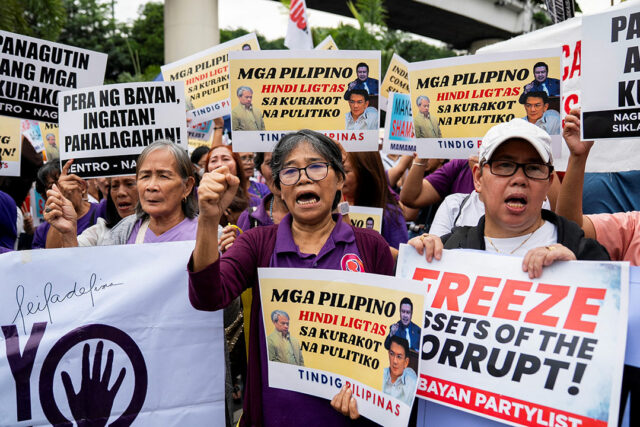
Filipino protesters raise placards during a protest denouncing corruption in Quezon City, Sept. 11. — REUTERS/LISA MARIE DAVID

THE PHILIPPINE government’s response to corruption allegations involving flood control projects could have far-reaching implications for its official development assistance (ODA) portfolio, the Department of Economy, Planning, and Development (DEPDev) said.

DEPDev Undersecretary Rosemarie G. Edillon said on Thursday that the country’s ODA partners will be looking at how the government will address the issues of corruption in flood control and other infrastructure projects.

“(ODA partners) will take note of the fact that (this) issue being discussed out in the open. They’ll be looking for details on how exactly we address it,” Ms. Edillon told reporters on the sidelines of the Philippine Chamber of Commerce and Industry event on Thursday.

Infrastructure projects are now facing more scrutiny after allegations of corruption in flood control projects involving lawmakers and contractors.

Ms. Edillon said that ODA-funded projects undergo strict appraisal and monitoring, and that additional safeguards are being considered.

“If it’s ODA, then it goes through us for appraisal, etcetera… We could assure them of other measures that we will be putting in place,” she said.

The country’s ODA portfolio rose by 6% to $39.6 billion in 2024. ODA is a form of aid, typically loans and grants with concessional terms, provided by governments or international organizations to developing countries.

The country’s top sources of ODA include Japan, the Asian Development Bank, World Bank, the United States and South Korea.

Ms. Edillon also addressed concerns over job losses in the construction sector due to the ongoing investigations, describing them as temporary.

She stressed the need for the government to address the corruption in public works projects, so that there will be no impact on jobs in the construction industry.

Ms. Edillon called for stronger transparency mechanisms and encouraged private sector participation in monitoring infrastructure projects.

She cited the Department of Budget and Management’s Digital Information for Monitoring and Evaluation (DIME) initiative, which uses satellite imagery, drones, and geotagging to track government projects and prevent so-called “ghost” infrastructure.

Finance Secretary Ralph G. Recto earlier said corruption related to flood control projects may have cost the Philippines between P42.3 billion and P118.5 billion in average economic losses since 2023.

MEETINGS IN JAPAN
Meawhile, Mr. Recto and DEPDev Secretary Arsenio M. Balisacan have held high-level meetings with Japanese officials, including the Japan International Cooperation Agency (JICA).

Japan remains the Philippines’ largest development partner, with $13.23 billion in active commitments across 82 projects.

The officials discussed the progress of major infrastructure projects, including the Metro Manila Subway Project, the North-South Commuter Railway Project, and the Metro Rail Transit Line 3 Rehabilitation Project.

The meeting followed an Aug. 27 dialogue between JICA’s Parliamentary League and Philippine officials in Pasay City, which tackled implementation delays due to right-of-way and counterpart funding issues.

Mr. Recto also met with the Kankeiren Executive Committee, representing over 1,300 Japanese firms, to promote the Philippines as a strategic investment destination.

“In the Philippines, you are in the right place, at the right time, with the right partners, and the right opportunities to win big,” he was quoted as saying in a Department of Finance statement.

He cited the country’s two “A-” investment-grade ratings from Japanese credit agencies as a vote of confidence in the Philippines’ fiscal management and growth trajectory.

Last month, Japanese credit watchdog Rating and Investment Information, Inc. affirmed the Philippines’ investment-grade “A-” rating with a “stable” outlook, citing its steady economic growth. — Aubrey Rose A. Inosante

PHL banks’ loans to MSMEs still below quota

A woman looks for cheap clothes at the Taytay tiangge in Taytay, Rizal, May 15. — PHILIPPINE STAR/MIGUEL DE GUZMAN

PHILIPPINE BANKS once again failed to meet the mandated lending quota for micro, small and medium enterprises (MSMEs), data from the central bank showed.

Data from the Bangko Sentral ng Pilipinas (BSP) showed bank loans granted to MSMEs grew by 10.8% to P540.92 billion as of end-June from P488.13 billion a year ago.

However, this was equivalent to 4.59% of their total loan portfolio of P11.78 trillion.

This was below the 10% overall requirement for banks under the Magna Carta for MSMEs. Under the law, banks must allocate 8% of their loan portfolio to micro and small enterprises, and 2% to medium-sized businesses.

The law defines a microenterprise as a business with total assets not exceeding P3 million, while a small enterprise’s assets range from more than P3 million to P15 million, and a medium-sized enterprise’s assets would be over P15 million up to P100 million.

Based on BSP data, loans to micro and small enterprises amounted to P220.55 billion as of end-June. This accounted for just 1.87% of their total loan book, well below the 8% quota.

Banks disbursed P320.37 billion worth of loans to medium enterprises, which accounted for 2.72% of their total portfolio, exceeding the 2% quota.

Most banks have opted to incur penalties for noncompliance with the MSME lending quota, instead of taking on the risks associated with lending to small businesses.

By type of bank, universal and commercial banks provided a total of P139.65 billion in loans to micro and small enterprises at end-June. This represented 1.42% of their P10.74-trillion total loan portfolio.

Big banks’ loans to medium enterprises stood at P260.23 billion or 2.42% of the total.

Thrift banks lent P46.95 billion to micro and small enterprises, which made up 4.04% of their P846.58-billion portfolio. Loans to medium enterprises reached P39.76 billion or 4.77% of their loan book.

Only rural and cooperative banks met the overall MSME lending quota. They disbursed P33.35 billion in loans to MSMEs, representing 20.45% of their portfolio. Their loans to medium enterprises reached P20.31 billion or 12.46% of their P163.06-billion portfolio.

Credit provided by digital banks to the micro and small enterprise sector stood at P590 million, accounting for 1.71% of their total loan portfolio of P34.74 billion.

Digital banks extended P60 million in loans to medium enterprises or 0.18% of their total loan book.

The BSP had allowed banks to count MSME loans as alternative reserve compliance with the reserve requirements to help support the sector during the pandemic, but this relief measure expired in June 2023.

However, this relief measure was extended for thrift banks and rural and cooperative banks until Dec. 31, 2025.

LOWER BORROWING COSTS
Analysts attributed the 10.8% increase in bank loans to MSMEs as of end-June to lower borrowing costs.

“The uptick in MSME loans over the past year possibly reflects the improvement in demand for credit after BSP moved aggressively to lower borrowing costs to support moderating growth momentum,” Metropolitan Bank & Trust Co. Chief Economist Nicholas Antonio T. Mapa said.

The BSP lowered borrowing costs by 25 basis points (bps) to 5% on Aug. 28. Since August 2024, it has reduced rates by 150 bps.

“The increase in lending activity is reflective of the effects of policy rate cuts spilling over to lending institutions, making borrowing more accessible,” Reinielle Matt M. Erece, an economist at Oikonomia Advisory & Research, Inc., said in a Viber message.

Mr. Erece noted that small businesses are more sensitive to interest rates, “due to the uncertainty of their cash flows and lack of large assets given their size.”

“Smaller-sized businesses have limited means of raising funds as opposed to larger corporates and thus could be more sensitive to interest rate adjustments,” Mr. Mapa said.

At the same time, Mr. Erece said many MSMEs are still unbanked and hesitant to secure loans from banks.

“MSMEs may still prefer informal lending channels and loan sharks due to their accessibility despite the risks,” he said. — Katherine K. Chan

DoTr to issue NSCR bid soon amid interest from 28 Japanese firms

A train is seen at the construction site of the Malanday Depot and station in Valenzuela City. — PHILIPPINE STAR/MIGUEL DE GUZMAN

THE PHILIPPINES is doubling its efforts to find the operator for the North-South Commuter Railway (NSCR), the Department of Transportation (DoTr) said, as it hopes to issue bidding documents later this month or early October.

This came after the DoTr concluded the final leg of its roadshow for the NSCR project which gained the interest of foreign companies, mainly from Japan.

“We’re very happy to see the attendance in this fourth leg for our O&M (operations and maintenance) roadshow. It only goes to show that we are in the right direction in terms of structuring and developing this O&M concession,” Transportation Undersecretary Timothy John R. Batan said in a statement on Thursday.

He said there was a high turnout of participants during the final leg of the NSCR market sounding event in Japan.

Mr. Batan said around 28 Japanese companies including Mitsubishi Corp., Hitachi Ltd., Tokyo Metro, Sumitomo Corp.; and Alstom Japan have signified their interest in the O&M for NSCR.

The DoTr has been ramping up its roadshows to promote the P229.32-billion O&M contract for the NSCR project. It had conducted similar events in Singapore and Paris, France.

The agency will now consolidate comments from roadshow participants which will be included in the bidding document and concession agreement to be issued within this month or next month, Mr. Batan said.

Asian Development Bank (ADB) Director for Office of Markets Development and Public-Private Partnership (PPP) Siddhartha Bhaskar Shah said the ADB and the DoTr expect to award the concession by March or April 2026.

“The immediate next step to look forward to is the launching of the bid documents which we intend to do by the end of this month and will kick off the formal bidding process which will continue over the next six months with the idea that the bid will be awarded sometime in the March-April time frame,” he said.

The ADB is the technical advisory services provider of the DoTr for the NSCR project.

“We will reflect those in our bidding documents, our concession agreement, so by the end of September of the first week of October we will be able to officially launch and publish the tender for this O&M concession,” Mr. Batan said.

Nigel Paul C. Villarete, a senior adviser on public-private partnerships at the technical advisory group Libra Konsult, Inc., said public-private partnerships for O&M projects are more attractive compared to build-operate-transfer (BOT) types of projects.

“I am not particularly sure if roadshows can help a lot, but these are more advertising efforts. Even without those (roadshows), we’ll get the full array of prospective PPP operators from all over,” Mr. Villarete said in a Viber message.

“The more important thing is that the agency properly drafts the proposed PPP contracts that strikes a balance between sufficient protection for the country’s economic interests and high expected returns to draw the interests of private sector capital,” he added.

The 147-kilometer NSCR will connect Malolos, Bulacan with Clark International Airport, and Tutuban, Manila with Calamba, Laguna. The P873-billion project is co-financed by the Japan International Cooperation Agency (JICA) and the Asian Development Bank. It will have 35 stations and three depots.

According to the DoTr, the NSCR can partially operate its Valenzuela to Malolos line by 2027; while the Malolos to Clark segment can start operations by 2028. — Ashley Erika O. Jose

ERC OKs original rates for Meralco supply contracts with SMGP and ACEN

A lineman checks meters and wires in Marikina City, July 17, 2025. — PHILIPPINE STAR/MIGUEL DE GUZMAN

By Sheldeen Joy Talavera, Reporter

THE Energy Regulatory Commission (ERC) has approved Manila Electric Co.’s (Meralco) power supply agreements (PSAs) with San Miguel Global Power Corp. (SMGP) and ACEN Corp. at their original applied rates, securing 479 megawatts (MW) of renewable capacity.

“The final decision that we rendered, we based it on the applied rates and the rationale being that this was already the product of the competitive selection process,” ERC Chairperson and Chief Executive Officer Francis Saturnino Juan said on the sidelines of an energy forum organized by the Economic Journalists Association of the Philippines on Thursday.

Under Mr. Juan’s leadership, the ERC approved the original rates under Meralco’s PSAs with SMGP’s San Roque Hydropower, Inc. (SRHI) and ACEN’s Gigasol 3, Inc., covering a total supply of 479 MW.

SRHI and Gigasol 3 were among the winning bidders in Meralco’s competitive selection process last year for its 500-MW renewable energy supply requirement.

SRHI offered a rate of P7.10 per kWh for 340 MW, while Gigasol 3 submitted P8.1819 per kWh for 139 MW. The supply deals were set to take effect on Feb. 26 this year.

The ERC had granted provisional authority last year to implement the PSAs at a fixed rate of P5.1908 per kWh, lower than the companies’ proposed rates.

SRHI subsequently sought reconsideration over the ERC’s decision, which imposed a different rate and limited the sourcing of contracted capacity to eligible renewable energy facilities.

Meralco said the potential termination of its contracts would affect not only its ability to ensure continuous and reliable electricity for consumers but also its compliance with the Renewable Portfolio Standards.

“If [Meralco] would not be able to implement this mid-merit supply coming from these two generation companies, it will be forced to buy from the RE market which could be an additional cost on the part of Meralco,” Mr. Juan said.

The ERC chief added that the commission is working to streamline the resolution of PSA applications resulting from the competitive selection processes conducted by distribution utilities and power suppliers.

“We are acting with extreme urgency right now…We understand that timeliness of our decision, many are dependents, such as the generator and distribution utility that will need supply,” Mr. Juan said.

For the September electricity billing, Meralco slashed power rates by P0.1852 per kWh to P13.0851 per kWh, mainly due to lower generation charge.

Meralco’s controlling stakeholder, Beacon Electric Asset Holdings, Inc., is partly owned by PLDT Inc. Hastings Holdings, Inc., a unit of PLDT Beneficial Trust Fund subsidiary MediaQuest Holdings, Inc., has an interest in BusinessWorld through the Philippine Star Group, which it controls.

Ayala, Security Bank, SMIC lead PHL firms in Time 2025 World’s Best list

AYALALAND.COM.PH

TEN PHILIPPINE COMPANIES were included in Time magazine’s World’s Best Companies for 2025, a ranking of the top 1,000 corporations worldwide.

In the list compiled with Statista, conglomerate Ayala Corp. ranked 210th globally and was the top Philippine company for the third straight year.

Other Philippine companies in the ranking were Security Bank Corp. (369th), SM Investments Corp. (SMIC) (407th), Jollibee Foods Corp. (685th), and Union Bank of the Philippines (764th).

International Container Terminal Services, Inc. (828th), China Banking Corp. (882nd), JG Summit Holdings, Inc. (949th), Robinsons Retail Holdings, Inc. (962nd), and Filinvest Development Corp. (995th) also made the list.

“This recognition inspires us to be an even better Ayala as we journey to our 200th year. We share this with our employees and partners, whose hard work and support helped Ayala earn this honor,” Ayala Corp. President and Chief Executive Officer Cezar P. Consing said.

“This recognition inspires us to keep strengthening our efforts in creating value for our stakeholders and contributing positively to our communities,” SMIC President and Chief Executive Officer Frederic DyBuncio said.

Time said the ranking measured companies across three equally weighted dimensions: employee satisfaction, revenue growth, and sustainability transparency.

Employee satisfaction was assessed from surveys of over 200,000 verified employees worldwide, covering workplace image, atmosphere, conditions, salary, equality, and recommendations.

Revenue growth included companies with at least $100 million in revenue in 2023 or 2024, with positive growth over three years. The evaluation considered both absolute and relative growth.

Sustainability transparency was gauged through an environmental, social, and governance (ESG) index. The environmental component considered 2023 carbon emissions intensity and Carbon Disclosure Project (CDP) scores; the social aspect measured women’s representation on boards and the existence of a human rights policy; and governance was assessed based on whether Corporate Social Responsibility (CSR) reports complied with Global Reporting Initiative (GRI) standards.

Scores from the three categories were combined to select the top 1,000 companies, highlighting those with strong financial performance, employee engagement, and sustainability practices. — Alexandria Grace C. Magno