Home Blog Page 642

Dairy duty: Indonesia presses businesses to find a million cows

REUTERS

KUNINGAN, Indonesia – The once-empty barns of the Laras Ati milk cooperative are filled with the recent arrival of more than 200 pregnant spotted Holstein-Friesian cows from Australia under Indonesia’s ambitious plan to ratchet up milk production.

The centerpiece of a program to provide free meals to 83 million children and expectant mothers, the plan calls for importing a million dairy cows over five years, at a cost of nearly $3 billion, to lift the size of the country’s dairy herd more than four-fold from 220,000 now.

With limited fiscal space, Jakarta is pressing private companies to fund the imports – an unorthodox approach causing concern amongst the business community in Southeast Asia’s largest economy, according to scheme participants and documents seen by Reuters.

The spokesperson for Indonesia’s Presidential Communication Office and state secretariat minister did not respond to requests for comment.

Progress has been slow since its launch in December, with just 11,375 dairy cows imported by the end of July, all from Australia thus far, against a target of 200,000 for the year, government data shows.

The slow pace has cast doubt over the expanded rollout of the free meals plan, which was the biggest pledge made to voters by President Prabowo Subianto as he swept to power in last year’s election, experts said.

A lack of cattle means the world’s fourth-largest country by population relies mostly on milk powder imported from Australia, New Zealand and the United States. Prabowo’s policy platform also pushes for greater self-sufficiency for the archipelago.

Helmed by the agricultural ministry, the plan called for businesses – many without direct dairy experience – to pay for and import cows that are brought into the care of cooperatives such as Laras Ati in West Java.

The idea, Deputy Minister of Agriculture Sudaryono said in June, is to import live cattle to decrease the need to import milk and meat.

“It’s not the government that will allocate funds to import live cattle,” he said in a statement. “There is a significant demand for meat and milk, so we are opening the opportunity for many investors,” he said.

PRESSURE TO PARTICIPATE
Last November, shortly after Prabowo took office, the agriculture ministry sent a communique to over 200 private businesses asking them to commit voluntarily to import cattle to support the free meals program, industry sources said. The commitment was for 20 cows per year from 2025 through 2029.

Reviewed by Reuters, the communique was also sent to more than a dozen multinational companies.

Ministry data said 196 businesses committed to bringing in cows as of May. Sources familiar with the matter have said that most of the companies have no prior experience dealing with live cattle.

Four people involved in the program, speaking on condition of anonymity due to concern they could face government backlash, said the companies felt compelled to participate fearing the consequences of not doing so, such as facing delays in securing import licenses for their core businesses, including frozen meats and milk powder.

Documents and correspondence reviewed exclusively by Reuters illustrate such consequences for one company, whose import commitment earlier this year was below the expected 20 cow “minimum” that companies had been advised to fund.

The correspondence, via text messages, showed an official of the company inquiring with a government official about an inordinate delay in the approval of an import license recommendation despite its commitment to import cattle.

The government official asks for the import commitment to be raised to 20 cows. The company official complies and resends the license recommendation request, which is then approved in a matter of days.

The details of the company and ministry are being withheld to protect the company official from what they feared would be further backlash.

The Directorate General of Animal Husbandry and Animal Health at Indonesia’s agriculture ministry did not reply to requests for comment.

DAIRY NEOPHYTES
Arip Setiadi, who heads the Laras Ati co-op about 250 kilometres (155 miles) southeast of Jakarta, said the agriculture ministry called investors as well as dairy cooperatives into a meeting in March.

“They told us, importers and cooperatives, to collaborate in increasing the dairy cow population and milk production,” Setiadi, 42, said during a recent visit to his farm, located in a region where half the cattle population was wiped out by a foot and mouth disease outbreak in 2022.

Of the cows at Laras Ati, 160 were bought by 16 members of the Indonesian Association of Animal Protein Entrepreneurs (APPHI), with no cattle experience, which is why the herd is managed by the co-op. Another 160 bought by APPHI members were moved to the KAN Jabung cooperative in East Java.

Achmad Fachmi, head of APPHI, said that businesses are under obligation to adhere to government regulations and policies in their operations. The association represents businesses in cold chain distribution, including meat and dairy products.

He added that close discussions were held with the ministry, expressing “our hopes that by running this program, we will be supported in terms of the licensing process” for their core businesses.

Each cow costs the buyers around 45 million rupiah ($2,800), which includes the import price as well as six months’ worth of expenses for items including transport, feed, and vaccines.

Under the scheme, cattle purchasers and the cooperatives will share revenues, with the buyers expected to recoup their investment in about three-and-a-half years, APPHI figures.

Several industry experts expressed skepticism over the structure of the plan as well as the country’s readiness to manage a massive influx of cattle.

“As an exporter we have responsibilities with animal welfare. The infrastructure there doesn’t support all that,” said Adam Petty, founder of Dairy Livestock Exports, an Australian exporter of dairy heifers that ships thousands of animals a year, including to Indonesia.

Rochadi Tawaf, an adviser with Indonesia’s Cattle and Buffalo Breeders Association and a lecturer in animal husbandry at Padjadjaran University, questioned the reliance on inexperienced firms.

“If the program is given to entrepreneurs with no track record of success in the dairy business, it won’t produce results,” he said. — Reuters

ICC postpones hearing for Philippines’ Duterte for health assessment

International Criminal Court -- Reuters

THE HAGUE – International Criminal Court judges on Monday postponed hearings to determine the definitive charges against former Philippine President Rodrigo Duterte to see if the octogenarian is fit enough to follow the pre-trial proceedings in his case.

Duterte, 80, was arrested and taken to The Hague in March on murder charges linked to his “war on drugs”, where thousands of alleged narcotics peddlers and users were killed.

He has maintained his arrest was unlawful and tantamount to kidnapping.

In August, his defense lawyers asked the court for an adjournment of all proceedings arguing that the former president was not fit to stand trial. Details of Duterte’s alleged health conditions were redacted in the public version of the request.

On Monday, judges allowed for an indefinite postponement of the so-called confirmation of charges hearings set for September 23. But they stressed the period would be limited “to the time strictly necessary to determine whether Mr Duterte is fit to follow and participate in the pre-trial proceedings”, according to a decision published on the court’s website.

Many of the filings related to Duterte’s health are confidential or heavily redacted and it is not clear when the court expects to rule on his fitness to follow his case. It is rare for international courts to find suspects, even increasingly elderly suspects, wholly unfit for trial.

The ICC has never found a suspect unfit for trial despite several other defendants’ petitions. — Reuters

MBC Media Group: Notice 2025 Annual Stockholders Meeting


Spotlight is BusinessWorld’s sponsored section that allows advertisers to amplify their brand and connect with BusinessWorld’s audience by publishing their stories on the BusinessWorld Web site. For more information, send an email to online@bworldonline.com.

Join us on Viber at https://bit.ly/3hv6bLA to get more updates and subscribe to BusinessWorld’s titles and get exclusive content through www.bworld-x.com.

Analysts see BSP pause in October

INDIVIDUALS shop for food items inside a supermarket in Quezon City, Jan. 16, 2023. — PHILIPPINE STAR/ MIGUEL DE GUZMAN

By Katherine K. Chan

THE BANGKO SENTRAL ng Pilipinas (BSP) may hold off further monetary easing in October after inflation rose to a five-month high in August, with analysts expecting the central bank to deliver its last interest rate cut for the year in December.

Union Bank of the Philippines (UnionBank) Chief Economist Ruben Carlo O. Asuncion said it would be difficult for the BSP to justify another reduction in borrowing costs next month given the rebound in price pressures.

“Given the upside surprise in headline and core inflation, a rate cut in October looks unlikely,” Mr. Asuncion said in an e-mailed reply to questions. “It is difficult to justify a BSP rate cut as both cyclical and structural inflation measures tilt upward.”

Security Bank Chief Economist Angelo B. Taningco said the Monetary Board would likely pause in October “in light of the rising inflationary pressures.” “However, we still maintain our view for the BSP to conduct its fourth 25-basis-point (bp) rate cut for the year in December,” he said in an e-mail.

Headline inflation quickened to 1.5% in August from 0.9% in July, mainly due to typhoon-driven spikes in vegetable and fish prices. It was faster than market expectations but slower than 3.3% a year earlier.

The August rate fell within the BSP’s 1-1.8% forecast but exceeded the 1.3% median estimate in a BusinessWorld poll of 16 analysts. It also marked the sixth straight month that inflation remained below the BSP’s 2-4% target.

For the first eight months, inflation averaged 1.7%, matching the central bank’s 2025 forecast.

Reinielle Matt M. Erece, an economist at Oikonomia Advisory and Research, Inc., said the August outcome would weigh heavily on the BSP’s next policy move.

“While inflation from the previous months went below analysts’ expectations, the August reading went beyond,” he said in a Viber message. “Thus, we may see a more cautious and calibrated approach from the central bank with regard to the timing of the next rate cut.”

In a report, Deutsche Bank also noted that inflation risks in the coming months could prompt a pause in October, though it still expects easing to resume in December.

The BSP lowered the benchmark interest rate by 25 bps to 5% on Aug. 28, its third straight cut since August 2024. In total, it has reduced rates by 150 bps this cycle.

BSP Governor Eli M. Remolona, Jr. earlier signaled that there could be room for one more adjustment before yearend but stressed that the easing cycle is nearly complete.

Emilio S. Neri, Jr., chief economist at Bank of the Philippine Islands, said the central bank’s stance reflects concerns about inflationary risks next year.

“(Mr. Remolona) is probably foreseeing the changes in inflation next year,” he told Money Talks with Cathy Yang on One News. “We will be on an uptick that could lead to a breach.”

“And if we aren’t able to control inflation expectations, that could lead the BSP to actually hike instead of cut,” he added.

Still, he said a cut later in the year remains possible, particularly if global developments support looser policy.

FED CUE
Nicholas Antonio T. Mapa, chief economist at Metropolitan Bank & Trust Co., said the Philippine central bank would likely align its decision with the US Federal Reserve’s next policy move and domestic growth data.

“We expect BSP to await more data points on inflation, see whether the Fed cuts in November and look to third-quarter GDP (gross domestic product) numbers for guidance,” he said in a Viber message.

If the Fed resumes easing, domestic growth stays modest and inflation trends align with the target, the BSP may consider another rate cut before yearend, he added.

Mr. Erece said labor market and growth conditions could justify another adjustment.

The Monetary Board will meet on Oct. 9 and Dec. 11 for its final two policy reviews this year.

Meanwhile, analysts flagged the increase in core inflation, which strips out volatile food and fuel items, as a key concern. Core inflation climbed to 2.7% in August, the highest in eight months, from 2.3% in July.

“The main surprise from our standpoint in the latest release is the jump in core inflation to an eight-month high,” Miguel Chanco, chief emerging Asia economist at Pantheon Macroeconomics, said in a note last week. “It’s worth remembering, though, that in the Philippines, core inflation still includes some elements of food and energy prices.”

Mr. Mapa said the uptick was driven by select food items outside the core basket that were affected by storm damage. “These food items, such as other vegetables, appear to have been impacted by the recent spate of storms and thus constitute a supply-side shock inflation episode,” he said.

Despite the August rise, core inflation averaged 2.4% in January to August, slower than 3.2% a year ago.

This shows companies are passing on more costs and demand remains firm, which the BSP is watching closely, Mr. Asuncion said.

The central bank expects full-year inflation to stay below target in 2025 before returning to within 2-4% by 2026 and 2027. Its forecast for 2026 is now 3.3%, while its projection for 2027 is 3.4%.

Pantheon Macroeconomics forecasts inflation at 1.8% this year and 3% in 2026, higher than its earlier 2.6% projection. “We continue to believe that the BSP will cut at least one more time before the end of 2025, by 25 bps, though it is unlikely to pull the trigger again until December,” Mr. Chanco said.

UnionBank likewise revised its forecast to 1.8% from 1.6%.

PHL CEOs upbeat despite corruption worries

PHILIPPINE STAR/NOEL B. PABALATE

By Justine Irish D. Tabile, Reporter

MOST Filipino executives remain confident about their industry outlook for the next 12 months but remain dissatisfied with the government’s handling of corruption, a survey by PwC Philippines and the Management Association of the Philippines (MAP) showed.

Of 175 chief executive officers (CEO) surveyed, 83% expressed confidence in business prospects over the next year, with 31% saying they were “very confident.” However, this is slightly lower than last year’s 85% as CEOs weigh external risks such as the US reciprocal tariff and global geopolitical tensions.

PwC-MAP 2025 CEO Survey: Fewer CEOs REmain confident in industry prospects“In general, all the sectors are growing,” Karen Patricia A. Rogacion, deals and corporate finance partner at PwC Philippines, told a news briefing on Monday. “That’s why we need to really have a very responsive government.”

She said executives remain positive about their industries but are mindful that optimism could be tempered by shifting trade rules and geopolitical disruptions.

PwC said 31% were “very confident” compared with 36% last year, and 52% were “somewhat confident” compared with 49% in 2024. The share of those who were “not very confident” rose to 17% from 13%.

Almost half (47%) of CEOs cited geopolitical uncertainty as a major concern, along with uncertain economic growth. About 20% flagged threats from US tariffs and trade regulations.

“There is one important factor that was not present last year, and that is the potential impact of the shifting trade policy, especially by the US,” PwC Philippines Chairman and Senior Partner Roderick R. Danao told the same briefing.

He said tariffs are likely to dampen US demand and increase import costs, raising caution among Philippine companies. “That is a very important precautionary factor for all the CEOs. That is why they are slightly less optimistic despite the sustained consumer demand locally.”

The US government has begun charging Philippine goods entering its market with a 19% reciprocal tariff. While some importers stocked up to offset the short-term impact, Mr. Danao warned that these measures might not be sustainable.

CEOs anticipate the tariffs could translate to higher supplier costs, weaker international revenues, reduced foreign investment and potential customer losses, according to the survey.

Still, 84% of respondents said they were confident about revenue growth in the next 12 months, while 87% expect growth in the next three years. They cited infrastructure development, domestic consumption and state spending as the top drivers of Philippine growth.

“CEOs in the Philippines see both the risks and opportunities that lie ahead, such as the rising digital economy, sustained consumer spending, a robust banking system, and lower inflation and interest rates,” Mr. Danao said.

“They remain optimistic while at the same time anticipating the headwinds arising from fracturing geopolitics and global trade disruptions, which can trigger inflation,” he added.

STICKING POINT
Despite the optimism, CEOs remain critical of the government’s performance in curbing corruption. Only 9% of respondents said the government was doing well in fighting graft.

The survey period, from July 22 to Aug. 25, coincided with a high-profile government probe of “ghost” flood control projects.

“It is a great opportunity for the government to really demonstrate that they are serious about transparency and governance,” Mary Jade Roxas-Divinagracia, deals and corporate finance managing partner at PwC Philippines, told reporters. She added that both business and the public are pushing for accountability.

“The government has to really take this seriously and have a credible investigation,” she said. The business community will be watching closely, and this is the government’s chance to show Filipinos and foreign investors that it is serious about fighting corruption, she added.

Mr. Danao said initiatives such as the sumbongsapangulo.ph website, which lets citizens lodge complaints directly, could be a game-changer. “It keeps on going every day. Now the next step is for the government to show serious enforcement and legal actions to set the tone moving forward.”

The survey also found that 52% of CEOs think their companies would not be economically viable beyond 10 years if they continue on their current path. This is up from 46% last year, reflecting mounting pressure from megatrends such as technological disruption and climate change.

“The pressure is really driven by megatrends like technological disruption and climate change,” Ms. Rogacion said. “The good thing is the CEOs recognize the need to embrace tech, innovation and new investments so they can be more relevant even after 10 years.”

Executives also highlighted the growing role of artificial intelligence (AI). Donald Patrick L. Lim, a member of the CEO Conference Committee of MAP, said the synthetic workforce is on the rise and reliance on AI would only deepen.

“It’s not going to be a very far future,” he said. “It’s very near term, where you will have a machine helping you do a lot of things on its own.” Mr. Lim said.

“That’s why every company right now should have a very strong push towards AI governance from a corporate perspective because AI is, as we all know, going to displace a lot of jobs and a lot of things in how we do our work,” he added.

Based on the survey, 68% of CEOs have explicitly factored AI into their business plans, while 60% have begun implementing AI initiatives. However, many cited resource constraints and the pace of technological change as barriers to broader adoption.

Executives said AI is already helping improve productivity, increase revenue and enhance customer engagement. Over the next year, 82% said they plan to invest in their workforce, 78% in automation and 63% in advanced technologies.

Metro Manila rental yields seen subdued amid high vacancies

Condominium and office buildings are seen in the Ortigas Business District, April 4, 2025. — PHILIPPINE STAR/MIGUEL DE GUZMAN

By Beatriz Marie D. Cruz, Reporter

RESIDENTIAL RENTAL YIELDS in some parts of Metro Manila are expected to remain weak this year as developers grapple with unsold condominium units and elevated vacancy rates, property consultants said.

“The current oversupply of condominiums in Metro Manila has placed downward pressure on rental yields,” Jamie S. Dela Cruz, research manager at KMC Savills, said in an e-mailed reply to questions. “The exit of POGOs (Philippine offshore gaming operators), which previously boosted demand, has further softened the market.”

Data from Colliers Philippines showed rental yields in Metro Manila condominiums rose slightly to 4.2% in the second quarter from 4% in 2019. However, the firm said a meaningful recovery is unlikely in the near term.

“We do not see a significant improvement in Metro Manila residential yields for the remainder of 2025 up to 2026 as we are still projecting vacancy rates to hover between 25% and 26%,” Joey Roi H. Bondoc, director and head of research at Colliers Philippines, said in an e-mail.

Colliers data showed that as of the second quarter, 30,500 ready-for-occupancy units remained unsold. Of the total, 32% were from the lower middle-income segment valued at P3.6 million to P6.99 million, while 22% were from the affordable segment priced at P2.5 million to P3.59 million.

The Bay Area, Makati fringe, Pasig and Manila accounted for 35% of the unsold units in Metro Manila.

Mr. Bondoc also noted that rental rates in submarkets are heavily reliant on POGO tenants, such as the Bay Area, remain below pre-pandemic levels. Studio units there now lease for about P700 per square meter (sq.m.) compared with P1,200 per sq.m. before 2020.

The Bay Area — covering Pasay, Manila and Parañaque — posted the highest residential vacancy in the second quarter at 54%.

“Once we see a substantial improvement in vacancy rates and a corresponding rise in rents, then we project yields to marginally increase,” he said. “But given that we still have sizable unsold ready-for-occupancy units in Metro Manila, and with soft demand in the secondary market, we are not projecting a significant increase in yields over the next 12 months.”

Mr. Bondoc added that weak demand is partly tied to hybrid and remote work arrangements. “As a result, employees are no longer required to rent condominium units in Metro Manila and would rather go back to their home provinces and work from home.”

Still, property analysts said landlords could take steps to improve competitiveness.

“Unit owners can differentiate their properties by adding value — such as offering parking spaces, upgrading unit interiors and enhancing amenities such as internet, cable television and security features,” Ms. Dela Cruz said.

She said tenants who could support rental demand include employees under mandatory return-to-office policies, as well as expatriates and professionals who prefer renting to buying.

“As more companies enforce return-to-office policies, occupancy may gradually improve, supporting rental demand,” she said.

“Marketing efforts should focus on tenants with a strong preference for renting, like corporate clients, expatriates, and professionals who reside in nearby provinces but work in Metro Manila,” she added.

StanChart expects Fed to cut rates by 50 bps next week after weak job data

REUTERS

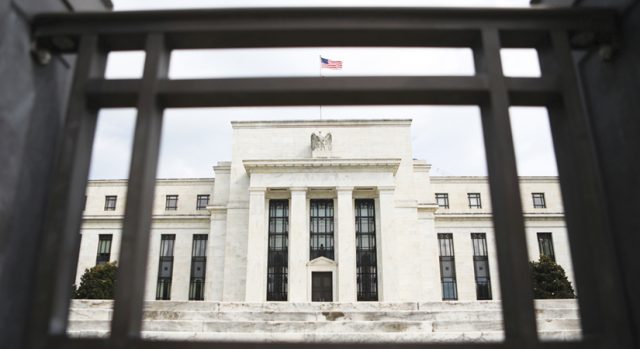
STANDARD CHARTERED (StanChart) expects the US Federal Reserve to cut interest rates by 50 basis points (bps) at its policy meeting this month, double its earlier projection of a 25-bp reduction, following a soft August job report.

Data on Friday showed US job growth weakened sharply in August and the unemployment rate rose to a near four-year high of 4.3%, confirming a softening labor market and bolstering the case for a rate cut this month. In a client note on Friday, the brokerage said that the labor market had shifted “from solid to soft in less than six weeks.”

“August labor market data has paved the way for a ‘catch-up’ 50-basis-point rate cut at the September FOMC (Federal Open Market Committee) meeting, similar to what occurred at this time last year.”

After a 50-bp cut, the market could take time to price in a slower subsequent pace of cuts, the brokerage added.

Meanwhile, Morgan Stanley and Deutsche Bank do not consider the August job report weak enough to warrant a 50-bp rate cut in September, though they noted it could pave the way for reductions at consecutive meetings.

Last month, Fed Chairman Jerome H. Powell signaled a rate cut was possible at the Sept. 16-17 policy meeting, citing rising labor market risks, while cautioning that inflation remained a threat.

Barclays revised its forecast on Friday to include 25-bp reductions at each of the remaining meetings this year, while Macquarie brought forward its expected December cut to October.

Bank of America also revised its outlook, now expecting 25-bp cuts each in September and December, after previously forecasting no cuts this year.

Markets are pricing in a 90% chance of a 25-bp rate cut next week and a 10% probability of a larger 50-bp reduction, according to the CME FedWatch Tool. — Reuters

The Juans releases milestone album

THE JUANS (above) at the press conference announcing their latest album Tawid (inset).

THE POP ROCK band The Juans is dropping their latest album, Tawid, to celebrate their 10th year in the OPM scene. Ahead of its release on digital platforms on Sept. 12, the band performed a live showcase of the new songs on Aug. 29 at the SM North EDSA Skydome.

The album extends beyond their reputation as a “hugot band” that specializes in songs about heartbreak. It contains songs about love, self-reflection, happiness, and moving on. Tracks include “‘Di Na Masakit,” “Naiwan,” “Ako Na Lang,” “Tanda,” and “Magaan.”

At Tawid Live, fans were treated to collaborations onstage — with Janine Berdine for “Ano Ba Talaga Tayo?” and Rhodessa for “Missed Call.”

For band members Carl Guevarra, Japs Mendoza, RJ Cruz, and Chael Adriano, Tawid is the culmination of a long process of elimination from a pool of 20 to 30 songs. The album contains 10 tracks.

Halos kalahating taon o higit pa namin pinaghandaan ‘yon (We’ve been preparing for this for almost half a year or more.),” said Mr. Adriano at the album’s press launch on Sept. 4 in Quezon City.

“Some of the songs were written years ago. When we performed them in Tawid Live, we were happy with the response of the Juanistas. We’re excited for them to hear the studio album this time,” he explained.

The Juans frontman Mr. Guevarra added that song selection was indeed the most challenging part of the process.

“It really showed our maturity as artists, as band members, and as songwriters. Many songs couldn’t make the cut because we had to commit to the storytelling. We wanted to write from a place where we actually are in our lives,” he said.

As for specific songs that resonated with the audience at Tawid Live, the band said that there seemed to be a wide variety of favorites among fans. “Ano Ba Talaga Tayo?” was among the most popular, since it featured Janine Berdine’s electric chemistry with Mr. Guevarra during the concert.

Marami rin nag-post online ng kanta na “Ngiti” (Many people posted online about the song “Ngiti”). It feeds their lover-girl era. It’s what they listen to after the heartbreak, ‘pag di na masakit (when they’re no longer in pain),” said Mr. Cruz.

For Mr. Mendoza, the opening song, “Gusto Kita,” was another one that received good attention.

May mga nag-tag sa amin kasi pasabog daw ’yung opening. Sobrang nagustuhan nila ’yung energy. (There were people who tagged us in their posts saying the opening was explosive. They really liked the energy),” he said.

After the release of Tawid, which means “to cross,” The Juans hope to continue their steady momentum after 10 years in the music business — with the album as the beginning of a new stage of their career.

Ito ang unang hakbang sa pagtawid namin to our next season (This is the first step of our crossing to our next season). This is our tawid moment,” said Mr. Guevarra. “God will take us to a different place, to a different level.”

Tawid comes out on all digital music streaming platforms on Sept. 12. — Brontë H. Lacsamana

Tumandok leads Gawad Urian with 11 nominations

A SCENE from the film Tumandok.

WITH 11 nominations, Arlie Sweet Sumagaysay and Richard Jeroui Salvadico’s Tumandok leads this year’s pack of film nominees for the 48th Gawad Urian.

The Manunuri ng Pelikulang Pilipino released the list of nominations for the film awards last week.

Tumandok, produced by Southern Lantern Studios and Terminal Six Post, is a “docufiction” about the Ati people. Aside from Best Film, it was nominated in almost all categories: Direction, Screenplay, Production Design, Cinematography, Editing, Music, and Sound.

Acting nominations were also given to Tumandok cast members Jenaica and Rowena Sangher and Felipe Ganancial, all of whom are Ati people and first-time actors.

The next film with the most Gawad Urian nominations — 10 — is Best Picture nominee Kono Basho which was directed by Jaime Pacena II, a subtle drama set in Japan about grief and healing. Its nominations include Direction, Screenplay, Production Design, Cinematography, Editing, Music, and Sound.

Its two lead actresses, Gabby Padilla and Arisa Nakano, were both nominated for Best Actress.

Other nominees in the Best Picture category are thriller-drama Green Bones by Zig Dulay, documentary Alipato at Muog by JL Burgos, psychological drama Phantosmia by Lav Diaz, experimental fiction Rizal’s Makamisa: Pantasma ng Higanti by Khavn, and social drama The Hearing by Lawrence Fajardo.

This year’s Gawad Urian will be giving its lifetime achievement award — the Natatanging Gawad Urian — to actor Dante Rivero.

The 48th Gawad Urian awarding ceremony will be held on Oct. 11 at De La Salle University, Manila.

The annual Gawad Urian Awards are presented by the Manunuri ng Pelikulang Pilipino, an organization of film critics, writers, and scholars. — Brontë H. Lacsamana


The full list of nominees for the 48th Gawad Urian Awards are:

Best Picture: Alipato at Muog, Green Bones, Kono Basho, Phantosmia, Rizal’s Makamisa: Pantasma ng Higanti, The Hearing, Tumandok

Best Director: JL Burgos, Alipato at Muog; Zig Madamba Dulay, Green Bones; Jaime Pacena II, Kono Basho; Lav Diaz, Phantosmia; Khavn, Rizal’s Makamisa: Pantasma ng Higanti; Lawrence Fajardo, The Hearing; Arlie Sweet Sumagaysay and Richard Jeroui Salvadico, Tumandok

Best Actor: Carlo Aquino, Crosspoint; Baron Geisler, Dearly Beloved; Dennis Trillo, Green Bones; Ruru Madrid, Green Bones; Sid Lucero, Outside; Ronnie Lazaro, Phantosmia; Enzo Osorio, The Hearing

Best Actress: Lovi Poe, Guilty Pleasure; Aicelle Santos, Isang Himala; Gabby Padilla, Kono Basho; Arisa Nakano, Kono Basho; Mylene Dizon, The Hearing; Jenaica Sangher, Tumandok

Best Supporting Actor: Takehiro Hira, Crosspoint; Art Acuña, An Errand; David Ezra, Isang Himala; Nor Domingo, The Hearing; Felipe Ganancial, Tumandok

Best Supporting Actress: Kei Kurosawa, Crosspoint; Chanda Romero, Espantaho; Bituin Escalante, Isang Himala; Kakki Teodoro, Isang Himala; Ina Feleo, The Hearing; Rowena Sangher, Tumandok

Best Screenplay: JL Burgos and Bernardine De Belen, Alipato at Muog; Ricky Lee and Anj Atienza, Green Bones; Jaime Pacena II, Kono Basho; Honeylyn Joy Alipio, The Hearing; Arden Rod Condez and Arlie Sweet Sumagaysay, Tumandok

Best Cinematography: JL Burgos, Alipato at Muog; Neil Daza, Green Bones; Dan Villegas, Kono Basho; Lav Diaz, Phantosmia; Pabelle Manikan, Tumandok

Best Editing: JL Burgos, Alipato at Muog; Marya Ignacio, Kono Basho; Furan Guillermo, Rizal’s Makamisa: Pantasma ng Higanti; Lawrence Fajardo and Ysabelle Denoga, The Hearing; Pabelle Manikan, Tumandok

Best Production Design: JL Burgos, Alipato at Muog; Marxie Maolen Fadul, Green Bones; Eero Yves Francisco, Kono Basho; Lav Diaz, Phantosmia; Zeus Bascon, Rizal’s Makamisa: Pantasma ng Higanti; Lynne Belle Salvadico, Tumandok

Best Music: Len Calvo, Green Bones; Vincent De Jesus, Isang Himala; Len Calvo, Kono Basho; David Toop and Khavn with the Kontra-Kino Orchestra, Rizal’s Makamisa: Pantasma ng Higanti; Paulo Almaden and the Ati People of Kabarangkalan and Nagpana, Tumandok

Best Sound: Ronaldo de Asis, Crosspoint; Albert Michael Idioma and Emilio Bien Sparks, Isang Himala; Allen Roy Santos, Kono Basho; Jannina Mikaela Minglanilla and Michaela Docena, The Hearing; Lamberto Casas, Jr., Alexis Tomboc, and Kevin Padilla, Tumandok

T-bill yields fall as demand rises

STOCK PHOTO | Image by RJ Joquico from Unsplash

THE GOVERNMENT made a full award of the Treasury bills it auctioned off on Monday as yields dropped across all tenors, with investors looking to take advantage of still-high rates swamping the offer amid expectations of further monetary easing here and abroad.

The Bureau of the Treasury (BTr) raised P25 billion as planned from the T-bills it placed on the auction block as the offering was more than six times oversubscribed, with total bids reaching P156.428 billion. This was higher than the P125.04 billion in tenders recorded on Sept. 1.

The Auction Committee fully awarded the T-bill offer amid the strong demand and as all tenors fetched average rates that were lower than those seen at the previous auction and prevailing secondary market yields, the BTr said in a statement.

Broken down, the Treasury borrowed P8.5 billion as planned via the 91-day T-bills as total tenders for the tenor reached P37.225 billion. The three-month paper was quoted at an average rate of 5.046%, down by 8.1 basis points (bps) from the 5.173% recorded in the previous auction. Yields accepted ranged from 5% to 5.104%.

The government likewise raised P8.5 billion as programmed from the 182-day securities as tenders amounted to P63.072 billion. The average rate of the six-month T-bill was at 5.222%, falling by 10.1 bps from the 5.323% fetched last week, with accepted rates spanning from 5.185% to 5.248%.

Lastly, the Treasury sold the planned P8 billion in 364-day debt as demand for the tenor totaled P56.131 billion. The average rate of the one-year T-bill dropped by 12.7 bps to 5.376% from 5.457% previously. Tenders awarded carried rates from 5.373% to 5.383%.

At the secondary market before Monday’s auction, the 91-, 182-, and 364-day T-bills were quoted at 5.1769%, 5.3135%, and 5.4699%, respectively, based on PHP Bloomberg Valuation Service Reference Rates data provided by the Treasury.

The government fully awarded its T-bill offer as average yields continued to fall following the Bangko Sentral ng Pilipinas’ (BSP) latest rate cut and signals of one more reduction before yearend “that led more investors to lock in yields before they go down further in the coming months,” Rizal Commercial Banking Corp. Chief Economist Michael L. Ricafort said in a Viber message.

Headline inflation also remains below the BSP’s 2-4% target despite the faster print seen in August, which could support one final reduction, he said. Inflation picked up to 1.5% last month from 0.9% in July, bringing the eight-month average to 1.7%.

The Monetary Board on Aug. 28 lowered benchmark borrowing costs by 25 bps for a third consecutive meeting, bringing the target reverse repurchase rate to 5%. It has now trimmed rates by a cumulative 150 bps since the start of its rate cut cycle in August 2024.

BSP Governor Eli M. Remolona, Jr. said that the policy rate is now at a “sweet spot” in terms of both inflation and output, but left the door open to one last cut this year to support growth if needed, which would likely mark the end of its current easing cycle.

The Monetary Board’s last two meetings this year are scheduled in October and December.

Mr. Ricafort added that expectations of monetary easing by the US Federal Reserve as early as next week following the soft jobs data released recently also helped pull T-bill yields down.

Markets are pricing in a 90% chance of a 25-bp rate cut by the Fed next week and a 10% probability of a larger 50-bp reduction, according to the CME FedWatch Tool, Reuters reported.

This comes after data on Friday showed US job growth weakened sharply in August and the unemployment rate rose to a near four-year high of 4.3%, confirming a softening labor market and bolstering the case for a rate cut this month.

T-bill rates also dropped amid the large demand seen for Monday’s offer, Mr. Ricafort said.

“Demand is noticeably higher compared to last week’s… This likely due to the 10-60 maturity tomorrow, as the resulting liquidity allows market players to buy more than usual in today’s auction, which then goes to explain the fall in yields,” a trader said in a text message, referring to the 10-year Treasury bonds (T-bonds) maturing on Tuesday.

The maturity is expected to add some P288.659 billion in liquidity to the financial system that could again be invested in government securities, Mr. Ricafort added.

On Tuesday, the government will offer P30 billion in reissued seven-year T-bonds with a remaining life of four years and 10 months.

The BTr is looking to raise P220 billion from the domestic market this month, or P100 billion via T-bills and P120 billion through T-bonds.

The government borrows from local and foreign sources to help fund its budget deficit, which is capped at P1.56 trillion or 5.5% of gross domestic product this year. — Aaron Michael C. Sy

Ariana Grande, Lady Gaga land top honors at MTV’s Video Music Awards

LL COOL J presents Ariana Grande with the Video of the Year Award at the 2025 MTV Video Music Awards on Sept. 7. — REUTERS/BRENDAN MCDERMID

NEW YORK — Pop singer Ariana Grande claimed the top prize at the MTV Video Music Awards (VMA), and Lady Gaga and Sabrina Carpenter scored major honors, at a star-studded celebration of fan favorites in New York on Sunday.

Ms. Grande won video of the year for “Brighter Days Ahead,” earning her the biggest award of the night at the fan-voted awards.

“Art has been a safe space for me since I was a kid. I’m so grateful I get to do this,” Ms. Grande said as she held the MTV Moon Person trophy on stage at the UBS Arena.

Minutes earlier, Ms. Grande took the best pop prize and thanked her father, who acted for the first time in the “Brighter Days Ahead” video. She called him “the best scene partner, and dad, in the world.”

Lady Gaga was crowned artist of the year at the start of the show, prevailing over VMA favorites Taylor Swift and Beyoncé.

Gaga, currently on tour with her album Mayhem, took the stage in a black-and-purple ruffled gown with giant sleeves.

“I cannot begin to tell you what this means to be rewarded for being an artist, being rewarded for something that is already so rewarding,” Gaga said before dashing off to perform a concert at Madison Square Garden.

Gaga’s win prevented Beyoncé or Ms. Swift from emerging as the most-honored artist in VMA history. The pair remained tied at 30 VMAs each.

Gaga also landed best collaboration for “Die with a Smile,” a duet with Bruno Mars that had been in the running for the video award that went to Ms. Grande.

Sabrina Carpenter claimed best album for Short n’ Sweet.

“I really don’t take for granted when you guys take the time out of your lives to listen to an album,” the pop singer said. “I’m just the luckiest girl in the world.”

“APT.,” a collaboration between Bruno Mars and K-pop singer Rosé, won the VMA for song of the year.

Rosé, 28 and a member of the group Blackpink, dedicated her win to her 16-year-old “oddball” self.

“This is a really big moment for 16-year-old me, and for anyone else dreaming of being accepted equally for their hard work,” she said on stage.

English singer Yungblud belted “Crazy Train” to kick off a musical tribute to late British rocker Ozzy Osbourne with Nuno Bettencourt on guitar. Aerosmith members Steven Tyler and Joe Perry joined for a rousing version of “Mama, I’m Coming Home” that had the audience waving their hands in the air.

Mariah Carey received a lifetime achievement award and talked about the fun of making music videos.

Videos are “mini movies visualizing the sheer fantasy of it all,” she said. “And sometimes it’s just an excuse to bring the drama and do things I wouldn’t do in real life.”

The VMAs began airing on MTV in 1984 and became known for memorable moments such as an onstage kiss between Madonna and Britney Spears and Gaga’s appearance in a raw meat dress. Sunday’s ceremony was broadcast live on CBS and on MTV.

In other awards, folk-pop singer Alex Warren was named best new artist. — Reuters

Peso jumps to one-month high as dollar struggles after weak jobs data

BW FILE PHOTO

THE PESO jumped to an over one-month high against the dollar on Monday as weak US jobs data boosted hopes of a rate cut by the US Federal Reserve next week.

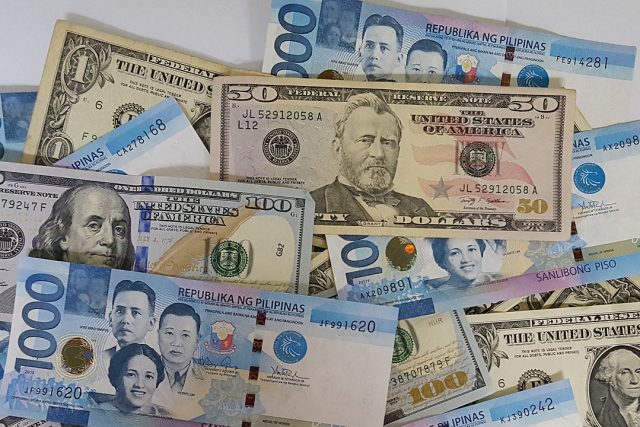
The local unit closed at P56.69 per dollar, strengthening by 22.5 centavos from its P56.915 finish on Friday, Bankers Association of the Philippines data showed.

This was the peso’s best finish in more than a month or since it ended at P56.65 on July 24.

The peso opened Monday’s session stronger at P56.777 versus the dollar. Its intraday best was at P56.67, while its worst showing was at P56.93 against the greenback.

Dollars exchanged went down to $1.32 billion on Monday from $1.62 billion on Friday.

“The dollar-peso closed lower as the market responded to the weak US NFP (nonfarm payrolls) release last Friday, which bolstered expectations that the Fed will cut rates this month,” a trader said in a phone interview.

The dollar was generally weaker on Monday following the decline in global crude oil prices and US Treasury yields, Rizal Commercial Banking Corp. Chief Economist Michael L. Ricafort added in a Viber message.

For Tuesday, the trader sees the peso moving between P56.50 and P56.90 per dollar, while Mr. Ricafort expects it to range from P56.55 to P56.80.

The dollar remained on shaky ground on Monday after Friday’s weak US jobs report, which cemented expectations of a Federal Reserve rate cut this month, Reuters reported.

The dollar struggled to recoup its heavy losses after falling sharply on Friday on data that showed further cracks in the US labor market.

The nonfarm payrolls report showed US job growth weakened sharply in August and the unemployment rate increased to nearly a four-year high of 4.3%.

Investors ramped up bets of an outsized 50-basis-point rate cut from the Fed later this month following the release and are now pricing in a 10% chance of such a move, as compared to none a week ago, according to the CME FedWatch tool.

The dollar index edged down 0.2% to 97.7, having tumbled more than 0.5% on Friday.

“(The payrolls report) has resulted in the dollar index falling back below support at the 98.000-level although the negative impact on the US dollar is more modest than implied by the drop in short-term US yields,” MUFG currency strategist Lee Hardman said in a note.

“The weak nonfarm payrolls report for August has reinforced expectations that the Fed will resume cutting rates this month, and has even encouraged expectations that they could begin with a larger 50-bp rate cut similar to last September.” — A.M.C. Sy with Reuters