Home Blog Page 6297

Making the Agri-Agra Law work

JCOMP-FREEPIK

Some implementable proposals

The Agri-Agra Law has been a frustration of regulators and farmers alike. The banks who find it inconvenient to comply just opt to pay the penalties. The penalties are not even prohibitive because the Central Bank implementors themselves (they will not admit it though) are unconvinced about the efficacy of the law so they do not make it too costly to not comply. There is a not-so-obvious regulatory forbearance in that sense. The banks who comply are those that are into agricultural lending in the first place. They would have done that sort of lending with or without the Agri-Agra Law.

In short, the Agri-Agra Law does not really generate “new funds” that become available for farmers. The whys and the wherefores of non-compliance by banks is a long conversation in itself but the more useful discussion is how to make the law achieve its objectives. Much of it though has to do with the saying that “you can bring a horse to the water but you cannot make him drink.”

The relevant question therefore is how do you make banks pour money into agriculture and agrarian reform? Here are some suggestions:

1. First, forget about making banks do production loans. It is just too risky for any private financial institution. None of the risk management algorithms support it. The math doesn’t justify it — period. You hear cooperatives and social development organizations talk about approaches that they claim to have worked but all their successes are obviously not commercially replicable and scalable. Why? What many people overlook is that it is not just about repayment. It is, probably more so, about administrative costs and loan margins. You can get good repayment but see all your lending margins disappear because it took massive resources (ergo costs) to get the repayment you wanted.

2. Make banks go into inventory finance. While they are totally clueless when it comes to production finance, they are masters of asset-based finance. Look at how great they are with auto finance, jewelry finance, condo finance, etc. How do you make them do inventory finance? Make them feel comfortable about the inventory that they finance. Make them feel that it will not disappear or lose value before the loan that financed it is liquidated. Let’s take palay (unmilled rice) and corn as an example. There are so many National Food Authority (NFA) warehouses nationwide. They are no longer needed because the government has already applied tariffs to rice imports. Why not make NFA operate as a warehousing entity whose mandate is to ensure that everything stored in its warehouses is reasonably protected and cared for during storage? Then, these warehouses can issue receipts to farmers who store their palay and corn.

These farmers can then go to banks and borrow against these receipts. The banks will lend if the government will guarantee, NOT THE REPAYMENT OF THE LOAN, but the sanctity and integrity of these receipts. This makes the warehouse receipt a tradable instrument because it has guaranteed value. This is even better than floor stock financing that banks do for automotive dealers. All that’s needed is for the government to guarantee that when a holder of a warehouse receipt for high-grade palay goes to the NFA warehouse to redeem the high-grade palay, he will get it.

Warehouse receipts, more popularly known as quedans, have been extensively used in the Philippines but their integrity has always been suspect because the very issuers of warehouse receipts are owners of the commodities supposedly stored in these warehouses.

3. Make banks go into capex finance. If entities other than the NFA want to go into the warehousing business, let them do so but prohibit them from going into trading of commodities that are stored in these warehouses. Why? The integrity of a warehouse receipt becomes suspect when the issuer of the warehouse receipt himself owns the commodities stored in the warehouse. Make it a serious crime to engage in trading while holding a warehousing license. But make warehousing a profitable business by itself. How? If you want to encourage the creation of more warehouse capacity, you need to guarantee the throughput or capacity utilization. Be ready to subsidize those who are experiencing low-capacity utilization during the pre-harvest season.

Is it bad economics to do it? That is debatable. What’s inarguable is that it is not bad public policy to subsidize a private endeavor that supports an essential good. Just look at the iron-clad power purchase commitments given to private parties that invested in new power generating capacity when the country urgently needed power. Look at the subsidy given by the Department of Education to private schools that invested in new classrooms to accommodate new K-12 enrollees that public schools couldn’t take in. With throughput guaranteed, private warehouses will become profitable. If they are profitable, banks will finance them.

How does that help the small farmers? If there are independent warehouses (i.e., not owned by the commodity owners themselves) and if warehouse receipts are sacrosanct (and are therefore bankable), farmers can choose to store their produce instead of selling at bargain basement prices during harvest season when supply is plenty. If they need liquidity in the meantime, they can go to the banks and borrow against these warehouse receipts. Dry warehouses are just one form of capex. We can talk about cold storage facilities too. The same principle applies.

4. Securitize private investment in agricultural infrastructure and make the banks buy the resultant securities. It is clear to everyone that we lack essential agricultural infrastructure. Everyone mouths it: farm-to-market roads, transport systems and equipment, processing facilities (as rudimentary as drying and shelling, etc.), and storage. Throw in food terminals and town-center agricultural exchange marketplaces. Throw in online platforms enabled on phones. All these can be done by the private sector. But, unless there is a clear agreement on throughput protection by the government, private entities will not go into these projects. When I speak of throughout protection, I’m not talking about the messy type of arrangements, such as those in MRT 3. I’m talking about arrangements as neat and unequivocal as the purchased power deals with power generation companies. If these deals are present, private entities will invest and the banks will finance.

5. Use technology to enable agricultural trading. Online trades are transparent. Banks will be able to easily verify deals done on neutral platforms and can therefore finance both spot and forward purchases of agricultural commodities (i.e., forward means purchases today for delivery at a later time, say 90 days). This is no different from PO financing which banks are so familiar with. It is not even that much different from salary loans. Of course, there is the risk of non-delivery, especially in cases of force majeure. Therefore, we need an honest-to-goodness crop insurance system. This is a job for the government. There is no need to go blind on risks like the Philippine Crop Insurance Corp. is doing today. We have weather and disaster data spanning probably a century. We can use that data to inform and enrich the risk algorithms that will be the basis for insurance tariffs. If there is credible insurance cover for delivery failure, banks will lend against forward deals. They are well-positioned to do this because they have good control of the cash tunnel, being the ultimate settlement institutions in any online platform.

There are practical ways of making banks channel money into agriculture in magnitudes bigger than any mandatory asset allocation, such as the existing coercive Agri-Agra Law, can ever do.

This article reflects the personal opinion of the author and does not reflect the official stand of the Management Association of the Philippines or MAP.


Joey A. Bermudez a former president of MAP. He is chair of Maybridge Finance and Leasing, Inc.

map@map.org.ph

joeybermudez@yahoo.com

Inflation, cement importation, and electricity concerns

Three different topics here, we go straight to them.

RISING PHILIPPINES INFLATION, BIDENFLATION
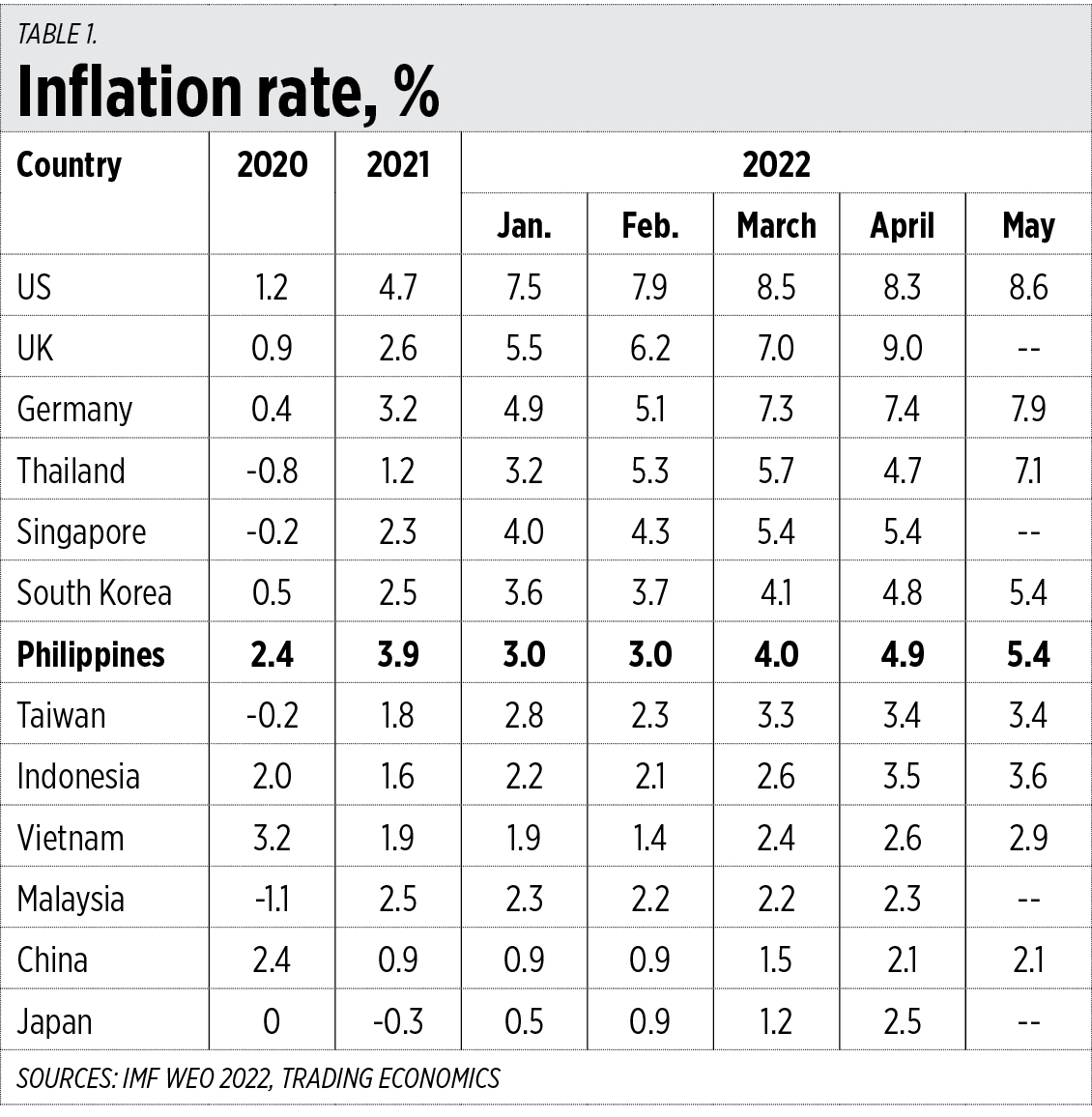
The Philippines saw a big jump in its inflation rate last month, from 3% in January-February to 5.4% in May. Big increases in May happened in transport (14.6%), housing, water and electricity (6.5%), and alcoholic beverages and tobacco (6.8%).

In the US, “Bidenflation” continued to wreak havoc in ordinary American households. The US inflation rate was only 1.4% in January 2021 when Trump left the White House; it jumped to 7.5% in January 2022 or 12 months into the Biden presidency and before the Russian invasion of Ukraine, and went up to 8.6% in May, the highest rate in 40 years.

Germany’s inflation of 7.9% in May was highest perhaps in about six decades, while the United Kingdom’s 9% in April was the highest in 40 years. The industrial economies of America and Europe are limping from high inflation (Table 1).

The west’s “war on fossil fuels” is a big reason why this happened. High oil-gas-coal prices mean a higher cost of manufacturing, and higher commercial and household electricity bills. Underinvestment in oil refining also contributed to low fertilizer output and high fertilizer and food prices.

CEMENT IMPORTATION AND THE CONSUMERS
I recently received many materials on “Cement Anti Dumping” presented by the Cement Manufacturers Association of the Philippines (CEMAP). They believe that cheaper imported cement, mainly from Vietnam, is bad for the economy because it adversely affects the revenues of their member-companies, their capacity expansion and job generation. Their argument is summarized in one report in BusinessWorld, “Cement group seeks safeguard for local manufacturers” (June 9).

Free trade means the consumers are the main beneficiaries of trade. Cheaper cement, steel, and other construction materials means poor people who otherwise would have weak wooden or bamboo houses can have concrete houses that can better protect them from strong typhoons and flash flooding, helping save lives and properties. And CEMAP think this is bad, that cheaper imported cement should be penalized with high tariffs to make it more expensive for consumers. Bad lobby.

I checked the Philippine Statistics Authority (PSA) data — the construction materials price index and price changes from 2020 to April 2022 — and it shows that concrete materials and cement has low or small price changes compared to overall construction materials and national inflation. In 2021, Philippines inflation was 3.9%, inflation for all construction materials was 3.2%, and inflation for cement was 1.5%. In the first four months of 2022, Philippines inflation was 3.7%, all construction materials 6%, cement 4.1% (see Table 2). This means cement liberalization is working for the consumers and if CEMAP will have its way, cement inflation should rise higher — at a time when higher inflation is causing more social and economic stress on Philippine households and businesses.

The Tariff Commission (TC) should consider the interests of consumers and not just the cement manufacturers, importers, and traders. Free trade is pro-consumers.

ELECTRICITY CONCERNS
These recent reports in BusinessWorld are interesting.

1. “NGCP starts new transmission line for Bataan capacity expansion” (May 26),

2. “Meralco seeks ‘sound’ policies to cut power costs” (June 1),

3. “Razon firm ‘poised’ to control Malampaya project” (June 3),

4. “Prime Infra unit plans world’s largest solar farm” (June 9),

5. “Gov’t imposes sanctions on two electric cooperatives” (June 9),

6. “Meralco power rates to rise in June” (June 10).

Report No. 1 is somehow good because the National Grid Corp. of the Philippines (NGCP) has a record of frequent delayed delivery of the needed transmission lines between new power plants and distribution utilities. The report refers to the Mariveles to Hermosa, Bataan line, which should have been finished much earlier. And NGCP should have finished the Hermosa, Bataan to San Jose, Zambales line by June 30 as the delayed transmission line there chokes 818 MW of power (GN Power Dinginin Unit 2 with 668 MW and SMC Mariveles Unit 1 with 150 MW) that can expand supply in the Luzon grid. This is far from happening yet. See Table 3 of this column on May 16, https://bit.ly/Oplas051622.

Reports Nos. 2 and 6 are related: Meralco has no choice but to raise electricity rates because the generation cost has increased. The price of coal (Newcastle) this June was $390+ per ton which is three times higher than a year ago when it was $175+ per ton. Even the price of domestic Malampaya gas is pegged to Dubai crude’s price and thus is also rising. Good thing that Meralco is able to keep its distribution charge flat, with no increase since about 2015.

Reports No. 3 and 4 show further expansion of Mr. Razon’s Prime Infra in energy. Its planned 2,500-3,500 MW solar plants will have a big impact on competition for land use because that will require about 4,000 to 5,500 hectares of land. In addition, more intermittent renewables with priority dispatch to the grid mean they can discourage other investments in coal, oil, gas, and nuclear as they are a lower priority in the grid. For instance, if coal and gas plants offer power at P5/kwh and solar offers P6/kwh, the latter will still be prioritized. Discouraging investments in conventional thermal plants can lead to the threat of blackouts in the future, and this is happening now in Europe, the US, and even Japan.

Report No. 5 is about Maguindanao Electric Cooperative, Inc. (Magelco) and Lanao del Sur Electric Cooperative, Inc. (Lasureco). They respectively owe P3.8 billion and P12.9 billion — a total of P16.7 billion — to the state-owned Power Sector Assets and Liabilities Management Corp. (PSALM). These two electric cooperatives (ECs) could be the reason why PSALM asked for P16 billion in budgetary support for 2021 and 2022. So, taxpayers from Zamboanga to Visayas to Luzon are subsidizing these ECs as they extract more “free electricity” from PSALM. Wow. This is one more reason why the National Electrification Agency (NEA) that supervises all ECs should go, and all ECs should become private distribution utilities, supervised and monitored by the Securities and Exchange Commission (SEC) and not by a political agency like the NEA.

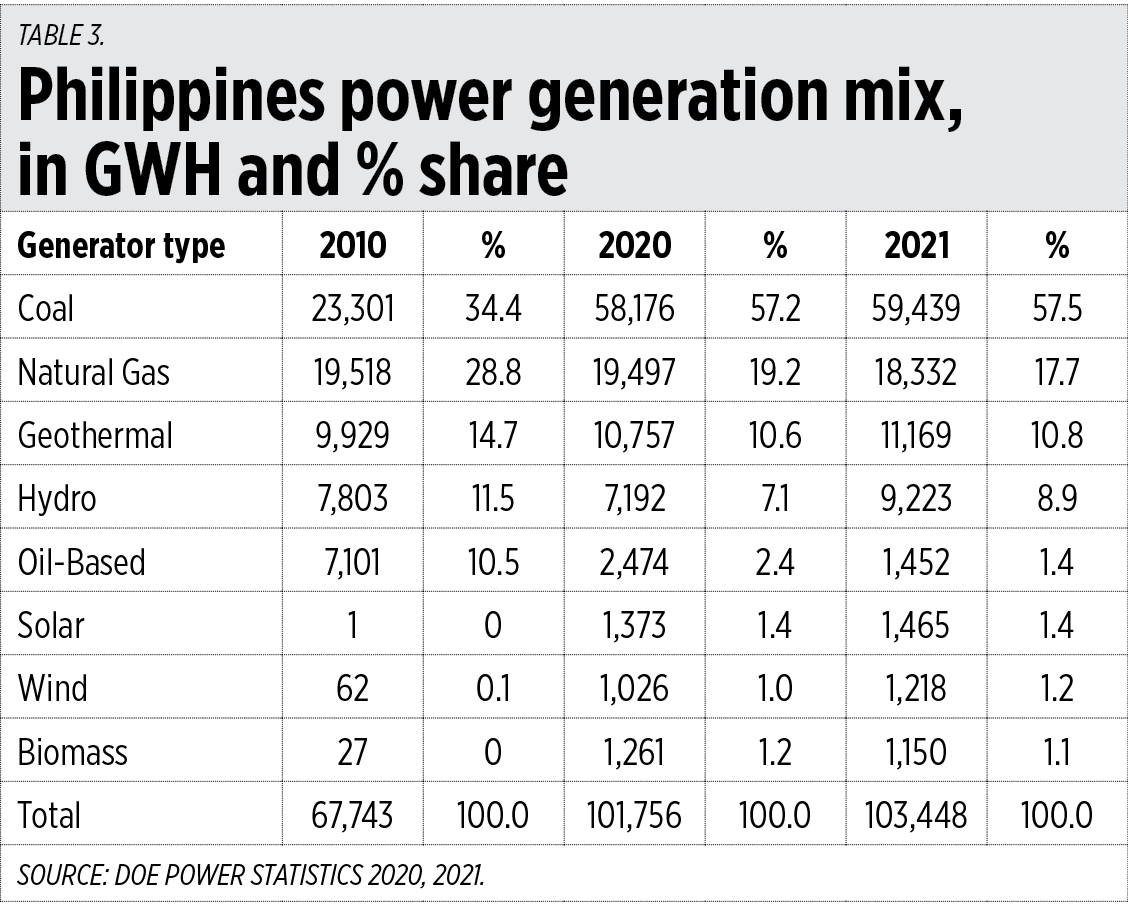
Meanwhile, Department of Energy (DoE) data show that in 2021, the Philippines produced 103,448 gigawatt-hours (GWH) of electricity, more than 2020’s 101,800 GWH but still lower than 2019’s 106,000 GWH. Coal’s share in installed capacity is still at around 35% of the total but contributed 57.5% in actual power generation in 2021.

Malampaya gas generation is declining, from 19,500 GWH in 2010 and 2020 to 18,300 GWH in 2021. The shares of geothermal and hydro are increasing slightly, and wind-solar’s contribution is only 2.6% of total generation in 2021, still insignificant even if the Renewable Energy law was enacted in 2008 and feed-in tariff (FIT) or assured high prices for 20 years was granted in 2012 or a decade ago (Table 3).

I am hoping that the Ferdinand Marcos, Jr. administration will realize that energy rationing, giving unnecessary priorities to intermittent renewables and discouraging investments in thermal power generation, will be counter-productive economically. The right energy mix should be done by the consumers themselves, not by government’s Executive or Legislative branches, nor by environmental and climate lobby groups.


Bienvenido S. Oplas, Jr. is the president of Minimal Government Thinkers.

minimalgovernment@gmail.com

Japan’s assertive foreign policy can start in Southeast Asia

SPDEL-FREEPIK
SPDEL-FREEPIK

“UKRAINE today may be East Asia tomorrow,” Japanese Prime Minister Fumio Kishida told an international security gathering in Singapore, a catchphrase that speaks to the harsh lessons learnt over the past few months. Better deterrence and response capabilities, he told a room packed with defense officials and diplomats, will be “absolutely essential if Japan is to learn to survive in the new era and keep speaking out as a standard-bearer of peace.” Cranking up rhetoric, though, is the easy part.

Russia’s invasion of Ukraine has jolted the pacifist nation into making bigger promises on spending, security, and a foreign policy that relies on more than economics — welcome news for allies eager to have a muscular Japan discouraging provocations from its nuclear-armed neighbors. Tokyo now needs to overcome what remains of domestic resistance, free up funds, and strengthen alliances, and fast. But this “courteous power” can already use diplomatic tools to do more for the “rules-based free and open international order” that Kishida talked up at the Shangri-La Dialogue on Friday. He could do worse than to start in Southeast Asia. It’s a region that, like much of the emerging world, has largely distanced itself from allies’ response to President Vladimir Putin’s aggression, and where Japan has more credibility than most.

Ukraine has made even Tokyo’s most ardent pacifists realize that a totally unprovoked war is not a distant prospect. It’s a tough neighborhood: North Korean missiles, Russian saber-rattling around islets it says are part of its Kuril chain and Japan calls its Northern Territories, and tensions in the East China Sea — never mind the dramatic consequences of a Chinese invasion of Taiwan. Joint military exercises by Russia and China have done little to ease nerves. Little wonder that even if an overhaul of Japan’s constitutional article forbidding “land, sea, and air forces, as well as other war potential,” remains unlikely, public opinion is shifting, and limits are becoming more flexible, with counterstrike capabilities now up for discussion. Even Kishida, whose family hails from Hiroshima and is less hawkish than others in his party, is pledging a substantial increase in defense spending, a step further from the pacifist mindset of recent decades.

Even so, it will be challenging to move quickly at home. Kishida gave no specifics, but an increase in the defense budget to 2% of gross domestic product, or NATO levels, as his party has proposed — roughly doubling the current share — may be a tough sell in practice, given post-pandemic demands and already stretched public finances. Kishida can still add manpower to the Self-Defense Forces, as Japan’s military is known, bolster missile defense and cybersecurity (a major concern), while working on strengthening the alliance with America — though Kishida has, for now, pushed aside nuclear sharing, or the possibility of hosting US nuclear weapons on Japanese soil.

But Japan, which has already broken with precedent by accepting refugees and sending bulletproof vests to Ukraine, can take other steps to protect not just itself but the rules-based order it depends on, with more forceful diplomatic efforts to help widen the alliance of nations condemning Russia’s aggression and pushing to isolate its economy. Southeast Asia is a good place to begin.

With the exception of Singapore, which has imposed unilateral sanctions for the first time in more than four decades, the region has largely sought to remain neutral in the conflict. That’s due in equal parts to the power of Russian weapons exports, deep-seated anti-Western sentiment, Soviet-era ties, disinformation — and of course diplomatic disengagement on the part of the wealthy world, not to mention sheer distance. Just a day after Kishida addressed the Singapore gathering, Indonesian Defense Minister Prabowo Subianto, whose country has refused Ukraine’s request for weapons, defended what he called strategic neutrality, with a reference to former South African leader Nelson Mandela’s comment when asked in a US interview about Cuba’s Fidel Castro: “Your enemy is not necessarily my enemy.” It’s a position Russia is exploiting as the food crisis worsens, which will be used to weaken support for Ukraine as the war grinds on. And it’s an issue the West is not doing enough to tackle.

Southeast Asia is important, not just as a grouping of important emerging economies but because this year, it has the global spotlight: Indonesia chairs the G20, which will meet in Bali in November, and Thailand will host the Asia-Pacific Economic Cooperation’s economic leaders summit. So it matters when Cambodia, the current chair of ASEAN, joins with Indonesia and Thailand to issue a statement on their respective meetings that skirts the small matter of  a war of conquest entirely, in favor of working “with all partners and stakeholders.”

Japan is already engaged with the region and in his first months, Kishida has visited Cambodia, Vietnam, Indonesia, Thailand, and Singapore, and welcomed Malaysia’s prime minister in Tokyo. It’s also the region’s most trusted partner, not to mention a leading investor. But as with its investment, diplomatic efforts have been patient and understated, and far more is needed. There is an uncomfortable colonial past and officials will be dealing with reluctant and distracted governments — Indonesia, for one, is already beginning to look ahead to a 2024 election. It will also have to steer away from values conversations around political systems. Singapore’s defense minister is right that there will be “few takers for a battle royale on that basis.”

But stronger economic ties will help, as will military supplies to reduce dependence on Russia, not to mention coordinating food aid and support where needed as the conflict in Ukraine fuels a surge in prices and hunger. Persistent diplomacy too. Avoiding another aggressor trampling over smaller neighbors demands it.

BLOOMBERG OPINION

SM Foundation: Creating ripples of social good

The 2021 SMFI Primer (cover)

SM Foundation (SMFI), the corporate social responsibility arm of the SM group, underscores how the power of doing social good, even to a single beneficiary, creates a ripple effect wherein more Filipinos can benefit from.

Since its establishment in 1983, SM Foundation’s wide array of programs has generated positive impacts to its host areas — uplifting the lives especially of those living in grassroots communities. SMFI shares some of its beneficiaries, who are now spreading social good themselves in their own unique way.

Creating work opportunities

A 2010 SM scholar graduate, Darmae Tan, who finished a computer science degree from the University of the Philippines-Cebu, is now managing her own software development company, MYT SoftDev Solutions, Inc. and her latest venture, ErrandBoy.PH.

SM Scholar Darmae Tan

ErrandBoy.PH provides on-demand help such as courier service, purchase service and bills payment service for people who are either too busy or have limited mobility because of the government-imposed restrictions to contain the spread of COVID-19. The first employees Ms. Tan hired for her new company were displaced workers, mostly from the hospitality industries, affected by the pandemic. Ms. Tan envisions ErrandBoy.PH as a tool in helping people have time for more important things in life like time for their families.

“This is exactly how SM Foundation helped me. Aside from the financial help that they extended for my college education, they also helped me develop myself and figure out what I wanted my future to be like — which is to extend a helping hand to others and spread social good,” Ms. Tan said.

“Not everyone is given the same opportunity, and I am very grateful to SMFI not only for the chance to have a quality college education but also for providing me with learning opportunities through various enrichment activities when I was still a scholar,” Ms. Tan further added.

Sharing his knowledge on farming

Another SMFI beneficiary under its Kabalikat Sa Kabuhayan (KSK) on Sustainable Agriculture, who now shares his knowledge on farming to his community, is Jeffrey Toleran of Davao Cty. He is a High School Teacher at Emilio Ramos National High School designated as Gulayan Sa Paaralan Coordinator. With just a little knowledge on farming, Mr. Toleran exerted efforts to equip himself with the skillsets needed to run their school’s gardening initiative — that’s when he joined SMFI’s KSK training program under Batch 211 in 2019.

KSK farmer-graduate Jeffrey Toleran

With what he has cemented in their school in terms of their Gulayan sa Paaralan project, it’s no surprise that Teacher Toleran was recognized not just at the school level but also on the regional level. While continuing what he has started at their school, he also expanded his platform and established the Barangay Angliongto Organic Practitioner Association (BAOPA) in his community.

Ang BAOPA ay naglalayong makatulong sa ibang tao na mabigyan ng ideya sa pagtatanim at mahikayat na gawin ang home gardening na maaari nilang pagkunan ng pagkain para sa kanilang hapag-kainan. Ang BAOPA ngayon ay rehistrado sa City Agriculture ng Davao City. Natutuwa ako na makitang hindi na ako nag-iisa sa pagtupad ng aking mga layunin. Mula sa ‘ako’, ngayon ay naging ‘kami’ na dahil sa asosasyong ito,” he concluded.

The stories of Darmae and Jeffrey are just a few among the thousands of SMFI beneficiaries, who are now making their own way to help others — fully embracing SMFI’s principle of people helping people.

To know more about the various social development impacts and social good stories of SM Foundation, read and download 2021 SMFI Primer: https://bit.ly/3xp7Z0u.


Spotlight is BusinessWorld’s sponsored section that allows advertisers to amplify their brand and connect with BusinessWorld’s audience by enabling them to publish their stories directly on the BusinessWorld Web site. For more information, send an email to online@bworldonline.com.

Join us on Viber to get more updates from BusinessWorld: https://bit.ly/3hv6bLA.

Beijing tests millions over COVID cluster at 24-hour bar

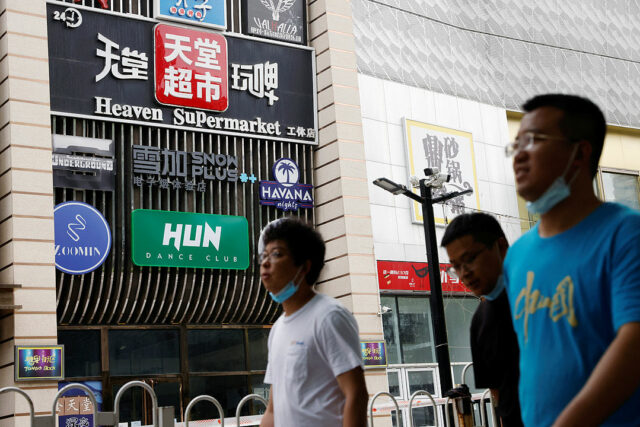
PEOPLE walk past a sign of the Heaven Supermarket bar, where a coronavirus disease (COVID-19) outbreak emerged, in Chaoyang district of Beijing, China, June 13. — REUTERS

BEIJING — Authorities in China’s capital Beijing on Monday raced to contain a COVID-19 outbreak traced to a raucous 24-hour bar known for cheap liquor and big crowds, with millions facing mandatory testing and thousands under targeted lockdowns.

The outbreak of nearly 200 cases linked to the city center Heaven Supermarket Bar, which had just reopened as curbs in Beijing eased last week, highlights how hard it will be for China to make a success of its “zero COVID” policy as much of the rest of the world opts to learn how to live with the virus.

The re-emergence of COVID infections is also raising new concerns about the outlook for the world’s second-largest economy. China is only just shaking off a heavy blow from a two-month lockdown of Shanghai, its most populous city and commercial nerve center, that also roiled global supply chains.

Dine-in service at Beijing restaurants resumed on June 6 after more than a month in which the city of 22 million people enforced various COVID curbs. Many malls, gyms and other venues were closed, parts of the city’s public transport system were suspended, and millions were urged to work from home.

“We have to test every day now. It’s a bit of a hassle, but it’s necessary,” said a 21-year-old resident surnamed Cao, who runs a convenience store in Beijing’s largest district Chaoyang, where the bar cluster was discovered. “The virus situation has hurt our business a bit, it’s down about 20-30%.”

Chaoyang kicked off a three-day mass testing campaign among its roughly 3.5 million residents on Monday. About 10,000 close contacts of the bar’s patrons have been identified, and their residential buildings put under lockdown, and some planned school reopenings in the district have been postponed.

Queues snaked around some testing sites on Monday for more than 100 meters, according to Reuters’ eyewitnesses. Large metal barriers have been installed around several residential compounds, with people in hazmat suits spraying disinfectant nearby.

‘IN VAIN’
Last week, as dine-in curbs were lifted, Heaven Supermarket Bar, modeled as a large self-service liquor store with chairs, sofas and tables, reclaimed its popularity among young, noisy crowds starved of socializing and parties during Beijing’s COVID restrictions.

The bar, where patrons check aisles to grab anything from local heavy spirits to Belgian beer, is known among Beijing revelers for its tables plastered with empty bottles, and customers falling asleep on sofas after midnight.

With the almost 200 COVID cases linked to the bar since June 9, authorities described the outbreak as “ferocious” and “explosive” — people infected live or work in 14 of the capital’s 16 districts, authorities have said.

Officials have not commented on the exact cause of the outbreak, nor explained why they are not yet reinstating the level of curbs seen last month.

The bar cluster was caused by loopholes and complacency in epidemic prevention, state-backed Beijing Evening News wrote in a commentary piece on Monday.

“At a time when … normality in the city is being restored, the fall of Heaven Supermarket Bar means the hardship and effort of countless people have been in vain,” the newspaper wrote.

If the outbreak grows, “consequences could be serious, and would be such that nobody would want to see,” it added.

Heaven Supermarket Bar, and other businesses nearby, including the Paradise Massage & Spa, were under lockdown, with police tape and security staff blocking the entrances.

A handful of customers and staff at the parlor would be locked in temporarily for checks, authorities said.

In all, Beijing reported 51 cases for Sunday, versus 65 the previous day, in line with a national trend of falling cases.

Shanghai, which completed mass testing for most of its 25 million residents at the weekend after lifting its lockdown and many of its curbs at the start of the month, reported 37 cases, up from 29.

As Beijing authorities wrestled with new COVID cases in April, retail sales in the capital shrank 16% year-on-year, while property sales nosedived 25%. Data for May, due later this month, is expected to be dire as well.

Before the bar cases, there had been high hopes for a rebound in June. — Reuters

Pfizer COVID-19 vaccines safe and effective for small kids, FDA staff say

US FOOD and Drug Administration (FDA) staff reviewers on Sunday said Pfizer-BioNTech’s coronavirus disease 2019 (COVID-19) vaccines were effective and safe for use in children aged 6 months to 4 years.

The FDA reviewers said in briefing documents published on Sunday evening that their evaluation did not reveal any new safety concerns related to the use of the vaccine in young children.

The FDA analysis of data from Pfizer’s trial was published ahead of a June 15 meeting of its outside advisers. Recommendations from the external advisers will determine the FDA’s decision on the vaccines.

“Available data support the effectiveness of the Pfizer-BioNTech COVID-19 Vaccine 3-dose primary series in preventing COVID-19 in the age group of 6 months through 4 years,” FDA staff said in the review.

An early analysis of data from Pfizer-BioNTech’s vaccine based on 10 symptomatic COVID-19 cases identified when the Omicron coronavirus variant was dominant suggested a vaccine efficacy of 80.3% in the under-5 age group.

COVID-19 shots for children under the age of 6 are yet not approved in most parts of the world. It remains unclear how many parents will get their young ones vaccinated as demand has been low for kids aged 5 to 11.

US President Joseph R. Biden’s administration expects vaccinations for young children to begin in earnest as early as June 21 if the FDA and the Centers for Disease Control and Prevention approve the vaccines.

Government officials say pre-orders for use in the under-6 age group has been low but demand is expected to pick up once the vaccines gain authorization.

The FDA on Friday released a staff review of Moderna, Inc.’s COVID-19 vaccine which said the doses were safe and effective for use in children aged 6 months to 17 years old. — Reuters

Britain orders review of fuel market as pump prices surge

PIXABAY

LONDON — Britain’s competition watchdog has been asked by the government to review the retail fuel market to see whether a cut in duty has been passed onto consumers as prices at the pump hit unprecedented highs.

Business Secretary Kwasi Kwarteng said on Sunday the investigation would find out why fuel prices were always quick to rise but slow to come down.

The price of oil has surged worldwide, driven by Russia’s invasion of Ukraine and economies reopening after the pandemic.

Britain reduced fuel duty by 5 pence per liter for one year in March in a 5-billion-pound ($6.2 billion) package to ease the burden on motorists amid a worsening cost-of-living crunch for households.

However, prices have continued to rise, and the average cost of filling a family car rose above 100 pounds for the first time last week, according to data firm Experian Catalist.

“The British people are rightly frustrated that the 5 billion pound package does not always appear to have been passed through to forecourt prices and that in some towns, prices remain higher than in similar, nearby towns,” Mr. Kwarteng said in a letter to the Competition and Markets Authority (CMA).

He said the review should consider the health of competition in the market, regional factors, including localized competition, and any further steps that the government or the CMA could take to strengthen competition. He requested an initial report by July 7. — Reuters

Telco DITO launches digital campaign to promote local talent

Local talents featured in the Galing DITO digital campaign.

DITO Telecommunity Corp. launched on Sunday the digital campaign “Galing DITO,” to celebrate Filipino artists, dancers, and musicians on the Philippines’ 124th Independence Day. 

“Galing Dito emboldens Pinoy talents. DITO wants to empower them so they can showcase what it takes to be a Filipino,” explained Jasper O. Evangelista, DITO brand and marketing director, at the pre-launch on Friday. 

A play on the word “galing” that can mean “talent” or “hailing/coming from,” the campaign aims to put Filipino talent center stage, he added.  

The highlight of the campaign is the Galing DITO song and music video that was released on June 12. It features P-Pop (Pinoy Pop) groups Dione and 13C, singers Marga Jayy and Maan Chua, rappers February Bank, Faifai Flojo, Denial RC, Cookie$, and Kaye Seballos, and dance crews Femme MNL and Kingsmen.  

“DITO’s mission has always been to bring Filipinos together,” said Mr. Evangelista, pointing out that all the talents come from different regions in the Philippines. 

The song and video also feature the Buganda Drumbeaters and kulintang players Nurainie Datumanong Ampatuan.  

Evelyn Jimenez, DITO chief commercial officer, said that the telco has now reached nearly 9 million customers in over 500 cities and areas nationwide since it started building its network a little over a year ago. 

DITO’s goal for 2022 is to hit 12 million subscribers. 

“We’re still building our product portfolio and improving our customer experience and all that, but our assurance to all of you is our commitment that we will strive to do better each and every day in the service of the Filipino people,” she said. 

The telco previously said that it is spending over P50 billion on network rollout this year. — Brontë H. Lacsamana

Crypto firm Celsius pauses all transfers, withdrawals as markets tumble

REUTERS

Cryptocurrency lending firm Celsius Network will pause withdrawals and transfers between accounts due to “extreme market conditions”, the company said on Monday, in the latest sign of pressure in the crypto industry.

Bitcoin extended earlier declines after Celsius’s announcement, falling more than 6% to as low as $24,888, an 18-month low. Ether, the world’s second-largest cryptocurrency, dropped more than 8% to $1,303, its lowest since March 2021.

“We are taking this necessary action … in order to stabilize liquidity and operations while we take steps to preserve and protect assets,” the company said in a blog post.

“Furthermore, customers will continue to accrue rewards during the pause in line with our commitment to our customers.”

Celsius Network, which raised $750 million in funding late last year, is a significant player in crypto lending. It offers interest-bearing products to customers who deposit their cryptocurrencies with the company, and lends out crypto currencies to earn a return.

As of May 17, the company had processed $8.2 billion worth of loans and had $11.8 billion in assets, according to its website.

It said in August last year that it had more than $20 billion in assets.

While crypto lending has become increasingly big business, the sector has come under regulatory scrutiny, particularly in the U.S.

Crypto markets have been under pressure in recent months, falling alongside other so-called risk assets as interest rates have risen around the world.

Price falls have also both been caused by and contributed to the collapse of some crypto projects. Most notable was the fall of stablecoin TerraUSD, which last month broke its dollar peg and collapsed in value, rocking the crypto industry. — Reuters

Malaysia firms turn down orders as migrant labor shortage hits

Photo by Craig Morey/Flickr/CC BY-SA 2.0

KUALA LUMPUR — Malaysian companies from palm oil plantations to semiconductor makers are refusing orders and forgoing billions in sales, hampered by a shortage of more than a million workers that threatens the country’s economic recovery. 

Despite lifting a coronavirus disease 2019 (COVID-19) freeze on recruiting foreign workers in February, Malaysia has not seen a significant return of migrant workers due to slow government approvals and protracted negotiations with Indonesia and Bangladesh over worker protections, say industry groups, companies and diplomats. 

The export-reliant Southeast Asian nation, a key link in the global supply chain, relies on millions of foreigners for factory, plantation and service sector jobs shunned by locals as dirty, dangerous and difficult. 

Manufacturers, who make up nearly one-fourth of the economy, fear losing customers to other countries as growth picks up. 

“Despite the greater optimism in outlook and increase in sales, some companies are gravely hampered in their ability to fulfill orders,” said Soh Thian Lai, president of the Federation of Malaysian Manufacturers, which represents over 3,500 companies. 

Palm oil growers are at breaking point, said Carl Bek-Nielsen, chief executive director of oil palm grower United Plantations. 

“The situation is dire and very much like having to play a game of football against 11 men but only being allowed to field seven,” he said. 

Malaysia lacks at least 1.2 million workers across manufacturing, plantation and construction, a shortage worsening daily as demand grows with an easing of the pandemic, industry and government data show. 

Manufacturers say they are short 600,000 workers, construction needs 550,000, the palm oil industry reports a shortage of 120,000 workers, chipmakers lack 15,000 and cannot meet demand despite a global chip shortage, and medical glovemakers say they require 12,000 workers. 

Malaysia’s manufacturing Purchasing Managers’ Index dropped to 50.1 in May from 51.6 in April, barely remaining in expansion, as the sector shed the most jobs since August 2020, according to data from S&P Global. 

Chipmakers are turning away customers, locals are not interested in working in the industry and many who do join leave in less than half a year, says Wong Siew Hai, president of the Malaysia Semiconductor Industry Association. 

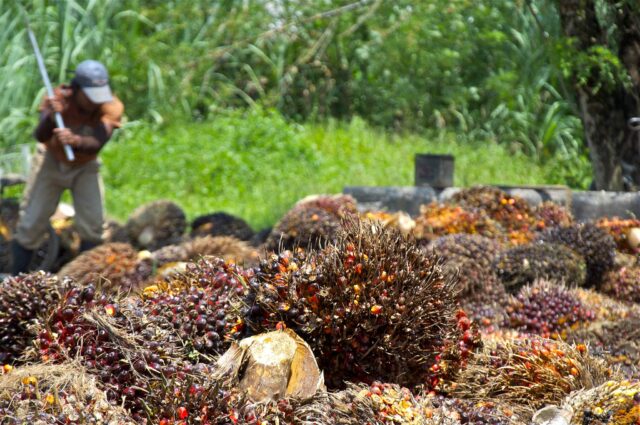
The palm oil industry, which contributes 5% to Malaysia’s economy, warns 3 million tonnes of crop could be lost this year as fruit rots unpicked, meaning losses of more than $4 billion. The rubber glove industry estimates $700 million of lost revenue this year if the labor shortage persists. 

WORKERS’ RIGHTS
Malaysia’s Ministry of Human Resources, which is responsible for approving the intake of foreign workers, did not respond to Reuters queries for comment on the labor crunch and its economic impact. 

In April, Minister M. Saravanan said companies had asked to hire 475,000 migrant workers but the ministry had approved just 2,065, rejecting some for incomplete information or lack of compliance with regulations. 

Diplomats from Indonesia and Bangladesh, two of Malaysia’s biggest sources of foreign labor, told Reuters that workers’ rights were part of the hold-up in sourcing migrant workers. 

Bangladesh signed an agreement in December to send workers, but implementation was delayed after Dhaka protested Malaysia’s proposed hiring process, citing fears the plan could lead to increased costs for the workers and debt bondage, said a Bangladeshi diplomatic source. 

“Our main focus is our workers’ welfare and rights,” said Bangladesh’s expatriate welfare and overseas employment minister, Imran Ahmed. “We’re making sure they get standard wages, they have proper accommodation, they spend minimum cost for migration and they get all other social security.” 

He told Reuters that Dhaka does not “want workers to end up falling into a cycle of debt trap”, adding that Malaysia wants to hire 200,000 Bangladeshi workers within a year. 

The United States has banned seven Malaysian companies over the last two years over what Washington called forced labor. 

Malaysia’s Mr. Saravanan, who was in Dhaka early this month, said Malaysia had given the Bangladesh government reassurances that it would ensure better salaries and protection of workers’ welfare. He has denied claims that the hiring process was flawed. 

Mr. Saravanan said last week the government was finalizing technical matters, recruitment procedures and agreements with some source countries. 

Indonesia’s ambassador to Malaysia, Hermono, who like many Indonesians goes by a single name, said concerns over worker protection came up in recent bilateral talks. ($1 = 4.3880 ringgit) — Reuters

Report casts doubt on net-zero emissions pledges by big global companies

REUTERS

LONDON — Corporate plans to slash greenhouse gas emissions fall short of what is needed to combat climate change, with “major credibility gaps” found among the world’s largest companies, according to a new stocktake of net-zero efforts in the public and private sector. 

Roughly half of the Forbes 2000 largest companies have yet to announce plans to reach net-zero — the point at which greenhouse gas emissions are negated by deep cuts in output as well as methods to absorb atmospheric carbon dioxide. Of the 702 companies with a net-zero target, two-thirds haven’t made it clear how they plan to achieve that goal, Net Zero Tracker found in their annual report. 

Net Zero Tracker, run in part by the UK-based Energy and Climate Intelligence Unit (ECIU) and the University of Oxford, assesses publicly available data for about 200 countries as well as large publicly traded companies, including those in fossil fuels. 

“We see a lot of issues with credibility, and the quality and robustness of these targets,” said report co-author Frederic Hans, a climate policy analyst at NewClimate Institute, a German think tank. 

Many companies with net-zero targets have set no interim emissions goals for before 2050, which the report said was “unacceptably low” if the world is to halve emissions in the next eight years, as scientists say is needed. 

Carbon offsetting — or buying credits for emissions reduced elsewhere — also featured prominently among corporate strategies. Nearly 40% of the Forbes 2000 companies with a net-zero target plan to use offsets, despite concerns about the lack of regulation. 

Governments will need to impose legal standards and regulations to ensure net-zero progress, said co-author John Lang of the ECIU. At the moment, companies are confused about what’s needed from them. “They don’t know what information has to be disclosed,” he said. 

At its climate summit in Glasgow last year, the United Nations established an expert group to produce net-zero standards for the private sector and analyze commitments. The European Union is also in the midst of drafting net-zero reporting standards, to be adopted in November. The current draft text bars companies from counting carbon offsets toward net-zero. 

“We have to have mandatory, top-down regulations to guide them,” Mr. Lang said. However, he doubted the issue could be resolved before the next UN climate summit, “COP27,” in Sharm al-Sheikh, Egypt, this November. It “probably can’t be fixed before COP28” in 2023,  he said. — Reuters

Global nuclear arsenal to grow for first time since Cold War — think-tank

US nuclear weapons test in Nevada in 1953. — US Government

STOCKHOLM — The global nuclear arsenal is expected to grow in the coming years for the first time since the Cold War while the risk of such weapons being used is the greatest in decades, a leading conflict and armaments think-tank said on Monday.

Russia’s invasion of Ukraine and Western support for Kyiv has heightened tensions among the world’s nine nuclear-armed states, the Stockholm International Peace Research Institute (SIPRI) think-tank said in a new set of research.

While the number of nuclear weapons fell slightly between January 2021 and January 2022, SIPRI said that unless immediate action was taken by the nuclear powers, global inventories of warheads could soon begin rising for the first time in decades.

“All of the nuclear-armed states are increasing or upgrading their arsenals and most are sharpening nuclear rhetoric and the role nuclear weapons play in their military strategies,” Wilfred Wan, Director of SIPRI’s Weapons of Mass Destruction Program, said in the think-tank’s 2022 yearbook.

“This is a very worrying trend.”

Three days after Moscow’s invasion of Ukraine, which the Kremlin calls a “special military operation,” President Vladimir Putin put Russia’s nuclear deterrent on high alert.

He has also warned of consequences that would be “such as you have never seen in your entire history” for countries that stood in Russia’s way.

Russia has the world’s biggest nuclear arsenal with a total of 5,977 warheads, some 550 more than the United States. The two countries possess more than 90% of the world’s warheads, though SIPRI said China was in the middle of an expansion with an estimated more than 300 new missile silos.

SIPRI said the global number of nuclear warheads fell to 12,705 in January 2022 from 13,080 in January 2021. An estimated 3,732 warheads were deployed with missiles and aircraft, and around 2,000 — nearly all belonging to Russia or the United States — were kept in a state of high readiness.

“Relations between the world’s great powers have deteriorated further at a time when humanity and the planet face an array of profound and pressing common challenges that can only be addressed by international cooperation,” SIPRI board chairman and former Swedish Prime Minister Stefan Lofven said. — Reuters

ADVERTISEMENT
ADVERTISEMENT