Home Blog Page 6171

May trade deficit widens as imports climb

The country’s trade-in-goods deficit grew slightly in May as imports rose to its five-month high, the Philippine Statistics Authority (PSA) reported this morning.

Preliminary data from the PSA showed the value of merchandise exports went up by 6.2% year on year to $6.310 billion in May, steady from the revised 6.2% in April but lower than 30.8% in May last year.

Likewise, merchandise imports grew by 31.4% annually to $11.989 billion in May. This was faster than the revised 29.4% in April, but slower than the 55.8% growth in May 2021.

This was the highest import growth in five months or since the 39.1% growth in December 2021.

This brought trade-in-goods deficit — the difference between exports and imports — to $5.679 billion in May, wider than the $3.180 billion deficit a year ago. The trade gap that month was also larger than the revised $5.349 billion deficit in April.

Total trade — the sum of exports and imports — grew by 21.5% to $18.299 billion, up from 20.3% in April, but lower than the 44.9% in May 2021.

Year to date, exports rose by 8.4% to $31.874 billion, above the 7% growth projected by the Development Budget and Coordination Committee for 2022.

Similarly, imports grew by 29% year on year to $56.796 billion in the first five months of 2022. This was also above the revised 18% imports growth penciled in by the government this year.

In the five months to May, the trade balance ballooned to a $24.922 billion deficit from $14.623 billion trade gap a year ago.

Total trade in the first five months rose by 20.8% to $88.670 billion from $73.421 billion in the January-May period last year.

FDI net inflows rise to 4-month high

ALEXANDER MIL-UNSPLASH

By Keisha B. Ta-asan

NET INFLOWS of foreign direct investments (FDIs) into the Philippines surged to a four-month high in April as further reopening of the economy and trade liberalization reforms lifted investor confidence.

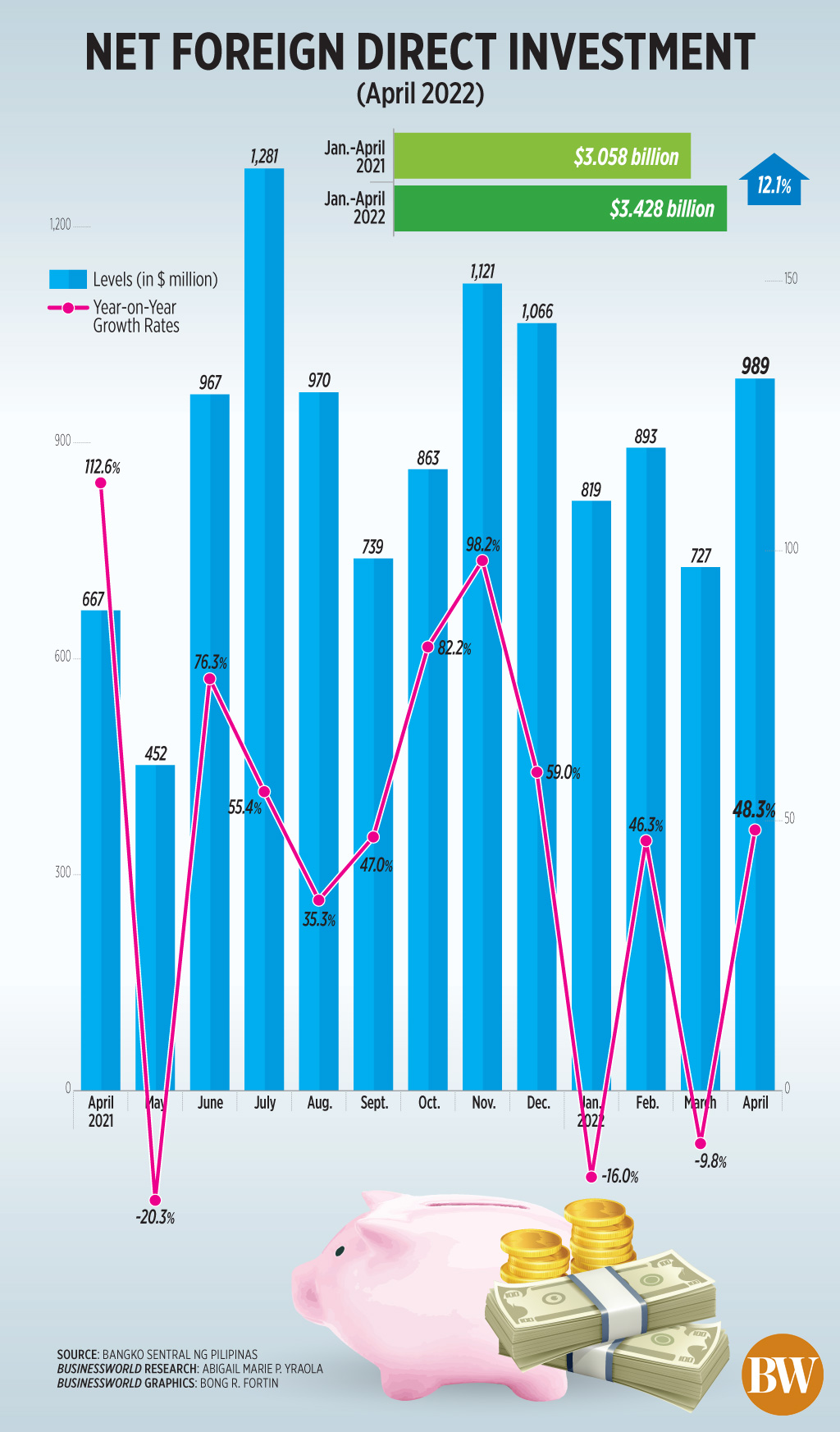
Data released by the Bangko Sentral ng Pilipinas (BSP) on Monday showed that FDI net inflows rose by 48.3% to $989 million in April from $667 million in the same month in 2021.

This was the highest monthly FDI inflow recorded since the $1.06 billion in December last year.

Net foreign direct investmentsMonth on month, net inflows of FDIs, which stand as a key source of jobs and capital for the local economy, grew by 36% from $727 million in March.   

“The pickup in FDI reflects the positive fallout from reopening of the economy. With the Philippines posting a solid 1Q GDP report and with mobility restrictions lowered, this may have prompted investments into the Philippines, including the placement of equity or ‘fresh FDI,’” ING Bank N.V. Manila Senior Economist Nicholas Antonio T. Mapa said in an e-mail.   

Metro Manila and most areas in the country have been under the most lenient alert level since March, as coronavirus infections declined.

“Vaccination rates and the country’s ability to control COVID surges without having to resort to crippling lockdowns also indicated a better business outlook for investors,” China Banking Corp. Chief Economist Domini S. Velasquez said in a Viber message. 

Ms. Velasquez also noted the FDI inflows are mainly driven by the economic reforms put in place by the Duterte administration.

“The amendments to the Public Service Act (PSA) and the Retail Trade Liberalization Act (RTLA) which loosened restrictions of some sectors to foreign ownership likely drew investors’ interests,” she added.

President Rodrigo R. Duterte in March signed into law Republic Act No. 11659, which amended the PSA to allow up to 100% foreign ownership in airports and airlines, subways and railways, telecommunications, domestic shipping, and tollways and expressways.

Mr. Duterte also signed into law the measures amending the RTLA and the Foreign Investment Act, which are expected to boost the competitiveness of the Philippines’ industries and services.

Data from the BSP showed net inflows of FDI went up, following the increases recorded across all components, led by non-residents’ net investments in debt instruments.

April data showed a 40.6% increase in foreign firms’ investments in debt instruments of local affiliates to $684 million from $487 million a year ago.

Foreigners’ net investments in equity capital surged by 127.8% to $206 million in April. Equity capital placements jumped by 103.3% to $224 million, while withdrawals declined by 9.9% to $18 million. 

The equity placements were mainly from Malaysia, the United States, and Japan, and invested mostly in construction, real estate and manufacturing industries.

Reinvestment of earnings fell by 10.2% to $99 million in April.

For the first four months of the year, total FDI net inflows grew by 12.1% to $3.4 billion.

“Cumulative FDI net inflows rose due mainly to the increase in non-residents’ net investments in debt instruments,” the BSP said, referring to the 35.3% jump in foreign investments in debt instruments to $2.5 billion.   

Reinvestment of earnings was flat at $329 million in the January to April period.

Meanwhile, investments in equity capital slumped by 37.2% to $517 million in the four-month period, as placements declined by 39.4% to $576 million. Equity withdrawals also dropped by 53.2% to $59 million.

Net inflows of FDIs are expected to slow in the next few months, amid the darkening global economic outlook.

“We could see a moderation in the near term as the economy faces short-term headwinds but should the Philippines weather the turbulence, we can expect FDI to resume once we have cleared the present challenges,” Mr. Mapa said.   

Aside from economic reforms, Ms. Velasquez said FDI net inflows may get a boost from “infrastructure investments with private sector participation, and efforts to streamline tax administration.”

“Outside of these reforms, ease of doing business, anti-corruption efforts, and firmly instilling the rule of law will be favorable to investors,” she added.   

The central bank projects FDI net inflows will reach $11 billion this year.

Marcos’ planned new taxes may have limited impact

REUTERS

By Diego Gabriel C. Robles and
Alyssa Nicole O. Tan, Reporter

THE ECONOMIC TEAM’S plan to pursue new taxes on digital services and pollutants, as well as “rightsizing” of the bureaucracy, may not generate enough revenues needed to repay the Philippines’ ballooning debt, experts said.

Finance Secretary Benjamin E. Diokno last week said they are considering the imposition of taxes on digital or online transactions, single-use plastics, and carbon emissions. This as the Marcos administration looks for new sources of revenues to lower the fiscal deficit and repay the P3.2-trillion additional debt incurred during the coronavirus disease 2019 (COVID-19) pandemic.

“New taxes on digital transactions, single-use plastics, carbon and online services will likely help deliver fresh revenue streams to government coffers. Estimates have been floated on projected collections although it may be difficult to say whether this will be enough to completely offset the current debt and deficit levels,” said ING Bank N.V. Manila Branch Senior Economist Nicholas Antonio T. Mapa.

Bernardo M. Villegas, economist at the University of Asia and the Pacific, said these additional taxes “will not be enough but they will contribute to reducing the fiscal deficit.”

“We need all the tax increases we can get,” Mr. Villegas said.

The Bureau of the Treasury (BTr) earlier estimated the government needs to raise P249 billion annually in incremental revenues to avoid new borrowings and repay debt.

“Given the amount of plastics, carbon and online services that are being used, this can bring in a sizable amount. This may not be enough to pay for the debt, but its consequences in terms of the environment and the inequality are probably more important than reducing the debt,” said Leonardo Lanzona, director of the Ateneo Center for Economic Research and Development.

John Paolo R. Rivera, economist from the Asian Institute of Management, said a tax on single-use plastics and carbon emissions will have “good environmental implications because it will inhibit its use, which is good for the environment in the long run.”

Finance Secretary Benjamin E. Diokno last week broached the possibility of taxes on single-use plastics and on carbon emissions, which would also aid the country’s efforts against climate change and pollution.

Under the previous administration’s fiscal consolidation plan, a P20 excise tax per kilogram of single-use plastics would generate P1 billion in revenues annually.

A 12% value-added tax on online advertisement services and other digital and online services would also generate P13.2 billion in annual revenues.

SENATE SUPPORT
Several senators backed the proposed tax on single-use plastics and online transactions.

“Goods and services bought through the internet should really be taxable for VAT (value-added tax) as all goods and services are, unless expressly made exempt by law,” Senator Juan Edgardo M. Angara said in a Monday statement.

Other countries already impose a tax on single-use plastics, which is intended to encourage the use of recyclable bags, Mr. Angara added.

In a Viber message, Senator Mary Grace Natividad S. Poe-Llamanzares said taxing single-use plastics would hopefully discourage people from using these, and lessen their impact on the environment.

Also, Senator Ramon B. Revilla, Jr. said Congress should review and update its existing tax laws on the digital economy.

“It is also unfair because local online businesses are covered by taxation laws, but multinational corporations who have less physical presence but a wider reach do not seem to be within the scope. They may have to be properly taxed given the outdated provisions and leakages in tax measures,” Mr. Revilla said in a statement.

The House of Representatives approved in September 2021 a bill seeking to impose a 12% VAT on digital sale of services such as online advertisements, subscription services, etc. However, the Senate did not approve the counterpart measure.

Meanwhile, Senator Francis Joseph G. Escudero said that it may not be the best time to implement the two proposed measures.

“It’s always easier to go for imposing new, or increasing whatever existing, taxes in order to raise revenues for (the) government,” he said in a Monday statement. “However, this is burdensome and is not in keeping with the times of slow economic growth, increased unemployment and rising inflation.”

Mr. Escudero suggested that Mr. Diokno focus on plugging tax loopholes and improving revenue collection by the Bureau of Internal Revenue and Bureau of Customs.

“With nearly P200 billion in uncollected taxes lost to either corruption and/or inefficiency, this is by far more than any projected revenue of the new taxes he is mulling,” he said.

RIGHTSIZING BILL
Economic managers are also pushing for the passage of a government rightsizing law that would eliminate redundancies and duplication in government operations. 

Budget Secretary Amenah F. Pangandaman last Friday said they will endorse the rightsizing bill as one of the legislative priorities.

“It’s fairly unpopular, I think, but with the instructions of the President to the Cabinet members to also look at your existing structures, it’s wise to refile the bill,” she said.

For Security Bank Corp. Chief Economist Robert Dan J. Roces, rightsizing the bureaucracy is fine, “as long as this supports the objective of fiscal consolidation without crimping government functions and the private sector’s recovery.”

Mr. Lanzona noted that reducing the bureaucracy will result in greater savings for the government.

“[But] the amount saved may not be enough relative to the huge debt but its externalities are very important not only for economic but also institutional efficiency,” he added.

Mr. Rivera said the impact of this measure may not be huge, but “some impact is better than no impact.”

NCR prices of building materials surge in April

A construction site is seen in Cubao, Quezon City. — PHILIPPINE STAR/ MICHAEL VARCAS

RETAIL PRICES of building materials in Metro Manila grew at its fastest annual pace in more than 13 years in April amid global supply constraints caused by the ongoing Russia-Ukraine war.

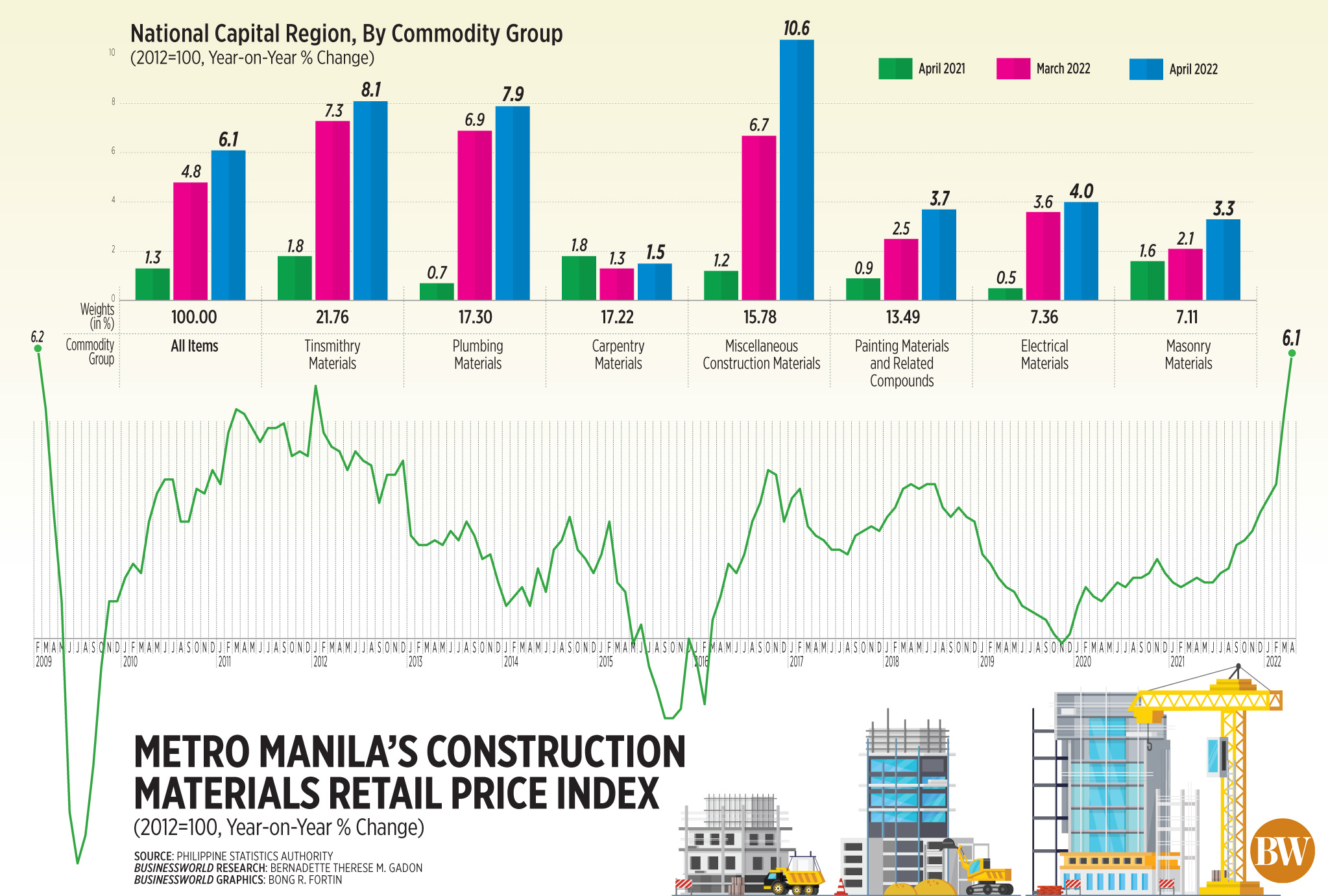
Preliminary data from the Philippine Statistics Authority (PSA) showed the National Capital Region’s (NCR) construction materials retail price index (CMRPI) rose by an annualized 6.1% in April, faster than the 4.8% print in March.

This was also significantly higher than the 1.3% print recorded in April 2021.

Metro Manila's construction materials retail price index

The April print was the highest year-on-year growth for building materials prices in NCR in over 13 years, or since the 6.2% growth logged in February 2009.

For the January to April period, the CMRPI in Metro Manila averaged 4.3%, higher than the 1.2% in the comparable four months a year ago.

Asian Institute of Management economist John Paolo R. Rivera said retail prices of building materials were affected by the ongoing Russia-Ukraine conflict, which disrupted global supply chains. He also cited the higher demand for construction materials as economic activity increased.

“The depreciation of the peso, with respect to the US dollar, made imported construction materials more expensive,” Mr. Rivera said in a text message.

In April, the Philippine peso averaged P51.9760 against the dollar, weaker than the P48.4620 average in April last year, central bank data showed.

The price growth in construction materials was driven by faster year-on-year increase seen in all commodity groups, led by tinsmithry materials (8.1% in April from 7.3% in March).

Retail prices of the following materials also grew annually: plumbing materials (7.9% in April from 6.9% in March), carpentry materials (1.5% from 1.3%), miscellaneous construction materials (10.6% from 6.7%), painting materials and related compounds (3.7% from 2.5%), electrical materials (4% from 3.6%), and masonry materials (3.3% from 2.1%).

Retail construction prices reflect the demand from small-scale building contractors.

Retail prices of construction materials may continue to rise in the next few months, Mr. Rivera said. — Ana Olivia A. Tirona

Lotilla to return to DoE under Marcos

PRESIDENT Ferdinand R. Marcos, Jr. named former Energy Secretary Raphael P.M. Lotilla to lead the Department of Energy (DoE), according to the Presidential Palace.

Mr. Lotilla served as Energy chief from 2005 to 2007 under the administration of former President Gloria Macapagal-Arroyo, Press Secretary Rose Beatrix Laviña Cruz-Angeles said in a statement on Monday.

Prior to that, he was president of the state-run Power Sector Assets and Liabilities Management Corp. (PSALM) and deputy director-general at the National Economic and Development Authority (NEDA).

In a separate statement, Ms. Cruz-Angeles clarified that the designation of Mr. Lotilla is “right now a nomination” pending review of his employment status.

She said Mr. Marcos’ “personal choice to head the DoE” is currently an independent director of Aboitiz Power Corporation and ACE Enexor Inc.

The press chief cited the law that created the DoE, which bars any officer, external auditor, accountant, or legal counsel of any private firm or enterprise primarily engaged in the energy industry from being appointed as secretary of the agency “within two years from his retirement, resignation, or separation therefrom.”

“Thus while the matter is reviewed to determine whether an independent director is considered an officer of the company, Lotilla is considered a nominee,” Ms. Cruz-Angeles said.

In light of Mr. Lotilla’s uncertain appointment to the DoE, Lawmaker Jose Maria Clemente S. Salceda clarified that independent directors “are not officers of the company.”

“By definition, an independent director is ‘a person other than an officer or employee of the corporation’,” he said in a statement.

Mr. Marcos earlier said the role of the Energy secretary will be crucial as the government faces surging prices of fuel and energy.

The Philippine Chamber of Commerce and Industry (PCCI) last week urged the Marcos administration to tackle the continued increase in electricity rates, and the power supply shortages affecting industries. Electricity rates in the Philippines are already one of the highest in Southeast Asia.

The next DoE chief also needs to address the declining output of the country’s Malampaya natural gas field.

Fitch Solutions Country Risk & Industry Research said in a note in August last year that the depletion of the country’s only indigenous gas field is “problematic” since it accounts for 30% of Luzon’s power generation and services 20% of national demand. — Kyle Aristophere T. Atienza


Electricity rates to go down in July, says Meralco

BW FILE PHOTO

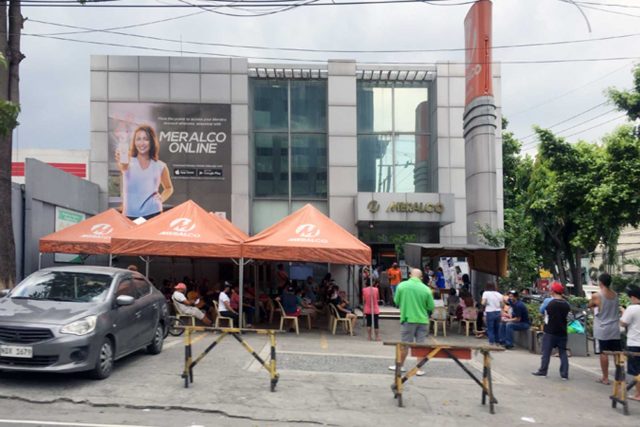
CUSTOMERS of Manila Electric Co. (Meralco) will pay a lower rate of about 71 centavos per kilowatt-hour (kWh) in July after the energy regulator called for a refund of a previous over-collection, offsetting an increase in the power generation charge.

“It’s basically good news for Meralco customers as we are announcing a 71-centavo rounded off rate reduction for the residential consumers this month of July 2022,” said Meralco Spokesperson and Head of Corporate Communications Joe R. Zaldarriaga in a press briefing on Monday.

Meralco said the reduction came after the Energy Regulatory Commission (ERC) directed the utility to refund P21.8 billion following the validation of its applicable tariff for July 2015 to June 2022.

As a result, the overall rate in July will go down by P0.7067 per kWh to P9.7545 per kWh from P10.4612 per kWh in June.

Households consuming 200 kWh will see a P141 decrease in their monthly power bill. Those consuming 300 kWh, 400 kWh, and 500 kWh, will see their monthly bills decline by P212, P283, and P353, respectively.

“The immediate implementation of the ERC decision was able to more than offset the impact of higher generation charge this month to the benefit of our customers,” Jose Ronald V. Valles, Meralco’s head of regulatory management, said separately in a press release.

The refund will be 87 centavos per kWh for residential customers and will appear as a separate line item called “Distribution True-up 4” in the power bills starting this July.

On the other hand, there is an increase in the generation charge of 22 centavos per kWh in July to P6.7756 per kWh from the P6.5590 per kWh registered in June.

Mr. Zaldarriaga said that the increase is primarily caused by the increase in the prices at the wholesale electricity spot market (WESM) of P3.9649 per kWh.

Meralco also reported an increase in charges from power supply agreements (PSAs) by P0.3186 per kWh and a decrease in charges from independent power producers (IPPs) by P0.4669 per kWh.

“Mitigating factor however was the rates of the independent power producers, which went down by 47 centavos per kWh,” Mr. Zaldarriaga.

PSAs, IPPs, and the spot market accounted for 50%, 43%, and 7%, respectively, of Meralco’s energy requirement for the period.

“[In] the May versus June 2022 daily Luzon weighted average price, there were a series of yellow and red alerts for the June 2022 supply month which led to the pressure of WESM prices to go up,” Mr. Zaldarriaga said.

The yellow alerts, a warning of thinning power reserves, were placed by National Grid Corporation of the Philippines (NGCP) due to the forced outage of several power plants from June 20 to 22. The red alert was placed on June 18 due to the tripping of NGCP’s Hermosa-BCCP 230 kilovolt lines 1 and 2, which isolated several power plants.

Mr. Zaldarriaga said that 16 out of 41 times last month, the secondary price cap, a price-mitigating mechanism imposed when there are persistent high prices at the spot market. It was triggered 35.71% of the time, the highest incidence of secondary price cap imposition since the start of the year.

He also factored in peso depreciation and continued increase in international coal prices as reasons for higher generation costs.

“There was a steep depreciation of the peso from P52.37 in May to almost P55 in June,” Mr. Zaldarriaga said. “The generating plants utilize majority of their expenses using dollar-denominated expenses.”

Meralco placed the cost components in the July rate as: P0.2166 for power generation; P0.0012 for transmission; P0.8656 for distribution rate true-up; and P0.0565 for other charges such as taxes, subsidies, and feed-in tariff allowance.

Distribution, supply, and metering charges, where Meralco gets its income, remained unchanged since the reduction in July 2015.

Generation charges are paid to the power suppliers, transmission charges are paid to the system operator, and the other charges are all remitted to the government.

On Monday, shares in the company rose by 1.14% or P4 to close at P354 apiece at the stock exchange.

Meralco is the largest power distribution company and the largest private-sector utility in the Philippines. Its controlling stakeholder, Beacon Electric Asset Holdings, Inc., is partly owned by PLDT, Inc.

Hastings Holdings, Inc., a unit of PLDT Beneficial Trust Fund subsidiary MediaQuest Holdings, Inc., has an interest in BusinessWorld through the Philippine Star Group, which it controls. — Justine Irish DP. Tabile

Filipinas eye fifth straight win as it duels archrival Thailand

HAT TRICK for striker Sarina Bolden — PFF

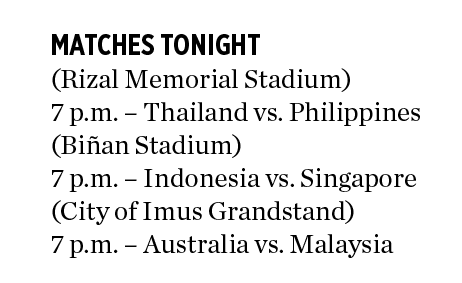
HOST Philippines aims for payback, a record-extending fifth straight win and No. 1 spot in the semifinals as it duels with rival Thailand in the last group match of the AFF Women’s Championship on Tuesday night at the Rizal Memorial Stadium.

The Filipinas hit the pitch at 7 p.m. teeming with motivation to go for maximum points versus the Thais in the marquee Group A matchup.

First, Thailand denied the Philippines a place in the last Southeast Asian Games gold medal match with a 3-0 win in the semis in Hanoi and payback at home is a really tantalizing proposition.

Then there’s this chance to further improve on the team’s best start in the tournament, which currently stands at 4-0-0 (win-draw-loss for 12 points) after that 4-1 come-from-behind verdict over Indonesia on Sunday night.

A winning result against the second-running Thais (10 points on 3-1-0) will land the Filipinas top of the table in Group A for a Final Four duel with the No. 2 team from Group B.

A draw will also suffice for the group’s pole position, but a loss will enable the Thais to climb ahead and send the home squad down to the No. 2.

Alen Stajcic’s Philippine charges look to have more supporters in the stands to draw inspiration from, especially with the most important stages up.

“We want this place rocking. We want it full,” Mr. Stajcic ahead of the clash with 2019 runner-up Thailand.

“It’s so good to have a bigger crowd last Sunday (1,474 strong) and the noise and the atmosphere. The bigger the atmosphere, the more chances we have of winning this tournament. That’s the whole point of having hometown advantage — to help us get over the line.”

Against a regional power, the Filipinas can’t afford a listless start like that of the outing versus Indonesia, which caught them with the opening goal.

If anything, that fightback showed the Philippine booters’ resilience and character.

“It’s an important quality within a team to remain calm and composed. Football’s not always going to go your way, sometimes you have a bad day. So for us to come out on top, 4-1, after starting poorly, it’s a good sign,” said Mr. Stajcic.

“We didn’t let that 1-0 (deficit) stop us; we used it as motivation. We’ve been down before so we’re not scared to be down. I’m glad we stuck with it, kept making the runs, kept defending hard. But we got to be better next game against Thailand,” said striker Sarina Bolden, who fired a hat trick versus Indonesia to up her collection to 14 goals in 22 appearances. — Olmin Leyba

Get to know the Cinemalaya 2022 feature films

Batsoy by Ronald Espinosa Batallones

Aspiring boxers, lost soldiers, and hungry children are just some of the characters in this year’s films

AFTER two years of online film screenings of short feature films, the 2022 edition of the Cinemalaya Independent Film Festival returns with onsite screenings of full-length and short feature films in competition in August.

The festival’s 18th year, which has the theme “Breaking Through the Noise,” will feature 11 full-length films and 12 short features from Aug. 5 to 14 at various venues around the Cultural Center of the Philippines (CCP).

This year’s full-length films were the finalists selected for 2020 and 2021 editions of the film festival.

The 11 full-length films in this year’s film festival are:

• Angkas by Rain Yamson

The story follows two estranged friends rebuilding their relationship while traveling together to retrieve the body of a deceased friend.

• 12 Weeks by Anna Isabelle Matutina

In the film, a 40-year-old woman finds out she is pregnant just a few weeks after ending a romantic relationship.

The film is set in 2017 and includes events from Mindanao such as the Marawi Siege, said the film’s director, Anna Isabelle Matutina, during a press conference on July 6 at the CCP Main Theater.

“It is a story about modern Filipino women who continue to struggle in a highly conservative and deeply patriarchal country where anti-woman laws continue to exist,” Ms. Matutina, who is a director and editor for the documentary series i-Witness, wrote in her director’s notes.

• Bakit ‘Di Mo Sabihin? by Real S. Florido

Real S. Florido’s personal thesis on communication, the film follows a deaf couple whose marriage is failing.

Lahat tayo kaya natin magsalita… pero naipaparating ba natin doon sa kausap natin ang gusto nating sabihin? (We can all speak… but do we really effectively express what we mean to those we speak to?),” the film’s lead actor, JC De Vera, said of the story’s message.

For the hearing audience, the film includes translations of the Filipino sign language (FSL) as well as gay FSL used in the film.

• Batsoy by Ronald Espinosa Batallones

The film follows two young siblings in a fantastical adventure to satiate their craving for batsoy or batchoy (a noodle soup made with pork offal).

Director Ronald Espinosa Batallones recalled that as a child he and the children in their town craved the local delicacy like they would food from a new fast-food joint.

“The film will highlight the noble and supreme love of the elder child for his younger sibling,” Mr. Batallones wrote in his filmmaker’s notes.

• Blue Room by Ma-an L. Asuncion-Dagńalan

The film follows young rock musicians who are arrested for possession of illegal drugs.

“As a writer, I just want to tell the story of using power in the right way. Don’t abuse it or misuse it,” director Ma-an L. Asuncion-Dagńalan said, adding that in the film, the young characters use their musical talents as their source of power.

• Bula Sa Langit by Sheenly Gener

In the film, Wesley, a soldier who fought in a siege, finds himself faced with a different battle when he comes home.

“Something that you celebrate may be a scar to other people,” director Sheenly Gener said in English and Filipino. “We consider soldiers as heroes, [but] how they shift from being at war to being with their families does not cross our minds.”

“How do they bridge the gap knowing that when you are a soldier, they are weapons of war and not carry much emotion. When they come back to their families, [the problem is] how do they shift [back to] being a family member,” she said.

• Ginhawa by Christian Paolo Lat

Director Christian Paolo Lat is a boxing enthusiast and heard stories from his trainers when he got into amateur boxing. These inspired the film which is about an aspiring boxer who is exposed to the sport’s grim reality while in training.

“Amateur boxers fight it out, blood, sweat and tears, just to have a chance to train in Manila under a boxing stable. They’re promised the world at their fingertips by their managers, but often return to their province with less than what they arrived with,” Mr. Lat wrote in his filmmaker’s notes.

“We take so much pride in our athletes, but we do not see what they had to go through to make it [to the] top,” he said.

• Kaluskos by Roman S. Perez

A psychological thriller about a single mother fighting for custody of her child, “this film reminds us not to belittle women, especially mothers, as they continue to find ways in solving different problems in whatsoever ways that can also from the society we live in,” director Roman S. Perez wrote in his notes.

• Kargo by TM Malones

The film is about a woman who seeks revenge from the man who killed her family.

“Born out of a short film concept confronting a past traumatic experience, Kargo became a feature film about living and redemption. This film is a story of one of countless fellow Filipinos that I would like to tell,” director TM Malones wrote in his filmmaker’s notes.

• Retirada by Milo Alto Paz and Cynthia Cruz-Paz

A film about finding one’s purpose in their twilight years, it follows a retired government employee whose new hobby leads her to desperation and financial problems.

“We usually value youthfulness and doing want we want while we are young,” co-director Milo Alto Paz said in English and Filipino.

• The Baseball Player by Carlo Obispo

The film is about a Moro child soldier who aspires to become a baseball player.

“As in any war, lives are lost, families are broken apart, hope is lost; and dreams, especially those of the children, if they even had the chance to have any, are shattered,” director Carlo Obispo writes in his notes.

SHORT FEATURE FILMS
Meanwhile the 12 short feature main competition films are:

Ampangabagat nin Talakba ha Likol (It’s Raining Frogs Outside) by Maria Estela Paiso is about a girl who resists her childhood home’s attempts to destroy her with her own personal history.

Black Rainbow by Zig Dulay (Luzon) follows an Aeta boy who chases his dream of going to school to learn how to read the legal documents given to their community and understand why they are being forced to give up their ancestral lands.

City of Flowers by Xeph Suarez is about a couple’s attempt to survive the devastatingly low yield of their flower farm and raise money for the birth of their first child

Dikit by Gabriela Serrano follows a young woman with a monstrous secret who desperately longs for a different body. The arrival of a new couple next door gives her a chance at it.

Distance by Dexter Paul de Jesus is about a mother and son who have not seen each other for seven years. The reunion forces the pair to tackle their estranged relationship.

Duwa-Duwa by Nena Jana Achacoso is about a runaway daughter who comes home to steal her mother’s prized rooster, only to find out it isn’t worth as much as she thought.

Kwits by Raz de la Torre follows a man who struggles to get by in the time of COVID-19 and fight to get his ayuda (government aid).

Mata Kang Busay (Vision of the Falls) by Nińo B. Maldecir and Cypher John T. Gayorgor is about a father who makes a wish on a waterfall to keep up with the demands of life.

Mga Handum nga Nasulat sa Baras (The Dreams that are Written in the Sand) by Arlie Sweet Sumagaysay and Richard Jeroui Salvadico follows three boys who become teachers to their parents upon the announcement of a new educational system where parents must take an exam to determine whether they are fit to teach their children.

See You, George! by Mark Moneda follows a group of hospital workers commemorating the life of a deceased colleague through a virtual memorial service.

Si Oddie by Maria Kydylee Torato is about a delivery rider struggling to find his untraceable customer while racing against time to also pay for his mother’s medical needs.

Roundtrip to Happiness by Claudia Fernando is an experimental film shot with Google Earth. Amid the pandemic, friends Ara and Hiro visit Google Earth and travel virtually to places such as Quezon, Banaue, and Disneyland. Then their conversation and virtual tour is interrupted by a power outage.

FILM SCREENINGS
The festival will open on Aug. 5 with the screening of the 2022 Sundance Film Festival Jury Prize winner Leonor Will Never Die, written and directed by Martika Ramirez Escobar. Starring Sheila P. Francisco, the film follows a retired screenwriter who falls into a coma and finds herself as the protagonist of her unfinished screenplay. The festival will close with two documentaries: Karl Malakunas’ Delikado, about illegal logging in Palawan, and Stafanos Tai’s We Don’t Dance for Nothing, about the lives of overseas Filipino workers during the protests in Hong Kong.

The competing films will have screenings in partner cinemas nationwide from Aug. 10 to 17. Regional screenings will follow in selected cities on Aug. 22 to 29. The film festival’s online screenings will run from Oct. 17 to 31 via the CCP Vimeo account.

For more details, visit the CCP and Cinemalaya websites and social media pages. — Michelle Anne P. Soliman


Okada Manila records positive results, says new management

BW FILE PHOTO

CASINO-HOTEL complex Okada Manila has posted a positive business performance since the group led by the side of Japanese tycoon Kazuo Okada has taken the helm amid the ongoing ownership issue, the lawyer of its new management said.

“Okada Manila has seen an upward business trajectory under the current management. Among other things, visitation has increased and hotel occupancy has reached 99%. Food and beverage outlets are also doing very well,” the Okada side’s legal counsel Norman T. Golez said during a media round table in Parañaque City on Monday.

It was the first press conference held by the current management since it took the helm of Okada Manila on May 31.

Okada Manila said in a separate statement that its June property traffic is on the uptrend and is 74% of 2019 levels.

“With average daily foot traffic increasing by 8% month on month, customers can now better enjoy their stay at Okada Manila as more stores are being opened and more services being offered for Okada Manila’s growing clientele,” it said.

Further, Okada Manila said that 33 permanent tenants have already been operational as of May, with 11 more tenants expected to open by August.

“Gross gaming revenues posted an all-time high this year of 44% ahead of budget (target), 4% ahead of June 2019. Year-to-date hotel and room revenues have posted an increase of 6% and 8% respectively, higher [than] during the same period in 2019. Food and beverage cash revenues have also been up 14.5% compared to the same period in 2019,” Okada Manila said.

“With the economy and borders opening up, Okada Manila is expected to sustain the momentum and become the fastest-growing integrated resort in Entertainment City,” it said.

Meanwhile, Mr. Golez reiterated that Mr. Okada’s side peacefully took over Okada Manila on May 31, when the former management led by Tiger Resort, Leisure and Entertainment, Inc. (TRLEI) was ousted.

Mr. Okada’s side previously said that its takeover of the casino-hotel establishment is provided under the status quo ante order (SQAO) issued by the Supreme Court in April. Mr. Okada was ousted in 2017 due to alleged misuse of funds.

“The SQAO is effective immediately, and continuing until further orders from the Supreme Court. To date, there is no order from the Supreme Court reversing or nullifying the SQAO,” Mr. Golez said.

According to Mr. Okada’s side, the SQAO determined Mr. Okada as the lone representative of Tiger Resort Asia Ltd. (TRAL), which is the parent firm of Okada Manila’s previous operator TRLEI.

Following the management change, TRLEI officials filed criminal complaints against Mr. Okada, Antonio O. Cojuangco, and Dindo A. Espeleta, among others, citing the alleged “forceful takeover” of Okada Manila.

Sought for comment, TRAL said in a statement that Okada Manila’s current growth is driven by the recovery plan that the TRLEI board developed.

“The claim that they drove up Okada Manila’s revenues — from gaming, hotel bookings, food and beverage sales, and daily visits — is absurd and without factual basis. To claim that the Kazuo Group’s one-month seizure of Okada Manila magically resulted in significant growth in the company’s revenues is just plain and blatant falsehood,” TRAL said.

“Even before the easing of pandemic restrictions, the legitimate board of TRLEI led by Byron Yip has already crafted a recovery and sustainability program that will allow Okada Manila to grow and flourish after suffering from the adverse effects of the community quarantines,” it added.

Further, TRAL insisted that there was a “violent takeover” during the change in Okada Manila’s management to the side of Mr. Okada.

“We would also like to highlight that there was no formal turnover of the management of Okada Manila to the Kazuo Group. But there was in fact, a violent takeover. Video evidence and testimonies show the brute force used on the legitimate board to illegally take over Okada Manila,” TRAL said.

“TRAL abhors the violent acts of the Kazuo Group and strongly condemns their attempt to divert the issue. We would like to reiterate to the public that any claim from the Kazuo Group is not reflective of our position as the owners of integrated casino resort Okada Manila. TRAL does not recognize Kazuo and his cohorts Mr. Cojuangco and Mr. Espeleta, among many others, as officers of Okada Manila’s operator TRLEI,” it added. — Revin Mikhael D. Ochave

First four MMFF films for 2022 announced

THE METRO Manila Film Festival (MMFF) announced the first four films in its lineup for this year.

A post on July 8 on the Facebook page of the Metro Manila Film Festival (MMFF) listed the first four official films in the line-up: Rodel Nacianceno’s Labyu with an Accent, starring Coco Martin and Jodi Sta. Maria; Shugo Praico’s Nananahimik Ang Gabi, starring Ian Veneracion, Mon Confiado, and Heaven Peralejo; Cathy Garcia-Molina’s Partners in Crime, starring Vice Ganda and Ivana Alawi; and Paul Soriano’s The Teacher, starring Joey de Leon and Toni Gonzaga.

This year, the film festival mounts its 48th edition with the theme “Balik Saya” (Back to the Fun). The movies will be screened in physical theaters nationwide.

The deadline for film entries for the rest of the line-up is on Sept. 2 (for early bird submission) and Sept. 30 (regular submission). The final four films that will complete the lineup will be chosen by the MMFF selection committee, headed by Chairperson Boots Anson-Rodrigo and Vice-Chair Jesse Ejercito.

The announcement of the final and official lineup of eight films is on Oct. 15.

The MMFF opens on Dec. 25 and will run for two weeks. No foreign films are screened in theaters for the duration of the film festival. — MAPS

Creamline clashes with Petro Gazz at Filoil Arena

MICHELE Gumabao (third from left) returned with Creamline and the acquisition of rookie middle blocker Lorie Bernardo (second from left) from UP. — PVL

CREAMLINE launches its bid for a second straight Premier Volleyball League (PVL) crown as it clashes with an old, familiar rival in Petro Gazz on Tuesday in the Invitational Conference at the Filoil Flying V Arena.

The 5:30 p.m. duel will be a rematch for the Cool Smashers and the Angels after the former swept the latter in the Open Conference finals in April this year to cap a perfect eight-win title conquest.

Creamline will come in as the heavy title-favorite again especially after its already formidable roster was boosted by the return of one of its former leaders in Michele Gumabao and the acquisition of rookie middle blocker Lorie Bernardo from University of the Philippines (UP).

Mses. Gumabao and Bernardo joined a powerhouse squad that already has Open Conference Most Valuable Player (MVP) and finals MVP Tots Carlos and Alyssa Valdez, respectively, and a veteran cast that included setter Jia Morado-De Guzman, Jema Galanza, Jeanette Panaga, Risa Sato and Ced Domingo.

Petro Gazz, for its part, had retained its old, reliable cast headed by the power-hitting combo of Grethcel Soltones, Aiza Maizo-Pontillas, Myla Pablo, MJ Philips and Jonah Sabete with grizzled vet Chie Saet as their setter and Bang Pineda as libero.

While Petro Gazz head coach Jerry Yee will sit on the bench, Arnold Laniog will call the shots this conference as the former will focus on his college team, St. Benilde, in the NCAA.

“I’m still the head coach but this Invitational, Arnold will call the shots but I’ll be on the bench,” Mr. Yee told The STAR.

In the other game, Chery Tiggo and PLDT face off at 2:30 p.m. — Joey Villar

Emperador sets secondary listing date in Singapore

EMPERADOR, Inc. is set to list and start trading on the main board of the Singapore Exchange Securities Trading Ltd. (SGX-ST) on July 14, the alcoholic beverage maker said on Monday.

“This will expand opportunities for participation by investors in Singapore and beyond as we continue to invest in our ambitious international expansion,” Emperador President and Chief Executive Officer Winston S. Co said in a media release.

He described the listing as a “key milestone” in developing the global reach and brand portfolio of the manufacturer, bottler, and distributor of brandy, Scotch whisky, and other drinks.

Emperador’s shares will be trading under the stock code EMI.

The company expects the conditions in the eligibility-to-list letter from SGX-ST to be satisfied, citing the latest share price of the company on the Philippine Stock Exchange (PSE) and the Singapore dollar equivalent before the listing.

Upon Emperador’s listing on the SGX-ST, it will continue to maintain its primary listing on the PSE and is anticipated to concurrently trade on both exchanges, making it the first PSE-primary listed company to conduct a secondary listing in Singapore.

JPMorgan (S.E.A.) Ltd. and UBS AG, Singapore branch are the joint managers for the proposed secondary listing.

The trading of the company’s shares on the SGX-ST is subject to a stock transaction tax (STT) of 0.6% of the gross selling price or gross value in money of the shares sold.

The gross selling price is the total amount of money or its equivalent that the purchaser pays the seller as consideration for the shares, the company said.

The STT is a final tax due on and payable by the seller of the shares, and is required to be collected by and paid to the Philippine tax authorities by the selling stockbroker on behalf of the seller, it added.

Emperador is a global whisky and brandy company based in the Philippines with a deep portfolio of globally recognized, market-leading whisky and brandy brands distributed in more than 100 countries.

It owns subsidiaries that operate the integrated business of manufacturing, bottling, and distributing distilled spirits and other alcoholic beverages from the Philippines, Scotland, Spain, and Mexico.

It is a subsidiary of Alliance Global Group, Inc., a publicly listed conglomerate in the Philippines with diversified investments in real estate development, food and beverage, quick-service restaurants, and tourism-entertainment and gaming business.

At the stock market on Monday, Emperador’s shares climbed by 1.27% or 22 centavos to P17.50 apiece. — Justine Irish DP. Tabile

ADVERTISEMENT
ADVERTISEMENT