Home Blog Page 6121

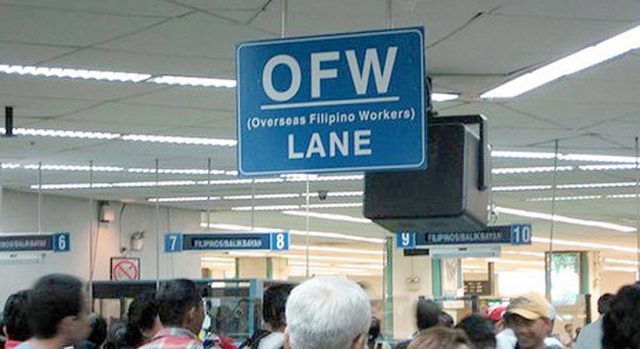
New department for migrant workers targeted for full operations by 2023 

THE DEPARTMENT of Labor and Employment (DoLE) and the Department of Migrant Workers (DMW) on Thursday signed a joint circular to ensure a smooth and speedy transition of several agencies to the latter, which is targeted to be fully operational by next year.   

The six labor agencies that will be absorbed by the newly-established DMW include the Philippine Overseas Employment Administration, Philippine Overseas Labor Offices, International Labor Affairs Bureau, National Reintegration Center for Overseas Filipino Workers, Overseas Workers Welfare Administration, and the National Maritime Polytechnic. 

DMW Secretary Susan V. Ople will exercise “primary administrative control” over these agencies, according to a copy of the joint circular sent to reporters.  

In the signing ceremony streamed live on DoLE’s Facebook page, Labor Secretary Bienvenido E. Laguesma said both departments aim to expedite the transition process to ensure the continuation of the attached agencies’ projects.  

“By focusing on our mandate, DoLE will be rendering faster and quality service to our workers in the country,Mr. Laguesma said.  

“In the same manner, DMW will be working exclusively for our overseas Filipino workers (OFWs), meaning their time and effort would center on the Filipino migrant workers which is an efficient way of serving our modern-day heroes,he added.  

Ms. Ople, for her part, acknowledged the cooperation and support of the Labor department.    

“The DMW is the youngest child in the Cabinet, we are very appreciative of all the help, guidance, and support Secretary Laguesma has been giving us,” she said. “I am sure he will continue to help us until such time that we can stand on our own.”  

In December last year, former President Rodrigo R. Duterte signed the law establishing the DMW with a goal of streamlining procedures that will address OFW concerns. 

There were 1.77 million land- and sea-based OFWs as of 2020, according to the latest available data from the Philippine Statistics Authority.  

This is lower than the 2.18 million reported in 2019, due mainly to the impact of the global coronavirus pandemic.   

Under the law, the transition of DoLE’s attached agencies dealing with OFWs to the DMW should be completed within a maximum of two years.  

Ms. Ople earlier said that the agency is still waiting for the Department of Budget and Management to approve the DMWs proposed staffing pattern to create new positions within the agency.  

She also said that the agency will have four undersecretaries focusing on finance, foreign employment, welfare, and international cooperation. John Victor D. Ordoñez 

New Bangsamoro wage rates take effect July 21 

@BANGSAMOROGOVT

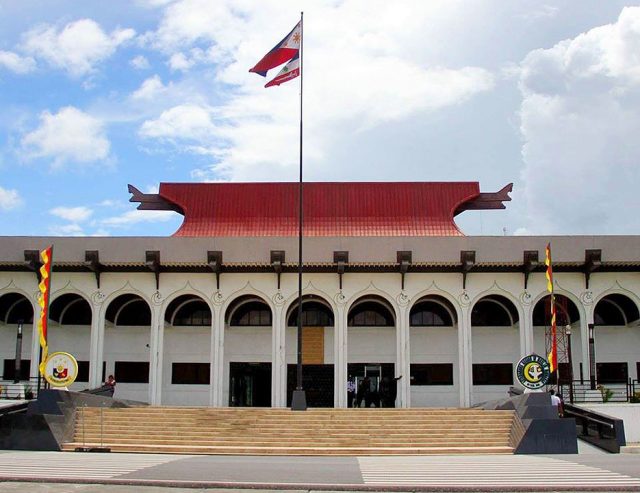
THE NEW minimum wage rates in the Bangsamoro region in southern Philippines will take effect on July 21, according to the National Wages and Productivity Commission (NWPC).  

The Bangsamoro Tripartite Wages and Productivity Board granted on May 31 a P16 increase in daily minimum wage in all sectors within the Bangsamoro Autonomous Region in Muslim Mindanao (BARMM).  

The wage order had complied with the required publication in at least one newspaper of general circulation in the region, the NWPC said.  

With the increase, the provinces of Maguindanao, Lanao Del Sur, Basilan, Sulu, Tawi-Tawi and the cities of Marawi and Lamitan will have a daily minimum pay rate of P316 for non-agricultural workers and P306 for workers in the agriculture sector. 

In Cotabato City and the 43 barangays in North Cotabato that are clustered as Special Geographic Area (SGA), the pay hike would bring the new daily minimum rate to P341 for the non-agriculture sector and P316 for the agriculture sector.  

Under the new wage order, any employer that refuses or fails to comply with the pay adjustments may be subjected to penalties under the wage rationalization act, which imposes a fine of P25,000 and up to four years imprisonment.  

In 2019, BARMM issued its first wage order which set a minimum daily wage of P300 for the non-agriculture sector, and P290 for agriculture. 

The Bangsamoro Organic Law provides that “Labor, employment, and occupation” is listed among the “exclusive powers,” or where the BARM government is free to exercise exclusive authority and jurisdiction. — John Victor D. Ordoñez 

Biggest state hospital in Mindanao raises alert on influx of emergency cases 

BW FILE PHOTO

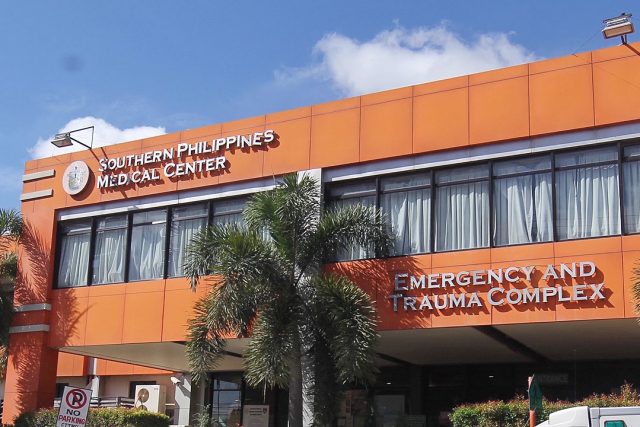
THE SOUTHERN Philippines Medical Center (SPMC), the biggest government-run hospital in Mindanao, issued an alert Wednesday evening on restricted admission at its emergency department due to a sudden increase in cases.  

We are experiencing an influx of patients in our Emergency Department,the hospital located in Davao City said in a post on its official Facebook page.   

As such, we will only be able to accept severe and critical cases as of this time.”  

SPMC did not say that the rush of emergency cases was due to coronavirus infections.   

As of July 12, the latest available data from the hospital, it had 91 active coronavirus disease 2019 (COVID-19) cases. Its intensive care unit beds allocated to COVID-19 cases were at 37.29% occupancy rate with 22 of 59 in use, while ward beds were at 51.74% with 104 of 201 occupied.   

SPMC serves as the primary COVID-19 referral hospital for Davao City, which had 213 active cases as of June 13 data from the Department of Healths tracker site.  

Last week, Davao City COVID task force spokesperson Michelle B. Schlosser flagged the 30 new cases recorded on Wednesday, the highest daily log since March. The city had a total of 142 active cases as of July 6.   

SPMC, a 1,500-bed hospital that caters to a wide area and provides specialized services, has asked partner medical institutions to strictly use the referral system to avoid further congestion.  

For our healthcare partners, please adhere to coordinated transfers by getting in touch with our National Patient Navigation and Referral Center,it said.   

SPMC has centers for cancer, burn, heart, and lung conditions, among others, which may not be available elsewhere in Mindanao.   

It also operates a teleconsultation service from 7 a.m. to 3 p.m. on weekdays. MSJ 

Disaster management treaties database launched to strengthen Philippines’ international partnerships  

DFA.GOV.PH
DFA.GOV.PH

THE DEPARTMENT of Foreign Affairs on Thursday launched a database of foreign agreements and treaties on disaster management that the Philippines is party to, a tool that is intended to help strengthen linkages towards resilience amid the global climate crisis.     

The digital listing of disaster risk reduction and management (DRRM) accords includes multilateral instruments such as the Paris Agreement on climate change as well as bilateral treaties with countries like Vietnam, Norway, and Thailand, the department said in a statement.   

The Database aims to provide a consolidated reference for generating periodic reports on its compliance with various DRRM agreements and treaties, in order to help strengthen partnerships and coordination among all key actors and stakeholders in disaster risk reduction and management,it said.    

The launch was held in line with the countrys observance of National Disaster Resilience Month in July every year. The tool is part of the Philippines’ National Disaster Risk Reduction and Management Plan 2020-2030. 

The Philippines, located within the Pacific typhoon belt, gets an average of 20 storms of different intensities annually. It is also within the Pacific ring of fire, which makes it vulnerable to earthquakes and volcanic eruptions. Alyssa Nicole O. Tan 

Unity in conformity

Congressman Arnolfo Teves, Jr. of Negros Oriental has filed a bill renaming the Ninoy Aquino International Airport (NAIA). Other individuals have been proposing the same thing. But the difference is that his bill, if made into law, would rename the NAIA the Ferdinand E. Marcos, Sr. International Airport (FEMIA).

Other proponents of name change have limited themselves to suggesting that the former Manila International Airport (MIA) be given its old name. But one doesn’t need a PhD degree to discern the motives behind their stated reasons, which have included the supposed need to familiarize international travelers with the name of the Philippine capital.

The explanatory portion of Teves Jr.’s bill claims that “this project was done during the time of the presidency (sic) of Ferdinand Marcos, Sr.,” hence, “it is more appropriate to rename it to (sic) the person who has (sic) contributed to the idea and execution of the said noble project.”

But as some journalists and news media organizations were quick to point out, that was not exactly true. Construction of the former MIA began in the late 1940s, and it was completed in 1961 — four years before Marcos Sr. assumed the country’s highest elective office in 1965.

What is true is that former Senator Benigno “Ninoy” Aquino, Jr. was assassinated there by the thugs of the dictatorship when, despite the possibility of being arrested or killed, he returned to the Philippines from the United States on Aug. 21, 1983. The MIA was renamed after him by an act of the restored Philippine Congress in 1987, a year after the civilian-military “People Power” mutiny at Quezon City’s Epifanio de los Santos Avenue (EDSA) overthrew the Marcos regime.

Aquino’s killers and some of their immediate superiors in the military were eventually identified, tried, and imprisoned. But who the mastermind behind the assassination was has never been established. There are lingering doubts on whether it was Marcos Sr., since he was far too astute not to have anticipated the public outrage over, and “Ninoy” Aquino’s being made a martyr of, his murder, as well as its international repercussions. Unlike some of his successors, with whom he has been wrongly compared, Marcos Sr. was intelligent enough to calibrate his responses to whatever problems he faced. There were even rumors then that he was furious when he learned of Aquino’s assassination. Who ordered the killing is still among those unsolved mysteries in the Philippine culture of impunity.

Nevertheless, it does seem too much for Teves Jr. to propose that the NAIA be named after Marcos Sr. Because of the political context at the time of the Aquino murder, many suspected that his minions were responsible for it — a suspicion that was eventually confirmed by the conviction in court of the military people involved. Even if he did not mastermind it, Marcos Sr. was at least partly at fault because he was unable to prevent it despite his vast powers.

But it is far from the facts that are driving the name-changing game. Although they are not saying it, Teves Jr. and his political ilk who have been campaigning to change the NAIA name want to expunge from what little remains in the collective Filipino memory any reminder not only of what the Marcos Sr. dictatorship was like, but also of how direct people’s action through the EDSA 1 “People Power” civilian-military mutiny overthrew it.

EDSA 1 was hailed in many parts of the world as a sterling example of democracy at work and encouraged similar uprisings against dictatorships. But the political dynasties in control of Philippine governance see its example and possible repetition as threats to their interests, hence their determination to consign it to the limbo of forgetfulness.

Beyond the immediate aim of feeding mass amnesia, however, the name-changing business is but another means of advancing the “unity” mantra that the current President appropriated from the older Marcos. Marcos Jr.’s “unity” theme during his campaign and after echoes his father’s own “Isang Bansa, Isang Diwa” (One Nation, One Mind) emphasis during martial law. Implicit in both is a concept of “unity” based on conformity and compliance with — as limited and as simplistic as those may be — the thoughts, values, and ideas of the political class, its clones, surrogates, and its instrumentalities such as the police and military.

Marcos Jr.’s non-engagement with his rivals for the Presidency during the campaign was publicized as part of his commitment to national “unity.” It was vague enough to be interpreted by many sectors as a reflection of their own aspirations for a better society. But it was actually based on the assumption that those views different from his own are of no value — they divide rather than unite — and are therefore unworthy of being acknowledged, much less discussed. Equally invalid from the perspective of that concept is what really happened in history, such as the Aquino assassination at the then MIA. What matters is the dynasts’ version of the past, no matter what the facts may say.

Authentic unity is based on a diversity of views, out of the clash of which can emerge a common understanding of the nation’s aspirations and how to achieve them. It is precisely to encourage the diversity of outlooks, interpretation, opinion, and politics that can lead to the crafting of an inclusive national agenda that the Constitution protects free speech, free expression, and press freedom.

But that is unacceptable to the Philippine power elite, the main focus of which has always been to acquire power and keep it whatever the cost. The same contempt for diversity is evident in police, military, and bureaucratic intolerance with, and their demonization of, those who hold opinions different from, or contrary to, their bosses’ own. Hence the forcible suppression of free expression and press freedom in furtherance of purging from the collective consciousness any and all awareness of what is going on and what has gone before.

Rewriting history is a means to that end. Only seemingly unprecedented is the extent to which the heralds of conformity have disparaged even the country’s historians and other social scientists. It has happened before, in the 1950s, when academics and scholars were persecuted for holding views different from those of government functionaries in a campaign to force them to add their voices to those of the mob.

In his 1951 novel The Conformist, the Italian novelist Alberto Moravia described how fascist rule in his country was based on its leading disciples’ and adherents’ compulsion to be part of an unthinking herd — and on their coercing everyone else to be the same in their politics, their social lives, and even their persons.

The justification for it was the supposed need for the “unity” those with authoritarian proclivities claim is needed for a society to achieve its aspirations — which they presume without defining what it means are for “greatness.” The same appeal to ultra-nationalist sentiments was, and is, not incidentally also part of both Marcos regimes (“This Nation Can Be Great Again”) as it also was of such other authoritarian populists as the United States’ Donald “Make America Great Again” Trump, Brazil’s Jair Bolsonaro — and much earlier, Germany’s Adolf Hitler and Italy’s Benito Mussolini.

A replication of mindless conformity and blind obedience is in process in the Philippines, where the power elite and its minions regard dissent and the diversity of views necessary in a democracy as a vice rather than virtue. Instead of unity in diversity, what the oligarchy wants is unity in conformity.


Luis V. Teodoro is on Facebook and Twitter (@luisteodoro).

www.luisteodoro.com

Nudging and public policy

STARLINE-FREEPIK

Survey results are possible nudge instruments of public policy. They could restore the appropriate focus of those in authority to what the times and the seasons demand. Since surveys derive from the people themselves that the government ought to serve, they are no less like a poll on what on the ground needs priority attention of the leadership of the land.

“Nudging” to behavioral economist Richard Thaler and legal scholar Cass Sunstein, who published Nudge: Improving Decisions About Health, Wealth and Happiness in 2008, is simply any intervention in the so-called choice architecture that could alter people’s behavior in a predictable way without impinging on any options or perhaps changing their economic incentives in a different way. But Thaler and Sunstein were quick to add that such intervention should remain “easy and cheap to avoid.”

Nudging, being a soft instrument to promote public policy, has become game changing today when a certain notion of rationality breaks down as when people decide on public policy without internal consistency, uneven over time and, for some, context-specific. They could be driven by mood changes, or biases. This is when one finds difficulty reconciling public policy design and the absence of rationality.

For there is an obvious breakdown of rationality these days.

Ronald Holmes of Pulse Asia Research, in releasing its June 22, 2022 “Nationwide Survey on Urgent National Concerns and Issues to be Prioritized by the New President” on July 12, cited certain developments “that transpired in the period leading up to the survey period and during the conduct of the face-to-face interviews.” Some might come up to outside the bounds of rationality.

One, the United Vloggers and Influencers of the Philippines (UVIP) is now pursuing accreditation with the Securities and Exchange Commission to gain access to Malacañang. Whether this type of social media without the editorial safeguard of its traditional counterpart would be institutionalized in this time of uncontrolled disinformation should be a big issue from a public policy perspective. Only the private, organized fact checkers could perhaps stand a chance against any irresponsible uploads to social media.

Two, a couple of executives of Pharmally Pharmaceuticals Corp. were released on June 2 upon the signing of their release orders by the outgoing Senate President. Instead of being charged possibly with plunder, graft, and perjury along with some public officials, they were freed because the Senate Blue Ribbon Committee report was signed by only eight senators out of the required 11. How this could disabuse the people’s mind that we no longer tolerate the culture of impunity should be a puzzle to many.

Three, the National Telecommunications Commission, upon the request of the former National Security Adviser, blocked access to 27 websites of groups suspected to be allied with the Communist Party of the Philippines. We can only hope that there was due diligence before this was undertaken, that this was not red tagging, that the freedom of information was not breached. Are there no attempts to reopen peace talks with the Left for the sake of, yes, rational peace and unity?

Four, we have started to see the second-round effects of cost-push inflation: minimum wages in the National Capital Region (NCR) and 13 other regions across the country were scaled up effective June 2022; and the P1 provisional increase in the minimum fare for jeepneys in four regions including the NCR. Cab drivers also filed their petitions for a P20 increase in the flag-down rate. The Philippine Statistics Authority (PSA) report on the May inflation of 5.4% rocked the market without realizing the June inflation was to be much higher at 6.1%. The peso contributed to inflation because it has also sharply depreciated beyond P56 to a dollar. Yet, many of us continue to insist inflation is cost-push and interest rate adjustment, and much more an aggressive one, could just mess up growth.

So, what can we nudge this government to focus and act on?

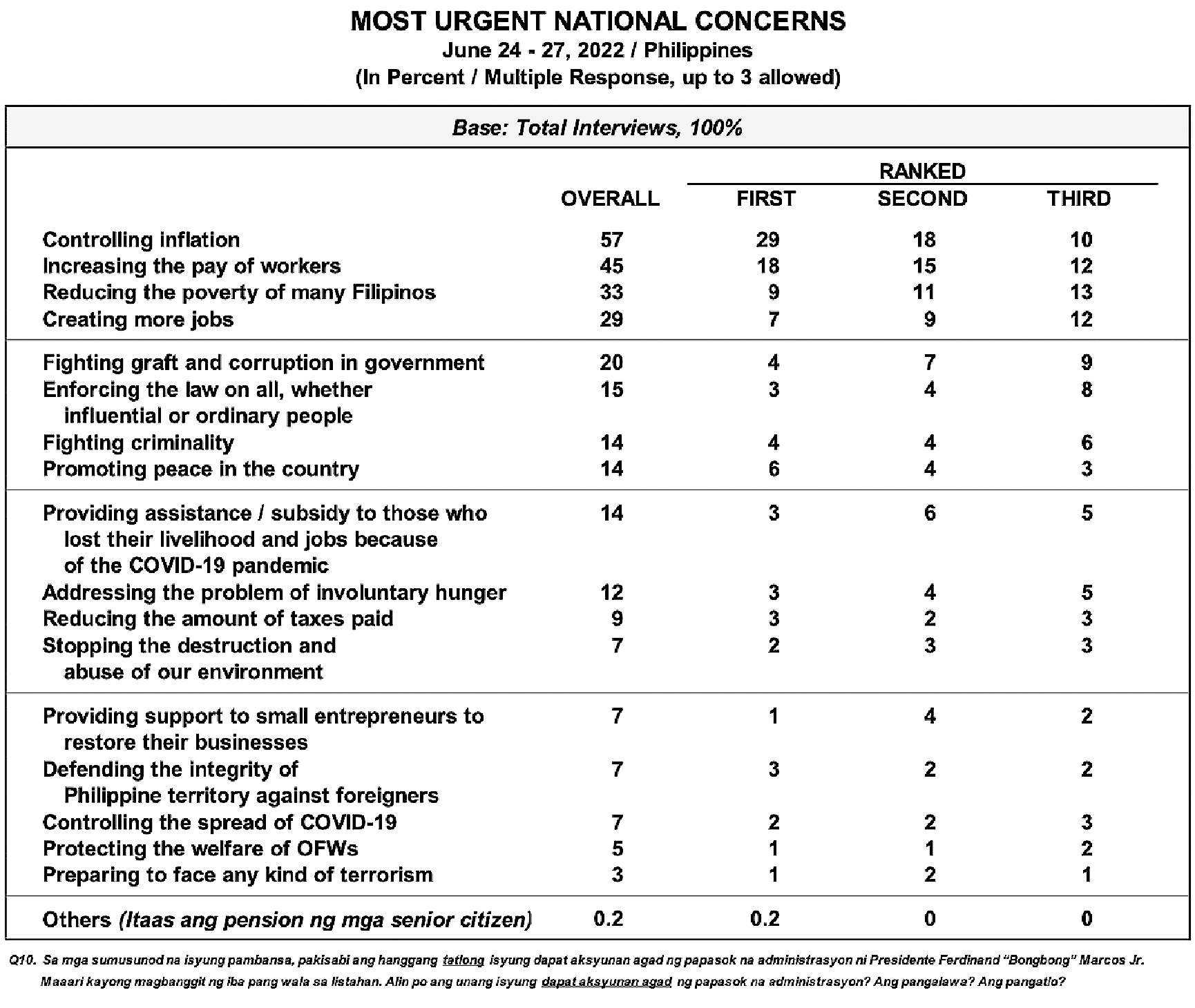
Pulse Asia’s latest face-to-face national survey, conducted between June 24 to June 27, is most revealing because the top four national concerns have hardly changed over the years.

Controlling inflation remains the major concern of the majority of those surveyed, or 57%. Averaging 4.4% for the first half of 2022 with the June’s 6.1% in the Philippines, inflation is today’s scourge in the global economy. No less than the IMF’s Managing Director Kristalina Georgieva (“Facing a Darkening Economic Outlook: How the G-20 Can Respond,” July 13, 2022) rallied member countries to “do everything in their power to bring down high inflation.” She hit the right notes when she clarified that “persistently high inflation could sink the recovery and further damage living standards, particularly for the vulnerable.”

As we wrote this column yesterday, the Bangko Sentral ng Pilipinas (BSP) decided to adjust its policy rate by 75 basis points, from 2.5% to 3.25%. Its decisive forward guidance was exceeded by its appropriately aggressive monetary move ahead of the Aug. 18 meeting. Let this nudge come gently but let it continue to fortify its resolve. There are too many irrational white noises out there, and the battle is yet to be won.

Nudging is hardly necessary when it comes to BSP communication. They are doing a splendid job at this. It is crucial because policy credibility should be preserved.

The second major concern of the people is increasing workers’ pay, as indicated by 45% of those polled. If inflation is eating their income away, the next best thing is to adjust their pay up. Many workers’ wages have been increased starting this June. This is timely because in the last five years, while nominal daily wages for non-agricultural workers have risen, their real wages have actually declined because of inflation. The level dropped from P529.50 to only P486.85. Wage adjustment is also necessary because wages and salaries remain to be the primary source of total family income, as shown by the first semester 2021 Family Income and Expenditure Survey (FIES) of the PSA.

Third is another perennial major concern, that of reducing poverty in the Philippines. One way to look at it is to check the PSA’s survey of the proportion of poor Filipinos whose per capita income is not sufficient to meet their basic food and non-food needs. Between the first half of both 2018 and 2021, the proportion rose from 21.1% to 23.7%, or some 26.14 million Filipinos. The very poor, those who could not even earn enough for their most basic needs, increased from 8.5% to 9.9%, or nearly 11 million people. While the computed Gini Concentration Ratios between 2018 and 2021 show that there was some leveling off in inequality, this was rather too little.

The fourth major concern is creating more jobs. This is the only way by which millions of fixed-income earners could participate in the development process. The two-year pandemic decimated jobs and business activities with its infamous lockdowns. We continue to see the economic scars, especially in the labor market. Between May 2021 and May 2022, the unemployment rate dropped from 7.7% to 6%. However, underemployment actually worsened from 12.3% to 14.5%. More Filipinos would like more hours of work, or additional jobs on the side. The nudge is for the new government to attain more sustainable, self-sustaining, and inclusive growth that would create more quality jobs.

It is easy to see that gut issues on prices, wages, poverty, and jobs weighed more heavily than governance issues like fighting graft and corruption, rule of law, and peace; climate issues like abuse of the environment; and even health issues like control of the pandemic spread. It’s plain and simple gut issues that are at the core of people’s daily struggle. Rule of law and peace, good governance, and even territorial integrity are to be sure equally important but it’s a matter of priority that the survey respondents had to establish their own pecking order.

For the policymakers, a little nudging is strategic because of one bias called salience effect. They would likely notice and focus on the more obvious, the more salient. If Pulse Asia’s survey results make these gut issues more salient, and they are considered important by a lot of people, perhaps we should do this more often so that the right salient issues always get to the top.

The government owes it to the people.


Diwa C. Guinigundo is the former deputy governor for the Monetary and Economics Sector, the Bangko Sentral ng Pilipinas (BSP). He served the BSP for 41 years. In 2001-2003, he was alternate executive director at the International Monetary Fund in Washington, DC. He is the senior pastor of the Fullness of Christ International Ministries in Mandaluyong.

Carmen Guerrero Nakpil 100

The eminent historian, journalist, technocrat and diplomat, Carmen Guerrero Nakpil, was in a class of her own. Her elegant prose was impeccable, charming, witty, wry and incisive. The 100th anniversary of her birthday is July 19, 2022.

In her honor, here are some insightful quotes that describe the iconic writer who passed away on July 30, 2018.

I start with her own words. Mrs. Nakpil wrote in her autobiographical trilogy Myself, Elsewhere; Legends & Adventures; and Exeunt:

“Without being aware of it, I must have acquired the certain knowledge of what everyone has been calling a ‘sense of identity.’ I have always known who and what I am and have been free from the qualms and confusions others have had to wrestle with. What a valuable gift from the instinctive pedagogy of my elders.” — Myself, Elsewhere

“A new life is riskier than the old one, as any tatterdemalion survivor will tell you… The steely old rules of Ermita are gone … and the only etiquette is Dog eat Dog.” — Legends & Adventures

“We Filipinos draw our endless patience, our good nature and our trust in God’s master plan from a simple unshakeable faith. I surprise myself by quoting to a distraught, son, daughter or friend, Teresa of Avila’s comforting lines which I learned when I was nine, ‘Nada te turbe, Nada te espante.’ Let nothing disturb or frighten you. Everything passes. God never changes. Solo Dios basta. God alone suffices.” — Exeunt

“No longer restless or fractured, rid at last of all strange gods, this very old heart withdraws into peace.

“In the very end, after all is said and done, we need only God. Everything else is vanity of Vanities. All is Vanity.” — Exeunt

Here are the words of others:

“When she was coping with old age, I was by her side. Mommy became very demanding. Her threshold for pain was no longer high so she was uncomfortable most of the time. I had to coax her to eat, to drink water often. She complained that she no longer had anyone to talk to because all her close friends had gone before her. We prayed the rosary together, recited the Ultimo Adios which always made her cry. She reverted to talking in Spanish, sometimes she would look at me and call me Mama. Indeed, we had changed places without being aware of it.” — Gemma Guerrero Cruz Araneta

“Lifelong lessons we learned from Mom are: First and foremost is love of country. And the rest are: Integrity. Industry. Impeccable manners and dressing tastefully.” — Ismael “Toto” Guerrero Cruz

“When I was little, I was convinced my Mom was Lucile Ball. I would watch TV in the afternoon and was enthralled by the antics of the I Love Lucy comedy series. Just as each episode would end, Mom would show up, back from one of her outings. So, I assumed that Lucy had ended her show and decided to come home to me.

“Much later, when I confided to my siblings that it had been my long-held conviction that Lucy and Mom were one and the same person, they took it as early proof of my eccentricity. I have since often wondered where I got that misimpression and I am guessing that, even as a little boy, I had focused on one of my Mom’s most essential traits: her sense of humor and wit. No, my Mom was not anything like a red-headed American, TV sitcom star but she was truly funny, witty and endlessly entertaining.” — Luis “Luijo” Guerrero Nakpil

“I don’t know whether it came from jumping in and out of foxholes in World War II — during the Battle of Manila — but Mom was of an impatient, impulsive character. No slow-burn for her, no carefully laid-out plans; she often had no time for the big and the little in life. She would get dressed for a fancy-schmalzy ball in 30 minutes; and dash off her daily column in about the same time.

“One had the sensation that she was always in perpetual motion, hurtling through space as it were. Thinking about it now, I can only explain the phenomenon as an excess of talent that made everything she did, no matter how difficult, look easy.” — Lisa Guerrero Nakpil

“Carmen Guerrero Nakpil is a most intelligent Filipino writer. Her mastery of the English language is incomparable. Her sense of history is as great as her knowledge of our country’s past.” —Virgilio S. Almario, National Artist for Literature

“Not for her untrammeled, whimsical, headlong spirit, the qualifiers of Ph.D. dissertations: the ‘yes buts.’ The ‘on the other hands,’ the interminable appendices, the ponderous weighing of ‘facile conjectures against available evidence.’ Against the turbulence of such heavy weather, Mrs. Nakpil gaily bounces her gleaming, miraculously maneuverable monoplane. She is a storyteller, which most historians aren’t. And so she makes history come alive when all most textbooks can do is bury it with honors.” — Fr. Horacio de la Costa S.J. wrote in the preface of her book History Today, a compilation of her newspaper columns on history.

“Tita Chitang — a force of nature with her cutting wit.” — Katrina Legarda

“Carmen Guerrero Nakpil was the greatest National Artist we never had.” — Deanna Ongpin Recto, former UNESCO representative

“Tita Chitang is special to me. She recommended me for my first job to the Associated Press, and to the middle-income condo which is my permanent residence. She was also close to my mother in spirit. They both suffered during the war. Both lost their husbands in February 1945.” — Amadis Ma. Guerrero

What they wrote about her book Myself, Elsewhere that won the National Book Award:

“Sparkling wit and ravishing language… material here for a War and Peace.” — Adrian Cristobal, Manila Bulletin

“It is the authenticity that makes her book so powerful, her authentic affection for so alien a life as to seem impossible to present day readers. This is a look back at the way people really lived, loved and even hated, with details no novelist could have invented.” — Manuel Quezon III, Philippine Daily Inquirer

On a personal note, Tita Chitang was my cultural Mom who inspired and encouraged me on my art journey and matters of the heart. She loved and cared about her family and friends. She was the epitome of regal elegance, eloquence, wit and style. The confident woman of the world who used the perfect word or turn of phrase. She made history easy to read and enjoy.

The CGN friends celebrated historical events, book launches, exhibits for many years. We were fortunate to have her until her 96th birthday. She is now a glowing star in the firmament. We all miss her. Cheers to 100!


Maria Victoria Rufino is an artist, writer and businesswoman. She is president and executive producer of Maverick Productions.

mavrufino@gmail.com

Abortion and international law

ISAAC QUESADA-UNSPLASH

An interesting issue that got minimal discussion from the US Supreme Court in the case of Dobbs vs. Jackson Women’s Health Organization is the role of international law in shaping US law particularly in relation to abortion. Which is likely the right thing to do.

The late great US Supreme Court Justice Antonin Scalia, in his dissent in Roper vs. Simmons, correctly wrote that “the court’s argument — that American law should conform to the laws of the rest of the world — ought to be rejected out of hand… To invoke alien law when it agrees with one’s own thinking, and ignore it otherwise, is not reasoned decision-making, but sophistry.”

In the US — and definitely for the Philippines — international law is a secondary source of law, in the sense that the Constitution is paramount and cannot be relied on to subvert a constitutional precept.

In any event, had international law been taken up in Dobbs, such would have been useful if only to demonstrate how absolutely abortion is not an international right, contrary to what many in the academe or media would have people believe.

AMICUS CURIAE OF INTERNATIONAL LAWYERS
This was essentially the point made in the amicus curiae brief filed by “141 International Legal Scholars” in support of the petition seeking to uphold the constitutionality of a law banning abortion [For full disclosure, the author is one of the legal scholars signing the brief, the only Filipino invited to join as legal academic]:

“… international law can be instructive on the nature of abortion and its regulation. The consensus of human rights law and State practice confirms the absence of any global right to abortion, and the recognition that unborn children are rights-holders worthy of State protection.”

TREATIES AND CUSTOM
“Under the primary sources of international law — treaties and custom — States have no duty to legalize abortion because it is not recognized as a human right. With regard to treaties, abortion advocates can point to no international treaty that contains language referencing abortion, nor any reference that can be interpreted as recognizing the right to take the life of an unborn child. No such instrument exists.

“Nor has any so-called right to abortion been established through customary international law, as United Nations (UN) officials have acknowledged. To the contrary, most States prohibit or restrict abortion, reflecting a standard of practice at odds with any claim of a customary right to abortion. Recent evidence of State practice rejecting a global abortion right can be seen in the 2020 Geneva Consensus Declaration on Promoting Women’s Health and Strengthening the Family, signed by government representatives from 34 States across the globe. That declaration reaffirms that ‘there is no international right to abortion, nor any international obligation on the part of States to finance or facilitate abortion, consistent with the long-standing international consensus that each nation has the sovereign right to implement programs and activities consistent with their laws and policies.’ Such assertions make clear there has been no emergence of a right to abortion by way of custom.”

INTERNATIONAL COURTS, ORGANIZATIONS, OR CONFERENCES
“Nor has any international court ever declared the existence of a global right to abortion. To the contrary, the European Court of Human Rights rejected the concept under the European Convention on Human Rights.”

Indubitably, “some groups and advisory bodies have tried to reinterpret international law to include a right to abortion. Third-party actors, however, lack the authority to redefine international legal norms, which are created between sovereign States.”

Then there are some international instruments misused or misinterpreted to allege a “right” to abortion, the most notable of which are the Convention on the Elimination of Discrimination against Women (or CEDAW, which never even mentions the word “abortion”) and the Rome Statute (which created the International Criminal Court). Of the latter, admittedly the “treaty’s final compromise language includes the offense of ‘forced pregnancy’; however, the crime’s definition explicitly rejects any international obligation to decriminalize abortion. Specifically, the final definition states, ‘‘Forced pregnancy’ means the unlawful confinement of a woman forcibly made pregnant, with the intent of affecting the ethnic composition of any population or carrying out other grave violations of international law. This definition shall not in any way be interpreted as affecting national laws relating to pregnancy.’ Thus, it is clear this provision neither requires any State to legalize abortion nor serves as a basis for creating an international right to abortion.”

Then there is the 1994 Cairo International Conference on Population and Development (ICPD) and the 1995 Beijing Fourth World Conference on Women, which produced two documents: the ICPD Program of Action, and the Beijing Declaration and Platform for Action. But as pointed out in the brief, despite the attendance of “thousands of participants from UN agencies, governments, and intergovernmental and non-governmental organizations,” “neither of these non-binding documents can or do create a right to abortion.”

DOBBS: THE BEGINNING OF THE END FOR ABORTION
Finally, as reported in the New York Times, nine US States completely outlawed abortion (with two instituting bans but with exceptions for rape or incest), with 12 more States imposing greater restrictions on abortion. That makes 21 US States, at present, that banned, will ban, or restrict abortion.

Clearly, there is still some long way to go, for the US and for the rest of the world, before the murderous scourge that is abortion is completely eliminated.

As for the Philippines, our Constitution declares protection for the “life of the unborn from conception.” And that is a right thing we proudly uphold, with or without international law.


Jemy Gatdula is a senior fellow of the Philippine Council for Foreign Relations and a Philippine Judicial Academy law lecturer for constitutional philosophy and jurisprudence

www.facebook.com/jigatdula/

Twitter @jemygatdula

Fresh COVID wave sweeps Asia, NZ warns of pressure on hospitals

REUTERS

WELLINGTON/TOKYO — A new wave of coronavirus infections is rapidly spreading through Asia, prompting warnings for residents from New Zealand to Japan to take precautions to slow the outbreak and help prevent healthcare systems from being overwhelmed.

The renewed surge in cases, mostly of the BA.4/5 Omicron variants, provides a further challenge for authorities grappling with the economic fallout of earlier waves of the pandemic while trying to avoid extending or reintroducing unpopular restrictions.

The New Zealand (NZ) government on Thursday announced free masks and rapid antigen tests as it tries to relieve pressure on the country’s health system, which is dealing with an influx of both COVID and influenza patients during the southern hemisphere winter.

“There’s no question the combination of a spike in COVID-19 cases and hospitalizations, the worst flu season in recent memory and corresponding staff absences are putting health workers and the whole health system under extreme pressure,” Ayesha Verrall, Minister for COVID-19 Response, said in a statement.

New Zealand, which has a population of 5.1 million, has almost 69,000 currently infected with the virus. Of those, 765 cases are in hospital, which has caused increases in wait times and surgeries to be canceled.

In Japan, new COVID-19 cases have surged to levels not seen since early this year. The government has called on people to be especially careful ahead of an upcoming long weekend and imminent summer school vacations.

Japan reported almost 95,000 cases on Wednesday and newly infected patients have increased by 2.14-fold compared to the last week, according to a government spokesperson.

“The number of new cases is rising in every prefecture in Japan, and it seems to be rapidly spreading,” Health Minister Shigeyuki Goto said at the start of a committee meeting on dealing with the coronavirus.

Tokyo raised its alert level to the highest tier. “Tomorrow, we will hold a meeting of the task force to decide on measures to be taken this summer, taking into consideration the national trend and the opinions of experts,” Tokyo Governor Yuriko Koike said at a meeting.

Like New Zealand, South Korea was praised for its response early in the pandemic, but by Wednesday, daily cases there had tripled in a week to more than 39,000.

Officials and experts expect South Korea’s new daily cases to reach 200,000 by around mid-August to end-September and are expanding inoculations of booster shots but not planning renewed curbs.

Australia warned it could be hit with its worst COVID-19 outbreak over the next few weeks fueled by the BA.4/5 Omicron variants. Authorities said “millions” of new infections could be expected, but ruled out any tough restrictions to contain the spread.

“We’ve moved beyond that … we’re not in the era of lockdowns and those sorts of things,” Federal Health Minister Mark Butler told radio station 2GB on Thursday, even as he urged Australians to consider working from home again.

Australian hospital admissions are already hovering near levels seen in the last major Omicron outbreak earlier this year with its health system also under pressure from high COVID and influenza numbers.

While cases in Thailand have trended down, infections in Indonesia have picked up, reaching the highest since March.

New infections and hospitalizations in the Philippines remain low, but the government has warned case numbers could rise at least 20-fold by the end of the month.

Manila is urging more people to get their booster shots as health ministry data shows only a quarter of eligible adults have received their first booster as of July 12.

Mainland China has reported an average of over 300 locally transmitted COVID daily infections in July, higher than around 70 in June, as Beijing’s strict “dynamic COVID-zero” policy helps keep local clusters in check and has prevented any overwhelming of hospitals. — Reuters

China’s tough COVID policy still drags on economy

REUTERS

BEIJING — China has been tweaking its stringent COVID curbs but shows no sign of backing off from its “dynamic zero” policy, and has lagged in vaccination efforts that would enable it to do so, casting a heavy shadow over the world’s second-largest economy.

The absence of a roadmap out of zero-COVID and expectations that it will persist well into 2023 leaves residents and businesses facing a prolonged period of uncertainty.

Recent scattered COVID flare-ups, the imposition of lockdowns in some cities and the arrival of the highly-contagious BA.5 variant have added to those worries.

On Friday, China is expected to report that gross domestic product (GDP) grew just 1% in the second quarter, with full year growth forecast at 4%, according to a Reuters poll — far short of Beijing’s official target of around 5.5% for 2022.

In addition to a sharp lockdown-induced slowdown, growth has been weighed down by a sputtering property market and an uncertain global outlook.

This week, Shanghai’s 25 million people were subject to more mandatory city-wide testing, and fear of tougher measures or getting caught up in China’s zero-COVID bureaucracy continues to exact an economic toll, including on consumption and jobs.

Nomura estimated 31 cities were implementing full or partial lockdowns as of July 11, affecting nearly 250 million people in regions accounting for a quarter of China’s GDP.

As the rest of the world tries to coexist with COVID, China points to the lives saved by its tough measures. President Xi Jinping has touted it as an advantage of China’s governance system.

Critics say China is hamstrung by the success of an approach that is obsolete now that vaccines have made COVID far less deadly.

China’s self-isolation also has long-term economic implications.

“The rest of the world is reopening and the zero covid policy in China will probably drive export orders and production to other countries during the supply-chain normalization,” Ken Cheung, chief Asian FX strategist at Mizuho, wrote on Wednesday.

Businesses have described how they have been badly hurt and find it hard to plan given the possibility of abrupt lockdowns, while international business groups have been especially vocal about the costs of zero-COVID, with members warning of plans to invest elsewhere.

“The world is not going to wait for China to improve her herd immunity,” said Joerg Wuttke, president of the EU Chamber of Commerce.

While China has been spared the ravages of widespread infections and deaths, it therefore lacks herd immunity, with its vast elderly population especially exposed.

However, China has refrained from aggressive vaccination efforts. Last week, the city of Beijing quickly reversed a planned vaccine mandate for entry to crowded places after strong online backlash. nL4N2YP19D

China also has not approved the import of more effective vaccines using mRNA technology or fully developed its own.

“The curbs can only be lifted after the country has finished vaccinating the elderly. This might not be before fall 2023,” said Wuttke, who has suggested to Premier Li Keqiang that China set up vaccination tents next to its now-ubiquitous testing kiosks.

China has vaccinated nearly 90% of its 1.41 billion population and given around 56% of its population a booster shot. Still, 30 million Chinese elderly are unvaccinated.

Zhang Zuofeng, a UCLA professor of epidemiology, said a lack of data on the safety of China’s vaccines or their effectiveness against Omicron has undermined government and public confidence in them.

“Had China had confidence in its vaccines, with high vaccination rates among Chinese people, it would have already moved from focusing on eliminating COVID infections to mitigation of serious illnesses and deaths,” he said.

SOFTENING EDGES
To be sure, China has become increasingly surgical in managing COVID, and few expect a repeat of Shanghai’s two-month lockdown nightmare.

It is trying to soften the edges of a zero-COVID approach that is grating on a population frustrated by the sluggish economy — youth unemployment is at a record 18.4% — and the third year of pandemic, with no end in sight.

Beijing has warned local officials against needlessly arbitrary enforcement. More refined measures also decrease the likelihood of massive global supply chain disruptions like those caused by lockdowns in April and May, economists say.

Among other recent moves, China slashed centralized quarantine times for inbound travellers to seven days. Domestically, it has reduced scrutiny of recent travel history.

This week, China said local governments no longer need to test some imported goods for the coronavirus, and while chilled and frozen foods will continue to be tested, exporters will not face import suspensions if their goods test positive.

It is a tricky balance for Mr. Xi, poised to secure a precedent-breaking third leadership term later this year, who wants to avoid both a sharp rise in COVID cases and deaths and an abrupt economic downtown. Either would threaten social stability.

Last month in Wuhan, where COVID-19 first emerged, Mr. Xi said the zero-COVID policy is “correct and effective,” and that temporary economic impact is preferable to loss of life.

“Xi said it very clearly… he wants to achieve final victory against COVID,” said Chen Daoyin, former associate professor at Shanghai University of Political Science and Law.

“It’s not a matter of before or after the 20th Party Congress. Any change to the zero-COVID policy, which would not be made easily, will have to depend on how the BA.5 situation pans out,” he said. — Reuters

High energy costs could make it more difficult to cut emissions, emerging nations warn

UNSPLASH/BRENDAN O'DONNELL

NUSA DUA, Indonesia — Indonesia and India on Thursday underscored a call by emerging nations for more climate change financing, warning that rising energy prices due to the Ukraine war would make it difficult for countries to cut emissions.

With inflation rising globally amid the Russia-Ukraine conflict, some countries, including in Europe, have reverted to coal and other fossil fuel-based power or delayed their energy transition out of concerns over affordability and supplies.

India’s Finance Minister Nirmala Sitharaman and her Indonesian counterpart, Sri Mulyani Indrawati, said at a Group of 20 (G20) event in Bali that emerging markets’ energy transition should not come at high costs to the public.

They both noted current high energy prices and Sri Mulyani said rising interest rates would also make it more expensive for emerging countries to raise funds for climate action.

“If we cannot pay and you cannot also help, then this is not going to be delivered,” she said, referring to Indonesia’s plans to build renewable power sources and to phase out coal power plants.

Indonesia and India, among the world’s largest coal producers and users, have committed to reaching net-zero emissions by 2060 and 2070 respectively.

Rich nations have pledged to provide $100 billion per year from 2020 to help poorer countries tackle climate change, but have so far failed to meet the promised amount. The Group of Seven (G7) economies last month said they will be paying the full amount every year by 2023.

A US official said the private sector will have to augment government funds to meet the massive global need, noting that some $250 billion in assets were now available in private environmental, social and governance funds.

Andy Baukol, acting undersecretary of the U.S. Treasury for international affairs, said his country had launched an inaugural $8.5 billion energy transition partnership with South Africa, and that further partnerships were now being set up by the G7 with India, Vietnam, Indonesia and Senegal.

“All of these partnerships are relatively new … We think they have a lot of promise,” he said.— Reuters

R&A blasts LIV Series as disruptive money driven enterprise

ST. ANDREWS, Scotland — Royal & Ancient (R&A) CEO Martin Slumbers blasted the rebel LIV Golf Series as a disruptive money driven enterprise not in the best interest of the sport on Wednesday, prompting the governing body to examine how players qualify for future Opens.

With The Open’s 150th anniversary party in full swing, Slumbers interrupted the celebrations to deliver a blistering rebuke of the Saudi-backed venture that is threatening to tear apart the sport.

Bank-rolled to the tune of $250 million by Saudi Arabia’s Public Investment Fund (PIF) the LIV Series with its 54-hole format, no cuts and a team element bolted on, has branded itself the exciting new era in golf.

But Slumbers viewed such boasts as a sham and damaging to a golf ecosystem that, “has successfully provided stable pathways for golfers to enter the sport and develop and realize their full potential.”

“Professional golfers are entitled to choose where they want to play and to accept the prize money that’s offered to them,” Slumbers told reporters. “I have absolutely no issue with that at all.

“But there is no such thing as a free lunch.

“I believe the model we’ve seen at Centurion and Pumpkin Ridge is not in the best long-term interests of the sport as a whole and is entirely driven by money.

“We believe it undermines the merit-based culture and the spirit of open competition that makes golf so special.

“I would also like to say that in my opinion, the continued commentary that this is about growing the game is just not credible.”

With limited 48 player fields many of the prominent names like major winners Phil Mickelson, Dustin Johnson, Bryson DeChambeau and Brooks Koepka have been lured to the LIV Series by super-sized prize money and massive appearance contracts.

Mickelson, it has been reported, was paid $200 million to sign on while winners of the opening two events at the Centurion and Pumpkin Ridge pocketed $4 million.

Tiger Woods also questioned LIV’s credibility comparing it on Tuesday to the senior Champions Tour.

“What these players are doing for guaranteed money, what is the incentive to practise?,” questioned Woods. “What is the incentive to go out there and earn it in the dirt?”

The US and European based PGA and DP Tours have responded to the LIV insurgence by banning any player jumping to the Series but the majors have so far allowed anyone who has qualified to continue to compete in golf’s most prestigious events.

Slumbers said the R&A has no immediate plans to ban any player but made it clear they will be reviewing their qualifying criteria without revealing what those might be.

“Looking ahead to The Open next year, we have been asked quite frequently about banning players,” said Slumbers. “Let me be very clear. That’s not on our agenda.

“But what is on our agenda is that we will review our exemptions and qualifications criteria for The Open.

“And whilst we do that every year, we absolutely reserve the right to make changes as our Open Championships Committee deems appropriate.

“Players have to earn their place in The Open, and that is fundamental to its ethos and its unique global appeal.” — Reuters