Home Blog Page 6112

Solaire tops off second property

SOLAIRE Resort & Casino has topped off its second property located in Vertis North, Quezon City which will cater to the luxury integrated resort’s market in the northern and eastern parts of Metro Manila.

Solaire Resort North had its topping-off event on July 25, making it the latest addition to the Solaire brand of Bloomberry Resorts Corp.

“Solaire Resort North is Quezon City’s first 5-star destination built to promote the city’s tourism sector and local economy,” the company said in a press release on Wednesday.

Bloomberry’s flagship property, Solaire Resort & Casino, is in the government-sponsored economic development zone known as Entertainment City in Parañaque City.

The second property is expected to offer a hotel, gaming, restaurants and bars, meeting facilities, and retail spaces like the pioneer development.

The project is in partnership with DMCI Holdings, Inc., Prime Metro BMD Corp., Arcadis Philippines, Inc., Habitus Design Group, Sy2 and Associates, Inc., Casas and Architects, Inc., and Forsspac (MBR) Corp.

Bloomberry develops destination resorts featuring premium accommodations, gaming and entertainment, and world-class restaurants and other amenities. Its subsidiaries own and operate the Solaire Resort & Casino in the Philippines and Jeju Sun Hotel & Casino in Korea.

Solaire Resort & Casino is a $1.2-billion integrated destination resort on an 8.3-hectare site in Manila and the first to open in Entertainment City.

It currently operates two distinctive towers, the Bay Tower and the Sky Tower with 800 rooms, suites, and bayside villas and a two-level gaming space spanning 30,200 square meters in Entertainment City that accommodates 200 electronic table games.

On the stock market on Wednesday, Bloomberry shares ended lower by 12 centavos or 2.01% to P5.84 apiece. — Justine Irish D. Tabile
Dining In/Out (07/28/22)

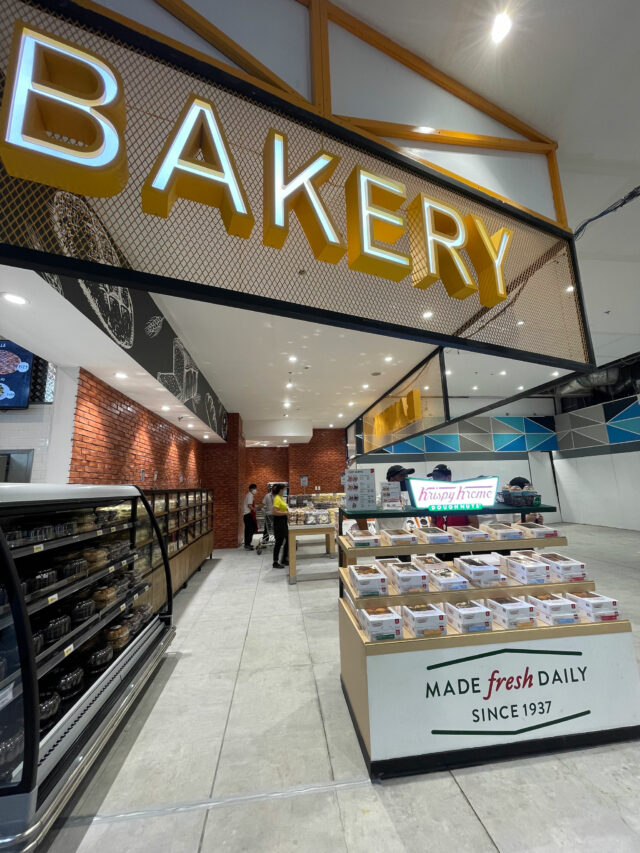
Krispy Kreme turns 85

TO MAKE the celebration of Krispy Kreme’s 85 years special, they’ve made shopping for doughnuts easier through Delivered Fresh Daily. Shoppers can now get pre-assorted boxes of doughnuts while shopping for grocery essentials inside 27 supermarkets and grocery stores. Also offered is a special Box of Six window packaging. Prices are the same as in Krispy Kreme stores. Delivered Fresh Daily (DFD) is a key global Krispy Kreme initiative, offered to select retailers, providing the market more convenience and accessibility to their doughnuts through supermarkets. While the first DFD shop in the Philippines opened at Shopwise Antipolo last December, it has now expanded to 27 doors in various Shopwise, Robinsons Place, Robinsons Supermarket and The Marketplace groceries.  DFD can be found at Shopwise Antipolo, Makati, and Circuit; The Marketplace Makati, Powerplant Mall, Greenbelt, Shangri-La, Tomas Morato, San Antonio, Katipunan, Santolan, and Baguio; Robinsons Supermarket Ermita, Lipa, Townville Nuvali, Meycauyan, Galleria South, Townville Regalado Fairview, Metro Town Tarlac, Angeles, Nepo Dagupan, Nepo Mall Angeles; Robinsons Place Dasma, Malolos, Antipolo, General Trias, and Galleria Ortigas.

McDonald’s offers Happy Meal Carnival Deal

MCDONALD’S Philippines now offers the Happy Meal Carnival Deal, a special Happy Meal promotion where children get an extra surprise toy with every Happy Meal purchase. With a variety of toys in the deal — from science-themed, fairy tales, and even dinosaurs — children can form their very own toy circus. The McDonald’s Happy Meal Carnival Deal can be available off while dining in-store, via drive-through, take-out, or through McDelivery. The special promotion is ongoing until Aug. 11.

BIMI to launch new investment product focused on REITs

BPI Investment Management, Inc. (BIMI) is looking to launch a new product that focuses on real estate investment trusts (REIT) by the middle of August.

BIMI, a wholly-owned subsidiary of Bank of the Philippine Islands (BPI), said the ALFM Real Estate Income Fund (ALFM REIF) is a peso-dominated equity mutual fund and is ideal for aggressive investors with an investment horizon of more than five years.

BIMI is the fund manager, principal distributor and transfer agent of ALFM mutual funds.

“The investment objective of the Fund is to provide a stable stream of dividends and generate long-term capital growth by investing predominantly in real estate investment trusts and real estate assets,” BIMI Investment Management Head Rico Gomez said in a press briefing on Wednesday.

The ALMF REIF is authorized to offer up to 100 billion units of participation to the public with an initial net asset value of P10 per unit.

For a minimum initial investment and maintaining balance of P5,000, the fund enables investors to invest in the country’s growing real estate sector and earn dividend income amid capital appreciation.

The fund allows clients to capitalize on rentals for residential homes, shopping malls, office spaces, and a portion from land spaces.

“For the exposure, we will be doing a mix of local and global with our friendly partners from BlackRock to at least diversify the portfolio and allow us to participate in the upticks of regional or even global property sectors as well,” Mr. Gomez said.

According to Mr. Gomez, the ALMF REIF will adopt an active strategy of balancing income and growth. It will invest in equity securities of various real estate types globally. It will also target to pay out income on a quarterly basis.

“Diversifying into real estate, both through REITs and real estate-linked securities, is a good hedge against inflation, especially with inflation driven by the current market conditions,” BIMI President Roberto Martin S. Enrile said. “Unfortunately, as we roll over to this year, with the inflation picture. The AUM (assets under management) growth isn’t quite the same as it had been throughout 2020-2021.”

“For this particular fund, we typically target about P500 (million) to P1 billion in AUM six to twelve months after launch But again, there are so many moving parts in the investing environment right now. We do expect rates to continue to go up. We do expect volatility in foreign exchange, which is principally why we’re offering a stable income fund at the moment. This is the principal driver and I think it’s a very timely product offering as well given all the uncertainties that the markets are facing,” Mr. Enrile added.

The global multi-asset fund invests at least 90% of its assets in the BlackRock Global Fund Multi-Asset Income Fund as the target fund, allowing local investors to tap global securities and other investments for at least $100, and $20 in incremental investments thereafter.

BIMI is one of the Philippines’ largest managers of mutual funds with P218 billion in AUM as of end-June, approximately 50% of the industry.

Its parent BPI’s net income rose by 59.6% to P8 billion in the first quarter, driven by higher interest earnings and lower loan loss provisions as asset quality improved.

The bank’s shares closed at P87 apiece on Wednesday, up by 50 centavos or 0.58%. — Keisha B. Ta-asan

Cryptoverse: What crisis? Venture capitalists bet big on crypto

TRUSTPAIR.COM

IT’s not all doom and gloom.

Even as the crypto sector shivers in the bleak winter, venture capitalists (VCs) are pouring money into digital currency and blockchain startups at a pace that’s set to outstrip last year’s record.

In the first half of the year, VCs bet $17.5 billion on such firms, according to data from PitchBook. That puts investment on course to top the record $26.9 billion raised last year, a warmer and happier time for bitcoin and company.

“The current market conditions — I don’t think they faze investors,” said Roderik van der Graf, founder of Hong Kong investment firm Lemniscap, which focuses on crypto and blockchain. “The capital available is massive.”

VC funds offer financing to young companies they believe have strong growth prospects. The data suggest a solid faith in the future of crypto and blockchain tech, despite a bruising six months for the industry.

A double whammy of macroeconomic headwinds and blowups at major projects this year have seen bitcoin plummet about 65% from its November record of $69,000, with the overall value of the crypto market tumbling by two-thirds to $1 trillion.

Companies have shuddered as prices fall, with major US exchange Coinbase Global COIN.O and NFT platform OpenSea among those to lay off hundreds of workers.

Yet some VCs are shrugging off the gloom, with many deploying substantial war chests as their faith in the underlying tech behind crypto coins remains strong.

Though not all investors are so bullish in the face of the crypto carnage, not by any means.

David Siemer, CEO of California crypto management firm Wave Financial, said there were signs of a pullback from the sky-high valuations of crypto firms last year.

“This will get a lot worse — we’re a couple of months into this cycle. In the last cycle, the pain for those looking for funding was about 12 months.”

AMERICAN HOTSPOT
North America, long the hotspot for VC deals, has again been the focus of activity with about $11.4 billion in the six months to June, versus $15.6 billion for the whole of last year.

The numbers contrast with general VC activity in United States, where deals fell to $144.2 billion in the first half from $158.2 billion in the same period last year as macro conditions and market turmoil chill investment.

Rumi Morales, director of investments at Digital Currency Group, a major US crypto investor, said the data reflected increasingly robust faith in the crypto and blockchain sector.

“There used to be existential risk being in the space — that the whole industry was just going to go away, it was all a dream. That is not the case anymore.”

Adoption of crypto as an investment tool mushroomed last year, with the use of blockchain also gaining ground — even if the revolutionary changes from the technology promised to industries such as finance and commodities remain elusive.

Among the mega US crypto deals in 2022: $400 million raised by the US arm of crypto exchange FTX in January; a $450-million fund-raising round by blockchain developer ConsenSys in March; and $400 million raised by stablecoin issuer Circle a month later.

Activity is strong in Europe too, with $2.2 billion of VC investment in the first half of the year.

Lisbon-based Fedi, an app designed to help people receive, hold and spend bitcoin, said this month it had raised $4.2 million in seed financing.

“Within seven days, we had all of the investment commitments,” Obi Nwosu, one of its founders, told Reuters. “And within less than a month and a half, we had the initial fundraise target in the bank. Done.” — Reuters

Kia Philippines opens new Ortigas dealership 

KIA PHILIPPINES recently inaugurated a new dealership in Ortigas Ave. as part of the car manufacturer’s expansion efforts in the country this year.

The company said in a statement that Kia Ortigas, which was launched on July 15, augments its local dealership network in 41 locations. The new outlet is located in Celilu Compound, KM 17 Ortigas Ave. Ext., Cainta.

Kia Philippines said that the new location helps bring the company closer to the target of expanding its dealership network to 50 by the end of 2022.

“We aim to make Kia Ortigas a destination point for everything that Kia Philippines has to offer. We want to be here to take care of Kia customers. We want them to experience our brand of customer service: Delivered by the best people, with a passion to serve,” Kia Ortigas General Manager Louie Lee said.

Meanwhile, Kia Ortigas is currently offering a 10% discount on parts until Aug. 31, following its recent launch.

“We are grateful for the trust and confidence that the owners of Kia Ortigas have given us. We believe that they will be a significant player in the entire dealer network to make Kia among the major drivers in the local automotive industry,” Kia Philippines President Emmanuel A. Aligada said. — Revin Mikhael D. Ochave 

Sunland plans Red Hotel in Cebu

SUNLAND Development Corp. (SDC) is constructing a 200-room Red Hotel in Cebu as it banks on the city’s economic expansion.

“[Cebu’s] impressive economic growth has been carried by the rapid expansion of businesses in different industries which led SDC to its decision,” the company said in a press release on Wednesday.

The company said that the urban center of Metro Cebu is the largest metropolitan hub outside Metro Manila, making it the center and economic hub of the province of Cebu and the Central Visayas region.

The groundbreaking event happened on July 25, marking the construction of the new hotel located in Lot 2-3 Block 23 N. Escario St., Kamputhaw, Cebu City.

The project, the third Red Hotel in the country, will house 200 rooms, a pool, and a restaurant, which the company deems to be worthy of its four-star status.

“In the past, we have penetrated Metro Manila by building two Red Hotel branches in key destinations particularly, Cubao and Pasay. Now, we’re bringing 4-star hotel accommodation here in the Queen City of the South, to provide a one-of-a-kind hotel experience to all Cebuanos,” said Simon Tan, the group’s chief operating officer.

To date, Sunland has nearly 183,240 square meters of property space and roughly 3,822 rooms available in Luzon.

The company aims to build 2,000 more rooms within the next two years and to broaden its accommodation services to Coron, Davao, and Tagaytay within the next three years. — Justine Irish DP. Tabile

Philippines’ political risk remains ‘significant’

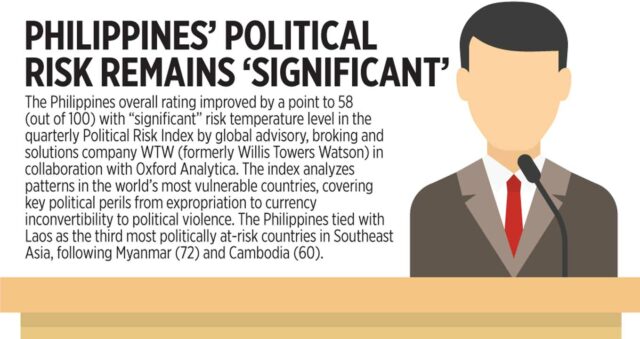
The Philippines overall rating improved by a point to 58 (out of 100) with “significant” risk temperature level in the quarterly Political Risk Index by global advisory, broking and solutions company WTW (formerly Willis Towers Watson) in collaboration with Oxford Analytica. The index analyzes patterns in the world’s most vulnerable countries, covering key political perils from expropriation to currency inconvertibility to political violence. The Philippines tied with Laos as the third most politically at-risk countries in Southeast Asia, following Myanmar (72) and Cambodia (60)

Philippines’ political risk remains ‘significant’

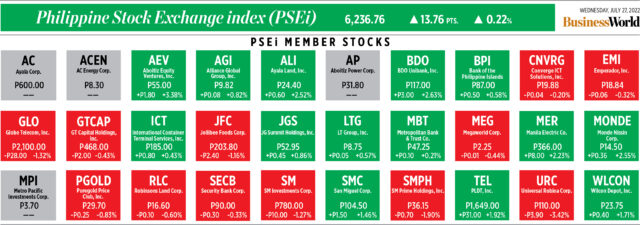
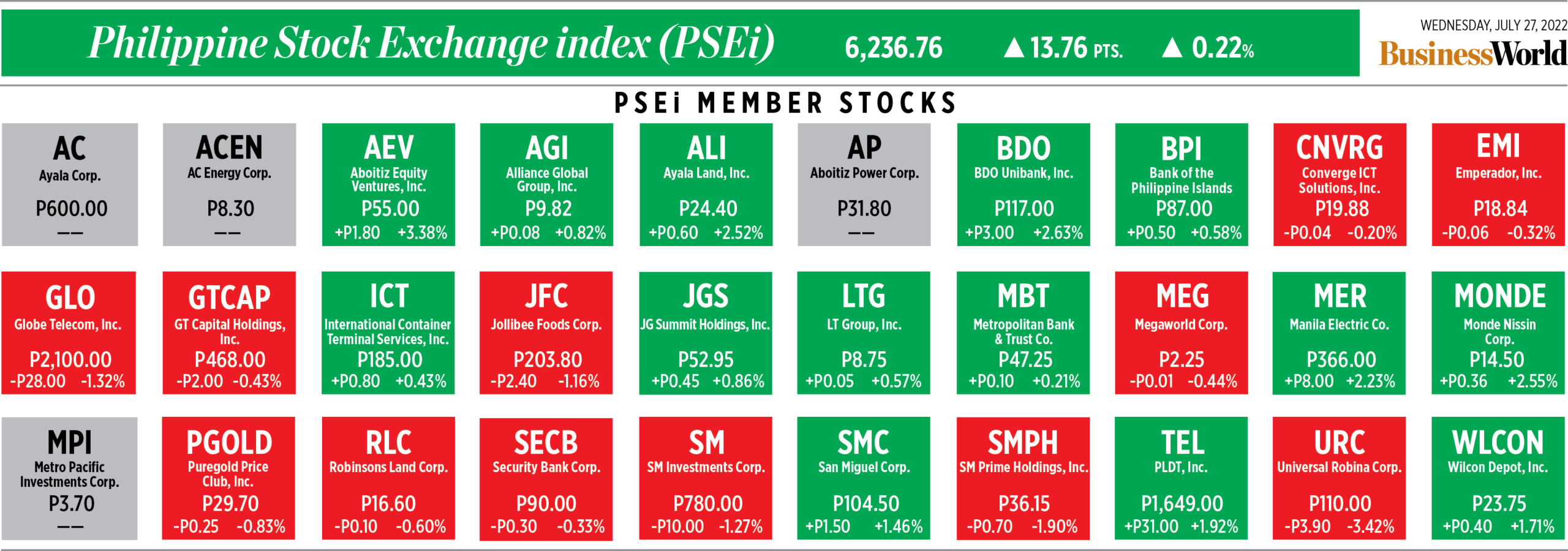
How PSEi member stocks performed — July 27, 2022

Here’s a quick glance at how PSEi stocks fared on Wednesday, July 27, 2022.


Peso weakens vs dollar ahead of Fed decision

BW FILE PHOTO

THE PESO ended weaker versus the dollar on Wednesday on expectations of another aggressive rate hike from the US Federal Reserve.

The local unit closed at P55.68 against the dollar on Wednesday, down by 38 centavos from P55.30 on Tuesday, data from the Bankers Association of the Philippines’ website showed.

The peso opened the session at P55.40 against the dollar. Its weakest showing was at P55.82, while its intraday best was at P55.37 versus the greenback.

Dollars exchanged went down to $1.01 billion on Wednesday from $1.43 billion on Tuesday.

“[The peso] will take its cue from tonight’s Fed meeting. A hawkish Fed should cause peso to slide once more while a dovish Fed could mean peso rallies a touch to close the week,” ING Bank N.V. Manila Senior Economist Nicholas Antonio T. Mapa said on Wednesday.

“Sharp swings show that [the] BSP (Bangko Sentral ng Pilipinas) didn’t need to conduct their emergency jumbo rate hike and could have settled for more measured 50 bps (basis points) rate increases in June and August to achieve similar results,” Mr. Mapa said.

Likewise, a trader attributed the peso’s decline to the anticipated rate hike from the Fed.

“The local currency might depreciate further ahead of the release of the second-quarter US GDP (gross domestic product) report amid lingering concerns of a US recession,” the trader said.

For Rizal Commercial Banking Corp. Chief Economist Michael L. Ricafort, this is “considered a healthy correction after the strong peso appreciation of 80 centavos the previous day.”

“The peso is still among the strongest in three weeks ahead of the widely expected 75 bps Fed rate hike,” he said.

Market sentiment has been supported by the administration’s presentation of its economic plans, which include the shift towards more local borrowings to manage foreign exchange risks, he added.

The US Federal Reserve is widely expected to raise benchmark rates by at least 75 bps at its July 26-27 meeting to temper soaring inflation that hit another 40-year high in June.

The BSP Monetary Board on July 14 raised its benchmark interest rates by an all-time high 75 bps in an off-cycle review. The surprise move came ahead of its regular policy meeting scheduled on Aug. 18, and follows two 25-bp rate hikes each in May and June.

BSP Governor Felipe M. Medalla said then that the big rate increase was due to signs of growing price pressures, compounded by the impact of aggressive tightening by the US Federal Reserve on the peso, which could lead to higher inflation.

On Tuesday, Mr. Medalla said the central bank will likely hike borrowing costs by another 25 bps or by 50 bps at their August meeting with the Fed expected to continue firing off big rate increases, although he ruled out another off-cycle move.

Headline inflation was at a near four-year high of 6.1% in June, bringing the first-half average to 4.4%, above the BSP’s 2-4% target but still below its full-year forecast of 5%.

For Thursday, Mr. Ricafort sees the peso moving within P55.40 to P55.80 against the dollar, while a trader expects it to be between P55.60 and P55.80. — D.G.C. Robles

PHL shares rise on last-minute bargain hunting

STOCKS climbed on Wednesday on last-minute bargain hunting ahead of the US Federal Reserve’s policy statement, concerns over a possible recession in the United States as well as the wider Philippine budget deficit in June.

The Philippine Stock Exchange index (PSEi) went up by 13.76 points or 0.22% to close at 6,236.76 on Wednesday, while the broader all shares index increased by 5.59 points or 0.16% to 3,370.58.

“The local bourse was able to close in the green, up by 13.76 points (+0.22%) to 6,236.76 due to last-minute bargain hunting,” Philstocks Financial, Inc. Research Analyst Claire T. Alviar said in a Viber message.

Ms. Alviar said that the sideways movement of the PSEi was due to negative sentiment in US markets and the government’s wider budget deficit in June.

“Most investors were also on the sidelines… as they wait for the interest rate decision of the Federal Reserve,” she added.

“Local shares were bought as investors became wary of the US, as Walmart slashed its earnings forecasts, fueling concerns that consumer spending might not be strong enough to keep the US out of the verge of recession,” Regina Capital Development Corp. Head of Sales Luis A. Limlingan said in a Viber message.

Mr. Limlingan said investors were also looking ahead to the US Federal Reserve’s latest policy decision.

The Fed is holding its policy review on July 26-27 and was expected to announce its decision overnight. Markets were pricing in at least another 75-basis-point hike as inflation in the world’s largest economy continues to soar.

Meanwhile, the Bureau of the Treasury on Tuesday said the budget gap stood at P215.5 billion in June, 43.8% higher than the P149.9 billion in the same month a year ago.

In the first six months of 2022, the budget deficit narrowed to P674.2 billion, 5.84% lower than the P716.1-billion gap a year ago and 18.64% below the program.

The majority of sectoral indices ended in the green on Wednesday except for property, which went down by 13.59 points or 0.48% to 2,782.28.

Meanwhile, financials climbed 18.94 points or 1.29% to 1,479.43; services increased by 5.77 points or 0.35% to 1,632.54; mining and oil went up by 30.34 points or 0.26% to 11,312.30; holding firms gained 7.06 points or 0.11% to end at 5,919.51; and industrials inched up by 0.26 point to close at 9,359.24.

Decliners outnumbered advancers, 100 versus 75, while 41 names closed unchanged.

Value turnover inched up to P3.83 billion on Wednesday with 325.86 million shares changing hands from the P3.75 billion with 728.03 million issues seen the previous day.

Net foreign selling further declined to P136.75 million from the P431.57 million seen on Wednesday.

Regina Capital’s Mr. Limlingan placed the PSEi’s support at 6,100 and resistance at 6,400, while Philstocks Financial’s Ms. Alviar put support between 6,100 and 6,150 and resistance at the 6,400 area. — J.I.D. Tabile

Marcos asked if he plans to raise taxes to fund priority programs

PHILSTAR

THE ADMINISTRATION has been asked for its funding plan for the priority programs spelled out by President Ferdinand R. Marcos, Jr. during his address to Congress delivered on Monday, particularly whether new taxes are to be imposed.

“The President has presented a very compelling vision of which the country should unite around,” Senator Francis Joseph G. Escudero said in a statement. “What follows is the hard part of funding those dreams.”

He was particularly concerned whether the Department of Finance will raise new taxes to meet its goals, which Mr. Escudero said will be a burden on the population.

During the President’s first State of the Nation Address (SONA), Mr. Marcos promised to modernize and upgrade the healthcare system. He cited plans to devolve to the countryside specialty hospitals currently located in the capital like the Philippine Heart Center, National Kidney and Transplant Institute, and Lung Center of the Philippines — all built during his father’s presidency.

He also promised to expand the Build, Build, Build infrastructure program through public-private partnerships, spurring economic growth in remote areas.

“Every government program carries a price tag, often hidden, while the purported benefits are highly praised. Lost in the euphoria is the fact that it is the people, and nobody else, who will eventually pay for them. The buck begins with the taxpayer,” Mr. Escudero said.

“How do they intend to fund the projects mentioned by the President? Will it be through new taxes or new borrowing? Will the people pay in pain right now through higher taxes or will the government just take out a mortgage on our children’s future?” he added. 

At a news conference on Tuesday, Senator Ana Theresia N. Hontiveros-Baraquel called the economic roadmap laid out in the SONA “unclear” on the matter of how the targets will be achieved. 

“There are so many priorities but when the plan is that ambitious, the revenue generation should also be ambitious,” she said.

Mr. Escudero said a clear and comprehensive proposal should be made on the proposed value-added tax on digital services and e-commerce transactions.

“There is no doubt that the people have united behind the President’s articulation of their aspirations. But unity is soluble in taxes — high and unfair taxes,” he said.

Congress will soon begin budget deliberations for the 2023 General Appropriations Act. Mr. Escudero said he was looking forward to receiving the proposed P5.2-trillion national budget to judge the adequacy of the funding for the government’s program. — Alyssa Nicole O. Tan

Globe ready to support digitalization in health, education, fintech

GLOBE Telecom, Inc. said it is ready to support the government’s digitalization efforts, particularly in government services, healthcare, education and fintech, for which its broadband and technology solutions will serve as critical infrastructure.

The company said Globe’s services are a good fit with the Marcos administration’s plan to digitalize government processes and provide universal connectivity, which President Ferdinand R. Marcos, Jr. highlighted in his address to Congress on Monday.

“The administration can count on the universe of Globe’s digital solutions — from new technologies our core telco business offers to our portfolio companies in and more — to provide innovative services to make its digitalization and connectivity goals a reality,” Globe President and Chief Executive Officer Ernest L. Cu said in a statement on Wednesday.

“Globe also fully supports the President’s call for an e-commerce law that aims to protect consumer rights, data privacy and intellectual property,” he added.

The group is intensifying its online anti-piracy campaign in conjunction with the Intellectual Property Office of the Philippines and the Asia Video Industry Association.

According to Mr. Cu, the President’s State of the Nation Address (SONA) “very much echoes Globe’s long existing programs on digital enablement, intellectual property and clean energy, reflecting our shared goal to see a Filipino nation admired.”

“This fuels our fire in consistently bringing reliable services and solutions towards digital enablement.”

Mr. Marcos said he has tasked the Department of Information and Communications Technology to ensure digital connectivity across the archipelago.

“This will be done through the implementation of the National Broadband Plan, the common tower program, connecting our geographically isolated and disadvantaged areas (GIDA) via our ‘Broad Band ng Masa’ project,” he said in his SONA.

“These may be through a combination of terrestrial or submarine fiber optics, wireless and even satellite technology,” he added.

He called for the deployment of “breakthrough technologies” such as quantum computing, artificial intelligence, nanotechnology, the internet of things, robotics, self-driving electric vehicles, 3D printing, and virtual and augmented reality to revolutionize the way business is done.

The new administration is expecting an increase in direct investment from overseas as a result of the amended Public Service Act, which has opened doors and removed restrictions on foreign investment in key industries. — Arjay L. Balinbin