Home Blog Page 601

Del Monte trading resumes after audit disclaimer clarified

Bugo cannery workers in Cagayan de Oro — DELMONTEPACIFIC.COM

DEL MONTE PACIFIC Ltd. (DMPL) shares resumed trading on Monday after the Philippine Stock Exchange (PSE) lifted a suspension tied to the company’s audit disclaimer.

The PSE said in a notice that it reinstated trading of DMPL shares at 10:30 a.m. following a “detailed discussion” on the impact of excluding its US subsidiary from its financial condition, business operations, and overall performance.

In a disclosure, DMPL said the disclaimer attached to its fiscal year ending April 30, 2025 audited financial statements was not due to any breach of accounting standards or restrictions on audit procedures, but rather from limited access to evidence amid its US subsidiary’s bankruptcy proceedings.

“The audit disclaimer pertains only to the carrying values of the assets and liabilities of, the company’s investment in, and its share in the net losses of its US subsidiary Del Monte Foods Holdings Ltd. (DMFHL),” it said.

DMFHL filed for voluntary Chapter 11 bankruptcy in April and has since been deconsolidated from DMPL’s financial statements.

It is now classified as assets held for disposal and presented as discontinued operations in accordance with IFRS/PFRS.

“Since exposures to the US operations have been fully impaired and segregated, any further developments in the Chapter 11 proceedings are not expected to materially impact the company’s consolidated financial statements going forward,” DMPL said.

The company added that its Philippine and Asian businesses, which account for its continuing operations, “remain fully audited without qualification” and that the disclaimer “has minimal bearing, if any, on the integrity of these results.”

For the year ended April 30, DMPL fully wrote down its investment and other assets in its US subsidiary, posting impairment losses of $703.4 million. Gross revenue, however, rose 11.06% to $789.46 million from $710.81 million a year earlier.

DMPL also noted that trading on the Singapore Exchange, where its primary listing is, was unaffected as the audit disclaimer does not trigger a suspension under SGX rules.

The PSE halted trading of DMPL shares on Sept. 16 after the company failed to file its annual report (SEC Form 17-A) on time. The company earlier said the delay stemmed from complications linked to its US subsidiary.

DMPL shares fell 9.83% or 41 centavos to close at P3.76 apiece on Monday. — Alexandria Grace C. Magno

Security Bank eyes at least P5B from bond offering

BW FILE PHOTO

SECURITY BANK Corp. is looking to raise at least P5 billion from an offering of fixed-rate peso-denominated bonds, marking its return to the domestic debt market after over a year.

The bank on Monday launched a public offer of five-year peso bonds with a minimum issue size of P5 billion and an oversubscription option, it said in a disclosure to the stock exchange.

The offering will run until Oct. 17, unless ended earlier by the bank or the transaction’s bookrunners and arrangers.

The bonds carry a fixed rate of 6% per annum. They will be issued out of the bank’s P200-billion peso bond and commercial paper program.

Security Bank will use the bond offer’s proceeds to support its lending business and expand its funding base, it said.

“We’re excited about this peso bond offering as it further strengthens Security Bank’s funding base and supports our growth and lending activities. At the same time, it gives investors a high-quality peso investment with stable, predictable returns — underscoring the Bank’s financial strength and commitment to our clients,” Security Bank Executive Vice President and Financial Markets Segment Head Price Edward “Jim” C. Yap said.

The papers will be sold in minimum denominations of P500,000 and in increments of P100,000 thereafter.

They will be listed on the Philippine Dealing and Exchange Corp. on Oct. 29 to provide secondary market liquidity to investors who would like to trade the papers.

Security Bank tapped Philippine Commercial Capital, Inc. and Security Bank Capital Investment Corp. as the joint bookrunners, joint lead arrangers, and selling agents for the issuance.

The bank last tapped the domestic bond market in July 2024, raising P20 billion from an offering of five-year fixed-rate peso corporate bonds that were priced at 6.05% per annum.

Meanwhile, Security Bank is now part of The Financial Times Stock Exchange’s (FTSE) Asia Pacific Small Cap Index, it announced on Sunday.

“This recognition underscores the trust that investors continue to place in Security Bank. Our commitment to delivering BetterBanking and creating long-term value for clients, communities, and shareholders is now being validated on a global stage,” Security Bank President and Chief Executive Officer Sanjiv Vohra said in a statement.

“As we celebrate our 74th anniversary this year, being part of the FTSE Asia Pacific Small Cap Index reinforces our mission to be the most customer-centric bank in the Philippines. We see this milestone not only as market recognition, but as an inspiration to continue innovating and putting customers at the heart of everything we do,” he added.

The inclusion took effect on Sept. 19 after close of business as part of FTSE’s September 2025 quarterly review.

The FTSE Asia Pacific Small Cap Index is a benchmark used by institutional investors worldwide and is part of the FTSE Global Equity Index Series, which covers large-, mid-, small-, and micro-cap stocks across developed and emerging markets.

The index is reviewed and rebalanced quarterly to stay aligned with evolving market conditions.

“Security Bank was among a select group of Philippine companies named in the FTSE review. Its addition highlights the bank’s increasing relevance to international investors, who often use FTSE indices to guide investment decisions,” it said.

Security Bank’s net income grew by 7.85% year on year to P3.04 billion in the second quarter on the back of double-digit revenue growth.

This brought its first-semester earnings to P5.86 billion, up by 7.59% year on year.

The bank’s shares rose by 95 centavos or 1.24% to close at P77.45 each on Monday. — Aaron Michael C. Sy

Pianist Cecile Licad: Playing through a blackout, dreaming of Banaue

PIANIST CECILE LICAD

THOSE who watch a classical music performance may think that it is all about never-ending practice, calculated moves, and absolute perfection. For Cecile Licad — a piano prodigy who had her first concert at the age of seven and was one of the youngest recipients of the Leventritt Gold Medal in 1981 at the age of 20 — it is the unexpected that pushes her music to its very best.

In a group interview with various media outlets last week, Ms. Licad told BusinessWorld about the importance of adversity in coaxing the best performances out of a musician.

“When something unexpected happens, when my hands become painful or stiff, during adversity, those are the times when my playing, my music… comes out the best,” she said.

This openness to surprises has allowed her to continue doing concerts with the Philippine Philharmonic Orchestra (PPO) and going on country-wide tours in venues of varying sizes. Her upcoming concert in Manila will be held on Sept. 24 and will be followed by an outreach tour.

The PPO concert, titled The Pianist’s Pianist, is presented by Rustan’s and will be conducted by Grzegorz Nowak at the Metropolitan Theater in Manila. It will have Ms. Licad perform Chopin’s Concerto No. 2, which earned her the prestigious Grand Prix du Disque from the Chopin Society of Warsaw, and Saint-Saëns’ Concerto No. 2.

Ms. Licad said that she chose those pieces because of their relevance to her career. “These are the first two concertos I ever recorded with André Previn and the London Philharmonic Orchestra.

“The Chopin concerto I played when I was 11 years old in the Philippines. That’s when I first left the country!”

While she remains a perfectionist who practices every day, her biggest motivation is clarity, she said. “I practice because I want to make a passage clearer to listeners, but first of all, to me.”

For the prodigy, caring too much about others’ opinions can ruin a performance. Dressed in elegant black-and-white, peering at her interviewers through her large, white-framed glasses, and making sweeping hand gestures with a Cartier ring on her prized fingers, Ms. Licad gives the impression of someone who knows what she’s worth and no longer fusses about what others think.

Tension and uncertainty do not seem to faze her. “It’s that difficulty, adversity, that makes the music unique. My own, you know?”

FROM BLACKOUTS TO BANAUE
One of the best examples of Ms. Licad’s music prevailing in the face of adversity took place in 2002.

“It’s kinda good sometimes to look back. I still don’t like listening to myself, but there was a very memorable performance of mine in a blackout,” she said, describing a concert at the Cultural Center of the Philippines.

She recalled playing Rachmaninoff’s Piano Concerto No. 3, and the lights going out three minutes into it. “I was almost about to stop, but the music was saying to me, it’s going to a real height.” Then her voice grew more excited as she recounted the incident. “There were difficult passages where I had to put my hand towards the top and, without any light, it was hard — but I still hit it. And I became like an orchestra because the orchestra had to stop. It was such a magical moment because everybody was so quiet.

“Then, finally, the lights came on and the conductor, Rodel Colmenar, was able to tell the orchestra which part, and they came in at the perfect time. I remember it felt like the heaven key, it was in D-flat major, the key that sounded like the heavens opened up.”

As for the future, Ms. Licad talked about how she dreams of someday playing atop the Banaue Rice Terraces. “Imagine there’s a piano, big speakers, nice weather…” she said.

Anton T. Huang, president and CEO of Rustan’s and SSI Group and the chairman of the Philippine Philharmonic Orchestra Society, Inc., was taken aback to hear this request. Though intent on continuing the legacy of his arts patron mother, the late Rustan’s matriarch Zenaida “Nedy” Tantoco, the logistics of such a performance was the question.

“Is it doable?” he said at the group interview. “I’m trying to figure out what hotel we will stay in!”

For Ms. Licad, whose precious hands aren’t even insured, getting caught up in the nitty-gritty doesn’t matter. “It would be wonderful,” she boldly insisted.

Cecile Licad’s The Pianist’s Pianist with the PPO will take place at the Metropolitan Theater in Manila on Sept. 24, 6:30 p.m., with tickets available via TicketMelon: https://www.ticketmelon.com/rustans/cecile-licad-concert/.

She will then play at the Baguio Country Club, Baguio City, on Sept. 27; at the Pinto Art Museum, Antipolo City, on Sept. 28; at the Miranila Heritage House, Quezon City, on Oct. 1; the Sta. Ana Parish on Oct. 6 and UPV Museum on Oct. 7, both in Iloilo City; and the ECrown Hotel in Virac, Catanduanes, on Oct. 11. — Brontë H. Lacsamana

I loved being a ’90s rock journalist, but sometimes it was a boys’ club nightmare

Book Review
Men Of A Certain Age: My Encounters with Rock Royalty
By Kate Mossman
Maybe I’m Amazed: A Story of Love and Connection in Ten Songs
By John Harris

IN THE 1990s, I was a rock journalist striving to assert myself as a young woman, working at the heart of the United Kingdom’s male-dominated music press. I loved my job. I met and interviewed all my favorite bands, and spent my twenties and early thirties in a whirl of parties, clubs, gigs and all-expenses trips to America and Europe.

I began my career through a combination of ignorance, bloody-mindedness, and good timing. With no idea about the protocol of editorial commissions, I was annoyed when a music paper failed to publish my unsolicited live review of a friend’s band. Determined to succeed, I followed a tipoff from an artist who lived in a squat with a media contact (this was London in the 1980s), and soon found myself writing for a bi-monthly heavy metal magazine.

The editor, Chris Welch, was a softly spoken, conservatively dressed man in his late forties whose office walls were lined with photos of himself hanging out with Marc Bolan, Led Zeppelin’s Jimmy Page, and Eric Clapton, in his days as a young reporter. I rarely saw him during my year at the magazine, but I’ve never forgotten his gentle demeanor and the trust he placed in my inexperienced, 22-year-old self. Without his support, my life may have taken a very different turn.

Chris was one of a kind. Other than him, respectful, benevolent older men did not figure in my work for the music press.

By contrast, Kate Mossman is a British arts and music writer whose debut book is presented as “a meditation on the powerful archetype of the ageing rock star.” Her fixation with rock’s fading old guard provides a compelling premise for Men Of A Certain Age: My Encounters with Rock Royalty, but the blurb is a little misleading. This is essentially a collection of republished interviews and personal reflections, rather than an in-depth analysis.

That said, Mossman has produced a thoughtful and entertaining retrospective. Her conversations with the likes of Wilko Johnson, Terence Trent D’Arby, Ray Davies (The Kinks), Jeff Beck, and Kevin Ayers are humorous, perceptive and beautifully composed.

She describes the Happy Mondays’ and Black Grape’s Shaun Ryder as resembling “a Russian Mafia boss in the corner, whisky in hand, arms elevated by the pressure of a thick leather jacket.” She chats with Paul Stanley of KISS while he applies his makeup before a show.

“Here is my clown white,” he says softly, picking up a pot of the thick, sweat-resistant foundation he discovered in the ’70s. “And here are my puffs.”

These encounters afford the reader a certain insight into Mossman’s idiosyncratic predilection for wrinkly rock stars twice her age. Yet while the book affectionately probes her strange, decidedly gendered interest, it avoids the glaring issue of structural misogyny that contaminates the music industry.

It’s not as if Mossman is unaware of the sexual politics at play. She positively delights in the “exciting father-daughter energy” of the older man-younger woman dynamic, intentionally exaggerating her youth and assumed innocence in the presence of ageing rockers. She knows men like Tom Jones and Gene Simmons will respond openly to her coltish, unthreatening persona, because what could be safer than “just a pretty lady”? It’s a clever and effective strategy.

I fully appreciate the quality of Mossman’s profiles, but her attempts to lean into the patronizing attitudes of rock’s elders land uncomfortably with me. And having once had my own tender skin in the game, I can’t help seeing the book’s negation of sexism as a missed opportunity.

When I was a rock journalist, I never felt advantaged by my gender or energized by the older male rocker’s entrenched misogyny. Quite the opposite.

AT JARVIS COCKER’S HOUSE PARTY
Twenty or so years before Mossman began pursuing her beloved senior rockers across the US, I was being reprimanded by my editor for my “unprofessional” rejection of the creepy advances of a famous middle-aged musician.

In 1989, I was a staff writer for a fortnightly rock magazine based in London’s Carnaby Street. We smoked and drank at our desks, played loud metal on the stereo, took half-day lunches on record company money, and hosted a constant stream of visiting rock stars in all manner of altered states throughout the working day.

One of my regular jobs was to review the singles with a handful of guest musicians, depending on who was in town. This was often a riotous affair that occasionally descended into chaos. One time, a German drummer, old enough to be my dad, asked me to sit on his lap while we listened to the records. When I didn’t see the funny side, he sniggered at my rebuttal and asked if I was having my period. So I walked out, leaving him with his embarrassed band mate in a room shocked into silence.

A year or so later, the editor who scolded me would help bring about my eventual redundancy after I started to retaliate against a toxic male colleague. This man, previously a friend who’d tried to date me, bullied and ostracized me for the entire duration of my employment. I put on a brave face, cried in the toilets and still managed to enjoy my work. But when I eventually reacted, I was blamed for aggravating the situation, and the magazine let me go.

I spent the next eight years escalating my freelance career and writing books. I waded in the ocean with The Verve’s Richard Ashcroft, toasted a Chicago sunrise on tour with Alice in Chains, went snowboarding with a young British band in California, tripped over Jarvis Cocker at his own house party, and gratefully received a pair of secondhand John Fluevog sandals from the closet of Sonic Youth’s Kim Gordon in New York. But my confidence remained dented until I published my first academic article in the early 2000s.

Forgive me then, for baulking when Mossman describes herself as “a small girl sitting on the knee of Father Rock” at her first job for the now-defunct UK music monthly, The Word.

While I’m sure she’s attempting to describe a more supportive, paternalistic workplace environment than the one I endured, she is nevertheless referring to a situation in which she, too, was the only woman in a small team of men. In her case, a generational divide reinforced the sense of male authority which left her wondering “who I was without these men, and who I would be.”

Years before Mossman met him, one of the men she mentions reportedly claimed women were unable to write effectively about music. I once encountered him too, and found him to be smooth, charming, and arrogant, with the ruthless attitude of a tabloid journalist.

Working with men like this produced some of the worst experiences of my career. Luckily, such occasions were rare, but could be significant. Bands never saw the bigger picture, of manipulated stories and doctored headlines, but their lives were directly affected by decisions made by people they’d often never met.

I remember once having a conversation with Kurt Cobain about power and the media, and telling him journalists like me could only do so much. Ultimately, we were at the mercy of our editors, which is why I tried to pick mine wisely. Musicians don’t have the choice. Under contract with record labels, they are legally obliged to engage with the media and must take what’s on offer. I’d known Nirvana before they were famous, and watching Kurt develop from a shy, goofy kid into a cynical megastar persecuted by the press was heartbreaking.

Part of the reason Mossman’s book sits uneasily with me is because it appears to ignore the hard-won heritage of female music journalists, and the struggles women like me had in the workplace. Deferring to big daddy editors and accommodating the fragile egos of doddery rock gods feels too much like turning the clock back.

MORE INTERESTED IN HER
Interestingly, at the back of her book, an intriguing detail lies almost buried in the acknowledgments. Here, Mossman says she recently learned her mother was responsible for introducing a bunch of records she thought had belonged to her dad into the family home.

This untold chapter of Mossman’s story speaks volumes about women and rock culture. Swinging like a loose thread, it threatens to unravel so much of what we have come to accept about the world of rock and the stories of its appointed gods.

Hence my other frustration with the book. While Mossman is a critically acclaimed journalist and former Mercury prize judge, nothing can fire my interest in men such as former Journey singer Steve Perry, or the insufferable Sting. I simply don’t care about them. I’m much more interested in her.

Had Mossman developed the snippets of memoir she uses to contextualize her interviews, and foregrounded herself instead of her tired old giants, I believe her book would have been much more powerful. The strongest, most illuminating passages are when she interrogates her past and mines her personal experiences for clues to her adult obsession with the old guys.

Her teenage infatuation with Queen, her discomfort with the irreverence of 1990s pop culture, her desperate need for parental approval, the peculiar sense of shame she feels in writing about people she loves. The way she listens to music through her father’s “imaginary ears,” the energy writing affords her. All of this outshines the perpetually recycled male rock-star myths, no matter how well Mossman interprets them.

Perhaps in trying to convince the reader to share her love for middle-of-the-road musicians, Bruce Hornsby and Glen Campbell, both of whom had their heyday before she was born, Mossman is still trapped in her teenage cycle of needing her parents to approve of Queen. If so, I hope she manages to shake this off and step more fully into her own story with conviction and faith. With her talent, a full-blown memoir would be a runaway bestseller.

In many ways, Mossman’s book highlights the limits of music journalism as a genre. Her long-form profiles are detailed sketches rather than complex studies, reflecting the fleeting nature of the interview format. Ultimately, even with a fascinating subject, this type of interaction will always be a superficial exercise and therefore something of a game.

For Mossman, with her obsessive fan tendencies, this may be hard to accept, but faced with Sting’s smooth professionalism, she has no choice. “There is a desire for connection that drives every interview,” she writes, “and with Sting, it was a connection I never got.”

For me, 10 years of music journalism was enough. By 1998, I’d met everyone I wanted to meet and there were only five or six bands I still wanted to hang out with. I was ready to expand my writing skills and deepen my understanding of the human psyche. Funnily enough, given Mossman’s interest in Jungian theory, I retrained as a Jungian psychotherapist.

AN ELITIST BOYS’ CLUB
I wasn’t the only one to quit music journalism after the 1990s. With magazines folding left, right, and center, many writers moved onto other careers. One of them was John Harris, now a political and arts columnist for The Guardian. We met briefly at the NME during my six-month stint as its rock correspondent, and occasionally ran into each other at Britpop gigs with mutual friends.

Now, NME is an online platform full of celebrity gossip and brimming with ads. But in the early 1990s it still held currency, for emerging bands and music fans alike. So when the editor invited me to interview Alice in Chains and Screaming Trees on tour in America, I was excited.

I arrived at the NME office fresh from the friendly clamor of Kerrang! magazine, and the first thing that struck me was the silence. Everywhere I looked, studious-looking guys with neat haircuts sat typing furiously away at their desks. There was no music, no talking — and, apart from the secretary, no women.

I soon discovered the few female writers who managed to find a way in were either resented (like me), or given “special dispensation,” whatever that meant.

It all seemed so weirdly petty, like an elitist boys’ club. I hated it.

On one occasion, I refused to disclose the location of a secret Hole gig — at the band’s request. I was punished for my disloyalty to the paper by not being allowed to review it. Another time, a couple of journalists offered to “help” me with a two-part feature on the Riot Grrrl movement, even though I’d single-handedly managed to gain the trust of some of the key women on the scene, all of whom despised the male-dominated music press.

The final straw came in the form of a commission to interview Aerosmith. Asked to “get the drug stories,” I argued for a more original angle: by then, the band was clean. But I was shut down and told to be “more humble.”

Needless to say, after spending a lovely afternoon laughing about outlandish but predictable druggy adventures with Aerosmith band members Joe Perry and Steven Tyler (who tried to steal my fake fur coat), I filed my copy and walked away from the NME with my head held as high as it would go.

AUTISTIC AND THRIVING WITH MUSIC
After freelancing for the NME, Harris went on to work for monthly music titles Q and Select. Now, he’s an award-winning journalist with a string of books to his name. His latest one, Maybe I’m Amazed: A Story of Love and Connection in Ten Songs, is his fifth, and arguably his most important work to date.

Harris’ memoir is a beautiful, heartwarming, enlightening, and uplifting book that chronicles the profound impact of music on the life of an autistic child. It captures the grief and frustration of two loving parents as they struggle with the UK’s broken education system and underfunded health services, on behalf of their son. And it details the individual nature of autism and the multiple, miraculous ways an autistic person can flourish when given the right support.

As first-time parents, Harris and his partner Ginny, a former press officer with Parlophone Records, are not aware of any issues with their baby, James. He’s a little slow to speak and has some cute, characterful quirks, but nothing seems out of the ordinary until their daughter Rosa is born and the family moves from Wales to Somerset.

Slow to adapt to the new changes in his life, James begins to exhibit ritualistic behaviors that concern Harris. Three weeks after James starts attending his new nursery, Ginny is told her son might be autistic. Suddenly, she and Harris are plunged into a brutal spin of fear, anxiety, guilt, denial, and fundamental uncertainty.

Together, the family embarks on a punitive round of tests and assessments as the tyranny of diagnosis takes hold. At first, supportive frameworks carry the weight of a heavy sentence. But Harris and Ginny immerse themselves in research and fact-finding missions to educate themselves about autism. After investing a significant amount of time and money, they manage to establish a viable routine to help James thrive.

It’s not an easy journey. Setbacks, personnel changes and bureaucratic complications are ever-present, but with a small team of specially trained, caring individuals, James makes progress. Meanwhile, as a lifelong music lover, Harris becomes increasingly aware of the profound relationships his son is developing with certain songs by particular bands. Kraftwerk, The Beatles, and Mott the Hoople all exert a steadying influence on James, enabling him to communicate in ways he cannot through verbal language.

A visit from musician Billy Bragg, with whom Harris organizes an annual talks tent for Glastonbury Festival, results in James actually making music himself. This leads to keyboard lessons and a slot at the school concert. By the time he enters his teens, James is playing bass, and looking every inch the rock star.

Structurally, Harris has produced a masterclass in memoir, seamlessly blending the past with the present. Cleverly shifting between his own life in music and his son’s, he charts his teenage years as a mod, his ill-fated band’s only performance, and his forays into music journalism — all of which he now values anew in the context of parenting James.

He describes how the pair share their joy in gigs and experience the deep bond of making music together, sometimes with Rosa on drums. Watching his child come alive through rhythm and melody, Harris finds himself re-enchanted by music and uncovers the wonder of parenting through unexpected and creative channels.

The book delivers a wealth of information about the vast and complicated spectrum of autism, taking a deep dive into medical theories and the world of neurology. By weaving this complex material into his personal experience of huge emotional and practical challenges, Harris keeps it relatable. In many ways, he has forged a map, complete with a beacon of hope: albeit an individualized one. Informative, enriching, and engaging, his story of love, persistence and hard-won daily miracles is music writing at its absolute best.

Wildly disparate in content, both Harris’ and Mossman’s books show how music can define us. In this way, their narratives speak to us all.

They remind me of a time when I couldn’t leave home without a Walkman and a spare set of batteries. They take me back to when I was a teenager, when music shaped my social life, determined my image, and gave me the courage to withstand an emotionally abusive upbringing. And they return me to my twenties, when music powered my glamorous first career and launched me into a lifelong creative practice.

Ultimately, they remind me the pulse beneath my writing still belongs to music. And who knows? Maybe I’ll expand on that one day.


Liz Evans is an adjunct researcher, English and Writing, at the University of Tasmania.

Alternergy to take over 2 proposed wind projects in Quezon

ALTERNERGY HOLDINGS CORP.

ALTERNERGY HOLDINGS CORP. will acquire two proposed wind power projects in Quezon province, totaling 246 megawatts (MW), as part of its plan to expand its renewable energy portfolio.

Calavite Passage Wind Power Corp., a special purpose company of Alternergy, is taking over the 96-MW Tayabas North Wind and 150-MW Tayabas South projects from CleanTech Global Renewables, Inc., the company said in a media release on Monday.

“We are excited to develop our second wind project in Quezon Province after our 64-MW Alabat Wind Project is completed in early 2026,” Alternergy President Gerry P. Magbanua said.

The Tayabas North Wind project was among the qualified bids under the fourth round of the green energy auction conducted by the Department of Energy (DoE) and is slated for completion by 2028.

Established in 2014, CleanTech is developing a portfolio of clean energy projects in the Philippines, with 650 MW of solar plants either operational or under construction.

“We look forward to co-developing these wind projects with Alternergy, the pioneer in wind energy in the country,” CleanTech Chief Executive Officer Salvador Antonio Castro, Jr. said.

CleanTech will maintain an equity stake in both projects and has the option to make additional investments in each of them.

Mabuhay Capital served as financial advisor to the transaction. The transfer of assets is subject to regulatory approval by the DoE.

On Monday, shares in Alternergy fell 2.2% or P0.02 to close at P0.89 apiece. — Sheldeen Joy Talavera

Maya Bank to focus on underserved sectors, improving services amid growing competition

MAYA BANK, Inc. will focus on underserved sectors like small and medium enterprises (SME) and improving its product offerings and services to drive its growth as it faces heightened competition from other financial technology (fintech) players and digital service providers.

“It’s really about being more creative with the products you offer and being more customer-centric in how you serve,” Maya Bank Chairman Alfredo S. Panlilio told BusinessWorld on the sidelines of a recent event.

The bank is focused on continuously improving its services and the customer experience they provide, particularly for underserved markets as they aim to be more inclusive, he said.

“We’re always, from the very start, targeting the unbanked because 70% of Filipinos are unbanked. Also, the SMEs have little if no access to financial services. So, that’s an area that we’re working on.”

In February, Maya Bank launched a financial literacy program for micro, small, and medium enterprises (MSMEs) that also gives them access to credit called Negosyo Serye. It is for eligible small business owners who operate Maya Center businesses.

Data from the Bangko Sentral ng Pilipinas (BSP) showed that loans granted by banks to MSMEs grew by 10.8% year on year to P540.92 billion as of end-June, which was equivalent to just 4.59% of their total loan portfolio of P11.78 trillion.

Maya Group or Maya Innovations Holdings, Pte. Ltd. is the parent holding company of Maya Bank and Maya Philippines, Inc.

Maya Bank is one of the six BSP-licensed digital banks in the country, while Maya Philippines is registered with the central bank as an electronic money issuer, remittance and transfer company, operator of payment system (OPS), and virtual asset services provider.

PLDT Inc., Maya Innovations’ main shareholder, said last month that the group posted a net income of P582 million in the second quarter, up 60% from the previous quarter and a turnaround from the P739-million net loss it booked in the same period last year.

This was partly driven by Maya Bank’s growing customer base and deposit and lending businesses, PLDT said. The bank’s customers reached 8.2 million as of June, up 101% year on year, while deposits rose by 54% to P50.4 billion. Loan disbursements climbed by 147% to P32 billion in the second quarter, bringing life-to-date releases to P152 billion.

Based on its annual report, Maya Bank booked a P72.78-million net income in 2024 versus the P826.83-million net loss it recorded in 2023, driven by increased net interest and non-interest earnings that offset the growth in its expenses.

These come as the BSP in January lifted a three-year moratorium on the grant of digital banking licenses, allowing four new players to operate in the country.

Last month, the central bank said they have determined that Apple Pay and Google Pay are technology service providers and not OPS as they do not hold funds but only process payment credentials. This means that they do not need to register with the banking regulator, paving the way for their potential entry into the Philippine market.

In Southeast Asia, Apple Pay and Google Pay are currently available in Malaysia, Singapore and Vietnam. Google Pay is also present in Cambodia.

The BSP is targeting to achieve a 60-70% share of digital payments over total retail payments volume by 2028, in line with the Philippine Development Plan.

Hastings Holdings, Inc., a unit of PLDT Beneficial Trust Fund subsidiary MediaQuest Holdings, Inc., has a majority stake in BusinessWorld through the Philippine Star Group, which it controls. — Aubrey Rose A. Inosante

On the MAP CEO Academy Training for Management Excellence

STOCK PHOTO | Image by Rawpixel.Com from Freepik

(Part I)

To pursue future-ready Filipinos in the complex 21st century, the Management Association of the Philippines (MAP) must return to its raison d’être of promoting management excellence for a progressive Philippines, especially on its 75th Anniversary.

What better way to address, in the knowledge age, one of the root causes of the miseducation crisis in the country: the overall relatively low quality of our education institutions, including those at higher levels. They graduate many of the leaders and managers shaping the Philippine economy — for MAP members, a third of the GDP of the country.

These institutions are responsible for producing the early childhood, primary, and secondary school teachers who, with parents, largely shape the workforce and leadership of our society, economy, and governance organizations.

However, teachers are beholden to the CEOs of HEIs and their Boards, as well as the government agencies promoting and regulating them. These HEI Boards include regional or local elected political leaders, other appointed industry and alumni representatives in state or local universities and colleges.

These result in the cumulative downward spiral of quality education institutions in the country. For example, why do college graduates have to take more vocational-technical courses for them to be gainfully employed, as data from the Second Congressional Commission on Education (better known as EDCOM II) show? Is the coordination problem with Department of Education (DepEd) teachers and principals who are products of the Commission on Higher Education (CHED)? Can TESDA — the Technical Education and Skills Development Authority — co-create Senior High School course content and pedagogy to develop job-ready Filipinos for future industries?

TRILEMMA ACROSS EDUCATION BODIES
The confused state of theoretical vs. practical coordination among the trifocal education agencies of government emanates from a classical trilemma: two parties (dilemma) talking to each other minus a third party that matters, compounded as two dilemmas are repeated three times (trilemma): A vs B, B vs C, C vs A — now being partially resolved at EDCOM II in efforts to coordinate DepEd, CHED, and TESDA structures and programs.

CHED is shaping the normal schools responsible for teacher education, whose graduates — around two-thirds of whom are unlicensed to practice teaching – are recruited by DepEd for sheer lack of qualified teachers. Multiple intelligences deserve different learning and teaching styles — but to what extent does DepEd promote this, without the data on nutrition status of normal school graduates?

Healthy solutions to malnutrition of the past decades are not even taught in TESDA in its popular food courses, like baking and pastry production, or Food Processing NC II — as a respected Filipino-American biochemist and medical doctor who taught at Harvard and UCLA found out in a training program for national and regional officials in TESDA’s Learning by Doing course.

OVERALL EDUCATION CEO PERFORMANCE EXCELLENCE
For its part, MAP, on its 75th year, under the leadership of MAP President Alfredo Panlilio, is launching its first training program of the newly named MAP CEO Academy. It was germinated in earlier years at the MAP Education Committee through previous MAP Presidents Rene Almendras and Dick Du-Baladad.

It will focus on CEOs of Higher Education Institutions (HEIs) as they collaborate with government agencies, mainly the Department of Trade and Industry (DTI) for its Philippine Quality Awards (PQA) promotion mandate, and various industry and training associations with an AI interest or focus.

PQA is based on the global standard for organizational excellence in any economic field. Hence, the Academy must be infused with high levels of rigorous educational standards in pursuit of overall performance of groups organized for either profit- or non-profit purposes.

PQA ROOTS
That global gold standard was unconsciously set up by former US Commerce Secretary Malcolm Baldrige (1981-87), under President Ronald Reagan, through a National Quality Award for export competitiveness. It led to antitrust reform, discussion of technology transfer issues with China and India, and US-Cabinet level talks on economic relations with the Soviet Union.

This total quality management approach was also the basis of an Asia-Pacific Economic Cooperation (APEC) program on results-based management in the first decade of the new millennium. When President Fidel V. Ramos hosted the APEC 1996 Economic Leaders Meeting, the Summit ideas led to his Executive Order creating the PQA. It was institutionalized in R.A. 9013 (Feb. 28, 2001) under President Gloria Macapagal-Arroyo, aimed to “encourage organizations in both the private and public sectors to attain excellence in quality in the production and/or delivery of their goods and services.”

Hopefully, among others, the PQA discussion in the MAP Training will revive the Malaysian model requiring several years of formal training for any person to be eligible for appointment as a President of a public university, a very interesting case widely discussed at a CHED-AIM Global Academic Leadership Program during the COVID years.

AI ROADMAP
The MAP CEO Academy PQA Training Program will also follow the National AI Strategy Roadmap No. 2 (DTI, 2024), based on an earlier Department of Science and Technology strategy of preparing Filipinos for a digital future.

The good news on this front is that “world tech titans” are reportedly heading to the Philippines “to shape AI-powered future of the $1-trillion BPO Industry (Bilyonaryo Business News, Sept. 16). The Philippines’ dominant strengths in global nursing and maritime human resource markets should generate more interest in managerially excellent educational training and health sector institutions around AI.

MAP PQA TRAINING
The MAP Training for HEI CEOs will be conducted at the University of the Philippines-BGC campus on Oct. 13 and 14. Beyond talks that move toward more internal training workshops, as in corporate universities, MAP can later collaborate with other education reform groups on management excellence programs to deepen industry-academic linkages, an EDCOM II agenda among several priorities in its first two years.

Designed to give substance to the talks around town, the two-day training session follows an earlier related program of the MAP Education Committee, held at the Asia Pacific College in the early second quarter of this year. It zeroed in on “Building a Stronger Workforce through Structured Internship and Lifelong Learning Legislation.”

For the present training program, the seven criteria of the PQA will be integrated into CEO skills for overall performance excellence. This will not just focus on curriculum for industries of the future, nor mere employability of graduates, but overall leadership excellence to prepare all Filipinos to be 21st century-ready. This now falls on the shoulders of HEI CEOs.

Part II of this article will elucidate on the training workshop themes on three national reform areas — environment, social, and governance issues — where the PQA criteria will be integrated for quality education-industry linkages. The HEI CEOs will be challenged to present ideas on training in negotiation skills for tariff wars anent these.


Federico “Poch” M. Macaranas is the Chair of the MAP Education Committee. He has designed and taught courses for CEOs and high-level officials of various industries and economies in the Asia-Pacific Region.

map@map.org.ph

fmmacaranas@gmail.com

ALLHC expands Cavite and Batangas technoparks, cites demand

Cavite Technopark — AYALALANDLOGISTICS.COM

AYALALAND LOGISTICS Holdings Corp. (ALLHC), a listed industrial park and real estate logistics developer, is expanding its Cavite and Batangas technoparks to provide additional industrial space in Southern Luzon.

“By opening new phases in Cavite and Batangas technoparks, we are creating more opportunities for enterprises to set up operations, generate employment, and contribute to local and national growth,” ALLHC President and Chief Executive Officer Robert S. Lao said in a press release on Monday.

Cavite Technopark in Naic is adding Phase 2B, which covers 20.2 hectares (ha) with 14 non-Philippine Economic Zone Authority (PEZA) industrial lots, targeting completion by the fourth quarter of 2026.

The park has grown to 183.6 ha since its 2015 launch, primarily hosting light to medium “non-polluting industries” from local and international markets.

It also houses two ALogis warehouse complexes and a custom-built facility for a retailer.

Only Phase 1 holds PEZA accreditation, while Phases 2A, 2B, and 3 remain non-PEZA zones. PEZA and Bureau of Customs offices are located on-site to support trade activities. The development incorporates sustainable features, including native trees and detention ponds, to enhance environmental resilience.

“We continue to see strong demand from both local and international locators looking for accessible and sustainable industrial spaces, [and] the new phase of Cavite Technopark allows us to meet this demand,” ALLHC Chief Operating Officer Patrick C. Avila said.

The Cavite Technopark is along Governor’s Drive, about 10 minutes from the Cavite Gateway Terminal, and its accessibility will improve with infrastructure projects such as the Cavite-Laguna Expressway, Manila-Cavite Expressway extension, and Cavite-Tagaytay-Batangas Expressway.

Future developments, including Sangley Airport and the Bataan-Cavite Interlink Bridge, are expected to further link the park to Metro Manila and nearby provinces.

Meanwhile, Phase 2 of Batangas Technopark in Padre Garcia adds 20.6 ha with 38 industrial lots registered with the Board of Investments (BoI), bringing the total park area to 75.6 ha. Land development is expected to finish by the third quarter of 2026.

The first phase covers 55 ha and includes a bagsakan center, retail outlets, and a gas station. It also features wide sidewalks, native trees, and detention ponds to enhance resilience to geohazards.

Mr. Avila said the Batangas expansion strengthens ALLHC’s capacity to meet growing industrial space demand outside Metro Manila.

Batangas Technopark is accessible via the SLEX–STAR Tollway at the Lipa–Tambo exit. Upcoming projects such as the Lipa–Padre Garcia Bypass Road and SLEX TR4 are expected to further improve access.

The park is 33 km from Batangas Port, 88 km from Makati, and 86 km from Ninoy Aquino International Airport. — Alexandria Grace C. Magno

Cebu’s hotel sector positioned for more developments — Colliers

CEBU-CORDOVA LINK EXPRESSWAY (CCLEX) — CCLEX.COM.PH

CEBU’S LEISURE sector continues to perform well as shown by impressive rise in hotel occupancies and average daily rates.  This is understandable given that Cebu remains as one of the most visited domestic destinations in the Philippines. This has been resulting in more property developers scouting aggressively in Cebu for the next viable location for a hotel or a leisure-oriented township.

Data from the Department of Tourism (DoT) revealed that foreign arrivals reached 3.96 million as of the first eight months (8M) of 2025, down 1.6% from 4.03 million a year ago. Given the current pace, the Philippines is again unlikely to breach even the 7.7 million arrivals set by the Philippine government in 2024. Tourists from South Korea dropped by 19% to 877,700 in 8M 2025, while arrivals from China also plummeted by 24% year on year. In 2019, China accounted for about a fifth of the 8.26 million international arrivals recorded during the year.

DOMESTIC MARKET FILLING THE VOID
Despite lackluster arrival figures, the Tourism department reported that the share of tourism to the country’s economy rose to 8.9% in 2024 from 8.7% in 2023. The Philippines also has the largest domestic tourism market in Southeast Asia, accounting for more than a third of the region’s total, with domestic tourism expenditure growing by 16.4% from P2.7 trillion ($48 billion) to P3.1 trillion ($55 billion). Tourists are also spending more and staying longer, with average expenditure per arrival at $2,073 in 2024 (from $1,218 in 2019) and length of stay at 11 nights in 2024 (from nine nights in 2019). In our view, domestic tourism will continue to be a catalyst for Philippine tourism. In 2023, the Tourism department recorded 55.3 million overnight travelers, up from 39.9 million in 2022, with Cebu attracting four million travelers.

Property developers planning to expand their leisure footprint need to keep an eye on Cebu. We remain bullish with our growth projections for Cebu as it continues to receive a good mix of foreign and domestic tourists. Cebu continues to corner more foreign investment pledges and the investors’ oculars and due diligence should have a positive impact on the demand for business hotels within the city’s information technology and business parks.

STABLE HOTEL OCCUPANCY IN FIRST HALF
To provide context let’s look at Metro Manila hotel occupancy then compare it with Cebu hotels’ average occupancy  at the peak of covid crisis  versus 2024 occupancies.

In the first half (H1) of 2025, average hotel occupancy in Metro Manila remained stable at 64% (+1% YOY). In 2025, we project average occupancy to hover at 60%, as international arrivals have yet to return to pre-pandemic levels and a sizeable number of new hotel rooms are expected to come online in H2 2025, putting a downward pressure on occupancy and daily rates of three-star hotels.

Metro Manila occupancies are pretty decent already compared to pandemic period occupancies of only 20% to 30%, when most hotels were used as quarantine facilities.

As of end-2024, key destinations outside Metro Manila have recovered from their pandemic lows especially Cebu. From hotel occupancies of between 10% and 40% in 2020 and 2021, these locations are now recording 50% to 80% occupancies, with Cebu already at pre-pandemic  occupancy level. Colliers believes that occupancy will likely be sustained due to the steady demand from domestic and business travelers.

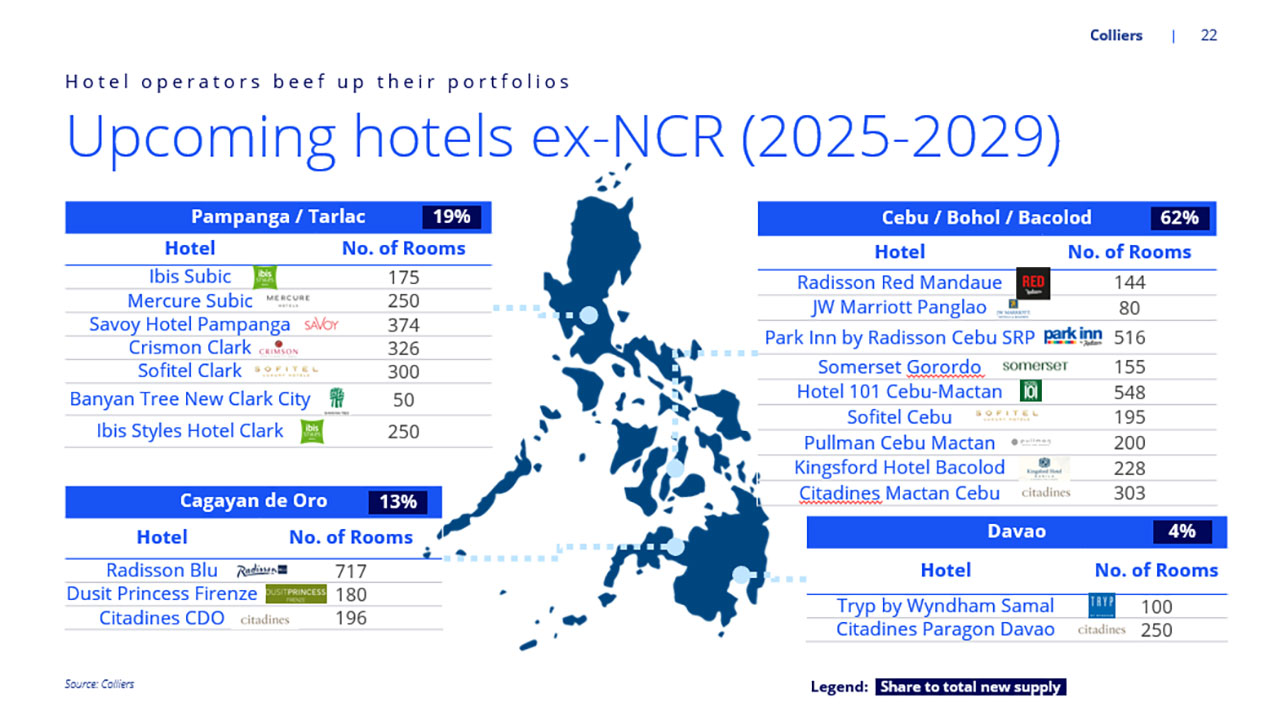
From 2025 to 2028, Colliers expects the delivery of nearly 4,000 rooms in Cebu, with foreign brands accounting for 65% of the new supply. Among the new foreign-branded hotels likely to be completed during the period include Radisson Red Mandaue, Fairfield by Marriott Mahi Mactan, Somerset Gorordo Cebu, Mercure Mactan Cebu, Sofitel Cebu City, Park Inn by Radisson Cebu South Road, Citadines Mactan, Pullman Cebu Mactan Hotel and Residences, Asai Hotel Oslob, and Hilton Garden Inn Mactan.  Foreign brands continue to expand in Cebu thru partnerships with local players and this should further excite leisure and business travelers.

Colliers believes that hotel and leisure-themed developments generally benefit from improving connectivity. Major hotel projects in the Cebu-Bohol corridor, for instance, are taking advantage of improving access and road network within Central Visayas.  These projects will only enhance Cebu and its environs’ tourism attractiveness moving forward.


Joey Roi Bondoc is the director and head of Research of Colliers Philippines. joey.bondoc@colliers.com

Peso strengthens as market digests Fed guidance

BW FILE PHOTO

THE PESO strengthened against the dollar on Monday as the market continued to digest the US Federal Reserve’s rate cut last week and policy guidance from officials.

The local unit closed at P57.056 versus the greenback, rising by 9.4 centavos from its P57.15 finish on Friday, Bankers Association of the Philippines data showed.

The peso opened Monday’s session weaker at P57.15 versus the dollar. Its intraday high was at P57.04, while its worst showing was at P57.195 against the greenback.

Dollars exchanged went down to $1.27 billion on Monday from $1.31 billion on Friday.

“The peso continued to appreciate on more dovish expectations following the Fed decision last week,” a trader said in a Viber message.

The peso was also supported by the dollar’s decline late last week after the Fed meeting and lower global crude oil prices, Rizal Commercial Banking Corp. Chief Economist Michael L. Ricafort said in a Viber message.

For Tuesday, the trader said the peso could continue to appreciate on expectations of a mild uptick in the August US personal consumption expenditures price index data to be released this week, which would support further Fed easing.

The trader sees the peso moving between P56.90 and P57.15 per dollar, while Mr. Ricafort expects it to range from P56.95 to P57.15.

The dollar rose slightly on Monday as traders looked ahead to a slew of speeches from Federal Reserve officials throughout the week that could provide further clues to the US rate outlook, after the central bank resumed its easing cycle last week, Reuters reported.

The greenback hovered near levels seen before last week’s Fed decision. The current pricing is consistent with the central bank’s messaging, which highlighted rising concerns over the labor market as the key driver of policy, analysts said.

Last week’s US economic data showed the number of Americans filing new applications for unemployment benefits fell, reversing the prior week’s jump.

“The lack of significant data until Friday’s core personal consumption expenditures inflation release leaves investors open to rethinking Fed rate cuts and the plan ahead,” said Bob Savage, head of markets macro strategy at BNY Mellon.

“Fed speakers will be important, with over 18 events planned,” he added, mentioning Chair Jerome H. Powell, but also the Cleveland Fed’s Beth Hammack and the St. Louis Fed’s Alberto Musalem given their hawkish view prior to the Fed meeting. — A.M.C. Sy with Reuters

South Asia lived with inequality. Then ‘Nepo Babies’ arrived.

STOCK PHOTO | Image from Freepik

By Mihir Sharma

SOUTH ASIA’s relative tranquility has always puzzled outsiders. It has grotesque inequality, but few revolutions. Class solidarity is rare, and its politics are seldom oriented around narrowing the gap between the rich and poor. This centuries-old stability might not, it turns out, survive the age of Instagram. In South Asia, the revolution is being streamed.

New Delhi’s political elite will be thinking carefully about events in their small Himalayan neighbor, Nepal, which is closely integrated — culturally and economically — with India. This month, mobs of young people, including college students, occupied the streets of its capital Kathmandu; the prime minister was forced to resign; 13,500 prisoners escaped when their jails were damaged; and the main government complex was set on fire. The spark for this conflagration? Short videos on TikTok and Instagram that edited together the luxurious life of Nepo Baby influencers — many related to senior politicians — with scenes of harrowing poverty.

That wasn’t all that happened: The government made major missteps, including trying to shut down social media, and using live ammunition against demonstrators. When men in uniforms kill students in the streets, protests tend to metastasize — that’s what happened in Bangladesh last year as well. In both countries, overreaction by the security forces had a great deal to do with how things turned out for those who gave them their orders.

Still, it’s strange for a movement to go from reels to revolution in a fortnight. Particularly since the pictures and videos that provoked the initial marches were not so unusual: Young people filming themselves in the expensive, manicured parts of the world where rich people congregate, while holding up designer handbags or brightly colored drinks. They could have been related to oligarchs from anywhere — Russia, maybe, or the Persian Gulf. That’s who the influencers benchmarked themselves against, perhaps: Other scions of other political elites. Not other Nepalis.

In previous decades and centuries, that would not have been a problem. Maharajas could buy Rolls-Royces, and nary a mob would turn up. But something’s changed. In 2022, protesters outraged at Sri Lanka’s economic meltdown took over the country’s presidential palace and were stunned by its luxury. In 2024, after Bangladesh’s prime minister fled the country, crowds looted furniture and handbags from her Dhaka residence — as well as a giant fish. (Some things, including jewelry and a cat, were later returned.)

Nepal’s protestors have been much more violent than their counterparts elsewhere in South Asia. Politicians’ homes were attacked, and one former prime minister’s house was burned down while his elderly wife was still inside. It is easy to see this as a trend: Anger on the streets that is more violent the longer it has been suppressed.

What of India, then? In the past, protests against corruption have helped remove governments in New Delhi. Could a building anger at inequality do the same? The country’s elite has always thought that dynasty-building is one of the perks of office, and it will take more than a revolution next door to change that.

But there have certainly been murmurs of resentment that members of the political establishment — even those who insist on self-reliance or vernacular education — send their children abroad to study. That was a crucial part of the anger in Kathmandu as well. Conspicuous consumption at home might be tolerated; much more resentment attaches to the ability to leave the country, to transcend the difficult circumstances that shackle everyone else. You can carry an expensive handbag as long as you don’t post pictures of yourself buying it on Fifth Avenue.

And perhaps that tells us something about how circumscribed, how limited this anger still is. The crowds are off the streets of Kathmandu for now, and a new prime minister, Sushila Karki, has been chosen. Her name emerged not from the streets, or from the army that won them back — but from a vote on a Discord server.

Nepal has 30 million people, and a lot of them are on the internet. But it’s a much smaller proportion that might participate in an English-language Discord poll. In the final vote, only 7,713 participated.

It is a safe bet that those 7,713 people earn a lot more than the $1,400 a year that is Nepal’s per-capita income. The Nepo Baby videos might have contrasted influencers with the country’s poorest people, but it wasn’t the most deprived who were on Discord, or on the streets holding posters inspired by Japan’s long-running One Piece manga.

Perhaps the reason that South Asia has been quiescent so long is that its upper-middle class felt it had as good a shot at a better, globalized life as the politically connected elite. But slowing growth, technological changes, and restrictions on travel and trade are closing off their options, while TikTok and Instagram insistently reminds them of what they’re missing.

Some social media networks, we know, are performative. They’re set up to inspire, but also to influence — and to generate envy. But it’s no longer just individuals whose self-esteem is affected, but entire societies. Even those with a long history of handling wealth disparities might yet be sent over the edge.

BLOOMBERG OPINION

Entertainment News (09/23/25)


The Summer I Turned Pretty gets a movie

PRIME VIDEO has just announced that the global hit series The Summer I Turned Pretty will conclude with a feature film written and directed by Jenny Han. The reveal was made during the Season 3 finale red carpet celebration in Paris, marking a milestone for the coming-of-age series. While story details are still under wraps, the film promises to deliver “a heartfelt final chapter to Belly’s journey.”


The Favors releases debut album

POP ACT The Favors, made up of acclaimed solo artists FINNEAS and Ashe, released their debut album The Dream via Darkroom Records. Its focus track is “David’s Brother,” a high-spirited song that has its own music video directed by Claudia Sulewski. The up-tempo yet nostalgic track dives into the tension of running into someone unexpectedly at a bar and balancing self-restraint. The rest of the album aims to revive the warmth and groove of 1970s pop, drawing inspiration from the golden era of Laurel Canyon and artists like Carole King and Simon & Garfunkel.


Museum of Speaking Skin opens at Shangri-La mall

AT Shangri-La Plaza, an immersive space about the beauty of skin, showcased in a way that art comes to life, will open this week. The space, set up by Lactacyd, focuses on skin science. Admission is free. The Museum of Speaking Skin opens on Sept. 25 and will run until Sept. 28.


Mind S-cool TV to premiere 7th season

THE 7th season of the show Mind S-cool TV kicks off on Sept. 28 on Cignal TV’s ONE PH channel and streaming via the Mind S-Cool YouTube channel. The educational program centers on Barangay Komplikado, a neighborhood where six Very Important Problems (VIPs) personify pressing environmental and societal issues in the Philippines: KLIMA, SARI, SUSI, UNOS, HILOM, and the elusive BUKAS. Though science-based narratives, Season 7 invites audiences of all ages to explore the interconnected challenges of climate change, biodiversity loss, sustainability, and resilience.


Chen Linong collaborates with Lola Amour

ACCLAIMED Mandopop artist Chen Linong has collaborated with Filipino band Lola Amour for a single titled “With You.” It features Mr. Chen’s crystal-clear vocals alongside the expressive tones of Lola Amour’s vocalist, Pio Dumayas. An acoustic piece, “With You,” a reflection on love and longing, was inspired by an unwritten letter to a former lover. It is out now on all digital music streaming platforms.


Cinemalaya reveals new venue partners this October

The 21st edition of Cinemalaya film festival returns with 10 full-length films and 10 short film entries in three partner venues. From Oct. 3 to 12, Shangri-La Plaza will serve as the main hub of the festival for the first time, while films will also be screened at Ayala Malls Cinemas and Gateway Cineplex 18.


Pacquiao to lead athletes in Physical: Asia

THE Physical:100 franchise has revealed the 48 contestants of Physical: Asia, a nation-vs-nation showdown. Eight countries — Korea, Japan, Thailand, Mongolia, Türkiye, Indonesia, Australia, and the Philippines — will take part in a competition of strength, strategy, and teamwork. The six-person squad for the Philippines will be led by boxing icon Manny Pacquiao. His teammates are Fil-Am national team sambo athlete Mark Mugen, strongman Ray Jefferson Querubin, national team rugby player Justin Coveney, national team hurdler Robyn Lauren Brown, and crossfit athlete Lara Liwanag. The eight-nation spectacle premieres in October, streaming on Netflix to audiences worldwide.


ONE OR EIGHT releases second track

FRESH off their VMA appearance, rising global boy group ONE OR EIGHT has released “BET YOUR LIFE,” the second track in their ongoing Anthems of Challenge series. It is out now on all digital music streaming platforms while its official music video premieres Sept. 26.


Korean thriller No Other Choice to screen in PHL

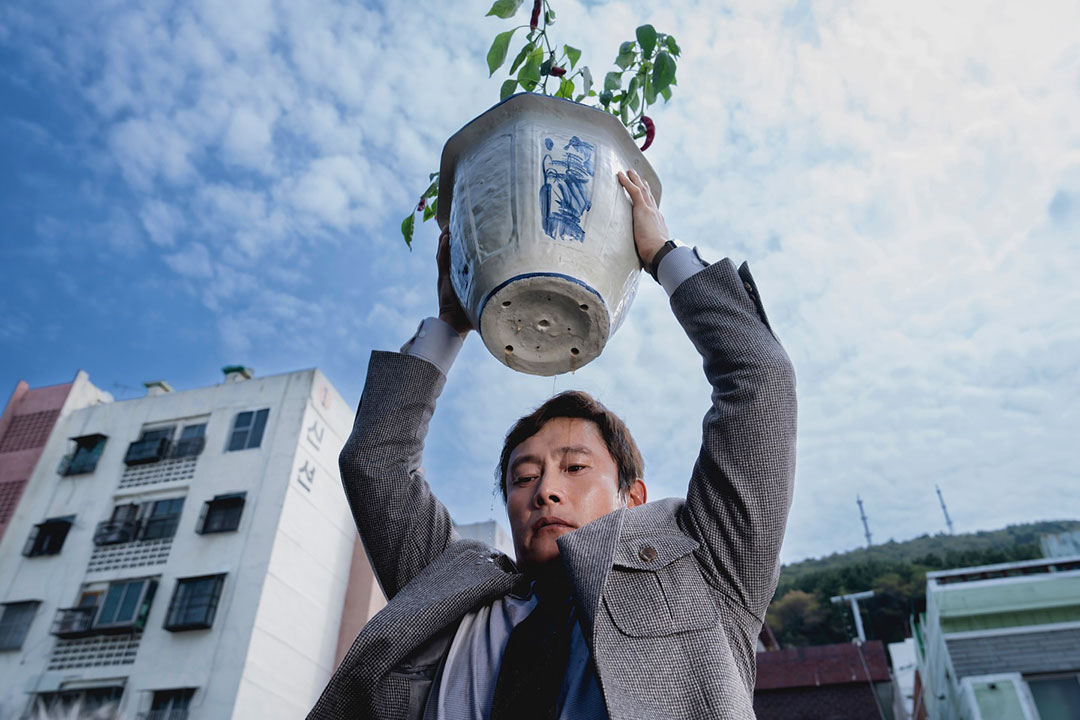
CREAZION Studios has announced that it is bringing No Other Choice, the Korean thriller by director Park Chan-wook and South Korea’s official entry to the 98th Academy Awards, to Philippine cinemas. It will premiere on Oct. 29.