BRUSSELS – European Union targets to cut CO2 emissions from vehicles, including a 100% reduction for cars by 2035, are no longer feasible, the heads of the European automobile manufacturers’ and automotive suppliers’ associations said on Wednesday.
European Commission President Ursula von der Leyen is set to host automotive sector executives on September 12 to discuss the future of the sector, which is facing twin threats of Chinese competition in electric vehicles and U.S. tariffs.
In a letter to von der Leyen, Mercedes-Benz CEO Ola Kaellenius and Matthias Zink, CEO of powertrain and chassis at Schaeffler AG, said they were committed to achieving the EU’s net zero goal in 2050.
However, they said EU manufacturers now faced near-total dependency on Asia for batteries, as well as uneven charging infrastructure, higher manufacturing costs and U.S. tariffs.
The bloc needed to go beyond new-vehicle targets, they argued, such as 55% CO2 emissions reductions from 2021 levels for cars and 50% for vans by 2030 and of 100% for both by 2035.
Electric cars have a market share of around 15% of new EU cars, with vans at 9%.
“Meeting the rigid car and van CO2 targets for 2030 and 2035 is, in today’s world, simply no longer feasible,” they wrote.
Legal mandates and penalties would not drive the transition, they wrote.
“EVs will lead the charge, but there must also be space for (plug-in) hybrids, range extenders, highly efficient internal-combustion engine vehicles, hydrogen and decarbonized fuels,” the letter said.
CO2 regulation for heavy-duty trucks and buses must also be reviewed, the two association chiefs said.
In March, the Commission agreed to give automakers extra time to meet CO2 emission reduction targets initially set for 2025. Members of von der Leyen’s center-right grouping have also called for the EU to withdraw its 2035 ban on combustion engines. — Reuters
NEW DELHI – U.S. President Donald Trump’s doubling of tariffs to as much as 50% on goods from India took effect as scheduled on Wednesday, escalating tension between the world’s two largest democracies and strategic partners.
COMMENTARY:
RADHIKA RAO, SENIOR ECONOMIST, DBS BANK:
“Even as India’s exports to the United States amount to a modest 2.3% of GDP, the sectoral impact of the second 25% tariff kicking in on Wednesday will be asymmetrical.
“Signs of downside risks to growth will also draw in the central bank’s hand, alongside potential relief on the credit and liquidity fronts.
“Meanwhile, other counterefforts, including seeking alternate markets, strengthening trade and investment ties through multilateral as well as bilateral trade deals, will be important.
“Subject to other geopolitical developments, the door for negotiations might reopen later in the year.”
RAJESWARI SENGUPTA, ASSOCIATE PROFESSOR, INDIRA GANDHI INSTITUTE OF DEVELOPMENT RESEARCH:
“The government should adopt a more trade-oriented, less protectionist strategy to boost demand, which is already slacking.
“Doing free trade agreements with multiple countries, doing regional agreements, lowering tariffs and non-trade barriers could be one way to support trade and encourage foreign direct investment.”
AASTHA GUDWANI, INDIA CHIEF ECONOMIST, BARCLAYS:
“We estimate 70% ($55 billion) of India’s exports to the United States are now under serious threat, accelerating downside risks to growth.
“From a ‘good friend’ to a ‘bad trading partner’, it has come a long way.”
SUJAN HAJRA, CHIEF ECONOMIST AND EXECUTIVE DIRECTOR, ANAND RATHI GROUP:
“Washington’s 50% tariff is a jolt, but hardly a knockout. India’s trade deficit may widen by about 0.5% of GDP, growth could dip by half a percentage point and the rupee may weaken modestly.
“Up to 2 million jobs are at risk in the near term. Yet the bigger picture is less gloomy: India’s export base is diversified, its corporate earnings and inflation outlook remain intact, and domestic demand is robust enough to cushion the blow.”
AAKANKSHA SHRAWAN, ASSISTANT PROFESSOR, NATIONAL INSTITUTE OF PUBLIC FINANCE AND POLICY:
“The government should widen its horizons and position itself well, such that it can capitalise on the most overlooked component of India’s trade flows: services.
“There is, therefore, an urgent need to have a relook at the government initiatives (Service Export from India Scheme, Software Technology Park Scheme, Digital India Internship Scheme) and governing bodies (Service Export Promotion Council and MeITY) that aim to promote India’s service exports.” — Reuters
TAIPEI – Taiwan’s government will announce the appointment of former board member of chipmaker TSMC Kung Ming-hsin as the new economy minister after his predecessor resigned for health reasons, the official Central News Agency said on Wednesday.
Mr. Kung, who will move from the role of cabinet secretary-general, had previously sat on the board of the world’s largest contract chipmaker TSMC as a representative of the company’s major shareholder, the government’s National Development Fund.
Taiwan’s cabinet declined an immediate comment. Mr. Kung’s name has been repeatedly floated as the new economy minister by Taiwanese media over the past week.
One of the ministry’s key roles is overseeing the crucial semiconductor sector in Taiwan.
It also enforces controls to ensure sensitive high-tech goods do not end up in countries subject to export curbs such as China or Russia, and oversees energy policy. — Reuters
SYDNEY – New Zealand said on Wednesday it would introduce laws in November to fast track the approval process for new supermarkets in a bid to boost competition and bring in lower prices.
Finance Minister Nicola Willis said her center-right government’s proposed rules will speed up and simplify the process to open or expand supermarkets in the country.
“We’re creating an express lane for new supermarkets to boost competition and deliver better deals for Kiwi shoppers,” Ms. Willis said in a statement.
Tough regulations and a slow approval process for new applications are blocking new competitors from gaining a foothold in the country’s grocery sector, dominated by Foodstuffs NZ and Australia’s Woolworths, Ms. Willis said.
Some respondents to a government-initiated feedback process on the sector have argued for the break up of Foodstuffs and Woolworths, Ms. Willis said.
But she said any decision “to restructure the supermarkets is not a decision that would be taken lightly” though a cost-benefit analysis will check the specific options for restructuring the duopoly.
“It would be a significant intervention that would carry costs and risks that would need to be rigorously weighted against the potential benefits to shoppers,” Ms. Willis said.
The government will instead streamline the entry of new supermarkets by appointing a single authority to oversee the entire process and also modify the foreign investment rules to clarify investment pathways.
Companies could be prosecuted if they misuse their market power to exclude or stamp out competitors, Ms. Willis said.
U.S. retailer Costco, which opened its only store in the country in Auckland in 2022, has informed the government that the initiatives to boost competition will help with the company’s future expansion plans in New Zealand, she added.
Five domestic companies have also expressed interest to enter the grocery sector. — Reuters
WASHINGTON – SpaceX’s Starship rocket on Tuesday deployed its first batch of mock Starlink satellites in space and tested new heat shield tiles on its plunge through Earth’s atmosphere, clinching development milestones that had been held up by a streak of previous testing failures.
The giant 403-foot-tall (123 m) Starship system in its tenth test flight lifted off around 7:30 p.m. EDT (2330 GMT) from SpaceX’s Starbase facilities in south Texas, followed by its towering Super Heavy booster releasing the Starship upper stage into space three minutes later, dozens of miles above ground.
Cruising in space some 30 minutes into the flight, Starship’s “Pez”-like satellite deployment system dispensed eight dummy Starlink satellites for the first time, a key demonstration for a rocket that represents the future of SpaceX’s dominant launch business.
Much is riding on the rocket’s success. NASA picked Starship to put its first astronauts on the moon’s surface since the Apollo program. And Musk sees Starship, designed to be fully reusable, as core to fulfilling his goal of routinely ferrying humans to Mars.
Starship’s blazing-hot supersonic reentry through Earth’s atmosphere over the Indian Ocean roughly an hour into the mission put a variety of hexagonal heat shield tiles to the test as billionaire Elon Musk’s space company tries to create an exterior shield that requires little to no refurbishment after each use.
Spacecraft that return to Earth have historically required new heat shields or repairs after each mission given the destructive and brutal erosion that occurs from high-speed atmospheric friction. The heat shield tiles on NASA’s retired Space Shuttle were fit for dozens of missions, though some had to be replaced.
“There are thousands of engineering challenges that remain, for both the ship and the booster, but maybe the single biggest one is the reusable orbital heat shield,” Mr. Musk said on Monday on a SpaceX live stream.
The mission concluded with a steady, engine-guided vertical landing on the ocean’s surface west of Australia.
The 171-foot-tall Starship then toppled over before exploding into a giant fireball, an expected demise likely triggered by its flight termination system.
The test flight showed long-sought progress in SpaceX’s test-to-failure development campaign after three previous failures occurred much earlier in flight and on a test stand in Texas.
Acting NASA Administrator Sean Duffy congratulated SpaceX on X and said: “Flight 10’s success paves the way for the Starship Human Landing System that will bring American astronauts back to the Moon on Artemis III.”
Artemis 3, the first crewed moon landing under NASA’s Artemis program that will use Starship, is scheduled to occur in 2027, though space analysts expect that date to slip.
A lengthy development to-do list remains for SpaceX’s next-generation rocket before it can fly humans into deep space, including novel in-space refueling demonstrations and sticking a safe landing on the rugged lunar terrain.
SpaceX, which Mr. Musk expects to record around $15.5 billion in revenue this year, has swiftly churned out new Starship prototypes at Starbase, a sprawling and rapidly growing rocket industrial complex. The area was made a municipality in May by local voters, many of them SpaceX workers.
SpaceX’s Starlink satellite internet business, a major source of company revenue, is tied to Starship’s success. Mr. Musk aims to use Starship to launch larger batches of Starlink satellites, which have so far been deployed by SpaceX’s workhorse Falcon 9 rocket, into space.
On Tuesday’s flight, Starship’s 232-foot-tall Super Heavy booster, which normally returns to land in its launch tower’s giant chopstick-like catch-arms, instead targeted the Gulf of Mexico waters after lofting Starship to space. The water landing was meant to demonstrate an alternate landing engine configuration. — Reuters
Riding the momentum of a successful Forum 1, Forum 2 of the I AM SECURE 2025 cybersecurity awareness campaign once again united the country’s top cyber minds at Makati Diamond Residences. With the recurring theme “Priming for Cyber Defense: The Consummate Strategy,” the forum delved deeper into how cognitive priming shapes the ethical and behavioral dimensions of cyber defense strategies.
In his opening address, ISOG President Chito Jacinto drew focus toward the human-centered core of cybersecurity efforts. “We turn our focus not just to the ‘how,’ but to the ‘should’ — not just the tool, but the ethics and outcomes behind using priming in our cyber strategies. At the heart of this forum is a belief we share: The human layer of cybersecurity is not a vulnerability — it’s a strategic advantage. But only if we invest in it responsibly.”
ISOG Vice-President Alvin Punsalan issued a call to action rooted in responsibility and leadership: “We must champion transparency, autonomy, and respect for users’ choices. That’s how ethical cybersecurity is done. I invite all of us — cyber leaders, security awareness champions — to rise to this next challenge: Let us expand our defenses beyond systems and code, and into the real behavior of real people. As ISOG, we are not just observers of change — we are drivers of it.”
Law Enforcement Perspective Anchors Keynote
Keynote Speaker Police Brigadier General Bernard R. Yang, Director of the Philippine National Police Anti-Cybercrime Group, inspired attendees with a compelling address on “Combating Emerging Cybercrimes: Insights from the Field.” His speech provided an eye-opening look into law enforcement’s evolving strategies and commitment to ensuring digital safety for every Filipino.
Thought Leadership in Action
The forum’s agenda was anchored by two powerful panel discussions, both moderated by Atty. Laurice Esteban-Tuason, SVP for Corporate Compliance and Data Protection and Corporate Sustainability Officer at Converge ICT Solutions, Inc., and a 2024 I AM SECURE Cybersecurity Excellence Awardee.
Panel 1: “The Ethics of Cybersecurity Priming: How Far is Too Far?”
Attendees gained new insights on ethical boundaries in applying behavioral science to cybersecurity. This high-level discussion tackled consent, autonomy, and transparency, with panelists from Titanium sponsors and a guest speaker from SGS.
Panel 2: “Measuring the Success of Priming Techniques in Reducing Cybersecurity Breaches”
This session explored the data-driven side of priming. Panelists — drawn from Platinum sponsors and ISOG cybersecurity 2022 and 2024 awardees — shared how their organizations assess priming’s effectiveness in reducing incidents, enhancing compliance, and driving behavioral change.
Awardees and Thought Leaders Spotlighted
Forum 2 also recognized several I AM SECURE Cybersecurity Excellence Awardees from 2022 and 2024, whose contributions to data protection and cyber awareness continue to raise the bar: Rookie Nagtalon, Strategic Business Adviser, Aidea Group of Companies; Atty. Rommel Oquendo, DPO and Head of Data Privacy, Metrobank; Calvert Cabungcal, CIO & DPO, J-Del Investments & Management Corp.; and Carlos Tengkiat, CISO, Rizal Commercial Banking Corp.
Special Guest Speaker: Roger S. Villanueva, Business Director for Business Assurance, SGS Philippines, Inc.
Sponsors Showcase Innovation and Collaboration
Titanium Sponsors: Linette Managhaya, Senior Sales Engineer, Sophos (via WSI); Christina Tee-Bautista, Senior Presales Consultant, Trend Micro (via VST-ECS); April Cacho, Solutions Senior Engineer, Trends & Technologies, Inc.
Cloudflare was also featured through a digital campaign display and an interactive survey.
Platinum Sponsors: David Medallo, President, Human Managed; Jessica Bernardo, Senior Solutions Architect, Infoblox
Gold Sponsors: Lau Boon Peng, Area VP, Sales Engineer, APAC, Menlo Security (via Novare); Atty. Elias Omar Sana, Head of Public Policy, Huawei Technologies Philippines
Silver Sponsor: Harley Magsino, Country Manager, Arcon
Forum Features: Digital Engagement & Global Partnerships
Attendees enjoyed a vibrant mix of activities, including interactive raffles, speed networking sessions, and a grand draw during the festive closing ceremony. The event also reinforced ISOG’s commitment to strategic global engagement, spotlighting its role as a supporting association of GovWare — Asia’s premier cybersecurity event and a key feature of the Singapore International Cyber Week (SICW). Happening from Oct. 21-23, 2025 at the Sands Expo and Convention Centre, Singapore, ISOG members will enjoy exclusive discounts as part of this partnership.
This collaboration, secured through the I AM SECURE program, marks a significant milestone in ISOG’s ongoing efforts to expand its influence on the global cybersecurity stage.
Previous, forum last June 19, featured sponsors:
Titanium Sponsors: F5 through Westcon, NMI, Rapid7, Arista through Netsec, Qualys, Fortinet through Netsec, and VST-ECS; Platinum Sponsors: Forcepoint,Palo Alto through Westcon, KnowBe4, Zscaler through Westcon; Gold Sponsors: Security Scorecard through Netsec; and Silver Sponsor: Gigamon with Extrahop
What’s Next?
The energy continues with the much-anticipated ISOGx Cybersecurity Solution Pitch & Exhibition, happening on Oct. 2, 2025, at the SMX Convention Center, SM Aura, Bonifacio Global City. This TEDx-style event will showcase short, impactful presentations from cybersecurity leaders and solution innovators across the region.
Media partners: BusinessWorld, DWDD AFP Radio, DIGI.PH, and Tech Travel Monitor
Event curation: XMS, partner of ISOG for I AM SECURE driven events
Spotlight is BusinessWorld’s sponsored section that allows advertisers to amplify their brand and connect with BusinessWorld’s audience by publishing their stories on the BusinessWorld Web site. For more information, send an email to online@bworldonline.com.
Join us on Viber at https://bit.ly/3hv6bLA to get more updates and subscribe to BusinessWorld’s titles and get exclusive content through www.bworld-x.com.
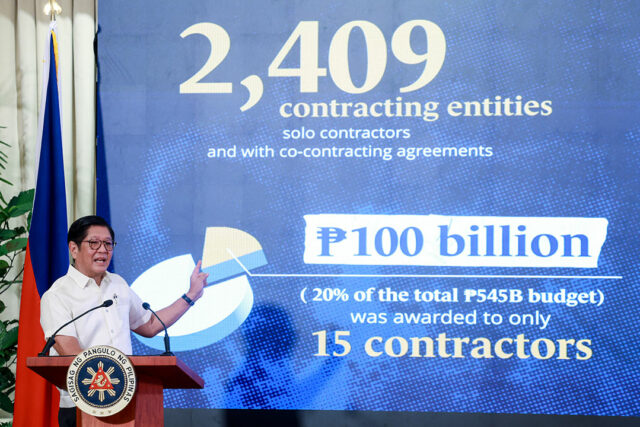
President Ferdinand R. Marcos, Jr. earlier this month launched a new website www.sumbongsapangulo.ph, where citizens can report anomalous flood control projects. — PHILIPPINE STAR/NOEL B. PABALATE
THE BUREAU of Internal Revenue (BIR) will investigate the contractors allegedly involved in anomalous flood control projects for possible tax fraud, according to Commissioner Romeo D. Lumagui, Jr.
“The BIR will undertake a parallel investigation of contractors implicated in irregular flood control projects. We will support the President’s crusade by auditing the tax returns and payments of these entities,” Mr. Lumagui said in a statement on Tuesday.
The tax agency’s probe comes after President Ferdinand R. Marcos, Jr. ordered a sweeping crackdown on corruption in public works, particularly in flood control.
Mr. Marcos earlier this month identified 15 contractors that have cornered around 20% or P100 billion worth of flood control projects out of the P545-billion budget since 2022.
Mr. Lumagui said the tax fraud investigation will focus on the contractors involved in these anomalous flood control projects as identified by Mr. Marcos.
“Should any contractor be found to have underpaid or evaded taxes, the BIR will not issue an updated tax clearance to them. The contractor will be disqualified from participating in future government procurements, and the final settlement of their existing government contracts will be suspended,” he said.
Under Revenue Regulation (RR) No. 17-2024, contractors must secure an updated tax clearance from the BIR before the final settlement of any government contract.
Failure to present this clearance will result in the suspension of contract settlements and the imposition of a tax lien over the contract amount in favor of the government, the BIR said.
The updated clearance guarantees that every contractor has no outstanding tax liabilities and has duly filed and paid all applicable taxes.
The BIR clarified that this document is different from the required initial tax clearance during the eligibility phase of the procurement process.
These clauses under Sections 2 and 3 of RR No. 17-2024 are meant to safeguard public funds from contractors who fail to comply with tax obligations.
Additionally, Section 235 of the National Internal Revenue Code authorizes the BIR to conduct multiple audits within the same taxable year in cases involving fraud or irregularities, as determined by the commissioner.
Earlier this week, the Department of Public Works and Highways announced the suspension of District Engineer Abelardo D. Calalo, who allegedly offered around P3.13 million in cash to Batangas Rep. Leandro L. Leviste to dissuade investigations into anomalies in flood control projects.
Meanwhile, Mr. Lumagui said those contractors involved in “ghost” projects will be issued deficiency tax assessments, once the BIR receives official certification from relevant agencies that there were no actual projects.
“If the BIR, through certification or endorsement from the appropriate government agencies, confirms that a flood control project is a ghost project, we will disallow all related cost and expense claims,” he said.
“No project means no deductible expense. A tax deficiency assessment will be issued accordingly.”
The Senate and House of Representatives have launched inquiries into the alleged irregularities in flood control projects. — Aubrey Rose A. Inosante
Toy figures of people are seen in front of the displayed logos of Disney +, HBO Max, Apple TV, Netflix, Hulu and Prime Video. — REUTERS/DADO RUVIC/ILLUSTRATION
By Aubrey Rose A. Inosante and Justine Irish D. Tabile, Reporters
THE PHILIPPINES may face additional tariffs after US President Donald J. Trump’s fresh tariff threat against countries that impose digital taxes on US technology companies, analysts said.
In a post on Truth Social, Mr. Trump threatened countries that have digital taxes with “substantial additional tariffs” on their exports to the US if they do not remove these laws.
“With this truth, I put all countries with digital taxes, legislation, rules, or regulations, on notice that unless these discriminatory actions are removed, I, as President of the United States, will impose substantial additional tariffs on that country’s exports to the USA, and institute export restrictions on our highly protected technology and chips,” Mr. Trump said.
The Philippines, which began enforcing its digital tax law in June, may be among the countries facing additional US tariffs.
“Likely to have an impact on us since we impose 12% VAT (value-added tax) on digital services,” Ateneo Center for Economic Research and Development Director Ser Percival K. Peña-Reyes said in a Viber message.
Republic Act No. 12023 imposes a 12% VAT on nonresident digital service providers such as Netflix, Amazon, and Google. The law aims to level the playing field between local and foreign digital platforms.
“This could be part of Trump’s reciprocal tariffs on digital transactions that are taxed by different countries around the world, especially by developed countries,” Rizal Commercial Banking Corp. Chief Economist Michael L. Ricafort said in a Viber message.
“So, there is a risk of retaliatory US tariffs in the country (Philippines), though the effect could still be minimal or negligible,” he added.
Mr. Peña-Reyes warned that the US may hike the current 19% tariff on Philippine goods since Mr. Trump remains “unpredictable.”
The US began imposing a 19% tariff on Philippines goods on Aug. 7.
Mr. Ricafort said the US president could still try to get concessions in terms of reduced digital transaction taxes for US companies as part of the trade negotiations.
Mr. Trump in February signed a memorandum to combat the digital service taxes imposed by foreign governments on American companies.
The directive renewed the digital service tax investigations that were initiated during Mr. Trump’s first term while also investigating additional countries that use digital service tax.
Analysts cautioned the Philippine government against hastily lifting the VAT on US technology firms.
“(This is) something the government should study and weigh carefully — revenues lost from lifting tax versus revenues from lower exports due to higher tariff,” Mr. Peña-Reyes said.
The Department of Finance has estimated that the government will generate P102.12 billion in revenue from digital VAT collections between 2025 and 2028.
“It’s hard to be optimistic that the trade benefits we may get from lifting taxes will be greater than the impact of additional revenues we may get from taxes which, if used correctly, may help in developing industries through government support and additional incentives,” Matt Reinielle M. Erece, an economist at Oikonomia Advisory and Research, Inc., said.
Asian Consulting Group Founding Chairman and Chief Tax Advisor Raymond A. Abrea said that the Philippine law is not solely targeted at US tech giants, “but reflects a broader global move to modernize tax systems in the digital age.”
“The Philippines did not create a separate digital tax. We simply expanded VAT to include online transactions and digital service providers, ensuring fairness between traditional and digital businesses,” Mr. Abrea said in a Viber message.
Mr. Trump had claimed these digital taxes were “designed to harm, or discriminate against American technology,” while giving a pass for Chinese firms.
Meanwhile, Mr. Erece said the threat of additional tariffs poses risks to the country’s export sector and broader economic performance.
“Therefore, the country must do two things: continue close but persistent trade negotiations with the US but also be aggressive in supporting and incentivizing exporting industries to develop competitive goods that remain attractive to foreign consumers despite tariffs being in place,” he said.
Philippine Chamber of Commerce and Industry Chairman George T. Barcelon said that businesses are in a wait-and-see stance until the new tariffs are clarified.
“We are taxing services that come from the US, like a lot of software platforms. Even if it’s on the cloud, on a prescription basis, now, there’s already a VAT,” Mr. Barcelon said in a phone interview.
“I do not know whether that translates to the fact that President Trump will impose their version of a tax on our exports. But it sounds like that will be the effect,” he added.
Meanwhile, the 19% US tariff is expected to have a smaller impact on the Philippine economy than previously expected, Fitch Solutions’ unit BMI said.
“We estimate that the revised tariff rate will lead to a 0.4-percentage-point (ppt) reduction in output over the medium term, a significant improvement from the 1.4-ppt decline we estimated in April,” BMI said in a report.
BMI said it maintained its full-year gross domestic product (GDP) growth forecast for the Philippines at 5.4% as it expects global economic conditions to deteriorate in the second half when US tariffs take effect.
BMI’s forecast is below the government’s 5.5-6.5% GDP growth target for the year.
“The Philippines remains a largely domestically driven economy. While interest rates have eased considerably from their peak, erratic US trade policies will weigh on global investor sentiment and limit foreign direct investment inflows,” BMI said.
“As such, we see little prospect for a meaningful investment recovery in the near term. Household consumption is showing similar weakness. Import volumes — a reliable proxy for private spending — continue to contract sharply and recent consumer surveys suggest confidence has eroded further as trade tensions escalate,” it added. — with K.K.Chan
Gambling dice and chips are seen on the keyboard in this illustration picture, June 5, 2020. — REUTERS/DADO RUVIC/ILLUSTRATION
THE BANGKO SENTRAL ng Pilipinas (BSP) is still studying further regulations to help curb risks related to e-gambling, as the proliferation of illegal sites could derail the country’s anti-money laundering efforts.
BSP Governor Eli M. Remolona, Jr. said the central bank can do more to tighten safeguards on e-gambling, after it ordered all electronic wallet providers to remove in-app gambling assets.
“We’re still studying it. Basically, as before, we just want to put sand in the wheels. Marami pang pwedeng gawin (There’s more that can be done)… along the same lines,” he told reporters on the sidelines of the 2025 Manila Tech Summit in Taguig City.
Following the BSP’s order, e-wallets, banks, and its other supervised institutions have removed links that would direct users to gaming or gambling websites.
Asked if the rise of e-gambling could affect the Philippines’ efforts to remain out of the Financial Action Task Force (FATF) “gray list,” Mr. Remolona replied: “Yes, but this will be resolved.”
He said illegal gambling sites will be addressed by the Department of Information and Communications Technology.
In February, the FATF removed the Philippines from its list of jurisdictions under increased monitoring for “dirty money” after over three years or since June 2021.
The next assessment is slated for 2027, when the FATF will verify if the country’s anti-money laundering measures are being sustained and still in place.
In June, the European Commission removed the Philippines from its list of “third countries” flagged with “high risk” of money laundering and terrorism financing.
“Exiting the FATF gray list and EU’s (European Union) high-risk list this year was not just compliance, it was a global validation,” Fintech Alliance.PH Chairman and Rizal Commercial Banking Corp. Executive Vice-President and Chief Innovation and Inclusion Officer Angelito “Lito” M. Villanueva said in a speech during the Tech Summit.
Mr. Villanueva said the organization condemns the misuse of digital payment platforms for e-gambling.
“We uphold a zero-tolerance policy against the misuse of digital payment platforms for illegal businesses, especially online gambling,” Mr. Villanueva said. “Consumer protection and industry integrity are nonnegotiable.”
In recent years, e-wallets have helped fuel the popularity of gambling websites after integrating gambling-related services in their apps, making it easy for users to access online casinos.
However, concerns over rising gambling addiction and mounting debt have prompted lawmakers and regulators to consider measures to ban or restrict online gambling in the country.
Union Bank of the Philippines, Inc. Chief Economist Ruben Carlo O. Asuncion said the government risks losing its “hard-won gains” against money laundering if it has no clear action on unregulated e-gambling platforms.
“The rapid growth of online gambling, especially through unregulated platforms, poses a real threat to the Philippines’ progress in exiting the FATF gray list,” Mr. Asuncion said in a Viber message. “Weak KYC (know-your-customer) controls and cross-border anonymity make it a prime channel for illicit financial flows.”
He also noted that the BSP should finalize its regulations on gambling-related financial activity to curb its potential impact on the country’s anti-money laundering efforts.
“To safeguard our AML standing, the BSP must tighten oversight of e-gambling transactions — enforcing stricter KYC, banning unlicensed operators, and finalizing rules that flag or restrict gambling-related financial activity,” Mr. Asuncion said.
“Collaboration with fintechs (financial technology) and legislative support will be key to closing regulatory gaps,” he added.
The BSP is still finalizing new rules to mitigate gambling-related harm by strengthening financial safeguards across banks, e-wallets, and payment platforms.
The central bank had also proposed measures such as biometric ID checks, daily transaction limits, time-based payment restrictions, and user tools for spending caps, voluntary breaks, and self-exclusion.
It said these safeguards aim to curb addiction, fraud, and financial harm while encouraging responsible use of digital finance. — Katherine K. Chan
Rooftop solar facility refers to a solar photovoltaic (PV) energy generating system built on the rooftop of a residential, commercial building, or industrial facility, which is used for self-consumption or commercial purposes. This file photo shows solar panels set up on the roof of a home in Algete, outside Madrid, Spain. — REUTERS/SUSANA VERA
By Sheldeen Joy Talavera, Reporter
WHILE rooftop solar financing in the Philippines is gaining traction, more efforts are needed to unlock its potential, according to major banks.
Dexter Lloyd C. Cuajotor, head of retail lending at Bank of the Philippine Islands (BPI), said the demand for solar rooftop financing solutions are expected to continue to expand in the coming years.
“BPI is optimistic about the rising demand for solar financing, driven by the steady growth in solar energy adoption, supported by the continued decline in solar installation costs brought by more solar panel providers in the market, more favorable government policies and stronger awareness campaigns that highlight the benefits of renewable energy,” he told BusinessWorld.
Rooftop solar facility refers to a solar photovoltaic (PV) energy generating system built on the rooftop of a residential, commercial building, or industrial facility, which is used for self-consumption or commercial purposes.
As of April, behind-the-meter solar PV systems had an installed capacity of 46 megawatts, data from the Department of Energy (DoE) showed.
Compared with large-scale renewable energy projects, rooftop solar projects tend to be viewed to be “lower risk and more scalable” as they require less capital expenditures and are quicker to implement, Mr. Cuajotor said.
He said that among the challenges faced by banks when evaluating rooftop solar financing are the availability of reliable solar panel providers, insufficient collateral property to cover the loan, and when savings on electricity do not cover the monthly amortization.
“The financing requirements of rooftop solar systems are generally much smaller versus utility-scale solar projects, so it is understandable that there is more attention on the latter,” Juan Paolo E. Colet, managing director of China Bank Capital Corp., said via Viber.
Mr. Colet said that there are banks that are supportive of rooftop solar developers amid growing demand for loans in the sector.
“When we evaluate potential rooftop solar financing deals, it’s important that our bank gets comfortable with the capabilities and track record of the developers and suppliers, the profile of the energy customers or offtakers, the quality of the contracts, and the size and characteristics of the project portfolio,” he said.
Eduardo V. Francisco, president of BDO Capital and Investment Corp., said that financing for rooftop solar loans is challenging as banks look at these individually, instead of portfolio lending.
“We don’t look at the rooftop solar as a security investment unlike buying a car or a home. So, we have to do something,” he said.
However, for a small installer of rooftop solar, what is needed is a type of financing that allows a “simple process, small loans, and faster turnaround,” according to Philippine Solar and Storage Energy Alliance Chairman Theresa Cruz-Capellan.
“Banks are a very reliable source of credit and financing. But they are not the best option for homeowners or small business for rooftop solar financing,” she said.
“The steps required by the banks, not because they like to, but because they are regulated and subjected to a lot of laws, are cumbersome for a small installer or homeowner to deal with,” she added.
Ms. Cruz-Capellan said that the industry is working on opening a way for everyone to access funds, especially amid a significant downtrend in the cost of solar panels.
The DoE is seeking to promote solar roof-mounted technologies to empower more electricity end-users and augment power supply in the country.
Aside from net metering, a program allowing electricity end-users to install renewable energy facilities and export excess power to the grid, the DoE has also paved the way for new business opportunities to solar PV developers.
Citing the Expanded Roof-mounted Solar Program, Energy Undersecretary Mylene C. Capongcol said that solar PV owners can inject power to the grid during a supply shortfall, lease or rent available rooftops for solar power projects, and peer-to-peer power sharing schemes.
“Locators or business establishments with rooftop solar may trade among each other and the excess is sold to the grid,” she said.
SHARES of Global Ferronickel Holdings, Inc. (FNI) fell on Tuesday as investors reacted to the arrest of the mining company’s chairman, Joseph C. Sy, over allegations that he misrepresented his citizenship.
FNI shares sank by 12.14% or 17 centavos to P1.23 apiece at the close of Tuesday’s trading.
“Most likely the decline in the share price of FNI is related to the arrest of its chairman, Joseph C. Sy, due to alleged immigration violations,” AP Securities, Inc. Research Head Alfred Benjamin R. Garcia said in a Viber message.
“Most likely sentiment towards the company won’t improve until the issue is resolved,” he added.
In separate stock exchange disclosures on Tuesday, FNI said Mr. Sy has been placed under detention by the Bureau of Immigration (BI) over an allegation of being an “overstaying alien.”
Mr. Sy, arrested on Aug. 21, now faces a deportation case for misrepresentation.
However, FNI said the charge has “no lawful basis” since Mr. Sy is a Filipino citizen, as affirmed in multiple rulings by various government agencies, including the BI, the Department of Justice, the Office of the President, the Securities and Exchange Commission, and the Supreme Court.
FNI also said that Mr. Sy has formally disputed the BI’s allegation through a motion to dismiss filed with the BI.
“We are confident that this matter will be resolved in accordance with the rule of law. In the meantime, we assure all stakeholders that the operations of FNI and its subsidiaries remain stable, unaffected, and fully compliant with all applicable regulations,” FNI said.
FNI also noted that Mr. Sy has never been involved in any criminal activity, describing him as a longstanding, multi-awarded business leader whose initiatives have created livelihood opportunities and socio-economic infrastructure for communities.
Meanwhile, FNI said it has initiated an internal review regarding the matter involving Mr. Sy.
If Mr. Sy is deemed an alien, FNI said it is ready to comply with national requirements through the divestment of his shareholdings to qualified holders, as well as coordinating with regulatory agencies to meet all legal and administrative obligations.
The company said it will also implement corporate actions to ensure the continuity of leadership and business operations.
“The citizenship case involving Mr. Joseph Sy pertains to him in his personal capacity. FNI, as a corporation, has a separate and independent juridical personality from its shareholders and officers. The company continues to operate in the ordinary course of business with its full management and organizational complement,” it said.
FNI is engaged in nickel ore mining, logistics, cement and steel production, and port operations.
HANN HOLDINGS, INC. said its decision to defer its P13-billion initial public offering (IPO), originally scheduled for listing next month, aims to protect investors until market conditions improve.
“We believe it is in the best interests of our investors and stakeholders to enter the market when conditions will allow for a fair reflection of the value we have created and the opportunities ahead,” Hann Holdings Chairman, President, and Chief Executive Officer Dae Sik Han said in an e-mailed statement on Tuesday.
“Our decision to defer the offering and listing is a matter of timing, not fundamentals. The strength of our business, our growth pipeline, and our long-term strategy remain firmly intact,” he added.
Hann Holdings, which operates the Hann Casino Resort in Clark, Pampanga, was supposed to be the second IPO this year, following Cebu-based fuel retailer and distributor Top Line Business Development Corp. The Philippine Stock Exchange expects six IPOs this year.
The company said it intends to proceed with the public listing at an “opportune time when market and industry conditions are more favorable.”
“In the meantime, we remain fully committed to executing our business plans, advancing our strategic initiatives, and maintaining governance and disclosure practices at the highest level,” Mr. Han said.
“When the right window emerges, we are confident that our listing will be a catalyst for further growth,” he added.
Last week, various news outlets reported that Hann Holdings opted to defer its IPO, citing market conditions. This reversed the company’s stance earlier this month when it said there was no expected pushback on its public listing.
According to the company, its stock market debut was postponed after consultations with advisers and stakeholders.
“The company continues to execute strongly on its business strategy and growth initiatives. However, it believes that current market conditions do not allow for an offering outcome that would accurately reflect its intrinsic value and long-term prospects,” it said.
“Against this backdrop, Hann Holdings has acted decisively to protect investor value by deferring its listing until conditions are more conducive,” it added.
Hann Holdings’ IPO consists of a primary offer of up to 500 million common shares and an overallotment option of up to 50 million secondary common shares, priced at up to P23.60 apiece. The overallotment option will be offered by Hann Holdings’ parent company, Hann Group Holdings W.L.L.
The offer period was supposed to run from Sept. 9 to 15, with listing on Sept. 23, according to the latest prospectus dated July 31.
Hann Holdings projected P11.43 billion in net proceeds, which will fund the development and expansion plans of Hann Philippines, Inc., as well as general corporate purposes.
The company tapped CLSA Ltd. as the sole global coordinator for the IPO. It will also serve as joint bookrunner, together with domestic underwriters Asia United Bank Corp., BDO Capital & Investment Corp., China Bank Capital Corp., and PNB Capital and Investment Corp. — Revin Mikhael D. Ochave