Home Blog Page 5999

Philippine DoJ indicts BPI official for involvement in Wirecard fraud

REUTERS

GOVERNMENT prosecutors have indicted an assistant manager of the Bank of the Philippine Islands (BPI) over his alleged involvement in a financial fraud at German payment company Wirecard AG, the Department of Justice (DoJ) said on Thursday.

The bank official was charged with four counts of falsification of bank certificates and two counts of violating the General Banking Act of 2010, it said.

DoJ added that it had dropped charges against other suspects for lack of evidence. It had yet to publish a copy of the charge sheet.

Under the law, bank officials are barred from making false entries in bank reports.

The Southeast Asian nation became embroiled in the collapse of Wirecard in June 2020, with the payment company initially claiming it had kept $2.1 billion in two Philippine banks, which the central bank and the lenders denied.

In 2020, the Bangko Sentral ng Pilipinas (BSP) said the money related to the incident did not enter the country, citing the country’s “strong financial oversight” against possible threats.

The Anti-Money Laundering Council in September 2020 said authorities were investigating 57 foreign and local “persons of interest” potentially involved in the scandal.

In June, global financial crime watchdog Financial Action Task Force (FATF) kept the Philippines on its gray list, citing the need to strengthen its action plan to address deficiencies in monitoring “dirty money” risks. — John Victor D. Ordoñez

PHL seen on track for 6-7% growth in 2022

PHILSTAR FILE PHOTO

THE economy’s 7.8% expansion in the first half, driven by investment and consumer spending, keeps it on pace for 6-7% growth for the full year even amid a global slowdown, First Metro Investment Corp. (FMIC) and the University of Asia and the Pacific (UA&P) said.

“The continuation of easing of alert levels, removal of tourism restrictions, return to work and school, among other initiatives, should support the economy which shows gradual recovery with respect to pre-pandemic performance,” the two institutions’ economists said in the August edition of their economic briefing, known as the Market Call.

Slower growth is expected in the second half given the absence of election spending and the likelihood of inflation exceeding 6% for the rest of the year, they said.

“While crude oil prices have stuck below $100 (per) barrel, the upward price effect on other consumer items since its earlier sharp runup this year may linger on for another three to four months, and so headline inflation will likely remain above 6% for most of the second half,” the economists said.

The 6% estimate is higher than the FMIC and UA&P’s earlier inflation forecast of 5-5.2% this year and the central bank’s 2-4% target.

The peso is also likely to weaken past P55 amid continued pressure for the remainder of the year, regardless of the impact of OFW remittances in the fourth quarter, as the Federal Reserve is expected to remain hawkish on rates to contain inflation.

The addition of 528,000 to the ranks of the employed in June and the positive impact on income of the peso’s depreciation “should offset likely fragility of inflation-beaten consumers” and drive further consumption-driven growth.

“The peso depreciated by 4.3% in July, but that means more income in the pockets of OFW (overseas Filipino workers) families, BPO (business process outsourcing) workers, exporters, and their suppliers, with an estimated 70 million beneficiaries,” FMIC and UA&P said.

“While we expect a slight slowdown in National Government spending, we do not think it will matter much, since the private sector has stepped up with close to 1 million jobs added in May and June. The National Government still has P1 trillion in unused (budget funds) for the second half while tax revenue will likely continue to outperform,” it added.

Healthy growth in investment spending is also expected to be maintained “as firms strive to catch up capacity to the unexpectedly faster rise in spending.”

However, the slight easing of manufacturing activity in July, as reflected in the Purchasing Managers’ Index (PMI) reading of 50.8 from 53.8 in June, indicates the presence of factors that may hinder economic activity.

Its assessment of the S&P Global Philippines Manufacturing PMI is that “while the modest expansion (of 50.8) showed up in employment gains, supply side issues persisted. Some of the drivers include global uncertainties, weakened client demand from foreign markets, logistical challenges, and port congestion.”

The PMI is a leading indicator of economic activity as raw material orders by the manufacturing sector are considered a proxy for the industry’s forecast for future demand. A reading above 50 signals an expansion in manufacturing activity, while a reading below 50 signals a decline.

The economy in the second half needs to grow by 5.2% to hit the lower end of the 2022 growth target of 6.5%, according to the Marcos administration. — Diego Gabriel C. Robles

Farm lobby says sugar tariffication could bring repeat of rice hardships

PHILSTAR FILE PHOTO

By Luisa Maria Jacinta C. Jocson, Reporter

THE farming industry said a liberal import regime for sugar could result in a repeat of the hardships endured by rice farmers when that commodity was subjected to tariffication.

“I have a few reservations (about sugar tariffication). The worry here is we might be jumping from the frying pan into the fire. What is happening now looks like a replay of what happened to rice in 2018. During that time, the rice inventory of the National Food Authority (NFA) fell to as low as a one- or two-day supply,” Federation of Free Farmers Chairman Leonardo Q. Montemayor said in an interview with ANC on Thursday.

“During the past three years, rice farmers have lost, based on data, at least P70 billion because of the depressed palay (unmilled rice) prices every year due to the non-stop entry of imports,” he added.

Bangko Sentral ng Pilipinas Governor Felipe M. Medalla on Wednesday raised the possibility of implementing a tariffication scheme on the sugar industry, emulating the Rice Tariffication Law of 2019.

The law liberalized the entry of foreign rice, whose importers needed to pay a 35% tariff on shipments from Southeast Asia, raising revenue for the government.

In compensation for exposing farmers to foreign competition, the law set up the Rice Competitiveness Enhancement Fund, which gets P10 billion a year from tariffs to support farm mechanization, credit assistance, and seed development, among others.

“The problem is when you allow imports… you really need the bureaucracy to decide,” Mr. Medalla said, adding that the rice model forces a choice on tariff levels to protect the domestic industry. “Do you want 100% tariff? Do you want 75%? So let the debate be on the tariff level,” Mr. Medalla said at an economic forum.

“Let people who bet their money on whether there will be a shortage or surplus do the importing, because they have the biggest incentive to get their forecast right, because if you forecast a shortage and import and there’s no shortage, you lose your money,” he added.

Mr. Medalla said that tariffs are a “transparent and efficient” scheme compared with import allocations decided by bureaucrats.

“The nice thing about tariffs is the revenue that’s raised can be used to target assistance, in this case, the farmers. So that’s another nice experience rather than bureaucrats who may actually get under the table payments for giving import allotments. At least the government captures the price difference,” he added.

According to Mr. Montemayor, a “dangerous” aspect of tariffication is that the government will be unable to regulate illegal imports.

“The government might lose the ability to regulate the industry’s fly-by-night importers or profiteers. We will be completely helpless. This might happen to our sugar sector if we are not careful… we want to make sure our farmers and workers are protected,” he said.

Mr. Montemayor said that the priority should be directed towards investing in modernization and providing subsidies to offset high input costs.

“With or without sugar tariffs, it’s critical that we strengthen our sugar industry. What happened in rice is that they totally liberalized the rice industry without (raising) the competitiveness (of rice farmers),” he said.

“It’s critical we start soon on the problem of fertilizer; subsidies for sugar planters, modernization for sugar mills, research and development for better varieties. We have to look for funding and support. That cannot be done overnight. It will take years,” he added.

Samahang Industriya ng Agrikultura Executive Director Jayson H. Cainglet said that the tariffication scheme can be replicated for other agricultural commodities, raising sufficient revenue that can go directly to the benefit of the workers.

“We’d rather that the end users are the ones importing. It should not be an unknown trader or importer,” he added in a Viber message.


Small stores, eateries seek gov’t action as sugar shortage impacts sales of softdrinks

BW FILE PHOTO

SMALL STORES and eateries, known as carinderias, are seeking government action because of the difficulty in sourcing sugary products like softdrinks, their industry association said.

The Philippine Association of Stores and Carinderia Owners, Inc. (PASCO) said in a statement on Thursday that its members have to contend with dwindling stocks of softdrinks, which are among their top sellers.

Noong pang mga nakaraang linggo ay napansin naming paunti nang paunti ang dumarating na stocks sa aming mga tindahan ng ilang produktong inumin, katulad ng ilang brand ng softdrinks (We’ve been noticing the diminishing supply of some products like softdrinks),” PASCO President Cristina A. Constantino said.

Kamakailan din ay may mga ilang wholesalers pa na nagsabi na asahan na raw namin na baka abutin ng tatlong buwan o higit pa na sila ay hindi muna makakapag-deliver ng sapat na dami ng softdrinks at iba pang inumin (Wholesalers have also alerted us that supply will remain tight for three months or more, and that they will be unable to fulfill our full drinks orders),” she added.

Talagang malaki ang epekto sa kinikita naming mga tindahan sa aming pangkalahatang kabuhayan ang kakulangan ng sapat na productong mabenta sa aming mga suki at mamimili (The impact on our income is serious because we don’t have enough goods to sell to our customers),” Ms. Constantino said.

Ms. Constantino said the sugar crisis is hindering the industry’s ability to recover from the pandemic.

Ngayong 2022 ay unti-unti na kaming nakakabalik sa pagtitinda dahil hindi na ipinapatupad ang mga hard lockdowns sa malaking bahagi ng bansa at hindi na rin gaanong limitado ang pagkilos ng ating mamamayan (We’ve only started to return to selling in 2022 after the lockdowns, now that movement restrictions have eased),” Ms. Constantino said.

She estimated a closure rate among association members of 57.6% in 2020, easing to 32.8% in 2021.

Coca-Cola Beverages Philippines, Inc., Pepsi-Cola Products Philippines, Inc., and ARC Refreshments Corp. have said that they are experiencing difficulty in accessing premium refined sugar. — Revin Mikhael D. Ochave

PHL metallic minerals output value rises sharply to P112.66B in first half 

DAVID HELLMANN-UNSPLASH

THE VALUE of the metallic minerals industry’s output in the first half rose 39.42% to P112.66 billion, driven by strong prices of gold, copper and nickel, according to the Mines and Geosciences Bureau (MGB).

Nickel ore and other nickel products accounted for P51.32 billion of the total, the MGB said. Gold accounted for P46.44 billion, copper P12.84 billion, and the combined output of silver, chromite, and iron ore P2.07 billion. 

“It is significant to note that production of chromite and iron has been expanding recently primarily because of the contribution of Taganito HPAL Nickel Corp. for chromite and Ore Asia Mining & Development Corp. for iron ore,” the MGB said.

“Of the current 55 operating metallic mines listed, only 39 mines reported production, the remaining 16 or 29% reported zero production and/or (were placed in) care and maintenance status,” it added.

In terms of volume, nickel direct shipping ore output fell 20% to 10.82 million dry metric tons (DMT), it said.

“Factors seen to have caused lower mine output would be the wet weather conditions together with lower demand from our major trading partner China due to their prolonged lockdowns,” the MGB said.

Surigao del Norte accounted for almost a quarter of nickel ore output at 2.66 million DMT.

This was followed by Palawan with 2.52 million DMT, Zambales with 1.71 million DMT, Surigao del Sur with 1.49 million DMT, and Agusan del Norte with 1.13 million DMT.

The MGB said that there are 32 listed operating nickel mines in the Philippines and more nickel mine projects are in the pipeline.

“Although their projected mine output is yet to be disclosed, suffice to say that these projects will significantly beef up nickel ore production in the country. With electric vehicles very much in the offing, we see demand for nickel growing,” the agency said.

“When it comes to minerals endowment, the Philippines is among the fortunate countries abundantly endowed with nickel, gold, copper, and other significant and important minerals,” it added. — Luisa Maria Jacinta C. Jocson

Senate bill to allow WFH for ecozone, freeport locators

A BILL allowing work-from-home (WFH) arrangements for registered business enterprises in economic zones (ecozones) and freeports without loss of tax and fiscal incentives has been filed in the Senate.

Senate Bill 135, or the Work-from-Home in Ecozones bill, seeks to amend Republic Act 11534 or the Corporate Recovery and Tax Incentives for Enterprises Act (CREATE). It effectively allows companies, from the Information Technology- Business Process Management sector located in ecozones, to adopt a WFH set-up.

Temporary authorization to offer ecozone employees hybrid work is due to expire in September.

Under the CREATE law, a project or activity registered with an investment promotion agency must be conducted inside an ecozone. Activities conducted outside such zones are ineligible for incentives.

“Many of our compatriots who have experienced the work-from-home setup are now choosing to resign from their jobs because of the cost in time, money and effort if they are forced to work on-site,” the bill’s author, Senator Emmanuel Joel J. Villanueva said.

He cited data from the Information Technology and Business Process Association of the Philippines indicating that the WFH arrangement facilitated the creation of 23,000 new jobs in 2020 and 100,000 new jobs in 2021, with revenue rising 12% in 2021 to P1.5 trillion.

“Adaptability has helped our country survive this pandemic, and we must ensure that flexibility emanates from our laws in light of the rapid technological developments and global best practices,” Mr. Villanueva said. — Alyssa Nicole O. Tan

Marcos advisers identify 5 priority areas to accelerate job creation

President Ferdinand R. Marcos, Jr. met with members of the Private Sector Advisory Council (PSAC) in Malacañang led by PSAC Convenor and Aboitiz Group President and CEO Sabin M. Aboitiz (fourth from left). — PSAC HANDOUT

THE Private Sector Advisory Council (PSAC) recommended five priority areas for President Ferdinand R. Marcos, Jr. to address, which it said will accelerate job creation. 

The priorities are headlined by programs to increase the number of small and medium enterprise, identifying labor-intensive industry segments, and attracting more investors by cutting red tape, the PSAC said in a statement on Thursday.

The rest of the five priorities are making labor regulations more flexible, and building worker skills, it added.

The meeting was attended by PSAC head and Aboitiz Equity Ventures, Inc. CEO Sabin M. Aboitiz and the council’s jobs sector lead, RFM Corp. CEO Jose Maria A. Concepcion.

JG Summit Holdings CEO Lance Y. Gokongwei, SM Investments Corp. Vice-Chairperson Tessie Sy-Coson, Magsaysay Group CEO Doris Magsaysay Ho, Alliance Global Group CEO Kevin Andrew L. Tan, and Ayala Corp. Independent Director Rizalina G. Mantaring were also present at the meeting with Mr. Marcos.

Labor Secretary Bienvenido E. Laguesma expressed his support for the PSAC recommendations, the PSAC said.

The council said it will again meet with Mr. Marcos in the coming weeks “to lay out a roadmap that will help the Build, Build, Build and tourism sectoral groups secure quick substantial wins in the first 100 days of the administration.”

In his first address to Congress, Mr. Marcos said he will work with the private sector and make the Philippines a destination for investment. — Kyle Aristophere T. Atienza

DPWH says Japan delivers assurances of support for infrastructure

THE Department of Public Works and Highways (DPWH) said on Thursday that the government has received assurances from the Japanese government of continued support for the Philippines’ infrastructure program.

“Japanese Ambassador Kazuhiko Koshikawa… (gave assurances of) the Japanese government’s continued support for the Philippine government’s infrastructure push… under President Ferdinand R. Marcos, Jr.’s administration,” the DPWH said in a statement.

The Japanese ambassador met with Public Works and Highways Secretary Manuel M. Bonoan on Aug. 17.

The two “talked on coordinating bilaterally” and to bring more infrastructure projects “to fruition,” the department said.

According to Senior Undersecretary Emil K. Sadain, the Japanese government through the Japan International Cooperation Agency (JICA) currently supports 13 big-ticket infrastructure projects in the Philippines, including the widening of the 23-kilometer Arterial Road (Plaridel) Bypass Project Phase 3 in Bulacan.

JICA also supports the improvement and maintenance of about 1,184-kilometer of arterial national roads and the 30-kilometer Central Luzon Link Expressway Project.

It is also backing the construction of the 45.5-kilometer Davao City Bypass project.

“Japan has been, and continues to be, the largest donor of official development assistance in the Philippines, with grants, loans and technical assistance provided all over the country since 1966,” the DPWH said.

The department noted that Marawi City has benefited from a ¥2-billion (P970 million) donation/grant for the design and construction of the 18.97-kilometer Marawi Transcentral Road Phase 1 under the “Program for the Support to Rehabilitation and Reconstruction of Marawi City.”

“This last quarter of 2022, a workshop on construction and operation and maintenance of road tunnels will be held with the goal of providing a strong foundation for joint venture enterprises between Japanese and Philippine businesses,” the DPWH said. — Arjay L. Balinbin

Well-milled rice prices decline in early July

PHILSTAR

THE average retail price of well-milled rice declined in five trading centers in early July, according to the Philippine Statistics Authority (PSA).

Prices fell between P0.10 and P0.75 per kilogram during the July 1-5 period, which the PSA calls the first phase of July, compared with prices from June 15-17, or the second phase of June.

They were down P0.10 at P37.95 in Cotabato City, P38 at P42.50 in Baguio City, P0.50 at P41.50 in Digos City, P0.63 at P41.70 in Legazpi City, and P0.75 at P42.45 in Kidapawan City.

On the other hand, retail prices rose P0.05 to P33.55 in Tuguegarao City, P0.19 to P43.32 in the National Capital Region (NCR), and P0.50 to P51.16 in Tacloban City.

Meanwhile, the price of bone-in pork per kilogram declined between P2.29 and P35 in seven trading centers.

Average prices dropped P2.29 to P321.15 in the NCR, P5 to P212.5 in Cotabato City, P5 to P220 in Cebu City, P20 to P335 in San Fernando City, P25 to P275 in Cabanatuan City, P30 to P190 in Cagayan de Oro City, and P35 to P309.5 in Legazpi City.

Of the trading centers reporting gains, prices increased P10 to P315 in Digos City and P15 to P259.92 in Butuan City.

The price of a kilogram of galunggong (round scad) rose P0.69 to P40.00 in seven trading centers during the first phase.

They rose P0.69 to P238 in the NCR, P10 to P190 in Cabanatuan City, P12.50 to P235 in Baguio City, P15 to P220 in Legazpi City, P20 to P180 in Tacloban City, P40 to P165 in San Fernando City, and P40 to P200 in Pagadian City.

Meanwhile, prices fell P5 to P185 in Tuguegarao City, P10 to P296 in Batangas City, P20 to P140 in Digos City, and P20.5 to P194.5 in Butuan City. — Luisa Maria Jacinta C. Jocson

Singapore to be Asia’s millionaire capital by 2030 — HSBC report

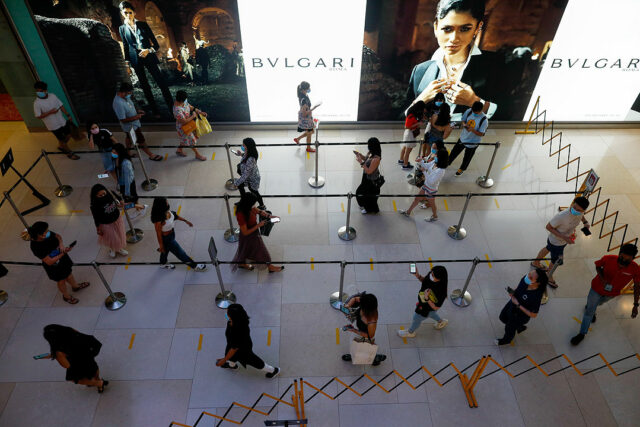
People queue for temperature checks as they enter a mall in Singapore, June 19, 2020. — REUTERS/EDGAR SU

SINGAPORE will overtake Australia to have Asia’s highest share of millionaires in the adult population by 2030, according to a report by HSBC Holdings Plc.

The financial hub is expected to top the list in Asia-Pacific followed by Australia, Hong Kong and Taiwan, the bank wrote in a report Tuesday. The proportion of millionaires in those four countries is also expected to come in higher than the US by the end of the decade, the report said.

Australia ranked highest in the region in 2021, while Singapore was second, according to HSBC, which did not say how the US compared for that year.

Asia’s financial wealth has exceeded that of the US since the aftermath of the Global Financial Crisis, HSBC said, and the region also includes some of the world’s fastest-growing economies. Vietnam, the Philippines and India are likely to see the number of adults holding wealth of at least $250,000 more than double by 2030, according to the report. Still, the region is home to many millions of impoverished people as well.

The household wealth projections in the report used estimates and projections of adult population, per capita mean wealth, and nominal per capita gross domestic product, HSBC said.

In absolute terms, mainland China is expected to have around 50 million millionaires by 2030 and India could house more than six million, HSBC said. That works out to about 4% of adults in mainland China, and less than 1% of adults in India, according to the report.

“An account of Asia’s growing wealth also shines a light on the societal resources that are ultimately available to lift millions more out of poverty,” Frederic Neumann, chief Asia economist and co-head of global research Asia for HSBC, wrote in the report. “After all, the region is hardly short of capital, even if this is unevenly distributed, both between and within economies.” — Reuters

US, Taiwan agree to start formal trade talks

REUTERS

TAIPEI — The United States and Taiwan have agreed to start trade talks under a new initiative to reach agreements with “economically meaningful outcomes,” with a Taiwan official saying China’s “economic coercion” would be also be discussed.

Washington and Taipei unveiled the US-Taiwan Initiative on 21st-Century Trade in June, just days after the Biden administration excluded the Chinese-claimed island from its Asia-focused economic plan designed to counter China’s growing influence.

The office of the US Trade Representative said the two sides had “reached consensus on the negotiating mandate” and it was expected that the first round of talks will take place early this autumn.

“We plan to pursue an ambitious schedule for achieving high-standard commitments and meaningful outcomes covering the eleven trade areas in the negotiating mandate that will help build a fairer, more prosperous and resilient 21st-century economy,” Deputy United States Trade Representative Sarah Bianchi said in a statement.

Taiwan’s top trade negotiator John Deng told reporters in Taipei on Thursday he hoped talks could start next month, and that this could one day lead to a free trade deal the island has long sought with the United States.

The negotiating mandate released along with the announcement said the United States and Taiwan have set a robust agenda for talks on issues like trade facilitation, good regulatory practices, and removing discriminatory barriers to trade.

It said the start of the formal talks would be for the purpose of reaching agreements with “high standard commitments and economically meaningful outcomes”.

Mr. Deng said one topic would be China’s economic coercion, a reference to actions Beijing takes to block trade with countries it is in dispute with, such as when Lithuania allowed Taiwan to open a de facto embassy in its capital.

“Its economic coercion targets are not just the United States or Taiwan, it’s done to a lot of countries. Its harm to the global economic and trade order is great,” he added.

Despite the lack of formal diplomatic ties, Washington has been keen to bolster support for Taiwan, especially as it faces stepped up political pressure from China to accept its sovereignty claims.

China has said it “firmly” opposes the new Taiwan-US trade initiative. — Reuters

Coronavirus’ harmful effects on the brain reverberate years later

REUTERS

COVID-19 survivors remain at higher risk of psychotic disorders, dementia and similar conditions for at least two years, according to a large study that highlights the mounting burden of chronic illness left in the pandemic’s wake.

While anxiety and depression occur more frequently after COVID than other respiratory infections, the risk typically subsides within two months, researchers at the University of Oxford found. In contrast, cognitive deficits known colloquially as “brain fog,” epilepsy, seizures and other longer-term mental and brain health disorders remained elevated 24 months later, according to a study published Wednesday in the journal Lancet Psychiatry.

The findings, based on the records of more than 1.25 million patients, add to evidence of the virus’s potential to cause profound damage to the central nervous system and exacerbate the global burden of dementia — which cost an estimated $1.3 trillion in the year the pandemic began. Oxford researchers showed in March that even a mild case is associated with brain shrinkage equivalent to as much as a decade of normal aging.

“The results have important implications for patients and health services as it suggests new cases of neurological conditions linked to COVID-19 infection are likely to occur for a considerable time after the pandemic has subsided,” said Paul Harrison, a professor of psychiatry and the study’s lead author, in a statement. The work highlights the need for more research to understand why this happens, and what can be done to prevent and treat these conditions, he said.

The study analyzed data on 14 neurological and psychiatric diagnoses from the TriNetX electronic health records network, containing de-identified information on roughly 89 million patients, ranging from children to seniors. The 1.28 million people with a confirmed COVID diagnosis during the two-year study period were matched to an equal number of patients with another respiratory infection that acted as a control group.

The likelihood of most neurological and psychiatric diagnoses after Covid was lower in children than in adults. Unlike adults, they weren’t at an increased risk of mood or anxiety disorders, and any cognitive deficit they experienced tended to be transient.

‘WORRYING’
“It is good news that the higher risk of depression and anxiety diagnoses after COVID is relatively short-lived and there is no increase in the risk of these diagnoses in children,” co-author Max Taquet said. “However, it is worrying that some other conditions, such as dementia and seizures, continue to be more frequently diagnosed after COVID, even two years later.”

The fact that these risks remain elevated for so long suggests the underlying mechanisms driving them persists well past the acute infection, the researchers said. Potential causes include damage to the cells that line blood vessels, leading to blood clots, and leakage of the blood-brain barrier.

Previous vaccination is associated with reduced or unchanged risks of most neurological or psychiatric outcomes, the authors said. The rates of these problems were similar after the emergence of the Omicron and Delta variants, suggesting that coronavirus infections may continue to spur neuropsychiatric illnesses even when they cause otherwise less severe disease.

The study is the first to attempt to examine some of the disparate and lingering neurological and psychiatric consequences of COVID in a large dataset, Jonathan Rogers and Glyn Lewis from University College London wrote in an accompanying comment piece.

“It highlights some clinical features that particularly merit further investigation,” they said, adding that more research is needed to validate the findings. — Bloomberg