Home Blog Page 5990

Gilas Pilipinas off to Beirut for game vs Lebanon in World Cup Asian Qualifiers

UTAH JAZZ guard Jordan Clarkson — PHILIPPINE STAR FILE PHOTO

THERE’S much excitement in the air in the Gilas Pilipinas camp right before Jordan Clarkson and 12 others fly to Beirut for the tough road outing against Lebanon in the FIBA World Cup Asian Qualifiers.

“The energy is very high,” Samahang Basketbol ng Pilipinas executive director and spokesman Sonny Barrios shared even as he announced the composition of the contingent during yesterday’s PSA Forum.

Utah Jazz guard Mr. Clarkson provides his NBA-caliber skills to a new-look Gilas crew out for redemption in the Aug. 25 match versus the powerhouse Cedars after a string of disappointing campaigns.

Mr. Clarkson is joining forces with Australia-based Kai Sotto, Japan B. League campaigners  Dwight Ramos, Kiefer and Thirdy Ravena and Ray Parks, PBA stalwarts Japeth Aguilar, Jamie Malonzo, Chris Newsome, Calvin Oftana and Scottie Thompson, free agent Roosevelt Adams and collegiate star Carl Tamayo.

The 13, from whom the Final 12 will be eventually  tapped, are taking the 12:15 a.m. Tuesday flight for the Lebanese capital.

Mr. Barrios noted that Mr. Clarkson, who previously suited up in the 2018 Asian Games, is blending well with the current crop of national mainstays.

“…Jordan adapts very well with his teammates, very comfortable siya, and he can relate very much to the three senior coaches,” he said, referring to head coach Chot Reyes and assistants Tim Cone and Jong Uichico.

This group, according to Mr. Barrios, is expected to utilize “fast ball movement and patient shot selection” while putting much premium on  defense.

Meanwhile, Mr. Aguilar is joining the trip after coming out of health and safety protocols last week and missing a week’s worth of practices. The 6-foot-9 Ginebra star attended the session last Sunday and had his first full practice with the team yesterday morning.

Gilas is up for a tenacious fight against a Lebanese side parading the core of its silver medal-winning team in the FIBA Asia Cup led by MVP Wael Arakji in the away game on Thursday night (early Friday in Manila). — Olmin Leyba

Gilas Pilipinas Under-18 routs Syria, 112-48, in FIBA Asian Championship in Tehran

GILAS Pilipinas U18 rolled past Syria, 112-48, for a resounding first win in the FIBA U18 Asian Championship over the weekend at the Azadi Basketball Hall in Tehran, Iran.

All players hit the board for Gilas led by Fil-Australian Mason Amos, who stamped his class over the Syrians with 26 points, four boards, an assist, two steals and a block in only 16 minutes of action.

Seven Gagate and EJ Abadam turned in 19 markers apiece while Joshua Coronel added 10 as Gilas banked on a scorching 35-7 start on its easy way to a mammoth 64-point win in Group C.

Gilas led by as many as 71 points with U16 standouts Kristian Porter (8) and Jared Bahay (6) also making their presence felt for their seniors.

The Nationals were to shoot for a 2-0 card in Group C last night against Syria to bolster their quarterfinal hopes before wrapping up their preliminary campaign against Chinese Taipei today.

A win by Gilas against Qatar, which bowed to Chinese Taipei on the same day, 96-62, would virtually seal their entry to the next round featuring powerhouse teams Australia, China, South Korea, Japan and host Lebanon.

It’s the first tournament for the new crop of the Philippine youth team since 2018 when the Kai Sotto-led squad finished in the Final Four to qualify in the FIBA U19 World Cup.

Gilas is being mentored by Josh Reyes, who also coached the U16 team that finished seventh in the return of Asian youth tilt last month in Doha, Qatar. — John Bryan Ulanday

Unbeaten La Salle and National U face separate foes in Preseason Cup

LA SALLE faces San Sebastian in quarterfinals. — FILOIL ECOOIL SPORTS FACEBOOK PAGE

Games today
(Filoil EcoOil Centre)
11 a.m. — Adamson vs LPU
1 p.m. — NU vs San Sebastian
3 p.m. — CSB vs La Salle
5 p.m. — UP vs FEU

UNBEATEN teams National U and La Salle loom as heavy favorites when they go against separate quarterfinal foes in the start of the Filoil EcoOil Preseason Cup playoffs at the Filoil EcoOil Centre in San Juan.

The Bulldogs, who wiped out Group A with an 8-0 card, and the Group B leader Green Archers (7-0) collide with San Sebastian College-Recoletos and College of St. Benilde at 1 p.m. and 3 p.m., respectively.

Serving as opener at 11 a.m. is the duel between Adamson and Lyceum while reigning UAAP champion University of the Philippines battles Far Eastern U in the main game at 5 p.m.

The spotlight, however, is on the Bulldogs, whose magnificent preseason build-up included an upset of UP in the elims — boosting their morale for an expected tough playoff run.

La Salle, for its part, faces a harder task given its juggling act in the PBA D-League, where it is already in the finals against Marinerong Pilipino. “This is all part of our program. We want to see our players get tested before the start of UAAP,” said mentor Derrick Pumaren. — John Bryan Ulanday

Mikey Willaims earns raves from Clarkson

MIKEY Williams of TNT drives to the basket against Rome dela Rosa and Ian Sangalang of Magnolia during the PBA Philippine Cup semi finals at the Araneta Coliseum.— PHILIPPINE STAR/ RUSSELL PALMA

MIKEY Williams earned raves from Jordan Clarkson no less but for the Fil-Am gunner, Game 1 of the PBA Philippine Cup finals truly belonged to Jayson Castro, whose last-gasp jumper led TNT to an 86-84 thriller.

“That’s Mr. Hero right there,” Mr. Williams said of Mr. Castro. “He’s made countless shots — big shots — for us in the stretch. He’s the savior.”

Mr. Castro saved the night as he conjured an opportunity with 1.6 seconds left to drill in the winning 16-footer just before the final buzzer sounded.

There were tense moments as game officials reviewed the video repeatedly from all angles to determine whether it beat the clock before ruling it did. The “counted versus not-counted” debate continued on social media the day after.

SMB star June Mar Fajardo similarly left it to the concerned officials’ judgement and quickly moved on to tomorrow’s Game 2.

The exciting series opener last Sunday was a starry affair with Gilas Pilipinas and Utah Jazz stalwart Clarkson catching the action live.

“Big fan! Mikey Williams got game! TNT!” the Fil-Am NBA player wrote on Twitter.

“That’s love,” (Mr.)  Williams, a former G League player,  said of Mr. Clarkson’s post. “I know him from LA. I played with him a lot there so I’m familiar with him.”

Mr. Williams fired a 12-point barrage in the third quarter to spark a 33-15 surge that enabled TNT to wrest control after getting buried to a 15-point hole in the first half. — Olmin Leyba

Podcast Goal Diggers YOUTH featuring sports personalities kicks off brand-new season

THE GOAL Diggers YOUTH Season 2 will feature 10 world-class Filipino athletes who will inspire and empower participants with their real-life experiences and advice.

THE Goal Diggers YOUTH podcast, which features some of the country’s accomplished sports personalities, kicked off its second season at the weekend and is looking to continue inspiring the younger generation and bringing about positive change.

Born at the height of the pandemic, the podcast was set up by sports marketing group XMPLR as a platform to reach out to the Filipino youth who are finding their way amid the challenging times.

The Goal Diggers YOUTH podcast has world-class athletes as guest speakers, who share the program’s vision and are out to inspire and empower participants with their real-life experiences and advice.

The Goal Diggers Youth Season 2 streams every Saturday at 8 p.m. and will run until Oct. 29.

Professional volleyball player and national athlete, and now volleyball program director of Far Eastern University, Dzi Gervacio got the ball rolling for the new season with her episode airing on Saturday, Aug. 20.

In it, the former Ateneo volleyball star talked about the importance of serving your purpose in sports and in life, drawing from her experiences as an athlete, sports organizer and collegiate sports official.

Also set to grace the podcast are Olympic equestrienne Toni Leviste, Paralympian Ernie Gawilan, and World Cup-bound footballer Camille Rodriguez.

Ms. Leviste will talk about overcoming hurdles and proving that challenge is only a pathway for bigger things; Mr. Gawilan about his experiences as a Paralympian and how physical disability is not a limitation from reaching your goals; and Ms. Rodriguez on developing a winning mentality that led to their historic win in the recent 2022 ASEAN Football Federation Women’s Championship.

Joining the podcast, too, this season are karateka Junna Tsukii, triathlete Kim Mangrobang, basketball players Kiefer Ravena and Ella Fajardo, motor racer Ashley Sison and world number three pole-vaulter EJ Obiena.

With the new season up, Robbie de Vera, founder and chief sports advocate of XMPLR, said they are happy with how things are panning out for The Goal Diggers YOUTH to date and reiterated the significance of having such platforms during this time.

The new season of The Goal Diggers YOUTH is hosted by Bey Pinlac, ZanD Bajarias, Louisa Tagulinao, and newcomers Johnny Tango and Kyra Dimaandal. — MASM

Lewandowski scores two as Barcelona thrash Real Sociedad

ROBERT LEWANDOSKI scores a brace for Barcelona. — REUTERS

ROBERT Lewandowski scored a brace as Barcelona cruised to a 4-1 victory at Real Sociedad on Sunday, their first win of the new LaLiga season.

Spanish teenage sensation Ansu Fati, who has been struggling to recover after a series of knee surgeries in the last two years, came off the bench in the second half and took charge of the proceedings with two assists and a goal.

The Polish striker opened the scoring in the first minute of the game, rifling in a shot after a great pass from Alejandro Balde inside the penalty area.

But Alexander Isak equalized five minutes later after latching onto a pass from David Silva.

Barca struggled to break the deadlock until coach Xavi Hernandez sent on Raphinha and Fati in the 64th minute, with both proving crucial to Barca’s success.

First, Fati assisted Ousmane Dembele with a brilliant heel pass after a fine piece of individual play from Raphinha.

Than Fati finished a beautiful team effort to assist Lewandowski to the third.

The Polish striker returned the favour 10 minutes later, enabling 19-year-old Fati to score Barca’s fourth to wrap up the points. — Reuters

New York Mets edge Philadelphia Phillies in ninth inning of rain-delayed slugfest

MARK Canha hit two home runs, including the go-ahead two-run shot in the ninth inning off David Robertson, to rally the New York Mets past the host Philadelphia Phillies 10-9 on Sunday.

Mr. Canha had three hits and drove in five runs for the Mets, who won three of four in the series. It was Mr. Canha’s third career multi-homer game. Brandon Nimmo added a solo homer in the ninth.

Jeff McNeil added three hits, Starling Marte had three hits and an RBI, Daniel Vogelbach had two hits and an RBI and Francisco Lindor contributed two hits.

Mets starter Jose Butto tossed four innings and gave up nine hits and seven runs in his major league debut. Mr. Butto struck out five and walked two.

Trevor May (2-0) earned the win in relief. Edwin Diaz allowed one run in the ninth but still earned his 28th save in 31 chances.

Jean Segura had put the Phillies ahead 8-7 in the bottom of the eighth with a pinch-hit solo home run. After Mr. McNeil led off the ninth with a double, Mr. Canha smacked his 10th homer of the season to put the Mets up 9-8 before Mr. Nimmo’s shot made it 10-8.

Nick Maton cut it to 10-9 with a sacrifice fly to center, but with two runners on, Mr. Diaz struck out pinch hitter Darick Hall to end the game.

Alec Bohm hit two homers and drove in six runs for the Phillies. Mr. Bohm had three hits, while Bryson Stott, Kyle Schwarber, J.T. Realmuto and Nick Castellanos added two hits apiece and Maton added two RBIs.

Phillies starter Kyle Gibson lasted only 4 1/3 innings and allowed eight hits and four runs, with two earned. Mr. Gibson struck out three and walked three. Mr. Robertson (3-1) took the loss.

The Phillies went ahead 4-0 in the first inning when Mr. Bohm crushed a three-run home run to left field and Mr. Maton added an RBI single.

The Mets quickly closed within 4-2 in the second when Michael Perez ripped an RBI single to center. Brett Baty also scored on the play due to a fielding error by Bradley Zimmer.

In the third, New York cut the deficit to 4-3 on a two-out RBI double by Vogelbach. One inning later, Mr. Marte tied the game with an RBI single.

Mr. Bohm hit his second three-run homer, this time to right, for a 7-4 Phillies advantage in the fourth.

After a 46-minute rain delay in the bottom of the sixth, Mr. Canha produced a three-run homer off Connor Brogdon in the seventh to tie the game at 7. — Reuters

Inspired Caroline Garcia goes from Cincinnati qualifier to champion

REUTERS

CAROLINE Garcia capped a long week by beating Petra Kvitova 6-2 6-4 to claim the Cincinnati Open title on Sunday and become the first qualifier to win a WTA Tour 1000 tournament.

After battling through qualifying, Ms. Garcia beat three top-10 world-ranked opponents, Maria Sakkari, Aryna Sabalenka and Jessica Pegula, on the way to the final where she delivered a master class against Czech Ms. Kvitova, the twice Wimbledon champion.

Leading the WTA Tour in aces and second in break points saved, the 28-year-old Frenchwoman relied on her big weapons to clinch her third title of the season, sending down 11 aces and saving all eight break points she faced.

Since coming back from a foot injury in May, Ms. Garcia has won three events on three different surfaces, on clay in Warsaw, where she beat world number one Iga Swiatek, grass in Bad Homburg and hardcourt in Cincinnati.

Under threatening skies Ms. Garcia got out to fast start with a break helped by a pair of double faults by Ms. Kvitova, as the 32-year-old once again struggled with her serve. Ms. Garcia carried on in the second set as she again broke Ms. Kvitova at the first opportunity and held for a quick 2-0 lead when Ms. Kvitova called for a medical time-out. — Reuters

The P95-billion budget

TOWFIQU BARBHUIYA-UNSPLASH

Did you know there is a Magna Carta for micro, small and medium enterprises (MSMEs) that provides for 10% of government spend to be supplied by this sector? That is a whopping P95 billion that could be availed of by women micro entrepreneurs as they comprise more than 60% of the MSME population.

The computed government spend is P959 billion and it is easy to say that if all local government units (LGUs) followed the Magna Carta, their local suppliers and producers can easily benefit from this prescribed budget. It is a goal to have everyone toe the line like what Quirino Province did. They used up the 10% for MSME suppliers. Thanks to the Department of Trade and Industry’s (DTI) proactive Regional Director Leah P. Ocampo, they are able to mobilize all LGUs in her region to be conscious of this budget allocation.

At a recent round table sponsored by UN Women, we discussed Gender-Responsive Procurement (GRP) as it has been proven to benefit mostly women who, after all, put back 90% of what they earn to the family table, and each woman entrepreneur hires six other women to help her in the business. These micro businesses are usually in food production, textile, and value-addition for agricultural products.

If the mentioned region can do it with P300 million, imagine if everyone did this. You may not have to resort to regular ayuda (handouts) if every woman engaged in a micro business of sorts. Or worked for a micro entrepreneur supplying government.

At the same round table, we learned that the Government Procurement Policy Board (GPPB) already has included farmers in the supply chain even if they do not yet belong to a cooperative or are not registered as a small business with the DTI. The government unit issues a Purchase Order which the farmer signs and accepts, and he or she is good to go! This is what is now called Community Participation, a feature of the Bayanihan Act issued during the height of the COVID-19 pandemic.

It is not so easy, however, for private businesses due to the provision that agricultural products do not carry a VAT input, and thus poses an added 12% for the buyer. Not a great incentive to buy from farmers if you are private. But for the government, it is a welcome opportunity for farmers to directly supply their LGUs.

In the example presented by Region II: 2,498 micro entrepreneurs were included in the supply chain and 66% were women. This region is a microcosm of the typical gender split across the country when it comes to reading gender-disaggregated data. Again, why is it important to have this data? Because what does not get counted, does not get measured. And what does not get measured does not get the benefits.

BUY LOCAL
Another campaign by the DTI Regional Operations Group is the Buy Local movement. It is an answer also to logistical challenges encountered by producers. If one LGU were to buy from its local producers, the cost is contained locally and thus follows the concept of “from the right pocket to the left” or containing the funds to benefit the producers’ region or local area. In this manner, the local producers are immediately given the advantage of doing business with the government. I heard from Undersecretary Bles Lantayona that Region II’s example is now being rolled out nationwide. So, local producers, get ready to have your LGU as your regular client.

This is part of a global trend of deglobalization. As the pandemic challenged supply chains, producers are better off selling the finished product locally than for it to be exported. It also makes use of local labor and keeps the resources intact within the locality.

The Procurement Law or R.A. 9184 really needs some amendments.

1. One is to identify suppliers or would-be suppliers by gender.

2. Next is for Philgeps, the government’s electronic procurement system, to identify if the business is women-owned (now loosely defined as 51% women-owned). The GPPB or DTI’s MSMED Council will have to define what “women-owned” is.

3. Philgeps will also need more awareness building among MSMEs so this sector can participate in “small spend” or “small items” that any LGU needs like food suppliers, etc.

4. The Bids and Awards Committee (BAC) members should not be penalized with such big criminal punishments for a minor mistake. This must be reviewed so we can have more civil servants serving in BACs. As it is, they say there are very few BAC officers because it is onerous to sit as a member due to a general penal provision no matter if the budget you approve is big or small.

But even with these challenges, we salute those who spearhead innovations, adopt inclusive measures, and are gender-responsive and not gender-blind. Although the Philippine Competition Commission (PCC) admits they, among all other agencies, have to be gender-blind to make it an equal opportunity for all. The others, save PCC, have Gender and Development (GAD) budgets as provided by the Magna Carta for Women, another law needing implementation. The Magna Carta provides that 5% of the NGA or LGU budget must be spent on gender-related activities, but that is yet another topic for another column. It is also underused and most agencies are actually cited by the Commission on Audit for underusing or not using the GAD in their Budget Utilization Reports.

In the meantime, the news about P95 billion is something we must think about. This is a lot of money that can benefit our over 900,000 MSMEs. And they do not even have to go out of their localities to do business.

Do business with the government. It can happen and it is already being done in many places. Take your slice of the pie. There is a lot more, even beyond P95 billion.

(This article reflects the personal opinion of the author and does not reflect the official stand of the Management Association of the Philippines or MAP.)


Chit U. Juan is a member of the MAP Diversity & Inclusion Committee, and the MAP Agribusiness Committee. She is chair of the Philippine Coffee Board, councilor of Slow Food for Southeast Asia and is an advocate for organic agriculture.

map@map.org.ph

pujuan29@gmail.com

10 things to watch in energy, the budget, and taxes

This week will mark the sixth month of Russia’s invasion of Ukraine, so we review commodity prices as a result of invasion and US-led economic sanctions against Russia. We will also discuss the Philippine government budget for 2023 which is to be submitted to Congress today. Here are 10 things to watch out.

1. Continued high power prices that trigger high inflation.

Last week, the Dutch Title Transfer Facility (TTF), the leading Europe benchmark for wholesale gas prices, reached an all-time high of €245 per megawatt hour (MWH) — 505% higher than it was a year ago. And last week, the UK reported a double-digit inflation rate of 10.1% in July, another 40-year high record. Germany’s overall electricity prices (all in for generation, transmission, distribution, etc.) have been rising from €0.14/kwh in 2000 to €0.24 in 2010, €0.32 in 2020, and €0.41 in 2022.

2. High fertilizer prices, high food prices.

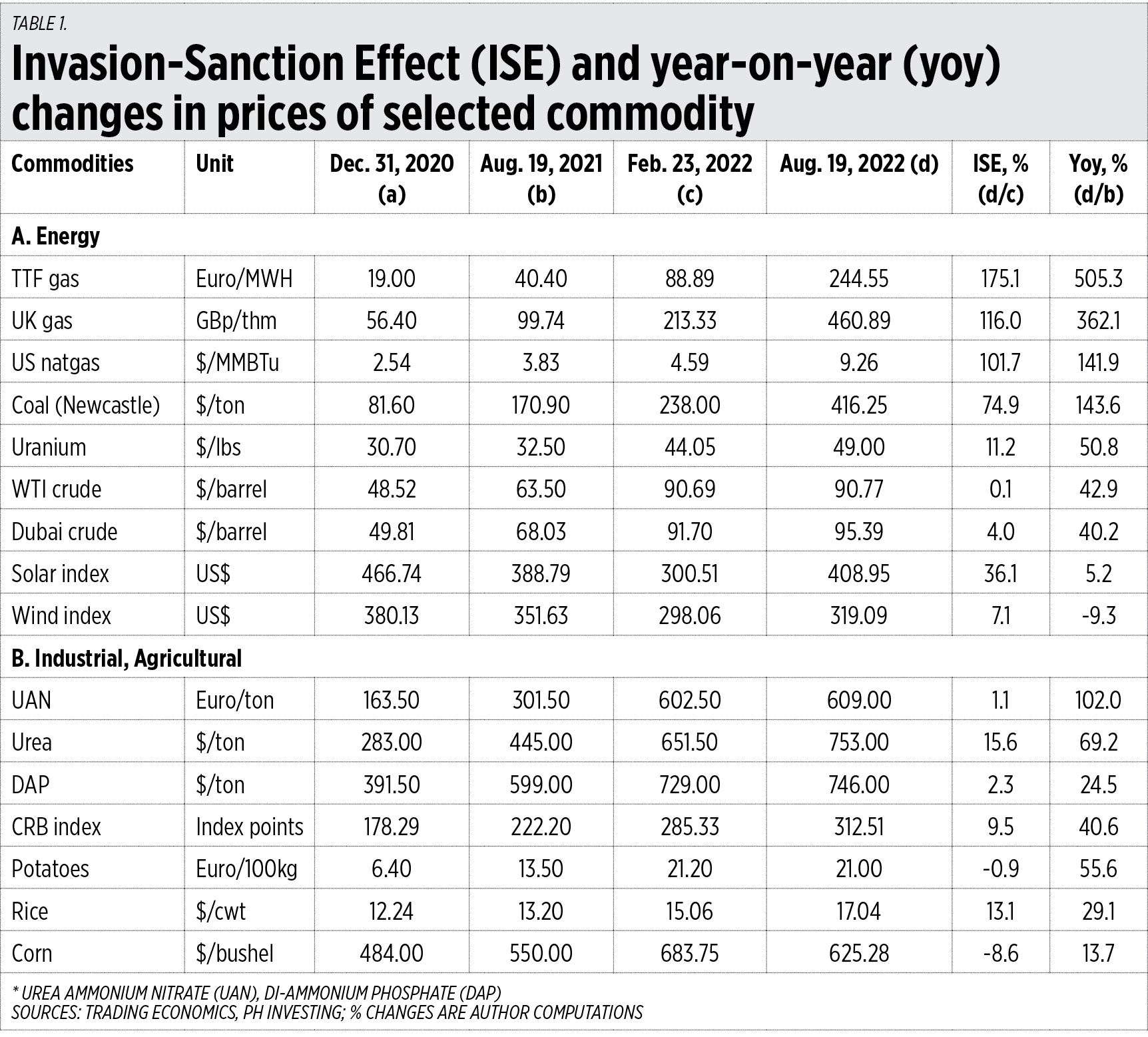
Fertilizers — urea/carbamide, urea ammonium nitrate (UAN), di-ammonium phosphate (DAP), and others — are mainly produced from oil and natural gas. The continued demonization of oil and gas on climate grounds leads to underinvestment and undersupply in fertilizer production, leading to higher fertilizer prices, thus higher agricultural prices for products like potatoes, rice, and corn (See Table 1).
3. Underinvestment in fossil fuels, not the Russian invasion, are drivers of high commodity prices.

The prices of some commodities today are generally similar to their pre-invasion levels — see Dubai and WTI crude, UAN, DAP, potatoes, and so on. Most price hikes occurred even before the invasion on Feb. 24, except for solar and wind price indices which had bubble prices that peaked in January-February 2021, coinciding with US President Joseph Biden entering the White House. The Commodity Research Bureau (CRB) Index, comprising a basket of 19 commodities in energy, agriculture and metals, also exhibited this trend.

4. Degrowth and deindustrialization economics.

The numbers mentioned in Table 1, like 40-year high in UK inflation, are among the indicators of the long-term deindustrialization and degrowth economics of Europe. Very soon many companies there will migrate to Asia, the ASEAN in particular. The Philippines should prepare a wide welcome mat for big foreign investments and ensure that our energy supply is big and prices are competitive.

5. The P1+ trillion/year deficit to continue until 2025.

Today the Department of Budget and Management (DBM) submitted the 2023 budget materials to Congress. These are thick documents — the National Expenditure Program, Budget of Expenditures and Sources of Financing (BESF), and Staffing Summary. From BESF, the overall fiscal program shows big increases in revenues and disbursements in 2023 to 2025, so the budget deficits are expected to slow down to below P1 trillion perhaps by 2026 (See Table 2).

6. Interest payment alone from huge public debt will be P582 billion in 2023.

Government annual financing or borrowings will remain at P2+ trillion/year until 2024. Huge interest payments alone will siphon off more public resources, to 11% of total expenditures.

7. The military and uniformed personnel (MUP) pension is still a big fiscal risk.

MUP pension is P120+ billion/year from 2021 onwards and constitute 2.4%+ of total expenditures. Contrast that with the pensions for all other civilian personnel (retired government doctors, nurses, teachers, engineers…) of only P5.5 billion in 2019, P6.2 billion in 2020, P5.6 billion in 2021, P7.1 billion in 2022, and P7.5 billion in 2023.

There is a need to control certain public spending, remove favoritism for certain sectors and personnel like the MUP, control subsidies and not make them last forever.

8. Tax revenues will jump starting 2023.

It will have taken nine years to double the tax revenues of P1.54 trillion in 2013 to P3.14 trillion this year. This then will rise by P300-400 billion a year from 2023 onwards. Excise tax revenues from “sin” products were the fastest to rise, from P119 billion in 2013 it nearly doubled to P209 billion in 2017, or just four years (See Table 3).

9. Tobacco tax will take in P200+ billion/year, alcohol tax P100+ billion/year starting 2022.

With the current excise tax of P55/pack of cigarettes, then a 5% increase yearly after, the advocates and implementers of universal healthcare will jump with joy when there are more smokers of legal tobacco. They will also be happy with more drinkers of legal alcohol.

10. Government should be more strict in fighting illicit trade and smuggled products.

Since the government earns big from legal alcohol and tobacco, and earns zero from smuggled cigarettes and alcohol, and smuggling rises in direct proportion to tax hikes, there should be stricter implementation of anti-illicit trade and anti-smuggling laws. Criminal and terrorist groups, smugglers, and their protectors in government are the main beneficiaries of more illicit trade.


Bienvenido S. Oplas, Jr. is the president of Minimal Government Thinkers.

minimalgovernment@gmail.com

Saudi Arabia’s EV battery bets are a warning

COMPARE FIBRE-UNSPLASH

THE WORLD’s oil capital wants to go electric and get clean. To do so, it’s getting its hands on minerals critical for batteries and taking a stake in the electric vehicle-supply chain. That should put countries and companies prone to announcing ambitious plans but then doing little to make them a reality on high alert.

As shortages loom and firms attempt to secure prohibitively expensive resources in a bid to scale up manufacturing, Saudi Arabia has drawn in lithium miners and battery makers to set up operations, filling a critical gap. The country wants 30% of cars on its capital city’s roads to be electric by the end of this decade.

Australian battery chemicals and technology company EV Metals Group Plc said it was kicking off the development of its processing plants for lithium hydroxide monohydrate — a key compound for batteries — deepening its plans in the kingdom. The firm has worked with its partners for the past two years on feasibility studies, and the facility now plans to produce high-grade chemicals for cathode materials in powerpacks, an important component that EV makers are trying to get their hands on. Another Australian firm, Avass Group, announced it signed an agreement in February to jointly manufacture electric vehicles and lithium batteries with the country.

Along with these commitments, Saudi Arabia’s Ministry of Industry and Mineral Resources has announced $6 billion of projects as part of a larger push to boost its mining industry. It’s also processing almost 150 exploration license applications from foreign companies. The government signed an agreement to buy as many as 100,000 electric vehicles over 10 years from Lucid Group, Inc., an EV maker that the country’s sovereign wealth fund has a stake in. It is allocating more than $3 billion in financing and incentives to set up the plant over the next decade and a half. Foxconn Technology Group, the largest assembler of iPhones, was in talks to establish a $9-billion facility that could make chips and EV parts.

Creating manufacturing and processing facilities within its borders is a shrewd and prescient move. Not only will it eventually help bring down the costs, but more immediately — and importantly — will ensure the nation becomes a key part of the global electric vehicle-value chain. So far, besides China and its behemoth battery makers, few others have been able to achieve manufacturing scale.

Saudi Arabia has the resources, capital, and conviction — and that’s exactly what’s missing for many companies and countries. It’s now using its oil-price and demand advantage to make a transition that others are struggling with. Its geographical position adds to that, allowing it to supply Europe and get resources from China and Australia. The kingdom has started assessing and issuing mining licenses quickly to tap into its mineral resources, with an estimated potential value of $1.3 trillion. Compare that to the US, where permitting is held up and approvals for such extraction plans have fallen to multi-year lows.

Meanwhile, it could develop its own resources, too: The lithium in the salty brine byproduct around its oilfields is becoming a key source for the metal as a supply deficit widens. Researchers are now working on economically efficient ways to remove and process the lithium into a pure enough form for use in batteries.

Saudi Arabia’s advance into battery materials, as shortages raise costs and companies’ battle tightening green regulations to get ahead, is turning what stands to be a huge threat to its economy into a long-term benefit.

It’s almost too late for the US and parts of Europe to catch up. Other places in the Middle East are also looking to make the transition away from their economic reliance on oil toward greener technology. Abu Dhabi recently drew in a lithium firm to build facilities at the Khalifa Industrial Zone to extract the metal and recover valuable by-products from lithium-mica and phosphate minerals.

It shouldn’t be a surprise, then, if firms and nations soon end up swapping their dependence on Saudi Arabian oil for critical battery materials, much like they’ve had to do with China.

BLOOMBERG OPINION

South Korea, US begin their largest military drills in years

SOUTH KOREAN soldiers salute in front of a huge national flag in Pohang, South Korea, Sept. 30, 2021. — LEE JIN-MAN/POOL VIA REUTERS

SEOUL — South Korea and the United States began their largest joint military drills in years on Monday with a resumption of field training, officials said, as the allies seek to tighten readiness over North Korea’s potential weapons tests.

The annual summertime exercises, renamed Ulchi Freedom Shield this year and scheduled to end on Sept. 1, came after South Korean President Yoon Suk-yeol, who took office in May, vowed to “normalize” the combined exercises and boost deterrence against the North.

South Korea separately launched the four-day Ulchi civil defense drills on Monday, designed to boost government readiness, for the first time since the coronavirus pandemic emerged.

The military and civil exercises are aimed at improving the country’s preparedness to match the changing patterns of war, with evolving cyber threats against key facilities such as chip factories and supply chains, Mr. Yoon said.

“Maintaining peace on the Korean peninsula is built on our airtight security posture,” Mr. Yoon told a cabinet meeting, calling for thorough exercises based on real-world scenarios.

The drills were the largest since 2017 after being scaled back because of COVID-19 and as Mr. Yoon’s predecessor sought to restart talks with Pyongyang, which has called the exercises a rehearsal for invasion.

North Korea fired two cruise missiles from the west coast last week, after South Korea and the United States kicked off preliminary training for the exercises.

North Korea has conducted missile tests at an unprecedented pace this year and is ready to conduct its seventh nuclear test at any time, Seoul officials said.

Mr. Yoon has said his government is willing to provide economic aid if Pyongyang takes steps toward denuclearization, but North Korea has rebuffed his offer, openly criticizing him.

Seoul’s defense ministry has said the allies would stage 11 field training programs, including one at brigade-level — involving thousands of soldiers — this summer.

To better counter North Korea’s growing missile threats targeting the South’s capital, the ministry said it would improve missile detection capabilities and push for an early deployment of a new interceptor system.

The United States, South Korea and Japan participated in a recent ballistic missile defense exercise off Hawaii’s coast, the first such drills since 2017, when relations between Seoul and Tokyo hit their lowest point in years. — Reuters

ADVERTISEMENT
ADVERTISEMENT