Home Blog Page 5921

Apple to appeal Brazil sales ban of iPhone without charger

STOCK PHOTO | Image by matcuz from Pixabay

Apple Inc said on Tuesday it will appeal a Brazilian order banning it from selling iPhones without a battery charger, pushing back on claims that the company provides an incomplete product to consumers.

The Justice Ministry fined Apple 12.275 million reals ($2.38 million) and ordered the company to cancel sales of the iPhone 12 and newer models, in addition to suspending the sale of any iPhone model that does not come with a charger.

In the order, published on Tuesday in the country’s official gazette, the ministry argued that the iPhone was lacking a essential component in a “deliberate discriminatory practice against consumers.”

The authorities rejected Apple‘s argument that the practice had the purpose of reducing carbon emissions, saying there is no evidence that selling the smartphone without a charger offers environmental protections.

Apple said it would continue to work with Brazilian consumer protection agency Senacon in order to “resolve their concerns,” while saying it would appeal the decision.

“We have already won several court rulings in Brazil on this matter and we are confident that our customers are aware of the various options for charging and connecting their devices,” Apple said.

The order comes a day before Apple is expected to announce its new iPhone model. – Reuters

Biden, Truss commit to stand up against Russia, economic woes

US President Joseph R. Biden, Jr. (left) and UK Prime Minister Mary Elizabeth Truss (right) | Original images from Reuters

President Joe Biden spoke by phone on Tuesday to congratulate new British Prime Minister Liz Truss and both leaders promised to strengthen their relationship as they stand together against Russia.

“I look forward to deepening the special relationship between our countries and working in close cooperation on global challenges, including continued support for Ukraine as it defends itself against Russian aggression,” Mr. Biden said in a tweet.

The two leaders could meet as soon as the UN General Assembly later in September. Ms. Truss won a leadership race for the governing Conservative Party on Monday and took over from Boris Johnson as prime minister on Tuesday, as Britain faces its most daunting set of challenges in decades. Read full story

The prime minister’s office said in a statement that Mr. Biden and Ms. Truss discussed deepening cooperation on NATO and the US-Australia-Britain security agreement established last year as a counter to China. Ms. Truss looks forward to “working closely with President Biden as leaders of free democracies to tackle shared challenges, particularly the extreme economic problems unleashed by Putin’s war,” the statement said.

A White House statement said the two leaders discussed continuing close cooperation on Ukraine, addressing challenges posed by China, preventing Iran from obtaining a nuclear weapon, and “securing sustainable and affordable energy resources.”

The so-called special relationship between the United States and Britain has maintained solid continuity in recent years, despite frictions between then-President Donald Trump and then-Prime Minister Theresa May.

Washington and London have been aligned on helping Ukraine in its war against Russia and in countering China’s influence in the Pacific. But a trade deal that some British officials hoped could offset trade and economic upheaval after Brexit has yet to materialize under Mr. Biden. Read full story

A US official said the White House expects a lot of continuity from Mr. Johnson to Ms. Truss and that Mr. Biden and Ms. Truss are likely to be aligned on countering Russia’s invasion in Ukraine and China’s rising influence in the Indo-Pacific.

Mr. Biden got on well with Mr. Johnson, but he could have tensions with Ms. Truss over Northern Ireland.

As a member of parliament, she introduced legislation to undo the Northern Ireland Protocol, which was part of Britain’s withdrawal agreement from the European Union. It prioritized protecting the 1998 Good Friday Agreement, or Belfast Agreement, for peace in the British-run region.

Mr. Biden has been insistent that Britain do nothing that could endanger a quarter century of peace in Northern Ireland.

The White House statement said Mr. Biden and Ms. Truss “discussed their shared commitment to protecting the gains of the Belfast/Good Friday Agreement and the importance of reaching a negotiated agreement with the European Union on the Northern Ireland Protocol.”

The British statement said both leaders “agreed on the importance of protecting the Belfast (Good Friday) Agreement.” – Reuters

New York City returns looted antiquities to Italy worth $19 million

Fifty-eight stolen antiquities worth an estimated $19 million were returned to Italy by New York authorities in a ceremony on Tuesday.

The items, many on display at the city‘s Metropolitan Museum of Art for years, included “The Marble Head of Athena,” worth an estimated $3 million.

“We are privileged to return it today,” said Colonel Matthew Bogdanos, chief of the Manhattan District Attorney’s Office’s antiquities trafficking unit, promising “many more seizures and many more repatriations” over the rest of the year.

The returned items also included a drinking cup called “White-Ground Kylix,” “Bronze Bust of a Man,” and vases, platters and other kitchenware. Some came from the collection of billionaire hedge fund manager Michael Steinhardt.

The antiquities were sold by convicted looters, including Giacomo Medici and Giovanni Franco Becchina, who used locals to raid unguarded sites in Italy, according to the Manhattan DA’s office.

The pieces are “part of our past, our ancestors,” Italian police General Roberto Riccardi said at the ceremony. “And they belong to the community. They will go back to the community to which they belong and to the future generations.”

Since the start of 2010s, Bogdanos’ antiquities unit has seized 4,500 pieces valued at more than $250 million, he said.

Bogdanos attributes the success to unprecedented cooperation.

“It’s happening now because … the Manhattan District Attorney’s Office formed the Antiquities Trafficking Unit, the only one of its kind in the world in which prosecutors, investigators and analysts are all on the same team.” – Reuters

Inflation slows to 6.3% in August

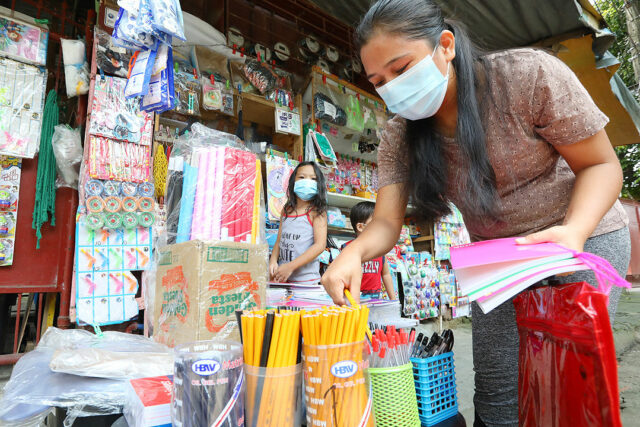
A woman shops for school supplies in San Mateo, Rizal. — PHILIPPINE STAR/ WALTER BOLLOZOS

By Abigail Marie P. Yraola, Researcher

INFLATION eased to a two-month low of 6.3% in August, as the rise in  food and transport costs slowed, the Philippine Statistics Authority (PSA) said on Tuesday.

But the surge in core inflation, which the PSA released for the first time in eight months after it shifted the base price to 2018, gives a hint that the worst is not over yet.

Preliminary data from the PSA showed the consumer price index (CPI) eased to 6.3% year on year in August, from the nearly four-year high of 6.4% in July. It remained significantly higher than the 4.4% seen in August 2021.

Headline inflation rates in the Philippines (Aug. 2022)

This was slightly lower than the 6.4% median estimate in a BusinessWorld poll conducted last week, but within the 5.9-6.7% forecast range of the Bangko Sentral ng Pilipinas (BSP) for that month.

August marked the fifth consecutive month that inflation went above the BSP’s 2-4% target range.

Last month’s inflation print was the slowest in two months, or since the 6.1% in June.

Month on month, inflation rose 0.4%. Stripping out seasonality factors, month-on-month inflation also inched up 0.4% in August.

In the first eight months of 2022, inflation averaged 4.9%, faster than the 4% a year ago. This is still below the BSP’s 5.4% full-year inflation forecast.

At a press briefing, National Statistician Claire Dennis S. Mapa attributed the slowdown in headline inflation to transport costs as fuel retailers cut pump prices in the early part of August.

The transport index, which accounts for 9% of the CPI, eased to 14.6% year on year in August from 18.1% in July. This was attributed to the deceleration of prices of diesel (70.95% in August from 91.3% in July) and gasoline (31.2% from 45.4%).

The heavily weighted index for food and non-alcoholic beverages, which account for nearly 38% of the theoretical consumer basket, slowed to 6.3% year on year in August from 6.4% in July.

The food-alone index likewise eased to 6.5% in August from 7.1% in the previous month.

Mr. Mapa said this was due to the slower increase in prices of fish (7.2% in August from 9.2% in July), meat (9.6% from 9.9%) and vegetables (-2.7% from 5.6%).

However, inflation in sugar, confectionary and desserts rose to 26% in August from July’s 17.6%, as prices of refined sugar remained elevated due to a supply shortage.

Major commodity groups that saw higher inflation included alcoholic beverages and tobacco (9.3% in August from 8.5% in July), education services (3.8% from 6.4%), restaurants and accommodation services (4.2% from 3.4%), and clothing and footwear (2.8% from 2.5%).

Housing, water, electricity and gas saw a 6.8% inflation in August from 5.7% in July, mainly due to higher electricity rates, rentals and liquefied petroleum gas.

Meanwhile, inflation as experienced by the poor households, which still remained under 2012-based prices, was at 5.9% in August, steady from July, and higher than 5.3% a year ago.
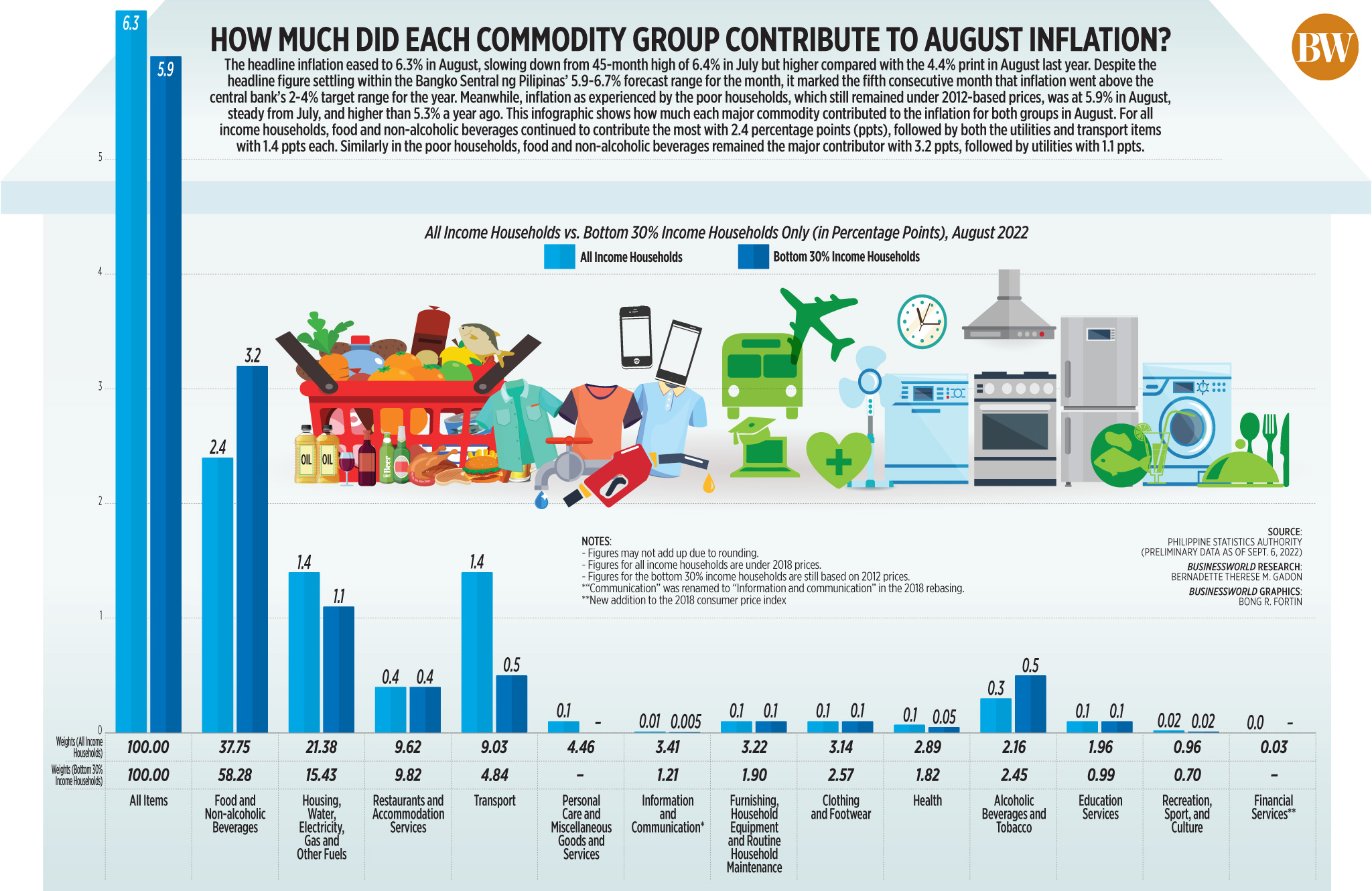
How much did each commodity group contribute to August inflation?

In a statement, the BSP said the uptick in inflation remains supply-driven, but is monitoring signs of broadening price pressures.

“The BSP is prepared to take further policy actions to bring inflation toward a target-consistent path over the medium term,” it said, noting that upside risks still dominate the inflation outlook due to higher global non-oil prices, fish shortage, spike in sugar prices, and pending fare hike petitions.

The BSP has raised rates by 175 basis points this year, as it tries to tame inflation and support the peso. Its next meeting is on Sept. 22.

The peso closed at a fresh all-time low of P57 against the US dollar on Tuesday, amid the dollar’s continued strength. (Read related story.)

CORE INFLATION SURGES
Core inflation, which excludes volatile prices of food and fuel, quickened to 4.6% year on year in August from 3.9% in July and 2.8% in August last year.

The core inflation in August showed the fastest year-on-year growth under the 2018-based prices based on latest available data dating back to January 2019.

Mr. Mapa said the PSA board in its August meeting approved the removal of some items with high volatility from the overall headline inflation to get the core inflation.

Core inflation rates in the Philippines

The 10 commodities excluded from the calculation of the core inflation rate are cereals (9.35% weight); meat, fresh chilled or frozen (4.82%); fish, live, fresh, chilled or frozen (4.17%); dates, figs, and tropical fruits, fresh (1.34%); other vegetables, fresh or chilled (0.69%); fruit-bearing vegetables, fresh or chilled (1%); electricity (4.55%); liquefied carbons (1.27%); diesel (0.60%); and gasoline (1.77%).

Colegio de San Juan de Letran Graduate School Associate Professor Emmanuel J. Lopez said in an e-mail that core inflation rate typically includes “common and essential” products purchased by consumers “so it is expected to lead the increase in prices considering it has a relatively higher demand.”

“Core inflation is on the uptrend and that’s not a good sign,” Nicholas Antonio T. Mapa, senior economist at ING Bank N.V. Manila, said in an interview with BusinessWorld Live on Tuesday.

In a separate e-mail, ING’s Mr. Mapa said this shows that second-round effects and demand-side pressures are “clear and present.”

“This suggests that elevated prices may be here with us for much longer as more items in the CPI basket become ‘infected’ with high inflation,” he added.

University of Asia and the Pacific Senior Economist Cid L. Terosa said in an e-mail that prices of discretionary services such as restaurants, accommodations, and personal services, lifted core inflation higher last month.

“Prices of imported inputs used by manufacturing industries led to higher prices for some manufactured products… These sectors passed on the increase in the cost of inputs, operations, and services to consumers. This trend was evident in the higher prices of items sold by fastfood outlets and stores,” Mr. Terosa said.

OUTLOOK
Finance Secretary Benjamin E. Diokno said inflation is expected to remain elevated for the rest of the year, with the peak seen within the third quarter but slowing in the fourth quarter.

“(Inflation) is seen to fall within the 4.5-5.5% DBCC (Development Budget Coordination Committee) assumption for 2022,” he said on Twitter.

The Marcos administration will continue to provide targeted support for sectors most affected by high inflation.

“Measures include fuel subsidies for the transport sector, fuel discounts for farmers and fisherfolk, and social pension for indigent senior citizens,” Mr. Diokno said.

He said the government will also implement measures to help improve local production and ensure an adequate food supply.

“It is our top priority to ensure that Filipino households have sufficient and healthy food on their table, especially the poorer sector of the society. We will continue implementing programs that reduce transport and logistics costs to bring inflation down and to protect the purchasing power of our consumers,” Socioeconomic Planning Secretary Arsenio M. Balisacan was quoted as saying in a statement on Tuesday.

ING’s Mr. Mapa said economic growth is expected to moderate in the second half of the year due to high inflation, rising interest rates and ballooning National Government debt.

“We saw a very good print in [the first half] but because of high inflation, rising interest rate environment, and fiscal handicap, high debt levels that we have, we are expecting growth to really slow down in the near term,” he said.

Mr. Terosa said he expects inflation to be slightly lower than the BSP’s forecast of 5.4% for the year, as global oil and food prices appear to be declining.

“If domestic supply issues of certain commodities such as flour, wheat, sugar and some vegetables and fruits are effectively addressed, the inflation rate for the year will definitely fall below the forecast of the BSP,” he said. — with Diego Gabriel C. Robles


Indonesia may export more coal, fertilizer to Philippines — Marcos

Indonesian President Joko Widodo walks with Philippine President Ferdinand “Bongbong” Marcos, Jr. during their meeting at the Presidential Palace in Bogor, Indonesia, Sept. 5. — ANTARA FOTO/SIGID KURNIAWAN/VIA REUTERS

PRESIDENT Ferdinand R. Marcos, Jr. on Tuesday said he discussed the possibility of securing coal and fertilizer supply from Indonesia during his meeting with President Joko Widodo.

Mr. Marcos, who ended his state visit to Indonesia on Tuesday, said he “brought up” agriculture with Mr. Widodo because that’s “a very important subject that needs to be discussed.”

“We talked about the possibility of them supplying us with fertilizer, with urea from Indonesia,” he told reporters in Jakarta, based on a transcript provided by Malacañang.

As a net importer of fertilizer, the Philippines is vulnerable to global supply disruptions and price fluctuations.

Fertilizer prices have sharply increased in recent months as supply was affected by the Russia-Ukraine war. Russia is the world’s biggest supplier of fertilizer.

The Philippines’ primary sources of fertilizer imports from 2018 to 2021 are China (40.66%), Indonesia (16.70%), and Malaysia (12.20%), according to data from the Fertilizer and Pesticide Authority (FPA).

In July, Mr. Marcos said he would reach out to Indonesia, China, Russia, Malaysia, and the United Arab Emirates to secure cheaper fertilizer through government-to-government deals.

During his state visit, Mr. Marcos said he also asked Indonesia for assistance in strengthening the local fisheries sector.

“I also asked for help on fisheries because I am obsessed with the fact that the Philippines imports galunggong. I can’t accept it,” he said. “So I asked for help because their fisheries sector is stable.”

Mr. Marcos, 64, has promised to boost local food production and limit imports as much as possible. But experts said this would be challenged by elevated inflation and rising costs of farm inputs.

COAL IMPORTS
Mr. Marcos, who has vowed to pursue a shift to renewable energy, said the country is poised to secure more coal exports from Indonesia.

“There was a time a few weeks back where they stopped exporting coal. We asked them and they included us in the list. They would export coal to us,” he said.

Indonesia, the world’s largest exporter of coal, has implemented coal export bans to ensure there is enough domestic supply.

Mr. Marcos said he and Mr. Widodo also talked about the green energy shift, noting that coal is not seen as environmentally friendly.

He noted the state visit to Indonesia was “more productive than we had expected.”

“I think the most extensive subject matter was in fact, PPP (public-private partnership). Because we are here to encourage PPPs with the Philippine government,” Mr. Marcos said, adding that they also sought to encourage joint ventures between Philippine and Indonesian companies.

Mr. Marcos also said he is considering building state-run malls in the Philippines to promote small enterprises and local products. This, after Mr. Widodo gave him a tour in a mall run by the Indonesian government.

INVESTMENTS
Meanwhile, the Department of Trade and Industry (DTI) wooed Indonesian companies to invest in the Philippines.

“The Philippines is open for business. Recent policy reforms, particularly on foreign investment ownership and other restrictions as well as on incentives, have made the Philippines more conducive for foreign businesses, including those from Indonesia,” Trade Secretary Alfredo E. Pascual said during a roundtable meeting with Indonesian executives in Jakarta on Sept. 5.

He touted the passage of economic reforms such as the Corporate Recovery and Tax Incentives for Enterprises (CREATE) law, which offers incentives to investors.

Mr. Pascual said the Philippines is seeking partnerships and investments in the industrial, manufacturing, and transport cluster; the technology, media, and telecommunication cluster; and the health and life sciences cluster.   

“We continue to invest in physical and cyber infrastructure, power generation and transmission, and logistics, as well as in modern and efficient air, land, and sea transport facilities. To build more of these support and service facilities, we welcome the participation of the private sector, both local and foreign,” he added.

Mr. Pascual said Indonesia is one of the top 10 sources of net foreign direct investments in the Philippines as of August this year. — Kyle Aristophere T. Atienza and Revin Mikhael D. Ochave

Impasse over WFH scheme may hurt PHL’s position as IT-BPM destination

BW FILE PHOTO

THE STALEMATE over the work-from-home (WFH) arrangement of registered information technology and business process management (IT-BPM) firms may damage the Philippines’ position as an investment destination, according to the head of an industry group.

IT and Business Process Association of the Philippines (IBPAP) President and Chief Executive Officer Jack Madrid on Tuesday said he found it “perplexing” that the Fiscal Incentives Review Board (FIRB) continues to insist that the extension of the 30% WFH arrangement for IT-BPM firms has no legal basis.

In a statement, he said the FIRB’s stand is “short-sighted and inconsistent with the objective of attracting and retaining investors in the country’s biggest job-generating industry and contributor of foreign exchange revenue.”

“The long-standing impasse with the FIRB and its very public exchanges with PEZA (Philippine Economic Zone Authority) on the matter of WFH/hybrid work is not only detrimental to our narrative of industry agility, innovation and resilience, but also to our positioning of the Philippines as the IT-BPM investment destination of choice,” Mr. Madrid said.

PEZA earlier approved in principle the extension of the arrangement that allows IT-BPM companies to have 30% of its employees work from home and continue to enjoy fiscal incentives under Republic Act No. 11534 or the Corporate Recovery and Tax Incentives for Enterprises (CREATE) law.

Registered business enterprises (RBEs) are mandated to conduct their business within ecozones in order to avail themselves of tax incentives.

The FIRB, which is in charge of granting tax incentives to RBEs, has maintained there is no legal basis to extend the scheme until March 2023. It reiterated the WFH arrangement for IT-BPM firms is allowed only until Sept. 12, 2022.

“The IBPAP stands by the PEZA and its power to enable hybrid work for RBEs. This long-standing policy is irrefutable legal basis for the continuance of the 30% WFH arrangement for IT-BPM companies and the provisions of the PEZA law,” Mr. Madrid said.

He noted the public spat between the FIRB and PEZA has detracted industry players from creating more jobs and generating much-needed foreign exchange revenues.

“This has been a recurring problem that has negatively impacted the ease of doing business in the country, as well as the confidence level of our principals and potential clients,” Mr. Madrid said.

“Considering that this issue is between and among government agencies, we hope that the FIRB threshes this out internally so as not to give the impression to investors of an unstable policy environment, which affects the country’s image. If this continues, IT-BPM’s potential to provide 1.1 million new jobs by 2028 will be seriously imperiled,” he added.

Mr. Madrid said the industry’s push for WFH/hybrid work arrangements is not just part of their business continuity plans amid the pandemic.

“This is more to adopt to global work trends for business flexibility that investors look for and to strengthen our country’s competitiveness in retaining existing and attracting new IT-BPM investors,” he said.

The clamor for WFH arrangement should make the government’s decision even more compelling.

“The least FIRB could do is to explore all possible means by which it can support the continued growth of the industry with all its contribution to the retention and creation of jobs, the generation of significant forex revenue in the two years of the pandemic, including how the industry fuels the recovery and growth of other major industries,” Mr. Madrid said.   

According to the IBPAP, the local IT-BPM industry generated $29.49 billion in revenues in 2021, up by 10.6% from 2020 figures, while total headcount surged by 9.1% to 1.44 million. — Revin Mikhael D. Ochave

Pressure mounts on telcos to combat text scams

UNSPLASH

Shared efforts among stakeholders sought

THE country’s major mobile operators, which are under greater pressure to address the worsening text scams, are seeking shared stakeholder efforts.

“At a time of aggressive cybercriminal activity amid growing digitalization, Globe Telecom, Inc. asserts that the public, government and industry players, including telcos, are all victims of these illegal acts,” Globe Chief Information Security Officer Anton Reynaldo M. Bonifacio said in an e-mailed statement on Tuesday.

“It is, thus, a shared fight among all of us to beat our common enemy, which is cybercrime,” he added.

Former Privacy Commissioner Raymund E. Liboro has said that the “privacy panic” should prompt regulators to look into the operations of mobile operators.

“This is very alarming,” he said in an appearance on One News PH’s Agenda program on Monday.

“These personalized messages are targeting individuals and they know these individuals. What is even worrisome is that they are targeting kids,” he added.

Various mobile phone users have reported receiving unsolicited or scam text messages that contain their names.

Globe said it has established “stringent measures” to ensure that customers’ data are protected against any breach.
“The company was able to block 784 million scam and spam messages from January to July this year,” Globe said, adding that it also blocked 610 domains or URLs.

“We work closely with the National Telecommunications Commission and the National Privacy Commission in pursuit of our common goal to crack down on cybercriminals and protect data privacy,” Mr. Bonifacio said.

“GCash also coordinated with law enforcement agencies such as the Philippine National Police–Anti-Cybercrime Group and the National Bureau of Investigation Cybercrime Division on reported scamming incidents, which have led to arrest and prosecution,” he added.

DATA SOLD
The culprits might have used a “popular e-wallet and an online messaging platform to harvest the names of subscribers,” Smart said separately, citing an investigation with the Philippine National Police (PNP) and the National Bureau of Investigation (NBI).

“Our initial investigation showed that criminals might have acquired or bought the data from different establishments. Then, they ran the mobile numbers on GCash and Viber to get the names of the subscribers and use them on their messages,” Christopher M. Paz, chief of the NBI Cybercrime Division, was quoted as saying.

PLDT, Inc. and Smart Communications, Inc. First Vice-President and Chief Information Security Officer Angel T. Redoble said: “To clarify, the infrastructure of GCash or any digital wallet has not been compromised.”

“The criminals simply checked the mobile numbers if they are subscribed to the platform. The scammers seem to have found a way to automate the harvesting of names from different sources. Another possible source also are some mobile loan applications that are designed to extract personal information from smartphones where they have been installed,” he added.

Mr. Redoble also noted that the recent smishing attacks could have been perpetrated by local cyber criminals.

“We continue to work with law enforcement agencies to track down the criminals.”

Smart said it continues to intensify its campaign against the attacks. The company managed to block “more than 11 billion attempts to open links associated with spam messages from January to August of this year.”

Senator Sherwin T. Gatchalian has filed a resolution seeking to investigate the “rampant” personalized text scams. 

“It is alarming that while major telecommunication providers claim to have already blocked a significant number of spam and phishing text messages, the problem continues to hound many telecommunication subscribers,” he said on Monday.

For his part, Senator Emmanuel Joel J. Villanueva said the data leak might not only lessen the trust in telcos, but also “our trust in every company or agency that we give personal data to.”

He has filed Senate Bill 366 or the Anti-Spam bill, which imposes a fine of as much as P100,000 for sending misleading links and collecting personal information without consent.

Hastings Holdings, Inc., a unit of PLDT Beneficial Trust Fund subsidiary MediaQuest Holdings, Inc., has a majority stake in BusinessWorld through the Philippine Star Group, which it controls. — Arjay L. Balinbin and Ashley Erika O. Jose

Chinese solar company keen on boosting presence in PHL

CHINESE company Trina Solar Co., Ltd. said it plans to expand its presence in the Philippines, which is expected to achieve its goal of increasing its solar energy capacity this year.

“We will help generate more electricity by pushing solar in the market,” Liu Zhen, Trina Solar’s regional marketing manager for Asia-Pacific and Middle East told BusinessWorld in a recent interview.

Trina Solar supplies modules for Aboitiz Power Corp.’s 94-megawatt (MW) solar project in Pangasinan. The project is expected to be completed by the fourth quarter of 2022.

“We are supplying around 142,000 Trina Solar’s Vertex DE21 modules for this project,” Todd Li, president of Trina Solar Asia Pacific, said in a statement.

Once completed, the power plant is expected to produce 147 kilowatt-hours  of clean energy yearly, or equivalent to the yearly power consumption of about 60,000 households, Mr. Todd said.

Meanwhile, Lim Cheong Boon, Trina Solar’s head of product and marketing for Asia-Pacific, said that the company sees the solar market industry thriving in the Philippines.

“Electricity from the grid is becoming more expensive… Installing rooftop solar allows companies to meet rising electricity needs while also providing an opportunity to significantly reduce their utility bills and reduce CO2 emissions,” Mr. Todd said further.

Coal-fired power plants are still the main source of power in the Philippines in terms of installed capacity, with 57.5% share at 11,684 megawatts (MW) in 2021. Oil-fired power facilities accounted for 16.1% or 4,417 MW and natural gas with 12.5% or 3,453 MW.

Renewable energy (RE) share in 2021 was at 7,965 MW, with solar accounting for the biggest share in RE.

The Department of Energy is initially targeting to increase RE share to 35% by 2030 and to 50% by 2040. — Ashley Erika O. Jose

Megawide targets more Manila subway contracts

MEGAWIDE Construction Corp. is looking to bid for more segments of the Japan-funded Metro Manila Subway Project, the company’s top official said.

“We are still aiming for one more project, which will be [offered by the government] by next year,” Megawide Chairman, Chief Executive Officer and President Edgar B. Saavedra told reporters at a recent gathering.

He was referring to the contract package that covers the Shaw Boulevard-Bonifacio Global City segment of the 36-kilometer underground railway that will run from Mindanao Avenue in Quezon City to the Ninoy Aquino International Airport Terminal 3 in Pasay.

The package involves building a station and a tunnel line, he added.

“We are considering around one or two [more packages after that],” Mr. Saavedra said.

The company and its joint venture partners from Japan, Tokyu Construction Co., Ltd. and Tobishima Corp., signed in May this year the contract package 104 of the subway project.

The package covers the construction of underground stations in Ortigas North and South as well as the tunnels connecting these two locations.

“The project has a contract value of P13.26 billion and JPY11.23 billion (approximately P4.49 billion), which together will have an aggregate estimated value of P17.75 billion,” the company said in a statement.

Tokyu Construction is engaged in commercial, institutional, and residential buildings as well as civil engineering works for dams, bridges, and transportation systems, while Tobishima is involved in large-scale civil engineering works for hydro-electric power plants, dams, and railroads, with onshore and offshore projects located in Brunei Darussalam, Indonesia, Pakistan, and Myanmar, among others.

Mr. Saavedra said Megawide hopes to work with its Japanese partners on other packages.

Megawide and its joint venture partners Dong Ah and Hyundai Engineering of South Korea also bagged the contract for package 1 of the Malolos Clark Railway Project in 2020.

Megawide and its partner India’s GMR Airports International BV are selling their stakes in the Mactan Cebu International Airport.

“In the medium-term, we are seriously looking at diversifying into other exciting and high-growth infrastructure platforms, where we can leverage our engineering and construction expertise,” Mr. Saavedra said.

“At the end of the day, we believe it is the further value creation, which the transaction unlocks, that makes it very rewarding and exciting, and something to look forward to,” he added. — Arjay L. Balinbin

SEC revokes Unity Premier’s registration

THE Securities and Exchange Commission (SEC) has revoked the registration of Unity Premier Business Group OPC for allegedly running an investment scheme.

The SEC said that Unity Premier, a one-person corporation, had violated Section 44 of the Revised Corporation Code or RCC.

Under the RCC, no corporation is permitted to exercise corporate powers beyond those specified in its articles of incorporation.

The company’s primary purpose upon incorporation was to directly sell beauty products “provided that the corporation shall not solicit, accept or take investments or placements from the  public  [nor]  shall  it  issue  investment contracts.”

An investigation showed, however, that Unity Premier “presents itself as a financial institution that provides its members the opportunity to  both  start  their  own  e-commerce  and  affiliate  platform  and  beauty  products  business.”

“Moreover, it entices the public to invest through guaranteed passive income without selling its business products,” the commission said in its order.

On Aug. 8, a show cause order was issued to Unity Premier and its single stockholder who also acts as its nominee and president.

The commission en banc also issued an order on Aug. 16, directing Unity Premier and its officers to immediately halt engaging  in  the  unauthorized  solicitation of  investment  contracts.

According to the commission, Unity Premier had required its members to purchase various investment packages with a guaranteed profit.

The investors expected a guaranteed return of investment ranging from 3.5% daily passive income to 200%.

“It is important to emphasize that Unity Premier, as a juridical person, is only allowed to exercise powers inherent to its corporate existence as provided in the Revised Corporation Code of the Philippines and those conferred in its Articles of Incorporation,” the commission said.

BusinessWorld tried to reach out to Unity Premier by e-mailing leomae24@yahoo.com, which the SEC identified as the company’s official e-mail address, but received no response. — Justine Irish D. Tabile

Poor air quality increases TB risk among the vulnerable

PHILIPPINE STAR/ MICHAEL VARCAS

By Patricia B. Mirasol, Reporter

AIR POLLUTION has an unequal impact on health, with the most vulnerable people bearing the brunt of its ill effects, according to Greenpeace.  

In a report released on Sept. 1, the independent global campaigning network said that socioeconomic deprivation increases an individual’s vulnerability to air pollution and chronic health conditions. 

Among them is tuberculosis (TB), a continuing problem in the Philippines, which has the third highest TB prevalence rate in the world  and where nearly 10 million people reside in urban slums.  

“We have [made] significant strides in TB control and improving the health of Filipinos nationwide. However, Filipinos would continue to suffer and [be] more susceptible to TB if we allow the continued deterioration of the quality of the air that we breathe,” said Michelle Lang-Alli, director of the Office of Health at USAID Philippines, at a webinar organized by non-profit human development organization FHI 360.   

An estimated 66,000 Filipinos die every year due to poor air quality. The economic cost of ambient air pollution is P4.5 trillion, roughly equivalent to $87 billion, said Climate Change Commissioner Rachel Anne S. Herrera at the same webinar.  

This cost is 23% of the country’s gross domestic product in 2019, she added, citing a November 2021 study by the Institute for Climate and Sustainable Cities and the Center for Research on Energy and Clean Air.  

According to the Greenpeace report, Benguet, Rizal, and Metro Manila have the worst air quality in the Philippines.  

BREAKING DOWN SILOS
There is a need to break down silos among agencies toward the development of green technologies needed for climate-resilient communities, said Ms. Herrera, adding that legislators are looking to update the Clean Air Act of 1999. 

“We recognize that we should look at long-term solutions,” she said in a Sept. 6 e-mail. “Our health sector must be resilient and must be strengthened — so it can protect the most vulnerable against climate change.”  

Integration between climate and health is possible through research and advocacy, said Dr. Rosalind G. Vianzon, head of the healthy settings and environment division of the Health Promotion Bureau of the Department of Health.  

“We will review healthy settings like homes, schools, and workplaces, and adopt a life-cycle approach, so we can understand how climate change affects the health of babies, children and adults,” she said. 

The National Government has earmarked P296.3 billion for the health sector in 2023, a 10.4% increase from its 2022 budget.  

The proposed National Expenditure Program for 2023 will include P453 billion for climate change adaptation and mitigation programs and projects, 56.4% higher than the P289.73 billion for 2022

Bank chiefs optimistic on economy’s prospects

BW FILE PHOTO

PHILIPPINE BANKS see double-digit growth in their assets, loans, deposits, and net income for the next two years as they expect the economy’s recovery to continue, the Bangko Sentral ng Pilipinas (BSP) said on Tuesday.

Results of the BSP’s Banking Sector Outlook Survey (BSOS) for the second semester of 2021 showed banking industry leaders are bullish on their operations as they are optimistic about the country’s economic outlook.

Respondents of the survey are presidents, chief executive officers, country managers of all universal and commercial and thrift banks, and 80 rural and cooperative lenders in the country that accounted for 94.4% of the total assets of the banking industry as of end-December 2021.

They were asked about their growth outlook, risk assessment, and business strategies within a two-year period. The survey is part of the BSP’s surveillance toolkit to help improve the banking system’s resilience.

Excluding the impact of the Russia-Ukraine war and inflation-related developments, banks expect Philippine gross domestic product (GDP) to grow above 6%, the survey results showed.

“More bank respondents (48.3% of respondents vis-à-vis 35.4% in end-December 2020) expect GDP to improve to above 6%. Of these respondents, 25.2% project GDP growth of between 6% and 6.3%, while 23.1% of the survey participants forecast GDP growth by more than 7%,” the BSP said.

“The banks’ level of optimism on the country’s economic prospects is also seen in their overall outlook for the Philippine banking system (PBS) with expectations of double-digit growth in assets, loans, deposits and net income,” it added.

The BSP said in terms of loan quality, a lower number of respondents or around 57.3% from 63.5% in the previous survey estimate a nonperforming loan (NPL) ratio of above 5% in the next two years.

The survey’s results showed universal and commercial banks (U/KBs) expect their NPLs to make up just 2-3% of their total loans from the 3-5% ratio they forecasted in the survey for the first semester of 2021.

However, most thrift banks (TBs) and rural and cooperative banks (RCBs) still expect elevated NPL ratios with only a marginal improvement in the latest survey.

Latest central bank data showed the gross NPL ratio of the Philippine banking industry dropped to 3.6% at end-June from 4.48% a year ago and 3.75% in May.

Meanwhile, 42.7% of respondents project an NPL coverage ratio of 51% to over 100%. The rest of the respondents see a ratio of 50% and below.

Banks also have mixed projections on restructured loans, the BSP said.

About 30.1% of respondents see a restructured loan ratio of more than 5% of their loan portfolio and up to 10% for small banks, while over 23% of respondents see a more conservative restructured loan ratio of between 1% and 2%. 

“This reflects continued efforts of banks to grant financial relief to their borrowers through modifications in their loan payment terms,” the BSP said.

“Philippine banks also intend to maintain risk-based capital, leverage, and liquidity ratios at levels higher than domestic and global standards to promote institutional stability,” it added.

Most leaders in the banking industry said corporate and retail banking will continue to be their main priorities, followed by payments and settlement services, cross-selling, and treasury operations.

Banks also said they expect wholesale and retail trade and consumer loans to recover in the next 12 months, while agriculture loans will take about two years to fully recover.

“Banks disclosed that digitalization of products and services will be prioritized in the next two years, as banks recognize the need to integrate technology in achieving their business objectives,” the BSP said.

According to the BSOS, banks are now looking to develop new capabilities, leverage on client relationships to maintain growth, and expand their market reach digitally or through the offering of new products or services in the new arrangement.

The survey results also showed there was increased organizational awareness among banks about sustainable financing following the BSP’s issuance of environmental, social and governance (ESG)-related guidelines.

“Majority of respondents indicated that they are planning to finance sustainable projects in the next two years,” the BSP said.

TOP RISKS

Meanwhile, banks said the top risks to their operations are asset quality and credit risks.

Respondents are also wary of macroeconomic and operational risks, the survey’s results showed.

To protect their respective banks against internal and external shocks, lenders said they are enhancing risk management systems, strengthening client relationships, and upgrading personnel capabilities, the BSP said.   

“Moving forward, the strength and positive outlook of the banking system is complemented by the prudential and strategic reforms undertaken by the BSP over the years, as well as its swift, time-bound and targeted relief measures, many of which remain in place,” the central bank said.

“The BSP will also adopt prudential standards that will strengthen corporate and risk governance, promote responsible innovation and sustainable finance, and uphold financial integrity and operational resilience in its supervised financial institutions. All these are intended to foster a resilient, dynamic, and inclusive financial system that is supportive of sustainable economic growth,” it added. — K.B. Ta-asan

ADVERTISEMENT
ADVERTISEMENT