Home Blog Page 59

ACX targets late 2026 for Makro’s return to Philippines

CPAXTRA.COM

ACX HOLDINGS CORP. is targeting late 2026 for the opening of the first Makro store in the Philippines as part of the brand’s return to the local market.

ACX Senior Vice-President and Head of Business Development Rohit Kohli told BusinessWorld that the company aims to open four stores in its first year, with the initial site targeted between the fourth quarter of 2026 and the first quarter of 2027.

“Store 1 and 2 will be at Cloverleaf and Arca South. For initial general rollout, [we are] targeting the Greater Manila area,” Mr. Kohli said in an e-mail response to questions.

Cloverleaf and Arca South are Ayala Land, Inc. developments.

In September last year, Ayala Corp. signed a deal with Thai retailer CP Axtra to relaunch Makro grocery stores in the Philippines through its wholly owned subsidiary, ACX Holdings.

Makro, a Dutch international brand, first entered the Philippine market in 1996 through a joint venture among SHV Holdings N.V., Ayala Corp., and Sy-led SM Investments Corp.

Ayala later sold its 28% stake to the SM Group, which rebranded Makro outlets in 2009. SHV also divested its Asian Makro operations, which are now operated by Thailand’s Charoen Pokphand Group through CP Axtra.

ACX Holdings and CP Axtra subsidiary Makro ROH Co., Ltd. also formed a joint venture, M&Co. Corp., which will operate the Makro stores.

Ayala Land Head of Leasing and Hospitality and Ayala Malls President Mariana Zobel de Ayala earlier told BusinessWorld that a Makro store will open at Ayala Malls Arca South.

Mr. Kohli said ACX has an active partnership with Anko and is working with partners from Makro and Spinneys on new ventures.

“ACX remains open and is actively searching for other potential concepts that we believe would uplift retail standards in the Philippines,” he added.

Anko, established in 2017, is part of Kmart Group, which includes Kmart Australia, Target Australia, and Anko Global. These are owned by Wesfarmers Ltd.

Anko debuted in the Philippines in November 2024 with a store at Glorietta 2 in Makati City under a joint venture with Ayala Corp.’s mall unit, Ayala Malls.

At the local bourse on Monday, Ayala Corp. shares fell by 2.25% to P522 apiece. — Alexandria Grace C. Magno

Some economic and energy trends in Q1

Last week, Vietnam released their GDP growth for the first quarter (Q1) of this year, the first country in the world to do so so far. So, I went back to look at their Q1 growth in previous years: 3.4% in 2023, 6% in 2024, 7% in 2025, and 7.8% in 2026. Vietnam rocks, with rising growth despite worsening global economic condition this year because of the Iran war.

The Philippines will release its Q1 GDP performance on May 7. This has been our Q1 GDP growth in previous years: 6.4% in 2023, 5.9% in 2024, and 5.4% in 2025, a declining trend. Our Q4 2025 growth was a dismal 3%, and our Q1 this year looks like it will be another dismal number, mainly because of high energy and transportation prices and overall inflation.

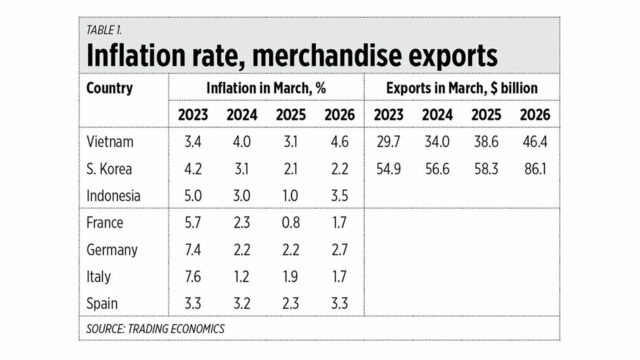
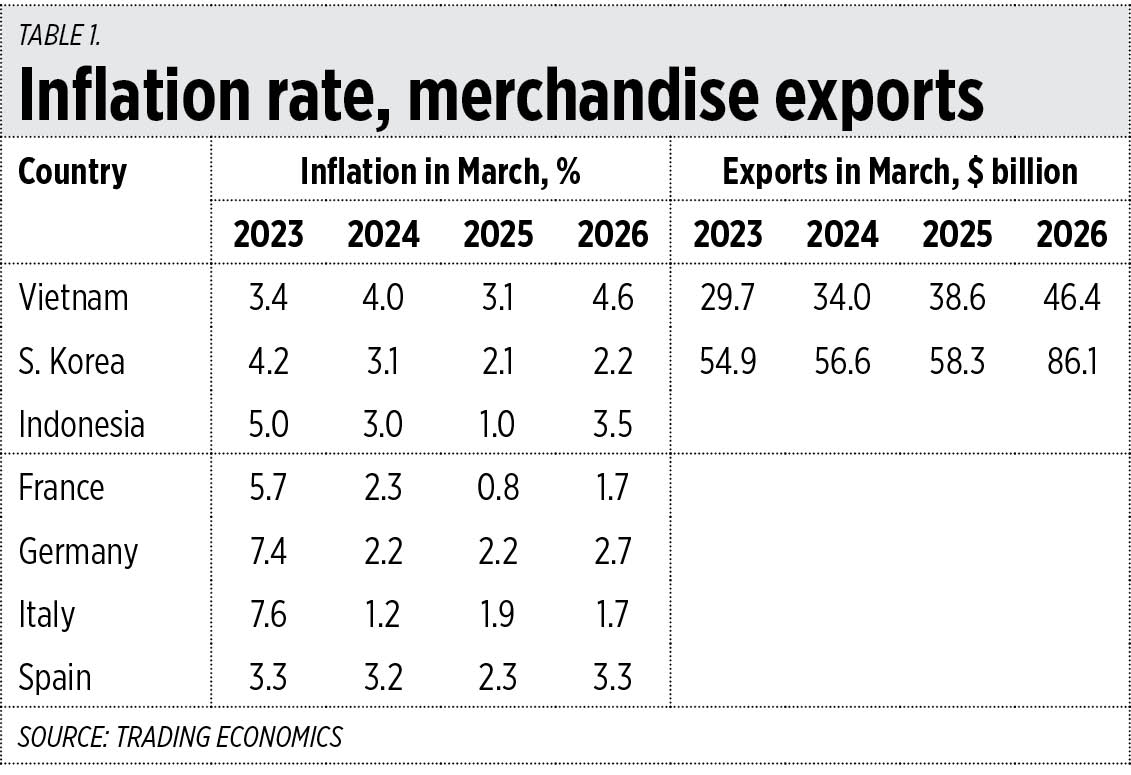
Vietnam and South Korea were the first two countries in the world to release their exports data for March. They also released their inflation data for the same period. So, I also looked at some European countries that released their inflation numbers early.

South Korea’s exports exploded to $86 billion this March, a 47.7% increase over $58 billion in March 2025. The main reason — South Korea exported lots of computer chips and semiconductors as other countries rushed to import from them while the supply of various petrochem products from the Middle East has been limited if not choked.

Vietnam’s exports also jumped, to $46 billion in March, a 20.2% increase over that a year ago.

Vietnam and Indonesia experienced higher inflation last month than they did in March in previous years, but South Korea was able to rein in their consumer prices this year, keeping them at 2025’s level. The European countries also experienced higher inflation so far this year except for Italy (see Table 1).

OIL PRICES
Last week I was interviewed by two reporters — from Philippine Star (Brix Lelis) and Bilyonaryo News Channel (Joash Malimban) — on why Philippine domestic oil prices remain high even if Philippine-bound oil tankers are allowed free exit at the Strait of Hormuz. I explained the higher prices of Dubai oil compared to oil from the US (WTI), Europe (Brent), and Russia (Urals) as we get about 98% of our crude oil from the Middle East, the depreciation of the Peso (from P57/$ on Feb. 27, the day before the war started, to the current P60/$), the higher cost of insurance per tanker, etc.

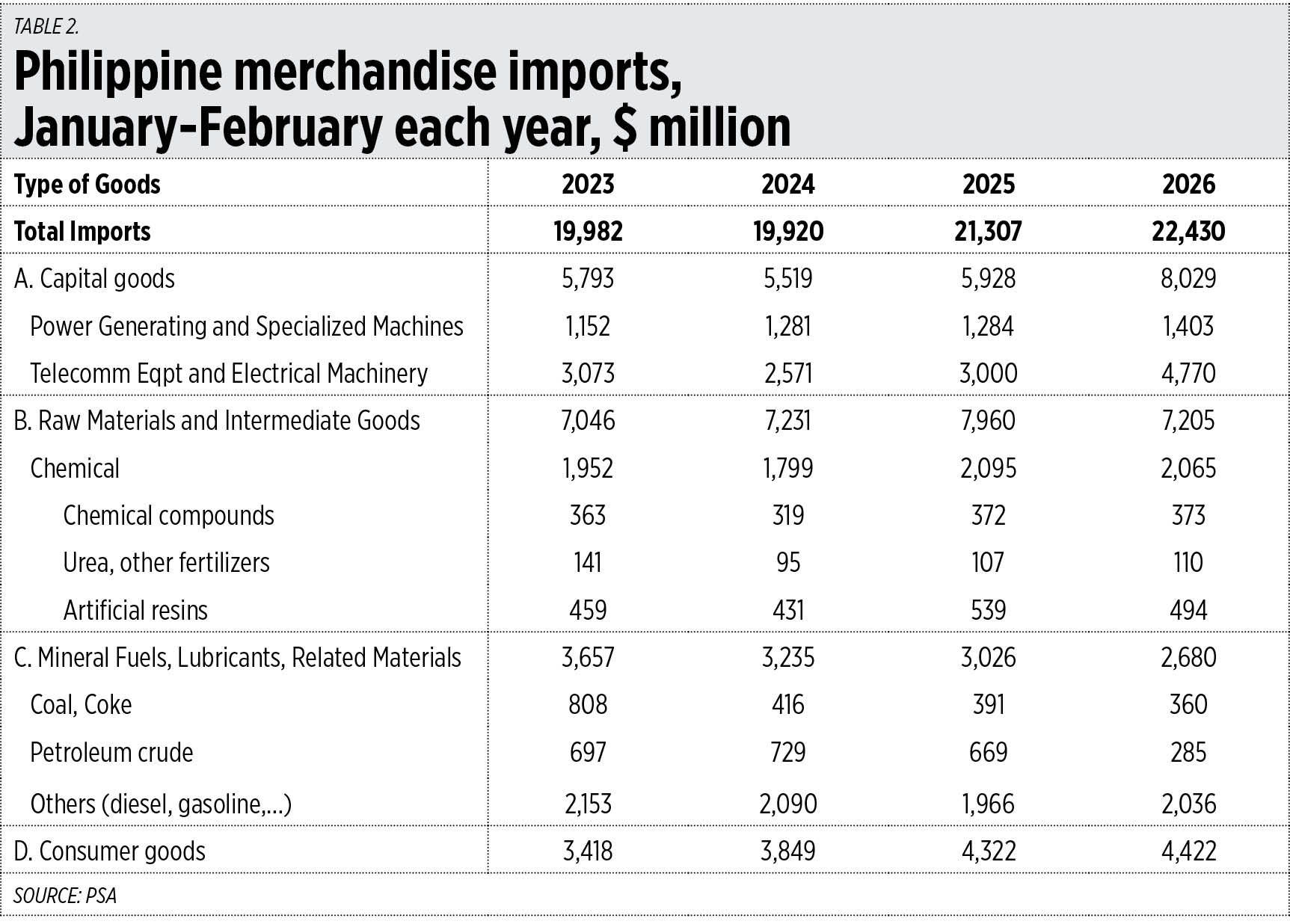
I checked our trade data from the Philippine Statistics Authority (PSA) for January and February. There is one noticeable thing about the period — our imports of crude oil declined significantly, from $669 million in 2025 to only $285 million in 2026, a big contraction of 57.4%. Meanwhile imports of other products — capital goods, raw materials and intermediate goods, and consumer goods — were flat or higher than their levels in 2025.

Our imports of refined petroleum products — diesel, gasoline, jet fuel, and other refined fuels — increased, from $1.97 billion in 2025 to $2.04 billion in 2026. Meaning only crude oil imports declined during that period, but finished oil products imports increased (see Table 2).

I asked an oil-gas expert, a Filipino executive in one of the country’s biggest energy companies, if the low crude imports this year was the main reason why we have high domestic oil prices. And if Petron, the only oil refinery company in the country, had under imported oil before the war started, so they have had to quickly source more expensive oil elsewhere by March. I also sent him the PSA excel file of imports.

His quick answer was “no,” saying that “the table does not show inventory levels, refinery runs, or timing of purchases, so it cannot establish that conclusion. There is some seasonality in demand, with consumption usually easing after the year-end peak. The effect is not large enough to explain a drop of this size. It may explain part of the overall decline in fuel imports, but not the sharp reduction in crude. What the data does point to is a change in supply mix. Possible reasons include refining economics, lower refinery utilization, or timing of crude cargo arrivals, with more reliance on imported finished fuels.

“To get to the root cause, a few areas would need to be checked: Petron refinery utilization in Jan.-Feb. 2025 versus 2026; any maintenance or operational issues affecting runs; Singapore refining margins and product crack spreads over the same period; relative economics of importing products versus refining crude; crude and product inventory levels at the start of 2026; and, whether crude cargoes were deferred from January-February into March.

“In short, the drop in crude imports is clear, but it does not by itself explain higher domestic oil prices. The data is more consistent with a shift in how supply was sourced rather than a shortfall caused by under-importing.”

Whew. That’s a mouthful of high caliber insights from an engineer-finance guy with decades of experience.

Meanwhile, US President Donald Trump has gone wild and irrational in further escalating and prolonging the Iran conflict. There is nothing we can do here to change his policies.

What we can adjust are domestic policies: in the short-run, engage in more energy and foreign affairs diplomacy to get more oil-gas from more countries, and make agreements on energy cooperation with our neighbors in the South China Sea. In the long run, we should embrace fossil fuels and explore more oil, gas, and coal sources in the country plus nuclear energy. We should junk climate alarmism and prioritize energy realism and sustain high economic growth.

I want to mention three energy conglomerates that are keeping and expanding their gas-coal facilities: Aboitiz Power, Meralco PowerGen (MGEN), and San Miguel Corp. They all have coal plants, and they are all partners in LNGPH, the owner and operator of three big LNG facilities in Batangas (South Premiere Power Corp. or SPPC, Excellent Energy Resources, Inc. or EERI, and Linseed). MGEN in particular is very serious about having a nuclear power facility very soon. Go for it, MGEN.


Bienvenido S. Oplas, Jr. is the president of Bienvenido S. Oplas, Jr. Research Consultancy Services, and Minimal Government Thinkers. He is an international fellow of the Tholos Foundation.

minimalgovernment@gmail.com

AI is rewiring the world’s most prolific film industry

BENGALURU — Welcome to the new-look movie set, where the quiet hum of a coding floor has replaced the cacophony of cameras, clapperboards, and shouted directions.

The Collective Artists Network, a top talent agency for Bollywood A-listers, has long brokered the careers of real-life superstars. Now, it’s engineering digital ones. In its Bengaluru premises, filmmakers use artificial intelligence (AI) tools to create content based on Hindu mythology — a popular genre in India. One movie, based on the religious text Ramayana, has a scene showing the god Hanuman flying while carrying a mountain. A show based on a separate ancient epic, Mahabharat, features a sequence depicting the princess Gandhari, who blindfolded herself upon marrying a blind king.

India produces the most movies of any country, and stars such as Shah Rukh Khan and Amitabh Bachchan command cult-like followings. But shifting audience habits, including the rise of streaming, are squeezing production budgets, many industry players say. The number of moviegoers fell to 832 million in 2025 from 1.03 billion in 2019, according to consulting firm Ormax Media. While box-office sales hit a record $1.4 billion last year, revenue has been choppy since the pandemic and reliant on a handful of hits and pricier tickets.

Studios in India are responding by deploying AI at a scale unseen elsewhere: creating full-fledged AI-generated films; using AI dubbing to release movies in numerous languages; and recutting endings of older titles to eke out additional sales. In the process, they are reshaping the economics of filmmaking, compressing production timelines, and pitting AI-driven efficiency against a recurring problem: Audiences have often reviewed AI content harshly, even when it sells.

“AI is slashing production costs to one-fifth of what they used to be for traditional filmmaking in genres such as mythology and fantasy,” said Rahul Regulapati, who heads Collective’s AI studio, known as Galleri5. And production time? “Down to a quarter,” he said.

The approach differs from Hollywood, where union contracts and fears of job displacement have constrained studios’ use of the technology. In India, at least one major production house is reviewing its entire library for AI re-releases, and Google, Microsoft, and Nvidia have made early bets by partnering with local filmmakers.

Previous reporting has explored how Indian filmmakers are harnessing AI, and India’s divergence with Hollywood. But Reuters is detailing for the first time the extent to which India’s film industry is reorganizing itself around AI and the economics driving the shift. Reuters visited two AI studios and tested moviemaking tools, attended film festivals and interviewed 25 people for this story, including directors, studio heads, industry executives and startup figures.

American and British studios have experimented with AI filmmaking — producing the first full-length AI animated features in 2024 and an AI-powered immersive version of The Wizard of Oz last year.

But the ambitions of India’s filmmakers are on a different level, said Dominic Lees, a film and AI researcher at Britain’s University of Reading. “If they can deliver, then the shift in AI filmmaking will be to India,” he said.

The pivot to AI reflects India’s embrace of the technology broadly. Last year, Reuters detailed India’s wager that leaning in to AI will create enough opportunities to offset shorter-term disruption. AI could boost Indian media and entertainment firms’ revenue by 10% and reduce costs by 15% over the medium term, according to analysis by consulting firm EY.

Vikram Malhotra, founder of Abundantia Entertainment, told Reuters the Bollywood production house, which recently announced investment in an $11-million AI studio, is building its AI capability from scratch and expects content generated or assisted by AI to account for one-third of its revenue within three years.

NEW ENDINGS FOR OLD DRAMAS
Last year, India’s Eros Media World re-released a 2013 hit, Raanjhanaa, with an AI-altered twist. It replaced a tragic ending, in which the protagonist died, with a happier finale where he opens his eyes to the surprise of his lover, who smiles through tears.

The rewrite drew backlash. Dhanush, the lead actor, who goes by one name professionally, said on X that the AI remake had “stripped the film of its very soul” and set a “deeply concerning precedent for both art and artists.”

Still, the re-release of Raanjhanaa drew audiences. India’s largest cinema chain, PVR Inox, told Reuters that 35% of available tickets to the Tamil-language version of the movie were sold during its release month, August. That was 12 percentage points higher than the average in 2025.

Now, Eros is going further: Pradeep Dwivedi, its group chief executive officer, told Reuters the studio is reviewing its 3,000-title catalog “to identify candidates for AI-assisted adaptation.” The group’s Indian unit, Eros International, last year warned of “competition from digital platforms” as its consolidated annual revenue from operations fell 44%.

“It’s both a revenue opportunity and a creative renewal strategy,” Mr. Dwivedi said of the plans for AI rewrites.

In Hollywood, such alterations would face barriers. Under an agreement with US actors’ union SAG-AFTRA, studios cannot digitally alter an actor’s performance or create a digital replica without the performer’s informed consent. The Directors Guild of America contract bars studios from using AI for creative decisions without consulting the director and prevents AI from doing the work of its members.

Indian studios, by contrast, are pushing into aggressive experiments using AI, including in Hindu mythological tales — big business in a country with millions of devout followers. Collective is planning eight AI-generated titles focused on deities such as Hanuman, Krishna, Durga, and Kali.

JioStar, a media joint venture between billionaire Mukesh Ambani’s Reliance and Walt Disney, has been airing an AI-generated adaptation of the ancient Hindu epic Mahabharat — the first episodic series to emerge from Collective’s cinematic AI lab.

The AI rendition of the tale about a dynastic war between princes has recorded at least 26.5 million views since its October release on JioStar’s streaming platform, the company told Reuters. An earlier TV adaptation drew 200 million viewers between 1988 and 1990.

The show has faced a rocky reception with audiences, however. Mahabharat holds a rating of 1.4 out of 10 on IMDb, with some reviewers criticizing lip-sync issues and others saying some sequences felt low-quality or lacked authenticity due to unnatural styling.

Alok Jain, a senior executive at JioStar, told Reuters the response “has been a mix of appreciation and healthy debate, which is natural for any ambitious creative leap.” He said JioStar is exploring making original stories in AI format.

Some industry figures lament the rise of AI in filmmaking. Jonathan Taplin, an American writer and producer who has worked with Hollywood studios, said the use of AI to create entire feature films is “an affront to the whole history of cinema.”

“It will fill your cinemas and screens with formula slop,” he said.

DUBBING WITH AI
Dubbing may offer a smoother path to acceptance of AI in film.

India’s 22 official languages and hundreds of dialects split the country into micro-markets, making dubbing essential for any movie to become a national blockbuster. Audiences have long griped about mismatched lip movement — a problem AI is beginning to address.

During a Reuters visit to NeuralGarage, an AI startup in Bengaluru that provides dubbing for top studios like Yash Raj Films, co-founder Subhabrata Debnath demonstrated a clip of an AI-generated character speaking in English. He then superimposed a German audio track, and within minutes the character was speaking fluent German, lips and jaw in sync.

Mr. Debnath said the technology preserves “the performance, identity, and the speaking style of the person” while altering the face enough to make the dubbing look natural.

NeuralGarage’s AI technology was used last year to dub Yash Raj’s Hindi movie War 2 into the Telugu language of south India. The production house didn’t respond to Reuters questions.

TECH MAJORS MEET THE RED CARPET
Global tech majors also want a piece of the action.

Google partnered with Bollywood director Shakun Batra in August to produce a five-part cinematic series using its Veo 3 video-generation and Flow AI tools to experiment with AI-powered filmmaking. Mira Lane, Google’s vice-president of technology and society, told Reuters that AI could also allow independent artists to create complex sequences that “might otherwise be out of reach due to budget or logistical constraints.”

Collective has been working with Microsoft, which told Reuters it is providing AI computing power to help “shape the next wave of global storytelling” through such collaborations.

To bypass the limitations of standard text prompts, Collective uses a hybrid of physical recording and digital animation. Actors wear sensor-equipped motion-capture suits to record body movements as 3D data, while smartphones capture facial expressions. This data is fed into the AI pipeline, allowing for nuanced control over the AI-generated characters.

The ripples are reaching beyond the studio. Globally, festivals dedicated to screening AI-generated shorts have proliferated in cities including Los Angeles, Cannes, and Barcelona. India’s first took place in November at Mumbai’s Royal Opera House, where young storytellers walked the red carpet alongside a dancing robot.

And in February, Nvidia shared the stage with aspiring AI filmmakers at the second edition of India’s AI film fest in New Delhi. Pradeep Gupta, a global vice-president of Nvidia, told the audience the company is working to slash computing costs so that anyone can “create something substantial without putting a lot of money” into production.

Anurag Kashyap, a Bollywood director, told Reuters he is concerned about the growth of AI in filmmaking in India and the lack of guardrails around its use. But he grudgingly conceded the economic case for studios to deploy the technology.

“In India, cinema isn’t about art. It’s purely business, so studios are going to use it to make mythologicals,” Mr. Kashyap said of AI. “Our audience is a sucker for it.” — Reuters


New BSP rules seek to ensure undisrupted settlement of transactions

FREEPIK

FINANCIAL INSTITUTIONS and other participants in the Peso Real-Time Gross Settlement (RTGS) system must report operational issues immediately and adopt alternative measures to ensure that transactions can go through despite disruptions, the Bangko Sentral ng Pilipinas (BSP) said in a new memorandum.

The issuance dated April 1 amends the Peso RTGS rules on incident management for participants in the Manual of Regulations for Payment Systems and is effective immediately.

Participants in the Peso RTGS payment system are banks, nonbanks with quasi-banking function, nonbank electronic money issuers, government agencies, financial market infrastructures (FMIs), clearing switch operators (CSOs), and BSP units, regional offices, and branches.

“In the event of connectivity or system availability issues affecting operational processes done through the Peso RTGS system, including report generation, transaction monitoring, and receipt of settlement notifications, the participant, once aware of the said issues, shall coordinate with the Bangko Sentral through official communication channels, in determining whether the issue originates from its end or from the Peso RTGS system,” the central bank said.

If the incident is on the side of the Peso RTGS system, participants can apply alternative settlement mechanisms if the issue remains unresolved two hours from incident confirmation. They must also monitor BSP advisories about the status of the incident.

Meanwhile, if the issue is due to a participant’s own system or connection to the Peso RTGS system, they must inform the BSP under an hour upon discovery and then adopt their preferred alternative solutions if the incident is still unresolved after two hours.

Participants must conduct an immediate incident investigation, implement their internal incident management framework, and coordinate with the BSP on the status of the incident. They should also extend all the necessary assistance for the timely and effective resolution of the issue.

They can also activate their business continuity plan (BCP) if necessary.

One alternative option for banks and other financial institutions is to apply bilateral netting arrangements with counterparties. This refers to the offsetting of obligations between two parties to reduce the number and value of payments or deliveries needed to settle a set of transactions.

They may also designate a paying agent, or a direct participant that makes payments on behalf of another direct participant, to execute their transactions in PhilPaSS Plus.

Lastly, they may invoke the BCP prescribed by the BSP for participants with settlement accounts. This contains procedures for when PhilPaSS Plus is operational but a participant is unable to connect and/or send payment messages, and for when PhilPaSS Plus is not operational.

Meanwhile, the alternative settlement options for FMIs and CSOs are to apply multilateral netting arrangements with their participants — which is the offsetting of obligations between or among multiple participants to result in a single net position per participant — and to invoke their respective joint BCPs with the BSP under existing regulations, which include contingency measures on backup facilities, recovery sites, connectivity backups, and alternative operating procedures. — K.K. Chan

Infrastructure Asia sees PHL as key market for investors

PHILIPPINE STAR/ MIGUEL DE GUZMAN

SINGAPORE-BASED project development facilitator Infrastructure Asia said the Philippines has become an increasingly attractive market for investors due to policies that support private sector participation.

In an interview with BusinessWorld, Devin Chan, deputy executive director of Infrastructure Asia, said the environment in the Philippines has become more encouraging for international private sector participation.

This includes policies allowing 100% foreign ownership in renewable energy projects, which he said have helped bolster investor confidence.

“Infrastructure buildup is expensive and the returns can be very long drawn… so there is a need to bring in private sector participation, and policies, I think, are in place to try to attract them slowly,” Mr. Chan said.

“The private sector, like our investors and developers, have identified the Philippines as one of the key markets for them in the last couple of years as well,” he added.

Infrastructure Asia is a project facilitation office established by Enterprise Singapore and the Monetary Authority of Singapore to support infrastructure development across the region.

Set up in 2018, it aims to attract private sector participation in infrastructure projects and focuses on six core markets: the Philippines, Indonesia, Cambodia, Vietnam, India, and Bangladesh.

The group works with governments, private companies, and commercial and multilateral development banks to build a pipeline of bankable projects and investment opportunities.

Mr. Chan said Infrastructure Asia prioritizes aligning project size with population needs to help ensure that infrastructure supports long-term economic growth.

In the Philippines, the group works with agencies such as the Department of Transportation and the Department of Energy to help identify partners for project development.

Mr. Chan said improved access to project information has helped facilitate faster project development.

“I think one of the key things that has been quite heartwarming is that it’s about project information transparency, it’s also about the level of openness to respond to questions and of course respond with good answers as well in that sense,” he said.

“So projects are getting more and more better prepared for procurement purposes or for engagement purposes with the private sector,” he added. — Sheldeen Joy Talavera

Ayala Land says new diversion road boosts prospects for Areza estate in Lipa City

AREZA IN LIPA — AYALALAND.COM

AYALA LAND Estates, Inc. said its Areza estate in Lipa City is poised for increased commercial and mixed-use development following improved connectivity from the newly opened Lipa City–Mataas na Kahoy Diversion Road.

“With the new road in place, Areza is now more seamlessly connected to major transport networks, nearby communities, and emerging business districts — strengthening its appeal for commercial, retail, and mixed-use developments,” the company said in a statement last week.

The 92-hectare Areza development in Batangas features linear parks, green spaces, and commercial areas. It is located near institutions such as De La Salle Lipa and Mt. Malarayat Country Club.

The estate is accessible by car, public transport, and ride-hailing services.

The 4.35-kilometer diversion road links Katigbak Road to Leviste Highway and the Southern Tagalog Arterial Road (STAR) Tollway. The road is expected to reduce travel time within Batangas and to Metro Manila, while improving access to public infrastructure, including the planned Lipa City Hall site.

Improved connectivity is expected to support increased activity and investment in surrounding areas.

“As Lipa continues to evolve beyond a manufacturing and logistics base into a more diversified urban center, infrastructure projects such as the Lipa City–Mataas na Kahoy Diversion Road are expected to play a critical role in shaping land use, connectivity, and long-term growth patterns across the city and neighboring municipalities,” Ayala Land Estates said.

Lipa City’s population has grown by more than 70% over the past two decades, alongside sustained expansion in manufacturing and services, reflecting broader growth trends in the Calabarzon region (Cavite, Laguna, Batangas, Rizal, and Quezon), the country’s largest industrial region, according to the company. — Alexandria Grace C. Magno

Wellness at 50: Between responsibility and self-care

STOCK PHOTO | Image by Jcomp from Freepik

As I approach my 50th year, I find myself asking a question that many people at my stage of life ask themselves: Is it still possible to be truly well at 50? Not just free from illness, but genuinely healthy, physically, mentally, and emotionally?

For most of my adult life, I have been deeply committed to my work and the people I serve. Being in a position that requires constant engagement with students, colleagues, and various stakeholders means that my days are rarely my own. There is always something urgent to attend to, someone who needs guidance, a decision that cannot wait. I have come to accept this as part of the responsibility I willingly carry. But what I did not fully anticipate was how easily my own well-being would be pushed aside in the process.

A quiet trade-off happens when you are constantly giving. You begin to sacrifice small, seemingly insignificant habits: regular exercise, mindful eating, and adequate rest. You tell yourself that you will make up for it later, when things are less busy, “Bukas diet na ako, promise” or “Isa lang naman, deserve ko ’to” (I will start dieting tomorrow, I promise; Just one more, I deserve it). But “later” has a way of never arriving.

Every year, I approach my physical check-up with a sense of unease, even dread. Waiting for the results of my blood chemistry, I cannot help but feel anxious. What if this is the year when the numbers finally reflect all the years of neglect?

It is not just about the results themselves, but what they represent. They are a mirror: objective, unforgiving, and honest. And sometimes, that honesty is difficult to face.

Yet, amid this anxiety, I have come to realize that wellness at 50 is possible. It is not reserved for those who have lived perfectly balanced lives. It is available even to those of us who are only now beginning to take it seriously.

However, it does not come easily.

Wellness at this stage of life demands discipline — the ability to choose what is beneficial over what is convenient. This might mean waking up early to fit in a short walk even when sleep is more appealing. It might mean saying no to unhealthy food choices even in social settings where indulgence feels like the norm. Discipline, I am learning, is less about restriction and more about respect for the body that has carried me this far.

Wellness also requires dedication. Unlike in our younger years, when the body was more forgiving, maintaining health at 50 calls for consistency. A single workout or a few days of healthy eating will not suffice. It is the repeated, everyday decisions that begin to create meaningful change. Dedication means continuing even when progress feels slow and results are not immediately visible.

And perhaps most importantly, wellness requires focus. In a life filled with competing priorities, we easily justify neglecting our health. There is always a meeting to attend, a report to finish, a concern to address. But I have come to understand that without focus, wellness will remain an afterthought. Taking care of myself is not separate from my responsibilities; rather, it enables me to fulfill them more effectively.

The journey, however, is far from perfect. There are days when I fall back into old patterns, when fatigue takes over, and when motivation wanes. There are moments when the demands of others feel overwhelming, leaving little room for self-care. But I am learning to extend grace to myself. Progress is not about perfection; it is about persistence.

What encourages me most is the realization that change, even at this stage, is possible. The body may not respond as quickly as it once did, but it is still remarkably resilient. Small, consistent efforts add up. A few minutes of movement each day, more mindful food choices, better sleep habits — these are not grand gestures, but they are powerful.

Wellness at 50 also shifts perspective. Wellness is no longer about aesthetics or external validation. It is about longevity, energy, and quality of life. It is about being present, not just for work or responsibilities, but also for family, for meaningful moments, and for oneself. It is about ensuring that the years ahead are not just lived, but lived well.

As I stand on the threshold of 50, I feel both apprehensive and hopeful. The challenges are real, and the adjustments required are not always easy. But I am beginning to see this phase not as a limitation, but as an opportunity, a chance to redefine what wellness means and to pursue it with intention.

So, is wellness at 50 still possible?

I believe it is.

Not because the journey is easy, but because it is worth it. Not because we have done everything right in the past, but because we can choose to do better moving forward.

And not because we have endless time, but because we have enough — enough time to make meaningful change, enough to care for ourselves, and enough to live healthier, fuller lives.

For those who are nearing or have reached this milestone, I offer this encouragement: it is never too late to begin. Start small. Stay consistent. Be patient with yourself.

Even at 50, or almost 50, we can still choose wellness.

And that choice, made daily, can make all the difference.


Dr. Rayan Dui is a full-time faculty member of the Department of Marketing and Advertising at the Ramon V. Del Rosario College of Business, De La Salle University, where he also serves as associate dean.

rayan.dui@dlsu.edu.ph

GSIS to release over P19 billion in loan refunds to members

THE GOVERNMENT Service Insurance System (GSIS) will release over P19 billion in refunds of loan payments under a program that aims to give its members and pensioners financial relief.

This will benefit 1.37 million members and pensioners with active loan accounts, it said in a statement on Monday.

Under the “Balik Ginhawa” modified loan moratorium program announced last week, qualified members and pensioners can get cash for their immediate needs by refunding up to three months’ worth of loan payments.

The program covers loan payments made from December 2025 to February 2026, with refund amounts depending on how many payments borrowers made during the period.

“This is a more responsive approach than a traditional moratorium. Instead of suspending payments, we are returning up to three months of amortizations in one lump sum, giving our members immediate support when they need it most,” GSIS President and General Manager Jose Arnulfo “Wick” A. Veloso said.

The state pension fund said that based on its data, its members’ monthly loan amortizations range from P4,000 to P39,000, which translate to roughly P12,000 to P117,000 over three months.

It previously said the voluntary program is expected to benefit over 3.2 million members and pensioners.

GSIS recorded a net income of P138 billion in 2025, as gross revenues reached P344 billion and nonlife gross premiums was at P11.4 billion. — A.M.C. Sy

HBO Max brings Euphoria to Coachella with late-night Season 3 premiere

Euphoria (2019)
Euphoria (2019)

LOS ANGELES — HBO Max will air the premiere of the third and final season of Euphoria on Sunday, April 12, at the Coachella Valley Music and Arts Festival, the first time a television series has screened at the iconic music event, the company announced on Thursday.

The episode of the Emmy-nominated drama, which stars Zendaya, a two-time Emmy winner for her role as the show’s troubled teen Rue Bennett, will be aired at the festival’s campgrounds at 11:59 p.m. PDT, following the venue’s final performances of the weekend.

The late-night screening will be open exclusively to Coachella wristband holders on a first-come, first-served basis.

HBO Max scheduled the episode to close out the first weekend of the two-weekend-long festival, which will feature big artists including Sabrina Carpenter and Justin Bieber.

The teen drama Euphoria, which debuted in 2019, follows a group of high school students in the fictional town of East Highland, California, as they navigate love, loss, sex, identity, and addiction.

Season 3, which is directed by creator Sam Levinson, finds the core group of characters entering adulthood. The new season explores themes of faith, redemption, and the lasting consequences of past actions.

Zendaya returns alongside much of the original cast, including Hunter Schafer as Jules Vaughn, Jacob Elordi as Nate Jacobs, and Sydney Sweeney as Cassie Howard.

The eight-episode season will also mark its official debut on HBO Max on April 12, with new episodes released weekly.

Founded in 1999, the Coachella Valley Music and Arts Festival has grown into one of the world’s most influential music festivals, blending high-profile performances with fashion, art, and pop culture moments. — Reuters

2GO, PCG sign deal for transport support, travel discounts

FACEBOOK.COM/2GOTRAVEL

LOGISTICS and sea travel provider 2GO Group, Inc. has partnered with the Philippine Coast Guard (PCG) to offer travel discounts to retired PCG personnel.

In a media release on Monday, 2GO said it signed a memorandum of agreement with the PCG to provide transport and logistics support for its personnel and their families, including legal spouses and authorized companions traveling with 2GO.

“Through this partnership, 2GO is proud to give back by making our transport and logistics services more accessible to them and their families. We remain ready to support our uniformed personnel and provide the reliable logistics services our country depends on,” said 2GO Chief Operating Officer and Chief Financial Officer William Charles Howell.

2GO said the partnership also establishes a framework for transport and logistics support for official PCG requirements, such as the movement of humanitarian and relief goods.

“This collaboration aims to support PCG operations during calamities by enabling faster and more efficient transport of essential cargo through 2GO’s nationwide shipping and logistics network,” it said.

2GO provides multimodal transportation, warehousing and inventory management, distribution, special container services, project logistics, and e-commerce logistics. It also offers sea travel, freight forwarding, import and export processing, and customs brokerage services. — Ashley Erika O. Jose

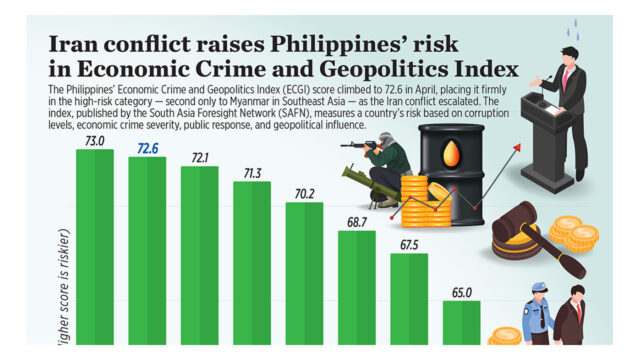
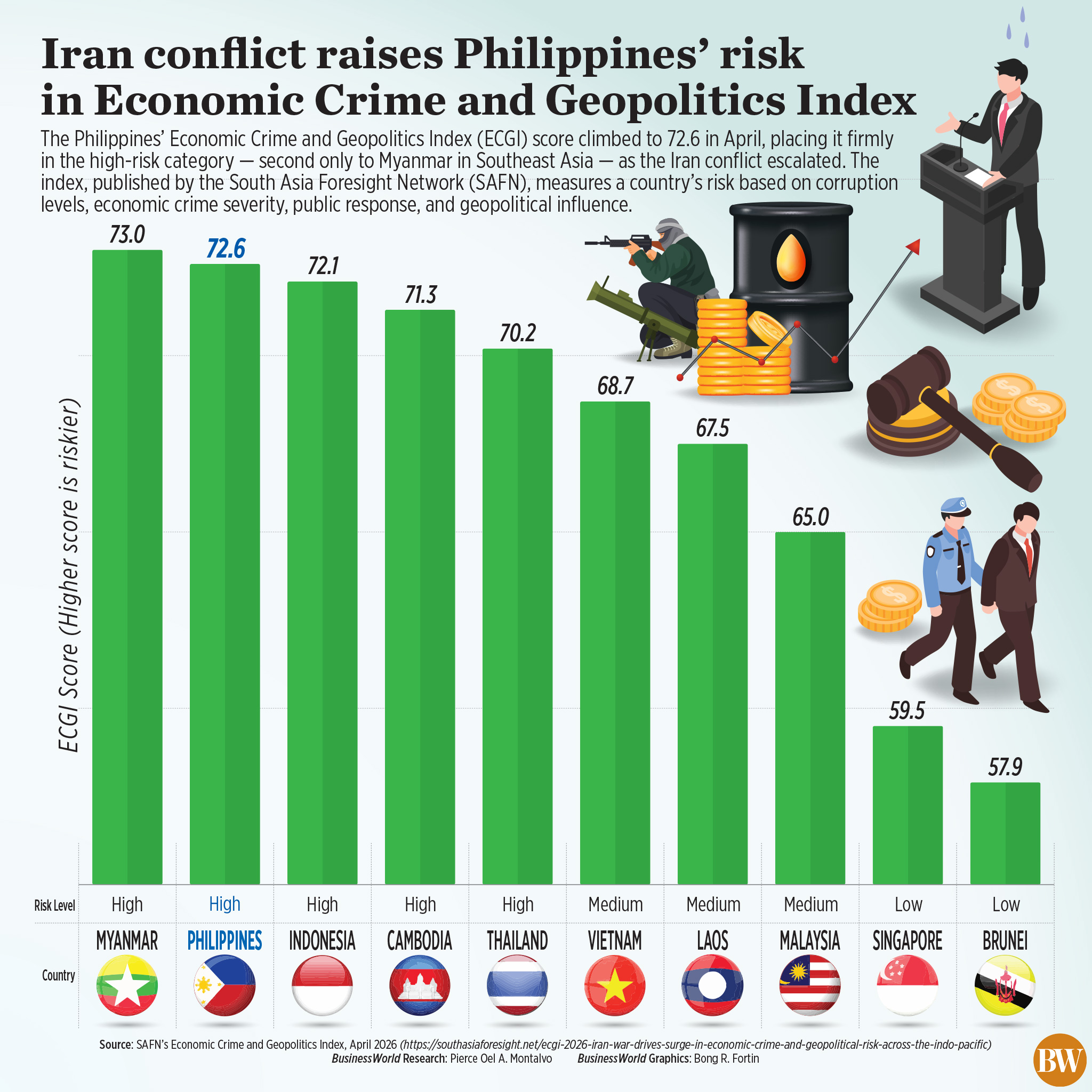
Iran conflict raises Philippines’ risk in Economic Crime and Geopolitics Index

THE PHILIPPINES remains at “high risk” for political instability as the widening conflict in the Middle East threatens local supply chains and energy security, according to Washington‑based South Asia Foresight Network (SAFN). Read the full story.

How PSEi member stocks performed — April 6, 2026

Here’s a quick glance at how PSEi stocks fared on Monday, April 6, 2026.


ADVERTISEMENT
ADVERTISEMENT