Home Blog Page 5890

BIR aims to have 100% of tax payments  done online

PHILIPPINE STAR/ RUSSELL A. PALMA

THE BUREAU of Internal Revenue (BIR) is aiming to have all taxpayers file their returns and pay their taxes through electronic means.

“Our objective is to make that a hundred percent — all taxpayers electronically filing and paying (taxes),” BIR Commissioner Lilia C. Guillermo said during a Senate Finance Committee hearing on Wednesday.

As of end-August, around 98% of taxpayers already use the BIR’s digital platforms. The BIR already has an Electronic Filing and Payment System, Electronic Fund Transfer Instructions System, and other e-payment channels.

“We are mandating our large taxpayers, as well as our medium taxpayers, to do electronic filing and paying with us. No option, because some of them would still like manual filing because they know that if they manually file, it will not be easy for us to automate our LoAs (Letter of Authority) on them,” Ms. Guillermo said.

An LoA authorizes a BIR officer to examine a taxpayer’s books to ensure proper taxes are paid.

The digital transformation programs of the BIR and the Bureau of Customs (BoC) have been allocated P3.56 billion under the 2023 proposed national budget.

“In so far as infrastructure is concerned, we thank the Budget department [for] giving us [funds] to upgrade our infrastructure, especially [since] we are after online sellers [and] online services in the Philippines and foreign based ones, once [the Internet Transactions] bill is turned into law,” Ms. Guillermo said. 

Last month, Ms. Guillermo said that only 15 out of 100 large taxpayers have responded to the BIR’s invitation for digitalization through its e-receipts and e-invoicing system.

“The BIR shouldn’t be the only one undergoing digital transformation… [for] audits to be done very conveniently,” Ms. Guillermo said then in the vernacular.

In August, the bureau also announced its launch of an Online Registration and Update System in 2022 or 2023, in compliance with its Digital Transformation Roadmap.

The BIR is expected to generate P2.39 trillion in revenues this year and P2.67 trillion next year.

The BIR has been transitioning into digital operations after adopting a 10-year digitalization roadmap in 2019. — D.G.C.Robles

Consistent application sought for key ERC ruling

LUIS-TOSTA-UNSPLASH

AC Energy’s call comes ahead of decision on joint SMC-Meralco rate hike petition

ACEN Corp. has joined participants in the energy sector that have called on the regulator to decide on a joint plea by the country’s dominant power distributor and its energy supplier to hike their previously approved electricity rate to reflect unforeseen events.

The call from the Ayala-led renewable energy platform came days after the Energy Regulatory Commission (ERC) heard the petition jointly filed by Manila Electric Co. (Meralco) and a unit of San Miguel Corp. (SMC).

“Whatever the decision will be, we hope that our regulator as well as Meralco, will treat all suppliers fairly and consistently,” ACEN President and Chief Executive Officer Eric T. Francia said in a statement sent via Viber.

“We have the same contract and similar set of circumstances, so if there is a change in circumstance in one supplier, the same should apply to others,” he added.

The change in circumstance was previously described by SMC President Ramon S. Ang as extraordinary and unprecedented, caused by commodity supply disruptions brought about by Indonesia’s coal export ban, Russia’s war on Ukraine, and the pandemic’s value chain issues.

Mr. Ang said that SMC’s power unit SMC Global Power Holdings Corp.’s power facilities in Sual, Pangasinan and Ilijan, Batangas had incurred a combined loss of P15 billion, prompting the group to seek temporary relief to allow it to continue supplying power.

SMC decided to absorb more than P10 billion of the losses, which were incurred last year and traced to a surge in the average coal price to $176 per metric ton (MT) in the second half of last year from just $99 per MT in the first half. It said the average coal price in 2019 and 2020 was only at $69 per MT. The Sual plant runs on coal.

The company also cited the unilateral natural gas supply restrictions from Malampaya for the Ilijan power plant.

SMC earlier said that coal prices in the global commodities markets had breached $400 per MT or way above the $60-$65 per MT price range that was factored in during the execution of its power supply agreements (PSA) with Meralco in 2019.

SMC Global Power is seeking temporary and partial cost recovery relief only for the losses it incurred from January to May 2022 through a rate increase on its contract capacity under the PSAs to be amortized over a period of six months.

Up for ERC resolution is the joint petition for a rate increase covering the first five months of this year of P0.80 per kilowatt-hour (kWh) from P4.3-P5.1 per kWh for the SMC group’s 670 megawatts (MW) of contracted baseload capacity from the Ilijan plant, and an average of P4 per kWh from P4.3-P8.3 per kWh for the 330-MW contracted baseload capacity from the Sual plant.

SMC is looking to recover from P5.2 billion in losses for the five-month period.

ACEN did not give details on its PSA with Meralco but based on ERC documents, the company under its previous name was issued a notice of award by Meralco after a competitive selection process (CSP) for its bid to supply 200 MW at P4.8849 per kWh.

In a media statement on Aug. 23, Mr. Ang called on the ERC for a fair and objective assessment of the joint petition, which was filed in May, seeking a temporary rate increase for six months.

He also said that the administrators of the Ilijan and Sual plants had issued notices of termination to Meralco of their PSAs, citing unexpected and unprecedented “change in circumstance.” He added that the termination is effective starting Oct. 4, if relief is not given.

Consumer groups such as Kuryente.org challenged the ERC to decide on the joint petition. In a statement last month, it said that if a company cannot respect its contractual obligations and the CSP, “it must close shop and allow those who could deliver these obligations as it does not have any moral ascendancy in staying in the industry.”

Separately, Greenpeace called on the ERC last month to “remain firm in prioritizing the welfare of consumers, by ensuring that electricity prices will not drastically increase to compensate for companies’ dirty, destructive, and expensive energy generation.”

On Aug. 30, the ERC held a hearing attended by the joint petitioners. It has yet to decide on the matter. — Victor V. Saulon

Israeli companies seek ICT cooperation with Philippine counterparts

CHARLESDELUVIO-UNSPLASH

ISRAEL has vowed to connect Israeli information communications technology (ICT) firms with Philippine stakeholders to strengthen trade relations and boost technological innovation between the two countries, the Israeli embassy said on Wednesday.

During a business-to-business networking event organized by the embassy at the New World Hotel in Makati City, Israeli Ambassador Ilan Fluss said the delegation of Israeli ICT firms that participated in the networking opportunity was the largest since the start of the coronavirus pandemic.

“I call our companies and the local partners, we should bring not only the very best of technologies but also aspects of knowledge transfer and job creation,” he said at the event. “This will make our long-term partnership beneficial for all parties.”

The companies that participated in the event were primarily engaged in cybersecurity, 5G network development, and user prediction.

Appnext, an independent application discovery platform, was one of the several firms that pitched services to local stakeholders.

Alon Benami, the director of strategic partnerships for Appnext, said his firm has been working with local application developers for the past two years.

“We are working with 3,000 applications every day, and we partner with the world’s top original equipment manufacturer (OEM) and telecommunications companies,” he said.

Artificial Intelligence and big data prediction platform Talamoos also presented how its service that anticipates a user’s interests and preferences based on online behavior could increase a firm’s revenues and engagements.

The networking event was a collaboration between the Israel Embassy and the Philippine Chamber of Commerce and Industry. Representatives from the Department of Information and Communications Technology, local investors, and other government representatives participated in the ICT roadshow event.

“Today technology and innovation is one of the key pillars in our relations with the Philippines,” Mr. Fluss said. “Our priority and main effort is promoting the establishment of bridges of innovation and technology between our two countries.” — John Victor D. Ordoñez

Tan-led firm expects leasing recovery on re-emerging POGO

eWestPod

LUCIO C. TAN group’s Eton Properties Philippines, Inc. said that demand for its office developments has shown recovery in the second half of the year on the re-emergence of Philippine Offshore Gaming Operators (POGOs).

“With the perceived stability and confidence of a new administration and the market starting to normalize, Eton Properties gradually felt an increase in the demand for leasing spaces this second half of the year,” Eton Properties Executive Director Kyle Tan said.

“One of the primary effects we see is the confidence of POGOs to return to the Philippines. These operators are not just from China, but within our neighboring countries in Southeast Asia as well,” he added.

The company said that it sealed a deal with “one of the biggest POGO companies from Southeast Asia” to lease more than 6,000 square meters of office space, eWestPod, in its Eton WestEnd Square near the Makati central business district (CBD).

The eWestPod space was developed “to create a particular built-to-suit concept that allows the user or tenant to design and customize the space according to their unique preference.”

The office building has four floors of offices that have direct access to the amenities and are close to the modern conveniences of the Makati CBD.

“[T]he whole master-planned development features eWestMall, which houses two floors of retail spaces, assuring no shortage of different lifestyle options,” the company said.

Last month, the company signed a three-year contract with a triple A construction firm to lease a whole floor of its other office project, Blakes Tower.

“Eton also sees the positive ripple effect of POGO in our leasing business because some of them are also looking for residential and commercial spaces, which are a good indicator of our overall growth in occupancy rate,” Mr. Tan said.

Eton Properties specializes in office projects, commercial centers, and mixed-use township developments as well as high-end and mid-income high-rise and horizontal residential developments.

Eton Properties is the real estate brand of the Lucio Tan group, one of the business conglomerates in the Philippines. Its foreign counterpart, Eton Properties Ltd., is a real estate brand in Hong Kong and mainland China. — Justine Irish D. Tabile

FEU reports surpassing pre-pandemic student population for 2022-23

FAR EASTERN UNIVERSITY, Inc. (FEU) said in a report on Wednesday that its student population for the school year 2022-2023 exceeded pre-pandemic levels on eased mobility restrictions.

“The easing of quarantine restrictions and normalized economic activities, including the return to in-campus learning under a face-to-face class set-up, together with in-person onsite reporting by administrative staff, is expected to lessen the uncertainties in the group’s business environment,” the company said in its annual report.

It added that it remains positive with the relaxation of business activity and people mobility restrictions amid global logistic challenges.

“Nonetheless, the group believes that it is an opportune time to engage in expansion opportunities,” it said.

Recently, the company announced its acquisition of Good Samaritan Colleges in Nueva Ecija and JPMC College of Health Sciences (JPMC-CHS) in Brunei.

Last month, the company disclosed that it signed an investment agreement with Good Samaritan Colleges for the acquisition of 77,273 shares or 34% of the outstanding capital stock of the institution.

Back in July, FEU entered its first private nursing school venture in Brunei after it signed an agreement with Jerudong Park Medical Centre and Darussalam Assets on the establishment of JPMC-CHS.

“Overall, the Group’s management is optimistic that it can maintain excellent results of operations in the next fiscal year but remains conservative with its outlook on the financial market and the overall economy,” it said.

FEU is a majority shareholder of East Asia Computer Center, Inc., FEU Alabang, Inc., Far Eastern College Silang, Inc., FEU High School, Inc., and Roosevelt College, Inc.

It is a major shareholder of Fern Realty Corp., which helps FEU schools in their real estate requirements.

FEU also owns 51% of Edustria, Inc., a joint venture with the Technological Institute of the Philippines. The joint venture operates a high school under the same name in Lipa City and Malvar, Batangas. — Justine Irish D. Tabile

Taking on the all-you-can-eat pasta challenge

BUCATINI

By Joseph L. Garcia, Reporter

WE like to think we have a very expandable stomach, so when we found out through a Facebook announcement that Mama Lou’s Italian Kitchen was having a 12th anniversary Endless Pasta promo, we knew we had to at least try to climb an Everest of unlimited pasta.

Mama Lou’s was founded in 2010, and operated by the Tremblay family in BF Homes, Parañaque. It still maintains a BF Homes branch, but has opened several branches since: these include restaurants in Nuvali, Evia, UP Town Center, Ayala Malls The 30th, Feliz, Manila Bay, Circuit Makati, North Exchange, and Venice Grand Canal Mall. It had opened a sister chain as well, called Nonna’s. The restaurant was named after its co-founder, the Tremblay matriarch Marilou (who unfortunately passed away due to cancer, according to the Philippine Daily Inquirer).

“In the mind of people any food establishment based on ‘Mama’ [h]as to be homey, friendly, and good. We named it after my wife Malou who was an excellent cook,” said Richard Tremblay in an old website for Mama Lou’s.

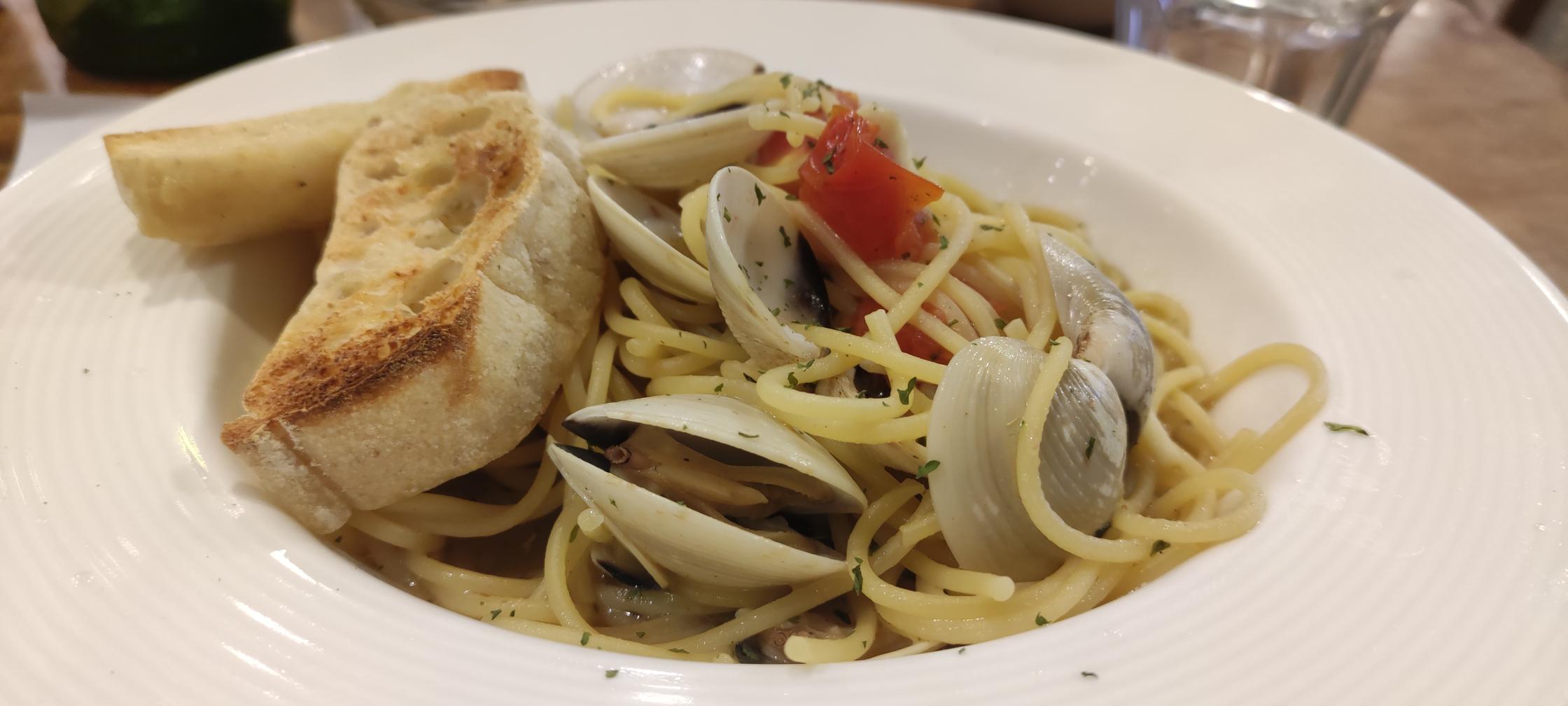
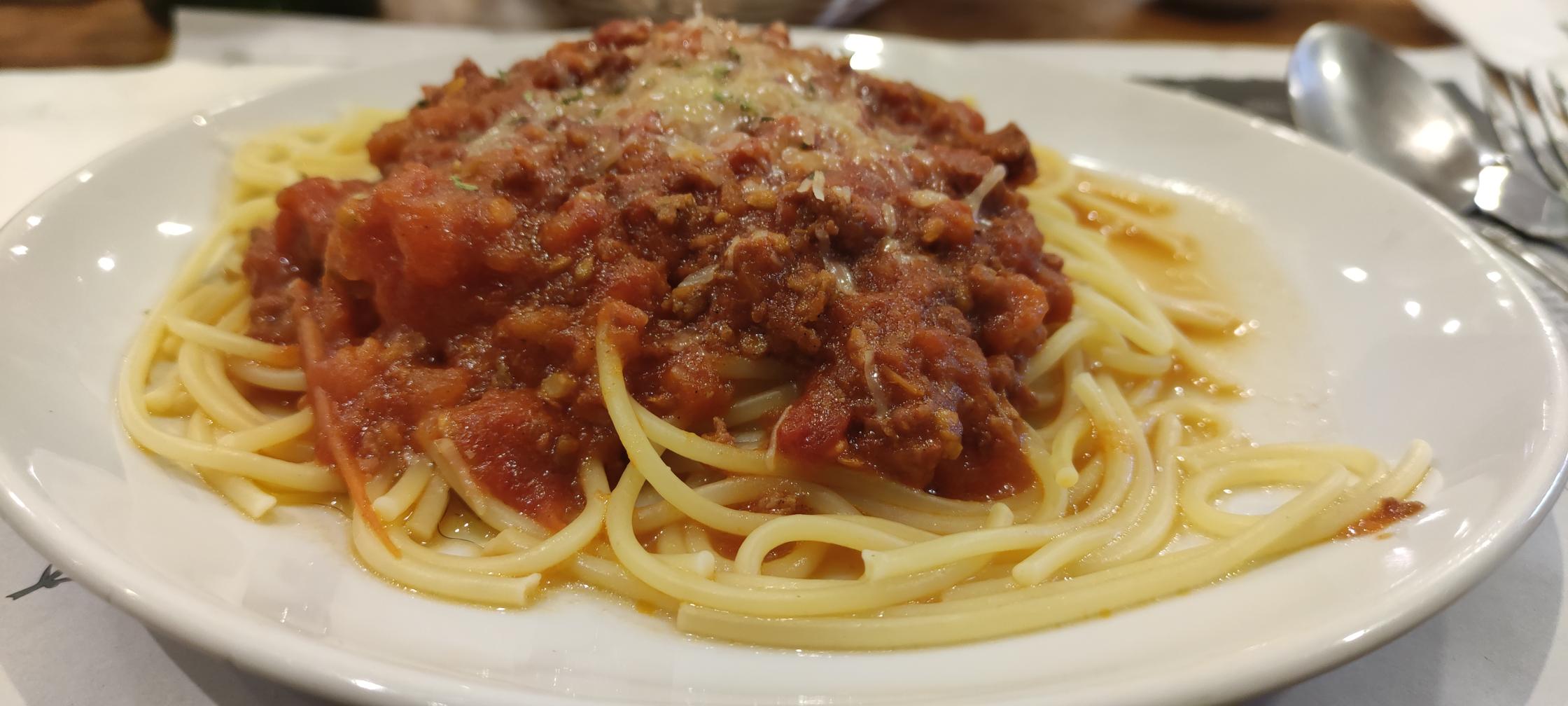
The announcement on Facebook said that guests may refill their plate with any flavor of pasta from the available choices (Carbonara, Bucatini Amatriciana, Mama’s Pesto al Pollo, Lucio’s Truffle, Spaghetti Bolognese, Vongole Olio, Spaghetti and Meatballs, Lasagna, Spaghetti Con Tuyo, Arabbiata, and Truffle Mac and Cheese). Guests may refill their plate an unlimited number of times, but they must finish their last serving of pasta before requesting a refill. Guests cannot leave any leftover pasta, or take it out, or share. The server told us that the first plate would be at 200 grams, and succeeding servings would be 100 grams. At a sum of P550 (when a plate costs upward of P300) per person, we figured we’d get our money’s worth after two plates.  Deal!

Friends refused to come because they were afraid of what too much pasta may do to a person. A loyal nephew decided to come with me to the UP Town Center branch, but unfortunately quit after just one plate. I had to do this quite alone.

We opened with the Vongole Olio, pasta cooked with clams in a light sauce. It had a rich clam broth pooling at the bottom of the plate; and the pasta looked glossy and appealing. It had that briny taste of the sea, and tasted almost like I ordered it at a seaside restaurant. So far, so good.

Lucio’s Truffle Pasta, the one that defeated my nephew, had a truffle taste that felt only like a suggestion (the scent of truffle was strong but faded easily), but the sauce was at least satisfyingly creamy.

The Bolognese (a tomato-meat sauce) was delightfully chunky, but comparable to other mid-priced Bolognese sauces found in the city. Mindful that Bolognese sauce takes several steps to make, it did have a quality that it had been stewed for at least a few hours.

We felt that the Spaghetti and Meatballs dish, with an acidic tomato sauce (which was felt on our tongue) did not add much to the experience, and took up valuable pasta real estate in the stomach. By then, the line of tomato-based sauces left us feeling a bit tired, so when the Bucatini Amatriciana arrived on our table, we had low expectations for it — and we were gladly mistaken. The sauce is traditionally made with guanciale (cured pork cheek), but we accepted the smoky bacon on our plates (but then, we could be wrong; and we really did strike out that day). Other ingredients in traditional Italian cuisine include tomato and pecorino Romano, but we weren’t picky. This was served with Bucatini, a long and hollow noodle. This shone with the sauce, for the thicker, heavier noodle slid silkily into the mouth (perhaps the noodle was made aerodynamic by its structure) and added good-natured heft to the dish.

At that point, we felt our eyes drooping (from a carbohydrates crash, no doubt) but we felt that we could eat more. We settled for the Spaghetti con Tuyo. This was a pleasant, deceptively simple, and well-balanced ending, with the spare slices of tuyo (dried and salted fish), arugula, and tomatoes singing together.

We had six plates of pasta all together, and had a good night’s sleep after. Did I get my P550’s worth? Yes, and then some. Will I do it again? Maybe. Should you try it? Yes, just so you could say you could (and the Vongole, Spaghetti con Tuyo, and the Bucatini were really good).

The Mama Lou’s Italian Kitchen Endless Pasta promo is available on the following dates: Sept. 19, 20, 21, 26, 27, and 28.

Smart aids law enforcers amid worsening text scams

SMART Communications, Inc. said on Wednesday that it is working with the Philippine National Police (PNP) and the coordinating council of the Department of Information and Communications Technology (DICT) to track down the people behind text scams.

From June to August, Smart said that it had blocked a total of 167,000 numbers that were identified or have a connection to fraud activities, while it had also blocked around 342 million “smishing” messages in the same period.

“We are supporting government-led efforts to identify the scammers and to pin down where they’re getting the SIMs that they’re using to run their modus,” PLDT, Inc. and Smart’s First Vice-President and Chief Information Security Officer Angel T. Redoble said in a media release.

Mr. Redoble said that Smart is investigating suspicious subscriber identity module (SIM) card purchases that might be related to illegal activities.

“Our initial investigation has shown that the fraudulent messages are being sent phone-to-phone. They don’t pass through aggregators. Most likely, the perpetrators have bought the SIMs in bulk. But through our blocking efforts, we are making it expensive for them to use this method,” Mr. Redoble said.

The National Telecommunications Commission (NTC) has directed telecommunication companies to block or deactivate domains and uniform resource locators (URLs) in text messages, amid worsening text scams.

Hastings Holdings, Inc., a unit of PLDT Beneficial Trust Fund subsidiary MediaQuest Holdings, Inc., has a majority stake in BusinessWorld through the Philippine Star Group, which it controls. — Ashley Erika O. Jose

What you need to know about oak-aging

THE TRADITIONAL botti used in Piedmont to age their Barolo and Barbaresco wines

ONE of the most important factors on wine quality, after the grape juice itself, is the proper use of oak in wine aging. Describing wine with lovely bouquet, tobacco flavors, and long vanilla-like finish is not possible without the influence of oak aging. Wine develops flavors and complexity when aged in oak barrels.

The use of barrels in wine started centuries ago, but more as storage and as transport vessels for the precious wine, rather than for its flavor enhancement qualities. It was just in the late 18th century that the role of oak barrels in wine aging was truly established.

Barrels come in different sizes, ranging from over 2,400-liter capacity in the case of traditional extra-large cask called botti used in Italy’s Piedmont region, to smaller ones like a 100-liter Hungarian barrel. Standardization of barrel-size eventually took place in the late 19th century, specifically in 1880s, when the French Bordeaux model of 225-liter barrel was made the “de facto” size and remains at present the most common barrel size used for aging wine.

These wine barrels are crafted from white oak trees found in France, eastern European countries like Croatia (specifically in region of Slavonia), Hungary and Romania, and the US, particularly from the state of Missouri. The companies making wine barrels are known as cooperage or in French as tonnellerie.

There are major considerations to look at in oak aging:

• The Grape Varietal — Oak aging can used for both red and white grape varietals depending on the style and intention of the winemaker. Most red varietals, from Cabernet Sauvignon, Syrah, Zinfandel, Merlot, to Pinot Noir, are very oak-friendly and benefit a lot from ample oak aging. On the other hand, other red varietals similar to Gamay (Beaujolais, France) and Dolcetto (Piedmont, Italy), are less conducive to oak aging and may be better off without its influence.

Oak aging adds extra flavors to the wine and contributes to richer textures. Oak barrels are porous and breathe during direct contact with wine, that helps develop the secondary flavors over a period of aging.

For white wines, the omnipresent Chardonnay benefited the best from oak-aging as evidenced by those beautifully crafted but ultra-expensive Grand Cru and Premier Cru from Chassagne Montrachet and Puligny Montrachet in Cotes du Beane, Burgundy. White varietals like Moscato, Torrontes, Riesling, Gewurztraminer, and, for me, new world Sauvignon Blancs are best made without oak-influence.

• The Type of Oak — Is it French or American oak? This is the most popular debate amongst winemakers when they choose to purchase oak barrels for aging their wine, though we can throw in Hungarian and Slavonian in this discussion too.

Taransaud, Beaune, Allier, Demptos. Sequin Moreau are just some of the more famous French oak brands from renowned cooperages that you hear from wineries and chateau owners. The French oak costs between $800-$1,000/barrel (225-liter size). The American oaks on the other hand can cost just around $400-$600/barrel. So, why opt for more expensive oak barrels then? The flavors imparted by these different oaks differ one from another.

French oak barrels in general, with their tighter grain structure, can soften wine better and manifest flavors of milk cream, spices, cloves, and, when toasted, chocolate and vanilla. American oak barrels, on the other hand, have a looser grain structure and are more robust. This structure enhances stronger influence on the wine, showing flavors of vanilla, coffee, toffee, and nutmeg. It is popular practice to use both American and French oaks in a wine to garner the good qualities of both worlds.

• The Usage of the Oak — Since oak barrels are pretty expensive, not all oak barrels used for aging are new, or virgin. There are those that are second-used and hand-down, up to the third use, depending also on the period of time wine spent in the barrels intended for re-use. There may no longer be flavors left after the third use.

The virgin oaks would impart the most intense flavors, as expected, while only very subtle nuances will be detected from the third use.

An in-house cooperage could, however, re-toast and re-stave the barrel (termed as “hogsheading” in some places), but this will not be as good as the virgin oak, as the barrels will be thinner and devoid of their original flavor intensity.

The most expensive wines in the world —  from classified growths of Bordeaux to new world icons Penfolds Grange, Screaming Eagle and Opus One —  all use virgin oaks exclusively.

• The Toast Level — When oaks are lightly toasted, the wine acquires a subtle creaminess and butter elements, and as the toast gets heavier, the wine will acquire more charcoal-like flavors, developing tobacco, toffee, coffee and dark chocolate type nuances.

The toast level has a lot to do with the style of wine intended. If the winemaker is looking at making bold, full-strength, and masculine wines made from Cabernet Sauvignon or Syrah, the tendency will be to have a heavier toast level. But if the intention is more finesse and an elegant type of wine, the toast level will be light to medium only, like what you will get from the French Meursault (from Burgundy) made of 100% Chardonnay.

• The Aging Period — Only Spain as a country has a law governing the oak aging period in all their wine regions and mandate terms corresponding to the periods of time wine spends in oak. This is an all or nothing rule, meaning the entire wine should be under oak, not a certain percentage of the wine, otherwise this classification cannot be used and manifested in the label. Under the Spanish Denominaćion de Origen (D.O.) laws, below are three general oak aging classifications:

Crianza — defined as wine that had undergone a minimum of six months of oak aging, with another 18 months in bottle aging prior to commercial release; or, another way of putting it is two years minimum cellaring prior to release, of which a minimum of six months should be in oak barrel.

Reserva — defined as wine that had undergone a minimum of 12 months of oak aging, with another 24 months in bottle aging prior to commercial release; or three years minimum cellaring prior to release, of which a minimum of one year should be in oak barrel.

Gran Reserva — defined as wine that had undergone a minimum of 24 months in oak aging, with another 36 months in bottle aging prior to commercial release; or five years minimum cellaring prior to release, of which a minimum of two years should be in oak barrel.

These classifications may vary from region to region, like Spain’s proudest Rioja region, through their Consejo Regulador (regulatory board), bumped up their minimum oak-aging requirement for their Crianza wines to 12 months, six months more than required by this law.

Other than Spain, neighboring Italy and Portugal are doing something similar with their labels. Famous ones include Tuscany’s Chianti Riserva with a minimum of 24 months of oak-aging (and an extra three months bottle aging) and Piedmont’s Barolo with minimum 18 months in barrel (and an extra 20 months bottle aging) before commercial release.

While oak aging cannot cover for a bad harvest, it can still mask some flavors that can improve a wine from bad to tolerable. That is also why only good vintages in Spain normally go through Reserva and Gran Reserva stages, as no bodega (winery) will risk patiently waiting for their inventory to reach higher required cellaring, if their wine will not improve with prolong aging to commercially succeed.

There are many cheaper but nefarious ways of duplicating real oak-aging, including the use of oak chips, oak staves, and even oak essences. Oak chips and oak staves (bigger portions), taken from real oaks are submerged into stainless steel tanks for days and then filtered off upon bottling. Oak essence, on the other hand, is a liquid form of oak flavor concentrate that is added to the wine after fermentation and before bottling.

The New World wine-producing countries, especially Chile and Argentina, are notorious for this. These superficial oak practices in these South American countries are not illegal. These same practices are, however, banned in Europe.

Despite the best “doctored” efforts, all these deceptive means are easily exposed during tastings, especially by discerning wine drinkers. The tendencies of these deceiving oak methods are to overwhelm you on the “nose” side — promising rich flavors, complexity, and texture — but once tasted, the wine will show a light diluted body, a missing mid-palate sensation, and an uneventful aftertaste, totally unlike what real oak aging can truly do.

So next time we drink some premium wines, take note of the flavors imparted by the oak aging, and learn to appreciate the added depth and complexity from the nose or what we call “bouquet,” to the supple texture and lingering finish. The key to an excellent wine is the synergistic integration of wine and oak. Good oak aging, after all, does not lie in the glass and may likewise manifest itself loudly on the price tag.


The author is the only Filipino member of the UK-based Circle of Wine Writers (CWW). For comments, inquiries, wine event coverage, wine consultancy and other wine related concerns, please e-mail the author at wineprotege@gmail.com, or check his wine training website https://thewinetrainingcamp.wordpress.com/services/.


JobStreet, CSC to hold online career fair 

ONLINE job platform JobStreet Philippines has partnered with the Civil Service Commission (CSC) to conduct a nationwide government career fair from Sept. 19 to 23 to help boost local employment.

According to JobStreet, over 20,000 government jobs on its platform and on the online career fair are available for interested individuals, including fresh graduates.

Of the total, JobStreet and CSC will be offering 2,000 jobs on the government online career fair platform and about 20,000 jobs on the JobStreet Philippines platform.

Among the available jobs are guidance counselor, administrative aide, revenue officer, engineer, planning officer, medical officer, and nurse.

“For two years since the pandemic, JobStreet and the CSC have successfully helped Filipinos find government jobs through online channels. With this year’s online career fair, we hope we’ll be able to empower more candidates with future-ready opportunities,” JobStreet Philippines Country Manager Philip A. Gioca said in a statement on Wednesday.

The 2022 version of the career fair is in its third year and coincides with the 122nd anniversary of CSC.

Some of the participating government agencies are the Department of Health, Department of Environment and Natural Resource, Department of Social Welfare and Development, Bureau of Internal Revenue, Commission on Elections, Development Bank of the Philippines, and Energy Regulatory Commission.

Meanwhile, JobStreet Philippines Head of Marketing Kim Viray said that younger Filipinos have to be supported in having access to job opportunities.

“While digital tools and innovation can help continue education and upskilling and is an advantage for the youth, there’s much more that is needed to be done for our country to catch up when it comes to internet access, speed, and affordability,” Mr. Viray said.

This is after JobStreet sees stiff competition awaiting fresh graduates as more Filipinos are searching for jobs that fit their lifestyle and reference and the returning experienced and migrant workers.

“Young jobseekers in the Philippines face multiple labor market risks such as severe disruptions in education and training, low earnings, limited employment prospects, and magnified job search constraints— all on top of the need for digital tools and devices among employees to secure job opportunities,” the online job platform said. — Revin Mikhael D. Ochave

Ninja Van Philippines opens processing hub in Novaliches  

LOGISTICS firm Ninja Van Philippines has launched a new hub in Novaliches, Quezon City to improve its delivery capabilities in the northern part of Metro Manila and in Central and North Luzon.

In a statement on Wednesday, the company said its 5,045-square meter Novaliches hub can process more than 50,000 parcels daily and features two newly constructed warehouses.

The new hub had its soft opening on Sept. 12.

“The growth of e-commerce in recent years, accelerated by the pandemic, now requires third-party logistics providers to stay ahead of shippers and shoppers’ changing demands,” Ninja Van Philippines Chief Operating Officer Vin Perez said.

“The launch of our new Novaliches hub is a testament to Ninja Van’s ethos of ‘todo hustle, no hassle’ amid the changing e-commerce landscape in the Philippines. As we begin to mark our sixth year in the Philippines, Ninja Van continues to strive for operational excellence by strengthening the core delivery business, improving delivery speed, and developing more value-added services,” he added.

According to Ninja Van, the hub is expected to create 190 jobs to address its operational requirements and is equipped with a conveyor belt that can automatically measure parcel dimensions.

“The entire compound also features a fire protection system, an improved lighting system, a security center, and insulated roofs for the safety of both employees and parcels that will be housed in the facility,” it said. — Revin Mikhael D. Ochave

A taste of Italy, American-style

INSTAGRAM.COM/OLIVEGARDENPHILIPPINES

ABOUT 10 years ago, Grand Forks, North Dakota food columnist Marilyn Hagerty (née Hansen) stepped into an Olive Garden restaurant for the first time. She was then well in her 80s, and left a positive review: “The chicken Alfredo ($10.95) was warm and comforting on a cold day. The portion was generous,” she said in her review for their local paper, the Grand Forks Herald. During the Olive Garden’s preview at the SM Mall of Asia late last week, we let out our inner Ms. Hagerty and tried to enjoy a chain restaurant as if it were our first time, as well as we can.

“We love first-time guests,” said Greg Dalogh, Director for International, Darden – International in an interview with BusinessWorld. Darden Restaurants, Inc. is the American parent company of Olive Garden, as well as of Longhorn Steakhouse, Cheddar’s Scratch Kitchen, and The Capital Grille, among others.

The restaurant chain opened its first branch in 1982 in Florida.

“Even though our brand is 40 years old, there are still guests that — even in the United States, where we have many markets that have an Olive Garden —  there are folks that have not tried it out,” Mr. Dalogh said about Ms. Hagerty’s review. “We certainly want them to come in and try our food, and experience the Italian warmth and generosity that we provide.”

Except Olive Garden isn’t authentically Italian — it’s American-Italian, formed by the senses of the Italian immigrant experience. Italian migrants, leaving the farmlands of (usually) the southern Italian regions of Naples and Sicily, found a land of abundance in America, and indulged themselves with meats and fat as they weren’t able to do back in the homeland.

“When you look at Italian-American food, really, it’s about rich, abundant flavors and value. When you look at American-Italian food versus true authentic Italian, it’s bigger, bolder flavors, larger portion sizes, [that] really deliver value to our guests,” said Abe Acosta, Director for Culinary, Darden – International. 

Bolder, bigger, and larger was right: like in the US, they serve their salad, soup, and breadsticks on an all-you-can-eat basis. We tried the Minestrone (an Italian vegetable soup), and a colleague had remarked that it was salty; but it was otherwise fine for me, if a bit too acidic because of the tomatoes. “First is value, but the second is sharing, which is very strong in Filipino culture. It brings together more of the home-like family environment, where you can share a meal together,” said Mr. Dalogh about the unlimited first course offerings.

Ms. Hagerty’s favorite, the Chicken Parmigiana (a breaded chicken cutlet), had an aggressive and forward flavor; which can be said for the rest of the dishes, including the lasagna and the Fettucine Alfredo.

According to Mr. Acosta, everything is made in-house, and the lasagna filling was made from scratch. A welcome respite was the Shrimp Scampi, with a light, invigorating sauce, and plump shrimp and chopped asparagus. That was our clean and clear winner for that day.

Mr. Acosta said that they did not alter the menu in its entry to the Philippine market, their first in this country; and in Asia. “We did not. We adjusted some flavors, some salinity, some sweetness, but for the most part, this is as close we could bring the Olive Garden to the Philippines,” he said. “The decision was made to be as close to the United States as possible, and then listen to the guests to understand any adaptations we may or may not need in the future.”

On opening in the Philippines, Mr. Dalogh said, “It’s just the growth here in the Philippines, and finding the Bistro Group which has been a fantastic partner, with many well-known American brands.” In the Philippines, the Bistro Group operates Denny’s, Buffalo Wild Wings, Texas Roadhouse, and Hard Rock Cafe, among others. “They’re just a great complement to our business.” Asked if they plan to open other Darden Restaurants Inc. concepts in the Philippines in the future, Mr. Dalogh said, “We don’t have anything signed, but we’re always looking.”

Several years ago, Olive Garden’s slogan had been “When you’re here, you’re family.” While the slogans have changed over the years, the sense of family is still strong. “I want them to feel like family,” said Mr. Acosta about how he wants people to feel when they enter an Olive Garden. “I want them to feel welcome, special, appreciated. I want family moments to be shared here.”

The Olive Garden is located at the SM Mall of Asia in Pasay City. It is open daily from 11 a.m. to 10 p.m. — Joseph L. Garcia

MRC Allied plans to acquire solutions provider 5G Security

MRC ALLIED INC. FACEBOOK PAGE

MRC Allied, Inc. plans to acquire security solutions provider 5G Security, Inc., the holding firm said in a disclosure to the Philippine Stock Exchange on Wednesday.

The company said that its board of directors approved the designation of Augusto M. Cosio, Jr., its president and chief executive officer, “to be the authorized representative in relation with the coordination, talk, transact and negotiate for the possible acquisition of 5G Security, Inc., subject with the due diligence of the company.”

Mr. Cosio will also be authorized to sign, obtain, execute, deliver, file, and process the documentary requirements of the transaction.

5G Security offers manned security, system, cyber and risk management for its clients.

MRC Allied said that the total asset of 5G Security to date is P248.85 million.

“The acquisition will depend on the result of the due diligence that shall be conducted whether to push through or not,” it said. “The disclosure is being made to give the public the opportunity to understand the company’s position in respect of the future.”

In November 2020, MRC Allied signed a deal with 5G Security to acquire 75% of Kerberus Corp. when it entered the holding industry.

Under the agreement, 5G Security increased the authorized capital stock of Kerberus to P300 million.

In the second quarter, MRC Allied’s net loss narrowed to P3.87 million, lower by 45% than last year’s P7.04 million.

The company’s topline climbed to P1.24 million in the second quarter, almost twice the previous year’s P652,500.

On the stock market on Wednesday, shares in MRC Allied closed 2.21% higher to P0.185 apiece. — Justine Irish D. Tabile

ADVERTISEMENT
ADVERTISEMENT