Home Blog Page 5862

Manila Water reduces its GHG emissions

MANILA Water Co., Inc. said it reduced its greenhouse gas (GHG) emissions by 4% in 2021 through onsite solar power generation and other renewables.

“It is imperative for Manila Water to adapt first to climate change because it is here, and its impacts are already felt. Now that a certain level of stability is achieved, then it is time to double our efforts to contribute to mitigating climate change impact through energy efficiency, renewable energy transition,” Manila Water’s Sustainability Head Sarah Monica E. Bergado said in a media release.

Manila Water claims that is the first company in the Philippines to adopt a climate change policy. Its GHG emission reduction programs include a transition to renewable energy.

The company said that it addresses raw water quality risk through nature-based solutions or natural processes to cost-effectively contribute to the improved management of water, with 2,459 hectares of watershed areas reforested with 1.2 million native trees since 2006.

Meanwhile, the International Water Association (IWA) recognized Manila Water as a climate-smart utility for its climate adaptation and mitigation policies. It is said to be the first utility company in Southeast Asia to be recognized under IWA’s Climate Smart Utilities Recognition Program. — Ashley Erika O. Jose

Elon Musk faces skeptics as Tesla gets ready to unveil ‘Optimus’ robot

REUTERS

SAN FRANCISCO — Tesla Chief Executive Elon Musk blamed overreliance on factory robots for sending the electric carmaker to “production hell” four years ago, saying humans were better at certain jobs.

My, how times have changed. Mr. Musk’s Texas company now is floating ambitious plans to deploy thousands of humanoid robots, known as “Tesla Bot” or “Optimus,” within its factories, expanding eventually to millions around the world, according to job postings.

Buzz is building within the company as Tesla is having more internal meetings on robots, a person familiar with the matter said.

Longer term, Mr. Musk said at a TED Talk robots could be used in homes, making dinner, mowing the lawn and caring for the elderly people, and even becoming a “buddy” or a “catgirl” sex partner.

The robot business eventually may be worth more than Tesla’s car revenue, according to Mr. Musk, who is now touting a vision for the company that goes well beyond making self-driving electric vehicles.

At its “AI Day” on Sept. 30, Mr. Musk said Tesla will unveil a prototype from its project Optimus, an allusion to the powerful and benevolent leader of the Autobots in the Transformers series.

Production could start next year, he said.

Tesla faces skepticism that it can show technological advances that would justify the expense of “general purpose” robots in factories, homes and elsewhere, according to robotics experts, investors and analysts.

Tesla already employs hundreds of robots designed for specific jobs for production of its cars. Humanoid robots have been in development for decades by Honda Motor Co and Hyundai Motor Co’s Boston Dynamics unit.

Like self-driving cars, the robots have trouble with unpredictable situations. “Self-driving cars weren’t really proved to be as easy as anyone thought. And it’s the same way with humanoid robots to some extent,” the lead of NASA’s Dexterous Robotics Team, Shaun Azimi, told Reuters.

“If something unexpected happens, being flexible and robust to those kinds of changes is very difficult.”

At an “Autonomy” event in 2019, Mr. Musk promised 1 million robotaxis by 2020 but has yet to deliver such a car. Mr. Musk’s robots may be able to demonstrate basic capabilities at the event, but it would be hard for them to impress public expectations of robots that are as capable as humans, experts say.

To succeed, Tesla will need to show robots doing multiple, unscripted actions, said Nancy Cooke, a professor in human systems engineering at Arizona State University. Such proof could provide a boost to Tesla stock, which is down 25% from its 2021 peak.

“If he just gets the robot to walk around, or he gets the robots to dance, that’s already been done. That’s not that impressive,” she said.

Tesla did not respond to Reuters’ request for comment, but Mr. Musk in the past proved skeptics wrong, jump-starting the electric car market and building a rocket company, SpaceX, although some product launches were behind schedule.

Initially, Optimus will perform boring or dangerous jobs, including moving parts around its factories, according to Mr. Musk.

Mr. Musk acknowledged that humanoid robots do not have enough intelligence to navigate the real world without being explicitly instructed. But he said Tesla can leverage its expertise in AI and key components to develop and produce smart, yet less expensive, humanoid robots at scale.

Tesla is on a hiring spree for people to work on humanoid bi-pedal robots, with about 20 job postings on “Tesla Bot” including jobs for designing key robot parts like actuators.

“The code you will write will at term run in millions of humanoid robots across the world, and will therefore be held to high-quality standards,” one of the job postings said.

Tesla has over 2 million vehicles on the road.

Jonathan Hurst, chief technology officer at Agility Robotics, a humanoid robot firm founded in 2015 said the technology “is right now starting to turn the corner.”

“Certainly, an important measure of success is do they make money from it,” he told Reuters, referring to Tesla’s humanoid robot efforts.

Analysts see more pageant than product. “It’s all part of distracting people and giving them the next shiny object to chase after,” Guidehouse Insights analyst Sam Abuelsamid said.

“Investors are not excited about Optimus,” said Gene Munster, managing partner at venture capital firm Loup Ventures, which holds Tesla stocks. “It’s just such a low probability that it works at scale,” he added, saying it is “infinitely harder than self-driving cars.”

And then there is Mr. Musk’s own experience with robots in the factory. During the 2018 production hell, Mr. Musk specifically noted the problems of the “fluff bot,” an assembly robot that failed to perform simple tasks that human hands can do — picking up pieces of “fluff” and placing them on batteries.

He said the cost of having technicians maintain the complicated robot far exceeded that of hiring someone to do the assembly.

The fluff bot is “a funny example but drives home the point that autonomy often doesn’t generalize well, and so handling soft fluffy material that isn’t as predictable as a rigid part was causing a huge problem,” Aaron Johnson, a mechanical engineering professor at Carnegie Mellon University, said.

“Human hands are way better at doing that,” Mr. Musk said. — Reuters

Microinsurance providers’ collection of premiums up in Q1

THE TOTAL PREMIUMS collected by microinsurance providers rose in the first quarter, the Insurance Commission (IC) reported on Wednesday.

The IC said in a statement that data from mutual benefit associations (MBAs) and life and nonlife insurance companies showed that total contributions increased year on year by 14.87% to P2.65 billion in the January-to-March period.

“It is likely that the continued relaxation of community quarantine protocols, taken together with the increasing awareness of the public of the importance of having affordable insurance products, led to the 14.87% increase in premium or contribution production,” the IC said.

“We have also observed that the lingering adverse economic impact of the pandemic at the micro level may have contributed to this increase, as those who availed microfinance or credit transactions were able to avail of the bundled microinsurance products,” it added.

Broken down, MBAs accounted for 59.20% of total premiums collected, life insurers 28.27%, and nonlife insurers 12.53%.

In real terms, these translate to P1.57 billion, P749.96 million, and P332.38 million, respectively.

In terms of premium production year-on-year growth, nonlife insurers led with 38.93%, followed by MBAs at 14.58% and life insurers at 7.22%.

The IC said that an estimated 44.81 million people availed of microinsurance in the first quarter, or a 4.6% decline from 46.97 million in the same period last year.

MBAs had a 57.45% market share or having provided microinsurance to 25.74 million, with the rest cornered by life insurers (33.36% or 14.95 million) and nonlife insurers (9.19% or 4.12 million).

Of the three, only the MBA sector experienced a decline in the number of estimated lives insured, recording an 11.99% dip from 29.25 million in the first quarter of 2021.

Meanwhile, the life insurance sector enjoyed an increase of estimated lives microinsured of 7.34% from 13.93 million, while the nonlife insurance sector posted a growth of 8.51% from 3.79 million.

As of the first quarter, 23 MBAs, 11 life insurers, and 14 nonlife insurers were actively selling microinsurance.

CARD Mutual Benefit Association, Inc. led all MBAs with the greatest number of estimated lives insured by microinsurance and in microinsurance contribution production as of the first quarter.

For life and nonlife insurers, the top three ranks for the most number of lives insured were occupied by Pioneer Life, Inc. and Pioneer Insurance & Surety Corp., respectively.

Microinsurance premium production for life and nonlife insurers were led by CLIMBS Life and General Insurance Cooperative and CARD Pioneer Microinsurance, Inc., respectively. — Diego Gabriel C. Robles

Conti’s to open more branches in Sept. 

CONTIS.PH/STORES

CONTI’s Bakeshop and Restaurant is set to open more branches and more drive-through concept stores in Luzon this year.

In a media release on Wednesday, Conti’s said it will open in Molino, Bacoor this month, and two more branches — on UN Avenue in Manila, and in Tagaytay.

“We are excited to grow our Conti’s Family and keep on strengthening Conti’s presence nationwide,” Conti’s President Joey R. Garcia said in a press release.

On Monday, Conti’s announced that it started opening stores in San Jose Del Monte, Bulacan; SM Sta. Mesa in Manila; Sto. Tomas, Batangas; SM Marilao in Bulacan; San Sebastian, Tarlac; San Fernando, Pampanga; SM City Grand Central in Caloocan; SM Trece Martires in Cavite; and Udenna Tower in Taguig.

“Our passion has always been to delight our customers with excellent food and service, which is why we continue to innovate and offer unique flavors for everyone’s palate,” Mr. Garcia said.

Conti’s has almost 70 stores in the country and is targeting to expand and add more stores.

“This year, more branches are expected to launch to cater to the increasing number of Conti’s lovers,” Mr. Garcia said in an earlier media release. — Ashley Erika O. Jose

YouTube in challenge to TikTok to give Shorts creators 45% of ad sales

CHRISTIAN WIEDIGER-UNSPLASH

LOS ANGELES — YouTube unveiled a new way for creators to make money on short-form video, as it faces intensifying competition from TikTok.

The Google-owned streaming service announced Tuesday that it would introduce advertising on its video feature Shorts and give video creators 45% of the revenue. That compares with its standard distribution of 55% for videos outside of Shorts, and TikTok’s $1 billion fund for paying creators.

Hairstylist-turned-YouTube-creator Kris Collins, who goes by Kallmekris, lauded YouTube for offering revenue-sharing for Shorts.

“Other platforms are focused on getting people their 15 seconds of fame, which is great,” she said. “But YouTube is taking a different approach. They’re helping creators make stuff in multiple formats.”

The internet’s dominant video site has struggled to compete with TikTok, the app that got its start hosting lip-sync and dance videos and has subsequently burgeoned to 1 billion monthly users.

YouTube responded in late 2020 with Shorts, minute-long videos that attract more than 1.5 billion monthly viewers.

In April, YouTube created a $100-million fund to entice creators to make the bite-sized videos in its bid to hang onto talent. The new revenue-sharing plan, first reported by the New York Times, is meant to be a bigger and more sustainable lure than the fund and something TikTok has yet to match.

YouTube is sharing a smaller proportion of sales with Shorts creators to offset its significant investment in developing the feature, Vice-President Tara Walpert Levy said.

Google generated $14.2 billion in YouTube ad sales during the first half of this year, up 9% from the same period in 2021.

But the most recent quarterly ad sales reflected the slowest growth since disclosure of that data began three years ago. Though global economic factors are at play, financial analysts have said TikTok also is a factor. — Reuters

How PSEi member stocks performed — September 21, 2022

Here’s a quick glance at how PSEi stocks fared on Wednesday, September 21, 2022.


Philippines improves in food security rankings

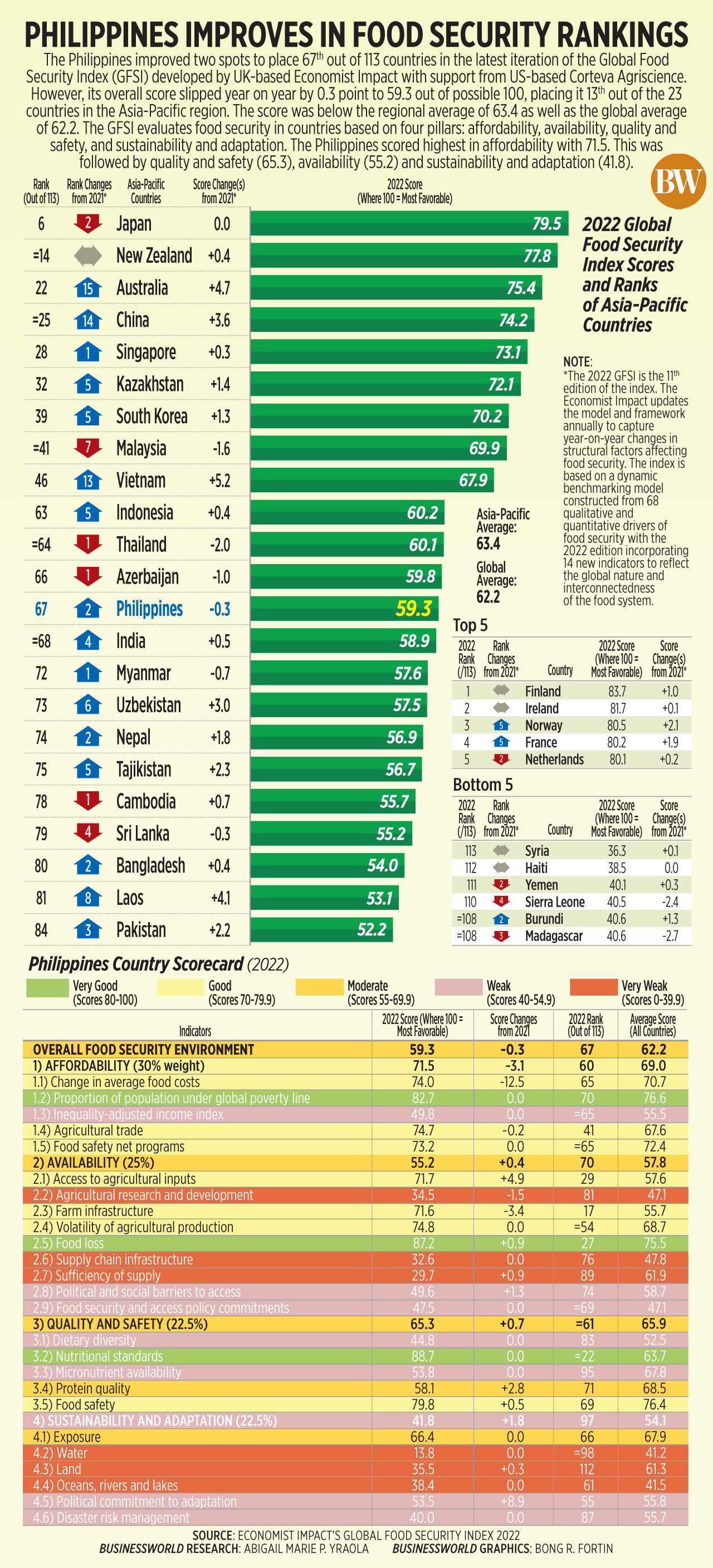
The Philippines improved two spots to place 67th out of 113 countries in the latest iteration of the Global Food Security Index (GFSI) developed by UK-based Economist Impact with support from US-based Corteva Agriscience. However, its overall score slipped year on year by 0.3 point to 59.3 out of possible 100, placing it 13th out of the 23 countries in the Asia-Pacific region. The score was below the regional average of 63.4 as well as the global average of 62.2. The GFSI evaluates food security in countries based on four pillars: affordability, availability, quality and safety, and sustainability and adaptation. The Philippines scored highest in affordability with 71.5. This was followed by quality and safety (65.3), availability (55.2) and sustainability and adaptation (41.8).

Philippines improves in food security rankings

Shares plummet on looming Fed hike, weak peso

BW FILE PHOTO

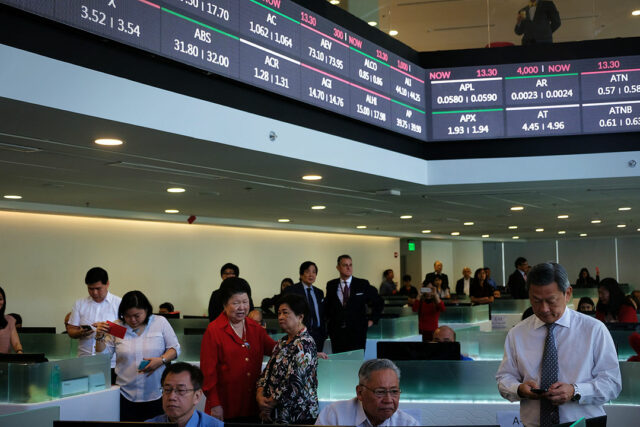
PHILIPPINE STOCKS plunged on Wednesday on expectations of another big rate hike from the US Federal Reserve overnight and as the peso tested new lows against the dollar.

The benchmark Philippine Stock Exchange index (PSEi) sank by 106.77 points or 1.65% to close at 6,341.69 on Wednesday, while the broader all shares index dropped by 47.22 points or 1.37% to 3,385.52.

“Philippine stocks tumbled on Wednesday, following Wall Street’s negative lead ahead of the Federal Reserve’s expected 75-bp (basis point) rate hike,” Papa Securities Corp. Equities Strategist Manny P. Cruz said in a Viber message.

“Philippine shares were sold on the first day of the Fed’s meeting as investors braced themselves for another interest rate hike announcement later,” Regina Capital Development Corp. Head of Sales Luis A. Limlingan added in a Viber message.

The Fed is expected to announce another jumbo-sized rate increase and signal more hikes at the end of its Sept. 20-21 policy meeting as it continues to battle inflation.

“Meanwhile, the Philippine peso dived to yet another new low against the US dollar,” Papa Securities’ Mr. Cruz said.

“Most investors were on the sidelines, waiting for the decision of the Fed. Since many were anticipating a hawkish stance, the peso depreciated further, touching the P58 level,” Philstocks Financial Research Associate Claire T. Alviar said in a Viber message.

The US central bank’s hawkish stance has caused the dollar to strengthen against most currencies, including the peso.

On Wednesday, the peso closed at a new record low of P58 versus the dollar, which was also its worst showing for the day, ahead of the Fed’s latest policy decision.

Year to date, the peso weakened by 13.72% or P7 from its P51-per-dollar close on Dec. 31, 2021.

Philstocks’ Ms. Alviar added that if the Fed will be more aggressive than the Bangko Sentral ng Pilipinas (BSP), the peso may weaken further which would have an adverse impact on the economy. The BSP will hold its own policy meeting on Thursday, where it is expected to raise rates by 50 bps.

The majority of the sectoral indices ended in the red on Wednesday, except for mining and oil, which rose by 20.30 points or 0.18% to finish at 11,276.63.

Meanwhile, financials declined by 39.63 points or 2.48% to 1,552.94; property went down by 63.97 points or 2.22% to 2,812.93; services dropped by 32.65 points or 1.95% to end at 1,640.59; industrials fell by 181.89 points or 1.93% to 9,234.72; and holding firms retreated by 34.56 points or 0.56% to close at 6,135.02.

Decliners overwhelmed advancers, 151 to 39, while 33 names closed unchanged.

Value turnover went up to P5.42 billion with 569.25 million shares changing hands from the P4.75 billion with 401.19 million issues recorded the previous trading day.

Net foreign selling grew to P421.14 million on Wednesday from P191.98 million on Tuesday. — Luisa Maria Jacinta C. Jocson

Hong Kong Bay Area Dragons burn Blackwater to the ground

Games Tomorrow
(PhilSports Arena)
3 p.m. — Terrafirma vs Converge
5:45 p.m. — NLEX vs Rain or Shine

FIRE-breathing Hong Kong guest team Bay Area Dragons quickly issued a strong warning of a mighty invasion force arriving in the PBA.

Powered by Myles Powell’s 41-point sizzler, the debuting Dragons burned Blackwater to the ground, 133-87, for a flying start in the Commissioner’s Cup yesterday at the MOA Arena.

The 6-foot-2 Mr. Powell, the squad’s import in its first four assignments, ran rings against the Bossing’s defenders and converted half of his 28 attempts to provide the big spark as the debutants ripped the game apart right in the first quarter, 36-19.

With Glen Yang (22), Zhu Songwei (13), Kobey Lam (13) and Hayden Blankley (11) joining Mr. Powell in a relentless assault, the Dragons went on to post the all-time biggest win margin of 46 by a guest team in PBA history.

Coach Brian Goorjian’s red-hot charges, who have been based in the country since August, also handed the Bossing their worst franchise loss ever.

“We’re honored to be involved in this great league and we hope to be a great team,” said Mr. Goorjian, whose troops are looking to be the first guest entry to go all the way to the PBA diadem since Northern Cement in the 1985 Reinforced Conference.

“I knew how great this league is and how great the top teams are. So we just want to come in and show the country that we’re here to help basketball.

“We want to learn, grow and present something to this public that’s entertaining. I hope we grow as a team that gets good over the stretch and compete against the San Miguels and TNTs,” he added.

Mr. Powell, a former player of the Sixers in the NBA, led Bay Area’s scorching 47-of-85 field goal shooting (55.3 percent) highlighted by a 16-of-39 (41 percent) three-point marksmanship.

“Everybody’s locked in. Whatever coach asked us to, that’s what we did and it showed tonight,” said Mr. Powell, the shortest among the imports in the mid-season tourney with a height limit of 6-foot-10. “We do everything together. There’s no distinction between imports or Chinese. We have a good group of guys who just want to lock in and win and that makes everything easier.

Blackwater did not get much from Mr. Powell’s counterpart, Cameron Krutwig, who managed only 11, making only five of his 16 shots, but grabbed 12 rebounds.

Rookie Ato Ular turned in a 13-14 double-double for the Bossing, who opted to give trade acquisition Troy Rosario a rest in the opener. Gab Banal, the other new arrival out of the blockbuster trade involving Blackwater, TNT and NLEX, saw action for 17 minutes but went scoreless. — Olmin Leyba

The Scores:

Bay Area 133 — Powell 41, Yang 22, Zhu 13, Lam 13, Blankley 11, Liu 9, Zheng 7, Reid 5, Song 5, Liang 3, Ewing 3, Ju 1

Blackwater 87 — Ular 13, Krutwig 11, McCarthy 11, Amer 10, Ayonayon 10, Taha 8, Jackson 8, Go 5, Sena 3, Dyke 3, Suerte 3, Publico 2, Ebona 0, Banal 0

Quarterscores 36-19, 64-36, 97-76, 133-87

San Beda Lions outlast San Sebastian Stags, 78-71, for a 2-2 slate in Season 98

JAMES Kwekuteye leads the San Beda Lions with 20 points. — NCAA/SYNERGY/GMA

Games Tomorrow
(Filoil EcoOil Centre)
12 noon — CSB vs Letran
3 p.m. — UPHSD vs Mapua

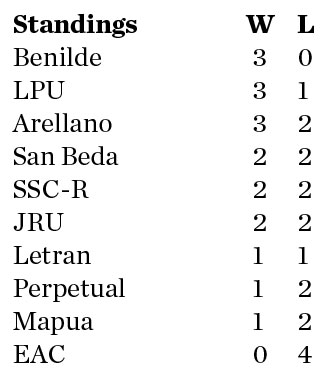
JAMES Kwekuteye showed the other facet of his game as he help lift San Beda to a 78-71 victory over a coach Egay Macaraya-less San Sebastian yesterday to swim out of murky waters in the 98th NCAA basketball tournament at the Filoil EcoOil Centre.

Mr. Kwekuteye erupted for a game-high 20 points while wreaking havoc in defense with three steals, three rebounds and a block as the Lions returned to an even 2-2 record after falling to their worst start in 17 years.

It was the same slate by the Stags, who played minus Mr. Macaraya due to health reasons.

Mr. Kwekuteye’s defensive improvement impressed San Beda coach Yuri Escueta the most.

“I know he can score, but one thing I appreciate about what he is doing right now is his defensive side,” said the newbie mentor of Mr. Kuwekuteye. “He is working his effort defensively in getting rebounds.”

“Offensively, he is trying to look where the open teammates are. He is trying to read what the defense is giving plus making good decision on offense,” he added.

The Lions relied on a white-hot start to build 16-0 and 23-2 leads in the opening quarter.

But the Stags plodded on and slowly but surely clawed their way back from within two points, the last at 67-65 with over four minutes to go.

San Beda though had all the answers and held JRU to just six points the rest of the way to preserve the win.

JB Bahio provided the needed scoring punch late as he scored eight of his 10 points in the fourth quarter.

JRU VS ARELLANO
In the other game, skipper Ry dela Rosa sank a game-winning three pointer from the left wing as Jose Rizal clawed back from 16 points down and outlasted Arellano U, 70-67, to grab a share of No. 4 with a 2-2 mark.

Joshua Guiab uncorked a career-high 17 points while William Sy continued to contribute significantly off the bench and chipped in 13 including three booming treys.

The Chiefs fell to 3-2.

Disappointed after blowing what could have been a win, AU wasn’t complete in the traditional singing of the school hymn at the end of the game. — Joey Villar

The scores:

First Game

San Beda 78 — Kwekuteye 20, Alfaro 11, Bahio 10, Ynot 10, Cortez 6, Tagala 6, Cometa 4, Jopia 4, Andrada 4, Cuntapay 3, Visser 0

SSC-R 71 — Sumoda 19, Villapando 13, Yambing 13, Desoyo 4, Felebrico 4, Escobido 4, Calahat 3, Shanoda 3, Altamirano 3, Are 3, Una 1, Suico 1, Cosari 0, Concha 0

Quarterscores: 30-11; 46-36; 59-57; 78-71

Second Game

JRU 70 — Guiab 17, Sy 13, Dionisio 12, Delos Santos 10, Miranda 7, Dela Rosa 4, Celis 3, Amores 2, Arenal 2, Medina 0, Villarin 0, Joson 0, De Jesus 0

AU 67 Doromal 24, Menina 13, Flores 8, Mallari 7, Tolentino 7, Oliva 6, Abastillas 2, Punzalan 0, Oftana 0, Domingo 0

Quarterscores: 23-21; 35-36; 45-56; 70-67

UAAP backs Gilas Pilipinas and World Cup hosting

THE UNIVERSITY Athletic Association of the Philippines (UAAP) has reaffirmed its commitment to support Gilas Pilipinas in its campaign for the remaining qualifying windows and beyond, including the World Cup hosting itself in 2023.

Part of that full backing is UAAP’s decision to take a break in November for the Gilas’ fifth window stint despite the return of the country’s premier collegiate to a complete 21-sport, 60-event calendar for Season 85 with Adamson as host.

As per UAAP executive director Atty. Rebo Saguisag, the UAAP after its opener on Oct. 1 will halt action from Nov. 7 to 15 in the middle of its centerpiece men’s basketball event to give way for Gilas’ away games on Nov. 10-13.

Gilas, though already in the World Cup as main host, continues its qualifying campaign on the road by then against Jordan on Nov. 10 and Saudi Arabia on Nov. 13

The move will stretch the basketball tourney around Christmas season until Dec. 17 for the first time, which the UAAP is willing to do for the sake of the national team after an initial discussion with the Samahang Basketbol ng Pilipinas (SBP).

“It’s a small sacrifice,” said Mr. Saguisag as University of the Philippines’ Carl Tamayo, La Salle’s Kevin Quiambao and Ateneo’s Ange Kouame are set for Gilas call-up next window.

More than that, the UAAP is in discussion with the federation on what roles could the universities and students play to assure the success of the historic World Cup hosting on Aug. 25 to Sept. 10 next year.

As for the trending development of some collegiate players taking their talents abroad, Mr. Saguisag and UAAP Season 85 President Fr. Aldrin Suan, CM, of Adamson in their personal views don’t see any problem at all.

“It’s in line with the goal to give the student-athletes the best position to succeed and give their families an opportunity for a better life,” said Mr. Saguisag, reiterating that the UAAP is not running out of talents and will only give other players a chance to shine.

“We have to take note that the professional opportunity of basketball in the Philippines is very limited and we have an overwhelming supply of basketball players. It creates an opportunity,” added Fr. Suan, who emphasized that their opinions do not represent the UAAP or their schools in any capacity. — John Bryan Ulanday

Qatar government planning for World Cup fans to avoid prosecution for minor offenses, such as drunkenness

AHMED bin Ali Stadium, Al Rayyan, Qatar, general view inside the stadium ahead of the World Cup. — REUTERS

DOHA — World Cup fans in Qatar caught committing minor offenses such as public drunkenness will escape prosecution under plans being developed by authorities in the conservative Muslim host nation, a diplomat and a person familiar with Qatari briefings to foreign police told Reuters.

While the policing strategy for the competition, which kicks off in less than two months, has yet to be finalized, organizers have told diplomats and police from qualified countries they intend to show flexibility for relatively minor infringements, the sources said.

The signals reflect the delicate balance which Qatar, a tiny Arab state where many follow the same puritanical school of Sunni Islam as in neighboring Saudi Arabia, is trying to strike between respecting religious traditions and accommodating the raucous exuberance of more than a million visiting soccer fans.

Qatar’s World Cup organizers, the Supreme Committee for Delivery and Leagacy, did not respond to a request for comment.

“Increased leniency pleases the international community, but comes with the risk that it might upset conservatives inside the country,” another Western diplomat said.

Organizers have not publicly clarified their approach to policing, and many embassies have warned fans they face punishment for behavior that would be tolerated elsewhere.

“Remember, while you’re in Qatar, you are subject to local laws,” US diplomat Morgan Cassell said in a YouTube video.

According to Qatar’s legal code, freedom of expression is restricted, homosexuality is illegal and sex outside marriage is outlawed. Public drunkenness can incur a prison sentence of up to six months and some things considered benign elsewhere like public displays of affection or wearing revealing clothes can be grounds for arrest.

“Arguing with or insulting others in public could lead to arrest. Activities like protests, religious proselytizing, advocacy of atheism and criticism of the government of Qatar or the religion of Islam may be criminally prosecuted here. That applies to your social media posts, too,” Cassell said.

LAWS RELAXED
However organizers already intend to relax Qatar’s strict laws limiting the public sale of alcohol, and will allow beer to be served near stadiums a few hours before matches kick off.

Informally, they have also told police from European countries which have qualified for the tournament and some diplomats in Doha to expect police to show flexibility in enforcing other laws, such as drunkenness or public disorder.

“Minor offences won’t result in a fine or arrest, but police will be instructed to go to a person and ask him or her to comply…Someone who removes a T-shirt in public will be asked to put his T-shirt back on. There is some sort of tolerance,” said the person familiar with Qatari briefings of several European police sending officers to Qatar.

While Qatari authorities have not confirmed this approach, special legislation taking effect during the tournament gives Qatar’s World Cup security chief — known as the Gold Commander — significant leeway in tackling violations of Qatar’s laws.

It says the commander, in coordination with authorities, can take decisions including how to treat “acts in violation of the provisions of the laws in force in the country”.

Police plan tougher action when the safety of people or property is under threat, World Cup organizers told diplomats in a briefing a few months ago, several diplomats said.

Fans who commit such acts, like using flares or fireworks which could cause damage, or being involved in a fight — even where there are no serious injuries — can expect to face fines and cancellation of their Hayya card, the permit to enter Qatar and access stadiums, the source said.

It was not clear whether fans who forfeit their Hayya card would be given a deadline to leave the country, or would be detained for deportation.

Security is just one challenge facing Qatar, the first Middle East country to host a soccer World Cup and the smallest nation to do so. With a population of less than three million people, it will host an influx of 1.2 million fans — an unprecedented challenge for the Gulf Arab state.

To help the policing effort, organizers have invited each qualified country to send at least four police officers to be on the ground in Qatar during the World Cup, the source with knowledge of policing plans said.

They will be based at a Ministry of Interior command centre and around the capital Doha to advise their Qatari counterparts.

“They will police it as they see fit…Our job is to say ‘This is how we think you should deal with our fans because that’s what gets the best results’,” said Mark Roberts, Chief Constable of the Cheshire police and the UK’s policing lead on soccer. — Reuters

ADVERTISEMENT
ADVERTISEMENT