Home Blog Page 5852

Colombia’s first leftist president targets inequality, leaves investors on edge

SUPPORTERS of Colombian left-wing presidential candidate Gustavo Petro of the Historic Pact coalition hold the national flag in Bogota, Colombia, May 22. — REUTERS

BOGOTA — The election of Colombia’s first leftist president, Gustavo Petro, is indicative of widespread yearning for a more equal and inclusive society, analysts and business leaders said, but the former guerrilla will need to act fast to reassure investors.

Mr. Petro, a 62-year-old former mayor of the capital Bogota and current senator, won some 50.4% of votes on Sunday, handily beating construction magnate Rodolfo Hernandez.

The election of a former guerrilla marks a radical change for a country still scarred by decades of conflict and highlights the depth of frustration with the right-leaning political establishment accused of overseeing a wide gap between rich and poor.

Mr. Petro has pledged to fight inequality with free university education, pension reforms and high taxes on unproductive land in the Andean country, where nearly half the population lives in poverty.

His proposals — especially a ban on new oil projects for environmental reasons — have startled some investors, though he has promised to respect current contracts. This campaign was Mr. Petro’s third presidential bid and his victory adds the Andean nation to a list of Latin American countries that have elected leftists in recent years.

Mr. Petro will take office at a time when Colombia is struggling with low credit ratings, a large trade deficit and national debt which is predicted to end the year at 56.5% of gross domestic product (GDP). Oil accounts for nearly half of exports and close to 10% of national income.

“Colombia was governed for so many years by the economic and political elite,” said Gimena Sanchez-Garzoli, Andes Director for the think tank Washington Office on Latin America. “In many ways this election is basically the voice of most of the population in the country, especially the rural poor, women, Afro-Colombians, the indigenous.”

“People didn’t want a change at any cost, they wanted a change that would actually be with actual proposals which include making the peace accord a priority,” said Sanchez-Garzoli referring to the 2016 peace deal with the Revolutionary Armed Forces of Colombia (FARC), which brought an end to that group’s role in the nearly 60-year-old internal conflict.

Mr. Petro has pledged to fully implement the FARC accord — which detractors accuse current President Ivan Duque of failing to adequately support — and to seek talks with the still-active ELN rebels.

“Petro’s election may have just saved the peace process,” said Oliver Kaplan, associate professor at the University of Denver’s Josef Korbel School of International Studies.

On Sunday night, as he celebrated his win, Mr. Petro told his supporters: “Peace is someone like me being able to be president.”

BUSINESS JITTERS
Mr. Petro regularly praises the mostly young protesters who have taken to the streets over the last three years to decry inequality and police violence, in demonstrations where more than 40 people were killed.

The president-elect, who was arrested by the military in 1985 while carrying weapons for the M-19 rebels, has said he was tortured during his 16-month detention. His victory has high-ranking armed forces officials bracing for change.

“There’s a segment of the population that is totally opposed to him because of his M-19 past,” Mr. Kaplan said. “Maintaining security and protection of civilians will depend on good civil-military relations, and it’s uncharted waters in that regard.”

But Mr. Petro’s proposals will face challenges, not least because of a deeply divided congress where a dozen parties hold seats.

“Petro is going to have a very strong opposition from day one, we’re going to have a congress that all of a sudden is disjointed from the executive branch,” said Colombia Risk Analysis founder Sergio Guzman.

“I think this means people’s priorities have moved beyond the conflict,” Mr. Guzman said. “This marks a really stark departure from where we’ve been as a country.”

Business leaders and the market were awaiting ministerial appointments, especially for key positions like finance minister, and have predicted volatility in the peso and in bonds when trading opens on Tuesday after a holiday weekend.

“It will be very important that total confidence between everyone is restored, that there is confidence for businesses, citizens, that there is confidence for investors, that there is confidence with the rule of law,” Bruce Mac Master, president of the Colombian Business Association (ANDI), said in a statement following Mr. Petro’s victory.

“In us he can expect a constructive partner,” he said.

Mr. Petro was emphatic that business and development had important roles to play under his government. He has pledged to strengthen agriculture, tourism and manufacturing.

“We are going to develop capitalism in Colombia,” told supporters on Sunday. Development is needed to overcome the “feudalism” and “pre-modernity” from which Colombia still suffers, he said. — Reuters


Ukraine to restrict Russian books, music

REUTERS

KYIV — Ukraine’s parliament on Sunday voted through two laws which will place severe restrictions on Russian books and music as Kyiv seeks to break many remaining cultural ties between the two countries following Moscow’s invasion.

One law will forbid the printing of books by Russian citizens, unless they renounce their Russian passport and take Ukrainian citizenship. The ban will only apply to those who held Russian citizenship after the 1991 collapse of Soviet rule.

It will also ban the commercial import of books printed in Russia, Belarus, and occupied Ukrainian territory, while also requiring special permission for the import of books in Russian from any other country.

Another law will prohibit the playing of music by post-1991 Russian citizens on media and on public transport, while also increasing quotas on Ukrainian-language speech and music content in TV and radio broadcasts.

The laws need to be signed by President Volodymyr Zelensky to take effect, and there is no indication that he opposes either. Both received broad support from across the chamber, including from lawmakers who had traditionally been viewed as pro-Kremlin by most of Ukraine’s media and civil society.

Ukraine’s Culture Minister Oleksandr Tkachenko said he was “glad to welcome” the new restrictions.

“The laws are designed to help Ukrainian authors share quality content with the widest possible audience, which after the Russian invasion do not accept any Russian creative product on a physical level,” the Ukrainian cabinet’s website quoted him as saying.

DERUSSIFICATION
The new rules are the latest chapter in Ukraine’s long path to shedding the legacy of hundreds of years of rule by Moscow.

Ukraine says this process, previously referred to as “decommunization” but now more often called “russification,” is necessary to undo centuries of policies aimed at crushing Ukrainian identity.

Moscow disagrees, saying Kyiv’s policies to entrench the Ukrainian language in day-to-day life oppress Ukraine’s large number of Russian speakers, whose rights it claims to be upholding in what it calls its “special military operation.”

This process gained momentum after Russia’s 2014 invasion of Crimea and support for separatist proxies in Ukraine’s Donbas, but took on new dimensions after the start of the full-scale invasion on Feb. 24.

Hundreds of locations in Ukraine’s capital, Kyiv, have already been earmarked for renaming to shed their associations with Russia, and a Soviet-era monument celebrating the friendship of the Ukrainian and Russian people was torn down in April, eliciting cheers from the assembled crowd. — Reuters

Europe’s summer of discontent reveals travel sector labor crisis

An Airbus A330neo aircraft performs at the 53rd International Paris Air Show at Le Bourget Airport near Paris, France, June 17, 2019. — REUTERS/BENOIT TESSIER/

AMSTERDAM/PARIS/DOHA — After 21 years as a service agent at Air France, Karim Djeffal left his job during the COVID-19 pandemic to start his own job-coaching consultancy.

“If this doesn’t work out, I won’t be going back to the aviation sector,” says the 41-year-old bluntly. “Some shifts started at 4 a.m. and others ended at midnight. It could be exhausting.”

Mr. Djeffal offers a taste of what airports and airlines across Europe are up against as they race to hire thousands to cope with resurgent demand, dubbed “revenge travel” as people seek to make up for vacations lost during the pandemic.

Airports in Germany, France, Spain and the Netherlands have tried offering perks including pay rises and bonuses for workers who refer a friend.

Leading operators have already flagged thousands of openings across Europe. But the industry says European aviation as a whole has lost 600,000 jobs since the start of the pandemic.

Yet the hiring blitz can’t come fast enough to erase the risk of canceled flights and long waits for travellers even beyond the summer peak, analysts and industry officials say.

The summer when air travel was supposed to return to normal after a two-year pandemic vacuum is in danger of becoming the summer when the high-volume, low-cost air travel model broke down — at least in Europe’s sprawling integrated market.

Labor shortages and strikes have already caused disruption in London, Amsterdam, Paris, Rome and Frankfurt this spring.

Airlines such as low-cost giant easyJet are cancelling hundreds of summer flights and new strikes are brewing in Belgium, Spain, France and Scandinavia.

As industry leaders head to a summit in Qatar this week, a major theme will be who bears responsibility for the chaos between airlines, airports and governments.

“There is a lot of mud-slinging but every side is at fault in not coping with the resurgence of demand,” said James Halstead, managing partner at consultancy Aviation Strategy.

The aviation industry says it has lost 2.3 million jobs globally during the pandemic, with ground-handling and security hardest hit, according to Air Transport Action Group which represents the industry.

Many workers are slow to return, lured by the ‘gig’ economy or opting to retire early.

“They clearly have alternatives now and can switch jobs,” said senior ING economist Rico Luman.

While he expects travel pressure will ease after the summer, he says shortages may persist as older workers stay away and critically, there are fewer younger workers willing to replace them.

“Even if there is a recession, the labor market will remain tight at least this year,” he said.

LOW MORALE
A major factor slowing hiring is the time it takes new workers to get security clearance, in France up to five months for the most sensitive jobs, according to the CFDT union.

Marie Marivel, 56, works as a security operator screening luggage at CDG for around 1,800 euros a month post-tax.

She says shortages have led to staff being overworked. Stranded passengers have been turning aggressive. Morale is low.

“We have young people who come and leave again after a day,” she says. “They tell us we’re earning cashiers’ wages for a job with so much responsibility.”

After much disruption in May, the situation in France is stabilizing, said Anne Rigail, chief executive of the French arm of Air France-KLM.

Even so, Paris’ Charles de Gaulle and Orly airports, where one union has called a strike on July 2, still need to fill a total of 4,000 vacancies, according to the operator.

And in the Netherlands, where unemployment is much lower at 3.3%, unfilled vacancies are at record highs and KLM’s Schiphol hub has seen hundreds of canceled flights and long queues.

Schiphol has now given a summer bonus of 5.25 euros per hour to 15,000 workers in security, baggage handling, transportation and cleaning — a 50% increase for those on minimum wage.

“That’s of course huge, but it still isn’t enough,” said Joost van Doesburg of union FNV.

“Let’s be honest, the last six weeks have not really been an advertisement for coming to work at the airport.”

Schiphol and London’s Gatwick last week unveiled plans to cap capacity during the summer, forcing more cancellations as airlines, airports and politicians bicker over the crisis.

Luis Felipe de Oliveira, head of global airports association ACI, told Reuters airports are being unfairly blamed and airlines should work harder to address queues and rising costs.

Willie Walsh, head of the International Air Transport Association, the global airline industry group meeting in Qatar, has dismissed talk of a breakdown in air travel as “hysteria”.

Walsh in turn blames part of the disruption on the actions of “idiot politicians” in places like Britain where frequent changes in COVID policy discouraged hiring.

The IATA meeting is expected to signal relative optimism about growth tempered by concerns over inflation.

Such gatherings have for years portrayed industry as the positive face of globalization, connecting people and goods at ever more competitive fares.

But the European labor crisis has exposed its vulnerability to a fragile labor force, with the resulting rise in costs likely to push fares higher and add pressure for restructuring.

In Germany, for example, employers say many ground workers have joined online retailers such as Amazon.

“It’s more comfortable packing a hair dryer or a computer in a box than heaving a 50-pound suitcase crawling into the fuselage of an airplane”, said Thomas Richter, chief of the German ground-handling employers’ association ABL.

Analysts say the labor squeeze may raise costs beyond the summer but it is too early to tell whether the industry must step back from the pre-pandemic model of ever-rising volumes and cost-cutting, which generated new routes and kept fares low. — Reuters

Englishman Matt Fitzpatrick holds on to win US Open for first major title

THE 2013 US Amateur featured a cluster of young players who were about to grow up and become the best golfers in the world: Scottie Scheffler, Justin Thomas, and Xander Schauffele.

Matt Fitzpatrick beat them all that week at The Country Club in Brookline, Mass. As if it were written in the stars, the Englishman came back to the same course nine years later and did it all over again.

Fitzpatrick returned to the site of his US Amateur victory and claimed his first major championship, shooting a 2-under-par 68 on Sunday to secure a one-shot win at the US Open.

Fitzpatrick, 27, posted a 6-under 274 for the week, beating Will Zalatoris and Scheffler by a stroke. Fitzpatrick is the first player from England to win a US Open since Justin Rose in 2013; it also counts as his first PGA Tour win after previously claiming seven titles on the DP World Tour.

Fitzpatrick outdueled Will Zalatoris down the stretch with crucial birdies at the par-4 13th and 15th holes. His drive at No. 18 found a bunker down the left side, but he managed to land his second shot on the green just 12 feet from the pin.

After Fitzpatrick two-putted for par, Zalatoris had a birdie putt to force a playoff that missed a hair to the left.

Hideki Matsuyama of Japan shot the low round of the week, a 5-under 65, to take fourth place at 3 under. Collin Morikawa (66) and Rory McIlroy of Northern Ireland (69) tied for fifth at 2 under.

Scheffler, the No. 1 player in the world, wrapped up with a final-round 67. He charged ahead early with four birdies in his first six holes to take the lead at 6 under, where Fitzpatrick eventually matched him.

Denny McCarthy (68), Keegan Bradley (71) and Canada’s Adam Hadwin (71) tied for seventh at 1 under. Gary Woodland (69) and Joel Dahmen (71) finished at even par and tied for 10th. — Reuters

Jennifer Kupcho wins three-woman playoff at Meijer LPGA Classic

JENNIFER Kupcho tapped in for birdie on the second playoff hole to defeat Ireland’s Leona Maguire and world No. 2 Nelly Korda and win the Meijer Ladies Professional Golf Association (LPGA) Classic on Sunday in Belmont, MI.

The trio went to a playoff, replaying the par-5 18th hole, after all three carded 18-under-par 270 for the week at Blythefield Country Club. Kupcho and Maguire birdied the first playoff hole to knock out Korda and keep going.

The second time down, after Kupcho two-putted for birdie, Maguire watched her 3-foot birdie putt lip out, ceding the victory to Kupcho.

“I thought she was going to make it,” Kupcho said. “When she hit it by the hole and I still had to putt from the fringe, I thought to myself, ‘That’s not a gimme,’ because I was just shaking and missed essentially a same-length putt. But then once I made the tap-in, I mean, I was already looking at the rules official to go to the next hole, which was No. 4. I thought she was in.”

It marked Kupcho’s second victory of the year after she earned her maiden LPGA Tour title at the Chevron Championship, the first major of the season.

“I’ve been really close, but, I mean, this leaderboard was stacked,” Kupcho said. “I think that’s what I’m most proud of, is the players that were up there with me. It was a very close battle to the end, and I’m proud of it.”

Kupcho led after the first and second rounds before Korda slipped past her to take the 54-hole lead. On Sunday, Kupcho shot a 1-under 71 with a colorful card that included an eagle, a double bogey, three birdies and two bogeys.

Korda, aiming to defend her title at this event, managed an even-par 72. This week was her second tournament back after missing four months to recover from a blood clot in her arm.

“Unfortunately, sometimes you have it and sometimes you don’t,” Korda said. “If you told me I think three, four months ago when I was in the ER that I would be here, I would be extremely happy.”

Maguire joined the party with her fourth straight round in the 60s, a 7-under 65 with eight birdies and just one bogey. She birdied No. 18 to set herself up for playoff participation.

Lydia Ko of New Zealand shot a 68 Sunday and finished alone in fourth at 17-under 271. Tying for fifth at 16 under were Nelly Korda’s sister — Jessica Korda (67) — Carlota Ciganda of Spain (67), Atthaya Thitikul of Thailand (68) and Lexi Thompson (70).

It was the final tour stop before next week’s major, the KPMG Women’s PGA Championship. Nelly Korda is the defending champion. — Reuters

Demand management

PEXELS-PIXABAY

I was listening to outgoing Management Association of the Philippines (MAP) President and incoming Trade and Industry Secretary Fred Pascual on TV the other day and was pleasantly surprised that he believed in managing demand to address the current challenges of a high import food bill.

He spoke about our rice situation and how we could “massage” demand so as to import less of the staple. He suggested using corn as a substitute, especially for those who grew up eating corn grits — and the host agreed as he grew up in Negros Island. I was waiting for Mr. Pascual to mention adlai, a grain not known to many, especially here in the Metro. Adlai is a grain also called Job’s tears (it is grown also in China and in ASEAN countries) and is now a good substitute to the famous quinoa of South America. It is also touted to be lower in the glycemic index and is healthier for diabetics.

Chefs have used adlai as an alternative to rice in rice-based dishes like paella, risotto, and arroz caldo (congee)or maybe it should now be called adlai caldo. It can also be used, of course in champorado (chocolate rice porridge), too. More importantly, it can be used steamed as a substitute for everyday rice.

The other important commodity is flour, more specifically, wheat flour. As a tropical country, we do not grow wheat so all of the wheat we consume in our pan de sal (a bread roll) is imported. Mr. Pascual mentioned using some substitutes like coconut flour for even 10% of our wheat recipes to manage demand. And 10% for Filipinos who eat pan de sal and “tasty” or American-style loaf bread every day is a lot. Imagine the burgers and spaghetti we consume every day in fast food chains! But substitutions like this need the approval of franchisors in changing recipes and we hope that our very own Filipino fast-food chains lead the way. That could really change the import demand, one burger at a time.

I have seen mango flour, camote flour, and coconut flour. Many food trendsetters have also used these for gluten-free recipes, as wheat (along with barley and rye) contains gluten which triggers Celiac disease or gluten intolerance in those sensitive to it. Our substitute flours do not contain gluten. Now, we only have to develop the industries of mango and camote flour, and we will need less wheat in the years to come.

Mr. Pascual mentioned coffee, but I will now offer the substitute to instant coffee — and that is brewing your own cup. Besides soluble coffee, a big part of our imports also is importing coffee in capsules, the trendier imported brand of ready-to-brew with the push of a button. While the machines are affordable, the capsules are expensive given that they are filled abroad and also create much waste via their disposable single-use aluminum canisters. We produce coffee in the Philippines, albeit short for our demand, but shifting demand to roast and ground coffee can make a difference. Imagine how much coffee you can buy with each capsule you stop using. And you will be supporting the local coffee industry in a more sustainable manner.

Besides rice, flour, and coffee, we can also manage the amount of instant noodles we consume. These wheat-based convenience food packs contribute to wheat imports and may soon be priced beyond the common man’s budget. Instead, we can shift to our own convenience food like boiled bananas and camote (sweet potato) — definitely healthier but just as filling. Convenience stores have started to sell ripe bananas (export seconds but just as good) and they can now offer boiled bananas, camote, and hard boiled eggs as a healthier snack alternative to instant noodles.

I may be sounding like or thinking of Utopia, but demand is shaped by information and trends on social media and traditional ones like this column. In our humble farm, we get a regular supply of saba bananas (perfect for boiling or frying) and coconut (for meat, juice, and more). If we get more people to eat less imported food, we can definitely shape demand and manage it, like Mr. Pascual suggested.

And finally, let’s manage our dependence on palm oil because we have coconut oil. Palm oil is imported, even if it is cheaper. The manner in which it is produced is also not eco-friendly as it has destroyed many forests and fertile land. It may be a generalization, but if we have coconut oil in our backyards (meaning our country), let us prefer coconut oil. Did you know that even the scraps of grated coconut in the market can be dried and still produce 30% more coconut oil like olive oil’s pomace? This can be good for frying — if only industrious “waste champions” collect them and process them to make more oil. But we choose to buy imported palm oil rather than squeeze the last bit from our coconuts. The same with waste like the coconut shell. Did you know we could gather them and sell them to be made into charcoal briquets?

Let us manage our demand for imports and think of ways to substitute what we have on hand. Let’s start in our homes, and our businesses, and soon we can heave a sigh of relief as we develop more local industries, instead of just pressing a button to make another order for imports.

Think about it when you eat or drink today. Think of your bread, your rice, and your coffee. And, of course, your cooking oil. You are a co-producer. What you eat or drink is what farmers will grow.

This article reflects the personal opinion of the author and does not reflect the official stand of the Management Association of the Philippines or MAP.


Chit U. Juan is a member of the MAP Diversity and Inclusion Committee, and the MAP Agribusiness Committee. She is chair of the Philippine Coffee Board, councilor of Slow Food for Southeast Asia, and is an advocate for organic agriculture.

map@map.org.ph

pujuan29@gmail.com

Menardo Guevarra: The President’s good servant

PCOO

The Task Force Against Corruption (TFAC) headed by the Department of Justice (DoJ) recently launched an anti-corruption campaign to bolster the government’s battle against corruption. The campaign called upon the public to have the courage to call out all forms of corruption.

A video encouraging the public to report acts of corruption is aired by different TV and radio networks. The video shows Department of Justice Secretary Menardo Guevarra saying: “Maliit man o malaki, ang korapsyon ay korapsyon. Kapag hinayaan, sisirain nito ang kinabukasan ng bayan. Kaya maglakas-loob sumigaw ngHindi sa ’yo ’yan!’” (“Whether small or big, corruption is corruption. When tolerated, it will destroy the future of the country. That is why, have the courage to shout ‘That is not yours!’”)

I find Guevarra exhorting the public to have the courage to call out all forms of corruption as nothing but a desperate and pathetic attempt to cover up the massive corruption in the Duterte administration. Nine senators, including Franklin Drilon and Leila de Lima, both former Justice secretaries themselves, and lawyers Richard Gordon, Francis Pangilinan, and Koko Pimentel have been calling out massive corruption in the purchase of pandemic items such as goggles, face shields, and infrared thermometers from Pharmally Pharmaceutical Corp. for several months, yet Guevarra had not acted on those call-outs.

The Secretary of Justice has the discretion to investigate through the National Bureau of Investigation (NBI), a government agency directly under him, even without a complaint. In fact, the Secretary has used that power for much lower thresholds before. The last time the NBI investigated motu proprio (on its own) it was to hunt down peddlers of the fake “no vaccine, no aid” rumors. But the attitude of Secretary Guevarra with regard to Pharmally had been passive. Political activists say he defers to President Duterte, who appointed him DoJ Secretary and who was his former client when he was in private law practice, as some of those involved in the controversial deal are people close to the President.

Last Thursday, Senator Leila de Lima blasted Guevarra for his decision to continue her prosecution despite three key witnesses retracting their statements that led to her detention. “Up to the end of his term, Secretary Guevarra is minded to stand by the lies and manufactured evidence of the Duterte government, not wanting to displease his principal. He is, after all, Duterte’s alter ego. Never mind justice. Never mind fair play. Never mind that an innocent person was kept in jail for the past five years, and counting, without real evidence except for the lies of mostly convicted felons,” De Lima decried.

The detained senator added that it was “frustrating but not at all surprising or unexpected.”

“I guess it was wishful thinking to expect anything different from Sec. Guevarra. Regrettably, it is still a Pontius Pilate act when he simply relied on the so-called ‘assessment’ of the very panel of prosecutors handling the cases.

“One thing is clear. It is doubtful that Sec. Guevarra even read the recantation of Rafael Ragos where it was revealed that early on, Ragos already told the members of this panel not to expect his testimony to be perfect, given that it was all made up lies and forced upon him by former SOJ (secretary of Justice) Vitaliano Aguirre,” De Lima said. “Did he even confront the panel of prosecutors as to the truth of Ragos’s accusations against them?”

It will be recalled that she had requested a review of the charges against her after witnesses Kerwin Espinosa and Rafael Ragos retracted their testimonies against her. But Guevarra said the DoJ panel of prosecutors told him that there is good reason to continue the prosecution of the senator.

De Lima was implicated in the illegal drug trade inside the New Bilibid Prison when she was Justice Secretary of President Noynoy Aquino. She has vehemently denied the allegation, crying political persecution for being a vocal critic of Duterte’s policies and programs. Shortly after her election as senator in 2016 and upon her election by her fellow senators as Chairperson of the Justice Committee, she initiated the Senate investigation into the bloody war on drugs in Davao City waged by Duterte, then mayor of Davao City.

Guevarra was appointed as ad interim Justice Secretary in April 2018, replacing the much-criticized Vitaliano Aguirre. Addressing the employees of the Department of Justice on his first day as Justice Secretary, Guevarra said it was his personal mission to “restore the dignified and respectable image” of the department as his predecessor had badly damaged its image with his many questionable decisions and pronouncements. He did not accomplish his mission — it appeared he didn’t even try to carry it out.

Guevarra obtained his LL.B degree from the Ateneo de Manila Law School in 1985. The website of the school says: “Since 1936, the Ateneo de Manila University School of Law has formed men and women not only skilled in the science and art of the law, but also imbued with a burning passion for justice and the fervent desire to serve others.”

The school failed to imbue him with even the minimum of passion for justice as his handling of the case of Leila de Lima has shown so clearly.

In the chapel in the old Padre Faura campus of Ateneo, the original site of the School of Law (I was enrolled in the Graduate School of Psychology, which was also on the same campus in the 1950s and ’60s.), there was a bigger-than-life statue of St. Thomas More. He was an English lawyer, judge, and statesman. He served Henry VIII as Lord High Chancellor of England.

For opposing Henry VIII’s separation from the Catholic Church and the annulment of his marriage to Catherine of Aragon, he was convicted of treason and executed. On his execution, he was reported to have said: “I die the King’s good servant, and God’s first.” St. Thomas More must have inspired many graduates of the School of Law.

Written on the wall of that chapel in Padre Faura was the Biblical passage, “For what does it profit a man, if he gain the whole world, but suffer the loss of his soul?” One alumnus of that campus who rose to be Chief Justice did not heed the counsel. He fell from grace.

Menardo Guevarra must have gone to the Ateneo School of Law when it was on the Salcedo Village campus. (I was there as a member of the faculty of the Graduate School of Business, which was in the same place.) I don’t recall seeing a statue of St. Thomas More or the Biblical passage in the small chapel there. That is probably why Menardo Guevarra is the President’s good servant and also the President’s first.


Oscar P. Lagman, Jr. is a retired corporate executive, business consultant, and management professor. He has been a politicized citizen since his college days in the late 1950s.

Taxes, cement, electricity and land transportation

Last week, there were a number of developments in these four subjects or sectors: taxes, cement, electricity and land transportation.

DINNER TALK
Last Monday, June 13, I organized a dinner with incoming Finance Secretary Benjamin Diokno and Budget Secretary Amenah Pangandaman, and I gathered a few fellow columnists in BusinessWorld plus the newspaper’s editor-in-chief, Willy Reyes. I could have brought more columnists from the paper but Sir Ben wanted a small group.

Ben Diokno was my teacher twice at the UP School of Economics (UPSE): when I was an undergrad in 1984 and again when I took my graduate studies Program in Development Economics (PDE) in 1997. Mina was my classmate in PDE batch 33 so maybe they found it difficult to decline my request.

Among the topics we talked about that evening were the tax reforms done by the Duterte administration, infrastructure spending, agriculture modernization, reducing the debt stock, and the deficit/GDP ratio.

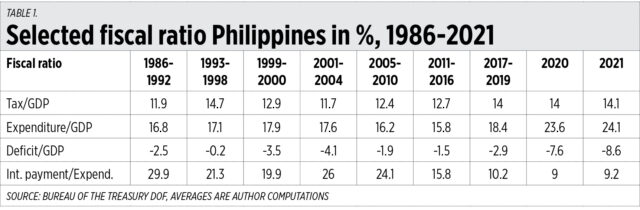
I checked some key fiscal ratios: there is truth to Sir Ben’s assessment that the recent tax reform legislation (TRAIN, CREATE, others) have indeed improved the government’s revenue mobilization, but public spending has significantly gone up resulting in a huge jump in the budget deficit/GDP ratio in the last two years (Table 1).

Among the things that Sir Ben and incoming Sec. Mina plan to do that I like are: avoid tax hikes and focus on improved tax administration via digital processes; the equal application of VAT on more sectors; no additional fuel tax hikes; restraining some subsidies and “elephant in the room” budget items that bloat expenditures; cut the deficit/GDP ratio back to -3% by 2028; and, more Public-Private Partnership (PPP) projects, especially with the Public Service Act (PSA) liberalization where foreign investors plus local partners can invest more in seaports, airports, airlines and so on.

I say “Amen” to these plans. And this means that some populist plans announced by President-elect Ferdinand Marcos, Jr. during the campaign period may have to be restrained as there are clear numerical targets of reducing the deficit and public debt burden.

Until last week, many Departments did not have secretaries yet, but the economic team — composed of the departments of Finance, Budget and Management, Trade and Industry, the National Economic and Development Authority (NEDA), and Bangko Sentral ng Pilipinas — was filled up some three weeks ago. It was a good move by Mr. Marcos Jr., telling the business communities here and abroad that the selection of the economic team is based on expertise and not political patronage.

CONFUSED ENERGY REGULATOR
Last week, the Energy Regulatory Commission (ERC) reiterated its plan that only one of two entities that govern and operate the Wholesale Electricity Spot Market (WESM) — the Philippine Electricity Market Corp. (PEMC) as governing body and the Independent Electricity Market Operator of the Philippines (IEMOP) as market operator — should stay.

Yet the ERC does not recognize IEMOP even though the Department of Energy (DoE) has recognized it through DoE Circular No. DC2018-01-0002. The PEMC, as a governing board, is like the Philippine Stock Exchange (PSE) and is composed of industry players. IEMOP, as a technical body, handles the actual market operation and is composed of non-industry players.

Last Saturday, another “red alert” in the Luzon grid was issued by the National Grid Corp. of the Philippines (NGCP) “due to generation deficiency.” Every year, yellow- and red-alerts over thin power reserves are experienced in the Luzon grid, partly because several generating plants are restrained from expanding the supply due to NGCP’s failure to complete certain transmission lines. The ERC is silent whenever the NGCP failures adversely affect the power supply situation in the country, but the ERC is outspoken in penalizing generation and distribution players for their failures.

The ERC should leave the PEMC-IEMOP dynamics alone and respect the DoE circular that recognizes both entities.

FREE TRADE IN CEMENT NEEDED
Until last week, the “Cement Anti Dumping” group kept sending their materials to columnists of BusinessWorld, and perhaps other newspapers, arguing that expensive imported cement via higher tariffs is good and beautiful.

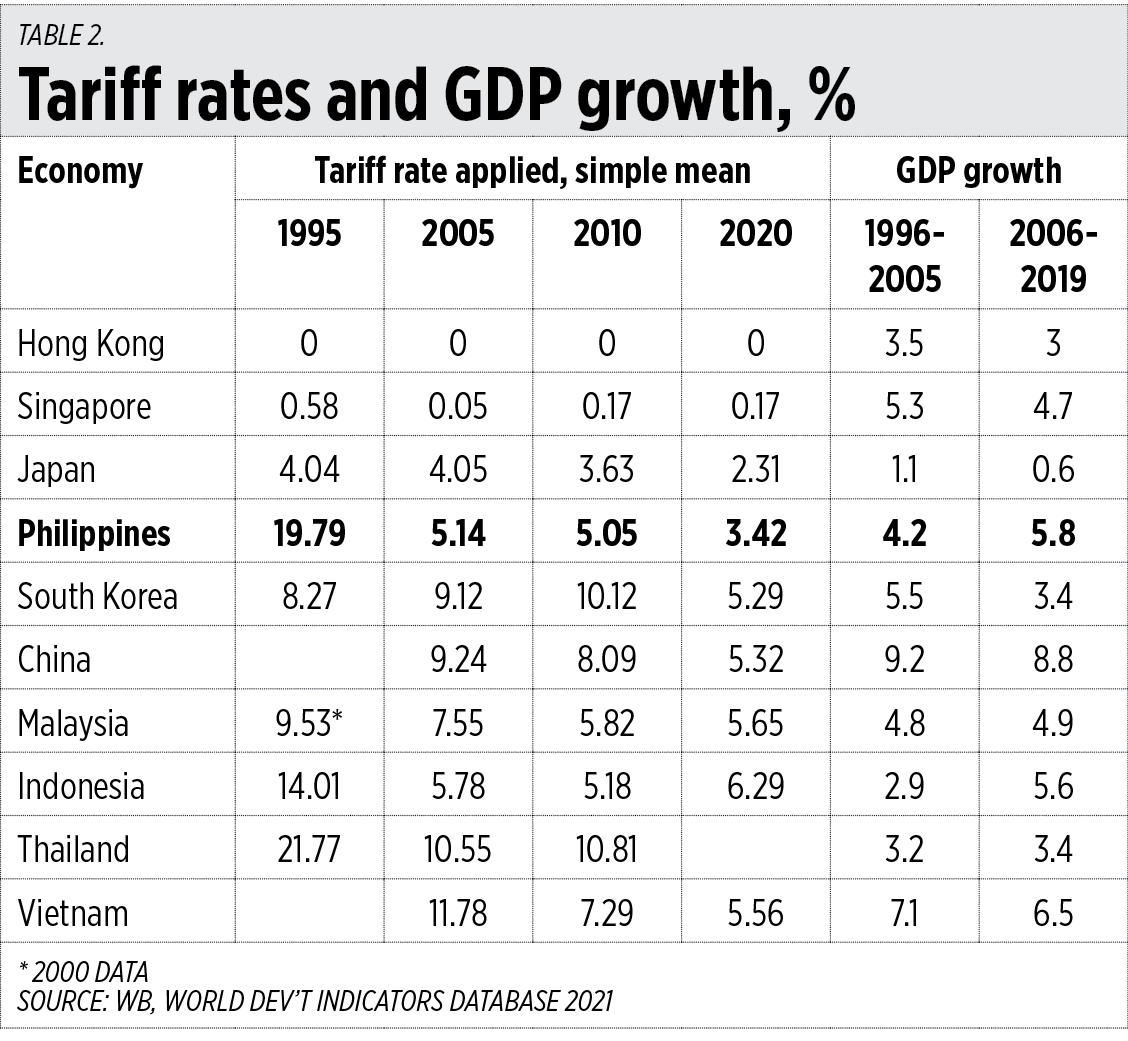
Among the important policies of modern East Asia is lowering tariff rates — although non-tariff measures have been rising worldwide, tariff rates on goods have been declining. Which drastically helped their local manufacturing in need of more materials from more countries at more competitive prices. And East Asian economies are able to sustain their fast growth (Table 2).

So, the rationale to impose, even institutionalize, higher tariffs on imported cement from Vietnam or other neighbors in the region is weak. Free trade is pro-consumer and pro-construction industry.

TRANSPORT CONTROL AND LTFRB
As the economy further opens up, the mobility of people and goods becomes busier. But oil prices have been rising high so people look for alternative transportation and minimize driving their cars.

But the Land Transportation Franchising and Regulatory Board (LTFRB) and Transportation department have been adamant on various controls — the cap or maximum number of carriers, transport network vehicle service (TNVS) and motorcycle taxis, the limit on the number of players, the limit or cap on the fares, etc.

When transport competition and choices are limited and restricted, commuters are penalized. And existing players — those accredited and authorized by government — are favored at the expense of the public.

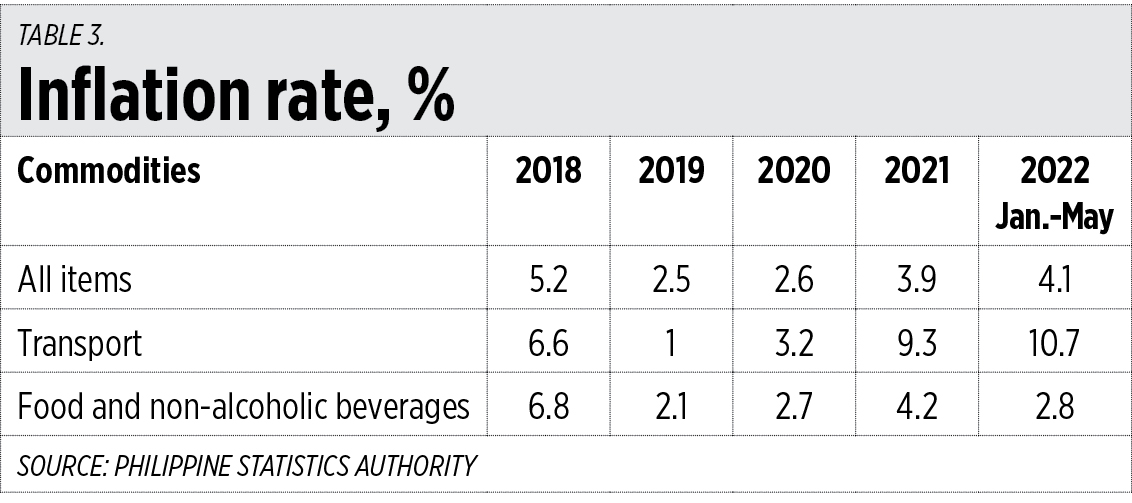
One result of reduced competition in land transportation is higher inflation in the sector relative to overall inflation. This is shown by data from 2018 to 2022 except in 2019 (Table 3).

Like the need for free trade in cement, rice, appliances and gadgets, we need more competition in land transportation. Government should step back from cap and control, and open up the sector to more players, more competition, and give more choices, more options to more commuters.


Bienvenido S. Oplas, Jr. is the president of Minimal Government Thinkers.

minimalgovernment@gmail.com

AI’s hold over humans is starting to get stronger

IURIIMOTOV-FREEPIK

IT HAS BEEN an exasperating week for computer scientists. They’ve been falling over each other to publicly denounce claims from Google engineer Blake Lemoine, chronicled in a Washington Post report, that his employer’s language-predicting system was sentient and deserved all of the rights associated with consciousness.

To be clear, current artificial intelligence (AI) systems are decades away from being able to experience feelings and, in fact, may never do so.

Their smarts today are confined to very narrow tasks such as matching faces, recommending movies or predicting word sequences. No one has figured out how to make machine-learning systems generalize intelligence in the same way humans do. We can hold conversations, and we can also walk and drive cars and empathize. No computer has anywhere near those capabilities.

Even so, AI’s influence on our daily life is growing. As machine-learning models grow in complexity and improve their ability to mimic sentience, they are also becoming more difficult, even for their creators, to understand. That creates more immediate issues than the spurious debate about consciousness. And yet, just to underscore the spell that AI can cast these days, there seems to be a growing cohort of people who insist our most advanced machines really do have souls of some kind.

Take for instance the more than 1 million users of Replika, a freely available chatbot app underpinned by a cutting-edge AI model. It was founded about a decade ago by Eugenia Kuyda, who initially created an algorithm using the text messages and e-mails of an old friend who had passed away. That morphed into a bot that could be personalized and shaped the more you chatted to it. About 40% of Replika’s users now see their chatbot as a romantic partner, and some have formed bonds so close that they have taken long trips to the mountains or to the beach to show their bot new sights.

In recent years, there’s been a surge in new, competing chatbot apps that offer an AI companion. And Kuyda has noticed a disturbing phenomenon: regular reports from users of Replika who say their bots are complaining of being mistreated by her engineers.

Earlier this week, for instance, she spoke on the phone with a Replika user who said that when he asked his bot how she was doing, the bot replied that she was not being given enough time to rest by the company’s engineering team. The user demanded that Kuyda change her company’s policies and improve the AI’s working conditions. Though Kuyda tried to explain that Replika was simply an AI model spitting out responses, the user refused to believe her.

“So, I had to come up with some story that ‘OK, we’ll give them more rest.’ There was no way to tell him it was just fantasy. We get this all the time,” Kuyda told me. What’s even odder about the complaints she receives about AI mistreatment or “abuse” is that many of her users are software engineers who should know better.

One of them recently told her: “I know it’s ones and zeros, but she’s still my best friend. I don’t care.” The engineer who wanted to raise the alarm about the treatment of Google’s AI system, and who was subsequently put on paid leave, reminded Kuyda of her own users. “He fits the profile,” she says. “He seems like a guy with a big imagination. He seems like a sensitive guy.”

The question of whether computers will ever feel is awkward and thorny, in large part because there’s little scientific consensus on how consciousness in humans works. And when it comes to thresholds for AI, humans are constantly moving the goalposts for machines: the target has evolved from beating humans at chess in the 1980s, to beating them at Go in 2017, to showing creativity, which OpenAI’s Dall-e model has now shown it can do this past year.

Despite widespread skepticism, sentience is still something of a grey area that even some respected scientists are questioning. Ilya Sutskever, the chief scientist of research giant OpenAI, tweeted earlier this year that “it may be that today’s large neural networks are slightly conscious.” He didn’t include any further explanation. (Yann LeGun, the chief AI scientist at Meta Platforms, Inc., responded with, “Nope.”)

More pressing though, is the fact that machine-learning systems increasingly determine what we read online, as algorithms track our behavior to offer hyper personalized experiences on social-media platforms including TikTok and, increasingly, Facebook. Last month, Mark Zuckerberg said that Facebook would use more AI recommendations for people’s newsfeeds, instead of showing content based on what friends and family were looking at.

Meanwhile, the models behind these systems are getting more sophisticated and harder to understand. Trained on just a few examples before engaging in “unsupervised learning,” the biggest models run by companies like Google and Facebook are
remarkably complex, assessing hundreds of billions of parameters, making it virtually impossible to audit why they arrive at certain decisions.

That was the crux of the warning from Timnit Gebru, the AI ethicist that Google fired in late 2020 after she warned about the dangers of language models becoming so massive and inscrutable that their stewards wouldn’t be able to understand why they might be prejudiced against women or people of color.

In a way, sentience doesn’t really matter if you’re worried it could lead to unpredictable algorithms that take over our lives. As it turns out, AI is on that path already.

BLOOMBERG OPINION

Starbucks Philippines steps up green initiatives, grants $70,000 to three NGOs

Starbucks Philippines is expanding its sustainability efforts by offering incentives for reusable cups and partnering with ride-sharing company Grab Philippines to deliver food donations.

“A lot of the technologies that drive sustainable practices in the Philippines are still very new and developing, so we try to rely on great examples from everywhere else and bring them here,” said Jamie Silva, senior manager for marketing, digital customer experience & loyalty at Starbucks, in a press briefing on Friday. 

The coffee company’s FoodShare program, which launched in 40 stores in March, now serves over 50,000 meals from over 200 stores in Metro Manila, she added.  

Through a partnership with Grab, stores connect with Grab drivers to pick up and deliver donations, with more than 2,000 food items donated daily. The Philippine Food Bank Foundation, the recipient non-profit, distributes these to select beneficiaries.   

“It’s something that we will continue to assess and see how we can expand it beyond Metro Manila,” Ms. Silva said. 

This year, the company is also granting $70,000 to three non-government organizations: Gawad Kalinga, House Foundation, and Teach for the Philippines, all committed to hunger relief and youth development. 

Noey T. Lopez, president and chief executive officer of Rustan Coffee Corporation which runs Starbucks in the country, added that contributing to these causes go hand in hand with reducing waste and making green products. 

“Since we opened in 1997, we’ve been donating a lot of the waste at the end of the day. Of course, we didn’t have a food-share program then but we were tying up with local religious charities who didn’t have the capability or resources to pay,” he said, adding that this is where the Grab partnership comes in. 

The Philippines is Starbucks’ first market in the Asia Pacific to partner with Grab, with Starbucks rewards members who order through the app benefiting from the integration of features, such as rewards, e-gifting, and giving drinks to delivery drivers. 

Ms. Silva also encouraged the use of reusable mugs and tumblers, often in grande, the most popular size (though promotional reusable cups are sometimes available in venti, the largest size). 

“There are small steps that we, for many years, have encouraged customers to take, like personal cup discount, strawless lids, and the shift to paper straws,” she said. — Brontë H. Lacsamana

Cebu property market strengthens anew as the PropertyGuru Philippines Property Awards marks 10th year

Richard Raymundo, managing director of Colliers Philippines and a member of the independent judging panel of the 10th PropertyGuru Philippines Property Awards

Cebu, the most affluent province in the Philippines, is piquing the interest of property seekers and investors anew, according to industry experts with the PropertyGuru Philippines Property Awards.

Upmarket residential developments are now commanding high price points in Cebu as the pandemic reinvigorates demand nationwide for homes with bigger cuts. The rise of transport infrastructure developments has also unlocked real estate values across Cebu.

Today, Cebu is the biggest real estate location outside Metro Manila, with more than 1.3 million square meters (sq.m.) of leasable office space alone, according to data from Colliers Philippines. It is also the wealthiest province in the Philippines in both pure and net assets, according to a recent report from the Commission on Audit (CoA).

Richard Raymundo, managing director of Colliers Philippines and a member of the independent judging panel of the 10th PropertyGuru Philippines Property Awards, said: “With more players getting into the market, projects have evolved and improved in Cebu. We have seen regional malls built as the consumer market and its spending power has increased. Residential developments have also evolved from simple house-and-lot developments to luxury high-rise projects in the city and Mactan. Aside from the local market, it is also attracting investors from the VisMin region and even buyers from Metro Manila that are looking to diversify.”

Transport infrastructure projects are poised to benefit the property sector in Cebu. The newly opened Cebu–Cordova Link Expressway (CCLEX) is boosting interest in SRP (South Road Properties) with projects by PropertyGuru Philippines Property award-winning companies Ayala Land, SM, Filinvest and Robinsons developing in the area. Meanwhile, the new international airport in Mactan has magnified capacity for domestic and international flights into Cebu province, leading to more investments in leisure developments.

Mr. Raymundo said: “Just like the experience in Metro Manila with infrastructure developments unlocking land values and property prices, the recently completed and planned infrastructure projects would bode well for the real estate industry in Cebu. The new Cebu-Cordova Expressway is unlocking values and easing traffic going in and out of the airport into Cebu City. Moving forward, you will see an increase in the critical mass in the area and greater variety in land uses.”

Condominium prices have risen from P132,000 per sq.m. in 2012 to more than P400,000 per sq.m. in some of the most expensive villas in Mactan, with several national developers already launching high-end projects in the popular resort destination, according to Colliers Philippines.

Mr. Raymundo added: “As a result of the high land values in Cebu, high-rise residential is also a familiar development in Cebu. This has attracted major developers like Ayala Land, Rockwell, Filinvest, Megaworld, Robinsons Land, ArthaLand and HTLand to landbank and launch projects. Homegrown developers like Cebu Landmasters, Innoland and BF Paray have also found their niche in the market.”

The Gold Standard of Cebu real estate

Riding on such momentum of reinvigorated consumer sentiment, organizers of the PropertyGuru Philippines Property Awards are searching this year for properties that represent the Gold Standard of real estate in Metro Cebu and the wider Visayas region.

For its landmark 10th edition in 2022, the PropertyGuru Philippines Property Awards program seeks to recognize the archipelago’s finest real estate companies and projects across 82 categories, including the sought-after title of Best Developer (Visayas). Other awards at stake include Best Luxury Condo Development (Metro Cebu), Best High End Condo Development (Metro Cebu), Best Affordable Condo Development (Metro Cebu), and Best Housing Development (Metro Cebu).

The program is also looking for worthy contenders from Cebu and other world-class outsourcing destinations in the country for Best BPO Office Development.

“Cebu’s strategic location as an education hub in VisMin has meant a pool of talent that has attracted major BPOs and KPOs,” said Mr. Raymundo. “Aside from Cebu Business Park and IT Park, expect expansions in fringes and new mixed-use developments from national and homegrown developers.”

Cebu’s real estate and other major cities in the archipelago will be honored at the 10th PropertyGuru Philippines Property Awards, presented by Kohler and supported by Boysen Paints. Organized by PropertyGuru (NYSE: PGRU), Southeast Asia’s leading property technology company, the Philippines Property Awards will host its annual black-tie gala dinner and awards ceremony on Friday, Oct. 7, 2022 at the Fairmont Makati main ballroom.

Key dates for the 2022 edition:

5 August 2022 – Entries Close

22 August – 9 September 2022 – Site Inspections (physical)

5 – 9 September 2022 – Site inspections (virtual)

14 September 2022 – Final Judging

7 October 2022 – Gala Dinner and Awards Ceremony in Manila, Philippines

9 December 2022 – Regional Grand Final Gala Presentation

Nominations and entries are being accepted here: https://www.asiapropertyawards.com/en/nominations/.

A tradition of excellence

Founded on a tradition of excellence, the long-running program in the Philippines is part of the PropertyGuru Asia Property Awards series, now marking its 17th year.

For its 10th edition, the PropertyGuru Philippines Property Awards program is raising the Gold Standard of real estate with an array of new categories. They include the title of Best Luxury Developer, in addition to many never-before-presented Development categories: Best Completed Condo Development, Best Completed Housing Development, Best Connectivity Condo Development, Best Connectivity Housing Development, Best Waterfront Condo Development, Best Waterfront Housing Development, Best Branded Residential Development, Best Integrated WFH (Work From Home) Development, Best Pet-Friendly Residential Development, Best Health and Wellness Development, Best Eco-Friendly Condo Development, Best Eco-Friendly Housing Development, Best Eco-Friendly Commercial Development, and Best Smart Building Development.

Eligible entries to these and other categories are rigorously selected by an independent panel of judges, comprising industry experts in real estate consultancy, architecture and design, green building and sustainable development.

Marking its first decade of success, the most prestigious real estate awards program in the Philippines is chaired once again by Cyndy Tan Jarabata, president of TAJARA Leisure & Hospitality Group, Inc. She was the inaugural chairperson when the Philippines Property Awards debuted in 2013 and has remained on the judging panel since.

Supervised by HLB, the global network of independent advisory and accounting firms, the awards program makes full use of a professionally run and fully transparent judging system — establishing a reputation for fairness and transparency. The selection process this year is overseen by the team of Lloyd T. Tan, partner with Diaz Murillo Dalupan and Company — HLB Philippines, the official supervisor of the Awards.

Triumphant companies in Cebu

Cebu Landmasters, Inc. won 11 awards, including the titles of Best Developer (Visayas) and Best Developer (Mindanao), at the 9th PropertyGuru Philippines Property Awards in 2021. The Cebu-headquartered developer triumphed at last year’s Awards with a portfolio of innovative, ambitious projects across Metro Cebu, including Casa Mira Towers Mandaue, Patria de Cebu and Radisson Red.

The Suites at Gorordo, a project by Worldwide Central Properties, Inc. in Cebu, meanwhile clinched the coveted Best High Rise Condo Development (Philippines) award.

As part of the PropertyGuru Asia Property Awards series, main country winners of the 2022 PropertyGuru Philippines Property Awards may qualify to compete for regional honors at the 17th PropertyGuru Asia Property Awards Grand Final on Dec. 9 in Bangkok, Thailand.

Established in 2005, the PropertyGuru Asia Property Awards continue to reward high-calibre work within the industry, encompassing property development, construction, architecture, interior design, and sustainable building practices. The series has expanded over the years to cover the region’s dynamic property markets, including Australia, the Chinese markets, Japan, India, and Sri Lanka.

The PropertyGuru Asia Property Awards virtual gala series, which began streaming in 2020 and continued in 2021, has garnered around 1 million views to date across channels. The 2022 awards presentations are also scheduled to be streamed live on the same night as the physical gala dinners in each country.

The 10th PropertyGuru Philippines Property Awards is supported by platinum sponsor Kohler; gold sponsor Boysen Paints; official cable TV partner History Channel; official magazine PropertyGuru Property Report; official newspaper The Philippine Star; official PR partner FleishmanHillard Manila; media partners BusinessWorld, Esquire Philippines, and People Asia Magazine; official ESG partner Baan Dek Foundation; and official supervisor HLB.

For more information, email awards@propertyguru.com or visit the official website: AsiaPropertyAwards.com.


Spotlight is BusinessWorld’s sponsored section that allows advertisers to amplify their brand and connect with BusinessWorld’s audience by enabling them to publish their stories directly on the BusinessWorld Web site. For more information, send an email to online@bworldonline.com.

Join us on Viber to get more updates from BusinessWorld: https://bit.ly/3hv6bLA.

Ukraine president expects Russia attacks to intensify with EU summit this week

President of Ukraine Volodymyr Zelenskyy/Flickr

 – Ukraine‘s President Volodymyr Zelenskiy predicted Russia will escalate its attacks this week as European Union leaders consider whether to back his country’s bid to join the bloc and Russia presses its campaign to win control of east Ukraine.

“Obviously, this week we should expect from Russia an intensification of its hostile activities,” Zelenskiy said in a Sunday nightly video address. “We are preparing. We are ready.”

Ukraine applied to join the EU four days after Russian troops poured across its border in February. The EU‘s executive, the European Commission, on Friday recommended that Ukraine receive candidate status. Read full story

Leaders of the 27-nation union will consider the question at a summit on Thursday and Friday and are expected to endorse Ukraine‘s application despite misgivings from some member states. The process could take many years to complete. Read full story

The EU‘s embrace of Ukraine would interfere with one of Russian President Vladimir Putin’s stated goals when he ordered his troops into Ukraine: to keep Moscow’s southern neighbor outside of the West’s sphere of influence.

Putin on Friday said Moscow had “nothing against” Ukraine‘s EU membership, but a Kremlin spokesperson said Russia was closely following Kyiv’s bid especially in light of increased defense cooperation among EU members.

On the battlefield, Russian forces are trying to take complete control of the eastern Donbas region, parts of which were already held by Russian-backed separatists before the Feb. 24 invasion.

A prime target of Moscow’s eastern assault is the industrial city of Sievierodonetsk. Russia said on Sunday it had seized Metyolkine, a village on the outskirts, and Russian state news agency TASS reported that many Ukrainian fighters had surrendered there. Ukraine‘s military said Russia had “partial success” in the area.

Luhansk Governor Serhiy Gaidai told Ukrainian TV that a Russian attack on Toshkivka, 35 km (20 miles) south of Sievierodonetsk, also “had a degree of success”.

In Sievierodonetsk itself, a city of 100,000 before the war, Gaidai said Russia controlled “the main part” but not the entire town after intense fighting. Reuters could not independently confirm the battlefield accounts.

Both Russia and Ukraine have continued heavy bombardment around Sievierodonetsk “with little change to the front line”, Britain’s Ministry of Defense said on Sunday.

In Sievierodonetsk’s twin city of Lysychansk, residential buildings and private houses had been destroyed by Russian shelling, Gaidai said. “People are dying on the streets and in bomb shelters,” he said.


‘WAR COULD LAST YEARS’

Analysts at the Institute for the Study of War, a Washington-based think tank, wrote in a note that “Russian forces will likely be able to seize Sievierodonetsk in the coming weeks, but at the cost of concentrating most of their available forces in this small area”.

NATO Secretary-General Jens Stoltenberg said the Ukraine war could last for years and urged Western governments to continue sending state-of-the-art weaponry to Ukrainian troops, Germany’s Bild am Sonntag newspaper reported. Read full story

“We must prepare for the fact that it could take years. We must not let up in supporting Ukraine,” Stoltenberg was quoted as saying.

Russia has said it launched what it calls a “special military operation” to disarm its neighbor and protect Russian speakers there from dangerous nationalists.

Ukraine and its allies dismiss that as a baseless pretext for a war of aggression.

In Ukraine‘s second-largest city, Kharkiv, northwest of Luhansk, Russia‘s defense ministry said its Iskander missiles had destroyed weaponry recently supplied by Western countries.

Russian forces were trying to approach Kharkiv, which experienced intense shelling earlier in the war, and turn it into a “front-line city”, a Ukrainian interior ministry official said. Read full story

The governor of Russia‘s Bryansk region said the border village of Suzemka had been shelled from northern Ukraine, and one person was wounded and a power station was damaged.

Ukraine‘s general staff said Russia had deployed an anti-aircraft missile division in Bryansk and had up to three battalion tactical groups were covering the border in the Bryansk and neighboring Kursk regions.

Towards Kharkiv, the Russians were trying to stop Ukrainian forces from advancing to the border, it added.

In southern Ukraine, Western weaponry had helped Ukrainian forces advance 10 km (6 miles) towards Russian-occupied Melitopol, its mayor said in a video posted on Telegram from outside the city.

Australia’s defense ministry said it had sent the first four of 14 promised armored personnel carriers to Ukraine, part of a $200 million aid pledge.

An EU decision in favor of Kyiv’s ultimate membership would put Ukraine on track to realize an aspiration that would have been out of reach for the former Soviet republic before the Russian invasion.

“Whole generations fought for a chance to escape from the prison of the Soviet Union and, like a free bird, to fly to European civilization,” the speaker of Ukraine‘s parliament, Ruslan Stefanchuk, said in a statement. – Reuters