Home Blog Page 5853

China keeps lending benchmarks unchanged, wary of policy divergence risks

 – China stood pat on its benchmark lending rates for corporate and household loans, as expected, on Monday, with global central banks’ rate increases making it tough for Beijing to stimulate a weak domestic economy by lowering rates.

Markets widely believe that Chinese policymakers are wary of risks that the yuan will depreciate and capital outflows will be triggered if they embark on further monetary easing to underpin a COVID-19-hit economy at a time when other major economies are tightening their rates policies.

The one-year loan prime rate (LPR) CNYLPR1Y=CFXS was kept at 3.70%, and the five-year LPR CNYLPR5Y=CFXS was unchanged at 4.45%.

“Perhaps there is some reluctance in loosening monetary policy to support economic activity, which could reflect some caution in moving in the opposite direction to other central banks, particularly the Federal Reserve,” said Stephen Innes, managing partner at SPI Asset Management.

“It seems a matter of time, however, before there are larger liquidity injections and measures to boost credit.”

Central banks across Europe raised interest rates last week, some by a level that shocked markets, in the wake of the Fed’s 75 basis point hike to combat high inflation. Read full story

“While the PBOC has little to fear from a weaker currency – the renminbi remains extremely strong – the last thing it wants is to have to defend against a sharp, potentially destabilizing sell-off,” economists at Capital Economics said in a note earlier.

“That could plausibly happen if it lowered rates now when almost every other major central bank has turned much more hawkish.”

Divergent Sino-U.S. policies have wiped out China‘s yield advantage in April, triggering a record monthly tumble in the yuan CNY=CFXS. And a deeper inversion of U.S. and Chinese government-bond yields US10YT=RRCN10YT=RR could revive such depreciation pressure on the Chinese currency.

About 90% of traders and analysts in a Reuters survey last week expected China to keep both rates unchanged. Read full story

China lowered the five-year LPR, the benchmark reference rate for mortgages, by an unexpectedly wide margin last month, in a bid to revive the ailing housing sector to prop up the economy. Read full story

Most new and outstanding loans in China are based on the one-year LPR. The five-year rate influences the pricing of mortgages. – Reuters

Macau shuts most businesses amid COVID outbreak, casinos stay open

STOCK PHOTO | Image by Kon Zografos from Pixabay

 – The world’s biggest gambling hub Macau began its second day of mass COVID-19 testing on Monday after dozens of locally transmitted cases were discovered over the weekend, with most businesses shut but casinos remaining open.

The testing of Macau‘s roughly 600,000 residents is expected to end on Tuesday as the Chinese-ruled former Portuguese colony adheres to China’s “zero COVID” policy aiming to eradicate all outbreaks at just about any cost.

Most residents are asked to stay home, restaurants will be shut for dine-in and border restrictions have been tightened, meaning casino revenue is likely to be close to zero for at least a week and likely the coming weeks, analysts said.

Shares of Macau casinos tumbled on Monday morning with Sands China 1928.HK leading the slide falling over 8% the biggest decline since March 15.

MGM China 2282.HK, Wynn Macau 1128.HK, Galaxy Entertainment 0027.HK, Melco 0200.HK and SJM Holdings 0880.HK dropped between 4%-7%.

Macau‘s government relies on casinos for over 80% of its income, with most of the population employed directly or indirectly by the casino industry.

The latest outbreak came suddenly and has been spreading rapidly with the source still unknown, Macau‘s chief executive Ho Iat Seng said in a statement on the government’s website.

Macau‘s previous coronavirus outbreak was in October last year. An outbreak in the neighboring Chinese territory of Hong Kong this year saw more than 1 million confirmed infections, and more than 9,000 deaths, swamping hospitals and public services.

While Hong Kong has seen an increase to over 1,000 daily cases in the past week, officials have said they are unlikely to further tighten restrictions as the pressure on medical services has not increased.

Macau only has one public hospital and its services are already stretched on a daily basis. The territory’s swift plan to test its entire population comes as it keeps open the border with mainland China, with many residents living and working in the neighboring Chinese city Zhuhai.

China in contrast has not opened its borders to Hong Kong, with the financial hub largely isolated from the mainland and the international world.

Macau‘s legislature is this week due to approve an amended gaming law which will lay the groundwork for what is required from the multibillion dollar casino operators to continue operating. Read full story

“Depending on how quickly Macau is able to get the newest outbreak under control, there is risk of delay to finalization of the gaming law amendments and subsequent concession

tender process,” said Vitaly Umansky, analyst at Sanford C Bernstein. – Reuters

BusinessWorld Roundtable: “The View from the Starting Line”

On June 20, 11 a.m., BusinessWorld, the country’s most trusted business newspaper and multimedia content provider will be airing the virtual BusinessWorld Roundtable: “The View from the Starting Line” featuring the incoming Bangko Sentral ng Pilipinas (BSP) Governor Felipe M. Medalla.

Listen to Mr. Medalla’s answers to the questions of BusinessWorld editors and journalists about BSP policy directions under the new administration, his plans and outlooks, and other important issues.

The BusinessWorld Roundtable: “The View from the Starting Line” will be shown for free on BusinessWorld’s Facebook page.

#BusinessWorldRoundtable is presented by BusinessWorld, with sponsors Metrobank, Tonik, Philippine Business Bank, Home Credit Philippines, Maybank Philippines, and Maya Bank.

Australian domestic airline demand strong but fuel prices a concern, bosses say

 – Qantas Airways QAN.AX and Virgin Australia have not seen any dent in domestic bookings from higher inflation and interest rates, but fares must rise to help them recover some of the cost of elevated oil prices, their chief executives said on Sunday.

Australia’s two biggest airlines are operating domestic capacity above pre-pandemic levels as demand rebounds, but Qantas has trimmed some flights for July and August to try to boost fares and could take more action, its chief executive said on the sidelines of an industry conference in Doha.

“We are seeing really strong demand internationally across the board and that is helping us recover oil prices in the international market,” Qantas Chief Executive Alan Joyce told reporters. “In domestic, we may need a little less capacity in the market to get that recovery and we are working through that at the moment.”

Virgin Australia Chief Executive Jayne Hrdlicka said her airline had put through two fare increases, but was warier of cutting capacity before it reached its target of 33% domestic market share, especially when demand was strong.

“Most months we’re 33% revenue share, but not quite 33% capacity share,” she told Reuters in an interview. “We’ll be carefully balancing a combination of capacity management and price increases.”

Virgin Australia was bought by U.S. private equity firm Bain Capital in 2020 and is no longer listed publicly.

Hrdlicka said it had returned to a profit in April and an IPO was likely as early as 2023, but the timing would depend on market conditions.

“Equity markets, as you know, are not in a great place at the moment,” she said. “So it will just depend on when there’s a good opportunity from a market standpoint.” – Reuters

[B-SIDE Podcast] Into the metaverse

Follow us on Spotify BusinessWorld B-Side

The metaverse, a virtual world that relies on technologies like artificial intelligence (AI) and blockchain, is seen as the next big thing by companies like Meta, as it is seen to change the way we work and connect with each other.

“It’s the virtual equivalent of being together. It’s going to be as close as possible to that,” John Rubio, country director of Meta Philippines, said at the BusinessWorld Virtual Economic Forum on May 26. “Imagine a world where you could go back to a different place in a different time and actually experience that. Imagine how immersive that could be.”

Carrying the theme “Revolutions 2022: Navigating the Changed World,” the two-day event highlighted the changes shaping the world after the pandemic.

This B-Side episode features the audio recording of Mr. Rubio’s fireside chat. Read the related story: “Metaverse touted as means to democratize access to technology.

Produced by Earl R. Lagundino and Sam L. Marcelo.

Follow us on Spotify BusinessWorld B-Side

Uplifting the country’s SMEs and homegrown brands

In photo (L-R) are Lucien C. Dy Tioco, executive vice-president of PhilSTAR Media Group; Ramon M. Lopez, Secretary of the Department of Trade and Industry; host RJ Ledesma; Ara Mina of Hazelberry Café; Carrie Nakpil of Paymongo; Tim Yap of Yaparazzi; James Gasara of Rush Technologies; and Miguel G. Belmonte, president and chief executive officer of PhilSTAR Media Group, during the launch of “Nakakalocal: Love Local, Grow Global” at Casa Buenas in Newport City last June 15.

PhilSTAR Media Group launches ‘Nakakalocal’ initiative

By Josielyn Luna-Manuel, Special Features Editor

With the micro, small and medium enterprises (MSMEs) comprising 99.51% of the Philippines’ business enterprises which also employ about 63% of the country’s workforce, MSMEs are considered the backbone of the Philippine economy.

Aiming to put the spotlight on the country’s SMEs and proudly-made Filipino products, PhilSTAR Media Group (composed of The Philippine STAR, BusinessWorld, The Freeman, and Pilipino Star Ngayon) officially launched last June 15 its year-long advocacy program dubbed as “Nakakalocal: Love Local, Grow Global.”

“The COVID-19 pandemic greatly challenged almost all industries including the SME segment. But with determination, creativity and diskarte, Filipino SMEs have been striving to rise above the crisis and continue to keep their businesses alive and serve their customers in the best way they know,” said Lucien C. Dy Tioco, PhilSTAR Media Group’s executive vice-president.

He added, “As the country’s biggest print-based multimedia company, we in the PhilSTAR Media Group believe in the power of local SMEs to drive our economy forward and continue building our nation. We value the important role they play, we are so inspired by their extreme passion even amid a crisis, and we are in awe of their unmatched resilience. Through Nakakalocal, we are honored to use our multimedia platforms to give back to our SMEs, to empower them, to help them grow further, and to lead them to doors of many possibilities.”

This June and in the coming months, the PhilSTAR Media Group has prepared an exciting lineup of events that will encourage everyone to support the country’s SMEs and homegrown businesses, and provide learning opportunities for them. These include online features, fun bazaars, enriching talks, e-convention, and business pitching and mentoring, among others.

Department of Trade and Industry Secretary Mr. Ramon M. Lopez also graced the event and expressed support to the Nakakalocal initiative. He shared that there are 2.3 million registered and an estimated seven million unregistered MSMEs in the country and projects like DTI’s Go Lokal! and PhilSTAR Media Group’s Nakakalocal will definitely boost the Filipino MSMEs.

“Micro [enterprises] should not remain micro forever. Let’s help them grow bigger. There’s bayanihan now especially during the pandemic,” Mr. Lopez said, adding that private-partnership is really vital to help MSMEs bounce back from the challenges brought by the COVID-19 pandemic.

Celebrity entrepreneurs Tim Yap, founder of Yaparazzi Event + PR; and Ara Mina, founder of Hazelberry Café; as well as Carrie Nakpil, relations manager of fintech startup Paymongo; and James Gasara, chief growth officer of loyalty and eCommerce software service company Rush Technologies, participated in a panel discussion moderated by entrepreneur and host RJ Ledesma.

Panelists shared their entrepreneurship journey and gave pieces of advice for aspiring and current entrepreneurs.

“Always be curious and identify opportunities. It’s not going to be smooth-sailing and perfect all the time. Roadblocks are just a hump, learn from the lessons,” Tim Yap shared.

For Ms. Ara Mina, passion and confidence are keys to succeed in business. “Don’t be afraid of failure and don’t be shy to ask questions. Research, develop and always improve your products,” she advised.

Mr. Gasara said that it’s okay to change the direction of your plans if needed and to embrace change. Meanwhile, Ms. Nakpil emphasized the value of grit and perseverance, more than talent, to achieve goals.

The PhilSTAR Media Group is also looking for “STAR36 SMES” which they will help in promoting their businesses. To be part of this, the applicant SME should be a registered business, with products that present a unique value, has a strong and patriotic vision, supports sustainability, and is ethical and socially responsible.

A STAR SMES Product Exhibit, led by PhilSTAR Media Group President and Chief Executive Officer Miguel G. Belmonte, Secretary Lopez, and Mr. Dy Tioco, was also unveiled featuring five of the already selected STAR SMEs.

These include LivClean PH, a brand of natural, eco-friendly surface cleaners that are free from harmful and toxic chemicals, and advocates for the Philippine agriculture industry by using Calamansi; FIRST for WOMEN/FIRST for MEN, a brand of natural skincare products that celebrates clean beauty, sustainably made with plant-powered ingredients from the Philippines and Swiss bioactives; Renegade Folk, a brand that creates comfortable leather footwear that is designed and handcrafted by local artisans of Marikina; Everyday Coffee, an e-commerce coffee company that offers various high-quality green bean coffee sourced all over the world, roasted upon order, and delivered right to your doorstep; and De Kalidad Kesong Puti, a food business that started in the midst of the pandemic and aims to promote the local cheese industry and support local farmers.

Mr. Dy Tioco also held a contract signing with representatives of some of the Nakakalocal partners.

Nakakalocal is presented by The Philippine STAR Media Group, in cooperation with Ortigas Malls, Robinsons Malls, SM Supermalls, Vistamall, Coffee Project, AllHome, AllDay Supermarket, Converge and RCBC Diskartech; with the support of San Miguel Corp., Trimotors Technology Corp., Bajaj Philippines, SGV and Entrego; with partner organizations DTI Philippines, Go Negosyo, Ayala Enterprise Circle, Pili Lokal, Rush and Yabang Pinoy, with media partners ABS-CBN, GMA and OneNews.


Last Mile, Inc: Delivering valuable digital logistics services

By Chelsey Keith P. Ignacio, Special Features Writer

Delivery services are integral part of online shopping, allowing customers to receive their purchase right at their doorsteps. Hence, amid the COVID-19 lockdowns and safety concerns, e-commerce has grown its relevance. Although the restrictions have begun to ease, many still make purchases in the digital space.

With consumers continuing to shop online, more deliveries for businesses are expected.

“Before the pandemic, most businesses tended to look at delivery services as just an extra revenue stream. Nowadays, most recognize that it is a potent tool not just to survive but thrive,” Jeff Sarmiento, co-founder and head of business of Last Mile, Inc. (LMI), told BusinessWorld.

Mr. Sarmiento also observed that customers now also have higher expectations of their delivery experience. “Everyone is so used to instant deliveries so much so that anything less is perceived as subpar,” he said. “In fact, sometimes, no matter how good your product is, you lose customers out of bad delivery service.”

“Logistics just can’t be ignored.”

But delivery operations could be complicated, especially when businesses handle numerous deliveries in a day while trying to meet customers’ delivery expectations.

“Operational visibility, access to third-party delivery service providers, and availability of in-house delivery assets are key factors that a business has to look into in order to remain competitive in the market — all these while keeping delivery costs in check,” Mr. Sarmiento said.

These three factors are what Last Mile, Inc. aimed to address through its products Fleet.ph, Deliveries.ph, and Riders.ph. The journey of LMI, a digital logistics service innovation company seeking to deal with the core issues of last-mile operations, started in 2017.

LMI began with Fleet.ph, a product it developed when a client wanted to gain visibility in their last-mile delivery operations. After doing proof of operation with the client, the company realized the value of such software, as well as the complexity of the issue.

“From those learnings, we’ve drawn out the blueprint of what products and services Last Mile, Inc. has now, which addresses complex issues in last-mile deliveries including the automation of order-to-fulfillment processes, setting up operational visibility, instant access to third-party delivery services whether on-demand or standard next-day shipping, and even the supply of contract delivery personnel,” Mr. Sarmiento said.

Fleet.ph is now a full-fledged fleet management software, providing last-mile operations visibility and enabling businesses to plan, dispatch, and track riders in real-time. And with such visibility of their operations, they could understand how to enhance their overall performance.

Meanwhile, Deliveries.ph connects businesses to their preferred logistics providers in the Deliveries.ph Provider Network.This on-demand fulfillment service platform is especially helpful as the number of orders to be delivered could vary; so even a business has in-house delivery staff, outsourcing from third parties could help when needed. Hence, this could also support businesses that completely depend on third parties for deliveries.

LMI also offers centralized sourcing and deployment management platform with Riders.ph to attend to businesses looking for help to fill up their in-house delivery staffing requirements. LMI works with reliable manpower agencies to bring in on-demand warm bodies to businesses.

“When used together, all three products create intuitive and seamless last-mile delivery operations. Most of our customers use at least two of our products. From our perspective, we feel that this is a validation of our assumptions from way back when we were designing the blueprint,” Mr. Sarmiento said.

LMI’s platforms have operated a little over 100,000 last-mile deliveries in 2020 and reached 300,000 transactions in 2021. This year, it seeks to accomplish one million deliveries.

The company also plans to make product improvements involving deeper automation, expand its network of third-party delivery service providers, and improve user experience.

“At the end of the day, we’re here to help businesses with their last-mile delivery operations through our platforms — of course, without breaking the bank,” Mr. Sarmiento said.

Israel builds bridges of innovation with Filipino startups

The Embassy of Israel in the Philippines, in partnership with IdeaSpace-QBO Innovation Hub (QBO), hosted a Qlitan Networking night to motivate and uplift the startup industry in the Philippines.

“Israel is known as the startup nation with over 6,000 active startups. We have built a strong ecosystem joined by various innovation key players. We are even shifting from start-up nation to building a smart-up nation to sustain innovation and prepare in addressing future challenges,” Ambassador Ilan Fluss said in his opening remarks.

“We would like to share the success story of Israel as a startup nation and create partnerships with the innovation community in the Philippines. We have to build bridges of innovation between our countries to contribute to addressing the development challenges of the Philippines,” Ambassador Fluss added.

Around 50 Filipino founders of startup companies and investors in the Philippines participated in the networking night. The event aimed to connect Filipino startups and key players of the innovation community and to come up with a collaboration between Filipino and Israeli startups. The night also featured a net café session wherein Philippine start-up founders engaged with Israeli businessmen and officials to exchange views and best practices in the industry as well as find ways to work together.

“We need to build a bridge between our two countries so that startups can benefit and gain business,” Butch Meily, president of IdeaSpace Foundation and QBO said. QBO is the Philippines’ first public-private partnership platform for Filipino startups led by the IdeaSpace Foundation and supported by JP Morgan Foundation, the Philippine Department of Science and Technology (DoST) and the Department of Trade and Industry (DTI). It connects and develops the local startup ecosystem.

Benny Schlick, founder and managing director of Innovation without Border, joined the networking night via Zoom and shared the Israeli innovation ecosystem’s recipe.

Ambassador Ilan Fluss also announced during the event that Department of Trade and Industry (DTI) Secretary Ramon Lopez signed an agreement with the chairman of the Israeli innovation authority to cooperate in technological innovation and research and development. “With this, we are opening more bridges to partner with you and build a stronger startup industry,” Ambassador Fluss shared.

The Qlitan Networking night was held on June 7 at QBO Innovation Hub.

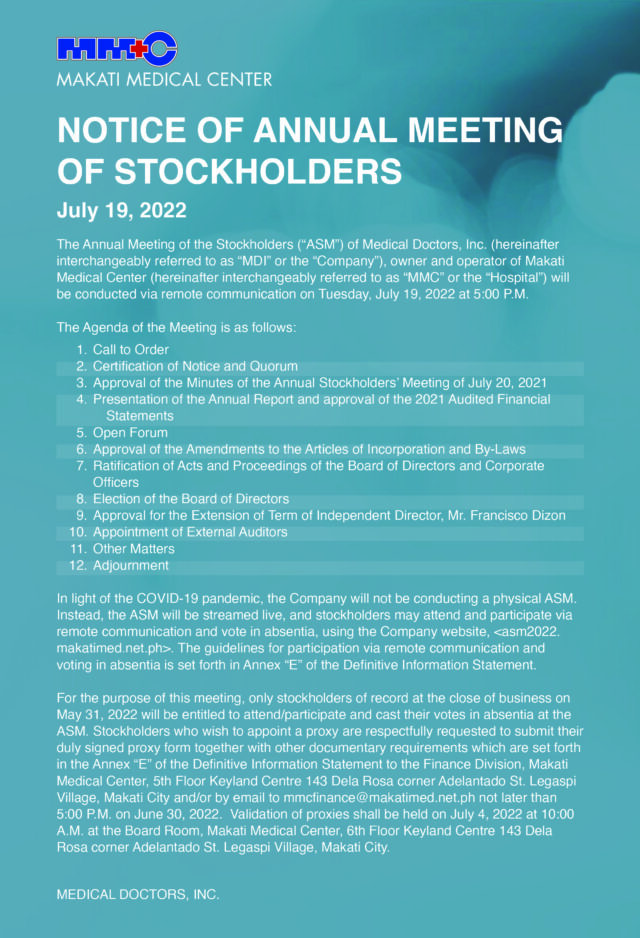
Medical Doctors, Inc. to conduct annual meeting of stockholders via remote communication on July 19


Spotlight is BusinessWorld’s sponsored section that allows advertisers to amplify their brand and connect with BusinessWorld’s audience by enabling them to publish their stories directly on the BusinessWorld Web site. For more information, send an email to online@bworldonline.com.

Join us on Viber to get more updates from BusinessWorld: https://bit.ly/3hv6bLA.

BSP may go for up to 50-bp hike — poll

PHILIPPINE STAR/ MIGUEL DE GUZMAN
Latest data from the Department of Energy showed prices of gasoline, diesel, and kerosene increased by P28.70, P41.14, and P37.95 per liter respectively since the start of the year. — PHILIPPINE STAR/ MIGUEL DE GUZMAN

By Keisha B. Ta-asan

THE BANGKO SENTRAL ng Pilipinas (BSP) is widely expected to raise interest rates on Thursday, with several analysts now forecasting a 50-basis-point (bp) increase after the aggressive tightening by the US Federal Reserve last week.   

A BusinessWorld poll last week showed 15 out of 16 analysts anticipate the Monetary Board increasing its benchmark interest rate at its June 23 meeting. However, analysts appear divided on the pace of tightening, with nine analysts seeing a hike of 25 bps while six analysts anticipate an increase of 50 bps.

“Considering the current volatility of the economy, where inflation rate is at its highest since 2018 at 5.4% (in May) and expectations are high that this will further erode and may breach the government target… coupled with the US Federal Reserve decision to increase their policy rate to 75 bps, it is expected that local policy rate to likewise increase by another 25 bps,” Colegio de San Juan de Letran Graduate School Associate Professor Emmanuel J. Lopez said in an e-mail.

Analysts’ expectations on policy rates (June 23)

Inflation rose to 5.4% in May, the highest in three and a half years and above the BSP’s 2-4% target range. The BSP last month raised its average inflation estimate to 4.6% this year, higher than the previous estimate of 4.3%.

Makoto Tsuchiya, an economist at Oxford Economics, said the BSP will likely put more focus on elevated prices than economic growth at the next meeting, citing the stronger-than-expected gross domestic product (GDP) growth in the first quarter.

“We think the BSP will be wary of stifling the recovery and will continue to tread carefully between maintaining growth momentum and containing inflationary pressures,” Mr. Tsuchiya said.

The Philippine economy already surpassed pre-pandemic levels in the first quarter, with GDP expanding by 8.3%.

Economic managers are targeting a 7-8% GDP growth this year.

China Banking Corp. Chief Economist Domini S. Velasquez said a more measured monetary tightening cycle is ideal for the Philippines.

“We think that continued moderate hikes by the BSP will allow the economy to absorb interest rate increases at a more measured pace. In this time of uncertainty, it also provides time for the BSP to assess the impact of monetary tightening on our growth recovery,” she said.

In a June 14 roundtable with BusinessWorld editors, incoming BSP governor and current Monetary Board member Felipe M. Medalla signaled the pace of subsequent tightening will be gradual, ruling out rate hikes of more than 25 bps.

However, Mr. Medalla’s statement was made a day before the US Federal Reserve approved a 75-bp interest rate hike, its biggest since 1994.

The aggressive monetary tightening by the US Federal Reserve may spur capital outflows and put more downward pressure on the peso, some analysts said. This may prompt the Monetary Board to consider a 50-bp rate hike, they said.

Philippine National Bank economist Alvin Joseph A. Arogo said he now expects a 50-bp increase by the BSP after the Fed’s latest rate hike and the peso breaching the P53-$1 level.

The peso closed at P53.75 per dollar on Friday, weaker by 28 centavos from its P53.47 finish on Thursday, based on Bankers Association of the Philippines data.

It also shed 75 centavos from its P53 close a week earlier. This was the peso’s weakest close in over three and a half years or since its P53.80 finish against the greenback on Oct. 25, 2018.

“A 50-bp bump in June will let the BSP balance growth recovery and manage inflation, while getting ahead of the Fed’s pace. This should also help temper the peso’s weakness with the current account deficit projected at $19.1 billion this year,” Security Bank Corp. Chief Economist Robert Dan J. Roces said in an e-mail.

Some analysts expect the BSP’s policy normalization to be gradual as inflation is expected to return to the 2-4% target range by 2023.

The Monetary Board kicked off its tightening cycle on May 19 by raising the yield on the BSP’s overnight reverse repurchase facility by 25 bps to 2.25%. Interest rates on the overnight deposit and lending facilities were also hiked to 1.75% and 2.75%, respectively.

This was the first increase in borrowing costs since 2018 and followed cuts worth 200 bps in 2020 as the BSP moved to support the economy amid the coronavirus pandemic.

“As things stand, we expect only two more interest rate hikes next year, taking the rate to 3%, implying that a full reversal of the COVID-era cuts is unlikely to take place until after 2023,” Pantheon Chief Emerging Asia Economist Miguel Chanco said.

Moody’s Analytics analyst Sonia Zhu said the central bank may increase rates three more times, with the policy rate seen at 3% and above by end-2022.

Oxford Economics’ Mr. Tsuchiya said the BSP is likely to hike the policy rate by 100 bps this year.

“We expect the BSP to gradually continue tightening beyond this year, and unwind all the 200 bps cuts implemented at the onset of the pandemic by early 2024,” he said.

However, for ING Bank N.V. Manila Senior Economist Nicholas Antonio T. Mapa, the BSP should “not simply be in ‘normalization mode’ but it should assume a tightening stance” to curb red-hot inflation.

“We have the BSP back at 4% by early next year,” he added.

After Thursday, there are four more Monetary Board meetings scheduled this year — Aug. 18, Sept. 22, Nov. 11, and Dec. 15.

PHL needs to ratify RCEP, says Balisacan

Vendors unpack sacks of vegetables in Balintawak market, Jan. 27, 2021. — PHILIPPINE STAR/ MICHAEL VARCAS

THE PHILIPPINES stands to lose potential foreign investments if it fails to ratify its membership in the Regional Comprehensive Economic Partnership (RCEP), incoming Socioeconomic Planning Secretary Arsenio M. Balisacan said.

In a June 16 roundtable with BusinessWorld editors, Mr. Balisacan said membership in RCEP would send the signal to investors that the Philippines is “open for business.”

“We want to be part of [the] global value chains. If investors [and] international traders don’t see us as a key player in those value chains, then we could not expect investors to think about us. That is important and I think that we need to ratify the RCEP,” he said.

The Senate failed to give its concurrence to the RCEP before it adjourned sine die on June 1, despite appeals from economic managers and business groups.

The RCEP, which entered into force on Jan. 1, is a major trade agreement involving Australia, China, Japan, South Korea, New Zealand and the 10 members of the Association of Southeast Asian Nations (ASEAN).

Representing about 30% of the global gross domestic product (GDP), the RCEP allows for zero or reduced tariffs in trade between the members of ASEAN and its free trade agreement partners.

Hesitation over the ratification of the RCEP comes from concern that local farmers will be negatively impacted by imports from other RCEP members. Some senators also cited the lack of safeguards for the agriculture sector.

“We can never really protect and do justice to our agriculture if our means of protecting our agriculture is inhibit competition, prevent competition,” Mr. Balisacan said.

The incumbent Philippine Competition Commission chairman said the main problem of low agricultural productivity has nothing to do with trade.

“It is the lack of public investments, the lack of institutional support… bad governance in the sector. I’m talking about infrastructure, research and innovation for agriculture. Our productivity, yield per hectare or production per hectare, is so low compared to our neighbors,” he added.

Mr. Balisacan said the government should raise the budget for agriculture research and development (R&D), which is around 0.3% of the country’s GDP compared with other countries that allocate around 1-2% of their GDP.

“We have very little regard for science and even more for agricultural sciences… Investing 2% of your GDP in R&D, you are likely to grow fast with productivity likely to go up,” he added.

“So we have to reset our priorities, go back to the basics, and address the key sources of productivity growth.”

Agriculture typically makes up around 10% of overall economic output, and a fourth of the country’s jobs.

President-elect Ferdinand R. Marcos, Jr. previously said he wants a review of the RCEP to determine if the agriculture sector is not unduly disavantaged by the trade deal.

Mr. Marcos would have to endorse the trade agreement to the 19th Congress when sessions open in late July.

President Rodrigo R. Duterte signed the trade deal on Sept. 2, 2021.

A video of the roundtable with Mr. Balisacan will be shown on BusinessWorld’s Facebook page on June 27. — Diego Gabriel C. Robles

Incoming BSP governor not keen on cryptocurrency

Representations of virtual currency Bitcoin are placed on US dollar banknotes in this illustration taken on May 26, 2020. — REUTERS/DADO RUVIC/ILLUSTRATION

INCOMING Bangko Sentral ng Pilipinas (BSP) Governor Felipe M. Medalla is not keen on regulating cryptocurrency, dismissing the virtual asset as based on the “greater fool theory.”

“Every Bitcoin buyer that I know does not use (cryptocurrency) for anything… The only reason you’re using this is you think somebody else will buy it from you at a higher price. That’s a very scary investment,” Mr. Medalla said during a virtual roundtable discussion with BusinessWorld editors on June 14.

Mr. Medalla, currently a member of the Monetary Board, said cryptocurrency is based on the “greater fool theory.” The theory goes that a market player can make money buying overpriced items if there is a “greater fool” that wants to purchase it at an even higher price.

Billionaire Bill Gates also cited the same theory in criticizing cryptocurrency at a TechCruch event last week.

“The value of crypto is what some other person decides someone else will pay for it, so not adding to society like other investments,” Mr. Gates was quoted as saying.

Mr. Medalla noted that cryptocurrency is valuable for people who want to hide their money from the government.

“This is a new tool that adds to the ability to do that. There are plenty of people who want to hide their money from the government,” he said.

The BSP does not regulate cryptocurrency itself but has guidelines on virtual asset service providers. Under the rules, entities that engage with virtual assets are required to secure a license from the BSP.

Cryptocurrencies in the Philippines are classified as digital or virtual assets.

“My view is the moment you cross from the virtual world to the fiat and physical world, you have to have KYC (Know Your Customer) policies… and apply the same anti-money laundering policy,” Mr. Medalla said.

KYC refers to the process that institutions use to verify identities of their clients and ascertain fraud risks they may pose. This can keep money laundering, terrorism financing, and other types of unlawful financial activities in check.

BSP data showed transactions in virtual currency, including cryptocurrency, surged by 71% to P105.93 billion in the first semester of 2021.

The cryptocurrency industry has suffered significant losses in recent weeks amid problems with stablecoins such as TerraUSD and cryptocurrency lending company Celsius Network. Bitcoin, the biggest cryptocurrency, dropped below the $20,000 level on Saturday.

The BSP is currently working on a pilot project that will test the use of wholesale central bank digital currency (CBDC) for large-value financial transactions among selected financial institutions.

“The pilot project covers the experimentation of the CBDC’s use to transfer large-value financial transactions on a 24 [hours] by 7 [days] basis, across a limited number of financial institutions but possibly covering both banks and nonbank institutions,” BSP Governor Benjamin E. Diokno said in April.

Project CBDCPH is a major step for the country’s central bank and the finance industry to understand the opportunities and risks of wholesale CBDCs.

The BSP chose to focus on the wholesale aspect of CBDCs as it assessed that it will have a bigger impact compared with retail use cases. — K.B.Ta-asan