Home Blog Page 5757

Siargao declared priority area for tourism development — DoT

THE Department of Tourism (DoT) said Siargao in Surigao del Norte is considered a priority area for tourism development.

“Siargao is a priority. In the next few years, your island will continue to flourish in partnership with the National Government,” Tourism Secretary Maria Esperanza Christina G. Frasco said during her keynote speech at the opening ceremony of the 26th Siargao International Surfing Cup on Oct. 15.

Siargao has received 14,404 visitors in the first half, according to a tally maintained by the provincial tourism office.

Of the arrivals, 12,870 were domestic tourists while 1,534 were foreign guests.

Ms. Frasco said the government is aiming to help Siargao recover with infrastructure projects and granting the island gateway status for direct flights.

“The National Government is here to help Siargao recover, is here to help Siargao rise to the primary position that it deserves in the world,” Ms. Frasco said.

Siargao was hit by Typhoon Odette (international name: Rai) in December.

The Surigao del Norte government has estimated the typhoon damage at P20 billion.  

Meanwhile, the DoT said that the side activities of the 26th Siargao International Surfing Cup to be held until Oct. 21 include surfing masterclasses,  communal yoga, salsa, arts and cultural show, a bazaar, a beach bonfire, concerts, and a beach clean-up. — Revin Mikhael D. Ochave

Artificial intelligence seen helping drive logistics industry cost cuts, sustainability

PHILSTAR FILE PHOTO

By Arjay L. Balinbin, Senior Reporter

THE logistics industry is expected to benefit from artificial intelligence (AI), which can improve the customer experience, cut costs, and make operations greener, Indian software company Shipsy said.

With e-commerce growing in the Philippines, the industry should take advantage of opportunities by going digital to meet evolving customer expectations, Shipsy Chief Executive Officer and Co-Founder Soham Chokshi told BusinessWorld in a recent e-mail interview.

“Almost 51% of shoppers return their orders if they don’t arrive on time,” Mr. Chokshi noted.

Delivery speed is among the primary challenges for retailers.

“The courier express and parcel industry struggle with poor quality addresses and drivers’ inability to navigate to the customer location on time, which ultimately leads to more returns, greater fuel consumption, and CO2 (carbon dioxide) emissions, putting all initial logistical efforts to waste,” he said.

Technology solutions powered by AI and machine learning (ML) help the industry address such challenges, he added.

“Advanced geocoding converts poor-quality addresses into exact latitudes and longitudes. The coordinates are displayed as a clear polyline on the driver’s mobile app leading them to the exact customer location,” he said.

Logistics tools powered by AI and ML optimize routes to reduce emissions. “Such route optimizers help eliminate empty miles, reduce the distance traveled, prevent vehicle idling, and lower trip volumes,” Mr. Chokshi said.

“Such tools provide predictive visibility to customers in terms of the expected time of arrival, along with allowing them to track delivery progress in real-time,” he noted.

“Innovative optimizers enable customers to reschedule the delivery to their preferred time slots.”

The company is optimistic about the Philippine logistics industry in 2023, citing the government’s efforts to boost digitalization.

“The introduction of the Unified Logistics Pass system and discussions on leveraging technologies to identify supply chain bottlenecks are encouraging,” Mr. Chokshi said.

He also added that rising consumer spending and a young, tech-savvy population are driving the growth of Philippine e-commerce.

“It is poised to reach $24 billion by 2025.”

“This is inviting international players to make strategic investments in the region, making it imperative for logistics service providers to keep up with the rapid technological advancements to stay competitive,” Mr. Chokshi said.

“Great opportunities await businesses that leverage technology to automate, optimize, track, and simplify their logistics and supply chain operations.”

Subsidies to gov’t firms down 63% in August

PHILSTAR FILE PHOTO

SUBSIDIES granted to government-owned and -controlled corporations (GOCCs) fell 63.32% year on year to P15.536 billion in August, according to the Bureau of the Treasury (BTr).

Budgetary support to GOCCs also fell 48.76% compared to the P30.321 billion posted in July. Year to date, subsidies amounted to P90.602 billion, according to preliminary data from the BTr.

Subsidies are extended to GOCCs to cover operational expenses not supported by their revenue.

The Philippine Health Insurance Corp. (PhilHealth) was the top recipient, taking in P11.231 billion or 72.29% of all subsidies in August. It was also the top beneficiary in July, taking in P22.462 billion.

The National Irrigation Administration (NIA) received P2.535 billion, against P5.872 billion the preceding month.

The Philippine Fisheries Development Authority received P291 million in August, it received no subsidies in July.

Other top recipients were the National Food Authority (P219 million), the Philippine Children’s Medical Center (P164 million), the National Privacy Commission (P147 million), the Philippine Heart Center (P147 million), the National Home Mortgage Finance Corp. (P109 million), and the National Kidney and Transplant Institute (P107 million).

GOCCs that were given at least P50 million were the Philippine National Railways (P96 million), the Philippine Coconut Authority (P92 million), and the Lung Center of the Philippines (P58 million).

Among the major nonfinancial GOCCs, the Local Water Utilities Administration, the National Electrification Administration, and the National Housing Authority (NHA) received no subsidies.

The Bases Conversion and Development Authority, the Civil Aviation Authority of the Philippines, the National Tobacco Administration, the Philippine Crop Insurance Corp., the Small Business Corp., the Social Housing Finance Corp., and the Sugar Regulatory Administration also received no subsidies.

The year-to-date subsidy total declined by 33.73% from a year earlier.

The top recipient in the year to date has been PhilHealth, which was given P33.693 billion, accounting for 37.19% of all subsidies.

This was followed by the NIA and the NHA, which received P26.753 billion and P8.841 billion, respectively.

In 2021, government subsidies to GOCCs fell 19.3% to P184.77 billion. Of the total, PhilHealth received P80.98 billion, nearly 44% of all subsidies. — Luisa Maria Jacinta C. Jocson

Scientists lobby for more public investment in STEM

FREEPIK

SCIENTISTS said government support for Science, Technology, Engineering, and Mathematics (STEM) remains low and called for a long-term plan to boost the scientific community.

The Advocates of Science and Technology for the People, who go by the acronym AGHAM, issued the statement after President Ferdinand R. Marcos, Jr. called himself a “frustrated scientist” during a recent convention for the Balik Scientist Program, which aims to encourage expatriate Filipino STEM professionals to return to the Philippines to help with “scientific, agro-industrial, and economic development.”

“The present government should acknowledge that we are suffering from brain drain due to the absence of a national program for the development of the country’s science and technology that could provide opportunities locally for our experts,” AGHAM said in its statement.

“This is critical as climate change is one of the important things that need to be addressed using science-based action,” AGHAM said.

AGHAM said the President “failed to recognize the historical neglect of our science and technology with the low public investment in science and mathematics education, lack of academic and industry institutional collaboration in research and development, and a growth pattern based largely on trade in services which has resulted in deindustrialization.”

AGHAM said the budgetary allocation for research and development does not meet the recommended UNESCO threshold of 1% of gross domestic product.

“There should be serious consideration in building our own scientific capacity for our own economic development,” the group said. “In this way, Filipino scientists no longer need to go abroad; rather their skills and expertise would be put to great use for the country’s needs.”

Under the proposed 2023 national budget, the Department of Science and Technology (DoST) will receive P24.06 billion, slightly lower than its current budget of P24.27 billion.

Science and Technology Secretary Renato Solidum, Jr., told the House of Representatives last month that the DoST originally proposed a P44.17-billion budget.

Half or P12.14 billion of the proposed budget for the DoST will be allocated to scientific and technical services, while 25.32% or P6.09 billion will be earmarked for the office of the secretary and regional offices. — Kyle Aristophere T. Atienza

Tax issues arising from cross-border WFH arrangements

Before COVID came, flexible work arrangements, such as work-from-home (WFH), were for the large part unheard of, at least in the Philippines.  However, when lockdowns were implemented, there was no other choice but to embrace WFH to continue business operations.

Lockdowns have now been lifted, but the COVID threat remains, resulting in WFH arrangements becoming accepted as the new normal. In fact, in the EY 2022 Work Reimagined Survey, 40% of respondents from the Philippines indicated that they would like to work remotely more than five days a week (essentially the entire work week), 20% prefer four days a week, 24% three days a week, 12% two days a week, 2% once a week and only 2% want to return full-time to the office. We can also see an increasing number of companies supporting their employees with WFH allowances and subsidies (e.g., internet allowances and equipment subsidies) so that they can set up their workstations and be able to carry out their tasks efficiently and effectively at home.

The WFH arrangement has also expanded to the cross-border workforce. Some foreign companies are now engaging Filipino or foreign nationals in the Philippines without physically moving such talent to foreign/host locations. There are also cases where foreign nationals are hired/assigned to Philippine entities but continue to work outside the country or from their foreign residences. While cross-border WFH may satisfy an employee’s remote working preferences, it may pose some tax issues to both the employer and the employee.

The Philippine Tax Code, with its various amendment in recent years, still considers the situs of taxation for income on services as the place where the personal services are rendered. Thus, compensation for labor or personal services performed within the Philippines regardless of the residence of the payor, or of the place in which the contract of services was made, or the place from which payment was made, is considered Philippine-sourced income. The determination of the tax residency also remains unchanged and so is the scope of taxation, based on the tax residency status of the taxpayer/filer.

To illustrate what these issues are, let us take as an example a Filipino citizen, Juan, who was hired by a Japanese entity, receiving payroll from Japan but living in the Philippines due to a WFH arrangement with the employer. For tax purposes, Juan will remain a resident Filipino citizen and is subject to tax on his worldwide income. His Japan-paid salary is Philippine-sourced income. Thus, even if his salary is paid by his Japanese employer and taxed in Japan, he will not be able to claim Japan-paid taxes as foreign tax credits for his Philippine income tax return because the salary, on which Japan imposes taxes, is not foreign-sourced but Philippine-sourced income. Consequently, there may be double taxation on the same income. Also, as Juan is an employee of the Japanese entity, there is a risk that his presence in the Philippines is creating a permanent establishment (PE) in the Philippines for his employer. If a PE status is created, the Japanese entity may be exposed to corporate taxes (i.e., income tax, VAT or withholding tax) and will be required to fulfill administrative tax compliance here in the Philippines.

Consider another example, this time a foreign national, John, who is on assignment to a Philippine entity, receives his payroll from the Philippine company but stays in his home country while on foreign assignment. Technically, John should not be subject to tax in the Philippines. As a foreign national, he is subject to tax only on his Philippine-sourced income. As he is rendering his services in his home country, the remuneration that he receives for such services is foreign-sourced income, not Philippine-sourced compensation. However, a corporate tax issue arises if the Philippine entity claims John’s salary as an expense in its books. There is a risk that the tax authorities may disallow the tax deduction of such salaries if these were not subjected to Philippine withholding taxes. Furthermore, as an employee of a Philippine entity working in a foreign jurisdiction, there is again a PE risk being created in that foreign jurisdiction. If PE is created, the Philippine entity may be subject to tax and administrative compliance in such foreign jurisdiction.

There are other variations to WFH arrangements (e.g., split payroll, working in third country, among others) that would likely result in the same double taxation, PE creation and tax deduction disallowance risks). Given that cross-border tax on WFH scenarios can be significantly more complex than what most people believe, it is advisable for both companies and their cross-border employees to proactively consult tax professionals who are well-versed in these issues before entering into such arrangements, if possible. For companies that have pre-existing cross-border employees, they should consider conducting a review well ahead of the actual filing of tax returns to ensure that they are not only compliant in both home and host jurisdictions, but that they also understand what options they have to address possible challenges that may arise.

This article is for general information only and is not a substitute for professional advice where the facts and circumstances warrant. The views and opinions expressed above are those of the author and do not necessarily represent the views of SGV & Co.


Jocelyn M. Magaway is a tax senior director of SGV & Co.

Typhoon Nesat forces a thousand Filipinos to flee

UNITED STATES NAVAL RESEARCH LABORATORY

TYPHOON Nesat (Neneng) forced almost a thousand people in northern Philippines to flee, the local disaster agency said on Sunday, as President Ferdinand R. Marcos, Jr. vowed to help typhoon victims.

In a report, the National Disaster Risk Reduction and Management Council said 960 people mostly from the Cagayan Valley region had been evacuated, with more than 350 people staying inside temporary shelters.

It said 5,357 people from 1,472 families were affected by the typhoon.

What was first labeled a storm reached typhoon category after it continued to intensify, the local state weather bureau said in a 2 p.m. bulletin.

“Further intensification is likely as this tropical cyclone moves over the West Philippine Sea,” it said, referring to areas of the South China Sea within the Philippines’ exclusive economic zone.

The storm was last spotted 145 kilometers west of Calayan, Cagayan, with sustained winds reaching as fast as 120 kilometers per hour (kph) near the center and gusts of as much as 150 kph, it added.

The government was closely watching the storm and was ready to help affected people, Mr. Marcos tweeted.

The Philippines lies along the typhoon belt in the Pacific and experiences about 20 storms each year. It also lies in the so-called Pacific Ring of Fire, a belt of volcanoes around the Pacific Ocean where most of the world’s earthquakes strike.

The southeast Asian nation constantly experiences unavoidable losses and damage equivalent to 0.5% of its annual economic output mainly due to an increasingly unpredictable climate, according to the Finance department.

Mr. Marcos said state resources would be used to “ensure the primary needs of those affected, especially food, safe drinking water and electricity.”

“Nevertheless, to the provinces in the north that have felt the effects, help is on the way. We encourage everyone to follow the directives of your local government units and Municipal Disaster Risk Reduction and Management Councils,” he said in another tweet.

The storm continued to intensify as it moved away from the Babuyan Islands, where winds had “storm-force strength,” the state weather bureau earlier said in an 11 a.m. bulletin. Gale-force winds were also expected in areas under Signal No. 2. 

The island group including Batanes would continue to experience moderate to heavy and at times intense rains, along with Apayao, Ilocos Norte and Ilocos Sur, it added.

Expect light to moderate and at times heavy rains over Batanes, the northern portion of Cagayan and the rest of the Cordillera Administrative Region and Ilocos Region, the agency said.

Several areas were earlier placed under tropical cyclone wind signals — the southern portion of Batanes that includes Basco, Mahatao, Uyugan, Ivana and Sabtang, as well as the Babuyan Islands.

The rest of Batanes and Cagayan, Apayao, the northern portion of Abra including Tineg, Lacub and Lagayan, as well as Ilocos Norte were under Signal No. 2.

Placed under Signal No. 1 were the northern and central portions of Isabela including the towns of Santa Maria, San Pablo, Maconacon, Divilacan, Palanan, Ilagan City, Tumauini, Cabagan, Santo Tomas, Quezon, Delfin Albano, Mallig, Quirino, Gamu, Roxas, San Mariano, Benito Soliven, Naguilian, Burgos, Reina Mercedes, San Manuel, Aurora, Luna, Cabatuan, San Mateo, Dinapigue and Cauayan City.

Kalinga, the rest of Abra, Mountain Province and the northern part of Ifugao including the towns of Aguinaldo, Alfonso Lista, Mayoyao, Hungduan and Banaue were also under Signal No. 1.

The northern and central portions of Ilocos Sur including the towns of Sinait, Cabugao, San Juan, Magsingal, Santo Domingo, San Ildefonso, San Vicente, Santa Catalina, Bantay, City of Vigan, Santa, Caoayan, Narvacan, Nagbukel, Santa Maria, San Esteban, Santiago, Burgos, Banayoyo, Lidlidda, San Emilio, Quirino, Gregorio del Pilar, Galimuyod, Candon City, Santa Lucia, Salcedo, Cervantes, Suyo, Sigay and Santa Cruz were likewise under Signal No. 1.

It was expected to leave the Philippine area of responsibility on Sunday afternoon or evening. It could further intensify and become a typhoon as it moves over the South China Sea, it added. — Norman P. Aquino


Analysts seek fair probe of drug case vs DoJ chief’s son

This handout photo from the Philippine Drug Enforcement Agency shows bags of marijuana seized during a counternarcotics operation where Juanito Jose Remulla III was arrested in October 2022. — PDEA / RELEASED

POLITICAL analysts on Sunday sought an impartial investigation of the drug case against the son of the country’s Justice chief.

“The drug case of the Justice Secretary Jesus Crispin C. Remulla’s son calls for an objective investigation, clear determination of guilt and firm implementation of our laws,” Arjan P. Aguirre, who teaches political science at the Ateneo de Manila University, said in a Facebook Messenger chat.

He should also prove that his openness about his eldest son’s recent arrest for illegal drug possession was out of sincerity and not due to pressure, he added.

Mr. Remulla did not immediately reply to a text message seeking comment.

Last week, officials of the Philippine Drug Enforcement Agency (PDEA) arrested Mr. Remulla’s son Juanito Jose for possession of high-grade marijuana worth about P1.3 million.

PDEA Director Derrick Arnold C. Carreon told CNN Philippines on Oct. 14 he was the lone suspect in the anti-illegal drug operation conducted in Las Piñas City near the Philippine capital.

The Justice chief said he would not interfere in his son’s case.

“This is a very difficult time for my family and me, but this is nothing compared to what so many Filipinos are going through,” he told reporters in a handwritten message via Viber. “I will respect the justice system and I wish my son a path to redemption.”

Calls for him to resign went viral on social media.

President Ferdinand R. Marcos, Jr. last week rejected calls for Mr. Remulla to resign. “You call for somebody to resign if he is not doing his job or if he misbehaves in that job,” he said on Oct. 14.

Albay Rep. Edcel C. Lagman said the Justice chief does not need to resign for as long as he keeps his word to stay out of his son’s case.  

Hansley A. Juliano, a political economy researcher studying at Nagoya University’s Graduate School of International Development in Japan, said Mr. Remulla’s resignation would depend on the pressure and potential damage of the incident to his reputation.

“There are always calls for resignations of Cabinet officials when they seem to damage the brand, integrity or reputation of the president vis-a-vis his governance promises,” he said in a Facebook Messenger chat.

Mr. Remulla was in Geneva, Switzerland last week to discuss the country’s human rights issues with the United Nations.

He told the UN Rights Council that the Department of Justice (DoJ) was aiming to “change the culture” of the local justice system, which he said was prone to delays.

The Justice department has brought five of the 52 cases involving 150 erring cops involved in the government’s deadly drug war.

The UN Office of the Commissioner for Human Rights last month said the government’s probe of human rights violations in connection with its deadly drug war lacked transparency.

Data from the Philippine government released in June 2021 showed at least 6,117 suspected drug dealers had been killed in police operations. Human rights groups estimate that as many as 30,000 suspects died. — John Victor D. Ordoñez

Failure of cash aid program reflects noninclusive growth — political analysts

Parents and students are seen crowding the entrance of the Pura V. Kalaw Elementary School in Project 4, Quezon City, Aug. 22. — PHILIPPINE STAR/ MIGUEL DE GUZMAN

POLITICAL analysts at the weekend cited the government’s failure to make economic growth inclusive, citing state data that showed 90% of beneficiaries of its conditional cash transfer program remained below the poverty line.

“This situation is more a reflection of the failure of the country’s unprecedented economic growth to translate into real economic gains in our marginalized communities,” Terry L. Ridon, a public investment analyst and convenor of think tank InfraWatch PH, said in a Facebook Messenger chat.

The state failed to create jobs and sustainable livelihood programs to help the poor get out of the program, he said.

The Pantawid Pamilyang Pilipino Program, also known as 4Ps, is a conditional cash transfer program that was launched in 2007. It was institutionalized in 2019 through a law.

Earlier this month, the Commission on Audit said 3.82 million people under the program have remained under the poverty threshold for as long as 13 years.

Arjan P. Aguirre, a political science professor at the Ateneo de Manila University, said the program should improve the economic standing of its beneficiaries.

“The livelihood component of the 4Ps program, most especially, should be strengthened to allow the beneficiaries to have stronger capabilities to enhance their social and economic potential through their own creative means,” he said in a Messenger chat.

Albay Rep. Jose Ma. Clemente S. Salceda said the 4Ps program is essential but should be supplemented with investments in the countryside.

“Money alone is not enough,” he said in a statement last week. “While it creates virtuous cycles in local economies and provides a basic social safety net that allows poor households to take more rewarding risks, money is not enough. Money on an individual and household level is not enough.”

Mr. Ridon said cash subsidies to the poor would continue indefinitely without a concrete plan on job generation specific to 4Ps families.

He added that this was fiscally unsustainable “as marginalized communities will continue increasing, particularly at this time of wide-ranging economic difficulties.”

The 4Ps program released a total of P537.39 billion in cash grants to 4.26 million beneficiaries from 2007 to June 30, 2021. — Matthew Carl L. Montecillo

5 years after Marawi siege: Residents push for compensation board creation, updated damage report 

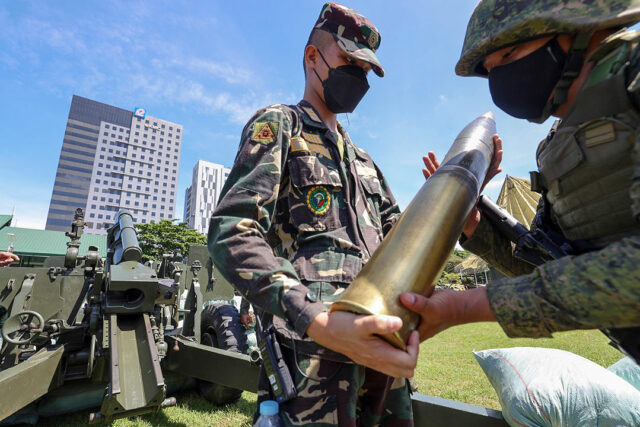
MILITARY artillery used during the 2017 Marawi siege are among the items on display at the Philippine Army Headquarters in Taguig City for an exhibit commemorating the 5th anniversary of the end of the five-month long battle on Oct. 17. — PHILIPPINE STAR/KRIZ JOHN ROSALES

THE PHILIPPINE Army opened an exhibit on Saturday at its headquarters in Metro Manila to commemorate the heroism of government forces who fought against Islamic State-linked terrorists five years ago in Marawi, where residents of the southern Philippine city affected by the destructive siege called on the administration to address issues that continue to hamper recovery. 

Jalilah S. Sapiin, a member of the multi-sector Marawi Reconstruction Conflict Watch, said President Ferdinand BongbongR. Marcos, Jr. should expedite the appointment of the Marawi Compensation Board members to avoid further delay in reparations for civilian lives and properties lost.  

We appeal to President Bongbong Marcos to expedite and make transparent the vetting process of the composition of the Marawi Compensation Board whose members should possess deep knowledge and understanding of the context and culture to ensure that the process of rehabilitation and compensation is appropriate and does not exacerbate conflict,she said in a statement from Conflict Alert Philippines, secretariat of the autonomous monitoring group.  

It has been almost six months since the law was approved on April 13, 2022. Without a Board, the Marawi Compensation Law cannot be implemented, said Ms. Sapiin, who also works for the Bangsamoro Ministry of Basic, Higher and Technical Education. 

Apart from setting up the board, the group said lingering problems in Marawi Citys rehabilitation include validation of displaced residents, land disputes, issuance of building permits to legitimate property owners, and an updated damage assessment.   

PRIVATE HEALTH FACILITIES
Another member of the Marawi group and head of the Bangsamoro Ministry of Healths Infectious Disease Cluster, Rolanisah Dipatuan-Dimaporo, said the P1-billion allocation under the 2023 national budget for the compensation law is not enough to cover victims, which includes owners of private hospitals and schools.  

The allocation of P1 billion is a welcome but inadequate initial budget for the monumental task of compensating the Marawi siege victimsFor example, private schools and hospitals have been asking for inclusion in the Marawi rehabilitation plan,she said.  

None of the private hospitals in (the most affected areas of the Marawi battle) have been able to rebuild since 2017. We still have unpaid claims from PhilHealth more than five years after the war ended,she added.  

An assessment conducted by the Asian Development Bank (ADB) estimated the cost to public and private property as of Aug. 2018 at about P11.5 billion in damage and P7 billion in losses.  

Of the total, private health facilities damage and loss amounted to P371 million, while that of the public sector amounted to P65.5 million, according to the ADB report.  

For public infrastructure, the national governments Marawi reconstruction program was 65% complete as of May, according to the former Task Force Bangon Marawi head, with more than P22 billion in funds released as of 2021.  

The Marawi Reconstruction Conflict Watch said there is a need to improve consolidation, transparency and accountability for the reconstruction budget as  

separate reports from different government agencies indicate P42 billion had already been released. 

Meanwhile, the Office of the Presidential Adviser on Peace, Reconciliation and Unity (OPAPRU) announced that it is holding a week-long social healing and peacebuilding activitiesin Marawi starting Oct. 16 in commemoration of the end of the siege. 

OPAPRU said it will include dialogues with various sectors, including women, youth and former rebels.  

In the capital region, the military will hold a wreath-laying ceremony at the Marawi Pylon in Fort Bonifacio on Monday. 

More than 160 soldiers and other members of the government security force were killed in Marawi, and over 1,000 others were wounded.  

The series of events will immortalize the sacrifices of soldiers and law enforcers in the liberation of Marawi City, and at same time highlight the citys journey for peace, development, and rehabilitation, Army Commanding General Romeo S. Brawner, Jr., said in a statement.   

Local terrorist groups led by the Maute and Abu Sayyaf laid siege to Marawi on May 23, 2017, and the heavy gun battle against government forces lasted for almost five months.  

Then President Rodrigo R. Duterte declared the citys liberation from terrorist influenceon Oct. 17.  

Marawi, one the main urban centers in what is now the Bangsamoro Autonomous Region in Muslim Mindanao, was the most populated city in the region as of the 2015 census with 201,785. MSJ 

Pension institution for poor senior citizens needed 

DSWD.GOV.PH

THE GOVERNMENT should shift its dole-out system for poor senior citizens into a pension fund to give them an opportunity to receive more benefits, a lawmaker said on Sunday.   

I would like to see the day when the Indigent Seniors Social Pension (ISSP) program and the Centenarians Act cash grants are cared for and managed by the Social Security System or something like the SSS, and with more benefits for seniors,Senior Citizens Party-list Rep. Rodolfo M. Ordanes said in a statement.   

Senior citizens who worked in the private sector get a pension from the SSS, while those from government service receive theirs from Government Service Insurance System.   

The Department of Social Welfare and Development handles the ISSP, which was previously set at P500 monthly.   

An increase to P1,000 monthly, which lapsed into law in August, was previously unfunded in the social welfare departments budget. The House of Representatives made amendments allotting an additional P5 billion to the program in the 2023 General Appropriations Bill.  

I envision an (indigent seniors pension program) that gets additional funding in the form of prepaid contributions from the families of the eventual seniors,the congressman said.    

What I mean is, before the seniors reach the age of 60, the children, grandchildren, nephews, nieces, grandnephews, and grandnieces can make voluntary premium contributions to the ISSP account of their eventual seniors, so that when they do become seniors, they can receive additional benefits on top of the ISSP amount of P1,000.”   

Mr. Ordanes said the government can use various studies undertaken by international institutions as reference for improving the pension system for poor seniors, or those 60 years and above.     

I will forward these studies to the Department of Finance, the Department of Budget and Management because they have financial geniuses who can understand and work out the details,he said.   

Mr. Ordanes said the current pension program for indigent seniors also distributes cash inefficiently.   

Last week, the Philippinesretirement income was ranked 43rd among 44 countries in Mercer-CFA Institutes Global Pension Index. Matthew Carl L. Montecillo 

Solon wants House probe on police visit to journalist’s house 

A HOUSE representative on Sunday urged her peers to investigate the home visit by a non-uniformed police officer to a journalist, supposedly to check on the welfare of media practitioners following the recent killing of a broadcaster.  

We think that this incident has to be investigated by Congress and should not be taken as an isolated incident and be viewed on the wider perspective of media harassment, red tagging and extra-judicial killings,Alliance of Concerned Teachers (ACT) Party-list Rep. France L. Castro said in a statement on Sunday. 

The lawmaker cited that these supposed visitssanctioned by the police leadership have been similarly done to teachers and members of organizations that the government labels as communist-terrorists.  

We want to have a copy of the memorandum ordering the visits as well as pose questions on its operationalization as this type of move only causes more anxiety to media practitioners as pointed out by the National Union of Journalists of the Philippines (NUJP),she said. 

GMA Network journalist John Paul JPSoriano relayed the police visit in a Twitter thread on Saturday.  

The NUJP said in a statement that similar visits, which violate privacy rights, have been reported by other members of the press.  

We urge the National Capital Region Police Office (NCRPO) and other police units to arrange these dialogues through more formal channels,NUJP said. 

We also call on the police to take note of and address online threats to our colleagues, including the baseless red-tagging that many in the community have had to endure,the group said. 

NCRPO head Jonnel C. Estomo has since issued a public apology and ordered a stop to the visits. 

The intention is good, but unfortunately, this has caused undue alarm and fear,he said, noting that the incident will be investigated. Kyanna Angela Bulan 

Iloilo officials order quick containment of 1st ASF case in Western Visayas 

PHILSTAR FILE PHOTO

LOCAL executives of Iloilo have ordered immediate containment measures against the potential spread of African Swine Fever (ASF) after the first suspected case of the viral disease was reported late last week.  

Iloilo and the entire Western Visayas had previously been among the last few regions in the country that had remained ASF-free since the first outbreak in July 2019.  

Iloilo City Mayor Jerry P. Treñas on Saturday ordered a ban on the entry of live hogs and pork products from the neighboring municipality Oton, although the Department of Agriculture had yet to issue a confirmation that the ASF case was in that town.  

Strict implementation of border controls and veterinary quarantine measures, including cargo and passenger inspections shall be imposed at all ports of entry into Iloilo City. All Livestock Transport Passes issued for Livestock Transport Vehicles and Reefer Vans shall be reviewed and regulated,Mr. Treñas said in the executive order dates Oct. 15.  

Iloilo City is administratively independent from the provincial government of Iloilo.  

Iloilo Governor Arthur R. Defensor, Jr. on Friday said movement of live pigs and pork products within the province shall not be hamperedbut called for the activation of all ASF task forces from the town to village levels.  

These task forces are mandated to check on all hog raisers in their respective areas, conduct continued monitoring, and immediately report suspected ASF cases.  

Provincial Veterinary Office chief Darel B. Tabuada reported to the governor on Friday that border control within the half-kilometer radius from ground zero to prevent the transport of pigs in and out of the areahad already been set up. — MSJ

ADVERTISEMENT
ADVERTISEMENT