Home Blog Page 5619

Term deposit yields climb on weak demand, rate hike hints
BW FILE PHOTO

YIELDS on the term deposits auctioned off by the Bangko Sentral ng Pilipinas (BSP) climbed on Wednesday amid weaker demand and rate hike signals.

Demand for papers under the BSP’s term deposit facility (TDF) totaled P247.361 billion on Wednesday, lower than the P310 billion on the auction block and the P321.566 billion in bids logged last week.

Broken down, the seven-day deposits attracted tenders amounting to P149.475 billion, short of the P150-billion offering as well as the P151.948 billion in bids recorded the prior week.

Rates for the one-week papers ranged from 3.125% to 3.75%, narrower and higher than the 2.75% to 3.69% range logged in the previous week. This brought the average rate for the tenor to 3.3839%, up by 13.80 basis points (bps) from the 3.2459% seen on July 20.

For the 14-day deposits, tenders hit P97.886 billion, below the P160-billion offering and the P169.618 billion in bids last week.

Accepted yields were seen from 3.25% to 3.75%, a higher and slimmer band compared to the 2.775% to 3.72% logged the previous week. This brought the average rate of the two-week deposits to 3.49%, increasing by 14.83 bps from the 3.3417% logged a week ago.

The central bank has not auctioned 28-day term deposits for more than a year to give way to its weekly offering of securities with the same tenor.

The term deposits and the 28-day bills are used by the BSP to mop up excess liquidity in the financial system and to better guide market rates.

Yields on the term deposits were higher as the BSP chief signaled another rate increase at the Monetary Board’s Aug. 18 meeting, Rizal Commercial Banking Corp. Chief Economist Michael L. Ricafort said in a Viber message.

Bangko Sentral ng Pilipinas Governor Felipe M. Medalla on Tuesday signaled an interest rate hike of less than 75 basis points (bps) at their Aug. 18 meeting with the US Federal Reserve expected to continue firing off big increases, although he ruled out another off-cycle move.

In a surprise move, the BSP raised its benchmark rates by 75 bps on July 14 as it sought to contain broadening price pressures.

This brought the rate on the key overnight reverse repurchase facility to 3.25%. The BSP’s overnight deposit and lending facilities were also increased by 75 bps, to 2.75% and 3.75%, respectively.

The Monetary Board has raised benchmark interest rates by a total of 125 bps so far this year as inflation continues to remain elevated.

Headline inflation was at 6.1% year on year in June, the fastest in nearly four years and exceeded the central bank’s 2-4% target band for a third straight month. The average inflation rate in the first six months is 4.4%, still below the BSP’s full-year forecast of 5%. — Keisha B. Ta-asan


Cybercriminals target fans of shows on big streaming sites

By Patricia B. Mirasol, Reporter

STRANGER THINGS fans who chose to watch the mystery series’ fourth season on sites other than the official platform have fallen victims to cybercriminals, global cybersecurity firm Kaspersky found.

“Cybercriminals have always ridden on trends to bait unsuspecting victims even before the pandemic,” said Yeo Siang Tiong, general manager for Southeast Asia at Kaspersky, in a July 26 e-mail. The pandemic has accelerated on-demand content — providing cybercriminals the opportunity to take advantage of fans’ eagerness to watch their favorite shows, Mr. Yeo added.

Netflix was the most popular streaming service used as a lure by cybercriminals, a 2021 report by Kaspersky found. Nine-tenths (or 89%) of the cybersecurity firm’s users faced malware (malicious software intended to compromise systems) or unwanted software while searching for Netflix and related content.

Other Netflix shows exploited by cybercriminals include The Mandalorian and Money Heist. The two accounted for 28.72% and 28.41% of infection attempts, respectively, between Jan. 1, 2020 and June 30, 2021.

Fans of Squid Game and Spider-Man: No Way Home were likewise the target of fraud schemes that included Trojans (malware disguised as legitimate software), adware (advertisement-supported software), and phishing (a cybercrime where scammers lure victims by posing as a trusted organization).

In the case of Stranger Things’ fourth season in 2022, Kaspersky researchers found examples of spam e-mails and phishing pages designed to steal the show’s fans’ money and personal information.

In one scheme, cybercriminals offered users the ability “to watch the new episodes for only $1 (P56).” Users were asked to register a new account and enter their address and bank details to access the offer. After entering the necessary information, fraudsters then drained the victims’ wallets without giving the purchased access to the series.

In another scheme, the researchers detected spam e-mails used to sell products of dubious quality, which were spread through promotional e-mails sans the recipient’s consent. In one of these e-mails, users were given the opportunity to buy limited-edition Stranger Things shirts through a domain that was only recently created.

“Fans need to be careful as trying to save money on a streaming service subscription can lead to them losing much more than they could ever save,” Olga Svistunova, security expert at Kaspersky, said in a July 25 press release.

“Consumers of [illegally obtained] entertainment should be aware that these types of websites are a cybercriminal’s playground where they disguise their malicious files as useful stuff,” added Mr. Yeo.

To avoid falling victim to scams, Kaspersky recommends the following:

  Avoid links promising early viewings of films or TV series.

  Check the authenticity of the website before entering personal data, and only use official, trusted web pages to watch or download movies.

  Pay attention to the extensions of the files you download: a video file will never have a .exe or .msi extension.

  Use reliable security solutions such as Kaspersky Security Cloud and Kaspersky Total Security.

Falling prey to threat actors causes user data to be compromised, Kaspersky said. Your bank details shared on the dark web are like an open Pandora’s box, Mr. Yeo reminded.

“Not only can you lose your hard-earned money, your identity can be compromised,” Mr. Yeo told BusinessWorld. “Also, those linked to you such as your family members and affiliates [can also become] vulnerable to any unimaginable attack.”

Shakey’s Pizza group rolls out plant-based menus

FACEBOOK.COM/SHAKEYSPH

SHAKEY’S Pizza Asia Ventures, Inc. is aiming to “future-proof” its business as it turns its healthy, plant-based menus into a company-wide campaign.

“Healthy offerings are a must-have in today’s world. We want to become more responsible and sustainable as a company,” Shakey’s President and Chief Executive Officer Vicente L. Gregorio said in a press release on Wednesday.

“We believe that these will also future-proof our business as consumers become more discerning,” he added.

The group started its plant-based initiative by rolling out the Goood Menu at Shakey’s in late 2020. Its restaurants are Shakey’s Pizza, Peri-Peri Charcoal Chicken & Sauce Bar, R&B — a Singaporean milk tea brand, and Project Pie.

In a partnership with unMEAT, a local plant-based meat alternatives brand by its affiliate company, Century Pacific Food, Inc., it launched the Goood Burger, which is made with 100% plant-based ingredients.

The meatless burger was followed by Goood Nuggets, another plant-based alternative launched at Shakey’s stores in 2021. It came with vegan-friendly sauces.

Goood Taco Pizza, a meatless pizza made with 100% plant-based unMEAT toppings, soon followed.

R&B milk tea brand recently launched its own 100% plant-based milk tea in the second quarter of 2022 which is made from premium brewed black tea, soy milk, organic coco sugar, and plant-based boba derived from seaweed extracts.

“This healthy innovation has no cholesterol and less calories versus regular milk tea offerings,” the company stated.

Meat-free pasta and pizza selections are also available at Project Pie outlets, while Peri-Peri offers a range called Healthy Eats, a trio of combos offering salad and proteins.

“Building our green menu is a long-term strategy that we are implementing across all our brands, so we will continue to innovate to add healthier, better-for-you options to our offerings as we move forward,” the company stated in an e-mail.

On the stock market on Wednesday, shares in Shakey’s inched lower by P0.02 or 0.28% to P7 apiece. — Justine Irish D. Tabile

Wildfire leaves sense of ‘total destruction,’ Spanish winemaker says

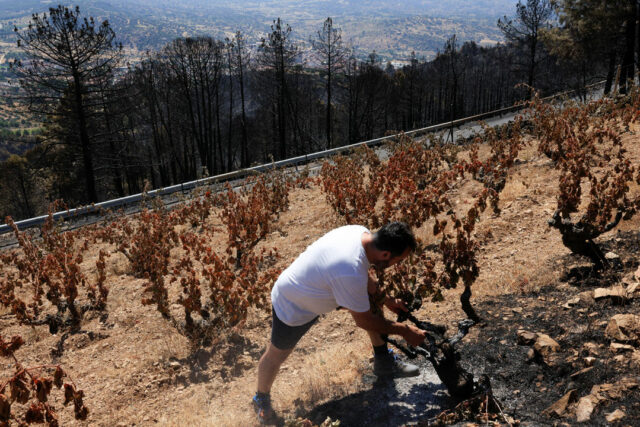
Jesus Soto checks his vineyard after it was partially scorched by a wildfire near Cebreros in the province of Avila, Spain, July 21, 2022. — REUTERS/BORJA SUAREZ

CEBREROS, Spain — When Spanish winemaker Jesus Soto returned to his land for the first time since a wildfire swept through the area, the sight of his charred grapevines left him in tears and feeling as though he had “lost part of my soul,” he said last Thursday.

With one of his vineyards — co-owned by former Spanish and former Manchester City midfielder David Silva —  gutted by flames, the owner of the SotoManrique wine label estimates he will only manage half of his habitual production of 3,000 bottles of Alto de la Estrella this year.

Mr. Soto, with the help of his daughter Belen Soto Manrique, 24, has spent more than a decade buying up and revitalizing small, ancient vineyards near Cebreros, in the central province of Avila, whose altitude of 700-1100 meters gives the wines their character.

“A fire is always terrifying because it kills everything around it and the feeling is just awful. The feeling, the smoke, the smell … There’s a sense of total destruction,” he told Reuters.

He now must decide how to reinvigorate the vineyard — covering just over one of his 20 acres —  and recover its soil, and worries about the potential impact on the quality of the wines he can produce this year.

“Everything that happens during a year in nature ends up affecting the wine,” he said.

Firefighters continued battling wildfires in several Spanish regions on Thursday. The authorities said they were making progress but were struggling with some complex conditions. In Cebreros, their efforts were being hampered by shifting winds.

Scientists say heatwaves that have spread across Europe in the past week and caused wildfires around the region are stark evidence of climate change.

Mr. Soto, 52, said that the abandonment of Spain’s vast countryside by people moving towards its cities was a more pressing problem than climate change.

“We always remember about climate change when something happens, but right now here and in many parts of Spain the big problem is the neglect of the countryside,” Mr. Soto said.

Scientists say increasingly dense vegetation in the Mediterranean belt is proving more fuel for the fires, while charities including the World Wildlife Fund and BirdLife met the Spanish government on Thursday to call for a shift in focus from firefighting to prevention and forestry management.

So far this year 90,000 hectares have been burnt across the country, including 20,000 hectares in the past week’s heatwave — an area slightly bigger than New York City. Spain is already experiencing the worst year for wildfires in a decade. — Reuters

Increased QR Ph adoption to boost digital payments

THE BANGKO SENTRAL ng Pilipinas (BSP) expects the increasing adoption of the national Quick Response (QR) Code Standard or QR Ph Person-to-Merchant (P2M) payment facility to boost consumers’ access to safe and efficient digital transactions.

Latest data from the BSP showed that the QR Ph P2M facility can now be used in 473,000 merchant locations across the country as of April. This is almost double the 243,000 merchant locations in the previous month. 

“The use of QR Ph P2M is convenient and cost-effective since it does not require expensive point of sale or data capture terminals to facilitate digital payments for individuals and businesses,” BSP Deputy Governor Mamerto E. Tangonan said in a statement.

QR Ph, which runs through the InstaPay rail, has helped contribute to the country’s progress towards reaching the BSP’s financial inclusion goals.

In 2019, the central bank initially launched QR Ph for person-to-person or P2P payments, catering primarily to payments and remittances in the informal sector.

The P2M use case for QR Ph was launched in October 2021, enabling interoperable digital payments between customers and merchants even if they maintain accounts with different financial service providers. The BSP said in the future, this can also be used for paying bills.

Under the BSP Circular No. 1055, the central bank required all participating payment service providers to adopt QR Ph for interoperability.

As of April, there were 28 and 17 financial institutions participating in the QR Ph P2P and P2M facilities, respectively.

“The BSP shall continue to engage the payments industry and relevant stakeholders to ensure the quality and responsiveness of digital payment services in the new normal. We ultimately want Filipinos to reap the benefits of a stronger and more inclusive Philippine economy,” Mr. Tangonan said.

The BSP targets to have 50% of the volume and value of retail transactions in the country done online by 2023. It also wants 70% of Filipino adults to have accounts with financial institutions by the same year.

The share of digital payments in the total volume of retail transactions in the country rose to 30.3% in 2021 from 20.1% a year earlier, according to latest data from the BSP.

Meanwhile, the value of payments done online represented 44.1% of total retail transactions last year, higher than the 26.8% share in 2020.

Merchant payments, peer-to-peer remittances and business transactions of salaries and wages to employees, all of which are high frequency and low value, were the key contributors to the growth in electronic transactions. — K.B. Ta-asan

The mainstream moment for foldable smartphones is here

By Dr. TM Roh, Samsung President and Head of MX Business

I HAVE worked my entire career as an engineer, and I have seen many innovations at Samsung that have pushed the limits of what’s possible with smartphones. Our mission is, and always has been, to create technology that makes people’s lives better. Ten years ago, we set out to create a transformative technology by looking at the one thing all smartphones were synonymous with —  a flat rectangular display. We asked ourselves a simple question: How can we have it all –— a bigger screen and better portability? 

We saw an opportunity not only to design a new shape but also to create new experiences that had never been possible with a smartphone before. Overcoming many technological hurdles, we successfully introduced the first-ever foldable smartphone in 2019 and have changed the future of our industry ever since.

Last year, we saw almost 10 million foldable smartphones shipped worldwide. That’s an industry increase of more than 300% from 2020, and I predict this fast-paced growth will continue. We are reaching the moment where these foldable devices are becoming widespread and staking a bigger claim in the overall smartphone market.

More importantly, Samsung Galaxy foldables have changed the way we use mobile devices and helped enable better lifestyles for users worldwide.

AS LIFESTYLES EVOLVE, A NEW LEGACY UNFOLDS
The world is more connected than ever and is moving at a much faster pace. Work and play intermix, and the lines between the physical and digital world have blurred. Where we turn for work, entertainment, wellness and more has become a single place — our phone. As such, our users need a flexible device to keep up with their daily demands.

The Galaxy Fold and Galaxy Flip deliver on that mandate. Last year, 70% of Galaxy foldable users turned to the Flip to help them see the world from a different point of view. Flip users love owning a device built for self-expression, whether choosing bold color options for their device or taking pictures in a new way with Flex mode.

It’s a different experience with the Fold. Nearly one out of three Galaxy foldable users last year opted for this ultimate productivity device, which has empowered them to do more through hyper-connected, individual computing. Fold users love the multitasking capability of a screen that doubles in size, so they can be more efficient and get things done faster.

Both foldable users have enthusiastically embraced what we have created. Their response is our biggest motivation to push forward, and that’s why we are committed to this journey of seeking new possibilities for mobile innovation.

This year, we’ve made advancements in every detail and opened the new experiences enabled by these behavior-shifting devices. I am excited to see people to discover new ways to do more of the things they love with the new foldable.

Of course, this wouldn’t have been possible without the open collaboration and a shared desire with our partners to continuously bring new innovations to the mobile category. We are working with industry leaders including Google, Microsoft and other carrier partners to expand the experiences that are possible throughout the foldable ecosystem.

REDEFINING WHAT’S POSSIBLE FOR PEOPLE EVERYWHERE
Three years ago, Galaxy foldables could be summed up in a single word: radical. Very quickly, however, it became clear that this groundbreaking, flexible design fit perfectly into modern lifestyles. As a result, what was once a novelty three years ago, is now the preferred choice for millions.

At our upcoming Unpacked on August 10th, you’ll see that the impact of our innovation is not only about what technology can do. It’s about what you can do. We’ve once again taken our inspiration from the most important source — Galaxy users — to push the limits of what’ possible.

I can’t wait to show you the potential of our new Samsung Galaxy foldables as the ultimate tool for both productivity and self-expression. Now, you can do more than you ever thought possible, all at once, on one device.

Get ready to unfold your world.

Solaire tops off second property

SOLAIRE Resort & Casino has topped off its second property located in Vertis North, Quezon City which will cater to the luxury integrated resort’s market in the northern and eastern parts of Metro Manila.

Solaire Resort North had its topping-off event on July 25, making it the latest addition to the Solaire brand of Bloomberry Resorts Corp.

“Solaire Resort North is Quezon City’s first 5-star destination built to promote the city’s tourism sector and local economy,” the company said in a press release on Wednesday.

Bloomberry’s flagship property, Solaire Resort & Casino, is in the government-sponsored economic development zone known as Entertainment City in Parañaque City.

The second property is expected to offer a hotel, gaming, restaurants and bars, meeting facilities, and retail spaces like the pioneer development.

The project is in partnership with DMCI Holdings, Inc., Prime Metro BMD Corp., Arcadis Philippines, Inc., Habitus Design Group, Sy2 and Associates, Inc., Casas and Architects, Inc., and Forsspac (MBR) Corp.

Bloomberry develops destination resorts featuring premium accommodations, gaming and entertainment, and world-class restaurants and other amenities. Its subsidiaries own and operate the Solaire Resort & Casino in the Philippines and Jeju Sun Hotel & Casino in Korea.

Solaire Resort & Casino is a $1.2-billion integrated destination resort on an 8.3-hectare site in Manila and the first to open in Entertainment City.

It currently operates two distinctive towers, the Bay Tower and the Sky Tower with 800 rooms, suites, and bayside villas and a two-level gaming space spanning 30,200 square meters in Entertainment City that accommodates 200 electronic table games.

On the stock market on Wednesday, Bloomberry shares ended lower by 12 centavos or 2.01% to P5.84 apiece. — Justine Irish D. Tabile

Dining In/Out (07/28/22)

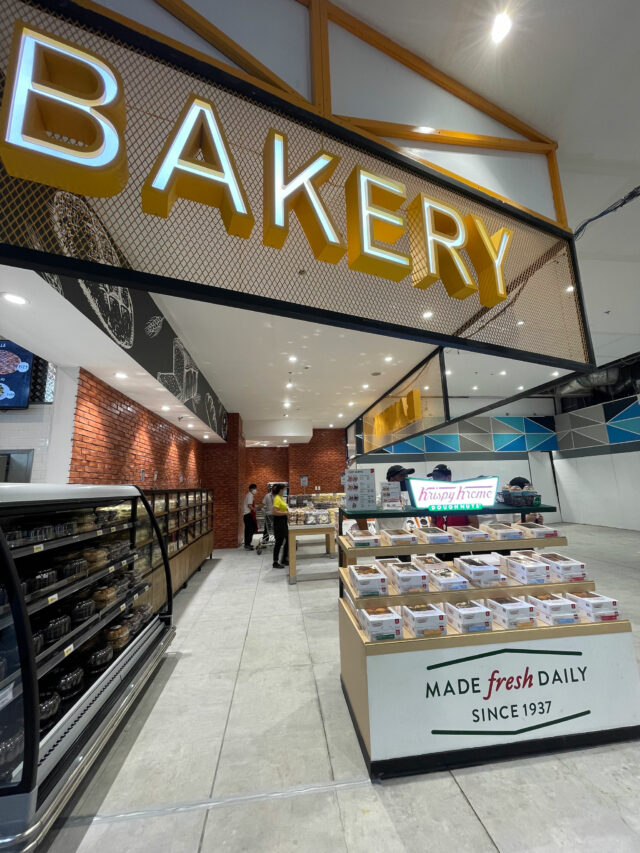
Krispy Kreme turns 85

TO MAKE the celebration of Krispy Kreme’s 85 years special, they’ve made shopping for doughnuts easier through Delivered Fresh Daily. Shoppers can now get pre-assorted boxes of doughnuts while shopping for grocery essentials inside 27 supermarkets and grocery stores. Also offered is a special Box of Six window packaging. Prices are the same as in Krispy Kreme stores. Delivered Fresh Daily (DFD) is a key global Krispy Kreme initiative, offered to select retailers, providing the market more convenience and accessibility to their doughnuts through supermarkets. While the first DFD shop in the Philippines opened at Shopwise Antipolo last December, it has now expanded to 27 doors in various Shopwise, Robinsons Place, Robinsons Supermarket and The Marketplace groceries.  DFD can be found at Shopwise Antipolo, Makati, and Circuit; The Marketplace Makati, Powerplant Mall, Greenbelt, Shangri-La, Tomas Morato, San Antonio, Katipunan, Santolan, and Baguio; Robinsons Supermarket Ermita, Lipa, Townville Nuvali, Meycauyan, Galleria South, Townville Regalado Fairview, Metro Town Tarlac, Angeles, Nepo Dagupan, Nepo Mall Angeles; Robinsons Place Dasma, Malolos, Antipolo, General Trias, and Galleria Ortigas.

McDonald’s offers Happy Meal Carnival Deal

MCDONALD’S Philippines now offers the Happy Meal Carnival Deal, a special Happy Meal promotion where children get an extra surprise toy with every Happy Meal purchase. With a variety of toys in the deal — from science-themed, fairy tales, and even dinosaurs — children can form their very own toy circus. The McDonald’s Happy Meal Carnival Deal can be available off while dining in-store, via drive-through, take-out, or through McDelivery. The special promotion is ongoing until Aug. 11.

BIMI to launch new investment product focused on REITs

BPI Investment Management, Inc. (BIMI) is looking to launch a new product that focuses on real estate investment trusts (REIT) by the middle of August.

BIMI, a wholly-owned subsidiary of Bank of the Philippine Islands (BPI), said the ALFM Real Estate Income Fund (ALFM REIF) is a peso-dominated equity mutual fund and is ideal for aggressive investors with an investment horizon of more than five years.

BIMI is the fund manager, principal distributor and transfer agent of ALFM mutual funds.

“The investment objective of the Fund is to provide a stable stream of dividends and generate long-term capital growth by investing predominantly in real estate investment trusts and real estate assets,” BIMI Investment Management Head Rico Gomez said in a press briefing on Wednesday.

The ALMF REIF is authorized to offer up to 100 billion units of participation to the public with an initial net asset value of P10 per unit.

For a minimum initial investment and maintaining balance of P5,000, the fund enables investors to invest in the country’s growing real estate sector and earn dividend income amid capital appreciation.

The fund allows clients to capitalize on rentals for residential homes, shopping malls, office spaces, and a portion from land spaces.

“For the exposure, we will be doing a mix of local and global with our friendly partners from BlackRock to at least diversify the portfolio and allow us to participate in the upticks of regional or even global property sectors as well,” Mr. Gomez said.

According to Mr. Gomez, the ALMF REIF will adopt an active strategy of balancing income and growth. It will invest in equity securities of various real estate types globally. It will also target to pay out income on a quarterly basis.

“Diversifying into real estate, both through REITs and real estate-linked securities, is a good hedge against inflation, especially with inflation driven by the current market conditions,” BIMI President Roberto Martin S. Enrile said. “Unfortunately, as we roll over to this year, with the inflation picture. The AUM (assets under management) growth isn’t quite the same as it had been throughout 2020-2021.”

“For this particular fund, we typically target about P500 (million) to P1 billion in AUM six to twelve months after launch But again, there are so many moving parts in the investing environment right now. We do expect rates to continue to go up. We do expect volatility in foreign exchange, which is principally why we’re offering a stable income fund at the moment. This is the principal driver and I think it’s a very timely product offering as well given all the uncertainties that the markets are facing,” Mr. Enrile added.

The global multi-asset fund invests at least 90% of its assets in the BlackRock Global Fund Multi-Asset Income Fund as the target fund, allowing local investors to tap global securities and other investments for at least $100, and $20 in incremental investments thereafter.

BIMI is one of the Philippines’ largest managers of mutual funds with P218 billion in AUM as of end-June, approximately 50% of the industry.

Its parent BPI’s net income rose by 59.6% to P8 billion in the first quarter, driven by higher interest earnings and lower loan loss provisions as asset quality improved.

The bank’s shares closed at P87 apiece on Wednesday, up by 50 centavos or 0.58%. — Keisha B. Ta-asan

Cryptoverse: What crisis? Venture capitalists bet big on crypto

IT’s not all doom and gloom.

Even as the crypto sector shivers in the bleak winter, venture capitalists (VCs) are pouring money into digital currency and blockchain startups at a pace that’s set to outstrip last year’s record.

In the first half of the year, VCs bet $17.5 billion on such firms, according to data from PitchBook. That puts investment on course to top the record $26.9 billion raised last year, a warmer and happier time for bitcoin and company.

“The current market conditions — I don’t think they faze investors,” said Roderik van der Graf, founder of Hong Kong investment firm Lemniscap, which focuses on crypto and blockchain. “The capital available is massive.”

VC funds offer financing to young companies they believe have strong growth prospects. The data suggest a solid faith in the future of crypto and blockchain tech, despite a bruising six months for the industry.

A double whammy of macroeconomic headwinds and blowups at major projects this year have seen bitcoin plummet about 65% from its November record of $69,000, with the overall value of the crypto market tumbling by two-thirds to $1 trillion.

Companies have shuddered as prices fall, with major US exchange Coinbase Global COIN.O and NFT platform OpenSea among those to lay off hundreds of workers.

Yet some VCs are shrugging off the gloom, with many deploying substantial war chests as their faith in the underlying tech behind crypto coins remains strong.

Though not all investors are so bullish in the face of the crypto carnage, not by any means.

David Siemer, CEO of California crypto management firm Wave Financial, said there were signs of a pullback from the sky-high valuations of crypto firms last year.

“This will get a lot worse — we’re a couple of months into this cycle. In the last cycle, the pain for those looking for funding was about 12 months.”

AMERICAN HOTSPOT
North America, long the hotspot for VC deals, has again been the focus of activity with about $11.4 billion in the six months to June, versus $15.6 billion for the whole of last year.

The numbers contrast with general VC activity in United States, where deals fell to $144.2 billion in the first half from $158.2 billion in the same period last year as macro conditions and market turmoil chill investment.

Rumi Morales, director of investments at Digital Currency Group, a major US crypto investor, said the data reflected increasingly robust faith in the crypto and blockchain sector.

“There used to be existential risk being in the space — that the whole industry was just going to go away, it was all a dream. That is not the case anymore.”

Adoption of crypto as an investment tool mushroomed last year, with the use of blockchain also gaining ground — even if the revolutionary changes from the technology promised to industries such as finance and commodities remain elusive.

Among the mega US crypto deals in 2022: $400 million raised by the US arm of crypto exchange FTX in January; a $450-million fund-raising round by blockchain developer ConsenSys in March; and $400 million raised by stablecoin issuer Circle a month later.

Activity is strong in Europe too, with $2.2 billion of VC investment in the first half of the year.

Lisbon-based Fedi, an app designed to help people receive, hold and spend bitcoin, said this month it had raised $4.2 million in seed financing.

“Within seven days, we had all of the investment commitments,” Obi Nwosu, one of its founders, told Reuters. “And within less than a month and a half, we had the initial fundraise target in the bank. Done.” — Reuters

Kia Philippines opens new Ortigas dealership 

KIA PHILIPPINES recently inaugurated a new dealership in Ortigas Ave. as part of the car manufacturer’s expansion efforts in the country this year.

The company said in a statement that Kia Ortigas, which was launched on July 15, augments its local dealership network in 41 locations. The new outlet is located in Celilu Compound, KM 17 Ortigas Ave. Ext., Cainta.

Kia Philippines said that the new location helps bring the company closer to the target of expanding its dealership network to 50 by the end of 2022.

“We aim to make Kia Ortigas a destination point for everything that Kia Philippines has to offer. We want to be here to take care of Kia customers. We want them to experience our brand of customer service: Delivered by the best people, with a passion to serve,” Kia Ortigas General Manager Louie Lee said.

Meanwhile, Kia Ortigas is currently offering a 10% discount on parts until Aug. 31, following its recent launch.

“We are grateful for the trust and confidence that the owners of Kia Ortigas have given us. We believe that they will be a significant player in the entire dealer network to make Kia among the major drivers in the local automotive industry,” Kia Philippines President Emmanuel A. Aligada said. — Revin Mikhael D. Ochave 

Sunland plans Red Hotel in Cebu

SUNLAND Development Corp. (SDC) is constructing a 200-room Red Hotel in Cebu as it banks on the city’s economic expansion.

“[Cebu’s] impressive economic growth has been carried by the rapid expansion of businesses in different industries which led SDC to its decision,” the company said in a press release on Wednesday.

The company said that the urban center of Metro Cebu is the largest metropolitan hub outside Metro Manila, making it the center and economic hub of the province of Cebu and the Central Visayas region.

The groundbreaking event happened on July 25, marking the construction of the new hotel located in Lot 2-3 Block 23 N. Escario St., Kamputhaw, Cebu City.

The project, the third Red Hotel in the country, will house 200 rooms, a pool, and a restaurant, which the company deems to be worthy of its four-star status.

“In the past, we have penetrated Metro Manila by building two Red Hotel branches in key destinations particularly, Cubao and Pasay. Now, we’re bringing 4-star hotel accommodation here in the Queen City of the South, to provide a one-of-a-kind hotel experience to all Cebuanos,” said Simon Tan, the group’s chief operating officer.

To date, Sunland has nearly 183,240 square meters of property space and roughly 3,822 rooms available in Luzon.

The company aims to build 2,000 more rooms within the next two years and to broaden its accommodation services to Coron, Davao, and Tagaytay within the next three years. — Justine Irish DP. Tabile