Home Blog Page 5612

TVIRD’s Balabag Project conferred with Presidential Mineral Industry Environment Award 
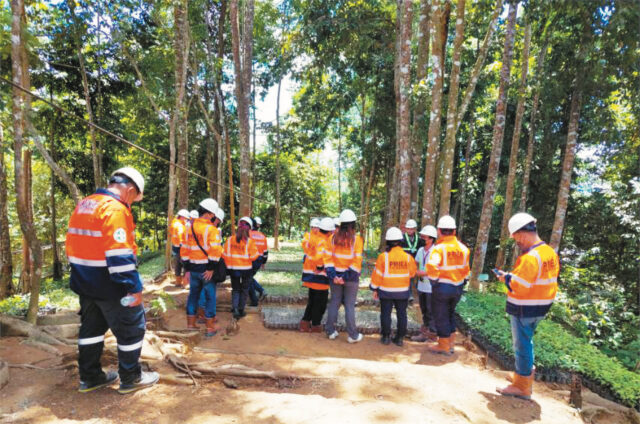
PMIEA Validators are joined by TVIRD field officers during the site inspection of Migligilian Tree Nursery where they witnessed the ongoing transformation of Bayog’s forest. To date, the Company has planted and grown 405 thousand trees, earning for itself the recognition of Best Mining Forest – Second Runner-Up.

Joins the ranks of TVIRD’s Platinum-awarded Canatuan Project and Presidential awardee, Agata Nickel Project

On its first full year of commercial operations, the Balabag Gold and Silver Project of TVI Resource Development Philippines Inc. (TVIRD) in Bayog Municipality, Zamboanga del Sur was recently honored with the Presidential Mineral Industry Environment Award (PMIEA) – the country’s highest accolade for excellence in environmental, social, and health and safety practices. 

Balabag follows the celebrated tradition of its sister projects under the TVIRD Group – the PMIEA Platinum-awarded Canatuan Gold-Silver / Copper-Zinc Project, and the Agata Nickel Project, which was thrice feted with the PMIEA Presidential Award as well as an ASEAN Mineral Award. 

In addition to its notable history, the Company draws confidence from lessons learned and Agata’s core philosophy of “Starting it Right, Keeping the End in Mind” – a set of future-oriented values that instill environmental responsibility way before mining operations even began. 

But it was not always smooth sailing for TVIRD in Balabag. And to say that the Company had to navigate through rough waters may be the greatest understatement yet. 

BAYOG: A CHECKERED PAST 

BIRD’S EYE VIEW. TVIRD’s field office and processing plant sit at the crest of Balabag Hill, which provides a good vantage point for monitoring its mining operations and progressive rehabilitation as well as a proper slope for directing effluents to its tailings impoundment and storage facility down below.

In September last year, Bayog’s mining stakeholders were jubilant that TVIRD finally commenced its mining operations in Sitio Balabag. The news also brought a smile to the late Timuay Casiano Edal – a member of the Subanen tribal council called Pigsalabukan Gokum de Bayog (PGB) and one of the signatories of the Memorandum of Agreement (MOA) signed by the tribe and TVIRD.  

“After many years of waiting, TVIRD is finally operational. I never thought I would still witness its mining operations,” said the chieftain who was among the many Subanens that welcomed the Company’s geologists who explored Balabag in the early days. 

In 2012 – prior to TVIRD’s entry – the provincial government of Zamboanga del Sur dismantled illegal mining operations that plundered the environment and contaminated the bodies of water in the area. A Cease-and-Desist Order was implemented by a multi-agency task force, led by the DENR’s Mines and Geosciences Bureau for this purpose. 

Under the MGB’s supervision, TVIRD embarked on a major clean-up activity to address the indiscriminate cutting of trees, un-engineered tunnels and earth-moving, and mine waste laced with mercury, cyanide, nitric acid, and other hazardous chemicals left by the illegal operators. 

Some TVIRD employees recall how they were forced into child labor under the illegal miners back then. It was for “livelihood,” they said, and like the others, it was their only way to earn a living.  

TVIRD Community Facilitator Marvin Edal, grandson of the late chieftain, cringes at his former life working in the tunnels: “We manually carried rocks out of tunnels and hammered on them to fit into the operator’s ballmill. They also cut down trees without permits and used the rivers and streams as their makeshift tailings ponds.” 

“But now with TVIRD, every tree is replaced several times over and employees are provided with hard hats, gloves, and protective equipment. The focus on environment and safety is the big difference – and I am grateful for this,” Edal said. 

PROTECTING INDIGENOUS CULTURAL COMMUNITIES 

“We firmly believe we can do more if we have the community’s participation,” said TVIRD President Yulo E. Perez on TVIRD’s vigorous IEC Campaigns that have encouraged locals to actively participate in the Company’s reforestation efforts – a shared responsibility for the conservation of Bayog’s natural environment.

The Subanens whom the illegal mining operators hired as laborers for their processing plants were not treated with dignity nor paid just wages. Instead, they were exploited in their own homelands.  

Prior to the Philippines’ enactment of the Indigenous People’s Rights Act (IPRA Law) in 1997, TVIRD signed a MOA with the indigenous Subanons for its maiden project in Canatuan, town of Siocon, Zamboanga del Norte.  

Also prior to operating in Balabag, TVIRD signed an MOA with its host Subanen tribe in 2015, securing a “social license” to operate in the area. The Company likewise received social licenses to operate via signed resolutions from Bayog’s twenty-eight (28) barangays, its Municipal Government as well as the Provincial Government of Zamboanga del Sur.  

Today, under the leadership of Timuays Lucenio Manda and Tony Edal who succeeded his father, the collective tribe receives royalties from TVIRD’s mining operations and are now able to invest in their future. And with the implementation of the Community Royalty Development Program – a common development roadmap for the Company and the indigenous Subanens – they are able to chart their own path to self-determination.  

TVIRD’s security personnel, aside from being trained on the Voluntary Principles on Human Rights and detailed by the Armed Forces of the Philippines, have also assisted TVIRD’s host communities as they likewise come from those communities – and some being indigenous people themselves. 

RESPONSIBILITY AND COEXISTENCE 

Marvin Edal, grandson of the late Subanen Chieftain Casiano Edal, inspects Abaca fiber that is hung out to dry. Potentially, the tribe’s abaca livelihood can make them part of an industry that earns over Php4.7 billion for the country.

During its period of care and maintenance, and eventual project development, TVIRD contributed significantly to various livelihood projects in the Bayog Municipality and its surrounding communities. The people of Bayog were finally on the path to a meaningful and sustainable development after decades of unwanted illegal mining.  

The Municipal Government likewise anticipates increased economic activity that will uplift the town, hopefully to a first-class municipality as TVIRD’s Canatuan model has proven. 

During its years of conducting exploration and pre-development activities in Bayog – and its established track record of safe and responsible mining in Canatuan – TVIRD has demonstrated a genuine commitment that goes beyond business alone. The immediate community and the townspeople are a living testament to this.  

BEYOND COMPLIANCE, BEYOND BUSINESS 

Eco-tourism is made a reality through the Company’s thematic landscaping within its MPSA.

Since bringing its operations on-stream in 2021, TVIRD has successfully completed thirty (30) shipments of gold and silver dore to refineries in Australia, Hong Kong, and Zurich, Switzerland. It has also ramped-up its operations, and the delivery of direct benefits to its host and nearby communities. 

Also, since then, TVIRD adhered to all applicable laws and regulations as evidenced by its outstanding Tenement, Health and Safety, Environment, and Social Performance in the past fiscal year. Aside from having no Notices of Violation, it likewise has Zero Fatal Accidents and garnered the top spot as the Safest Mine under PMIEA’s Surface Mining Operations category. The Company’s responders also train with the Philippine National Red Cross and the Bureau of Fire Protection with whom they team up in emergency situations. 

Its associates, Rachel Pingkian and Edwin Loreno were respectively named Best Mine Safety Supervisor, and Best Safety Inspector for their commitment to their chosen profession. 

In terms of reforestation, the Company has thus far planted and grown 405,822 trees in over 346 hectares, earning for itself the recognition of Best Mining Forest – Second Runner-Up. Its aggressive Plant Plant Plant Greening Program promotes biodiversity complemented by the creation of SIDLAK (Sustainable Integrated Diversified Livelihood Agricultural Knowledge) – the only farm school run by a mining Company in the Zamboanga Peninsula. 

In close collaboration with the Agricultural Training Institute (ATI), the Technical Education and Skills Development Authority (TESDA), and the Department of Agriculture, the Company’s SIDLAK Demo Farm School teaches locals the proper methods for gardening, tree planting, raising livestock, managing their farms and marketing their products.  

To date, its thematic landscaping program has introduced the eco-tourism concept to its beneficiaries – an alternative source of income that will eventually go beyond the life of the mine.  

The Company’s mining operations created vast opportunities for all its stakeholders. Despite operating for barely a year, its programs have already laid the groundwork for leaving a meaningful legacy. 

At the height of the pandemic, the TVIRD Group played an active role in helping those who were affected by Covid-19 and provided PPEs and food packs to individuals whose livelihood were curtailed. The group also sourced rice and vegetables from community organic farms that it helped create through its partnership with TESDA. 

In times of natural calamities, the TVIRD Group has been a first responder and extended its assistance to those who are affected in the Zamboanga Peninsula and Caraga Regions during recent typhoons 

And every time the community needs help, TVIRD’s synergistic response – through Balabag, Agata, Greenstone, and the help of VillarSIPAG Foundation – the TVIRD Group is now able to roll-out an even more integrated response with even wider coverage. All for the benefit of the communities it serves. 

TEN YEARS HENCE 
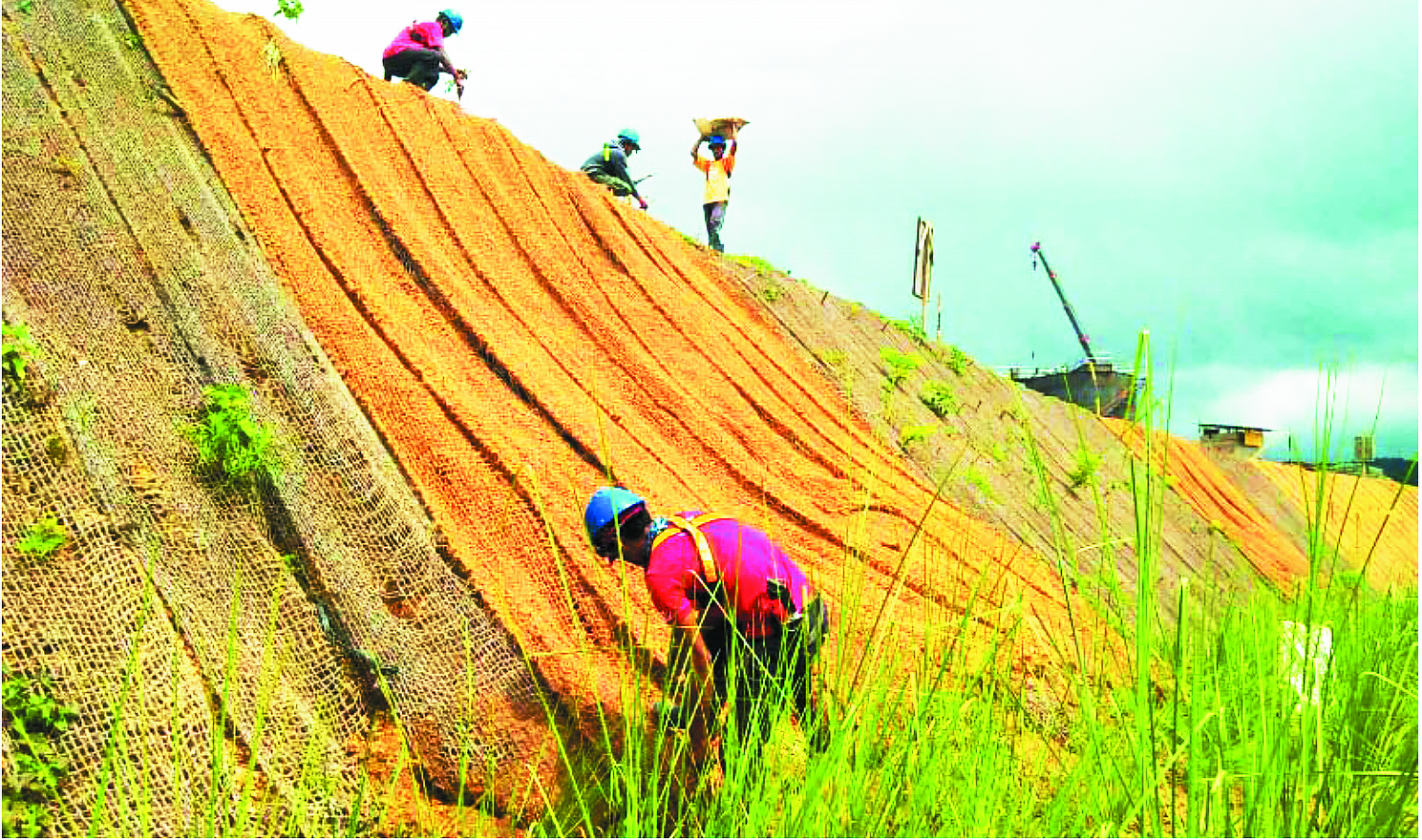
PROPER BENCHING. TVIRD employees place coconut mats and planted grass to protect and stabilize the slopes and prevent soil erosion. The slopes are also “benched” to add more stability.

A decade after the dismantling of illegal mining operations in Bayog, the town’s natural environment has grown into lush, forested areas that thrive around TVIRD’s gold and silver operations. The town itself has experienced a rebirth: new roads, a four-story school building, community stores and livelihood programs as well as a bustling downstream economy. 

“We operate under business ethics that never compromise the safety and health of our employees, communities and the environment,” said TVIRD President Yulo E. Perez. “We are opening our doors for everyone to see what we’re doing so our stakeholders are informed. Because we firmly believe we can do more if we have the community’s participation.”  

“We likewise keep an eye on the future. The overall plan is geared towards life after mining and that the Subanen farmers can still grow and produce farm products in their mined-out ancestral lands long after TVIRD has concluded its project,” according to the executive. 

From a social perspective, TVIRD is confident that its chosen roadmap for the future is the right one. Its social programs have been crafted in consultation with its beneficiaries to help both parties navigate the future together.  

From an environmental perspective, mining is not forever. That is why programs were put in place – with the end in mind. The future success of TVIRD’s programs is a testament that there is life after mining. 


Spotlight is BusinessWorld’s sponsored section that allows advertisers to amplify their brand and connect with BusinessWorld’s audience by enabling them to publish their stories directly on the BusinessWorld Web site. For more information, send an email to online@bworldonline.com.

Join us on Viber to get more updates from BusinessWorld: https://bit.ly/3hv6bLA.

Banking, tech experts and leaders form Blockchain Council of the Philippines

To further promote blockchain technology in the country, leaders from the industries of finance, marketing, and technology have formed the Blockchain Council of the Philippines.

Philippine Blockchain Week (PBW) lead convenor, Dr. Donald Lim, announced the formation of the council during a recent press conference held at the Manila Marriott Hotel in Pasay City.

The prestigious roster of council members include Lito Villanueva, executive vice president of RCBC and chairman of FinTech Alliance; Ida Tiongson, chairperson and independent director of PruLife UK and a trustee of Fintech Alliance; and tech lawyer Mark Gorriceta, managing partner and head of the technology media and telecommunications group of Gorriceta, Africa, Cauton, and Saavedra Law. They were also among the panelists of the presscon, whose discussion delved into the advantages of blockchain technology.

Henry Aguda, Chairman of the Board, UBX; Martha Sazon, president and chief executive officer (CEO), GCash; Chezka Gonzales, founder, Woman of Substance NFT; Sheree Gotuaco, CEO, Scarletbox.io; Kate Hancock, founder, Metaverse XYZ; Brian Poe Llamanzares, founder, Artifact; Gail Macapagal, country director, Dynaquest; Emman Navalan, CEO, Tetrix; Emmanuel Samson, founder and CEO, Impero Group; Paul Soliman, chairman and CEO, Bayanichain; Oscar Tan-Abing, Jr., CEO, Anotoys Collectiverse; and Dr. Lim, COO, DITO CME make up the rest of the council.

Dr. Lim said the council was formed to advocate blockchain education in the country and to help close the knowledge gap as Filipinos transition from Web2 to Web3. The council, he said, will actively pursue private sector and government cooperation to achieve the goal of making the Philippines the blockchain capital of Asia.

Blockchain is More Than Cryptocurrency

According to Villanueva, the objective of PBW is to help Juan Dela Cruz understand what blockchain is all about. He shared that the country is fortunate to have the most progressive and dynamic regulators.

“We thank the Bangko Sentral ng Pilipinas (BSP) and the Securities and Exchange Commission (SEC) for having an open mind in so far as welcoming innovations,” he said and emphasized that the end-goal of PBW is to provide Filipinos and the global community with an inclusive financial framework.

Gorriceta added that PBW will show the different uses of blockchain and address the negative news it has been receiving lately.

“Blockchain is the underlying technology of Bitcoin, Etherum, and the like. Basically, blockchain promotes decentralized finance. The purpose of PBW is to showcase the features of blockchain beyond Bitcoin and how the Blockchain Council of the Philippines will be able to promote, let’s say, how we can use this technology and how we can further enhance the Philippine economic agenda of our Central Bank,” he said.

Tiongson noted that while people often associate blockchain only with cryptocurrency, the technology can provide more to support industries and protect the integrity of data online.

“Blockchain is a technology,” she emphasized, and can be used in different ways. “You can also use it for digital asset offering as with NFTs, supply chain, payment system, medical tracing, and gaming,” she said.

Daniel Robbins, CEO of California-based IBH Media and co-founder of Metaverse Collective, called blockchain “the number one global impact on our economy that we’ve ever seen in our lifetime.”

“It’s great to understand the technology, but the next thing is (to learn) how you can implement that,” he said.

NFTs, the Metaverse, and More

With the press conference aimed at giving the attendees a glimpse of the upcoming week-long blockchain event, the second panel members were composed of three experts in the fields of NFT, AI, and the Metaverse. They are Gotuaco, Soliman and Hancock.

Blockchain and its relation to NFTs, Gaming, AI and the Metaverse will also be discussed during PBW. An NFT exhibition and gaming expo will likewise take place.

Dr. Lim also announced the launch of the Philippine Block Awards, one of the highlights of PBW that seeks to honor the people behind the blockchain ecosystem in the country.

Tickets to PBW are now available at www.philblockchainweek.com.


Spotlight is BusinessWorld’s sponsored section that allows advertisers to amplify their brand and connect with BusinessWorld’s audience by enabling them to publish their stories directly on the BusinessWorld Web site. For more information, send an email to online@bworldonline.com.

Join us on Viber to get more updates from BusinessWorld: https://bit.ly/3hv6bLA.

October balance of payments at $711M surplus

GIORGIO TROVATO-UNSPLASH

The Philippines’ overall balance of payments (BoP) position was a surplus of $711 million in October, lower than the $1.1 billion surplus recorded in the same month last year, the central bank said on Friday.

The BoP surplus for October reduced the cumulative BOP deficit in January-October to $7.1 billion from a deficit of $7.8 billion in the first three quarters of the year, it said in a statement. — Reuters


JLL celebrates 25 years in the Philippines

JLL Philippines’ business line leaders are seasoned experts in real estate advisory, capital markets transactions, office leasing, sustainability, property asset management, research and strategic consulting, facilities management, and development services.

The real estate firm’s anniversary heralds a brighter way in real estate as JLL unveils its new branding

As JLL celebrates its 25th year in the Philippines, the firm promises to see forward for clients, people, and communities. By combining innovative technology with world-renowned expertise, JLL is unveiling opportunities that create a brighter future for all.

JLL Philippines’ service offerings include:

    • Office Leasing Advisory (Tenant and Landlord Representation)
    • Capital Markets
    • Logistics and Industrial
    • Research and Strategic Consulting
    • Property and Asset Management
    • Energy and Sustainability Services
    • Project and Development Services
    • Work Dynamics

Leading real estate through the years

In the Philippines, JLL has been operating since 1997 and currently manages about 9.4 million square meters of real estate with a workforce of over 1,400 employees.

  •  Real Capital Analytics (RCA) — JLL Philippines is named the number one investment advisor, providing consulting services to investment deals worth $139.6 million, achieving approximately 48% of the market share
  • Royal Institution of Chartered Surveyors (RICS) Awards — JLL wins Property & Asset Management Team of the year (2021 and 2022)
  • International Organization for Standardization (ISO) — JLL’s Integrated Facilities Management business is ISO 41001:2018-certified
  • Ethisphere — World’s Most Ethical Companies (2008-2022)
  • WELL pre-certified — JLL Philippines gets international nod for employee wellness-centered office

With more than two decades of local expertise working hand-in-hand with its global legacy, JLL offers to the Philippine real estate market an unparalleled synergy of services with a process-oriented approach.

See a brighter way

There’s the conventional way of doing things. And then, there’s the JLL way — a more innovative, intelligent, and human way. For the firm’s 25th year, JLL intends to translate this vision across the brand.

See a brighter way: JLL unveils new branding.

“JLL takes pride in doing things differently. We see the built environment as a powerful medium with which to change the world for the better. By combining innovative technology and data intelligence with our world-renowned expertise, we’re able to unveil untapped opportunities for success,” says Joey Radovan, Country Head of JLL Philippines.


Spotlight is BusinessWorld’s sponsored section that allows advertisers to amplify their brand and connect with BusinessWorld’s audience by enabling them to publish their stories directly on the BusinessWorld Web site. For more information, send an email to online@bworldonline.com.

Join us on Viber to get more updates from BusinessWorld: https://bit.ly/3hv6bLA.

After Elon Musk’s ultimatum, Twitter employees start exiting

ELON MUSK — REUTERS

Hundreds of Twitter employees are estimated to be leaving the beleaguered social media company following an ultimatum from new owner Elon Musk that staffers sign up for “long hours at high intensity,” or leave.

In a poll on the workplace app Blind, which verifies employees through their work email addresses and allows them to share information anonymously, 42% of 180 people chose the answer for “Taking exit option, I’m free!”

A quarter said they had chosen to stay “reluctantly,” and only 7% of the poll participants said they “clicked yes to stay, I’m hardcore.”

Musk was meeting some top employees to try and convince them to stay, said one current employee and a recently departed employee who is in touch with Twitter colleagues.

While it is unclear how many employees have chosen to stay, the numbers highlight the reluctance of some staffers to remain at a company where Musk has hastened to fire half its employees including top management, and is ruthlessly changing the culture to emphasize long hours and an intense pace.

The company notified employees that it will close its offices and cut badge access until Monday, according to two sources. Security officers have begun kicking employees out of
the office on Thursday evening, one source said.

Musk took to Twitter late on Thursday and said that he was not worried about resignations as “the best people are staying.”

The billionaire owner amid the flood of resignations also added that Twitter has hit all time high in usage.

“And we just hit another all time high in Twitter usage…,” he said in a tweet, without elaborating.

Twitter, which has lost many of its communication team members, did not respond to a request for comment.

PLATFORM STABILITY

The departures include many engineers responsible for fixing bugs and preventing service outages, raising questions about the stability of the platform amid the loss of employees.

On Thursday evening, the version of the Twitter app used by employees began slowing down, according to one source familiar
with the matter, who estimated that the public version of Twitter was at risk of breaking during the night.

“If it does break, there is no one left to fix things in many areas,” the person said, who declined to be named for fear of retribution.

Reports of Twitter outages rose sharply from less than 50 to about 350 reports on Thursday evening, according to website Downdetector, which tracks website and app outages.

In a private chat on Signal with about 50 Twitter staffers, nearly 40 said they had decided to leave, according to the former employee.

And in a private Slack group for Twitter’s current and former employees, about 360 people joined a new channel titled
“voluntary-layoff,” said a person with knowledge of the Slack group.

A separate poll on Blind asked staffers to estimate what percentage of people would leave Twitter based on their perception. More than half of respondents estimated at least 50% of employees would leave.

Blue hearts and salute emojis flooded Twitter and its internal chatrooms on Thursday, the second time in two weeks as Twitter employees said their goodbyes.

By 6 p.m. Eastern, over two dozen Twitter employees across the United States and Europe had announced their departures in public Twitter posts reviewed by Reuters, though each resignation could not be independently verified.

Early on Wednesday, Musk had emailed Twitter employees, saying: “Going forward, to build a breakthrough Twitter 2.0 and
succeed in an increasingly competitive world, we will need to be extremely hardcore.”

The email asked staff to click “yes” if they wanted to stick around. Those who did not respond by 5 p.m. Eastern time on Thursday would be considered to have quit and given a severance package, the email said.

As the deadline approached, employees scrambled to figure out what to do.

One team within Twitter decided to take the leap together and leave the company, one employee who is leaving told Reuters.

Notable departures included Tess Rinearson, who was tasked with building a cryptocurrency team at Twitter. Ms. Rinearson tweeted the blue heart and salute emojis.

In an apparent jab at Musk’s call for employees to be “hardcore,” the Twitter profile bios of several departing engineers on Thursday described themselves as “softcore engineers” or “ex-hardcore engineers.”

As the resignations rolled in, Mr. Musk cracked a joke on Twitter.

“How do you make a small fortune in social media?” he tweeted. “Start out with a large one.” — Reuters

Zuckerberg says WhatsApp business chat will drive sales sooner than metaverse

STOCK PHOTO | Image by Webster2703 from Pixabay

Meta Platforms, Inc Chief. Executive Mark Zuckerberg told employees on Thursday that WhatsApp and Messenger would drive the company’s next wave of sales growth, as he sought to assuage concerns about Meta’s finances after its first mass layoffs.

Mr. Zuckerberg, addressing pointed questions at a company-wide meeting a week after Meta said it would lay off 11,000 workers, described the pair of messaging apps as being “very early in monetizing” compared to its advertising juggernauts Facebook and Instagram, according to remarks heard by Reuters.

“We talk a lot about the very long-term opportunities like the metaverse, but the reality is that business messaging is probably going to be the next major pillar of our business as we work to monetize WhatsApp and Messenger more,” he said.

Meta enables some consumers to speak and transact with merchants through the chat apps, including a new feature announced Thursday in Brazil.

The company did not immediately respond to a request for comment on Thursday’s internal forum.

Mr. Zuckerberg’s comments there reflect a shift in tone and emphasis after focusing heavily on extended reality hardware and software investments since announcing a long-term ambition to build out an immersive metaverse last year.

Investors have questioned the wisdom of that decision as Meta’s core advertising business has struggled this year, more than halving its stock price.

In his remarks to employees, Mr. Zuckerberg played down how much the company was spending in Reality Labs, the unit responsible for its metaverse investments.

People were Meta’s biggest expense, followed by capital expenditure, the vast majority of which went to infrastructure to support its suite of social media apps, he said. About 20% of Meta’s budget was going to Reality Labs.

Within Reality Labs, the unit was spending over half of its budget on augmented reality (AR), with smart glasses products continuing to emerge “over the next few years” and some “truly great” AR glasses later in the decade, Mr. Zuckerberg said.

“This is in some ways is the most challenging work … but I also think it’s the most valuable potential part of the work over time,” he said.

About 40% of Reality Labs’ budget went toward virtual reality, while about 10% was spent on futuristic social platforms such as the virtual world it calls Horizon.

Chief Technology Officer Andrew Bosworth, who runs Reality Labs, said AR glasses need to be more useful than mobile phones to appeal to potential customers and meet a higher bar for attractiveness.

Mr. Bosworth said he was wary of developing “industrial applications” for the devices, describing that as “niche,” and wanted to stay focused on building for a broad audience. — Reuters

APEC summit marred by suspected North Korea ICBM test, protest

​​BANGKOK — Asia-Pacific leaders gathered in Bangkok on Friday for a summit to focus on economic woes but their schedule was disrupted by a North Korean suspected intercontinental ballistic missile test while police fired rubber bullets to disperse protesters. 

US Vice President Kamala Harris convened a meeting of leaders from Australia, Japan, South Korea, Canada, and New Zealand on the sidelines of the Asia-Pacific Economic Cooperation (APEC) summit to discuss the missile launch. 

An official in charge of the security for the summit said police fired rubber bullets to disperse about 350 Thai anti-government protesters after a clash about 10 km (6 miles) from the summit venue in the capital, Bangkok.

APEC host Prime Minister Prayuth Chan-ocha of Thailand, earlier urged participants at the summit to seek sustainable growth and development after economic and social challenges from COVID, climate change and geopolitical rivalries. 

“We can no longer live like we did. We need to adjust our perspective, ways of life and ways of doing business,” he said to an audience that included Harris and China’s President Xi Jinping. 

Established to promote economic integration, APEC groups 21 economies that account for 38% of the global population, and 62% of gross domestic product and 48% of trade. 

Mr. Prayuth did not refer to North Korea’s missile, which Japanese officials said landed just 200 km (130 miles) off Japan and had sufficient range to reach the mainland of the United States. 

Japanese Prime Minister Fumio Kishida, who is in Bangkok for the APEC meeting, told reporters that North Korea had “repeated its provocations with unprecedented frequency.” 

The APEC gathering is the third summit in the region in the past week. A Southeast Asian summit that included China, Japan and the United States was held in Cambodia while the Group of 20 (G20) nations met on the Indonesian island of Bali. The earlier meetings were dominated by the war in Ukraine as well as tensions over Taiwan and the Korean peninsula. 

Campaigners are keen to see leaders address food insecurity, surging inflation, climate change and human rights. A reminder of such grassroot demands came as the anti-government protesters clashed with police after trying to overturn a police car plastered with posters of Messrs. Prayuth and Xi. 

Videos on social media showed protesters trying to overturn a police car, throwing projectiles and charging at police, while officers in riot gear advanced on them with shields and beat them back with batons. Police said they used rubber bullets to disperse the activists and arrested 10 people. 

‘DELIVER HOPE’ 

Thai Foreign Minister Don Pramudwinai said on Thursday the APEC meeting was taking place at a “pivotal juncture” with the world facing multiple risks. “That’s why APEC this year must rise above these challenges and deliver hope to the world at large,” he said in a statement.

Mr. Xi, warning against Cold War tensions in a region that is a focus for competition between Beijing and Washington, said on Thursday the Asia-Pacific was no one’s backyard and should not become an arena of big power rivalry, “No attempt to wage a new cold war will ever be allowed by the people or by our times,” Mr. Xi said in written remarks prepared for a business event linked to the summit. 

Relations between the world’s two largest economies have been strained in recent years over issues like tariffs, Taiwan, intellectual property, the removal of Hong Kong’s autonomy and disputes over the South China Sea, among others.

In a move that may be seen by Beijing as a provocation, a senior US official said Ms. Harris will visit the Philippine islands of Palawan on the edge of the disputed South China Sea on Tuesday. 

The trip will make Harris the highest-ranking US official to visit the island chain adjacent to the Spratly Islands. China has dredged the seafloor to build harbors and airstrips on the Spratlys, parts of which are also claimed by Brunei, Malaysia, the Philippines, Taiwan and Vietnam. 

At the G20 meeting, countries unanimously adopted a declaration saying most members condemned the Ukraine war, but that also acknowledged some countries saw the conflict differently. Russia is a member of both G20 and APEC but President Vladimir Putin has stayed away from the summits. 

First Deputy Prime Minister Andrei Belousov will represent him at APEC. Australian Prime Minister Anthony Albanese is among those also attending the main meeting, while French President Emmanuel Macron is a special guest. 

Mr. Xi held a rare summit with Japan’s Mr. Kishida in Bangkok, the first leadership-level meeting between China and Japan in nearly three years, after which Mr. Kishida said he conveyed concerns about peace in the Taiwan Strait. 

China’s CCTV reported that Mr. Xi told Mr. Kishida the Taiwan issue involved the political foundation of ties between their two countries, and territorial disputes should be properly managed. 

The meeting came a day after tensions simmered in Bali, where Mr. Xi criticized Canadian Prime Minister Justin Trudeau over alleged leaks of their closed-door meeting, a rare public display of annoyance by Mr. Xi. Mr. Trudeau is also in Bangkok. — Reuters


What if deglobalization is good for emerging markets?

TIRACHARDZ

Four trends are set to shape the world in the decades ahead: energy cost differentials, rising wages in China, nearshoring supply chains, and remote work. For emerging countries with the right natural resources and institutions, that means an opportunity to accelerate up the income ladder. Potential beneficiaries include Argentina, Colombia, and Mexico, as well as Malaysia and the Philippines.

Why these countries? They combine most of the ingredients of success: access to cheap energy, an abundant labor force, free trade with large parts of the global economy, and the ability to attract talent.

Conversely, Nigeria, Russia, and Sri Lanka are the worst-positioned among the 22 countries we scan. They would need to more deeply integrate into the global economy and improve their institutional frameworks to benefit from the shift in globalization.
Policy missteps can squander a country’s potential. Argentina’s strong ranking may not offset the disincentive to foreign workers and companies from tight capital controls. Colombia’s advantage is at risk if the recent political shift roils its trade agreements.

ENERGY SHOCK MAY DRIVE OFFSHORING
Access to low-cost raw materials plays a large role in determining the geographical distribution of industry. Typically, these relative prices remain stable, allowing businesses to specialize in certain countries. But every so often the global economy experiences drastic changes with the potential to drive significant relocation.

A historical example is Japan’s fertilizer business. The country exported 60% to 80% of its nitrogen fertilizers in the 1960s. But after the oil shock of the 1970s made export-oriented fertilizer manufacturing unfeasible, Japanese companies adapted by shifting production to emerging markets to capture their commodity cost advantage.

The current energy shock may drive a similar offshoring strategy in the years to come. In Europe in particular—where energy is set to stay expensive—there’s a strong incentive for companies to look elsewhere. The forward market for natural gas has prices three years from now staying five times higher than the level before Russia’s invasion of Ukraine.

One way to gauge how countries are affected by the energy shock is by the impact of the shift in relative commodity prices on their export and import prices. We use estimates of terms-of-trade changes, compiled by the International Monetary Fund. The data confirm that energy-exporting countries—Nigeria, Russia, and Saudi Arabia—have a natural advantage. But some countries that aren’t net energy exporters could still benefit from the offshoring trend. Energy-intensive industries in Germany, for instance, could move some of their production to a country where the impact of soaring energy costs is lower than at home.

Workers also matter. Demographic differences over time and across emerging markets have a significant effect on labor costs. China is a striking example. After years of boasting cheap labor as a key competitive advantage, the country now faces unfavorable demographics that are already leading to a significant rise in wages.

We gauge the outlook for labor costs by focusing on the share of the population at the prime working ages of 25 to 64 years old. Countries where this is expected to decline in the next 10 years are likely to face wage pressures as their labor force shrinks. That’s the case in China, Poland, Russia, and Thailand. Others still enjoying demographic dividends—India, Mexico, and Pakistan—are more likely to see a boost than a drag as labor cost differentials shift.

POLITICS OF NEARSHORING
Government and companies may sacrifice economic efficiency if it helps reduce their vulnerability to wars, sanctions, and supply chain disruptions. That has led administrations in advanced nations to increasingly support efforts to reshore, or at least nearshore, manufacturing. Countries that are part of large trading blocks, border major markets, and avoid trade conflicts are better nearshoring candidates.

Mexico, Peru, Poland, Turkey, and Vietnam stand out as emerging markets with the best potential access to external markets through trade agreements. The relative isolation of Nigeria, Russia, and South Africa makes it hard for them to engage in global production networks.

A final force at play is the potential for high-skilled migrants to drive emerging-market growth. Slowing growth in advanced economies and the work-from-anywhere reality could encourage workers to move to emerging markets, under the appropriate conditions. A “brain gain” would provide a welcome bump to productivity and enable the destination country to realize the benefits from input-cost advantage and the potential for nearshoring.

The Global Talent Competitiveness Index offers insight on countries’ ability to develop, attract, and retain workers. Chile, China, Poland, and Saudi Arabia stand out as most attractive to foreigners—though for China, COVID Zero has likely changed the picture. Nigeria, Pakistan, and Sri Lanka fare worse than their main emerging-market peers. — Bloomberg

BSP has to raise rates along with Fed to support peso — Medalla

REUTERS

The Philippine central bank will have to raise interest rates if the US Federal Reserve tightens policy further to support the peso and prevent the currency’s weakness from further stoking inflation, its governor said on Friday.

Bangko Sentral ng Pilipinas (BSP) has raised interest rates by 300 basis points this year to curb inflation, running near 14-year highs, and support the peso which has fallen sharply against the dollar, underpinned by aggressive US monetary tightening.

The Federal Reserve is expected to deliver a smaller rate hike in December, but economists polled by Reuters see a longer period of tightening and a higher policy rate peak as risks to the current outlook.

“If the Fed does 50, we cannot have zero right? So the question is whether it’s 25 or 50,” BSP Governor Felipe M. Medalla told Reuters in an interview in Manila.

“If you have a scenario (where) the Fed will not hike any more then I can tell you flat out, neither are we.”

BSP raised interest rates by 75 basis points on Thursday, largely to match the Fed’s three-quarter point hike this month, and is expected to hike again in December.

The Fed will likely raise rates by 50 basis points next month after four consecutive 75-bp increases, according to the Reuters poll.

Mr. Medalla reiterated the rate differentials between the United States and the Philippines should not be allowed to narrow sharply, lest the weakness in the peso would persist and push up already elevated prices of imported food and fuel.

BSP’s rate hike on Thursday brought the rate on its overnight reverse repurchase facility to 5.0%, the highest in nearly 14 years. That compares with the Fed’s policy rate of 3.75%-4%.

A shrinking rate gap has spurred an 11% decline in the peso against the dollar this year, putting the currency at the forefront of the BSP’s policy decisions. Mr. Medalla says the weak currency has become a price “shock generator.”

“If inflation is a huge problem, you don’t want the weakening of the peso to add to that further,” Mr. Medalla said.

The central bank wants to bring inflation, currently running at 7.7%, back to its 2%-4% target by the second half of next year, Mr. Medalla said.

Mr. Medalla said the economy, which grew by a faster-than-expected 7.6% in the third quarter, is strong enough to withstand the series of rate hikes, thanks largely to pent-up demand.

“The postponed spending on the capex side plus the pent up demand on (the) consumer side means we will have fairly strong demand despite the rate increases,” Mr. Medalla said.

Reuters

Capture the magic of Christmas with vivo V25 series

As soon as the sun sets and the sky darkens, houses and establishments come to life with glittering lights and dancing parols, all inviting a smartphone user to take a picture or a video of the magic of Christmas.

However, taking photos or videos in dark places remains a challenge, and what good are pictures and videos if your camera cannot give the Christmas decorations justice? Cue the vivo V25 series, the latest addition to vivo’s V smartphone lineup hailed for its night imaging capabilities. The vivo V25 series, nicknamed the Night Portrait Master, pushes the boundaries of night photography with its 64MP OIS ultra-sensing camera that has six times more light input than a regular phone camera. With this, users can take bright and high-quality photos at night, making it the perfect companion for documenting the magic of Christmas.

vivo shares its own list of tips on how you can maximize the vivo V25 series’s night imaging powers for a great and attention-stealing content this holiday season.

Shine with Christmas lights

Step under the majesty of a hundred twinkling Christmas lights and take a stunning portrait while they dance around you. During the holidays, there’s no backdrop more perfect than a waterfall of golden fairy lights.

And thanks to the vivo V25 series, one does not need to worry about pictures looking over- or underexposed with its Rear Super Night Portrait feature, which balances the light coming from one’s backdrop and the exposure needed for his or her face. Just switch on the Super Night Portrait mode and it’ll automatically adjust the camera’s brightness to produce a stunning and clear image with an excellent face and background quality.

Make the whole place shimmer and capture it on video

We are in the era of TikTok videos and IG reels. This means, pictures aren’t enough. Videos have to be added in the mix to give one’s content a little spice. But just as with capturing photos, taking videos in lowlight conditions often compromises video quality.

The vivo V25 Pro’s camera is equipped with a Super Night Video mode that is backed with a O+E stabilization system. This system helps keep your videos smooth and stable especially during exciting moments where lots of movements happen.

Whether you’re making a montage of the best Christmas spots you’ve been to or an attempt at the latest dance trend on TikTok with Christmas lights as your background, you can create smooth and noiseless videos that perfectly capture the charm of Christmas around you and your own shimmering moments.

Flex the magic of Christmas at home

For content creators, aesthetics is everything. But instead of going for a usual photo spot in a café or a park, why not add a more personal touch and flex the Christmas vibes in your home?

Turn off the light, let the garlands and your Christmas tree shine and get ready with the Super Night Mode on. This feature is powered by a raw HDR algorithm that when toggled on can capture authentic colors and deliver optimal brightness for a sharp and clear image.

With the Super Night Mode, your photos will come out in high contrast levels and no stray lights or glares so you can share clear and bright photos of your home’s Christmas decorations for all of your friends and followers to appreciate.

Take a selfie with the whole family

Nothing compares to being surrounded by the bright and smiling faces of the people that you love. The vivo V25 Series’ is equipped with up to 50MP Eye AF Selfie Camera where users can now take high-quality selfies even in dimly-lit rooms, all made possible by a technology that uses AI to improve face clarity, enhance details and the image’s overall quality. It also flexes an autofocus feature that keeps photos in focus especially when younger siblings keep moving around. Th feature also prevents blurred selfies when the focus adjusts. With this autofocus feature and its wide focus range, selfies can be taken with pristine clarity whether it’s taken close or far away.

Moreover, this smartphone takes its own magic tricks up its sleeve. The vivo V25 series boasts Photochromic 2.0 technology which uses a light molecular material that allows its back panel to change colors when exposed to sunlight or UV light. The vivo V25 Pro takes the hues of Starlight Black, sporting a million twinkling stars, and Surfing Blue that transforms from light blue sky to deep blue ocean shade.

On the other hand, the vivo V25 and vivo V25e variants shine in Sunrise Gold that shifts between golden, orange and reddish hues. These two variants under the vivo V25 series also come in Diamond Black that mimics the elegance and sparkles of black diamonds. The vivo V25 series is the only smartphone in the industry to feature this innovative color-changing technology.

Visit vivo stores and kiosks nationwide starting Nov. 15, 2022 to get a chance to win awesome and exciting freebies when you purchase the vivo V25 series.

To know more about the ongoing promotion, you may check this link: https://www.vivoglobal.ph/vivo-loca-promo-campaign/.

For more information, follow vivo’s social accounts on Facebook, Instagram, Twitter, and YouTube.


Spotlight is BusinessWorld’s sponsored section that allows advertisers to amplify their brand and connect with BusinessWorld’s audience by enabling them to publish their stories directly on the BusinessWorld Web site. For more information, send an email to online@bworldonline.com.

Join us on Viber to get more updates from BusinessWorld: https://bit.ly/3hv6bLA.

On the importance of property consultants

Few companies could have adequately prepared for the impact of the coronavirus pandemic. Fewer still could have done that on their own. The crisis that had stopped the world in its tracks had highlighted the fact that no business is an island. Industries and economies are built on collaboration and a shared vision of growth.

It is precisely this fact that underlines the significance of professional services and consultancy firms to any industry. No single executive, no matter how brilliant, can be expected to have the necessary expertise, experience, and knowledge to successfully navigate every challenge that may come their way.

Real estate is a prime example. Professional services firm McKinsey & Company found that the pandemic has led companies around the world to reassess their real estate — how much of it to have, how to use it, and how much to spend on it.

“Fortune 50 companies alone occupy 2.6 billion square feet of real estate, and some of it sat mostly empty for long stretches during the pandemic. At times in the prolonged work-from-home experiment, the media, employees, and even company leaders wondered whether large numbers of offices were necessary at all,” McKinsey wrote on its website.

“The right approach to real estate can help companies not only to grapple with the universal challenges arising in the pandemic’s wake but also to achieve their corporate goals. Marrying strategy to real estate requires a deep analysis of a company’s needs, as well as data to inform decisions. These decisions are best managed by top strategic thinkers guided by the CEO — a departure from the way companies have traditionally made real-estate choices.”

Consultants are not there to make those decisions themselves — that role falls solely on the chief executive. But what they do provide is the advice or research and analysis to help the CEO make well-informed decisions specifically targeted towards a company’s goals. Real estate consultants, in this example, can supply necessary information like the costs and benefits of each option available to the company, such as selling or leasing a property, or making investments in a particular area.

Adapting to the future of real estate

And while many companies had hoped property management to become easier after the pandemic, the reality is that many other challenges loom on the horizon.

In fact, the pandemic has only accelerated certain trends in the real estate industry, and it has shone a light on many of its underlying issues. According to Christian Ulbrich, chief executive of global real estate services firm Jones Lang LaSalle (JLL), “the convergence of multiple crises — public health, social, economic, and planetary — has served to drive home the urgency of our efforts to identify a few simple imperatives and create a set of signposts that could help the industry ‘build back better.’”

Mr. Ulbrich is also co-chair of the World Economic Forum’s (WEF) real estate industry community and one of the key contributors to ‘A Framework for the Future of Real Estate,’ produced by the WEF.

The framework shared a vision for the future of real estate: a future in which buildings provide us with comfort, are equipped for the most unprecedented of events, support our health and the planet, and are affordable and accessible for all.

As part of this vision, Mr. Ulbrich wrote that the future of real estate should be “liveable, creating suitable habitats for a rich, culturally vibrant existence.” He pointed out that in major cities around the world, people typically spend about 90% of the day indoors, making buildings instrumental in ensuring liveability through a combination of factors like a human-centric and inclusive design.

“Real estate should be sustainable, optimized for zero carbon output in every aspect from construction to operations. The environmental impact of real estate assets is highlighted by the fact that buildings account for 40% of global greenhouse gas emissions, 50% of the world’s energy consumption and 40% of raw materials. If we are to meet net zero carbon goals, we need to accelerate action; action that will require large-scale energy retrofits of older existing buildings and, crucially, the renovation or repurposing of buildings rather than demolition,” Mr. Ulbrich continued.

Part of this change should also lead to the improved resilience of real estate, so that it is capable of adapting to whatever exigencies might arise by mitigating the effects of unforeseen natural and man-made events, such as climate, financial and health crises, and preserve the cultural identity of communities.

Mr. Ulbrich said that properties need to withstand a variety of unpredictable shocks and to be flexible to adapt to changing patterns of working and living throughout their full life cycle.

“And real estate should be affordable, with housing, transportation and essential services available to all. The provision of fair access to quality space to live and do business is essential to the overall health of society. Affordability must comprise both financial access (affordable rents, low barriers to home ownership) and access to the appropriate standard of assets in terms of space, health, location and access to basic services,” Mr. Ulbrich concluded.

Real estate, alongside many other industries, is in a state of upheaval. Contemporary issues, particularly environmental, socioeconomic, and those concerned with health and safety, demand the transformation of this industry.

It is only a matter of time before governments all over the world enact policies and legislation that adhere to these demands. To ensure a long-term sustainable strategy for a company, one must be equipped with the know-how and expertise needed to deal with such changes in policy — expertise that consultancy firms can provide. — Bjorn Biel M. Beltran

PAXYS, Inc. to conduct annual meeting of stockholders on Dec. 13


Spotlight is BusinessWorld’s sponsored section that allows advertisers to amplify their brand and connect with BusinessWorld’s audience by enabling them to publish their stories directly on the BusinessWorld Web site. For more information, send an email to online@bworldonline.com.

Join us on Viber to get more updates from BusinessWorld: https://bit.ly/3hv6bLA.

ADVERTISEMENT
ADVERTISEMENT