Home Blog Page 5598

Lenders sustain momentum in Q3 — CreditSights

PHILIPPINE BANKS sustained their positive momentum in the third quarter as asset quality and loan growth stayed resilient despite macroeconomic challenges, CreditSights said on Monday.

CreditSights said in a report dated Nov. 18 that banks in the country have mostly built on the momentum they had during the first half in the third quarter.

“Net interest and fee incomes continued to provide good cushion for poor trading income, which continues to be down across the board due to rising rates, and sharply reduced credit costs kept profitability back at or near pre-pandemic levels,” it said.

The research firm said the central bank’s rate hikes in the third quarter have started feeding through first-tier banks’ net interest margins (NIMs) which supported their net interest income (NII).

However, second-tier banks did not experience the same uptick in NIM due to weaker deposit franchises. This prompted banks to pre-fund time deposits more aggressively amid current and savings account outflows as rates rise.

Philippine banks’ NII rose by 4% to 26% annually, driven by higher NIMs and high-single to mid-teen digits loan portfolio expansion, CreditSights said.

The exceptions were Rizal Commercial Banking Corp. (RCBC), which relied more on the growth of its securities portfolio, and Philippine National Bank (PNB), which recorded a flat NIM and modest loan growth, it said.

Meanwhile, the NII growth of UnionBank of the Philippines, Inc. (UBP) reflects the boost from the bank’s acquisition of Citigroup, Inc.’s Philippine consumer business, it added.   

“That said, NIMs are still likely to move higher in the coming quarters as the lag effect of the BSP’s (Bangko Sentral ng Pilipinas) hikes on loan yields come through. The banks have also been more active in growing their investment securities portfolios to take advantage of presently higher yields,” CreditSights said.

The BSP has hiked borrowing costs by 300 basis points (bps) since May as it seeks to get inflation under control.

Meanwhile, banks’ fee income remained steady, driven by the continued reopening of the economy, CreditSights said. Double-digit growth was recorded by all banks except for the Bank of the Philippine Islands (BPI) and PNB.   

Asset quality was also stable quarter on quarter, but CreditSights noted the higher nonperforming loan (NPL) ratio of Metropolitan Bank & Trust Co. (Metrobank) and that UnionBank did not disclose its own NPL ratio this quarter.

“Provisions were aided by write-backs in the first half particularly at the second-tier banks and thus came in much lower year-on-year at all the banks…”

Loan growth also decelerated from the previous quarter for first-tier banks, but was higher for second-tier lenders. Loan growth ranged between 3% and 6.5%, with the year-to-date expansion for banks that CreditSights covers at 5.5-8%.

“Policy tightening by the BSP has been aggressive and this is likely to damper growth momentum going forward,” the financial research firm said.

CreditSights said first-tier banks, namely BPI, BDO Unibank Inc. (BDO), and Metrobank, have stronger capital buffers and loss absorption, more benign asset quality, and larger business franchises compared to other banks.

“They benefit from a high exposure to large corporates which should be more resilient in a downturn, as well as their strong deposit franchises which temper the rise in deposit costs, allowing more uplift from the BSP’s rate hikes to their NIM,” it said.

“We acknowledge the headwinds facing the Philippines but see the risks as fairly captured in their current spreads, and thus retain our Market perform recommendation on BDO, BPI and MBT,” it added.

Meanwhile, the financial research firm said Security Bank Corp. and UnionBank lack size compared with the first-tier banks.

CreditSights also noted that UnionBank’s common equity tier 1 (CET1) ratio dropped to 11.9% in the third quarter as its acquisition of Citi’s consumer banking business officially closed in August.

Meanwhile, the research firm is considering to changed their “market perform” recommendation for RCBC after announcing that Sumitomo Mitsui Banking Corp. (SMBC) will hike its stake to 20% through a capital infusion.

“For RCBC, we view SMBC increasing its stake to 20% as a material credit positive as it provides an ~400 bp uplift to the CET1 ratio, and strengthens SMBC’s commitment to RCBC as the vehicle for its expansion into the Philippine market,” it said.   

“We see this level as somewhat wide but would look for signs of stabilization in its asset quality and credit costs before considering a change to our current Market perform recommendation on RCBC,” it added. — K.B. Ta-asan

ALI to open UV Express terminal in One Ayala

AYALA LAND, Inc. is set to open the next phase of its public terminal in One Ayala after opening its new bus terminal in partnership with the Department of Transportation.

“In the succeeding months we will be opening the UV Express terminal at the basement level of this facility,” Ayala Land’s Project Development Head for Makati Shiella G. Aguilar said in an interview.

Last Friday, the company opened the bus terminal of its transit-oriented development at the intersection of Ayala Ave. and EDSA.

The terminal will serve as the new bus stop for Ayala commuters and will cater to EDSA Bus Carousel, point-to-point buses, and southbound city buses. The UV Express terminal will be on the basement level of One Ayala and will have an air-conditioned passenger concourse open to the public.

The second level of the development will also have a big passenger concourse that will be directly connected to the Ayala station of the Manila Metro Rail Transit System (MRT).

“It’s like an atrium where people can actually go down to the different escalators in the different bus bays and there’s also a connection also at the second level to the MRT, it’s directly connected,” Ms. Aguilar said.

One Ayala is a mixed-use development that will have a terminal, two office towers, a hotel, and a commercial tower.

According to Ms. Aguilar, its first office tower is already operational and is home to a number of tenants. One Ayala’s six-storey retail component is expected to open by the third quarter of 2023, while the second tower is expected to top off by 2024. 

One Ayala will have a Seda hotel within the complex that is already under construction. It will be a flagship project for Seda as it will have 430 rooms and is set to open after the second office tower.

When asked how much was invested in the project, Ms. Aguilar said “the entire One Ayala project is P25 billion.” — Justine Irish D. Tabile

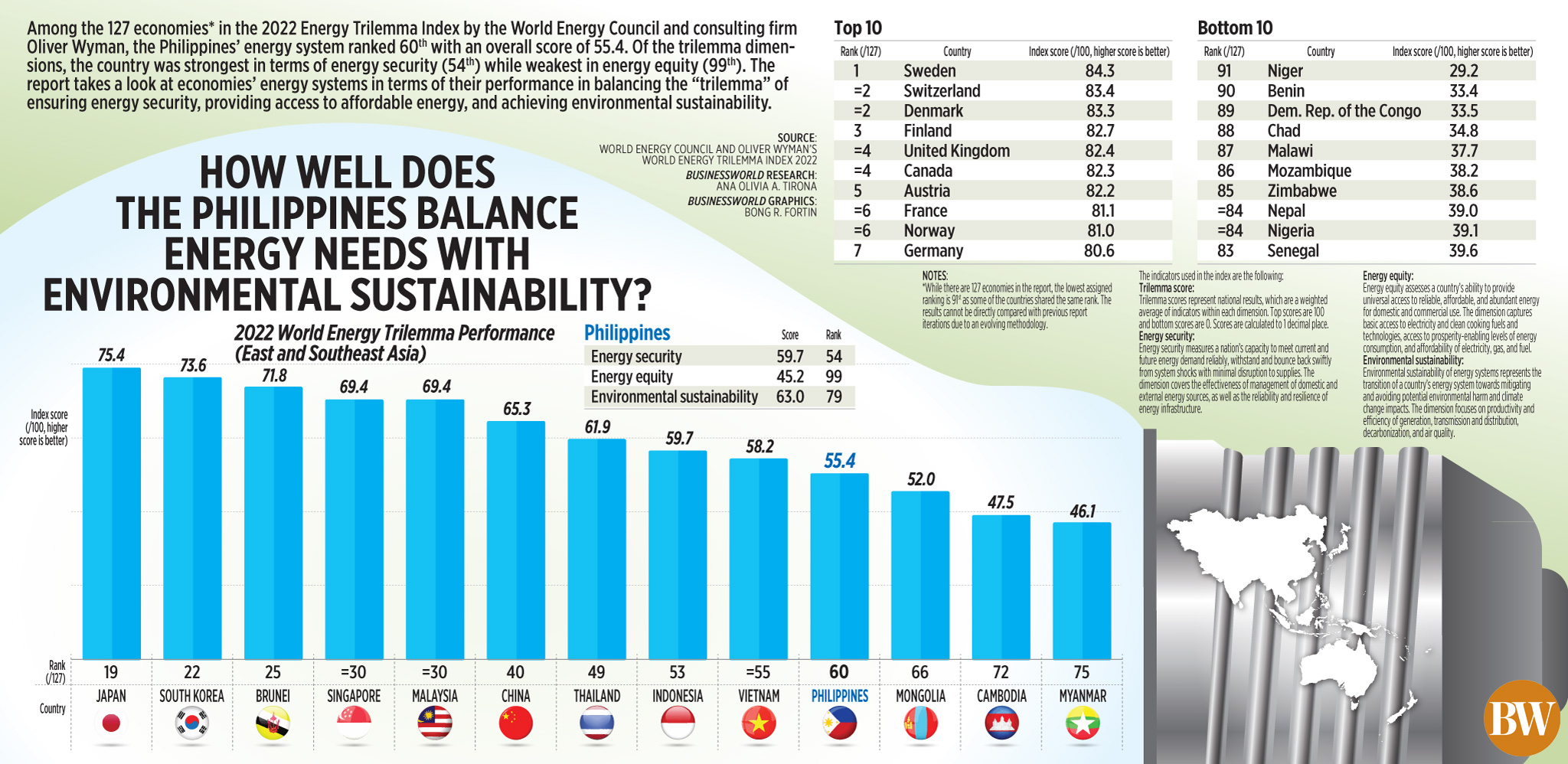
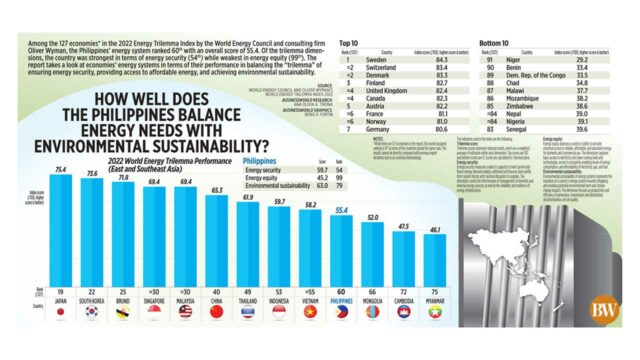
How well does the Philippines balance energy needs with environmental sustainability?

Among the 127 economies* in the 2022 Energy Trilemma Index by the World Energy Council and consulting firm Oliver Wyman, the Philippines’ energy system ranked 60th with an overall score of 55.4. Of the trilemma dimensions, the country was strongest in terms of energy security (54th) while weakest in energy equity (99th). The report takes a look at economies’ energy systems in terms of their performance in balancing the “trilemma” of ensuring energy security, providing access to affordable energy, and achieving environmental sustainability.

How well does the Philippines balance energy needs with environmental sustainability?

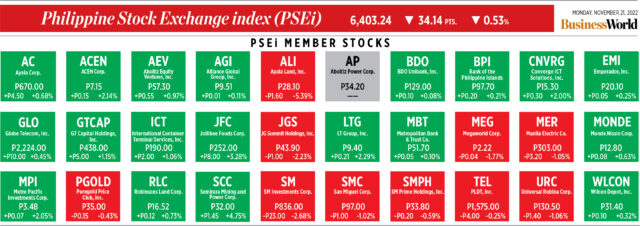
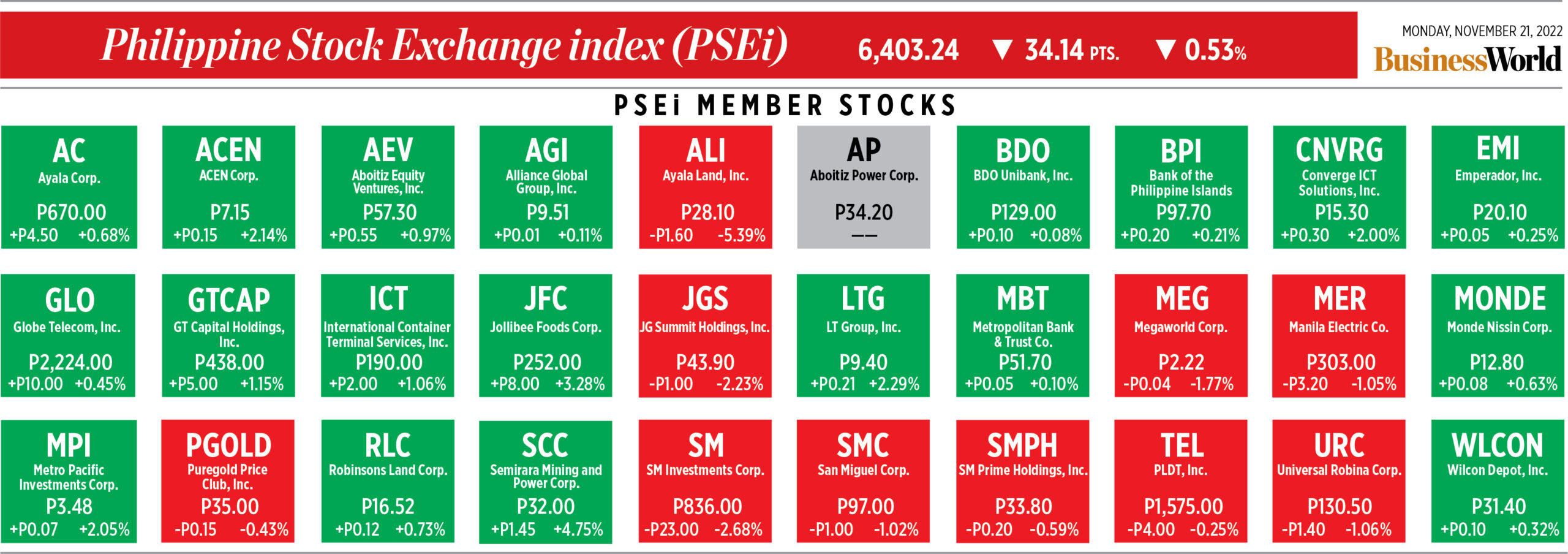
How PSEi member stocks performed — November 21, 2022

Here’s a quick glance at how PSEi stocks fared on Monday, November 21, 2022.


Peso declines on Fed worries

BW FILE PHOTO

THE PESO ended weaker against the dollar on Monday following hawkish signals from the US central bank, and as renewed coronavirus worries spurred safe-haven demand.

The local unit closed at P57.36 versus the dollar on Monday, down by 10 centavos from its P57.26 finish on Friday, data from the Bankers Association of the Philippines’ website showed.

The peso opened Monday’s session stronger than its Friday close at P57.20, which was also its intraday best. Its weakest point was at P57.37 versus the greenback.

Dollars exchanged went down to $527.82 million on Monday from $650.18 million on Friday.

The peso weakened on Monday as officials of the US Federal Reserve said they will likely continue hiking rates, Rizal Commercial Banking Corp. Chief Economist Michael L. Ricafort said in a Viber message.

Last week, Federal Reserve Bank of Boston President Susan M. Collins said the Fed may need to hike by another 75 basis points (bps) as it seeks to control inflation.

St. Louis Fed President James B. Bullard also said the Fed needs to keep on raising borrowing costs as its monetary tightening so far “had only limited effects on observed inflation.”

The US central bank has raised borrowing costs by 375 bps since March, with the latest move being a fourth straight 75-bp rate hike earlier this month, bringing the fed funds rate a 3.75-4% range.

Meanwhile, a trader attributed the peso’s depreciation to rising coronavirus disease 2019 (COVID-19) cases in China.

“The peso weakened from global growth concerns after China recorded new COVID-related deaths and surge in COVID cases over the weekend,” the trader said in an e-mail.

Reuters reported that students in schools across several Beijing districts buckled down for online classes on Monday after officials called for residents to stay home, as COVID-19 cases were higher in China.

China recorded 26,824 new local cases for Sunday, nearing the country’s daily pandemic peak in April. Two deaths were also reported in Beijing, up from one on Saturday, which was China’s first since late May.

For Tuesday, the trader said the peso may continue to weaken after China’s central bank flagged growth worries.

The trader said the peso could move from P57.25 to P57.50 on Tuesday, while Mr. Ricafort gave a forecast range of P57.20 to P57.40 per dollar. — KBT with Reuters

PHL shares decline as investors pocket profits

BW FILE PHOTO

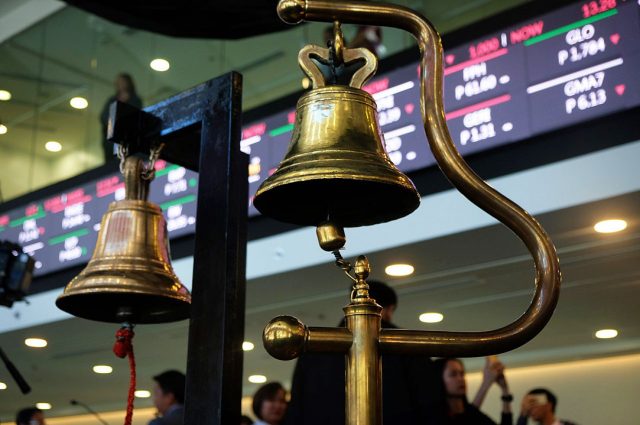
PHILIPPINE SHARES declined on Monday after investors booked profits from the market’s recent rally.

The Philippine Stock Exchange index (PSEi) went down by 34.14 points or 0.53% to end at 6,403.24, while the broader all shares index lost 10.67 points or 0.31% to 3,385.96.

AB Capital Securities, Inc. Vice-President Jovis L. Vistan said the PSEi went down on profit taking.

“After gaining by almost 13% for the past month and a half, the local equities market was ripe for profit taking. The earnings reporting season is over and attention now shifts to macroeconomic fundamentals,” Mr. Vistan said in a Viber message.

He said while US consumer inflation eased in October, which could lead to slower tightening by the US Federal Reserve, higher prices elsewhere weighed on sentiment. 

“Japan’s October inflation was the highest in four decades while Philippine inflation may not have peaked yet,” Mr. Vistan said.

Consumer prices in Japan excluding fresh food climbed by 3.6% in October, the fastest since 1982.

Meanwhile, Philippine consumer inflation accelerated to a near 14-year high of 7.7% in October from 6.9% in September and 4% in the same month in 2021. This is well above the Bangko Sentral ng Pilipinas’ (BSP) 2-4% target.

“The local bourse dropped … as investors took some profits, on the upside, the index still managed to stay above the 6,400 old resistance line,” Philstocks Financial, Inc. Research Analyst Claire T. Alviar in a Viber message. 

“Moreover, the BSP’s expectation that the Philippine economic growth may slow down in the next two years amid internal and external headwinds, and monetary tightening, weighed on the sentiment,” Mr. Alviar added.

The BSP last week delivered a 75-basis-point (bp) hike to match the Fed as it seeks to rein in rising inflation and support the currency. It has now raised borrowing costs by 300 bps since May.

The majority of sectoral indices ended higher on Monday except for property, which declined by 60.80 points or 2.13% to close at 2,785.09; and holding firms, which went down by 54.49 points or 0.89% to 6,047.32. 

Meanwhile, industrials gained 59.05 points or 0.62% to end at 9,543.82; services went up by 9.20 points or 0.55% to 1,667.56; financials rose by 2.74 points or 0.16% to 1,619.87; and mining and oil climbed by 10.85 points or 0.11% to 9,856.08.

Value turnover rose to P6.24 billion on Monday with 776.16 million shares changing hands from the P5.33 billion with 570.39 million shares issued on Friday.

Decliners outnumbered advancers, 97 versus 87, while 40 names closed unchanged.

Net foreign buying declined to P170.07 million on Monday from the P652.19 million seen on Friday.

AB Capital Securities’ Mr. Vistan placed the PSEi’s support at 6,150 and resistance at 6,450. — A.E.O. Jose

Shipping dev’t plan to highlight increase in yard, repair capacity

PHILSTAR FILE PHOTO

THE 10-year plan for the shipping industry will be anchored on an increase in shipbuilding and repair yard capacity, the Department of Transportation (DoTr) said on Monday.

The department said in a statement that Undersecretary for Planning and Project Development Timothy John R. Batan met with officials of the Maritime Industry Authority (Marina) on Nov. 18 to discuss the 10-year Maritime Development Plan.

The plan also calls for technology upgrades for the shipping industry, the development and expansion of shipping and maritime tourism routes, the improvement of maritime education and training, and upgrades to safety, security, and environmental protection practices.

“Updates are currently being undertaken by the Marina to align with the eight-point priority economic agenda of the Marcos administration,” the DoTr said.

The 10-year plan is expected to be fully implemented in 2028, with a goal of elevating the industry’s contribution to gross domestic product to P1.44 trillion from P720 billion.

On Nov. 13, Marina announced that it signed a memorandum of agreement with France to strengthen the shipping industry.

The deal focuses on maritime safety, security and shipbuilding and ship repair, Marina said in a statement.

Under the agreement, the French government will deploy a maritime expert to the Philippines to provide technical assistance, training, and consultancy services.

The Philippines is the fifth-largest shipbuilding nation in the world, according to 2020 estimates.

“Philippine registered vessels stand at about 29,974, comprising 4,114 large merchant vessels and 25,860 motor bancas/boats and fishing bancas/boats. Of the merchant fleet, passenger ships number 11,898. Excluding the pandemic years, over 72 million passengers per year were carried by sea vessels,” Marina said. — Arjay L. Balinbin

Hotels balancing value, affordability as inflation weighs on travel plans

THE Philippine Hotel Owners Association (PHOA) said on Monday that inflation will be a challenge for the industry, which hopes to keep rates affordable and raise the value proposition of its offerings to retain customers.

“Inflation will be a major factor in travel decisions in 2023. The challenge for the hotel industry is to make sure we offer value and come up with price point that will still be within reach of domestic travelers,” PHOA Executive Director Benito C. Bengzon, Jr. told BusinessWorld Live on One News channel.

“Apart from inflation, we’re also monitoring developments around the globe. The Ukraine-Russia war certainly will affect long-haul travel. Another thing that has to be factored in is that airfares have to be kept at reasonable levels,” he added.

Inflation was 7.7% in October, driven by higher food costs.

According to Mr. Bengzon, the PHOA is “cautiously optimistic” for 2023.

 “We are happy with the performance of our hotels in the past 11 months this year. Certainly, occupancy rate and revenue for 2022 are much better than what we registered for 2021. This has been driven largely by travelers from the US, Canada, and the UK. We’re also cautiously optimistic about 2023. (There are) a lot of challenges but we remain hopeful that it will be better than 2022,” Mr. Bengzon said.

Mr. Bengzon said an occupancy rate of 80%-90% will be a “comfortable level” for hotels to achieve in 2023.

“If we can sustain occupancy at 80% to 90%, that would be a comfortable level for many hotels. We have to consider that the performance indicator is not limited to just hotel occupancy but the more important indicator is average daily room rate. That’s where we have to strike a balance to make sure we’re able to operate viably while making sure we remain within reach of consumers,” Mr. Bengzon said.

Mr. Bengzon added that hotels are “looking at a daily rate that is affordable for travelers but at the same time, will allow hotels and resorts to operate. To make it more compelling… many of our hotels are coming up with new products like more al fresco options (or) pet-friendly rooms.”

The Tourism department has said that as of Nov. 14, 2.025 million visitors have arrived in the Philippines since the easing of entry requirements earlier in the year, exceeding its 1.7 million arrivals projection for 2022. — Revin Mikhael D. Ochave

Vape industry urged to improve tax compliance after lobbying for permissive regulation

REUTERS

THE vape industry must improve its tax compliance after having seeking a “loose” regulatory regime, a legislator said, claiming a shift in public opinion that now favors stricter handling of the industry.

“They asked for looser regulations, through the Vape Regulation Law, which supplanted many of the stricter conditions under the Tax Code, but they aren’t even paying taxes,” Albay Rep. Jose Ma. Clemente S. Salceda said in a statement.

The Vape Regulation Law took effect earlier in the year allowing electronic cigarette to be used by 18-year-olds instead of those aged at least 21. The law also transferred regulation of vapes and heated tobacco products to the Department of Trade and Industry from the Food and Drug Administration.

The Bureau of Internal Revenue reported during a House ways and means committee meeting that it collected P7 million in excise taxes from electronic cigarettes, against P242 million from heated tobacco products.

Mr. Salceda, who also chairs the ways and means committee, said market data suggests the vape market is generating P12.3 billion in sales. 

“In 2019, when the Vape Tax Law was being discussed, government revenue agencies projected as much as P1.4 billion in tax revenue annually from the measure,” he said. “In short, we are off target in taxes, while sales projections seem to be on track.”

He said the weaker-than-expected revenue generated by the industry “indicates the possibility of both smuggling and tax evasion going on.” 

Mr. Salceda filed House Bill 5532 which seeks to increase taxes on vape products by 14% and impose an additional tax on vaping devices.

The committee has created a technical working group to draft the committee report for the measure. — Matthew Carl L. Montecillo

Solar, wind projected to lead renewable energy expansion

ZBYNEK BURIVAL—UNSPLASH

SOLAR and wind energy projects will continue to drive the growth of Philippine renewable energy (RE) with additional capacity estimated at 6.8 gigawatts (GW) over the next 10 years, Fitch Solutions Country Risk and Industry Research estimated in a report. 

In a Nov. 18 report, Fitch Solutions said wind and solar capacity is expected to grow 10.4% a year.

Fitch Solutions said in the non-hydropower RE segment, 86% will consist of photovoltaic projects and 10% onshore wind power.

The latest Department of Energy (DoE) estimates have RE accounting for 23.4% of the power generation mix.

The DoE said that in 2021, renewable generating facilities made up 28.9% of installed capacity.

While the DoE noted that hydropower and geothermal accounted for the most RE capacity, solar was the fastest-growing.

The Energy department has set a target of more than 900 megawatts (MW) in new RE capacity for the 2021-2027 period. Of these, solar accounted for 489 MW, hydro 233 MW; geothermal 116 MW; and biomass 65 MW.  

Fitch Solutions estimates the number of non-hydro RE projects in the Philippines at 127, with combined capacity of 21.4 GW. Of these projects, 78 are solar.

In June 2021, the DoE conducted the first round of the Green Energy Auction Program (GEAP) in which 2,000 MW was committed for delivery between 2023 and 2025.

The second round of the GEAP is expected to be conducted in June.

Last week, the DoE opened up the RE industry to full foreign ownership, after amending the implementing rules and regulations of the Renewable Energy Act of 2008.

“We expect the government to go through with its policy of allowing foreign companies full ownership of renewable power projects, attracting more foreign investment for the development of the sector,” Fitch Solutions said.

Fitch Solutions added that the decision to lift restrictions on foreign ownership in RE will also intensify competition and will provide the needed capital to improve the energy sector.

“By promoting competition in the power sector, domestic companies will face increasing pressure to innovate and adapt to compete with international peers. We believe this is part of the government’s plan to accelerate the privatization of the power market,” Fitch Solutions said. — Ashley Erika O. Jose

Farmers lobby Marcos not to extend EO setting low rice tariffs

REUTERS

THE Federation of Free Farmers (FFF) asked President Ferdinand R. Marcos, Jr. not to extend the effectivity of an executive order setting lower tariffs for rice imports. 

FFF National Manager Raul Q. Montemayor said in a statement on Monday that lower tariffs do not benefit consumers.

Executive Order (EO) No. 171 signed by former President Rodrigo R. Duterte in May set the tariff for in-quota rice imports at 35%, equivalent to the rate enjoyed by grain imports from Southeast Asia, which enjoy preferential treatment due to trade agreements. Rice beyond the minimum access volume (MAV) quota is charged 50%.

The EO rates are set to expire by year’s end.

“Although imports from Pakistan and other countries outside the Association of Southeast Asian Nations (ASEAN) arrived at a cheaper price because of lower tariffs, ordinary consumers did not benefit because most of the imports were for premium grades of rice,” Mr. Montemayor said.

“If ever traders passed on any benefits to consumers, the beneficiaries were the rich consumers of Indian Basmati rice, Japanese stick rice, or clients of five-star restaurants serving exotic rice dishes,” he added.

The Foundation for Economic Freedom has petitioned the Tariff Commission to extend EO 171, which also lowers tariffs for pork, corn, and coal, saying that lower tariffs help keep inflation contained. 

The EO also reduced the tariffs on pork within the MAV quota to 15% from 30%, while pork imports beyond the quota are currently charged 25%, down from 40%.

The EO also lowered the tariffs of in-quota corn imports to 5% from 35% and those beyond the quota to 15% from 50%. The order also imposed zero duties on coal imports, down from 7%.

Mr. Montemayor said rice from Pakistan is expected to diminish because of extensive flooding there, while India will impose a 20% tax on rice exports to ensure rice remains adequate for domestic needs.

Mr. Montemayor proposed that the Philippines develop supply arrangements with other ASEAN countries such as Cambodia and Myanmar.

“This strategy will not require any tariff adjustment, will not incur any losses in customs duties, and will even improve our trade relationships with our ASEAN neighbors,” Mr. Montemayor said.

“Customs data further indicate losses of over half a billion pesos in potential tariff collections due to the slash in tariffs on rice imported from non-ASEAN sources. A further analysis revealed that rice from Pakistan would have been competitive against rice from Vietnam, the largest exporter to the Philippines, even if the former’s tariff had been retained at 50%,” the FFF added. — Revin Mikhael D. Ochave

IT-BPM shift to WFH: Issues and questions

Among the many things that the pandemic taught us is the ability to work efficiently at home. We have discovered the joys and challenges of just rolling out of bed and barely combing our hair to join our early morning Teams or Zoom call. The ability to work without the horrendous sacrifice of sitting in traffic or braving the jam-packed MRT are but a couple of the perks of working from home.

Clearly, working from home (WFH) is here to stay. No other industry is more affected than the Information Technology and Business Process Management (IT-BPM) sector. Hence, the government announcement that employees must go back to their registered offices threw the industry into tumult.

Fortunately, Fiscal Incentives Review Board (FIRB) through Resolution No. 026-22 allowed IT-BPM registered business enterprises (RBEs) to transfer their registration to the Board of Investments (BoI) which allows them to adopt up to 100% WFH arrangements without their tax incentives being adversely affected.

Various government agencies have issued implementing guidelines and procedures for the transfer and some RBEs have submitted their applications pursuant to these guidelines. However, there are still some lingering questions on the consequences of transferring or not transferring. Recently, I attended a webinar on the shift of the IT-BPM sector to WFH and here are some of the issues that were discussed.

WHAT HAPPENS TO THE PEZA REGISTRATION UPON TRANSFER?
FIRB Resolution No. 026-22 described the application as a transfer of registration. It stated that “affected RBEs in the IT-BPM sector may be allowed to transfer their registration to the BoI from the IPA administering an economic zone or freeport zone where their project is located until 31 December 2022 and adopt up to 100% WFH arrangement; Provided that the monitoring of these “transferee” RBEs’ compliance and the availment of their remaining incentives shall remain with the concerned IPA administering such economic zone or freeport zone where they are located.”

The Resolution denotes that the registration is being transferred to the BoI and the PEZA would only be a monitoring agency. However, instead of a transfer of registration, the application would allow a dual registration where the RBE is registered with both the BoI and PEZA. In this case, PEZA is not just a monitoring agency but remains the regulator for the PEZA-specific incentives being enjoyed by the RBE.

Hence, even if the Certificate of Registration is issued by the BoI in favor of the RBE, its PEZA registration is not canceled. PEZA will still be in charge of issuing the Certificate of Entitlement to Tax Incentives (CETI) and VAT Zero Rating Certificate to the RBE.

WHAT HAPPENS TO THE PEZA-SPECIFIC INCENTIVES UPON TRANSFER TO BOI
Since the PEZA registration is not canceled, all incentives specific to PEZA RBEs are retained. Nothing is expected to change after the BoI registration other than the ability of employees to work from home.

DTI Memorandum Circular No. 22-19 specifically stated that “(N)othing herein shall affect the other incentives and non-fiscal incentives that the covered RBEs are enjoying under their original registration with the concerned IPA, or under the NIRC or other laws, provided that the registration with the concerned IPA is maintained by the covered RBE.”

Hence, the benefit of branch profit remittance tax exemption under Section 28 of the NIRC for PEZA RBEs will remain. Likewise, the PEZA visas of expatriates, among other non-fiscal incentives, will subsist.

MOVING FORWARD, WHERE MUST THE IT-BPM RBE REGISTER NEW OR EXPANSION PROJECTS?
The ability to avail of the dual registration is time-bound to until Dec. 31. Hence, according to current rules, the ability of PEZA to endorse to BoI will terminate on the same date. Moving forward, new projects or expansion projects which will adopt the WFH model must now apply for registration with the BoI. This necessitates that the RBEs comply with two rules for their various projects. Old, registered projects will be under the dual registration of PEZA and BoI while new projects will be exclusively with the BoI.

WHY IS THERE A DEADLINE FOR THE TRANSFER?
Much discussion centered around the reason why the ability to transfer to BoI is time-bound. Some RBEs are claiming that the timeline is too tight. This may be the reason why PEZA has not yet received the deluge of applications it was expecting despite the deadline for filing, which is Dec. 16, is less than a month away. As of Nov. 14, PEZA has received only 154 applications, of which 56 have been endorsed to the BoI.

Note that the State of Calamity as extended by Presidential Proclamation No. 57-2022 will end on Dec. 31. Similarly, the 70-30% WFH arrangement allowed to the RBEs will also expire on the same date. Hence, any transfer to the BoI to resolve any questions about WFH must be put to rest not later than that date.

However, does window for RBEs to transfer to the BoI really need to be limited? Currently, RBEs not compliant with the WFH rules are subject to the regular corporate income tax. Would it be possible to adopt this penalty system for RBEs unable to transfer before deadline and while the RBEs are still sorting their requirements or getting their internal corporate approvals?

WHAT HAPPENS TO RBEs REGISTERED AFTER SEPT. 14?
FIRB Resolution No. 026-22 dated Sept. 14 allowed the transfer by RBEs to the BoI. The Resolution defined affected RBEs as “those transferee RBEs that have remaining tax incentives under Section 311 of the NIRC of 1997, as amended, or those with approved incentives on or before 14 September 2022 under the CREATE Act with the concerned IPA.”

Considering that the guidelines were issued sometime in late October, what happens to RBEs registered after Sept. 14 but before the issuance of the guidelines? Are they not allowed to avail of the WFH? Can they not file their application to be registered with BoI so that they too can also be allowed to adopt WFH?

ARE THE RBEs STILL REQUIRED TO FARM IN AND FARM OUT THEIR EQUIPMENT
BoI registration does not require the registered entity to operate within a particular zone or territory. Hence, the BoI does not require the farming in and farming out of equipment which PEZA entities are required to do. Some RBEs expect that once they are registered with the BoI, they will no longer be required to comply with this cumbersome requirement.

However, within 30 days from the issuance of the BoI Certificate of Registration, the covered RBE must submit to PEZA the list of all equipment and assets with required details. Thereafter, the covered RBEs must submit to PEZA (or their respective IPAs) within five days after the end of each month a report containing the (a) additional equipment/assets brought out of the ecozones and (b) total number of employees and number of employees under the WFH arrangement.

Further, considering that they remain under PEZA, the requirement of farming in and farming out of equipment will remain. The good news is that a bond will no longer be imposed on the movement of capital equipment under the WFH arrangement.

As RBEs shift to this new concept of dual registration which allows them to adopt WFH, new issues and questions may surface. Indeed, there will always be birth pains at the start of anything new. Fortunately, the government agencies involved in implementing this transfer are proactive and working together with the IT-BPM industry to iron out any creases in the implementation. With any luck, we may be even given an early Christmas gift of either the relaxation of the WFH rules or additional issuances that clarify the remaining issues.  

Let’s Talk Tax is a weekly newspaper column of P&A Grant Thornton that aims to keep the public informed of various developments in taxation. This article is not intended to be a substitute for competent professional advice.


Eleanor Lucas Roque is a principal of the Tax Advisory & Compliance division of P&A Grant Thornton, the Philippine member firm of Grant Thornton International Ltd.

pagrantthornton@ph.gt.com

ADVERTISEMENT
ADVERTISEMENT