Home Blog Page 5582

What to See This Week (11/25/22)

CAREY Mulligan & Zoe Kazan in SHE SAID

She Said

THE STORY of how New York Times reporters Megan Twohey and Jodi Kantor broke one of the most important stories in a generation — a story that helped launch the #MeToo movement and shattered decades of silence around the subject of sexual assault in Hollywood. Directed by Maria Schrader, the film stars Zoe Kazan and Carey Mulligan. The New York Time’s Alexis Soloski writes, “The points the film makes about predation, complicity and silencing are often made in passing. She Said concentrates instead on process, prioritizing the patient accretion of testimony and corroboration. It’s a thriller, yes, but rendered discreetly, in sensible workplace separates. Its force accumulates slowly, stealthily even — lead by lead, fact by verified fact — until the tension surrounding a cursor’s click is an agony. (The New York Times had no control over the production of the film.).” Film review aggregate site Rotten Tomatoes’ Tomatometer gives it a score of 87%, and an audience score of 89%.  

MTRCB Rating: PG


Strange World 

STRANGE WORLD is an animated feature about the Clades family of explorers whose differences threaten to topple their latest, and by far most crucial, mission. Directed by Don Hall, and Qui Nguyen, the film features the voices of Jake Gyllenhaal, Dennis Quaid, and Jaboukie Young-White. Variety’s Peter Debruge writes, “It’s the characters as much as the environment that make this vibrant, Journey to the Center of the Earth-style adventure movie colorful and diverse in all the best ways.” Film review aggregate site Rotten Tomatoes’ Tomatometer gives it a score of 74%.

MTRCB Rating: G


An Inconvenient Love

CONVENIENCE store staff Ayef dreams of becoming an international animator someday. Focused on her dream, she has no time for love until she meets Manny, a young man who is up for anything. Both believing that love is just another inconvenience, they agree to a convenient relationship that will expire on the month Ayef is set to leave for Singapore. Directed by Petersen Vargas, the film stars Donny Pangilinan, and Belle Mariano.

MTRCB Rating: PG

STI narrows loss to P42.37M on higher enrollments 

STI EDUCATION Systems Holdings, Inc. managed to shrink its attributable net loss in the past quarter to P42.37 million from the P114.23 million loss incurred last year after recording higher revenues.

In a press release on Thursday, the listed company said that in the three months ending September, its revenues reached P500.35 million, up by 34.2% from P372.8 million a year ago.

STI Holdings’ fiscal year, which follows its school year, starts on July 1 of every year and ends on June 30 of the succeeding year.

“The increase in revenues was mostly brought about by the increase in enrollment as well as improvement in the enrollment,” the company said.

For the school year 2021-2022, STI Holdings recorded 94,312 enrollments, which is higher by 14.1% than the 82,629 enrollments registered last year.

“New students contributed significantly to the increase, as they reached a total of 41,565 compared to the number of new students in the previous school year of 35,566, presenting a 17% increase,” STI Holdings said.

During the period, revenues from tuition and other school fees amounted to P370.4 million, 21.9% higher than the P303.79 million in 2021. Sales from education materials and supplies surged by more than five times to P68.28 million from P12 million a year ago.

STI Holdings incurred P540.66 million in total costs in the quarter, up by 14.4% from P472.77 million last year.

STI Holdings has three subsidiaries, namely: STI Education Services Group, STI West Negros University, and iAcademy.

On the stock market on Thursday, shares in STI Holdings added 1.56% to P0.325 apiece. — Justine Irish D. Tabile

When HR becomes unpopular

Our human resource (HR) department is unpopular because of its strict implementation of our policies. One other grievance against it is the delayed hiring of new employees. HR also hired a new canteen concessionaire last month that resulted in a minor food poisoning incident recently. How do we manage the situation? — Yellow Banner.

First thing to do is to immediately fire the new concessionaire subject to the terms of the contract to avoid a protracted court battle. This is a double-edged weapon as it could inconvenience the employees who rely on the canteen for reasonably-priced meals and snacks.

It’s imperative that employees not lose access to this. This means hiring a temporary but more experienced concessionaire that can set up in one to two days maximum. If they have the expertise, they should be able to organize themselves in record time to serve employee needs.

Don’t forget to sign a contract with them for say one or two months, depending on how long it will take you to agree on a long-term deal. Just the same, don’t allow the temporary concessionaire to think that a long-term engagement is contract is a done deal so they stay on their toes and keep improving.

Even if you’re hiring a temporary concessionaire, make sure to pick one with a track record of serving your industry, market and geographical location. A cafeteria concessionaire in a Laguna factory even with 30 years of experience may not be able to match a competitor with say, 15 years in an upscale location like Bonifacio Global City (BGC).

Or vice versa. That BGC concessionaire may not like the idea of serving a Laguna factory or lower its standards to meet the needs of shop floor workers. In fact, it may even reject an offer.

To ensure co-ownership, allow at least two employee representatives to participate in the bidding process to be handled by a five-person ad hoc committee chaired by management. If there’s a union, request it to send in representatives to the vetting committee.

PROCESS ORIENTATION
The delayed hiring of new employees is often a symptom of the deeper problem of poor employee motivation due to toxic management style. If this is true in your case, prepare to solve them simultaneously.

But then, what causes the delay in your hiring process? Some HR people tell me they can hire new employees after 60 to 90 days, depending on the job specifications. Sometimes, if the vacancy is for a sensitive managerial post, the hiring process takes longer, even if they outsource it to headhunters. Why that long?

I talked to several recruitment managers and I was surprised to learn they are still observing outmoded practices. When asked about the first step of their hiring process, about 90% tell me they require applicants to submit basic documents like diplomas, transcripts of records, birth certificates, police and court clearances, social security numbers, employment certificates, driver’s licenses and marriage certificates.

What does that have to do with their capacity to do the job? Wouldn’t it be better to simplify the process by requiring only a curriculum vitae? If one has passed the third level of job interviews, that’s when you require the three shortlisted candidates to submit their records for further evaluation.

You don’t have to require all job applicants to confuse you with so many documents that may not be needed in the first place because they have not passed your testing and interview process. And speaking of job interviews, focus on asking difficult questions about work situations peculiar to the vacancy. Questions like, how would you manage an irate customer who is badmouthing you and your brand of service?

Avoid interview questions about the strengths and weaknesses of a person or a trite question like — “tell me something about yourself.” They’re a waste of time. Rather, focus on the core competencies of a job and let the applicants justify how they would perform under critical work conditions.

CHANGE MANAGEMENT
HR is not engaged in a popularity contest. If HR is hated for implementing management policy, then you should not take it against them. Rather, you must commend HR for doing its job regardless of the folly of such policies and practices.

The best thing for HR to do is to re-examine a much-criticized policy and determine whether it is rational to continue with it. Issue a memorandum to all employees clarifying the logic behind such policies. Otherwise, accept the blame when something goes wrong. Or, change certain policies that were implemented in answer to specific situations that have since been resolved.

HR must be brave enough to admit mistakes. Be honest with people and be magnanimous with change as well.


Chat your questions with Rey Elbo on Facebook, LinkedIn or Twitter or e-mail elbonomics@gmail.com or via https://reyelbo.com


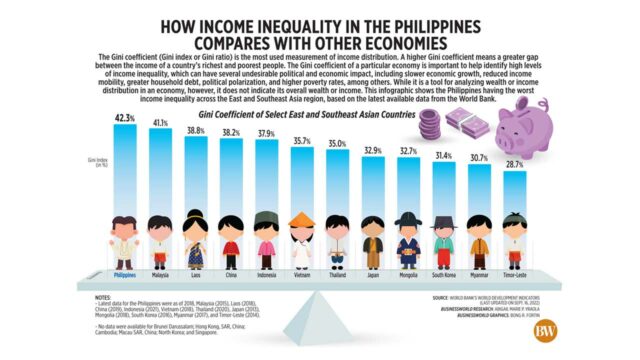
How income inequality in the Philippines compares with other economies

The Gini coefficient (Gini index or Gini ratio) is the most used measurement of income distribution. A higher Gini coefficient means a greater gap between the income of a country’s richest and poorest people. The Gini coefficient of a particular economy is important to help identify high levels of income inequality, which can have several undesirable political and economic impact, including slower economic growth, reduced income mobility, greater household debt, political polarization, and higher poverty rates, among others. While it is a tool for analyzing wealth or income distribution in an economy, however, it does not indicate its overall wealth or income. This infographic shows the Philippines having the worst income inequality across the East and Southeast Asia region, based on the latest available data from the World Bank.

How income inequality in the Philippines compares with other economies

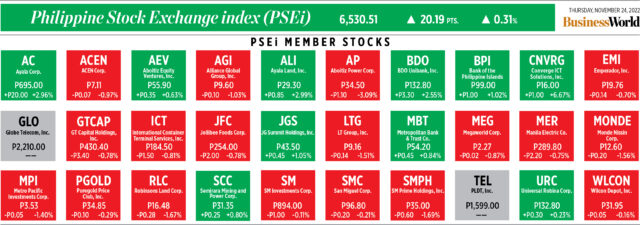
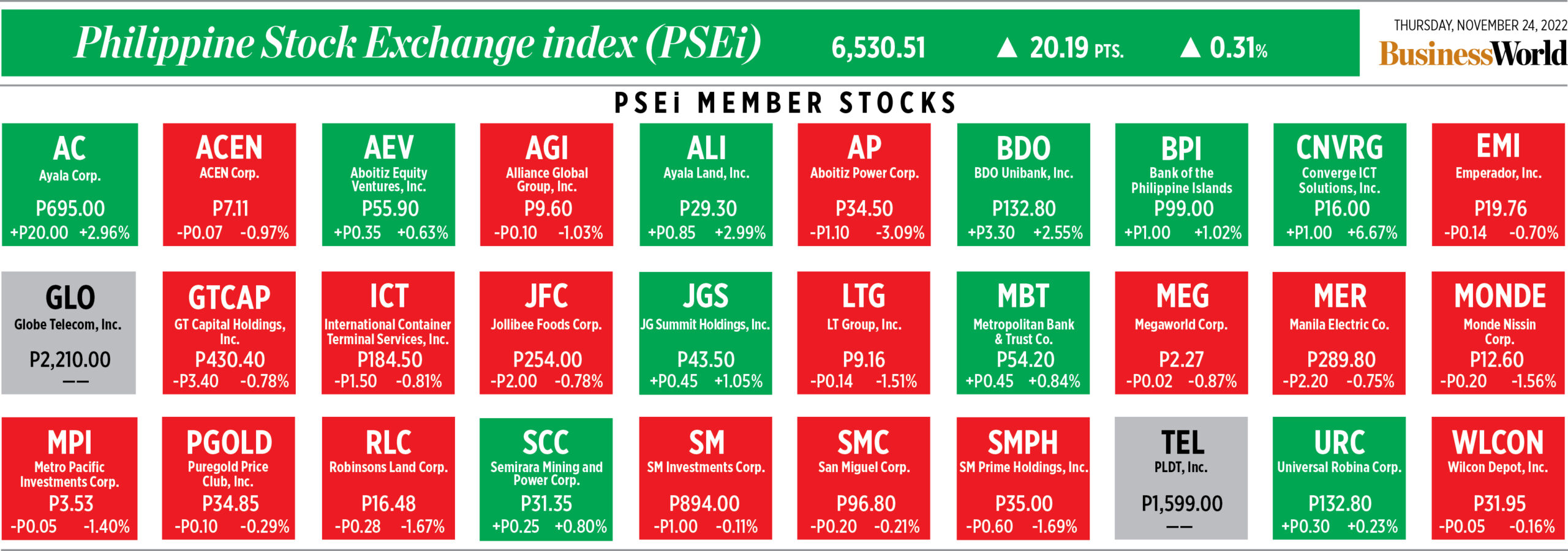
How PSEi member stocks performed — November 24, 2022

Here’s a quick glance at how PSEi stocks fared on Thursday, November 24, 2022.


Peso rises further on Fed minutes

BW FILE PHOTO
THE PESO climbed further against the dollar as minutes of the US central bank’s latest meeting showed policy makers favored a dovish pivot. — BW FILE PHOTO

THE PESO continued to strengthen against the dollar on Thursday amid signals of less aggressive tightening by the US Federal Reserve and on data showing the Philippines saw a net “hot money” inflow in October.

The local unit closed at P56.78 per dollar on Thursday, gaining 16 centavos from its P56.94 finish on Wednesday, based on Bankers Association of the Philippines data.

The peso opened Thursday’s session at P56.88 per dollar, which was also its weakest showing. Meanwhile, its intraday best was at P55.79 against the greenback.

Dollars exchanged rose to $870.5 million on Thursday from $687.85 million on Wednesday.

“The peso appreciated significantly after the Fed minutes  indicated that US central bank officials might need additional but softer rate hikes in future meetings,” a trader said in an e-mail.

Rizal Commercial Banking Corp. Chief Economist Michael L. Ricafort likewise said the local currency strengthened on the back of hints of smaller rate hikes from the Fed.

Minutes of the Fed’s policy meeting this month where they delivered a fourth straight 75-basis-point (bp) hike showed a “substantial majority” of policy makers agreed it would soon be appropriate to look at smaller increases.

The US central bank has raised rates by 375 bps since March in its fight versus inflation, bringing the fed funds rate to a 3.75-4% range. Its next meeting is on Dec. 13-14.

Mr. Ricafort added that the peso was also supported by strong hot money data.

Foreign portfolio investments posted a net inflow of $83 million in October, based on data released by the Bangko Sentral ng Pilipinas (BSP) on Thursday.

This was an improvement from the $367.3-million net outflow recorded in September and the $221.11-million net outflow in the same month a year earlier.

For Friday, both the trader and Mr. Ricafort said that the peso might move between P56.70 and P56.90 against the dollar. — Luisa Maria Jacinta C. Jocson

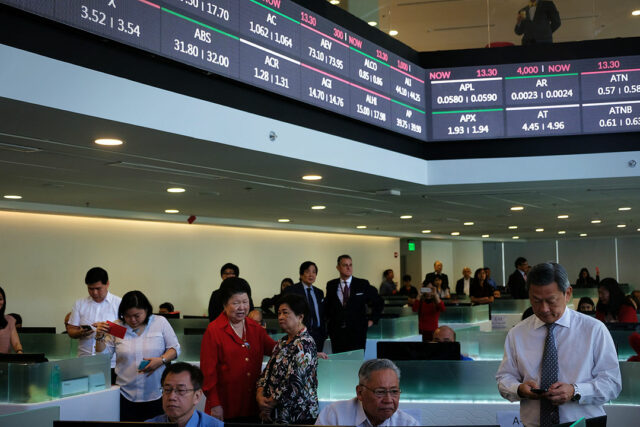
PSEi ends higher as Fed minutes fuel dovish bets

BW FILE PHOTO

PHILIPPINE SHARES extended their gains on Thursday after the release of the minutes of US Federal Reserve’s November meeting, which fueled bets that the central bank will consider slower rate hikes moving ahead.

The Philippine Stock Exchange index (PSEi) went up by 20.19 points or 0.31% to close at 6,530.51 on Thursday, while the broader all shares index rose by 6.28 points or 0.18% to 3,422.04. 

“Philippine shares sustained the rally as investors parsed through the latest FOMC (Federal Open Market Committee) meeting minutes, which pointed to a slowdown in Fed’s tightening in the coming months,” Regina Capital Development Corp. Head of Sales Luis A. Limlingan said.

“The PSEi continued its ascent, tracking Asian peers, on the back of encouraging statements from the Fed’s minutes, which hinted at the likelihood of the central bank slowing pace of rate hikes, and China’s economic stimulus rollout,” AP Securities, Inc. Equity Research Analyst Carlos Angelo O. Temporal said in a Viber message.

Mr. Temporal added that despite the PSEi’s rise, the market remained cautious as uncertainties over the Fed’s policy stance remain, with investors awaiting more data to cement this dovish view.

“The market was further buoyed by sustained uptrend in net foreign buying following the significant appreciation of peso against the dollar to levels below 57,” he said.

Minutes of the Fed’s policy meeting this month where they delivered a fourth straight 75-basis-point (bp) hike showed a “substantial majority” of policy makers agreed it would soon be appropriate to look at smaller increases.

The FOMC has raised rates by 375 bps since March as it battles elevated inflation. Its next meeting is on Dec. 13-14.

Meanwhile, China on Wednesday said they could cut banks’ reserve requirement ratio to help stimulate the economy amid a pickup in coronavirus cases.

At home, the peso on Wednesday returned to the P56-per-dollar level for the first time in two months, closing at P56.94. It climbed further on Thursday, ending the session at P56.78 against the greenback.

Most sectoral indices closed higher on Thursday. Financials climbed by 25.60 points or 1.56% to 1,661.81; holding firms went up by 34.31 points or 0.55% to 6,224.42; services gained 6.26 points or 0.37% to 1,665.16; and mining and oil added 9.08 points or 0.09% to end at 9,811.30.

Meanwhile, industrials declined by 52.17 points or 0.54% to 9,541.32 and property went down by 3.49 points or 0.12% to 2,876.19. 

Value turnover inched up to P5.89 billion on Thursday with 663.97 million shares changing hands from the P5.88 billion with 802.39 million shares traded on Wednesday.

Decliners narrowly outnumbered advancers, 94 versus 87, while 49 names closed unchanged. 

Net foreign buying rose to P655.85 million on Thursday from P423.97 million on Wednesday. 

AP Securities’ Mr. Temporal placed the PSEi’s immediate support at 6,200 and resistance at 6,600. — A.E.O. Jose

Tech firms seek PHL digital tax in line with international norms

REUTERS

TECH INDUSTRY associations said the Philippines should align its digital taxation policy with international practice, saying that predictability of business conditions is key to continued investment in innovation.

The Asia Internet Coalition (AIC) and the Asia Cloud Computing Association (ACCA) said they support a proposed measure imposing value-added tax (VAT) on digital transactions, but proposed provisions for single group registration of related companies and the removal of a requirement to appoint an in-country representative.

The House of Representatives approved on third reading on Nov. 14 House Bill 4122, which seeks to impose 12% VAT on non-resident digital service providers such as Spotify and Netflix. Senator Pilar Juliana S. Cayetano has filed Senate Bill 250 as the other chamber’s counterpart measure.

If the measure becomes law, 12% VAT will also be imposed on the digital sale of services like online advertising and the supply of other services delivered through online marketplaces, webcasts and mobile applications. Albay Rep. Jose Ma. Clemente S. Salceda, who chairs the House ways and means committee, said the measure is expected to generate P19 billion in revenue.

In a Nov. 23 letter to Sen. Sherwin T. Gatchalian, chairman of the Senate committee on ways and means, the groups said: “We earnestly request your leadership in aligning the proposed digital taxation policy with international norms espoused by the Organisation for Economic Cooperation and Development (OECD) and the International Monetary Fund (IMF).”

Legislators should frame the tax on digital transactions as a “simplified electronically supplied services (ESS) VAT regime that conforms with the recommendations of the international organizations for extraterritorial VAT compliance and successfully implemented in many countries,” they added. The letter was sent to reporters on Thursday.

They argued that the ESS VAT regime has been adopted by countries in the region such as Singapore. “Enhancing revenue levels from consumption taxes on cross-border sales while minimizing the compliance burden of digital suppliers can be achieved with broad support from businesses when the OECD or IMF best practices are followed,” the groups noted.

AIC and ACCA likewise noted that the in-country representative requirement for non-resident suppliers included in House Bill 4122 “does not align with international best practices.”

They said that such a requirement can have “unintended consequences,” including “reduced private sector investment and tax non-compliance by some non-resident companies.”

“No other jurisdiction in Southeast Asia, including Singapore, Malaysia, Indonesia, Thailand, and Cambodia, imposes such a requirement,” the two associations noted.

They expressed hope that the Senate version will include a clause that makes it easier for a group of affiliated or related companies to register.

“It would be more efficient for local tax authorities to deal with a single entity on behalf of a group of related companies,” AIC and ACCA said.

They also argued that extraterritorial VAT should apply to business-to-customer supplies only as VAT on reverse charge is already applicable on cross-border business-to-business supplies. 

“To advance the growth of the digital economy in the Philippines, it is critical that the environment is supportive of business-to-business services (including total cost of usage) as companies seek to increasingly grow digital in their operations,” AIC and ACCA said.

They want “sufficient time to implement such measures … before a new policy is enforced to ensure compliance readiness.”

They also want at least 9 to 12 months from the publication of the final law and release of detailed technical rules to align their systems to implement any substantial changes to tax laws.

“With respect to the withholding of creditable VAT, under the current domestic law, any payment made by government agencies should be subject to 5% withholding VAT — which is creditable,” AIC and ACCA noted. 

“However, since non-resident companies are not allowed to claim input VAT, sales to government customers will incur this 5% VAT as cost passed on to the non-resident company. We seek further clarification on the intention of legislators here, or a review of this provision in relation to current domestic laws,” they added. — Arjay L. Balinbin

Discussions to extend CARS program ongoing

REUTERS

A PROPOSED extension to the Comprehensive Automotive Resurgence Strategy (CARS) program is currently being discussed, according to the Department of Trade and Industry.

Ceferino S. Rodolfo, Trade undersecretary and Board of Investments (BoI) managing head, told reporters in a recent briefing that the two CARS participants, Toyota Motor Philippines Corp. and Mitsubishi Motors Philippines Corp., are still completing their proposals for an extension.

The BoI is the implementing agency of the CARS program, which provides incentives for manufacturers willing to assemble mass-market cars domestically.

“There is no (final proposal) yet but we are working on that. Trade Secretary Alfredo E. Pascual has met with the two CARS program participants (to determine) how much longer do they need so that they can be given a reasonable extension,” Mr. Rodolfo said.

“The two participants are still finalizing their offer for us. They suffered severely in terms of volume due to the coronavirus disease 2019 (COVID-19) pandemic,” he added.

Mr. Rodolfo said there are ongoing discussions to add more models into the CARS program as a possible stipulation in exchange for an extension, possibly for three years.

“If we extend, what would we get in return? For example, do we include additional models in the program? That is still under discussion. The CARS program participants already put in the fixed investments. It’s not just the two registered participants. It also includes their parts suppliers,” Mr. Rodolfo said.

Mr. Rodolfo added that there would be no additional funding for the CARS program even if an extension is agreed.

“The previous discussion (was about extending) the CARS program for three years across the board for the two participants without additional increases in the budget allotted for them,” Mr. Rodolfo said.

The program has a P27-billion budget for three car manufacturers to produce 200,000 units each for a six-year period in order to avail of fiscal incentives.

However, only Toyota and Mitsubishi joined the program.

Toyota produces the Vios compact car while Mitsubishi produces the Mirage model.

Toyota has until 2024 to meet its commitments while Mitsubishi’s deadline is 2023.

Mr. Rodolfo said the proposal to give the third slot in the CARS program to an electric vehicle (EV) manufacturer has been largely ruled out. 

“I am not expecting (a third participant) because this CARS program has been around for a long time,” Mr. Rodolfo said.

“The discussions on the third CARS slot will have to be consistent with Republic Act No. 11697 or the Electric Vehicle Industry Development Act (EVIDA),” he added.

Under EVIDA, the government and companies are required to meet a 5% EV quota for their vehicle fleets.

In the first 10 months of 2022, the auto industry has sold 280,300 units, up 30.9% from a year earlier, according to a joint report of the Chamber of Automotive Manufacturers of the Philippines, Inc. and Truck Manufacturers Association. — Revin Mikhael D. Ochave

Two LNG projects seen operational by next year

ENERGY.AGPGLOBAL.COM

THE Department of Energy (DoE) said on Thursday that at least two liquefied natural gas (LNG) projects are on track to start operations next year.

“(With) scheduled availability at the end of the first quarter of 2023, liquefied natural gas is considered an important source for fuel diversification,” Energy Secretary Raphael P.M. Lotilla said in a statement.

Last month, Atlantic Gulf & Pacific Co. (AG&P) said it has completed the conversion of a vessel into a floating storage unit, which will then be docked at its LNG facility in Batangas.

AG&P is expecting to deliver gas by March. Its import terminal has an estimated initial capacity of five million tons per annum (MTPA).

Meanwhile, First Gen Corp., through its subsidiary FGEN LNG Corp. has announced that its LNG terminal will also be completed by the first quarter. According to the DoE, FGEN’s LNG terminal has a total capacity of 5.26 MTPA and an estimated construction cost of P13 billion.

The DoE said FGEN will fuel the 1,000-megawatt (MW) Sta. Rita power plant, the 500-MW San Lorenzo power plant, the 414-MW San Gabriel power plant and the 97-MW Avion power plant.

“Our foremost concern is to ensure that there is enough capacity supplied through various sources most especially in the coming summer months to sustain the power supply,” Mr. Lotilla said.

The DoE said last month that red and yellow alerts are expected on the grid in early 2023, signifying periods when available power falls below acceptable safety margins.

The Luzon grid is dependent on gas landed in Batangas from the Malampaya field in northern Palawan. The depletion of Malampaya gas has forced gas-fired power plants to import gas, for which they must build storage facilities.

The DoE is positioning natural gas as a transition fuel necessary to supply cleaner-than-coal baseload power while the renewable infrastructure is built up. Renewable energy also suffers from intermittency problems because they cannot generate power in certain conditions, such as windless days for wind turbines or nighttime for solar panels.

Under the Clean Energy Scenario of the Philippine Energy Plan, the government is aiming to increase the contribution of natural gas power by establishing LNG terminals and regasification facilities.

The Power for People Coalition said in a statement that LNG facilities raise environmental concerns that will affect host communities. 

“LNG is a burden for consumers, especially now when global gas supplies are (at) record-high prices. Just a few days ago, the Japanese trade ministry came out and said long-term LNG contracts are sold out. Whatever supply we find will be very costly, especially during the upcoming summer peak season,” according to Gerry C. Arances, P4P convenor. —  Ashley Erika O. Jose

PHL coal, oil, gas reserves valued at P241 billion in 2021

FREEPIK

THE Philippines’ reserves of coal, oil, and natural gas and condensate were valued at P241.99 billion in 2021, up 68.4%, the Philippine Statistics Authority (PSA) said, reflecting the higher market prices for these resources even though volumes fell.

The Philippines classifies its reserves as Class A, commercially recoverable; class B, potentially commercial, and class C, non-commercial.

These reserves of so-called non-renewable energy are the equivalent of 0.2% of the economy.

Class A coal reserves were valued at P181.30 billion in 2021, more than double the 2020 level.

Class A oil reserves rose 51.4% to P14.08 billion in 2021, while natural gas reserves rose 16.2% to P26.02 billion.

Condensate reserves declined 23.1% to P20.59 billion in 2021.

By volume, the PSA said class A coal reserves fell to 365.71 million metric tons (MT) in 2021 from 381.47 MT a year earlier.

Oil reserves fell to 31.46 million barrels (bbl) in 2021 from 32.10 million bbl previously.  

Natural gas reserves declined to 212.38 billion standard cubic feet (scf) of gas from 333.47 billion scf in 2020, while condensate reserves fell to 9.41 million barrels from 29.38 million barrels. — Ashley Erika O. Jose

LGUs urged to develop capital investment plans

LOCAL government units (LGUs) have been instructed to develop a capital investment planning capability, the Department of Finance (DoF) said, citing the need to raise their creditworthiness and improve their access to financing.

“As we implement the full devolution of certain functions from the executive branch to local governments pursuant to Executive Order (EO) No. 138, government units are confronted with the challenge of funding the expanded scope of basic services and local development projects. It is therefore imperative that LGUs put in place plans on capital investment,” Finance Secretary Benjamin E. Diokno said in a statement on Thursday.

EO No. 138 outlines the devolution of National Government functions corresponding to the expansion of LGUs’ share of national taxes.

The expansion of the LGUs’ National Tax Allotment comes as local officials made only limited use of their authority to borrow.

According to the DoF, only 62% of LGUs have availed of credit in the past five years.

In 2021, LGU borrowing only amounted to P136.6 billion or around 0.74% of gross domestic product.

The Bureau of Local Government Finance (BLGF) reported that LGUs were only able to utilize 51.5% of their borrowing capacity in the past five years.

“These were most commonly used for the construction of local government buildings and roads, acquisition of lots, and procurement of heavy equipment,” it added.

The BLGF issues certificates of net debt service ceiling and borrowing capacity to LGUs to set the maximum amount that LGUs can borrow.

Mr. Diokno said the initiative is being pursued as part of an engagement with the World Bank Group, in which LGUs will be capacitated to undertake the planning of their capital investment programs.

“This initiative will steer our LGUs on the path to creditworthiness, which is key to accessing long-term financing required for sustainable investments,” he added.

Ateneo de Manila University Economics Professor Leonardo A. Lanzona said that LGUs are key players in the economy’ recovery.

“For this to happen, they should be allowed to create and develop their own economic programs and policies. The national agencies and departments should refrain from setting rules and policies for the LGUs to follow. In this case, matters relating to industrialization, agricultural development and the enhancement of the service sector, including infrastructure, should be decided at the regional level,” he said in an e-mail.

Mr. Lanzona said that LGUs should develop their own industrial policy along the lines of service expansion, which should be presented to the National Government in order to reduce barriers that can mobilize both labor and capital to competitive regions.

“It is likely that some regions may lag behind. While the National Government should keep their hands off from the economic programs of the regions, it is crucial that they provide the necessary public goods, such as health, education and infrastructure to the lagging regions. This should be the only rationale for government intervention,” he added. — Luisa Maria Jacinta C. Jocson

ADVERTISEMENT
ADVERTISEMENT