Home Blog Page 5569

Taking music production up a notch

FACEBOOK.COM/WAXIEFIED.SOUND.PRODUCTION/

IN a world where there is a playlist or soundtrack for everyone’s daily activities, from doing an early morning workout to soothing sounds for a restful evening, Waxiefied Sound Production (WSP) has brought a more immersive way to enjoy music and improve music recordings for artists.

The music production company has earned the Home Entertainment Studio Certification, the highest certification that sound pioneer Dolby Atmos issues to its partners. WSP also opened the first certified Dolby Atmos Home Entertainment Studio in the country in Pasig City.

“I downloaded specifications and qualifications of the Dolby Suite, and I handed it over to [WSP acoustics engineer] Jiggs Hermano. Then he decided to make these designs and what to build,” Waxie G. Joaquin, founder of Waxiefied Sound Productions and its Executive Mastering Engineer, said during a launch on Nov. 5.

“In my other day job, I do supply acoustics as well. We put our skills and know-how together and so we achieved the room,” Mr. Joaquin said.

The studio was finished in 47 days.

The equipment, which went through strict screening by Dolby’s international team, took about six months to arrive in the Philippines from suppliers worldwide.

“We had to find the right monitors, not because they sound good but because they will last long. We got the specifications of those speakers, sent them to Dolby for them to approve it. They gave us a list of equipment and what we needed to do for processing — types of computers, types of audio interfaces, types of cables, to the cables, even the plugs of the cables,” Mr. Joaquin explained.

“Because of the project and the dream that we had, all the suppliers that we were talking to us were assisting us. So, they found temporary equipment or equipment for loan. They know that Dolby was coming over to Manila to tune the room and to certify us,” he added.

The Dolby Atmos Mastering Suite facilitates and certifies high resolution mastering of audio which is the same as the Apple Digital Masters sound for Apple Music. It is a soundproofed studio surrounded by 14 main speakers that facilitate an immersive audio experience.

The WSP room was recalibrated to accommodate the proper positioning of the speakers and its distances from each other.

“It’s not just like painting a picture viewed in one scene,” WSP acoustics engineer Jiggs Hermano said. “Now you can look around and there are many scenes going on.”

WSP also introduced the Dolby Atmos Sound Mastering Service, used for mastering audio from a variety of content such as music, audio visual clips, reels, TV shows, TV series, and movies.

WSP has recently remastered songs by James Reid, New Game Plus, Nicole Asensio, Dan Gil, and Marga Jayy in different modes, from stereo mix to Waxiefied Stereo Master to Dolby Atmos. Other clients in the Waxiefied Sound Production portfolio include Massiah, Nadine Lustre, Jay Ortega, J. Mara, and Morobeats.

During a visit to the studio, BusinessWorld listened to the original recording and the Dolby remastered version of James Reid’s song, “u & i” (2022). This writer was seated at the work desk at the center of the room facing three main speakers. The computer screen at the desk showed how the sound dynamics shifts from every speaker through the movement of green dots.

“We believe that this is the future and we’re here to help everybody get to that point in the Philippines,” Mr. Hermano told BusinessWorld during the studio tour.

He clarified that the technology is suited only for the digital platform. “The media cannot fit in an analog format,” he said, noting that one three-minute track can take up two gigabytes.

WSP is offering the Dolby Atmos Sound Mastering Service to artists, record labels, and other music production companies. It is also available for rent.

Mr. Hermano hopes that WSP will be able to work on remastering the existing library of Original Pilipino Music (OPM).

“We have to raise the bar and make us (Filipino artists) listenable to the rest of the world,” Mr. Hermano said. “We are here to support any label or artist. The technology is for everyone.”

For more information about Waxiefied Sound Productions, visit their website at www.waxiefiedsoundproduction.com and follow their official social media pages on Facebook, Instagram, and Youtube. — Michelle Anne P. Soliman

Stocks climb on bargain hunting ahead of data

BW FILE PHOTO

PHILIPPINE SHARES ended in the green on Monday, testing resistance levels, on bargain hunting ahead of key US economic data.

The bellwether Philippine Stock Exchange index (PSEi) gained 74.53 points or 1.12% to end at 6,681.47 on Monday, while the broader shares index went up by 28.73 points or 0.83% to 3,481.17.

Regina Capital Development Corp. Head of Sales Luis A. Limlingan said the PSEi extended its climb and tested resistance levels ahead of the release of data from the United States.

“A slew of US economic data await investors to be digested this week, including November employment change, third- quarter GDP (gross domestic product) data, PMI (purchasing managers’ index) reading, non-farm payrolls, and unemployment rate,” Mr. Limlingan said in a Viber message.

“The market continued on with its countertrend rally after the main index broke a confluence of resistance levels,” AB Capital Securities, Inc. Vice-President Jovis L. Vistan said in a Viber message.

Mr. Vistan said the lack of leads was good for short-term traders, with positioning and bargain hunting lifting the market.

“Markets seemed to have stabilized and are forming a support base. Global rates may seem to be on the way up but the rising pace is slowing down as inflation have already in some countries,” he said.

Timson Securities, Inc. Head of Online Trading Marc Kebinson L. Lood said the PSEi tracked Wall Street’s rally over the weekend. 

“Philippine stocks rose, following the lead of the US market, which finished the holiday-shortened week higher, buoyed by a less hawkish signal from the Federal Reserve. The minutes of the Fed’s November meeting revealed an expected shift in policy after a majority of policy makers came to an agreement that easing the phase of rate increases would be reasonable,” Mr. Lood said. 

Almost all sectoral indices ended higher on Monday. Mining and oil surged by 414.56 points or 4.2% to 10,264.62; services gained 53.03 points or 3.14% to close at 1,740.94; holding firms rose by 82.56 points or 1.3% to 6,390.08; industrials added 41.47 points or 0.43% to end at 9,560.54; and financials climbed by 4.55 points or 0.27% to 1,687.42.

Meanwhile, property declined by 16.88 points or 0.57% to 2,903.93.

Value turnover climbed to P8.68 billion on Monday with 729.87 million shares changing hands from the P7.14 billion with 489.03 million issues traded on Friday.

Advancers outnumbered decliners, 112 versus 77, while 40 names closed unchanged.

Net foreign buying went up to P914.01 million on Monday from the P842.26 million seen on Friday.

For Tuesday, AB Capital Securities’ Mr. Vistan placed the PSEi’s immediate support at 6,630 and resistance at 6,720. — A.E.O. Jose

Peso up on easing oil prices

BW FILE PHOTO

THE PESO strengthened versus the dollar on Monday after global oil prices eased, erasing all gains posted since the start of the Russia-Ukraine war.

The local unit closed at P56.64 against the greenback on Monday, stronger by three centavos from its P56.67 finish on Friday, data from the Bankers Association of the Philippines showed.

The peso opened Monday’s session at P56.80 per dollar. Its intraday low was at P56.90, while its strongest showing was at its close of P56.64 against the greenback.

Dollars traded went down to $806.9 million on Monday from $849 million on Friday.

The peso strengthened after global oil prices eased to new 11-months lows, Rizal Commercial Banking Corp. Chief Economist Michael L. Ricafort said in a Viber message.

Brent crude dropped $2.43 or 2.9% on Monday to trade at $81.20 a barrel at 0731 GMT, after diving more than 3% to $80.61 earlier in the session, its lowest since Jan. 4, Reuters reported.

US West Texas Intermediate (WTI) crude slid $2.16 or 2.8% to $74.12 a barrel. It fell as far as $73.60 earlier, its lowest since Dec. 22, 2021.

Both benchmarks have posted three consecutive weekly declines. Brent ended the latest week down 4.6%, while WTI fell 4.7%.

This is due to the continued lockdowns in China, one of the world’s biggest importers of oil and major global commodities, Mr. Ricafort said.

“The peso was mostly weaker for the trading session, tracking regional weakness before closing almost unchanged from last Friday,” ING Bank N.V. Manila Senior Economist Nicholas Antonio T. Mapa said in a Viber message.

“Asian foreign exchange weighed down by concerns about growing unrest in China and what that might mean for growth in the near term,” he said.

China has stuck with President Xi Jinping’s zero-COVID policy even as much of the world has lifted most restrictions.

For Tuesday, Mr. Mapa said the market will take its cue from global developments, especially from US Federal Reserve Chair Jerome H. Powell’s speech on Wednesday, where he is expected to give an outlook for the US economy that could provide hints on their next policy move.

The Fed has so far increased borrowing costs by 375 basis points since March, bringing the fed funds rate to a 3.75-4% range. It will update its interest rate and economic forecasts at their policy meeting on Dec. 13-14

Mr. Ricafort gave a forecast range of P56.55 to 56.75 per dollar for Tuesday. — KBT with Reuters

Investigation looms after six power plants declare outages

THE Department of Energy (DoE) called on the Energy Regulatory Commission to investigate the forced outages or limited production at six power plants which caused yellow alerts, and, briefly, a red alert, to be raised over the Luzon grid on Monday.

On Monday, the National Grid Corp. of the Philippines (NGCP) twice placed the Luzon grid on yellow alert after outages removed 2,648 megawatts (MW) worth of supply from the grid.

The DoE said that power plants that went on forced outages were Calaca 2 and Sta. Rita Module 20 in Batangas; GNPower Mariveles 1 in Bataan; Sual 1 in Pangasinan; Masinloc 3 in Zambales; and San Buenaventura in Quezon.

“We anticipate that the Energy Regulatory Commission will also look into the root of this to prevent similar occurrence,” the DoE said in a statement.

In an advisory, the NGCP declared a yellow alert for the 10 a.m. to 5 p.m. period and again for the 6 p.m. to 9 p.m. period. The grid operator said that the capacity available on Monday was 11,750 MW, against peak demand of about 10,437 MW. 

The NGCP initially declared a red alert for the 5 p.m. to 6 p.m. period but withdrew it at 11:30 a.m. after Sual 1 and Masinloc 3 came back online.

Yellow alerts are declared when supply available to the grid falls below a designated safety threshold. If the supply-demand balance deteriorates to below an adequate supply of power, a red alert is declared, warning consumers of rolling brownouts.

“We assure the public that there appears to be no fuel constraints. Some of these generating plants are on forced outage caused by power plant tripping,” Energy Secretary Raphael P.M. Lotilla said.

Manila Electric Co. (Meralco) said it put interruptible load program (ILP) participants on standby for possible activation after the NGCP alert.

ILP participants are large power users that have their own generating facilities. These entities stop drawing power from the grid for a time, tapping their own power plants for their needs, reducing the overall load on the grid. 

“As of 11:30 a.m., we had 346.40 MW of committed de-loading capacity under the ILP,” Meralco said in a statement.

Meralco said that it currently monitoring the situation and is ready to implement manual load dropping or rotating power interruptions if instructed by NGCP. — Ashley Erika O. Jose

LANDBANK exploring financing deal for New Clark City gov’t facilities

NEW CLARK CITY

THE Land Bank of the Philippines (LANDBANK) and the New Clark Government Center Corp. (NGCC) are exploring a financing deal to support the construction of new government buildings in New Clark City in Tarlac.

LANDBANK said that NGCC is sounding out institutions willing to support the MTD Group’s upcoming projects, which include facilities for the National Bureau of Investigation.

NGCC is a special-purpose company created for the development of New Clark City. The company is an arm of the MTD Group.

In a statement, the state-run bank said that this initiative would “support the National Government’s plan to decongest Metro Manila.”

Since 2015, LANDBANK has helped finance the MTD Group’s infrastructure projects in Central Luzon.

These include the Palayan Government Center and Business Hub in Nueva Ecija, and the Bataan Government Center and Central Business Hub in Bataan.

The project in Nueva Ecija includes a five-storey government building for national and regional government offices, two six-storey buildings for business process outsourcing offices and commercial areas, and a six-storey business hotel with an adjoining two-storey commercial and retail complex.

Meanwhile, the project in Bataan serves as a one-stop shop for various government services, providing greater convenience to the constituents of the province. — Luisa Maria Jacinta C. Jocson

Romualdez files bill creating sovereign wealth fund

SPEAKER Ferdinand Martin G. Romualdez has filed a bill that, if passed, would create a sovereign wealth fund to be seeded by the major pension funds and government banks.

House Bill 6398, filed on Monday, seeks to establish the so-called Maharlika Investments Fund (MIF), which will “optimize investment allocation” by the Government Service Insurance System, Social Security System, Land Bank of the Philippines, and Development Bank of the Philippines.

The MIF will also ensure that “resources are efficiently channeled to investments that will provide the most value not only to the participating GFIs (government financial institutions), but also to the country.”

Mr. Romualdez described the MIF as a “sovereign wealth fund,” which is typically funded by a government’s oil or other commodity export revenue or excess foreign exchange reserves.

He said the MIF’s investment allocation policy will seek to align itself with President Ferdinand R. Marcos, Jr.’s Agenda for Prosperity and the eight-point socioeconomic roadmap.

Mr. Romualdez cited as a model the Indonesian fund, which invested in airports, supply chains, logistics, digital infrastructure, the green economy, healthcare services, the financial sector, technology, and tourism.

“The MIF will have a governing board, composed of nominees of contributing GFIs, which would be in charge of managing the fund. It will also have two independent directors.”

Mr. Romualdez said that the MIF will adhere to the Santiago Principles, a list of best practices for sovereign wealth funds.

Co-authors of the bill are Majority Leader Manuel Jose M. Dalipe, Senior Deputy Majority Leader Ferdinand Alexander A. Marcos, Marikina Rep. Stella Luz A. Quimbo, and Tingog Party-list Representatives Yedda Marie K. Romualdez and Jude A. Acidre. — Alyssa Nicole O. Tan

ADB touts microfinance role in building resilience vs climate change

MICROFINANCE institutions (MFIs) should be tapped in helping build resilience against climate change, especially for poorer and more vulnerable communities, according to the Asian Development Bank (ADB).

“Economic development supporting small- and medium-sized enterprises contributes to the resilience of the poor and vulnerable, including in urban areas,” the ADB said in a report.

“Building resilience against the impacts of climate change and geophysical shocks is critical for economic development and poverty reduction,” it added.

The world faces increasing flooding events; more frequent and longer heat waves; and stronger tropical cyclones, the ADB said.

The world’s extremely poor population is expected to rise to 132 million by 2030 due to the pandemic and climate change, according to the report.

“Microfinance institutions are well-positioned to be part of the solution. Additionally, MFIs in the region have a good history of serving women,” it said.

The ADB said that recent studies for urban MFIs operating in Bangladesh show contributions to savings, educational expenditure, and transportation expenditure, which increases labor mobility.

“MFIs in Bangladesh and Indonesia by and large focus their lending in urban areas. Some of the MFIs are concentrated in a single urban area. These concentrations compound the problems created by a geophysical shock,” it added.

In the Philippines, MFI initiatives should trickle down to the grassroots level, according to an economist.

“This is partly through applying environmental, social, and governance (ESG) standards on lending and investment decisions that help promote measures against climate change and make them more far reaching and more inclusive,” Rizal Commercial Banking Corp. Chief Economist Michael L. Ricafort said in a Viber message.

“These sectors in rural areas are also among the most prone to disasters due to climate change, especially the poorest of the poor and the most vulnerable or hardest-hit given limited resources and probably limited knowledge-awareness. Thus, technical, financial, preparedness, risk mitigated initiatives need to be targeted to them,” he added.

The report concluded that climate change and geophysical shocks are “creating an unresolved conundrum whereby the very financial institutions relied upon by the poor are also especially vulnerable to geophysical shocks, meaning that they are in a poor position to help their community when they are needed the most.”

“The balance sheet of the MFIs suffers, which means that they cannot respond to the community — either through recovery lending or by offering other forms of response immediately after the shock,” it added.

The ADB recommended implementing disaster risk financing solutions in order to support vulnerable communities.

“Efficient disaster risk financing solutions can be used to facilitate MFI recovery lending as an essential facet of building the resilience of the poor and vulnerable and, in turn, their communities,” the multi lender bank said.

MFIs have used disaster risk financing solutions to either expand lending into vulnerable regions or to pre-plan recovery lending programs, the ADB said.

The report also recommended the use of a single debt instrument to wrap normal credit with contingent credit and contingent capital together into one loan agreement.

“Contingent credit rebuilds liquidity and contingent capital flows with risk transfer instruments that are treated as subordinate debt and can be quickly converted to capital under Basel. The risk transfer goes to the global capital markets,” it added. — Luisa Maria Jacinta C. Jocson

Tablet demand drops as physical classes resume

PIXABAY

THE return of face-to-face classes dampened demand for tablets in the Philippines in the third quarter, according to the International Data Corp. (IDC).

“The Philippines tablet market declined 11.6% quarter on quarter in the third quarter, and was almost flat compared to last year,” the market intelligence company said in a report issued on Nov. 27.

The education market has been the primary driver of tablet sales in the Philippines since schools resorted to blended learning during the pandemic.

“But (the sale of tablets for school use) declined by 47.8% quarter on quarter and 42.4% year on year as more schools, both public and private, returned to physical classes as part of the Department of Education’s expansion of face-to-face classes,” IDC Philippines Market Analyst Angela Jenny V. Medez noted.

With public schools reverting to physical classes beginning November, and the looming global economic slowdown, the IDC expects the tablet market to decline in 2023.

“Even though more Chinese vendors have turned up in the tablet space and sparked competition, we don’t expect them to offset the slowdown of the overall tablet market,” Ms. Medez added.

The top five tablet brands in the Philippines in the third quarter were Samsung with a 43.5% market share, realme (13.9%), Cherry Mobile (11.2%), Huawei (8.6%), and Lenovo (6.4%).

Samsung “more than doubled its shipments compared to the previous quarter and grew 37.7% year on year,” the IDC said.

“This was driven by its top-selling Galaxy Tab A7 Lite model that accounted for almost 80% of its shipments,” it added.

The market intelligence company previously reported that smartphone shipments to the Philippines also fell in the third quarter as a result of inflation and recent typhoons.

Smartphone shipments declined by 8% quarter on quarter and 6.8% year on year, with 3.9 million units shipping in the third quarter, the IDC said.

Recent typhoons and inflation hurt both consumers and vendors, according to the market intelligence company.

“Vendors took a more conservative approach by clearing inventories, maintaining prices of existing models, and sustaining momentum by bringing in more affordable smartphones,” Ms. Medez noted.

Inflation accelerated to 7.7% in October, the highest in nearly 14 years. — Arjay L. Balinbin

Rice inventory up 6.5% as of Oct. 1 

PHILSTAR FILE PHOTO

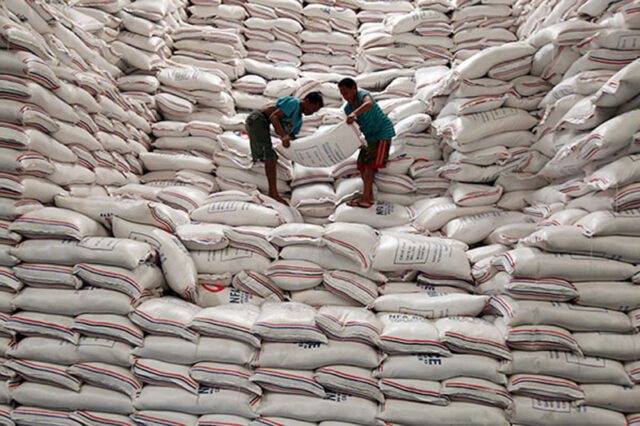
THE rice inventory at the beginning of October increased 6.5% year on year to 2.08 million metric tons (MT), according to the Philippine Statistics Authority (PSA).

In a report issued Nov. 25, the PSA said that month on month, the October rice inventory rose 43.5%.

Rice held by households as of Oct. 1 rose 10.7% year on year to 1.17 million MT while inventory held by commercial warehouses, wholesalers, and retailers increased 9.5% to 798,120 MT.

Stocks held by National Food Authority (NFA) depositories fell 33.2% to 111,040 MT.

Compared to September levels, the PSA said that household rice rose 65.1% while inventory held by commercial warehouses rose 27.1%. NFA stocks dropped 1.2%.

“As of Oct. 1, 2022, 56.3% of the total rice stocks were from households, 38.3% from commercial warehouses/wholesalers/retailers, and 5.3% from NFA depositories,” the PSA said.

Meanwhile, the PSA said that total corn stocks increased 40.2% year on year to 720,600 MT as of Oct. 1.

Month on month, corn stocks rose 28.3%.

During the period, corn held by households dropped 1.5% year on year to 210,040 MT while stocks held by commercial warehouses rose 69.8% to 510,570 MT.

Compared to September, corn held by households rose 119.4% while commercial warehouse inventories rose 9.6%.

“Of this month’s total corn stocks inventory, 70.9% were from commercial warehouses/wholesalers/retailers, and 29.1% were from the households,” the PSA said.  — Revin Mikhael D. Ochave 

Understanding transfer pricing methodologies

In our previous articles on transfer pricing (TP), we have discussed the functions, assets, and risks (FAR) analysis, entity characterization, and industry analysis. This time, we will talk about the different transfer pricing methodologies.

The Organisation for Economic Co-operation and Development (OECD) Transfer Pricing Guidelines provide five methodologies that are widely used and accepted by almost all tax authorities in determining transfer prices. These include three traditional transaction methods —   comparable uncontrolled price (CUP) method, resale price method (RPM), and cost-plus method (CPM); and two transactional profit methods — transactional net margin method (TNMM) and profit split method (PSM).

These have been adopted by the Bureau of Internal Revenue (BIR). To better understand them, we will discuss broadly each of the five TP methods with some sample illustrations.

1. CUP METHOD
The CUP method compares the price and conditions of products or services in a controlled transaction (i.e., between related parties) with those of an uncontrolled transaction (i.e., between unrelated parties). In applying the CUP method, comparable data between controlled and uncontrolled transactions are required which must be highly similar in order for prices to be considered comparable.

Since this method compares extremely similar products or services, it is considered the most effective and most reliable way of determining the arm’s-length price for controlled transactions. However, due to the high standards of comparability required in applying the CUP method, it is usually a challenge to identify a transaction that is appropriately comparable to the controlled transaction.

The CUP method can be applied in two ways — the internal CUP and external CUP. Internal CUP is applicable in case the company transacts comparable transactions with related and unrelated parties. On the other hand, external CUP uses comparable data of transactions entered into between two unrelated third parties. Between the two, external CUP is more difficult to apply due to the usual lack of publicly available data on comparable third-party transactions.

Below is an example of how the internal CUP method is applied.

Company A, which is engaged in the lease of commercial space, needs to determine how much rent it should charge Company B, an affiliate, for the lease of a commercial unit in one of the buildings owned by the former. Let’s say Company A leases some commercial space in the same building to third-party lessees. In applying internal CUP, Company A must ascertain that all lease arrangements made with the third-party lessees are sufficiently comparable with the terms and conditions of the lease to Company B (e.g., leased area, payment terms, liability provisions, etc.) in order for Company A to apply the same rent charged to independent third-party lessees to Company B.”

2. RPM
RPM evaluates whether the amount charged in a controlled transaction is at arm’s length by reference to the gross margin realized in a comparable uncontrolled transaction. It uses the selling price of a product or service, or the resale price, from which an appropriate gross profit is subtracted.

The usefulness of this method largely depends on how much added value or alteration the reseller has performed on the product before it is resold, or the time that has lapsed between purchase and onward sale. The greater the value added by the reseller, to the extent that market conditions might have changed before it is resold, the more difficult to use RPM to arrive at the arm’s length price.

Example:

Company C is a distributor of an energy drink manufactured by its parent company in Thailand. The product is being resold by Company C to consumers at P34 per 350ml bottle. Assuming comparable independent distributors earn margins of 5%, the arm’s length transfer price that the parent company may charge Company C is computed below.

Resale price/

Third-party sale price P 34.00

Less: Resale price margin — 5% 1.70

Transfer price P 32.30

3. CPM
Under CPM, the arm’s length price is arrived at by adding an appropriate gross profit to the overall cost (direct and indirect) of producing the goods or services involved in the controlled transaction. This method calls for a very high level of similarity in the functions being performed by the comparable companies. Therefore, if the comparison is not apples-to-apples, the results will not be reliable. As is the case for all transactional methods, the challenge in using CPM is the availability of comparable data and consistency in the accounting methods.

Here is an example of the application of CPM.

Company D provides engineering design services to its Japan-based parent company which is in the construction industry. In determining the appropriate markup (gross cost plus) for the services provided to the Japan affiliate, Company D may use the markup applied for its similar comparable transactions with third parties, provided the costs incurred are substantially the same for both services provided. If no comparable third-party transactions of Company D are available, then independent companies engaged in similar activity with Company D can be identified and can apply those comparable companies’ markup to the transactions with the Japan-based related party.

4. TNMM
Instead of testing and comparing the transfer price, TNMM compares the net margins, relative to an appropriate base such as costs, sales, or assets, attained by an entity from a controlled transaction as against those attained by comparable independent companies involved in similar transactions such that if the level of net margin of the related party is comparable with those independent companies, then the transfer price is carried at arm’s length.

This method is based on the concept that similar firms operating in the same industry would tend to yield similar returns over time. TNMM is the most broadly applicable transfer pricing methodology and commonly used due to its fairly easy implementation which only requires financial data.

Below is an illustration of TNMM.

Company E is a Philippine subsidiary of a US business process outsourcing (BPO) company. The parent company engages Company E to provide BPO services to its clients.

To determine how much profit Company E should earn for its BPO operations, comparable companies engaged in the same business activity in the Philippines are identified. Using the independent comparable companies’ profit margins before tax, a range of profit margins is computed which can be referred to as the arm’s length range of net profit. As such, Company E may then charge service fees to the parent company allowing Company E to earn a level of net profit within the arm’s length range.

5. PSM
Affiliated entities normally enter into closely interrelated transactions, so that they cannot be observed independently from each other. This typically is the case when unique intangibles are involved or where multiple controlled transactions happen at the same time.

Normally, the affiliated entities would agree to split the profits. Thus, in the profit split method, the operating profits or losses from controlled transactions are allocated in proportion to the relative contributions made by each party in creating the combined profits or losses. The terms and conditions of interconnected related party transactions are evaluated to determine how profits would be divided in case similar transactions are entered into between unrelated parties.

Below is an example of the application of profit split method.

Company F is an Australia-based intangible holding company that provides patents to a related manufacturing Company G in Malaysia. Company G sells its entire production to a related marketing company H. Assuming there are no significant marketing intangibles (trademarks, etc.), the determination of arm’s length price for royalties to be charged by Company F to Company G would be as follows:

1. Determine the optimum profits that should be earned by Company G on the basis of the profits of comparable companies (i.e., engaged in manufacturing).

2. Determine the optimum profits that should be earned by Company H on the basis of the profits of comparable companies (i.e., engaged in marketing).

3. Aggregate the entire actual profits of the group (F, G, and H).

4. From such aggregate profits, the optimum profits attributable to activities of Company G and H as determined in the previous steps are deducted.

5. The balance profits would be the value of intangibles held by F and would indicate the optimum level of royalty to be paid by G.

TAKEAWAY
The Philippine transfer pricing rules do not prefer any particular methodology. The tax authority only requires that the method used provides the most reliable measure of an arm’s length result. It is, therefore, crucial in preparing transfer pricing documentation that taxpayers are well informed of the different methodologies and on how and when they are applicable in order to arrive at justifiable transfer prices that comply with the arm’s length principle.

Stay tuned for our next month’s article as we continue to take you through the other components of transfer pricing documentation.

Let’s Talk Tax is a weekly newspaper column of P&A Grant Thornton that aims to keep the public informed of various developments in taxation. This article is not intended to be a substitute for competent professional advice.


Arianne Cyril L. Mandac-Villarama is a senior manager from the Tax Advisory & Compliance division of P&A Grant Thornton, the Philippine member firm of Grant Thornton International Ltd.

pagrantthornton@ph.gt.com

DoJ chief vows to prosecute top cops in drug war

PHILIPPINE STAR/ MIGUEL DE GUZMAN

By John Victor D. Ordoñez, Reporter

HIGH-RANKING policemen responsible for wrongful deaths in the Duterte government’s war on drugs would be prosecuted, according to the Philippine Justice chief.

“That will happen,” Justice Secretary Jesus Crispin C. Remulla told BusinessWorld in a Viber message on Sunday night in response to calls for the government to hold top-level police officers accountable for drug war killings.

Last week, a Caloocan trial court convicted a cop for torturing two teenagers and planting firearm ammunition, packets of marijuana leaves and crystal meth at the crime scene. He was sentenced to up to 40 years in jail.

Josalee S. Deinla, secretary general of the National Union of Peoples’ Lawyers, was skeptical of the Department of Justice’s (DoJ) commitment to prosecute higher-ranked cops.

“DoJ will have to improve case buildup by, among others, pursuing serious efforts to detect the perpetrators and enhancing the capacities of law enforcement authorities on evidence-gathering and preservation,” she said in a Viber message.

Union President Ephraim B. Cortez earlier said the conviction of the cop, who held the lowest rank in the police force, should cause a “sigh of relief” for drug war victims.

But the policeman’s superiors have not been brought to justice and that adds to the culture of impunity in the country, he said in a Viber message on Nov. 26.

Mr. Remulla has said he wanted to extend the Witness Protection Program to police officers who are willing to testify on extralegal killings under the government’s anti-illegal drug campaign.

He said a number of cases lacked witnesses since many families decided not to testify.

Meanwhile, in a separate statement on Monday, Interior Secretary Benjamin C. Abalos, Jr. said 24,159 drug suspects got arrested from July 1 to Nov. 24. About P9.9 billion worth of illegal drugs were seized during the period, he said.

“This number is a clear indication of the continued strict enforcement of our anti-drug campaign,” he said in Filipino. “We will continue catching drug pushers and drug lords.”

In August, President Ferdinand R. Marcos, Jr. told police to temper their use of force while enforcing the law. Mr. Abalos said in July the drug war would be “as intensive as before.”

National police chief Rodolfo S. Azurin, Jr. told a press briefing last week police had killed 46 suspects during illegal drug operations five months into Mr. Marcos’ term.

At least 25 police officers have been charged with murder in connection with ex-President Rodrigo R. Duterte’s deadly drug war, Mr. Remulla told the United Nations  (UN) Human Rights Council this month.

An inter-agency task force had investigated at least 17,000 cops, he added.

There were 221-drug-related killings from January to August this year, Human Rights Watch said in September, citing a joint study by the University of the Philippines and Belgium’s Ghent University.

At least 6,117 suspected drug dealers had been killed in police operations, according to data released by the Philippine government in June last year. Human rights groups estimate that as many as 30,000 suspects died.

The UN Rights Committee has said the government should cooperate with the International Criminal Court’s probe of the drug war.

The UN Office of the High Commissioner for Human Rights has said the country’s probe of human rights abuses in the drug war lacked transparency.

Philippine Solicitor General Menardo I. Guevarra has said the country would block an investigation by the International Criminal Court on the drug war and ensure suspects were tried under local courts.

The Philippines accepted 200 recommendations from the United Nations Human Rights Council — including investigating extralegal killings and protecting journalists — during its periodic review of the country’s human rights situation this month.

It also agreed to combat gender discrimination and violence, protect human rights defenders, avoid reinstating capital punishment and comply with a UN program on accountability measures and data gathering on police abuses, among other things.

The Philippines will respond to the remaining 89 recommendations “in due course,” Mr. Remulla said earlier.

More than 30 member-states of the UN Human Rights Council have urged the Philippine government to do something about extralegal killings and human rights abuses in extralegal killings in connection with Mr. Duterte’s anti-illegal drug campaign.

“We can’t say if the prosecution of high-level perpetrators from the ranks of the police will happen,” Ms. Deinla said “We need to see it to believe it.”

Daily COVID cases won’t top 5,000, says expert

DAILY coronavirus infections in the Philippines would probably stay below 5,000 after the entry of a new Omicron subvariant and as Filipinos celebrate Christmas next month, an infectious diseases expert said on Monday.

“Even if we see an increase in cases, most of them will likely be mild and won’t be needing hospitalizations,” Edsel Maurice T. Salvaña, a member of a Health department’s technical advisory group, told a televised news briefing in mixed English and Filipino.

Mr. Salvaña said existing vaccines are still effective in preventing severe symptoms of COVID-19.

Health authorities have yet to determine if BQ1, a new Omicron subvariant, is a more severe form of the coronavirus, he added.

Last week, the Department of Health (DoH) said it had detected the first 14 cases of the BQ1 subvariant in the country.

The World Health Organization (WHO) earlier said global weekly coronavirus cases dropped by 5% on Nov. 14 to 20 from a week earlier, with more than 2.4 million new cases reported. Weekly deaths fell by 13% to 7,800 it said.

In a statement on Nov. 26, DoH said new coronavirus variants and subvariants were expected, adding that Filipinos should learn to live with the virus in the “new normal.”

The WHO first declared Omicron as a variant of concern on Nov. 26 last year.

“We know that the virus mutates and what’s important is that we know how to protect ourselves, get our booster shots and for vulnerable members of our population to keep using face masks,” Mr. Salvaña said.

The OCTA Research Group on Sunday said daily coronavirus infections in the Philippines could hit as many as 3,during the Christmas holidays.

The country might record 2,000 to 3,000 daily coronavirus cases in December, OCTA Research Group fellow Fredegusto P. David said in a Facebook Messenger chat.

OCTA also expects a significant increase in severe and critical cases, though hospital use rate was unlikely to exceed 30%, he added.

The Philippines posted 8,004 coronavirus infections for Nov. 14 to Nov. 20, with a daily average of 1,143 cases.

Mr. David had said daily cases in the country might rise if there were threats from new subvariants of the coronavirus.

The country seeks to increase its vaccination rate and booster uptake amid the possible entry of more deadly variants and subvariants.

The government is set to hold a three-day vaccination campaign on Dec. 5 to 7. To broaden the campaign, it has been coordinating with other organizations such as the Chinese community, malls, fast-food restaurants and private doctors.

The Philippines has fully vaccinated 73.71 million people, according to DoH data. About 21 million people have received booster shots.

The United States will donate $5 million (P284 million) to boost the Philippines’ vaccination drive, the White House said last week.

The US government said it would also invest $8 million to strengthen its global health security partnership with the Philippines to “help prevent avoidable outbreaks, detect health threats early and respond rapidly and effectively when outbreaks occur.” — John Victor D. Ordoñez