Home Blog Page 5534

CIAC given oversight functions over privately-run Clark airport 
Clark International Airport
STOCK PHOTO | Image by BCDA.GOV.PH

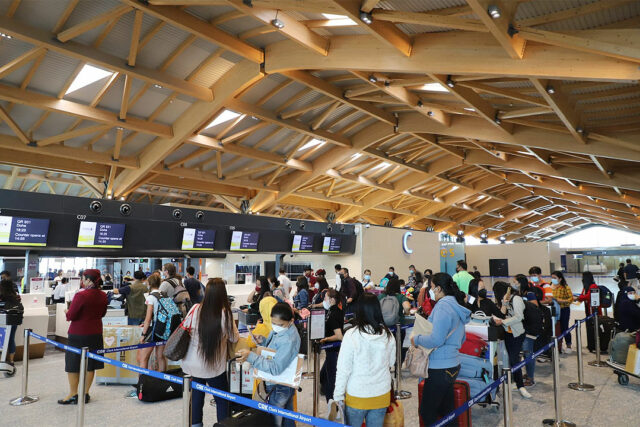
GOVERNMENT-OWNED Clark International Airport Corp. (CIAC) has secured oversight functions over the privately-run Clark International Airport, according to its officer-in-charge.  

The Department of Transportation (DoTr) has tasked CIAC to exercise regulatory supervision and oversight of activities occurring within the Clark Civil Aviation Complex, including Clark International Airport,CIAC Officer-in-Charge Darwin L. Cunanan said in a statement on Thursday.  

Clark International Airport, located about 96 kilometers north of the capital, is operated by the Luzon International Premier Airport Development (LIPAD) Corp.   

The consortium is composed of Filinvest Development Corp., JG Summit Holdings, Inc., Philippine Airport Ground Support Services, Inc., and Changi Airports Philippines (I) Pte. Ltd., a wholly owned subsidiary of Changi Airports International.  

The DoTr gave CIAC the authority to represent the department in the functions of its administrative supervision over LIPADs airport operations, so we shall be working closely with LIPAD in ensuring that operations abide by international standards and other rules and regulations as provided for by the national government,Mr. Cunanan said  

The Transportation department exercises policy and operational supervision over the government-owned corporation.  

According to Mr. Cunanan, the DoTr wants CIAC to contribute to the overall efficiency of the Philippine air transportation system.”  

As the national governments aviation authority in Clark, we have been ordered to oversee the day-to-day operations of the airport simultaneous with our day-to-day management of aviation-related business activities within the civil aviation complex,he added. Arjay L. Balinbin 

Political dynasties, parliament representation raised in consultations for Bangsamoro, election codes

BW FILE PHOTO/ TSBASMAN

ADDRESSING political dynasties and ensuring fair representation in parliament were among the issues raised as members of the Bangsamoro transitional government held consultations this week for the proposed regional laws on elections and local governance.   

The latest round of discussions was held in the island provinces of Basilan, Sulu, and Tawi-Tawi, where groups of Bangsamoro Parliament members met with local leaders and multi-sector representatives.  

Among the concerns raised were the proposed (local governance) codes inclusivity, its provisions on qualifications and disqualifications for elective local positions, and anti-political dynasties,the Bangsamoro Parliament said in a statement.   

Deputy Speaker Laisa M. Alamia noted that a provision against political dynasties would be unprecedented in the country.  

There is currently no enabling Philippine law that prohibits members of the same family or clan from concurrently or consecutively running for the same or different positions within a locality or at the national level.   

Section 40 of the proposed Bangsamoro Local Governance Code, which lists the basis for disqualification, includes Those who are related within the second civil degree of consanguinity or affinity to any incumbent local official running for an elective position.” 

This covers positions within the same province, city, municipality, or barangay.   

Election watchdog National Citizens’ Movement for Free Elections (NAMFREL), during consultations in October for the draft Bangsamoro Electoral Code, also put forward the adoption of an anti-political dynasty provision.  

NAMFREL recommended that, Candidates must not be related within the second civil degree of consanguinity or affinity to any incumbent elected national official or to any incumbent elected regional, provincial, city, municipal, or barangay official.”  

Meanwhile, officials in Tawi-Tawi, the farthest province from the southern mainland Mindanao, raised the need to consider the geographical characteristic of island localities for defining districts in the Bangsamoro region.   

The redistricting will determine representation in the Bangsamoro Parliament, whose members will be also be voted.  

Section 10 of Article 7 of the Bangsamoro Organic Law provides that parliamentary districts shall be apportioned based on population and geographical area, provided that each district shall comprise, as far as practicable, contiguous, compact, and adjacent territorial jurisdiction.”  

Tawi-Tawi Provincial Board member Dayang Carlsum S. Jumaide, who represents the womens sector, stressed the need to take into account the islands population and its remote location.  

Although the redistricting for parliamentary representation under the Bangsamoro Organic Law states that districts must be contiguous, compact, and adjacent, Island municipalities like those in Tawi-Tawi are separated by vast water, which criteria (contiguous, compact) may not apply as we perceive and believe, Ms. Jumaide said. 

Parliament Member John Anthony L. Lim, who is from Tawi-Tawi, agreed and said, Financial viability should be one of the criteria in apportioning the parliamentary districts to give a chance to smaller local government units to have representatives in the Parliament.”   

Bangsamoro Chief Minister Ahod B. Ebrahim has earlier committed to have both the Bangsamoro Electoral and Local Governance Codes passed within the first quarter next year.   

Another series of public consultations are scheduled this month in the regional capital Cotabato City, the provinces of Maguindanao and Lanao del Sur, and the regions Special Geographic Area. Marifi S. Jara

P6.5B needed for proposed subsidy on informal workers’ social insurance contribution  

A MEAT vendor at a public market in Manila qualifies as an informal worker based on House Bill 347 or the Magna Carta for Workers in the Informal Economy. — PHILIPPINE STAR/ RUSSELL PALMA

AROUND P6.5 billion in public funds will be needed annually to cover a proposed subsidy for the social insurance contribution of informal sector workers, according to the lawmaker who recommended the provision.   

Rep. Arlene D. Brosas of womens rights party-list Gabriela said the latest estimate is based on about 17 million Filipinos considered to be working in the informal economy.  

Last time (it was estimated), it was around the amount of P6.5 billion,she told BusinessWorld in a Viber message in mixed English and Filipino.   

In a separate text message, she said the number of informal workers should ideally not increase significantly if government can set up programs and policies on sustainable job creation.  

Supposedly workers in the informal economy do not increase because you have an industry that provides you a job, pays you, and establishes your rights. If more and more people are entering the informal economy, something is wrong with the governments management, she said.  

Ms. Brosas made the subsidy recommendation during the House committee meeting on labor and employment on Wednesday, where House Bill 347 or the Magna Carta for Workers in the Informal Economy was tackled.   

She said government can subsidize the monthly contribution of informal workers to the Social Security System (SSS), the state-run insurance program and pension fund for the private sector.  

The lawmaker said her proposal includes allinformal economy workers in line with the spirit of the proposed law.    

Under House Bill 347, informal economy workers include those who are self-employed, members of cooperatives, non-regular employees, agricultural and fishery workers, and those in legal but unrecognized or unregulated employment relationships, among others.   

We are only helping them (informal economy workers) up until the time that they can find a formal work or job,Ms. Brosas said in Filipino during a Makabayan bloc press conference on Thursday.   

Kabataan Party-list Rep. Raoul Danniel A. Manuel noted in the same press conference that the number of self-employed workers increased during the COVID-19 pandemic. Beatriz Marie D. Cruz

2023 bar exams set for September 

PHILIPPINE STAR/RUSSELL PALMA

THE SUPREME Court (SC) on Thursday confirmed that next year’s bar examinations will be held in September, earlier than the usual November schedule, which would allow for an earlier release of results.   

In a bulletin, the tribunal said the test for aspiring lawyers will be held on Sept. 17, 20 and 24.  

“The 2023 bar examinations shall thus proceed as it is nowdigitalized and regionalized, with a further-condensed schedule and carefully-streamlined scope for administrative efficiency,” said Associate Justice Ramon Paul L. Hernando, designated 2023 bar exams chairperson.  

Topics that tackle similar subject matter will be combined to modernize the implementation of the exams, he said in a statement on Dec. 4.  

This year’s exams were held on November 10, 13, 15 and 20 at 14 testing sites across the country.  

Last year’s exams were the first to be administered digitally and with multiple sites.  

Mr. Hernando noted that holding the exams in September will allow bar passers to seek employment earlier.  

A total of 8,241 takers passed the 2020/21 bar exams, which translates to a 72.8% passing rate.  

Chief Justice Alexander G. Gesmundo had said the bar exams would continue the digital format to take full advantage of new technology.    

“Exploit your last semester in law school to the fullest and your law review courses to the last minute as opportunities for mastery,” Mr. Hernando said addressing examinees for next year’s exams. John Victor D. Ordoñez 

Weightlifter Diaz routs field at Bogota World Championships

HIDILYN DIAZ — INTERNATIONAL WEIGHTLIFTING FEDERATION

TO BE recognized as the best, Hidilyn Diaz knew she had to prevail in the International Weightlifting Federation (IWF) World Championships.

And prevail she did. In a tour de force, the 31-year-old Olympic champion blew away the field in sweeping all three events in the IWF Worlds in Bogota, Colombia yesterday to finally collect the one medal color lacking in her impressive collection.

Ms. Diaz was nothing less than indomitable in breezing through the snatch, where she lifted 93 kilograms, clean and jerk with 114kg, for a combined total of 207kg. In the process, she added to her trophy case, which already includes titles in the Olympics, Asian Games, Asian Championships and Southeast Asian Games.

While it wasn’t as dominant as her effort in Tokyo where she had an electric 224kg total on a 97kg snatch and a 127kg clean and jerk, her performance in Bogota was nonetheless enough to take the win.

Colombian Rosalba Estela Aguila del Morales was at distant second with a 199kg (89kg snatch, 110kg clean and jerk) while Mexican Ana Gabriel Lopez Ferrer was third with 198kg (90kg, 108kg).

Along the way, Ms. Diaz earned precious qualifying points to the 2024 Paris Games, where she will be gunning for a second Olympic gold that could be her swan song.

It could be in Paris where Diaz seals her standing as one of the titans of the sport.

“She’s an outstanding athlete and Filipina,” an ecstatic Samahang Weightlifting ng Pilipinas president Monico Puentevella yesterday told The STAR. “She’s got more chances now to go to Paris 2024.”

“She really has a heart of a champion,” he added.

Mr. Puentevella, who thanked President Ferdinand R. Marcos, Jr. and the Philippine Sports Commission for the support, said Ms. Diaz’s performance should inspire the country and the rest of the national contingent in Bogota, including Olympian Elreen Ando and Asian and SEA Games titlist Vanessa Sarno.

“Her gold will inspire our other lifters coming up,” said Mr. Puentevella. — Joey Villar

Gilas call-up could be in the works for Adamson’s Lastimosa, DLSU’s Winston

ADAMSON’S Jerom Lastimosa — UAAP MEDIA

ADAMSON’S Jerom Lastimosa and La Salle’s (DLSU) Schonny Winston could be the next collegiate stars in line for a Gilas Pilipinas call-up soon.

Head coach and program director Chot Reyes said inviting the two UAAP standouts is on the horizon, though his coaching staff has yet to reconvene and compile an official training pool for the national team’s next tour of duty.

“We can invite Jerom, Schonny and the others but I’ll have to confer with the coaching staff first,” Mr. Reyes told The STAR ahead of Gilas’ reassembly in February for the sixth and last window of the 2023 FIBA World Cup Asian Qualifiers.

Mr. Lastimosa and Mr. Winston recently completed campaigning in UAAP Season 85.

Prior to his calf injury, Fil-American gunner Mr. Winston led the MVP race behind league-best averages of 21.3 points, 6.1 rebounds and 3.6 assists, while Mr. Lastimosa put up 14.8 points, 4.3 rebounds and 3.9 assists including an array of heroics to lift Adamson to the Final Four.

Mr. Winston, who has been cleared by FIBA as a local player, previously expressed his desire to play for Gilas while Mr. Lastimosa vowed to be ready when his number gets called in the aftermath of Adamson’s Final Four exit at the hands of No. 1 Ateneo, 81-60.

“Yes of course. Kapag kinuha nila ako, siyempre, i-grab ko ang opportunity na iyun. Hindi ko hahayaan na mawala iyun. Para iyun sa bayan natin (If I am called, I will grab he opportunity. I will not let that chance pass. It’s for the country)” said Mr. Lastimosa, who has not yet decided whether to play his last year in the UAAP or go pro.

If ever, Mr. Lastimosa and Mr. Winston would join UP’s Carl Tamayo, Ateneo’s Ange Kouame and La Salle’s Kevin Quimbao as UAAP representatives to the national team.

Last month, the UAAP paused its season for two weeks to accommodate Gilas during the fifth window, where it swept Jordan and Saudi Arabia in road games played in the Middle East.

Mr. Tamayo, who suited up in the FIBA Asia Cup and fourth window, begged off due to a right ankle injury while Mr. Kouame and Mr. Quiambao played vital roles in Gilas’ campaign ahead of the last window at the Philippine Arena against Jordan once more as well as tormentor Lebanon. — John Bryan Ulanday

Frayna rules blitz chess at national championships

JANELLE MAE FRAYNA — NATIONAL CHESS FEDERATION OF THE PHILIPPINES

JANELLE Mae Frayna vented all her frustrations from losing her crown in standard play by ruling the blitz event of the Philippine National Chess Championships presented by Nova Wellness Store at the PACE late Wednesday.

The 25-year-old, who is the first Woman Grandmaster from the Philippines, finished undefeated with 9.5 points out of a possible 11 on eight victories and three draws to rule the side event.

The triumph made up for her heartbreak in failing to defend the classical crown, which went to Woman International Master (WIM) Marie Antoinette San Diego.

Ms. Frayna, who played board number one for the Philippines at the Chess Olympiad, went home with a runner-up finish in standard chess, where she consoled herself with a P30,000 purse, with the blitz trophy a bonus.

Not bad for a week’s work.

“I’m sharing this victory with my family, (especially) my brother who first taught me to play chess,” Ms. Frayna said, referring to her elder sibling, police inspector Don Mari Phil Frayna, who was present during the awarding ceremony.

WIM Jan Jodilyn Fronda, a former national champion herself, wound up at No. 2 with seven points, while wonder girl April Joy Claros took No. 3 after edging Bea Mendoza via tiebreak. — Joey Villar

Qatar on track to miss 1.2 million World Cup visitor target

A GENERAL VIEW during an opening ceremony before a group stage match during the 2022 FIFA World Cup between Qatar and Ecuador at Al Bayt Stadium. — DANIELLE PARHIZKARAN-USA TODAY SPORTS

DOHA, — Qatar received just over 765,000 visitors during the first two weeks of the World Cup, according to an organizers’ report obtained by Reuters, putting it in danger of missing its projection of 1.2 million during the month-long event.

A huge surge in visitors at this stage is unlikely with only eight teams staying on in Doha out of the 64 that started the tournament on Nov. 20.

Organizers had previously identified the peak period for international visitors to be Nov. 24-28 during the busy group stage, when 32 teams were playing four matches every day.

The Dec. 7 report was prepared by the Supreme Committee for Delivery and Legacy (SC), which organizes the tournament, and said that the first 17 days of the World Cup saw 765,859 international visitors, more than half of whom have now departed.

The report registered 1.33 million match ticketholders and 3.09 million tickets sold across the eight stadiums in Qatar for the tournament that ends on Dec. 18.

A Qatari official, who did not wish to be named, confirmed the figures. The SC did not respond to Reuters’ requests for comment.

The tournament in Qatar, the first to be held in the Middle East, is considered one of the most expensive in terms of tickets, hotels and alcohol, sales of which are restricted.

Fewer international visitors than originally forecast led to an unexpected glut of accommodation but has also averted major over-crowding or traffic headaches in Qatar, the smallest country by both population and area to host the World Cup.

The influx of visitors represents a 25% boost to the country’s resident population of 3 million, of which only about 10-12% are Qataris.

“With over a week of competition still to go, a wave of new visitors has started arriving from the nations that made it to the quarter finals,” the Qatari official told Reuters.

More visitors are expected to flock to Qatar for popular matches and after the country lifted entry restrictions for nationals and residents of fellow Gulf states.

Cumulative stadium attendance at the first 52 matches was 2.65 million, the document said.

Previously, world soccer’s governing body FIFA said that stadium attendance in Qatar had surpassed attendance at stadiums during a corresponding period at the 2018 World Cup in Russia.

On Tuesday, hundreds of Moroccan fans flew into Qatar on special flights arranged ahead of their team’s victory over Spain.

It is expected that similar fights will be laid on to allow last-minute fans to fly in from overseas to watch their teams advance through the tournament’s final three rounds.

Visitors to Qatar must obtain a Hayya identification card ahead of travel as it doubles as a mandatory entry visa during the tournament period.

On Tuesday, Qatar dropped this requirement for Gulf Cooperation Council countries.  Reuters

Belgium’s Eden Hazard quits internationals after World Cup exit

BELGIUM captain Eden Hazard — SVETLANA BEKETOVA

AL RAYYAN, Qatar — Belgium captain Eden Hazard announced his retirement from international football aged 31 Wednesday after his second-ranked team’s World Cup campaign ended in a disappointing group stage exit.

Mr. Hazard, the anchor of Belgium’s “golden generation,” played in all three games but did not score as Belgium beat Canada, lost to Morocco and had to settle for a goalless draw with Croatia to finish third in Group F.

The forward made his senior debut in 2008 and scored 33 times in 126 appearances. He guided Belgium to their best World Cup finish at the 2018 tournament in Russia, when they came third.

“I have decided to put an end to my international career. The succession is ready,” Mr. Hazard wrote on Instagram. “A page turns today… Thank you for your love. Thank you for your unparalleled support. Thank you for all this happiness shared since 2008… I will miss you.”

Belgium lost to eventual champions France four years ago and beat England in the third-placed playoff but they were unable to find that spark in Qatar and bowed out with a whimper.

Hazard joined Belgium coach Roberto Martinez in stepping away from the national team after a dismal campaign in which they scored only one goal in three games, and made more headlines for reported off-field squabbles than their football.

Mr. Hazard, who won the Premier League and Europa League twice among other major honors in seven seasons at Chelsea, has struggled since his move to Real Madrid in 2019. He has won the Champions League and two LaLiga titles but scored only seven times in all competitions during his time in the Spanish capital. — Reuters

The Giants fail to land Aaron Judge

The San Francisco Giants had a good plan. No, scratch that. They had an excellent plan, one that focused on the seemingly incongruous notion that Aaron Judge would be going home were he to turn his back on the Yankees. That he stood as the face of the league’s biggest franchise situated in the media capital of the world — and he that just claimed a piece of history in pinstripes — didn’t faze them. In fact, it emboldened them, steeled as they were by the fact that he felt compelled to first bet on himself before his should-have-been-grateful employers recognized his true worth.

And so the Giants went about wooing Judge by leveraging his California roots and childhood predilections. They tried to appeal to his emotions, and, for  a while there, they looked close to sealing the deal. Because they knew negotiating in the spotlight would simply underscore the equity of the incumbent, they strove to keep his pre-Thanksgiving visit to the Bay Area out of the public eye.

Unfortunately, a walk through the lobby of the St. Regis, where he was billeted for the stop, turned out to be all that was needed for an ambush interview to hit social media. Which, in a nutshell, raised the profile of the sweepstakes even more and put the Yankees in win-at-all-costs mode.

To be sure, the Giants knew they were handicapped from the outset. All other things being equal, the competition would prevail. And although they were fully prepared to engage in a bidding war, they didn’t want to do so. Such a negotiating strategy would drive Judge’s price up and end in a Yankees win.

It’s why, in the end, they understood that the newly minted American League Most Valuable Player awardee would have to want to change addresses for reasons that went beyond the zeros on his paycheck. Whatever the non-material impetus that would move him to do so, they had to provide or highlight.

Perhaps Judge was going to sign with the Yankees no matter what. Perhaps the Giants were destined to be bidders that merely inflated the numbers. In any case, they had to swing for the fences. Notwithstanding the probability of their exertions ending in a whiff, they had to go all in — just as they did with other high-profile free agents in the past, and just as they will continue to do with targets in the future.

And if they turn out to be means to an end in just about every instance, so be it. In the final analysis, no one can say they didn’t try, and that they won’t keep trying.


Anthony L. Cuaycong has been writing Courtside since BusinessWorld introduced a Sports section in 1994. He is a consultant on strategic planning, operations and human resources management, corporate communications, and business development.

Sari-sari stores offering financial services among ‘megatrends’ seen to propel PHL fintech market

BW FILE PHOTO

Sari-sari stores that offer embedded financial services will help propel the local fintech market, according to an alternative finance expert.

“That’s the beauty of embedded finance,” said Mario Jordan “Magellan” Fetalino III, head of alternative finance and innovation garage of UBX Philippines Corporation, the fintech subsidiary of UnionBank of the Philippines. “Even players like groceries are now able to [offer] additional layers of services … At some point, you will see a lot of non-financial institutions acting like banks.” 

“Many businesses in the PH do not even have a bank account. Now they are the bank,” Mr. Fetalino added. He cited individuals in rural areas cashing in overseas remittances at sari-sari stores through their mobile phones. 

Mobile connections in the Philippines were equivalent to 140% percent of the total population in January 2022, according to GSMA Intelligence. Meanwhile, the World Bank reported that 51% of Filipinos have bank accounts in 2021, up from 34% in 2017.

Embedded finance or the integration of finance into non-finance companies like sari-sari stores is one of the three fintech “megatrends” identified at a Dec. 7 event organized by TechShake Asia, along with open finance and decentralized finance. 

Open finance, a model that allows platforms to share financial data provided that there is consumer consent, will pave the way for wider integration among services. 

“Open banking is going to be inevitable in the country,” Mr. Fetalino said. “I can just plug in to the open API [application programming interface] of an app like Foodpanda and already utilize the data of their customers as long as there’s permission … the permission will come from you as a customer.” 

Decentralized finance, which allows people to exchange financial assets on the blockchain without relying on banks or brokerages, will “push the production and provision of products and services at the point of need,” said Mr. Fetalino, who added that these three megatrends will be pushed by the government’s focus on digital infrastructure. P. B. Mirasol


‘Too many positives!’: As China rows back ‘zero-COVID’ policy, many fear spike in cases

PEOPLE wearing face masks are seen at a subway station in Shanghai, China, Jan. 18, 2021. — REUTERS

BEIJING — As many Chinese embraced new found freedoms on Thursday after the country dropped key parts of its tough zero-COVID regime, some cities warned residents to maintain vigilance against a virus that, until now, has been largely kept in check.

Three years into the pandemic, many in China had been itching for Beijing to start to align its rigid virus prevention measures with the rest of the world, which has largely opened up in an effort to live with the disease.

Those frustrations boiled over into widespread protests last month, the biggest show of public discontent since President Xi Jinping came to power in 2012.

Without saying it was a response to the protests, some cities and regions began relaxing COVID controls, in moves that heralded a nationwide loosening of the rules unveiled by the National Health Commission (NHC) on Wednesday.

The NHC said infected people with mild symptoms can now quarantine at home and it dropped the need for testing and health status apps for a variety of activities including travelling around the country.

Domestic ticket sales for tourist and leisure spots have soared, according to state press, while some people took to social media to reveal they had tested positive for the virus — something that had previously carried heavy stigma in China.

Others expressed caution.

“I know COVID is not so ‘horrifying’ now, but it is still contagious and will hurt,” said one post on the Weibo platform. “The fear brought to our heart cannot be easily dissipated.”

China reported 21,439 new COVID-19 infections on Dec. 7, compared with 25,321 a day earlier.

“Too many positives!” said another Weibo user.

ILL-PREPARED
Top officials have been softening their tone on the dangers posed by the virus in recent weeks, bringing China closer to what other countries have been saying for more than a year as they dropped restrictions.

But, while announcing the implementation of the new measures late on Wednesday, some cities urged residents to remain vigilant.

“The general public should maintain a good awareness of personal protection, and be the first responsible person for their own health,” Zhengzhou, the central city home to the world’s largest iPhone factory, said in a message to residents.

It urged residents to wear masks, maintain social distancing, seek medical attention for fever and other COVID symptoms and, especially for the elderly, to get vaccinated.

Some analysts and medical experts say China is ill-prepared for a major surge in infections, partly due to low vaccination rates among vulnerable, older people and its fragile healthcare system.

“It (China) may have to pay for its procrastination on embracing a ‘living with COVID’ approach,” Nomura analysts said in a note on Thursday.

Infection rates in China are only around 0.13%, “far from the level needed for herd immunity,” Nomura said.

Feng Zijian, a former official in China’s Center for Disease Control, told the China Youth Daily that up to 60% of China’s population could be infected in the first large-scale wave before stabilizing.

“Ultimately, around 80%-90% of people will be infected,” he said.

China’s current tally of 5,235 COVID-related deaths is a tiny fraction of its population of 1.4 billion, and extremely low by global standards. Some experts have warned that toll could rise above 1.5 million if the exit is too hasty. — Reuters

ADVERTISEMENT
ADVERTISEMENT