Home Blog Page 5520

Metrobank’s Wealth Insights provides expert advice, intelligence for managing and growing wealth

After years of building wealth, perhaps you are thinking about ways to preserve it and grow your money further.

Yet, as we know, there are many considerations before making an investment decision and ensuring that you made the right ones, especially in a volatile market and amid different external factors that may affect your positions.

Of course, you want to find the best opportunities in the market for you to invest in. And to do so, you would need to research and get relevant data, as well as seek insights from experts who are always updated on the global and local markets. These can be valuable to ascertain that you are properly managing and investing your wealth to reach more of your wealth goals.

To make access to such investment-related advice and information more convenient, you can simply go to the Wealth Insights website of Metropolitan Bank & Trust Co. (Metrobank).

On a wealth management proposition, access to financial planning and advice as well as market data and research are two of the four core priorities of more than three-quarters of investors, according to The Future of Asia Wealth Management Series survey.

Through Wealth Insights, Metrobank pioneered another means to make expert advice and other information associated with wealth management more accessible for its clients, particularly high-net-worth individuals (HWNIs).

“Wealth Insights is an online portal created by Metrobank for high-net-worth clients who want to smartly manage and grow their wealth,” said Fernand Antonio Tansingco, Metrobank’s Senior Executive Vice-President and Head of Financial Markets Sector. “It provides timely and relevant information, thoughtful perspectives, and expert advice and actionable investment ideas from Metrobank’s finance and investment experts as well as independent third-party research providers.”

Clients can get a daily dose of market updates and smart investment strategies at Wealth Insights’ The Gist section, which can serve as a guide to making portfolio decisions.

Metrobank also provides top stock and bond recommendations under Portfolio Picks. For ideas and advice for your bond portfolio, you can depend on the research and analysis of Metrobank’s in-house experts and its partner CreditSights, an award-winning credit research provider owned by the Fitch Solutions Group, for a wider coverage of global bond issuers. The stock recommendations are also based on the extensive research and experience of Metrobank experts.

In addition, the online portal gives you access to the most important market-moving news from Reuters, curated by Metrobank, that can affect the wealth of HNWIs in the country.

Wealth Insights also includes essays and articles on various financial and wealth management topics, where you can get opinions and perspectives from experts about issues and ideas that can shape your wealth management strategy.

Under these sections of Wealth Insights are a range of topics that cover news and expert analysis on the foreign exchange, rates and bonds, equities, and the local and global economy.

The website also features investment tips, inspiration, and advice on fine living, a guide to retirement, and webinars featuring Metrobank’s finance and investment experts talking about subjects related to wealth management.

The Wealth Insights website is accessible to anyone but some articles and pages, such as Portfolio Picks, are exclusive to registered high-net-worth clients.

“Because money management is not a one-size-fits-all for all consumers, we have different initiatives to properly guide Filipinos in their financial journey,” Mr. Tansingco said. “We want to enable them to live life to the fullest through financial education, so our customers can make decisions on how they can use their money in smart and meaningful ways.”

With Wealth Insights, Metrobank makes it easy for wealth clients to make their investment decisions through a single platform so they do not have to look elsewhere for information and insights that they need. Clients can now focus on things that matter to them.

Wealth Insights is backed by Metrobank’s proven wealth management expertise. The bank holds 60 years of wisdom and experience in the finance world. Since 1962, Metrobank has always put its clients at the center of the business, employing a strategy that revolves around meeting and foreseeing their needs.

Learn more about wealth management and make the right investment decisions with Metrobank’s Wealth Insights. Visit https://wealthinsights.metrobank.com.ph/.


Spotlight is BusinessWorld’s sponsored section that allows advertisers to amplify their brand and connect with BusinessWorld’s audience by enabling them to publish their stories directly on the BusinessWorld Web site. For more information, send an email to online@bworldonline.com.

Join us on Viber to get more updates from BusinessWorld: https://bit.ly/3hv6bLA.

BSP may hike rates by 50 bps — poll

BW FILE PHOTO

By Keisha B. Ta-asan, Reporter

THE PHILIPPINE central bank is widely expected to raise benchmark interest rates by 50 basis points (bps) at its meeting on Thursday, as the US Federal Reserve is also likely to tighten policy this week.    

A BusinessWorld poll last week showed 14 out of 15 analysts expect the Monetary Board (MB) to continue hiking borrowing costs at its Dec. 15 meeting.

For 13 analysts, the central bank may deliver a 50-bp rate increase, while one economist sees a 25-bp hike.

Analysts’ expectations on policy rates (Dec. 2022)

On the other hand, one analyst expects the Bangko Sentral ng Pilipinas (BSP) to keep rates unchanged.

“The outcome of the US FOMC (Federal Open Market Committee) meeting overnight, the trajectory of the dollar-peso exchange rate and November’s inflation print will be key considerations for the BSP’s decision,” ANZ Research economist Debalika Sarkar said.

“We believe that the central bank will maintain a comfortable interest rate differential with the US to support the peso and limit the pass-through effect on domestic inflation, which is already running far above the tolerance limit,” she added.

The BSP has hiked policy rates by 300 bps since May to keep rising prices in check, with the key rate now at 5%.

Meanwhile, the US Federal Reserve has raised borrowing costs by 375 bps since March to a range between 3.75% and 4%. It is widely expected to deliver a smaller rate hike of just 50 bps on Dec. 13-14 following four straight 75-bp increases.

“Definitely, the size of the Fed rate hike that will be announced just the day before the BSP Monetary Board meets [will be a key consideration for the BSP]; our base case is that the Fed will pivot, too, to a smaller rate increase,” Pantheon Macroeconomics Chief Emerging Asia Economist Miguel Chanco said.

“The current inflation print suggests that the BSP will opt for a 50-bp hike in its next policy meeting on Dec. 15, following an expected similar-sized hike by the US Federal Reserve, and in a bid to bring inflation back to a target-consistent path for 2023,” Security Bank Corp. Chief Economist Robert Dan J. Roces said.

Mr. Roces said it is important to see if inflation is being driven by “temporary” factors such as holiday-induced demand or weather-related supply disruptions.

“The rise in the prices of goods and services during the period leading up to and including Christmas can have implications for inflation as it causes retailers to raise prices to capitalize on the increased demand for their products,” he said.

Given already high prices of food due to agricultural losses from recent typhoons, inflationary risks are on the upside, he added. 

Headline inflation picked up to 8% in November from 7.7% in October and 3.7% in November 2021. For the 11-month period, inflation averaged 5.6%, still lower than the BSP’s 5.8% full-year forecast but well above its 2-4% target.

“The inflation rate is bound to stay at an accelerated level until the end of the year because of the heightened demand brought about by the onset of the holiday season,” Colegio de San Juan de Letran Graduate School Associate Professor Emmanuel J. Lopez said.

“One thing working favorably for the local economy is the continued appreciation of the local currency against the US dollar. Although this is not brought about by a stronger local economy but by the weak US economy and China’s lockdown, the appreciation of the peso has brought relief to the once-depreciating/ailing local currency,” Mr. Lopez added.

After hitting a new record low of P59 per dollar this year, the peso has rebounded, returning to the P55 level this month.

On Friday, the local unit closed at P55.37 against the dollar, up by eight centavos from its P55.45 close on Wednesday.

BSP MAY STILL HIKE RATES IN 2023
The central bank is also likely to extend its tightening cycle until next year as inflation is still expected to overshoot its 2-4% target, analysts said.

China Banking Corp. Chief Economist Domini S. Velasquez said core inflation will likely peak in the first quarter of 2023.

“This means that aside from the December hike, the BSP will continue its monetary tightening cycle until early next year. Our forecast for 2023 average inflation of 4.6% is higher than the BSP’s,” she said. 

Core inflation, which discounts volatile prices of food and fuel, climbed 6.5% in November from 5.9% in October. In the eleven months to November, core inflation averaged 3.7%.

For next year, the BSP sees inflation averaging 4.3% before easing to 3.1% in 2024. 

Ms. Velasquez added that the benchmark policy rate of the BSP may reach 6% next year, and policy easing, if any, will only happen in the fourth quarter as inflation is seen to return within target by then. 

“Both the BSP and the National Government will need to keep a close eye on the trajectory of core inflation, which could bleed into the first half of 2023 and prove more difficult to tame if left unchecked,” Security Bank’s Mr. Roces said.

“Should prices increase beyond normal market fluctuations and bleed into the core as well, the BSP may need to take further, stronger action to prevent a larger inflationary problem from developing, while the government will need to ramp up subsidies and price caps to complement the monetary side,” he added.

For UnionBank of the Philippines, Inc. Chief Economist Ruben Carlo O. Asuncion, the BSP will need to ensure inflation expectations remain anchored.

“While we hope for faster disinflation soon and thus, an early termination of the BSP’s rate hiking cycle, the additional challenge of an upbeat domestic demand backdrop will also require a higher terminal policy rate to reprioritize savings among households and thus, mitigate the demand-side contribution to inflation pressures,” he said. 

The BSP is also likely to continue mirroring the Fed’s actions until next year, said ING Bank N.V. Manila Senior Economist Nicholas Antonio T. Mapa.

“If the Fed carries out its pivot, the BSP will be able to do its own pivot with a pause in the second quarter of 2023 and rate cuts in the second half next year,” he said. 

However, for Pantheon Macroeconomics’ Mr. Chanco, the 50-bp rate hike in December may be the BSP’s last increase in this tightening cycle.

“Not much more are needed to guarantee that inflation will fall back to within the target range by around third quarter next year, at the latest, thanks to the moderation in global food and oil inflation,” he said.

Infrastructure spending rises 39% in September

BW FILE PHOTO

By Luisa Maria Jacinta C. Jocson, Reporter

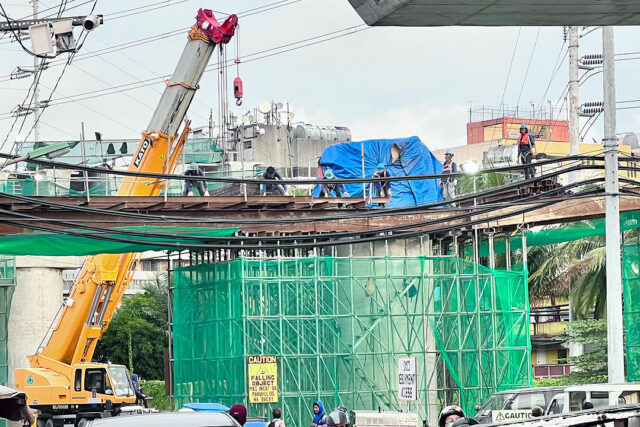
INFRASTRUCTURE SPENDING rose by 39.3% in September as the government completed more projects, the Department of Budget and Management (DBM) said.

In its National Government (NG) disbursement report, the DBM said expenditures for infrastructure and other capital outlays increased to P99.1 billion in September from P71.2 billion a year ago.

The September figure was also 34.6% higher than the P73.7 billion spent in August.

“The growth was largely due to the sizable disbursements of the Department of Public Works and Highways for completed and partially completed road infrastructure projects,” the DBM said in a press release.

Releases for the Active Transport Bike Share System and Safe Pathways Program by the Department of Transportation (DoTr) also contributed to higher capital expenditures during the month, it added.

In the nine months to September, infrastructure spending was up 13.4% to P727.7 billion from P641.5 billion a year earlier but 4.11% lower than the P758.9-billion program for the period.

The DBM said that spending in January to September was due to the implementation of road infrastructure projects nationwide and capital outlay projects under the Revised Armed Forces of the Philippines Modernization Program of the Department of National Defense.

It also cited direct payments made to suppliers by development partners for the implementation of foreign-assisted projects of the DoTr, such as the Metro Manila Subway Project Phase 1, Malolos-Clark Railway Project, and Maritime Safety Capability Project.

However, it attributed the lower spending against the program due to the unintended delays brought about by the election ban on public works during the earlier part of the year.

The modification of projects, unsettled right-of-way problems, intermittent weather conditions, delays in the submission of progress billings, and pending deliveries from suppliers and contractors also resulted in lower-than-programmed disbursements.

Infrastructure spending in the third quarter was higher by 16.3% to P249.9 billion from P214.9 billion in the similar period a year ago. It was also 8.84% above the P229.6-billion program.

“Infrastructure and other capital outlays have since picked up in the third quarter, exceeding the program for the period as a result of catch-up spending,” the DBM said.

“Furthermore, measures were already being undertaken to fast-track the implementation of said projects. For instance, the DoH (Department of Health) has been closely coordinating with their concerned operating units and providing them with assistance in resolving documentation requirements or issues. The review of current processes and existing systems is also ongoing with the end goal of improving fund utilization,” it added.

China Banking Corp. Chief Economist Domini S. Velasquez said the catch-up spending seen in September is much needed as the country still lags behind most of its neighbors in terms of infrastructure expenditures.

“Full utilization of the budget of line agencies is needed to ensure that the economy will be able to take full advantage of the budget. Historically, we have observed expenditures catching up in the fourth quarter as government agencies ramp up spending to close the year. Hopefully, the remaining programmed budget will be used on time,” Ms. Velasquez said in a Viber message.

Rizal Commercial Banking Corp. Chief Economist Michael L. Ricafort said infrastructure spending will likely remain a “bright spot” for the economy next year.

“Infrastructure spending remains a priority of the administration as a major economic driver, accounting for at least 5% of gross domestic product, more than twice the 2% over the past 20-30 years,” he said in a Viber message.

Mr. Ricafort added that increased spending on infrastructure is needed to help attract more foreign investments into the country and also support initiatives to further develop agriculture and manufacturing, including farm-to-market roads and storage facilities.

Contributing to sovereign wealth fund could undermine BSP’s independence, analysts say

BW FILE PHOTO

REQUIRING the Bangko Sentral ng Pilipinas (BSP) to contribute its annual dividends to the Maharlika Wealth Fund (MWF) could undermine its integrity, analysts said.

Calixto V. Chikiamco, president of the Foundation for Economic Freedom (FEF), said mandating the central bank to contribute its dividends to the planned sovereign wealth fund is “a bad idea.”

“Firstly, it amends the Charter of the Bangko Sentral, which mandates that the dividends of the BSP will go to its recapitalization. Such an amendment in the MWF is legally doubtful without an express amendment of the BSP Charter,” Mr. Chikiamco said in a Viber message.

“More importantly, by mandating that the profits of the BSP go to the MWF, it will undermine the mission and integrity of the Bangko Sentral because the BSP will be perceived as a profit-making institution and its income objectives will be perceived as driving monetary and exchange rate policy,” he said. “It will destroy BSP as a credible institution focused on fostering price and financial stability.”

On Friday, Finance Secretary Benjamin E. Diokno said the proposed Maharlika Wealth Fund is being revised to require the BSP to contribute 100% of its annual dividends into the sovereign wealth fund for its first two years.

After the fund’s first two years, the central bank will only need to remit 50% of its declared dividends to it, with the remaining 50% to be deposited to a special account meant to ramp up the P200-billion capitalization of the BSP.

The Maharlika Wealth Fund could again receive 100% of the BSP’s dividends once the central bank is fully capitalized.

Several lawmakers headed by House Speaker Ferdinand Martin G. Romualdez and Deputy Majority Leader Ferdinand Alexander A. Marcos last month filed a bill seeking to create a sovereign wealth fund in the country with an initial capitalization of P250 billion.

Last year, the BSP’s net income stood at P34.81 billion, while its dividends amounted to P17.41 billion.

In 2019, the BSP booked a net income of P46.1 billion, declaring dividends of P23.05 billion. Its net income stood at P31.79 billion in 2020 with its declared dividend at around P15.89 billion. 

“The whole concept of the MWF is a bad idea at this time and is irreparable. No amount of safeguards can salvage the concept, especially if the funding comes from the BSP,” Mr. Chikiamco said.

“Better that they reconceptualize the idea from the MWF to a development finance institution, revive the National Development Corp. (NDC) for the projects it wants to finance, and look at the privatization of government assets to recapitalize NDC,” he added.

Several business associations, economic policy groups, civil society organizations and labor groups have likewise opposed the proposed measure, citing concerns over lack of transparency, possible corruption and misuse of pension funds.

“The need to create a sovereign wealth fund has been felt across several countries in Southeast Asia with India, Malaysia, and Indonesia taking the lead on this front. However, such funds are usually funded by commodity revenue or excess foreign reserves, none of which the Philippines possesses,” Swarup Gupta, industry manager of the Economist Intelligence Unit, said in an e-mail. 

“In contrast, the Philippines has the highest fiscal deficit among economies in Southeast Asia, which makes the creation of a sovereign wealth fund a risky move at a time of great global economic uncertainty,” he added.

The National Government’s budget deficit ballooned to P99.1 billion in October, 54.08% higher than the P64.3-billion deficit in the same month a year ago.

Meanwhile, for the first 10 months, the fiscal deficit narrowed by 7.61% to P1.11 trillion from the P1.2 trillion during the same period a year ago.

Mr. Gupta said getting MWF funding from the BSP is “a move that could easily undermine the independence of the central bank and the country’s foreign exchange reserves, which could have serious implications if the global economic outlook worsens.”

“The example of Malaysia’s ill-fated 1MDB (1Malaysia Development Berhad) fund has often been quoted by critics of the fund, and with good reason,” he added. “While the Philippines’ fund will be subject to multiple audits, its initial charter allows investments in all possible asset classes without restriction.”

“Also, there are concerns about governance standards and clear objectives need to be laid out in order for it to be successful. The presence of an independent ombudsman, who periodically checks on the working of the fund, could go a long way towards preventing any malfeasance,” Mr. Gupta said.

The wealth fund must also align with international best practices laid down by the International Monetary Fund, he added. 

Domini S. Velasquez, chief economist at China Banking Corp., said a concern is if the budget would go through proper review channels or through a legislative process.

“In automatically diverting dividends to the Maharlika Wealth Fund, we lose this check and balance on government’s spending. As of now, the current proposal of the Maharlika Wealth Fund does not seem to have sufficient safeguards to guarantee promises of the proponents,” Ms. Velasquez said.

“I agree with most critics that timeliness of creating a wealth fund is vital. In a time where we need to bring down debt and close the fiscal deficit, dividends from revenue-generating government institutions are important to support fiscal consolidation of the government,” she added. — Keisha B. Ta-asan

Gov’t debt service bill declines in October

BW FILE PHOTO

THE NATIONAL Government (NG) saw its debt service bill drop in October as lower amortization payments offset the rise in interest payments.

Preliminary data from the Bureau of the Treasury (BTr) showed the government spent P39.817 billion for debt servicing in October, down by 55.3% from P89.066 billion in the same month a year ago.

Month on month, debt payments fell by 80.76% from P206.996 billion in September.

In October, around 83.34% of debt repayments went to interest payments, while the rest went to amortization.

Interest payments inched up 5.23% year on year to P33.185 billion in October from P31.536 billion.

Broken down, interest paid on domestic debt slipped by 6.59% to P22.407 billion from P23.989 billion, while that for foreign debt surged by 42.81% to P10.778 billion from P7.547 billion.

Domestic debt consisted of P17.636 billion in Treasury bonds, P3.575 billion in retail Treasury bonds, and P706 million in Treasury bills.

Meanwhile, overall amortization payments slumped by 88.47% to P6.632 billion in October from P57.53 billion in the same month last year.

The BTr settled P894 million with domestic lenders, while principal payments to foreign creditors amounted to P5.738 billion.

From January to October, debt repayments decreased by 11.63% to P929.663 billion from P1.052 trillion, with amortization taking up 53.41% of the total.

Principal payments in the 10-month period stood at P496.502 billion, dropping by 27.19% from P681.957 billion a year earlier. This consisted of P408.833 billion in domestic debt and P87.669 billion in foreign obligations.

Interest payments went up by 16.79% to P433.161 billion from P370.884 billion in the similar period. These included P328.617 billion worth of payments to domestic creditors and P105.544 billion to foreign creditors.

The government borrows from local and external sources to help fund a budget deficit capped at 7.6% of gross domestic product (GDP) this year, as it spends more than the revenue it generates to support programs that would stimulate economic growth.

The government plans to spend P1.298 trillion on debt payments this year, with P785.21 billion allocated for principal and the remaining P512.59 billion for interest.

The National Government’s gross borrowings declined by 32.7% to P1.85 trillion as of end-October.

In the same period, its outstanding debt hit a record high of P13.64 trillion.

The country’s debt-to-GDP ratio stood at 63.7% at end-September, still above the 60% threshold considered manageable by most multilateral lenders.

The government is aiming to bring down the ratio to 61.8% by the end of the year and to 52.5% by 2028. — Luisa Maria Jacinta C. Jocson

Lopez firm buys unit of US healthcare provider

LOPEZ-LED First Philippine Holdings Corp. (FPH) has signed an agreement to acquire the local subsidiary of Medical Services of America, Inc. (MSA) as part of its expansion plans in the healthcare industry.

MSA provides a comprehensive range of cardiopulmonary services and equipment for hospitals and home-services patients.

FPH President and Chief Operations Officer Francis Giles B. Puno and MSA-Philippines General Manager Aurora J. Dereja signed the agreement on Dec.9, the firm said in a press release on Sunday.

“This new acquisition provides FPH a platform to add new service offerings to what MSA-Philippines offers now in the healthcare industry,” FPH Senior Vice-President for Health Services Businesses Joaquin E. Quintos, IV said in a statement.

FPH currently has two more health-related businesses which are Asian Eye Institute and Philippine Impact Health.

“The services created from these various healthcare businesses aim to improve the ecosystem of healthcare providers in the country and, ultimately, the health and wellness of the Filipino population,” Mr. Puno said.

FPH received advice from SGV & Co. and Puno Law for the acquisition, while MSA was advised by PwC Philippines and Cabrera & Co.

MSA was originally organized in the US in 1973 as a provider of comprehensive healthcare services. It started in the Philippines as a servicing company for four partner-hospitals five years after it opened in the US.

At present, MSA-Philippines works with over 50 partner-hospitals and clinics nationwide with a portfolio of 200 employees.

“With a strong and credible Philippine parent company, MSA-Philippines hopes to expand further its footprint in the Philippines and offer more healthcare solutions to our partner-hospitals,” Ms. Dereja said.

FPH, which is led by the Lopez family, also has interests in power generation, infrastructure, manufacturing, and property development.

Its subsidiaries include First Gen Corp., Batangas Cogeneration Corp., First Philec, Inc., Rockwell Land Corp., and First Balfour, Inc. — Justine Irish D. Tabile

Inflation and weak demand weigh on local PC market

PHILIPPINE STAR/MICHAEL VARCAS

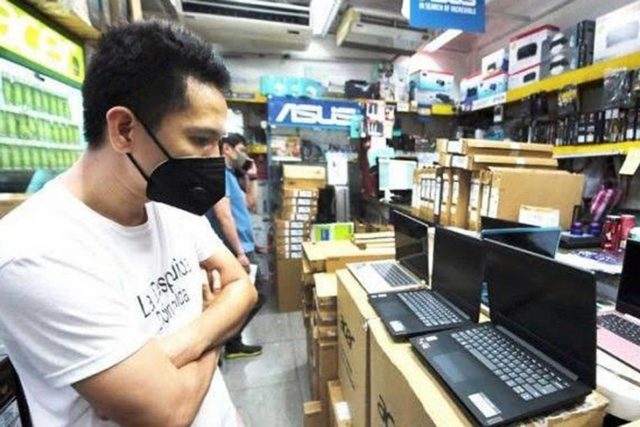
PERSONAL computer (PC) shipments to the Philippines continued to decline in the third quarter of the year due to weak demand and inflationary effects, according to International Data Corp. (IDC).

“PC shipments… continued to slump, declining 19.8% year over year and 11% quarter over quarter, reaching 565,000 units in the third quarter,” IDC said in a recent analysis, citing its Worldwide Quarterly Personal Computing Device Tracker.

It said that desktop shipments posted annual growth of 7.6% due to the “knock-on effects” of companies returning to physical work after strict mobility restrictions.

“On the flip side, notebook shipments recorded a year-on-year decline of 29.5% caused by the weakened demand from market saturation and inflation effects on the average buyer,” IDC noted.

At the same time, the market intelligence company noted that the “$600<$1,000 price band” remained the most popular price point for four consecutive quarters.

It declined by only 0.5% year on year “given its optimal price-to-performance ratio in which the top PC makers are maintaining affordability while offering sleeker designs with greater processing capabilities and a wider selection of available models,” IDC said.

For the third quarter, the top five PC companies in the Philippines in terms of market share are Acer Group (22.9%), Lenovo (19.8%), HP, Inc. (13.5%), ASUS (12.4%), and Dell Technologies (8.7%).

IDC also said the upcoming holiday season may become challenging for vendors as the demand for technological products dampens.

“Consumer spending priorities will be shifting to other goods and services, such as traveling, dining out, and recreation, while the commercial space will weaken due to seasonality and uncertainty in the government sector’s deployment of large-scale national projects, which will lower the expectations of shipment arrivals for the fourth quarter of 2022,” the market intelligence company added. — Arjay L. Balinbin

Filipino fashion by way of Switzerland

SWISS and Filipino fabrics were woven together during a fashion show at a party celebrating the 65th anniversary of Swiss-Filipino diplomatic relations on Nov. 29.

The roof deck of the Zuellig Building served as the runway for Pampinay, made by Filipina designers Pamela Gotangco and Christian Belaro. Both are artists residing in Europe; Ms. Gotangco lives and works in Switzerland, while Ms. Belaro is in London.

For the show, the designers put together lace from St. Gallen, deadstock fabric from Swiss factories, and combined them with their own designs, plus Filipino indigenous fabrics like binakol and inabel. Ms. Gotangco told BusinessWorld in an interview that they source their fabrics from Abra and Ilocos (as well as from actress Dina Bonnevie, who has herself started a business with indigenous fabrics), and then have the T’boli people of Mindanao do the beadwork. However, a bulk of their operations rely on a team of seamstresses from Taytay, Rizal the site of many garment factories near the capital.

“It’s my advocacy,” said Ms. Gotangco. “I’m Filipino. Even if I am a global Filipina, I take it as my responsibility to be able to help my countrymen.”

The business started in March 2021 with a single T-shirt with a slogan that she made craving for pinakbet (a native Filipino stew of vegetables in fish sauce). “If I’m going to do this, I will do it properly. It has to have some support to the lives of other women in the Philippines.”

Since the creation of the business, they have since built a foundation and cooperative called Bayanihan Spirit, in the form of a co-working space with sewing machines for women who don’t have their own. They have started with one machine, and at her count, they now have eight sewing machines in the space.

They take a slow fashion approach to clothing, so many pieces are one-of-a-kind or produced in limited numbers. Asked for the importance of this approach, she said, “I don’t want to make clothing that would end up in the landfill after two, three, four years.

“There’s no Planet B,” she said.

Their usual fare includes pairing their designs (inspired by pop art and Filipino exclamations) with Filipino indigenous fabrics. The limited collection shown during the party with the Swiss Embassy is just a first step towards a similar approach. These included designs approaching the avant-garde, with jeans paired with paillettes made with binakol or inabel, or else camouflage fabrics in the shape of a terno paired with the Swiss lace.

The business is quite young, and the limited numbers they produce won’t exactly be seen on thousands — in fashion, success is usually measured by how many people want to wear your work. Ms. Gotangco measures success differently. “Success is not measured by metrics of money, power, or fame. It could also be measured by the impact that you created in other people’s lives,” she said.

“It doesn’t work as much as currency, or how much money you make out of it, but how people will remember you, or how you’ve helped them, and how others would learn from you.”

Visit pampinay.com for more items. — Joseph L. Garcia

Yamaha Motor reels from semiconductor shortage, says Koike

MOTORCYCLE brand Yamaha Motor Philippines, Inc. said that the production of its motorcycles has been reeling from the semiconductor shortage which has affected its overall sales.

Hiroshi Koike, Yamaha Motor Philippines president, said that the company’s sales for 2022 are around 20% of pre-pandemic levels due to the lack of semiconductors used in assembling the motorcycles.

“This year, percentage-wise, I would say [we are] around 20% of pre-pandemic levels. In 2019 we had 580,000 units sold — [that’s] the most units sold in a year, a record-high for us,” Mr. Koike said in an interview on the sidelines of a launch event last week in Batangas.

“The older stock is gone and we are having difficulty replenishing our stocks, coming mainly from the chips,” he said, adding that many different industries “are fighting for” semiconductors.

Mr. Koike said that due to a lack of supply, 2022 is on par with last year in terms of units sold. “We wanted to increase but we ended up in just having similar units sold as last year,” he said.

According to Mr. Koike, the company has been experiencing production bottlenecks following the low supply of semiconductors.

“Unfortunately, the biggest selling models for us are the ones that use semiconductors,” he said, citing Aerox, Mio, NMAX, and Fazzio. “We source our chips from Taiwan, Malaysia, from multiple countries.”

Mr. Koike said the company does not directly procure as semiconductors come from suppliers that put the chips into the products such as an anti-lock braking system.

“Motorcycles do use quite a bit of semiconductors for anti-lock braking system you need a sensor, the keyless ignition, the idling stop, and the function where you can connect the phone to the motorcycle,” he added. 

Following the supply gaps in semiconductors, the company’s new production line launched in 2021 has not been operating at 100% capacity due to supply issues, he said.

“There is a new third factory line which we started mass producing last year. Due to the lack of component parts, we are not able to use up to the full capacity [at this] time. This is coming from the lack of semiconductors. The third factory line is about 40% operating level,” Mr. Koike said.

“[The] demand is strong. Dealers are asking for more. But at the moment, we cannot supply. Our first goal is to hopefully come back to at least pre-pandemic levels. If things are better, we still have room to expand and create another factory,” he added.

Mr. Koike said that Yamaha’s third line is capable of producing 300,000 units per year, while the other two lines have a total capacity of 400,000 units per year.

He also disclosed that Yamaha Philippines implemented price increases in July on the back of surging production costs.

“The price increases were different among models. But the average price increase is 3%. Some are more, some are less,” Mr. Koike said. — Revin Mikhael D. Ochave

Battery terminals

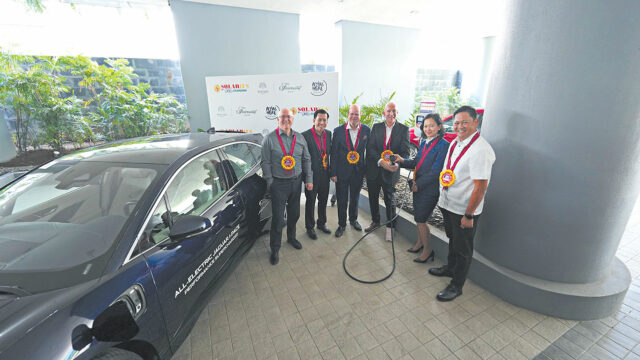
Posing at the electric vehicle charging points in Fairmont Raffles Makati are (from left) Jaguar Land Rover President Chris Ward, Department of Energy Director Patrick Aquino, Fairmont Raffles Hotels Cluster GM Bernd Schneider, Solarius EV Charging CEO Peter Wilson, Fairmont Raffles Makati Hotel Manager Aubrey Ada, and Electric Vehicle Association of the Philippines President Edmund Araga. — PHOTO BY KAP MACEDA AGUILA

Is your business looking to install EV charging points? Solarius is waiting for you

GONE ARE the days we’d look longingly across the ocean and wonder when electrified vehicles would make their way here.

A growing number of makes and models — from conventional and plug-in hybrids to full electrics — are already in showrooms near you. Thankfully, government and legislators have taken notice, thanks in no small part to the lobbying and earnest work of entities like the Electric Vehicle Association of the Philippines. And while we are still in relatively early stages of our mobility’s electrification compared to more affluent neighbor states, the EV ball has long started to roll.

Of course, we know what can imbue this ball further velocity and momentum, right? Yup, that would be a network of EV chargers to further assuage owners and fence-sitters that their electric car won’t be stranded in the middle of nowhere with zero charge. Establishing a meaningful charging network will do for EVs what cell sites did to mobile phones.

As it is, making the literal and figurative switch to electric isn’t as unpalatable (or sweaty-palm-inducing) as before. Peter Wilson listed four other “roadblocks” to EV adoption: range, performance, cost, and choice. More importantly, Mr. Wilson explained that contemporary times have seen the mitigation of these hurdles. With increased battery capacity and technology, EV range is up to more than 400 kilometers per full charge; modern EVs are more fun (and easier) to drive; acquisition costs (with the aid of tax relief and such) are going down; and, as mentioned, more brands are offering electrified options.

Peter Wilson is CEO of Solarius EV Charging, a new sibling company of Solarius Energy. The latter has been operating in the country for six years, establishing industrial, commercial, and residential solar installations throughout Luzon. “We have an opportunity here with the shift to electric vehicles to extend our impact,” declared the executive. “Either we wait for someone to build the (EV) infrastructure or we do it ourselves.”

Solarius EV Charging is obviously choosing the latter. “We’ve put a business model where the location partners, like Fairmont and Raffles, can put the chargers in their premises and get revenue for the charging. You don’t get petrol and diesel for free, so when you charge an electric car it shouldn’t be for free either,” he said.

But for Mr. Wilson, the biggest hurdle remains to be the aforementioned lack of charging facilities. “Where am I going to charge, will it be convenient, will it take 10 hours?” he averred.

The good news is that, based on a survey of EV owners, 80% to 90% of charging takes place when the car’s parked at home anyway, which basically softens (and not precludes) the need for a network of chargers. An additional benefit: “Because you’re charging at home, you have the option of charging your car with solar panels.” Owners need not tap into the electricity grid (which, in effect, means that the energy supplied to the car comes from traditional coal-fired plants).

Still, it will not hurt in the least to have charging points available that will basically serve as range extenders. Speaking at the Raffles and Fairmont Hotel Makati, the company’s first location partner, Mr. Wilson said that Solarius targets to have 60 locations “energized by end of Q1 2023, 180 locations by the end of 2023, and more than 500 locations by 2025.”

Responding to a question from “Velocity,” Mr. Wilson said that since the company started rolling out its chargers in October, six locations are now online. In terms of the absolute number of charging points, this will ultimately depend on the need, and may be scaled up as necessary. At the Raffles and Fairmont, there are currently three charging points. Location partners do not have to shell out capitalization on the charging equipment. Solarius will be responsible for installing and managing them, and will remunerate the establishment with the cost of electricity plus 10%.

For users, it’s a simple matter of “scan, pay, and charge.” Through an app, the customer can pay using a credit card, Apple Pay, Google Pay, voucher codes, and other means. Prepaid plans are also available — topped up through GCash, PayMaya, and Western Union.

And while the company specializes in solar panels, it will not be realistic or feasible to deploy these to all (or even many) host locations. Hotels, resorts, and other public destinations will necessitate tapping into the grid. This also enables the customers to charge at night. “We’re thus relying on the grid to clean up its act,” continued Mr. Wilson. Residential homes are where Solarius can more logically offer so-called “sun-to-wheels” solutions. The executive said that EV charging points can certainly be offered to condominium and apartment property companies.

The secret to responsible charging, he said, is “ABC” — “always be charging.” Trickle charging should be the norm, rather than the higher-capacity DC chargers, which cannot be used very often because these actually stress the battery. With regard to cost, Solarius gives us the following estimate: P2 per kWh (using pure solar energy during the day) for a private home or office, P6 per kWh for nighttime charging via solar, P12 to P18 per kWh for a multi-tenant residence using Solarius EV Charging, and P35 per kWh when tapped into the grid.

Mr. Wilson concluded by inviting resorts, condominium property managers, shopping malls, and public parking garages to contact the company through info@solarius.com.ph or (949) 882-2125 and join its charging network that should further us along on our journey to electrified mobility.

Two very different collections in time for the holidays

TWO designer collaborations are up for grabs at Uniqlo this season: the second collection of Italian brand Marni with the Japanese clothing giant, as well as the Fall Winter collaboration with Japanese brand Mame Koroguchi.

The two could not be more different: The Mame Koroguchi collection contains mostly innerwear, for one. The innerwear collection contains bras, underpants, T-shirts, and leggings. The T-shirts are made with a HeatTech woolblend that results in a thinness made for layering. A pair of Body Shaper shorts are made with 3D souffle yarn that contours the body. Most of the collection come in earthy tones like khaki and olive.

A statement says, “The Uniqlo and Mame Koroguchi innerwear collection no longer distinguishes between innerwear and clothing to allow women to shine from within.:

Meanwhile, at the Marni collection launched in Quezon City on Dec. 7, guests were overwhelmed by the colors and textures of the 1960s. Vivid colors of saffron, azure, neon green, and a reddish orange served as the backdrop for swirls and stripes, made with a combination of HeatTech and knits.

The designs play with androgyny, with loose silhouettes that add a mysterious shapelessness to the body.

A kaleidoscopic collection of scarves is also up for grabs, printed with bold designs like abstract watercolors. These are made with 100% silk, and are inspired by furoshiki (Japanese cloth used for wrapping gifts and packages).

In a designer interview with Marni Creative Director Francesco Risso, he said, “To almost everyone Marni stands for colors and prints. It always had. I have put a lot of my own into Marni, but it is also a process moving in the opposite direction. Every day I draw inspiration from what I see at Marni, from the team I work with, from the meaning of Marni itself. This collection regroups our love for patterns intended as an artistic expression of our collective imagination, and stripes, which have become epitomes of our style.”

His favorite pieces from the collection include the down coat in a cocoon silhouette, the striped knitted pants, and the baggy jeans.

CHRISTMAS AT UNIQLO
From Dec. 9 to Dec. 15, Uniqlo stores are coming out with special limited deals for the holidays. For example, a single purchase of P3,500 online or in-store gets you a free Uniqlo cable organizer. Some items for sale include women’s tank tops for P390, and crew neck shirts for men. The complete list can be found at uniqlo.com/ph/en/special-feature/celebrate-together. While shopping, one can also dance or sing along to the Uniqlo Christmas jingle, performed by Jose Mari Chan and The Juans.

But what’s Christmas without giving a gift to someone who really needs it?

Reichelle Vergara, Senior Marketing Manager for Uniqlo Philippines, discussed the opening of their last store for this year, the first Uniqlo store in Bulacan, located in Baliwag. The store opened on Dec. 2, but the day before, they invited a group of orphans from the area to shop for their very own holiday outfits. “They were our first customers,” said Ms. Vergara.

They do this whenever they open new stores, but also give out clothing during disasters like fires and typhoons. “We want, of course, not only our customers to experience Lifewear, but also those communities that are in need, as well,” she said. — JL Garcia

Cebu Pacific aims to transition on-ground fleet to e-vehicles

BW FILE PHOTO

CEBU AIR, Inc., the operator of low-cost carrier Cebu Pacific, has put the full transition of its ground support equipment (GSE) fleet to electric vehicles (EVs) in its long-term goals as it aims for zero carbon emission.

“For us, it’s a long-term goal — [the] full transition of all of our on-ground equipment,” Cebu Pacific Chief Strategy Officer Jose Alejandro B. Reyes said in a chance interview.

Cebu Pacific currently has around 700 pieces of internal combustion engine GSE that are being used throughout its network, said Mr. Reyes.

Medyo matagalyung transition (The transition will be slow) because some equipment was just bought recently and some are still useful. But our target is to do the easier ones first which have a high impact,” he said.

In November, the company ran the pilot test of its community-optimized managed electric transport, which it plans to use for its 25-passenger buses in Metro Manila.

“We’re doing the experiment now. We are learning from the trial period and when the trial period ends, we will come back and study our learnings on how we will operate them and its charging cycles,” Mr. Reyes said.

The buses have two uses: as service for Cebu Pacific employees and as passenger transport inside the airport. They serve employees in three routes, which are to and from Parañaque, Cubao, and Pasig. The buses that operate inside the airport bring passengers from the terminal to the aircraft.

“That’s what we are trying to work on and make sure it is efficient, optimal, it is right for the passengers and actually reducing carbon emissions,” Mr. Reyes said.

For its air fleet, Cebu Pacific is targeting to operate an all-new-engine-option (NEO) fleet by 2028.

In 2022, the carrier added five fuel-efficient NEO aircraft to its fleet, while it expects the delivery of 11 NEO aircraft in 2023. Three of the 11 NEO aircraft will be 320neo, four will be 321neo and four are 330neo.

The 11 aircraft are expected to cost around $2 billion with 2018 price quotes showing A320neo at around $110.6 million, A321neo at $129.5 million, and A330neo at least $259.9 million. — Justine Irish D. Tabile

ADVERTISEMENT
ADVERTISEMENT