
How PSEi member stocks performed — August 12, 2022
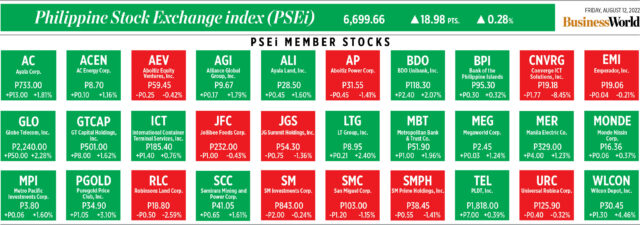
Here’s a quick glance at how PSEi stocks fared on Friday, August 12, 2022.
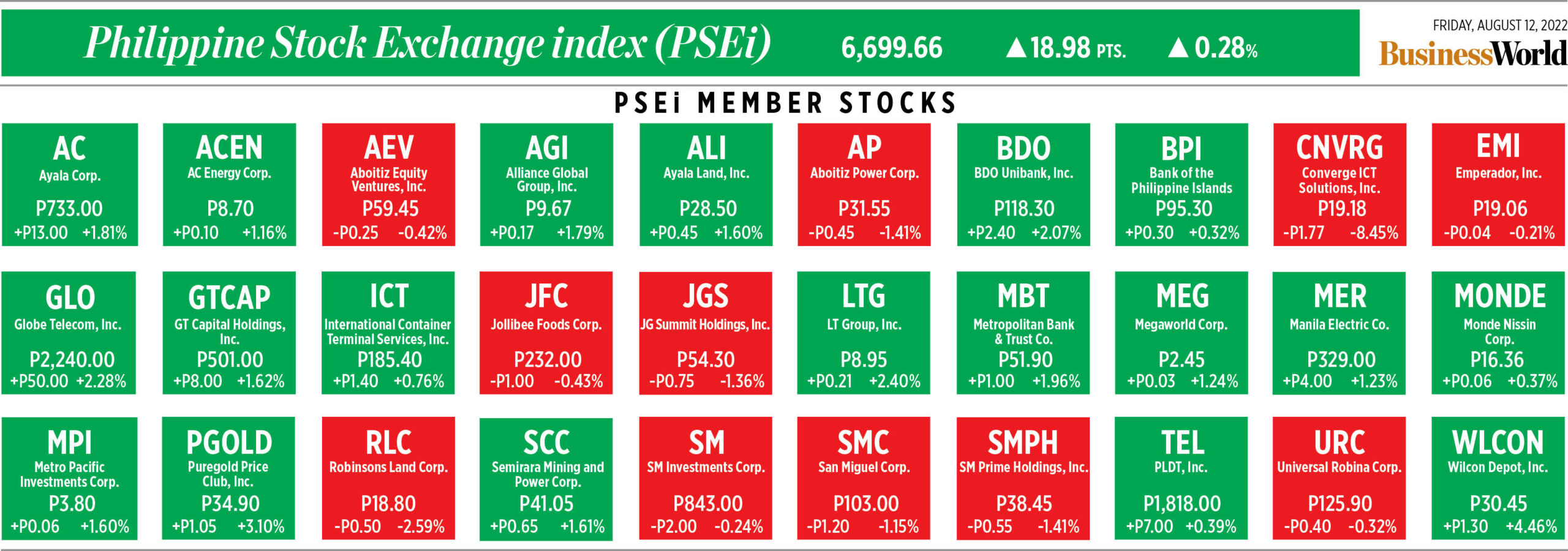

Here’s a quick glance at how PSEi stocks fared on Friday, August 12, 2022.

PHILIPPINE SHARES may move sideways this week amid an expected rate hike by the Bangko Sentral ng Pilipinas (BSP) at its Aug. 18 meeting and profit taking after last week’s rally.
The Philippine Stock Exchange index (PSEi) continued to post gains on Friday inching up by 18.98 points or 0.28% to close at 6,699.66, while the broader all shares index went up by 13.59 points or 0.38% to 3,564.16.
Week on week, the PSEi surged by 294.16 points or 4.59% from its close of 6,405.50 on Aug. 5.
Rizal Commercial Banking Corp. Chief Economist Michael L. Ricafort said that the PSEi climbed further on Friday “after Fitch Solutions upgraded its estimate for Philippine GDP (gross domestic product) growth for 2022 to 6.6% (from the previous estimate of 6.1%)” and better corporate earnings.
“Bargain hunters reigned, taking their cue from Wall Street’s ascent after a lower-than expected US inflation print,” online brokerage 2TradeAsia.com said in a report.
Wall Street rose on Friday as market sentiment was boosted by data showing a slowdown in consumer and producer prices in July, which could indicate that inflation has peaked and lead to less aggressive hikes from the Federal Reserve.
The Dow Jones Industrial Average rose 424.38 points or 1.27% to 33,761.05; the S&P 500 went up 72.88 points or 1.73% to 4,280.15; and the Nasdaq Composite climbed 267.27 points or 2.09% to 13,047.19.
The US consumer price index ended flat month on month last July from 1.3% in June. On an annual basis, inflation rose by 8.5% in July, slower than 9.1% in June.
Meanwhile, the producer price index for final demand declined 0.5% last month after climbing 1.0% in June. In the 12 months through July, it increased 9.8% after rising 11.3% in June.
For this week, Globalinks Securities and Stocks, Inc. Head of Sales Trading Toby Allan C. Arce said the market could move sideways ahead of the BSP Monetary Board’s policy review on Thursday.
“The market could move sideways ahead of the central bank’s policy meeting on Aug. 18 where it is expected to raise rates by at most 50 bps (basis points). But investors could also choose to pocket gains after last week’s rally,” Mr. Arce said.
“There could be some consolidation as the market awaits more data related to inflation and growth. Also, bets could be made ahead of the BSP meeting,” Regina Capital Development Corp. Head of Sales Luis A. Limlingan said in a Viber message.
The majority of 18 analysts polled by BusinessWorld last week expect the Monetary Board to raise benchmark rates on Aug. 18, while two see no changes to borrowing costs.
Of the 16 analysts expecting a rate hike, 14 see a 50-bp increase while two anticipate a 25-bp move.
Online brokerage 2TradeAsia.com placed the PSEi’s support at 6,450 and resistance at 6,830, while RCBC’s Mr. Ricafort put support at the 6,400-6,500 range and resistance at the 6,800-6,900 levels. — J.I.D. Tabile
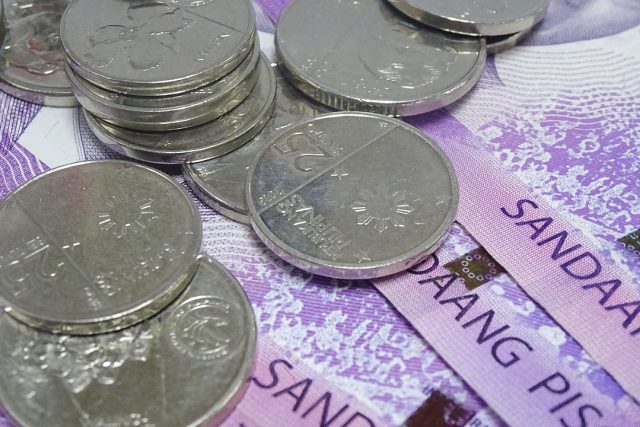
THE PESO may strengthen this week on expectations that the central bank will raise benchmark rates anew at its meeting on Thursday.
The local unit ended at P55.61 per dollar on Friday, weaker by 31 centavos from its P55.30 close on Thursday, based on Bankers Association of the Philippines data.
It also depreciated by 41 centavos from its P55.20-a-dollar finish a week earlier.
The peso depreciated after hawkish signals from another US Federal Reserve official, Rizal Commercial Banking Corp. Chief Economist Michael L. Ricafort said in a Viber message.
Federal Reserve Bank of San Francisco President Mary Daly on Thursday said she is open to a bigger rate hike at the Fed’s Sept. 20-21 meeting if inflation remains persistently elevated.
There was also risk-off sentiment in the market as oil prices increased after several days of decline, Mr. Ricafort added.
For this week, UnionBank of the Philippines, Inc. Chief Economist Ruben Carlo O. Asuncion said a widely expected hawkish move from the Bangko Sentral ng Pilipinas (BSP) will affect the foreign exchange market. He said the market will monitor the BSP’s forward guidance amid elevated inflation and a softening economy recovery.
Mr. Asuncion added that the peso may strengthen as the dollar has dropped from its recent highs.
The majority of 18 analysts polled by BusinessWorld last week expect the Monetary Board to raise benchmark rates on Aug. 18, while two see no changes to borrowing costs.
Of the 16 analysts expecting a rate hike, 13 see a 50-basis-point (bp) increase while three anticipate a 25-bp move.
BSP Governor Felipe M. Medalla earlier said the central bank’s policy-setting Monetary Board may hike rates by 50 bps at their Aug. 18 meeting after headline inflation surged to a near four-year high of 6.4% in July from 6.1% in June and 3.7% a year ago.
For the first seven months, inflation averaged 4.7%, faster than the 4% seen in the same period in 2021 and the central bank’s 2-4% target for the year but lower than its 5% forecast.
For this week, Mr. Asuncion expects the peso to move from P55 to P55.60 a dollar, while Mr. Ricafort gave a forecast range of P55.30 to P55.80. — K.B. Ta-asan

 THE Philippine Economic Zone Authority (PEZA) said it considers a downgraded investment growth target for 2022 of 6-7% to be within reach after investment approvals declined sharply in the first six months.
“We are bullish still that we can achieve our targeted 6% to 7% increase for this year,” PEZA Officer-in-Charge (OIC) and Deputy Director General for Policy and Planning Tereso O. Panga told BusinessWorld via Viber.
“With the assumption of the administration of President Ferdinand R. Marcos, Jr., we hope to bounce back by third quarter this year to exceed our investment approvals (in the April-June quarter,” he added.
According to Mr. Panga, PEZA considers the 6% to 7% target to now be the “official” target which “we submitted to the Department of Trade and Industry (DTI) and the Department of Budget and Management (DBM).”
The previous growth target for approved investments, announced in April, was 7-8%.
The agency has blamed the wait-and-see attitude adopted by investors ahead of the May 9 national election for the first-half slowdown.
PEZA-approved economic zone (ecozone) investments in the first six months declined 29.85% to P22.488 billion. The investments consisted of 90 new and expansion projects with projected annual export sales of $747.093 million and direct job creation of 14,354 positions.
Export income in the first half increased 7.68% to $32.495 billion while employment in PEZA-registered ecozones across rose by 10.16% to 1.79 million workers.
“The top countries with the highest investments in the first six months are Japan, Singapore, the US, UK, and the Netherlands. Japan remained PEZA’s top investor in the first half with P8.007 billion in investment, followed by Singapore with P2.169 billion,” PEZA said.
PEZA said approved investments in the second quarter rose by 114.93% year on year to P14.347 billion. These consisted of 61 new projects as well as expansions.
“The 114.93% increase in our investments for our comparative April-June 2022 data over last year indicate that we are on our way to recovery. (It also indicates) foreign investors’ strong interest in the Philippines,” Mr. Panga said.
According to Mr. Panga, PEZA is expected to present at least 50 applications for ecozone developer and locator projects to its board, which is meeting later this month.
“The usual top sources of ecozone investments are ecozone development, export manufacturing especially electronics and automotive, and information technology (IT) services,” Mr. Panga said.
Mr. Panga said growth in the broader economy heralds “flourishing” economic activity in ecozones.
“As our increasing gross domestic product (GDP) growth is a sign of economic strength, we can expect an upturn in the economy and thereby making PEZA more effective in attracting additional investment to generate the much-needed jobs, exports, local and national revenues, and other economic opportunities,” Mr. Panga said.
GDP rose by 7.4% in the second quarter, against the revised 8.2% growth rate in the first quarter, according to the Philippine Statistics Authority. — Revin Mikhael D. Ochave
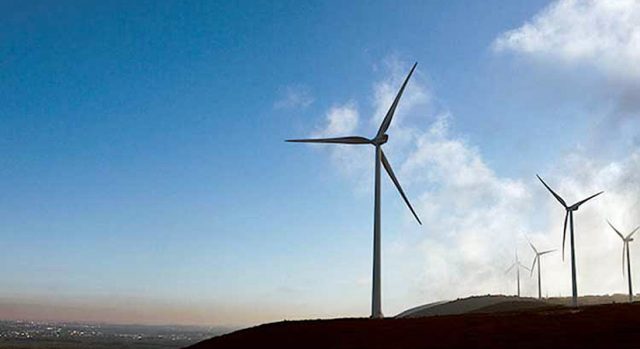
NORWAY’s ambassador said the Philippines is a potential destination for Norwegian businesses, but their interest in renewable projects here will depend on the industry’s openness to foreign investment.
“In the coming years, Norwegian businesses are planning huge investments in offshore wind and floating solar, and consider the Philippines to be a promising market,” Ambassador Bjorn Jahnsen told BusinessWorld in an e-mail. “However, the Philippines is competing with Europe and other countries in the region, where the push towards renewable energy sources is greater than ever.”
“The Philippines therefore has to put the right policies in place and should let foreign investors own more than 50% of equity in renewable energy projects to unleash the full potential for green energy production and the creation of good-paying Filipino jobs,” he added.
The 1987 Constitution prescribes 60-40% ownership in favor of Filipinos for most renewable energy (RE) projects, excluding biomass and geothermal.
The Department of Energy has also expressed its support for 100% foreign ownership of renewable energy projects to facilitate the shift to indigenous sources of power, making it less vulnerable to disruptions in the supply of imported fuels.
“Norway supports the Philippines’ efforts to increase the production of renewable energy, not only because this will reduce the emission of climate gases, but also because in the long run this may lower the price of electricity,” Mr. Jahnsen said.
Norwegian companies are currently involved in Philippine hydropower and liquefied natural gas projects.
Other foreign embassies have also expressed interest in investing in the Philippines’ renewable energy industry, including South Korea and the United Arab Emirates, and are awaiting news on the possible removal of the 40% foreign ownership cap.
Senator Rafael T. Tulfo, who chairs the Senate Energy Committee, told BusinessWorld in a Viber message that he supports more foreign ownership in renewable energy as “we are in desperate need of locally sourced power that will not be subject to the mercy of international issues and events, like the war in Ukraine and Russia.”
The Philippines, he added, currently does not have the capital to invest in renewable energy infrastructure and availing of more foreign loans is not the best option.
“Overall, we really have to open our doors to foreign renewable energy players in order to secure our energy resources,” he added. “This, of course, will be subject to limitations and regulations that will protect our country’s economic interests.”
Mr. Tulfo also said renewable energy can expand its share of the energy mix with the development of technology that makes it more reliable.
“There are…battery systems that allow renewable energy generation plants to store excess power and utilize it when needed,” he said. “Utilizing this technology would lead to a situation where there wouldn’t be any significant disadvantages to increasing renewable energy in our energy mix.”
The senator also cited plans to ease the process of attracting private-public partnerships to the sector.
For now, the country should prioritize hydro, solar, and wind energy sources as they have become more developed, safe and reliable throughout the years, he added.
Senator Ana Theresia N. Hontiveros-Baraquel said the “exploration and exploitation” of foreign entities should not be allowed.
“What the country needs today is a decisive shift to 100% renewable energy, not 100% ownership of our renewable energy resources,” she told BusinessWorld via Viber. “Renewable energy resources from nature rightfully belong to the state and their host communities,” she added.
The country should instead prioritize proper regulation over further liberalization, she added. The development of renewable energy should lead to more decentralized and community-based power systems using technologies like microgrid.
“To support these initiatives, the country must be very active in the climate negotiations demanding that rich polluter countries honor their commitments and contribute more in the renewable energy development of the most vulnerable countries like the Philippines,” she said.
“The push for renewable energy must be more determined today in order to achieve the 35% target for 2030,” she added, referring to the Philippine Energy Plan 2018-2040 which seeks a higher share for green energy in the power mix by 2030.
The current energy mix is 37.1% coal, 34.6% oil, 16.5% solar and wind energy, 5.5% natural gas, 4.5% hydropower, and 1.8% geothermal. — Alyssa Nicole O. Tan

THE government’s chief economic planner said the Philippines must minimize its exposure in case the geopolitical situation deteriorates, with analysts citing the potential of the China-Taiwan standoff to escalate.
“There are geopolitical risks (and) we have to live with that. That should not constrain you from planning for continued, sustained growth. We can take those. We need to be ready,” Socioeconomic Planning Secretary Arsenio M. Balisacan told reporters after the European Chamber of Commerce of the Philippines meeting last week.
“We have to identify what our vulnerabilities are and work on them. The global norm is, even if you are far away, everyone is affected. That’s the 21st century,” he added.
University of Asia and the Pacific Economist Bernardo M. Villegas said that if war breaks out between Taiwan and China, the Philippines and the rest of the Indo-Pacific region will face a disruption of both exports and imports.
China is the Philippines’ main trading partner, accounting for 22.7% of total imports in 2021. In the same year, around 15.5% of Philippine exports went to China.
Mr. Villegas, who is also a BusinessWorld columnist, has written in the newspaper that Taiwan investment in the Philippines amounts to P32.3 billion, exceeding that of China with P24.7 billion.
“In fact, over the years Taiwanese firms have poured in P32.3 billion in total investments in export-oriented enterprises in economic zones registered with the Philippine Economic Zone Authority (PEZA), mainly in electric equipment and apparatus, metal products manufacturing, as well as in the real estate sector,” Mr. Villegas wrote.
“But since our growth is mostly due to the domestic market, we will be less affected than our neighbors whose economies are very much export-oriented. Our OFW remittances and BPO-IT sectors will continue to support our economy with foreign exchange,” he said in an e-mail.
According to Gareth Leather, Senior Asia Economist for Capital Economics, further escalation will disrupt Taiwan’s exports, raising global inflation levels due to the heavy dependence on Taiwan for electronics products, including those used in the auto industry.
“Taiwan is by far the world’s biggest producer of the processor chips that are increasingly ubiquitous in new products. It has twice the market share of the next biggest producer. Its dominance at the high end is even greater: 92% of the most advanced semiconductors are made by TSMC (Taiwan Semiconductor Manufacturing Company Limited) in Taiwan,” he said in a Capital Economics publication.
Asian Institute of Management Economist John Paolo R. Rivera said an escalation will pressure global supply chains but the Philippines may catch some of the fallout because of its geographical proximity and in case it is forced to take sides should its ally, the US, come to the defense of Taiwan.
Mr. Villegas does not expect the confrontation to escalate into a shooting war.
“It will be just saber rattling. It would be advisable for us to keep friendly economic relations with both. Taiwan can continue to be a major investor in the Philippines. We can continue to be a major provider of high-value fruits to China,” Mr. Villegas said.
Manu Bhaskaran, an economist and CEO at Centennial Asia Advisors Singapore, said he sees no significant impact in the near term.
“In the near term, there might be some supply chain dislocations because of the military drills in the Taiwan Straits but this should be minor. In the long term, so long as there is no escalation in military operations, there could be some fall in business confidence which could affect economic growth in the region. But overall, I don’t see much impact,” he said in an e-mail.
Pantheon Chief Emerging Asia Economist Miguel Chanco said that it is too early to speculate about the impact on the Philippine economy.
“In any case, the country is not as reliant on external trade as its peers in the region so, even if there was to be some short-term shocks, I doubt it’ll have a material impact on the country’s growth prospects immediately,” Mr. Chanco said.
The government targets 6.5-7.5% growth this year, and 6.5-8% annual growth for next year until 2028. Gross domestic product growth averaged 7.8% in the first half.
China has extended its military drills along the east and west coasts exercise lasting only four days. Ballistic missiles have been launched, while attacks were simulated both within the skies and seas surrounding Taiwan.
The latest round of tensions was spared by US Speaker Nancy Pelosi’s visit to Taiwan, the highest-ranking official to visit Taiwan in 25 years. She said her visit is part of a “broader trip” to the Indo-Pacific region that focuses on “mutual security, economic partnership and democratic governance.” — Diego Gabriel C. Robles

THE new president of the Bases Conversion and Development Authority (BCDA) is a career official in the agency and the first woman to head it, the BCDA said in a statement on Sunday.
Aileen Anunciacion R. Zosa took her oath at Malacañang on Aug. 11, the agency said.
“For the development of our properties, we have introduced three major components that will distinguish our properties from the pack and make our projects more globally competitive. These are sustainability, gender diversity and gender sensitivity, as well as smart components. Our projects should embed those three important elements,” Ms. Zosa said.
The BCDA is a government-owned and -controlled corporation tasked with redeveloping former military bases to fund Armed Forces modernization.
Ms. Zosa promised to develop the BCDA to be “more responsive and efficient in the delivery of projects.”
Ms. Zosa replaces Aristotle B. Batuhan, who had served as officer-in-charge starting October 2021.
According to the BCDA, Ms. Zosa began her BCDA career as the manager for corporate planning and project development and successive promotions to vice-president and executive vice-president and chief operating officer.
“Ms. Zosa will be bringing to the table 27 years of institutional knowledge with the BCDA and know-how in the fields of business development and public policy, aside from more than a decade’s worth of experience in various academic and bureaucratic positions in the public sector including the Senate, the Office of the President, and the Commission on Audit,” the BCDA said. — Revin Mikhael D. Ochave
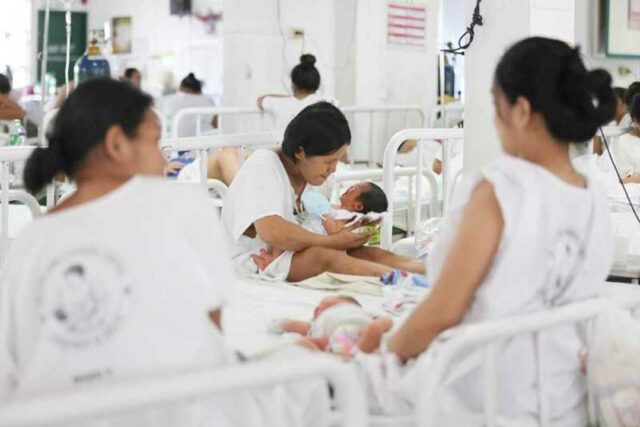
REGISTERED deaths rose 43.2% year on year to 879,429 in 2021, the second year of the pandemic, while births declined 10.7% to 1,364,739, the Philippine Statistics Authority (PSA) said.
Citing preliminary data from its Vital Statistics report, the PSA said deaths were led by Calabarzon (Cavite, Laguna, Batangas, Rizal, and Quezon) with 138,298, or 15.7% of the total, up 45.7% from a year earlier.
The National Capital Region (NCR) recorded 105,178 deaths during the period, up 24.7% from the 2020 total.
Calabarzon also led registered births with 204,333, down 12.2%. Births in the NCR totaled 160,946, down 19.1%.
Registered marriages totaled 356,839 in 2021, up 48.2%, led by Calabarzon with 50,211, up 53%. The NCR logged 41,025 marriages, up 26%.
In a separate report, coronavirus disease 2019 (COVID-19) was found to be the 15th leading cause of death in the first four months of 2022.
Registered deaths due to COVID-19 totaled 10,226 or 6.5% of all deaths. The leading causes of death during the period were ischaemic heart diseases (29,442), cerebrovascular diseases (16,316), and cancer (14,928).
Deaths associated with COVID-19 are either “virus identified’’ or “not identified” at the time of death.
Some 7,692 deaths associated with COVID were “virus identified,” while those “not identified” totaled 2,534.
The National Capital Region (NCR) posted the largest number of deaths due to COVID-19 during the period with 2,440, followed by Calabarzon with 1,521 and Central Luzon 1,355 deaths (13.3%).
Meanwhile, Bangsamoro Autonomous Region in Muslim Mindanao had the lowest number of COVID-19 deaths with 20.
Quezon City was the top city for COVID deaths with 526, followed by the Manila with 396 and Caloocan 242.
According to the PSA, COVID-19 death data were based on the descriptions found in death certificates and certified by health officers of local government units.
These COVID-19 tallies differ from the disease surveillance numbers reported by the Department of Health.
As of Aug. 13, the DoH estimated 60,992 deaths from COVID-19 in the year to date, with active cases at 40,324 and total infections 3.85 million.
The Vital Statistics report was compiled from city or municipal Civil Registrar data, as consolidated by the PSA’s Provincial Statistical Offices, and then submitted to the Office of the Civil Registrar General as of May 31. — Mariedel Irish U. Catilogo

THE Philippines’ “institutional population” — which includes the incarcerated, members of religious communities, and residents of dormitories — declined 9.7% as of the end of May to 366,202, equivalent to 0.3% of the overall population, according to preliminary data from the Philippine Statistics Authority.
The number of institutional living quarters (ILQs), meanwhile, rose 40%, for a ratio of 12 persons per ILQ, against 19 persons per ILQ in 2015.
The institutionalized population includes 160,350 in corrective and penal facilities, while 72,211 were residents of hotels, motels, lodging houses, and dormitories and 31,828 resided in convents, nunneries, seminaries, and boarding schools.
Hotels, motels, lodging houses, and dormitories topped the ILQs tally in 2020 with 17,813 (59.7%) of the total. Convents, nunneries, seminaries, and boarding schools accounted for 3,865, followed by military camps and stations with 1,873. — Mariedel Irish U. Catilogo

(Last of three parts)
Consumers around the world are settling into life amid uncertainty, adapting by assigning greater importance to taking control over their finances and favoring sustainable practices.
The EY Future Consumer Index, which examines shifting consumer attitudes and behaviors over a range of time horizons and across international markets, demonstrates how accustomed people are to living in a constant state of crisis and uncertainty.
In the previous parts of this series, we discussed three key shifts in play that differentiate the current crisis from previous ones, and the key trends in consumer behavior as identified in the Index. In this final part, we discuss the four imperatives that businesses have to take into account.
FOUR IMPERATIVES
Business leaders will have to adapt to meet the needs of consumer values that have shifted during the pandemic experience. Consumers are actively seeking more control over their lives instead of simply reacting to events.
To address this, businesses will have to review their operations to optimize for better pricing, approach sustainable products as a cost-effective option instead of a premium choice, explore new and targeted ways to engage consumers on multiple digital channels, and reconsider what their purpose is as well as what KPIs they want to set.
1. Review portfolios and operations to ensure affordability.
To get the products they want at prices they can afford, consumers are more and more likely to trade down. Companies must think about how to manage their product portfolios in this inflationary environment to improve pricing outcomes.
Prior iterations of the Consumer Index have demonstrated how the pandemic has increased the willingness of customers to switch to private label products. Retailers now have the possibility to broaden their selection of private label products. To ensure that they can best optimize for pricing, brands must also look for alternate supply chains, ingredients, or components and experiment with other product characteristics, such as packaging and package sizes.
Due to ongoing price and revenue worries, this necessitates and facilitates improved supply chains and industrial resilience, but it is also likely to be more than a temporary remedy.
2. Tailor sustainability strategies to offer affordable fixes.
Despite their increased resolve to live more sustainably, consumers are becoming more price sensitive. Many businesses will need to switch approaches and explore how to make sustainable goods and services become the affordable norm for consumers, rather than as premium alternatives.
The need to look into business models like renting, reselling, and mending to keep goods in use for longer is at the heart of this mindset. This creates a need to scale up current sustainability solutions so they can be more affordable from a procurement standpoint.
For instance, the increase in energy costs brought on by the increased price of fossil fuels may encourage more investment in alternative energy, enabling scalable and inexpensive green energy and providing a chance for innovation to produce more sustainable products.
3. Adjust investment in engagement to take advantage of new digital opportunities.
The importance of digital channels during the pandemic is likely to continue increasing. However, the physical world will not become subordinate to the digital one overnight. Brands will have new opportunities to interact online and in the still emerging metaverse as a result.
Now that consumers are becoming less brand loyal in their buying decisions, brands that have been generally decreasing marketing budgets during economic downturns run the danger of greater disintermediation. Businesses need to step up their efforts to clarify and define their unique brand offer by looking at fresh, focused approaches to connect with and engage with consumers through a variety of channels. This entails testing new digital technologies as well as gathering and using consumer data in ways that improve both physical and virtual customer experiences.
However, these initiatives must be weighed against customer worries about data privacy and cybersecurity. Not only is it crucial to protect consumer data, but businesses can also gain the trust of their customers by demonstrating how they responsibly use their data to benefit them in real ways.
4. Set KPIs that take shifting customer values into account.
The extent to which consumer values are shifting is highlighted by the current and previous waves of the Index. People are less driven by monetary gains, and sustainable behaviors rather than wealth are more used to determine status. The way that consumers use their time is changing, and they are searching for ways to alternate between saving time on the things they dislike and spending time on the things they enjoy. Instead of focusing on salaries and careers, people are now increasingly concerned by purpose and flexibility.
Companies need to reevaluate their goals, KPIs, and purpose in order to align with these developing values. Non-financial indicators like emissions, diversity, and innovation are progressively taking the place of traditional financial measurements like growth, profitability, share price, and shareholder returns. Companies must consider and evaluate these indicators in the context of the clients and staff they serve, and they must create new KPIs that instill non-financial values into their corporate culture.
ADAPTING TO CONSUMERS IN A WORLD IN CRISIS
When their finances are stressed, people look for ways to save money and companies may feel the same way. This is a typical response, and for many people, it is also their only possible option. However, having experienced a pandemic, many customers now approach crises differently.
In order to keep a sense of control over their lives, consumer values have altered, and they are determined to abide by them. They are more concerned with acting sustainably than they are with purchasing things they do not believe they need. To stay aligned with these evolving consumer needs and behaviors, businesses will need to start taking action as soon as possible if they wish to remain competitive and relevant.
This article is for general information only and is not a substitute for professional advice where the facts and circumstances warrant. The views and opinions expressed above are those of the author and do not necessarily represent the views of SGV & Co.
Maria Kathrina S. Macaisa-Peña is a business consulting partner and the consumer products and retail sector leader of SGV & Co.

RETAIL PRICE growth of construction materials in the National Capital Region (NCR) was 6.8% in the first half, the highest level in 13 years, the Philippine Statistics Authority (PSA) said. Read the full story.


Games On Wednesday
(Smart Araneta Coliseum)
9 a.m. – Marinerong Pilipino
vs. Apex Fuel-San Sebastian
11 a.m. – EcoOil-La Salle
vs. Adalem Construction-St. Clare
TOP-SEEDED Apex Fuel-San Sebastian and Adalem Construction-St.Clare refused to ride into the night without a fight, scraping past their separate counterparts to force a deciding Game 3 in the 2022 Philippine Basketball Association (PBA) D-League Aspirants’ Cup semifinals on Sunday at the Smart Araneta Coliseum.
On the brink of elimination, the Golden Stags hacked out an 82-74 win over Marinerong Pilipino while the Saints took down the Green Archers, 72-64, in Game 2 of their best-of-three Final Four duels.
The four squads go at it once more on Wednesday with the rightful winners arranging a battle for all the D-League marbles in another race-to-two salvo.
Both San Sebastian and St. Clare bowed in the series opener but made sure to stay alive behind a bevy of heroes led by the dazzling backcourt duo of Johnsherick Estrada and Joshua Fontanilla for the Saints.
Mr. Estrada, the NAASCU MVP, collected 22 points including 11 in the payoff period on top of six rebounds, three assists, two blocks and one steal while Mr. Fontanilla added 21 markers.
San Sebastian, meanwhile, leaned on a balanced attack as five cagers put up twin digits led by Romel Calahat’s 15-10 double-double to avenge its 74-66 defeat in the series opener.
Jessie Sumoda (14), Ichie Altamirano (13), Rafael Are (10) and Alex Desoyo (10) provided coverage for the Golden Stags, who flipped a 68-71 deficit in the last two minutes en route to the big do-or-die win.
Ben Phillips (15) and Jollo Go (28) had their efforts wasted in the foiled clincher of the Green Archers and the Skippers, respectively. — John Bryan Ulanday
The Scores:
First Game:
Adalem-St. Clare 72 — Estrada 22, Fontanilla 21, Rojas 9, Estacio 6, Sablan 5, Galang 5, Ndong 2, Lopez 2, Gamboa 0, Sumagaysay 0, Manacho 0.
EcoOil-La Salle 64 — B. Phillips 15, Quiambao 9, Nelle 8, M. Phillips 8, Nwankwo 8, Austria 6, Winston 5, Escandor 3, Estacio 2, Blanco 0.
Quarterscores: 14-19, 34-29, 51-52, 72-64.
Second Game:
Apex Fuel-San Sebastian 82 — Calahat 15, Sumoda 14, Altamirano 13, Desoyo 10, Are 10, Felebrico 8, Villapando 6, Escobido 4, Yambing 2, Cosari 0, Shanoda 0, Suico 0, Garcia 0.
Marinerong Pilipino 74 — Go 28, Gomez de Liaño 11, Nocum 10, Agustin 9, Gamboa 7, Carino 4, Manlangit 3, Pido 2, Bonifacio 0, Soberano 0, Bonsubre 0, Garcia 0.
Quarterscores: 16-11, 35-34, 60-58, 82-74.
