
How PSEi member stocks performed — January 4, 2023

Here’s a quick glance at how PSEi stocks fared on Wednesday, January 4, 2023.


Here’s a quick glance at how PSEi stocks fared on Wednesday, January 4, 2023.

THE PESO weakened further on Wednesday as investors flocked to the safe-haven dollar amid recession fears.
The local currency closed at P55.91 versus the greenback on Wednesday, down by 12 centavos from Tuesday’s close of P55.79, data from the Bankers Association of the Philippines showed.
The peso opened Wednesday’s trading session sharply weaker at P55.95 per dollar. Its worst showing was at P56.145, while its intraday best was at P55.895 against the greenback.
Dollars traded rose to $1.273 billion from $853.65 million on Tuesday.
A trader said in an e-mail that the peso weakened against the dollar due to fears of a recession this year.
“The peso weakened further due to safe-haven demand amid escalating market concerns of a potential global recession in 2023,” the trader said.
Meanwhile, Rizal Commercial Banking Corp. Chief Economist Michael L. Ricafort said in a Viber message that the peso declined after the dollar corrected slightly against major global currencies.
The dollar index, which measures the greenback against six other currencies, fell 0.74% after rising 1% overnight in a sign of investors’ uncertainty about the path forward for rates, Reuters reported.
The trader said the peso may continue to depreciate against the dollar on Thursday due to the release of December inflation data.
A BusinessWorld poll of 11 analysts yielded a median estimate of 8.3% for December inflation, within the 7.8% to 8.6% forecast of the Bangko Sentral ng Pilipinas (BSP) for the month.
If realized, December would be the ninth straight month that inflation surpassed the BSP’s 2-4% target for 2022.
The trader sees the peso moving between P55.80 and P56.05 on Thursday, while Mr. Ricafort gave a slightly narrower forecast range of P55.80 to P56 per dollar. — AMCS

PHILIPPINE SHARES continued to rise on Wednesday as local manufacturing activity improved in December, indicating a robust economy.
The bellwether Philippine Stock Exchange index (PSEi) surged by 132.49 points or 2.01% to close at 6,718.50 on Wednesday, while the broader all shares index rose by 60.37 points or 1.73% to 3,537.07.
“Stocks moved higher as latest economic numbers showed that the Philippines was an outlier in terms of manufacturing output… In the midst of contracting global output, the figures put the country among the best prospects in terms economic growth this year,” AB Capital Securities, Inc. Vice-President Jovis L. Vistan said in a Viber message.
The S&P Global Philippines Manufacturing Purchasing Managers’ Index (PMI) jumped to a six-month high of 53.1 in December, from 52.7 in November.
December also marked the 11th straight month of expansion for manufacturing activity.
The Philippines had the highest reading among some of its Association of Southeast Asian Nations neighbors for the month.
“Attention now shifts to the December inflation number, which will be released [on Thursday],” Mr. Vistan said.
A BusinessWorld poll of 11 analysts yielded a median estimate of 8.3% for December inflation. This is within the 7.8% to 8.6% forecast given by the Bangko Sentral ng Pilipinas (BSP) last week.
If realized, December would be the ninth straight month that inflation surpassed the BSP’s 2-4% target range for 2022.
“The local market trudged higher on upbeat buying appetite following the strong index open atop the 6,600 resistance level. Moreover, the improvement in trading activity and the prevalence of net foreign buying further supported the market’s ascent,” China Bank Securities, Inc. Research Associate Lance Gabriel U. Soledad said.
“We note that the index looks like it’s breaking out of its consolidation phase, which could be confirmed if the index surges above the 6,800 level,” he added.
All sectoral indices closed higher on Wednesday. Property surged by 102.34 points or 3.53% to 2,999.56; mining and oil went up by 294.70 points or 2.62% to 11,522.15; services added 42.49 points or 2.58% to end at 1,684.60; holding firms increased by 92.46 points or 1.43% to 6,540.9; industrials rose by 129.20 points or 1.35% to 9,675.41; and financials climbed by 19.16 points or 1.16% to 1,662.56.
Value turnover climbed to P6.7 billion on Wednesday with 1.38 billion shares changing hands from the P3.43 billion with 2.06 billion issues traded on Tuesday.
Advancers outnumbered decliners, 122 versus 72, while 47 names closed unchanged.
Net foreign buying stood at P333.74 million on Wednesday, a reversal of the P326.42 million in net selling seen the previous day.
Mr. Vistan placed the PSEi’s support at 6,500 and resistance at 6,850, while Mr. Soledad put the main index’s support at 6,380-6,420 and immediate resistance at 6,800. — Justine Irish D. Tabile

THE GOVERNANCE Commission for Government-Owned or -Controlled Corporations (GCG) on Wednesday ordered the Civil Aviation Authority of the Philippines (CAAP) to submit a report on the air traffic management glitch that led to thousands of canceled flights on Jan. 1.
In a statement, the body that serves as the central advisory, oversight and monitoring body for state agencies said CAAP had three working days to submit the report.
“As partners in national development and public service, the report will inform the GCG, as the central oversight agency for GOCCs, on how it may further support CAAP to avoid the reoccurrence of such incidents,” GCG Chairman Alex L. Quiroz said.
“This report will help us ensure the functional operation and safe and reliable management of Philippine air navigation systems.”
Meanwhile, the Department of Transportation (DoTr) in a separate statement said the Department of Information and Communications Technology (DICT) had offered to help fast-track the purchase of equipment to replace those affected by the technical glitch.
The facility upgrade and replacement of affected equipment were decided at a Jan. 3 meeting of officials from DICT, Defense department, National Intelligence Coordination Agency and Intelligence Service of the Armed Forces of the Philippines, DoTr said.
The glitch did not appear to be caused by cyber-crime since the equipment could not be controlled outside the agency’s compound, CAAP said.
National Security Adviser Clarita A. Carlos said the communications and electrical equipment used by CAAP should be treated as “vital to national security” to facilitate their purchase.
CAAP this week said the technical glitch had been caused by a problem in the electrical network of its uninterruptible power supply.
Also on Wednesday, more lawmakers filed separate resolutions seeking to investigate the New Year’s Day system failure.
“A thorough investigation must be undertaken to identify both the proximate and contributory causes of the incident, determine liabilities of government officials and private contractors and ensure that measures are in place to prevent a similar — or worse — scenario in the future,” Senator Ana Theresia N. Hontiveros-Baraquel said in Senate Resolution 401.
While DoTr had ruled out sabotage, Ms. Hontiveros said that the technical issues put into question the ability of the Philippines’ air traffic control system to withstand cyber-attacks and hacking.
“What is mind-boggling is that despite the fact that government officials have known that the outdated air control system of the Philippines’ main gateway to the world was in danger of conking out any time and this issue was supposedly already raised at a Cabinet meeting, no concrete plans had been made for upgrade or improvement,” she said.
Senator Joseph Victor “JV” G. Ejercito in a separate statement said the incident posed a serious national security concern, where the territorial integrity of the country might have been jeopardized and the vulnerability of the country’s air navigation system was exposed.
He filed Senate Resolution 400 asking the Senate committee on public services to conduct a probe and come up with recommendations to strengthen the aviation industry.
“Air passengers’ safety and well-being were also put at risk due to the seemingly outdated system that is being used by the Air Traffic Management Center of the country’s main airport facility,” he said.
‘CORRUPTION’
Ms. Hontiveros also cited the need to probe the private contractor of the communications, navigation and surveillance systems for air traffic management for a possible violation of its performance guarantee.
She also sought to investigate allegations of funding delays and possible corruption in the establishment of the system.
Ms. Hontiveros cited the long interval between the initial negotiation for the air traffic control system in February 2010 and its inauguration in 2018, and its impact on air control operations.
“Other allegations involve malversation, that is, the diversion of P13 billion supposedly earmarked for the backup of the air traffic control system to cosmetic projects during the administration of former President Rodrigo Duterte; negligence in the maintenance and upkeep of the equipment; and even possible human error,” she said.
Some migrant Filipinos workers who missed their flights might have lost their jobs, the senator said, adding that it could have affected the tourism industry.
San Jose del Monte Rep. Florida P. Robes filed a similar resolution seeking the probe. The lawmaker, who heads the good government committee, cited the lack of concern for air passengers and a “lack of coordination between CAAP and the Manila International Airport Authority (MIAA) with the airlines.”
Ms. Robes, who was one of the passengers affected by the glitch, said her committee would look into the maintenance of the country’s air traffic system and check if it has contingency plans.
The House of Representatives would also find out why the inauguration of the project took years after it was approved. “Was this really a force majeure or an act of man resulting from negligence and whose negligence?” she said in a statement.
Meanwhile, Party-list Rep. Bernadette Herrera-Dy has filed a bill that seeks to expand the refund of airline service fees in case of canceled flights under the Air Passenger Bill of Rights.
“Refunding has been a bother for airline booking despite reasonable causes of doing so,” she said in the bill’s explanatory note. “While this is a common issue for most passengers, airlines usually have no option for refunding these fees.”
Meanwhile, Senator Rafael “Raffy” T. Tulfo asked airlines to give a special rate for the airfare of overseas Filipino workers (OFWs) affected by the incident, noting that prices have since doubled after the crash.
“Many of them only come home once or less in a year,” he said in a statement. “The money that was supposed to be a gift or support for their family is instead going to the fare.”
Senator Mary Grace S. Poe-Llamanzares, who heads the public service committee, told reporters in a Viber message the congressional inquiry would start on Jan. 12. — Revin Mikhael D. Ochave, Alyssa Nicole O. Tan and Beatriz Marie D. Cruz
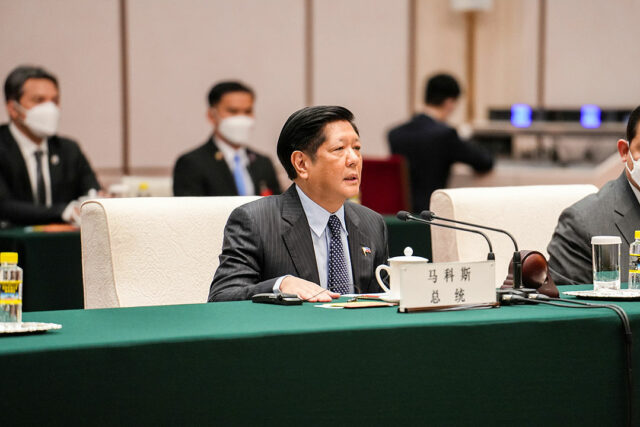
PHILIPPINE President Ferdinand R. Marcos, Jr. on Wednesday vowed to improve ties with China and explore more areas of economic cooperation in the post-coronavirus pandemic era.
Mr. Marcos made the commitment at a meeting with Li Zhanshu, chairman of the Standing Committee of the National People’s Congress, which is equivalent to the Philippine Legislature.
During the meeting at the Great Hall of the People in Beijing, Mr. Marcos “stated the need to raise the level of cooperation between China and the Philippines, particularly as the world recovers from the coronavirus pandemic,” the Office of the Press Secretary said in a statement.
“I have always stated that the partnerships between them in the next few years will be partnerships that will stabilize and strengthen all our economies so that we are able to face challenges and the different shocks that we are now beginning to feel and will continue to feel in the next few years,” Mr. Marcos said during the meeting, based on a video posted by the Radio Television Malacañang (RTVM) on Facebook.
“Certainly, we have considered in the Philippines as of primary importance to increase the relationship and to strengthen the relationship between China and the Philippines,” he added.
Mr. Marcos said he wanted China to continue investing in the Philippines, “noting that although there are some disagreements, the two countries must not allow them to be the sum of their relationship,” the palace said.
“President Marcos wants the Philippine-China relationship to extend to commerce, culture, education, trade and investment, as well as to people-to-people exchanges,” it added.
Pampanga Rep. and former President Gloria Macapagal Arroyo, who has backed the previous administration’s friendly relations with China against the backdrop of their South China Sea dispute, and Speaker Ferdinand Martin G. Romualdez were present at the gathering.
Foreign Affairs Secretary Jose Enrique A. Manalo, Finance Secretary Benjamin E. Diokno, Trade Secretary Alfredo E, Pascual, Socioeconomic Planning Secretary Arsenio S. Balisacan and First Lady Liza Araneta-Marcos were also present.
Mr. Marcos was set to meet with Chinese President Xi Jinping later in the day, where at least 10 agreements covering tourism, agriculture, trade and investments, among other things, were expected to be signed.
During the three-day state visit, the Philippines is expected to receive a 1.5-billion renminbi (P12 billion) grant from China, which accounted for 19% of the global economy in 2022 in terms of purchasing power parity.
Some Filipino foreign policy experts view the meeting between Mr. Marcos and Chinese President Xi Jinping with skepticism, citing China’s failure to deliver on its investment promises to the previous administration.
China claims more than 80% of the South China Sea, which is believed to contain massive oil and gas deposits and through which billions of dollars in trade passes each year. It has ignored a 2016 ruling by a United Nations-backed arbitration court that voided its claim based on a 1940s map.
The Philippines, which is being backed by the United States and its allies in ensuring freedom of navigation in the South China Sea, has been unable to enforce the ruling and has since filed hundreds of protests over what it calls encroachment and harassment by China’s coast guard and its vast fishing fleet.
In November last year, US Vice President Kamala Harris visited the Philippine island of Palawan near the disputed waterway as part of a three-day trip to an Asian ally that is key to America’s bid to counter China’s expansive activities in the region.
Analysts have said the US, the world’s largest economy, would likely remain as the Philippines’ No. 1 security ally under the Marcos administration after it made available $100 million in foreign military financing to Manila.
They also cited the “resurrection” of the Enhanced Defense Cooperation Agreement (EDCA), which allows the US military to operate in agreed locations in the Philippines on a rotational basis.
The Department of National Defense said last year $66.5 million had been earmarked for the approved EDCA projects. — Kyle Aristophere T. Atienza

By John Victor D. Ordoñez and Kyle Aristophere T. Atienza, Reporters
THE PHILIPPINES Interior Secretary on Wednesday called on hundreds of high-ranking police officers to quit to help cleanse their ranks of the “deep infection” of the illegal drug trade.
“It is coming out that there are generals and colonels involved in illegal drug activities,” Interior and Local Government chief Benjamin C. Abalos, Jr. told a news briefing in Filipino streamed live on Facebook.
“Upon the recommendation of the Philippine National Police (PNP) and a few other officers, I am calling on all full colonels up to the rank of police generals to submit their courtesy resignation.”
He said a committee would be formed to review the records of the police officers who will submit their “courtesy resignation letters.” “If you are not involved in illegal drugs, then you have nothing to worry about.”
He said law enforcers seized about P10 billion worth of illegal drugs in 24,000 drug operations last year. About 30,000 drug suspects were also arrested in the first 100 days of President Ferdinand R. Marcos, Jr.
Police had killed 46 drug suspects during illegal drug operations under the new administration, national police chief Rodolfo S. Azurin, Jr. told a press briefing in November. “The PNP is in full support of this call since we know that all of this is for the betterment of our organization,” national police spokesman Redrico A. Maranan told the same briefing in Filipino.
In a separate statement, the Gabriela Women’s Party called the Interior chief’s call a “half-baked” response to hold these police officers accountable for human rights violations during the drug war.
“If the Marcos Jr. administration really wants to cleanse the PNP of the drug problem, then it must pursue the filing of charges against erring cops instead of pushing for the approval of the free legal assistance bill for uniformed personnel,” it said.
The House of Representatives in December approved on final reading a bill providing free legal aid to law enforcement officials facing service-related cases.
Mr. Abalos’ call was “a bold move,” Michael Henry Ll. Yusingco, a policy analyst, said in a Facebook Messenger chat.
But the “dramatic flair” might have undermined its intended purpose, which is to cleanse the police ranks, “because doing it in a press conference can make some folks second guess his motive or resolve,” he said. “Some may simply dismiss this challenge as ‘for show.’”
“Secretary Abalos could have demonstrated the strong willingness to bring this plan to its logical conclusion, which is to get rid of the scalawags in uniform, had he issued this challenge without the press and their cameras,” he added.
National Capital Region Police Office Regional Director Jonnel C. Estomo told a separate briefing streamed live on Facebook he agrees with the Interior chief’s proposal.
“I hereby lead the team of NCRPO generals and police colonels to render our courtesy resignation to his excellency President Marcos,” he said.
Maria Ela L. Atienza, a political science professor at the University of the Philippines, said the Interior chief’s move shows the weakness of the Philippine justice system.
“Why not work closely with the Department of Justice and make sure PNP personnel are trained to gather evidence correctly and follow the rules of engagement in police operations?” she said in a Viber message.
“I hope the Interior and Local Government department is serious in their approach against illegal drugs especially by engaging institutions tasked to implement laws and policies that are meant to curb and not to further the systemic drug trade in the country,” Arjan P. Aguirre, a political science professor at the Ateneo De Manila University, said in a Messenger chat.
“This is a good strategy but this is not something new,” he said. “This has been done in the past and we have seen that these efforts later on did not lead to serious prosecution, clear conviction and incarceration of suspects who happen to be in power or used to be part of the government.”
Mr. Abalos said filing cases in court against ranking officers is a long process that tends to delay accountability.

PHILIPPINE President Ferdinand R. Marcos, Jr. has issued an order streamlining his office, which will be composed of five units.
Under Executive Order 11, the five offices under the Office of the President include the Office of the Executive Office, Office of the Chief Presidential Legal Counsel, Private Office, Office of the Special Assistant to the President and Presidential Communications Office.
The Executive Office will be composed of the Office of the Executive Secretary, Office of the Senior Deputy Executive Secretary and deputy executive secretary offices for General Administration, Legal Affairs, Finance and Administration and Internal Audit Office.
The Presidential Management Staff, which helps various offices under the Office of the President, will be controlled and supervised by the executive secretary.
The executive secretary, who is also known as the “Little President,” will continue to exercise administrative supervision over all the offices and agencies attached to or under the Office of the President and other executive offices, according to the order.
The order also renamed the Office of the Secretary as the Presidential Communications Office, which will be responsible for “crafting, formulating, developing, enhancing and coordinating the messaging system of the Executive branch.” — Kyle Aristophere T. Atienza

EIGHT UNVACCINATED Filipinos who recently came home from China tested positive for coronavirus disease 2019 (COVID-19) upon arrival at the main airport in Manila, according to the Health department.
The individuals, who arrived from Dec. 22 to Jan. 2, were “under isolation,” the Department of Health (DoH) said in a statement on Wednesday.
“The individuals are currently under isolation and have undergone confirmatory RT-PCR testing on Dec. 31, 2022 with positive results,” it said. “The department will continue to monitor developments on the matter.”
Under current Philippine protocols, “non-fully vaccinated individuals who are unable to present a negative pre-departure test result are tested upon arrival at the airport,” according to DoH.
Health advocates have been urging the Philippine government to enforce more travel restrictions on inbound travelers from countries with an alarming coronavirus situation, including China, which has been accused of failing to be fully transparent with its pandemic data.
The Philippines plans to welcome more tourists from China, which is expected to further ease restrictions on inbound and outbound travel as it seeks to fully reopen its economy this year.
China has begun dismantling its zero-COVID-19 strategy since December following unusual public protests in different parts of the country.
The US, Japan, Taiwan, South Korea, India, Australia, Italy, France, and Spain are among the countries that have already imposed coronavirus tests or additional requirements for passengers arriving from China.
There are worries that China might not be sharing data on new virus strains, which could lead to fresh outbreaks across the world. Chinese authorities have said the current outbreak is driven by versions of the Omicron variant, which has also been detected in the Philippines.
Beijing has always been “publishing information on COVID-19 deaths and severe cases in the spirit of openness and transparency,” a top health chief said at a press briefing held by China’s state council, based on a report by the state-run Xinhua News Agency.
DoH assured the public that the government would continue to conduct COVID-19 monitoring and surveillance activities in the country and keep an eye for “global health events that may occur.”
The department urges Filipinos to help prevent transmission sanitation, masking, distancing, good ventilation, and vaccination. — Kyle Aristophere T. Atienza

THE MINIMUM daily wage rate in five regions — Cordillera, Cagayan Valley, Central Luzon, Eastern Visayas, and Davao — increased starting this week, the second tranche of adjustments based on wage orders approved last year.
In the Cordillera Administrative Region, the minimum wage is P400 effective Jan. 1 for all sectors and provinces, including Baguio City.
This is based on Wage Order 21, approved on May 23 last year, which initially equalized the rate for the entire Cordillera to P380 per day starting June 14.
Cordillera is composed of Abra, Apayao, Benguet, Ifugao, Kalinga and Mountain Province.
Cagayan Valley’s rates, based on Wage Order 2-21 are now P400 for agriculture sector workers and P420 for non-agriculture, including service and retail establishments employing up to 10 workers.
Cagayan Valley or Region 2 is composed of Batanes, Cagayan, Isabela, Nueva Vizcaya, and Quirino.
In Central Luzon, the minimum wage for retail and service sector workers, regardless of the establishment’s manpower size, is P344. Other non-agriculture sector workers, regardless of manpower size, is P409.
For the agriculture sector, the minimum rate for plantation workers is P394, and P382 for non-plantation employees.
The Central Luzon or Region 3 wage board approved these rates in Wage Order No. RBIII-23 on May 30 last year.
Region 3 covers Aurora, Bataan, Bulacan, Nueva Ecija, Pampanga, Tarlac and Zambales.
In Eastern Visayas or Region 8, the following new rates took effect Jan. 2: P375 for non-agriculture sectors, including retail and service with more than 10 workers; and P345 for retail and service establishments with up to 10 workers, agriculture sector, and cottage and handicraft industries.
These adjustments are based on the Eastern Visayas regional board’s Wage Order VIII-22 approved on June 6 last year.
The region is composed of Biliran, Eastern Samar, Northern Samar, Samar, Leyte, and Southern Leyte.
For Davao or Region 11, rates are: P443 for industrial, commercial, retail and service companies with more than 10 workers; P428 for retail and service establishments with up to 10 workers; and P438 for the agriculture sector.
Establishments with up to 10 workers are due to increase their employees’ minimum daily wage to P443 by April 1, based on Wage Order XI-21 approved on May 31, 2022.
Region 11 includes Davao Oriental, Davao Occidental, Davao de Oro, Davao del Norte, and Davao del Sur, which geographically includes the independent city of Davao.
Minimum wage rates in the Philippines are set by region through tripartite boards composed of representatives from the workers sector, employers sector, and government.
Every wage order approved by a Regional Tripartite Wages and Productivity Board is subject to a final concurrence by the secretary of the Department of Labor and Employment.
The Philippines is divided into 17 regions. — MSJ
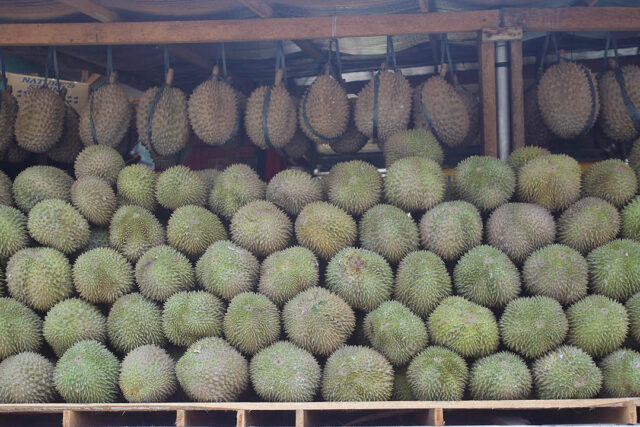
CHINA’s envoy based in Davao City sees expanded ties with the Philippines’ southern island Mindanao after President Ferdinand R. Marcos, Jr.’s state visit to China this week.
“Apart from carrying out the important consensus of our state leaders, let’s follow the outcome of the state visit of President Ferdinand Marcos Jr. to China and the summit between President Xi and President Marcos,” Consul General Li Lin told BusinessWorld.
An agreement for exporting durian to China, an agricultural commodity grown mainly in Mindanao, is among the deals that are expected to be signed during the Philippine leader’s visit from Jan. 3-5.
Davao City is among the main producers of durian and serves as a base for consolidators for harvests from other Mindanao areas.
In September, the Chinese Embassy in Manila announced that an inspection team has given the green light for durian imports from the Philippines following an on-site evaluation in the Davao Region.
Davao’s durian industry has been pushing for exports to China since at least 2016.
China is a leading durian importer, purchasing 822,000 tons worth $4.21 billion in 2021.
“I believe we will be able to discuss with Davao City government together to work out a more clear and comprehensive plan for cooperation in the year 2023,” Mr. Lin said.
Potential Chinese investments in other durian-producing regions in Mindanao will also be discussed during Mr. Marcos’ visit, Foreign Affairs Assistant Secretary for Asian and Pacific Affairs Nathaniel G. Imperial said during a briefing in Malacañang last week.
Assistant Secretary Romeo M. Montenegro, the deputy executive director of the Mindanao Development Authority, noted that the growing number of Chinese investors in southern Philippines signals a deepening China-Philippines relations.
He also cited government-to-government cooperation projects such as the Samal Island-Davao City bridge, which will be funded through $350-million loan deal with China.
A P3-billion bridge that will be part of the 18.2-kilometer Davao City coastal road project will be built through a grant from China. — Maya M. Padillo
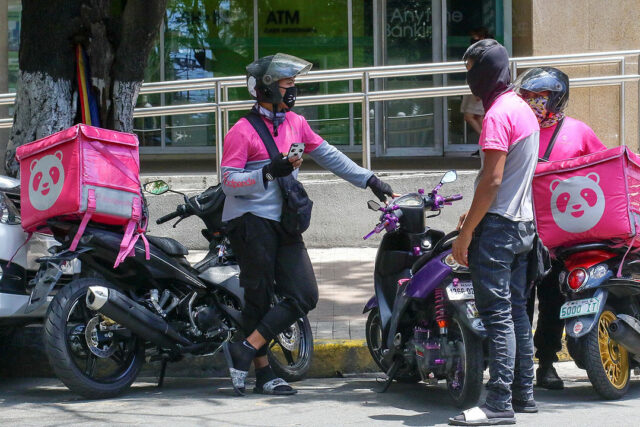
THE NATIONAL Labor Relations Commission (NLRC) has affirmed a ruling that recognized seven riders of online delivery service provider foodpanda Philippines as regular employees, according to a group of delivery riders based in Davao City.
The labor arbiter had ruled in favor of the delivery riders saying they had an employer-employee relationship.
The workers’ group, Davao United Delivery Riders Association, Inc. (DUDRAI), said they are expecting foodpanda to bring the case all the way to the Supreme Court and are prepared for the legal battle.
“In the still raging war against COVID-19, we take judicial notice of the fact that food delivery riders have repeatedly been alluded to as frontliners and heroes for enabling us to abide by physical distancing and other health protocols, while, at the same time, bolstering the economy,” the NLRC said in its Dec. 7 decision, based on a statement released on Wednesday by the group.
The NLRC said the riders were illegally dismissed since foodpanda suspended them for 10 years, which is considered constructive dismissal.
Constructive dismissal is when an employee is compelled by an employer to resign due to a specific incident.
The riders were suspended and denied access to foodpanda’s rider application in 2021 after they demanded for transparency about their pay.
A labor arbiter, in a decision released in July last year, ruled in favor of the riders and ordered foodpanda to pay them about P2.2 million in compensation plus lawyers’ fees.
Edmund D. Carillo, president of DUDRAI, said the latest NLRC decision was a victory for delivery riders nationwide.
“We are determined to see this through to the end, as we know that FoodPanda will appeal all the way to the Supreme Court,” he said.
“Apart from the money claims, this is a victory so that companies like FoodPanda will recognize the rights and benefits that should be given to delivery riders,” he added in Visayan.
Foodpanda has yet to issue a statement on the NLRC decision. In 2021, the company explained that it made the difficult decision to offboard a small number of riders who have violated their agreement with foodpanda by calling for disruptions that may affect the wider ecosystem that includes other riders, vendors, and customers. — John Victor D. Ordoñez
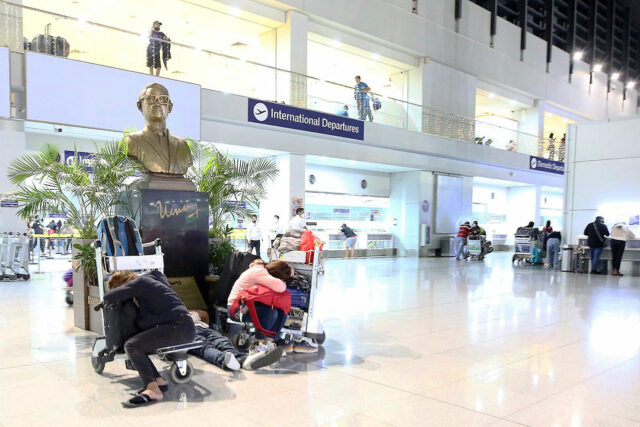
THE DEPARTMENT of Migrant Workers (DMW) on Wednesday said it will continue to provide assistance to stranded Filipino workers, including travel arrangements and contacting employers, after their flights were canceled on Jan. 1 due to a glitch in the country’s air control system.
“We will continue to man our airports and support our OFWs (overseas Filipino workers) until they get their flights rebooked,” DMW Undersecretary Hans Leo J. Cacdac told a televised briefing.
“As of now, we will continue accommodating those with rebooked flights.”
In an advisory dated Jan. 3, Migrant Workers Secretary Maria Susana V. Ople ordered all private recruitment and manning agencies to assist OFWs affected by the flight disruptions that occurred on Jan. 1.
The DMW has assisted at least 3,000 overseas Filipino Workers who were stranded at different airports across the country, Mr. Cacdac said on Tuesday.
Around 200 OFWs are still in hotels waiting for their rebooked flights, he added.
Meanwhile, Mr. Cacdac said the DMW is in talks with the Department of Foreign Affairs (DFA) on the deployment of Filipino workers to India.
The Philippines suspended in December the deployment of Filipino workers to the South Asian country for failing to meet standards on the protection of migrant workers.
India is not a signatory to the 1990 United Nations Convention on the Protection of the Rights of Migrant Workers and Members of their Families, DMW Undersecretary Bernard P. Olalia said then.
Data from the Philippine Overseas Employment Administration showed that there are currently less than 2,000 documented temporary Filipino migrants in India.
“We hope the status of deployment to India will be resolved soon which is why we are working closely with the DFA on the matter,” he told the same briefing. — John Victor D. Ordoñez
