Home Blog Page 5419

MREIT targets to complete P5.3-B acquisition in Q1 

MREIT, Inc. said it expects the acquisition of four prime properties worth P5.3 billion to be completed within the first quarter of the year.

“We remain committed to delivering competitive returns to our shareholders through a combination of organic growth and acquisitions,” MREIT President and Chief Executive Officer Kevin L. Tan said in a press release on Monday.

“We aim to complete within this quarter our planned acquisitions announced last year,” Mr. Tan added.

In April 2022, MREIT announced the acquisition of four prime properties, which will keep the company on track to achieving its goal of having 500,000 square meters (sq.m.) of gross leasable area by the end of 2024.

The four properties — the Festive Walk 1B and Two Global Center in Iloilo Business Park, and One West Campus and Five West Campus in McKinley West, Taguig City — are all located within Philippine Economic Zone Authority-accredited zones.

The grade A office properties are said to increase the total gross leasable area of MREIT by 44,567 sq.m.

Once realized, the company will start infusing income from the assets to the trust beginning Jan. 1 and is expected to increase MREIT’s property value by P5.3 billion.

“The acquisition will increase MREIT’s property value by 9% to P64.5-billion and will provide added growth in line with our promise to deliver sustainable value to our shareholders,” said Mr. Tan.

According to the company, the acquisition is still subject to the approval of the Securities and Exchange Commission.

Meanwhile, the company declared dividends of P0.24 per share to its shareholders based on the distributable income in the fourth quarter of 2022.

The dividends will be payable on Feb. 15 to stockholders on record as of Jan. 24.

The declared dividends brought total dividends for the year to P0.98 apiece and the company’s dividend yield to 7.1% as of MREIT’s closing price of P13.70 per share on Jan. 6. — Justine Irish D. Tabile

CIMB cash-in transactions hit all-time high in 2022

CIMB BANK Philippines, Inc. (CIMB Bank PH) saw a 68% growth in total transaction value in 2022, citing strong performance on its deposits and lending portfolios.

The bank said in a statement on Monday that it reached an all-time high cash-in transaction value of P128 billion in 2022, 68% higher than the P76 billion recorded in 2021.

Loan disbursements also more than doubled (167%) to 38 billion from 14 billion a year prior, the bank said.

“2022 has been a year of unprecedented growth as we continue our innovative embedded banking digital business model. We are proud to be the leader in disrupting the banking experience and will continue to bring unmatched value and experience to our customers,” CIMB Chief Executive Officer Vijay Manoharan said.

He attributed the higher deposits to its 12% per annum anniversary promo, where the bank saw deposits rise to over P1 billion within the first five days of the promo’s launch.

“By offering the highest ever interest rate in the country, CIMB Bank PH allowed its customers to earn a 12% per annum interest rate on their incremental average daily balance (ADB) growth for December,” he said.

The digital lender also saw its customer base double to two million last year from one million in 2021, while improving its asset quality and nonperforming loans.

Mr. Manoharan attributed the strong performance of its lending portfolio to CIMB Bank PH credit products REVI Credit and GCredit, as well as the launch of its partnership with SeaMoney for SPayLater.

“We are excited for the coming new year as we continue to live out our mission of providing Filipinos accessible digital financial solutions so that they can achieve their life purpose,” he added.

In November 2022, the bank partnered with SeaMoney to onboard 2.5 million loan customers this year, adding to the 1.3 million SPayLater users in the country.

Meanwhile, CIMB Bank PH launched REVI Credit for all its customers in December 2021, which gives clients access to higher credit limits of up to P250,000 and interest rates as low as 1% with no annual fees. It also allows clients to convert a portion of their credit lines into cash or a term loan at any time for emergency financing needs.

CIMB Bank PH provides mobile-first digital banking solutions and services. It is currently serving around six million Filipinos and over two million lending customers.

The bank’s total assets as of September stood at P24.4 billion, based on central bank data. — Keisha B. Ta-asan

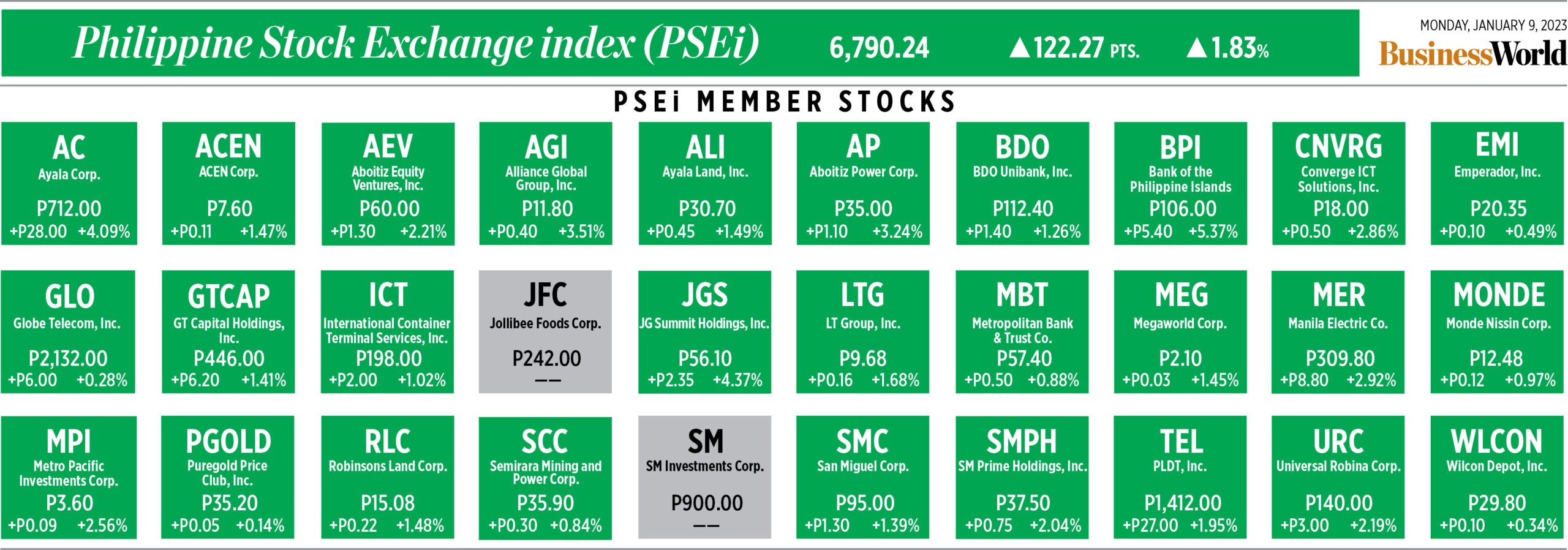
How PSEi member stocks performed — January 9, 2023

Here’s a quick glance at how PSEi stocks fared on Monday, January 9, 2023.


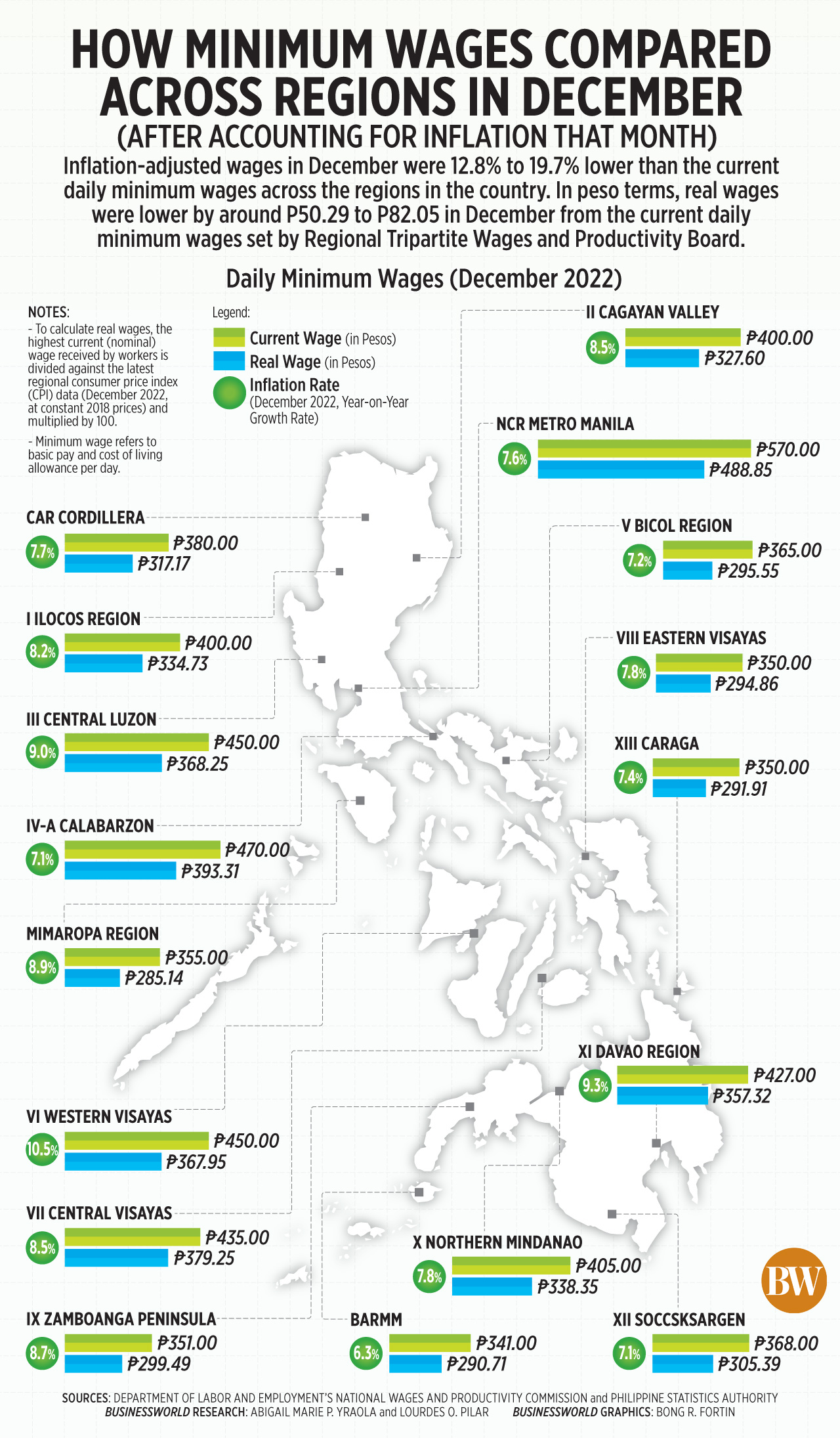
How minimum wages compared across regions in December

JANNELLE MICA D. VIDEZ plans to leave her job as a business analyst in the Philippine capital and move to Australia to work in public relations.

“While it’s true that the cost of living is also more expensive there, workers are paid better than in Manila,” the 22-year-old Filipina said in a Facebook Messenger chat. “Price tags only keep getting higher here, but the quality of life remains stagnant.” Read the full story.

How minimum wages compared across regions in December

Peso surges on GIR data, hopes of slower Fed hikes

MARI GIMENEZ-UNSPLASH

THE PESO surged against the dollar on Monday on bets of slower rate hikes from the US Federal Reserve and as the Philippines’ gross international reserves (GIR) rose at end-2022.

The local currency closed at P55.11 versus the greenback, up by 53 centavos from Friday’s finish of P55.64, data from the Bankers Association of the Philippines showed.

The peso opened Monday’s trading session stronger at P55.30 per dollar. Its weakest showing was at P55.32, while its intraday best was at P55.09.

Dollars traded rose to $1.22 billion from $1.052 billion on Friday.

“The peso appreciated significantly after the latest US labor reports showed softer wage inflation, which hinted at a potential easing in price pressures,” a trader said in an e-mail.

“The local currency might appreciate further amid prospects of a softer US policy rate hike in the upcoming Fed meeting,” the trader added.

Nonfarm payrolls increased by 223,000 jobs last month after rising 256,000 in November. However, average hourly earnings rose 4.6% in December from a year earlier, down from 4.8% in November.

Fed officials on Friday acknowledged cooling wage growth and other signs of a gradually slowing economy, with Atlanta President Raphael Bostic hinting at the chance of a quarter-percentage-point hike at the next policy meeting on Jan. 31 to Feb. 1.

The US central bank last year raised borrowing costs by 425 basis points to a 4.25%-4.5% range.

Meanwhile, Rizal Commercial Banking Corp. Chief Economist Michael L. Ricafort said in a Viber message that the peso strengthened against the dollar as central bank data released on Friday showed the country’s GIR climbed to $96.01 billion as of December 2022 from $95.12 billion in November.

This was above than the Bangko Sentral ng Pilipinas’ year-end projection of $93 billion.

It was also the highest since the $97.44 billion recorded as of August 2022.

For Tuesday, Mr. Ricafort expects the peso to move from P55 to P55.20 against the dollar, while a trader gave a stronger forecast range of P54.95 to P55.20. — AMCS

Local stocks track Wall St. rally on Fed hike bets

PHILIPPINE STAR/KRIZ JOHN ROSALES

SHARES went up on Monday, mirroring Wall Street’s climb, as investors were hopeful that improved US economic data could lead to slower tightening by the US Federal Reserve.

The 30-member Philippine Stock Exchange index (PSEi) rose by 122.27 points or 1.83% to close at 6,790.24 on Monday, while the broader all shares index added 55.90 points or 1.59% to end at 3,568.97.

“The PSEi mimicked the strong move from the US market, closing today up 1.83%,” Mercantile Securities Corp. Head Trader Jeff Radley C. See said in a Viber message on Monday.

“The Dow Jones was up 700 points last Friday, continuing its strong start this 2023. With good data results, investors are still hopeful that the central bank will pivot,” Mr. See added.

Sentiment on Wall Street got a boost last week from a benign blend of solid US payroll gains and slower wage growth, combined with a sharp fall in service-sector activity, Reuters reported. The market scaled back bets on rate hikes for the Fed.

On Friday, the Dow Jones Industrial Average rose by 700.53 points or 2.13% to 33,630.61; the S&P 500 gained 86.98 points or 2.28% at 3,895.08; and the Nasdaq Composite added 264.05 points or 2.56%, at 10,569.29.

US nonfarm payrolls rose by 223,000 jobs in December, the smallest gain in two years after rising 256,000 the previous month, while the 0.3% rise in average earnings was smaller than expected and less than the previous month’s 0.4%.

“The market was up on hopes for eventual Federal Reserve’s pause in its rate hiking amid falling inflation,” First Metro Investment Corp. (FMIC) Head of Research Cristina S. Ulang said in a Viber message.

In November, the US consumer price index rose less than expected by 0.1% after advancing by 0.4% in October. The December inflation report will be released on Jan. 12, Thursday.

The Fed in 2022 hiked rates by 425 basis points.

Back home, all sectoral indices closed higher on Monday. Mining and oil surged by 343.72 points or 3.04% to 11,631.66; financials added 37.22 points or 2.20% to end at 1,723.38; holdings firms increased by 118.36 points or 1.82% to 6,600.33; property rose by 52.57 points or 1.77% to 3,020.51; services gained 21.93 points or 1.31% to close at 1,686.21; and industrials went up by 122.01 points or 1.27% to 9,682.91.

Advancers overwhelmed decliners, 148 versus 47, while 43 names closed unchanged.

Value turnover climbed to P6.41 billion on Monday with 2.46 billion shares changing hands from the P5.47 billion with 7.15 billion issues traded on Friday.

Net foreign buying went up to P283.83 million from P180.11 million the previous day.

“The index will likely break its resistance level at 6,840 and might move further to its next resistance at 7,150,” Mercantile Securities’ Mr. See said.

He placed the PSEi’s support levels at 6,623 and 6,400, while FMIC’s Ms. Ulang placed market’s support at 6,500 and resistance at 6,900. — Justine Irish D. Tabile

Business chambers see tourism, agriculture driving 2023 recovery

Tourists continue to flock to Boracay, considered one of the top tourist attractions in the country. — PHILIPPINE STAR/KRIZ JOHN ROSALES

BUSINESS GROUPS said they expect tourism and agriculture to drive the economic recovery in 2023, with remittances providing a cushion against any possible external shocks.

George T. Barcelon, Philippine Chamber of Commerce and Industry president, said his organization is “cautiously optimistic” of the country’s economic performance this year.

“Our economy will sustain a healthy pace in the first half of the new year. There may still be interest hike(s) mirroring the US and EU actions to mitigate inflation (but) remittances and the rebounding domestic economy will allow the Philippines to weather it,” Mr. Barcelon told reporters in a Viber message.

The Bangko Sentral ng Pilipinas increased interest rates by 350 basis points in 2022, bringing its benchmark rate to 5.5% in response to high inflation and the weakening peso.

Mr. Barcelon said that the government should address high food prices, which have added to the pressure to raise wages, raising the prospect of more inflation going forward.

“This is a vicious cycle that could stunt business and negatively impact the competitiveness of the export sector. As such, the outlook on both job creation and sustainability for the year may encounter headwinds,” Mr. Barcelon said.

Mr. Barcelon said tourism and agriculture could be the economy’s sources of strength, as will infrastructure.

“The government’s plans to continue infrastructure spending and massive housing projects for the homeless will certainly give impetus to our economy. From worldwide trends, travel and leisure business are coming back on strong. The recent trip of President Ferdinand R. Marcos, Jr. has (secured) China’s support for our tourism and agricultural sectors,” Mr. Barcelon said.

Lily Lim, vice chair for media and public information affairs for the Federation of Filipino Chinese Chambers of Commerce & Industry, Inc., said in a separate televised briefing on Monday that the group is projecting 6.5% to 7.5% gross domestic product (GDP) growth for 2023. 

According to Ms. Lim, the forecast will come on the back of agriculture.

“We will hit 6.5% to 7.5% (GDP growth) for sure within the year with exports of our agricultural products to China. We have fruits such as durian, avocado, bananas, mangosteen, and others,” Ms. Lim said. 

“Following the trip of Mr. Marcos to China, we expect improvement in the agricultural sector. We should also expect improvements in development cooperation, infrastructure, maritime security, and tourism,” she added.

GDP grew 7.6% in the third quarter. Fourth-quarter GDP is set to be released on Jan. 26.

The government projects GDP to have increased between 6.5% and 7.5% last year. For 2023, the government has set a target range of 6% to 7%.

Ms. Lim called for a further easing of coronavirus disease 2019 (COVID-19) related restrictions in order to boost economic growth.

“There are so many countries and also for us, the case count has dropped. (We should ease) restrictions… and also prepare ourselves to grow agriculture, tourism… (and) infrastructure — everything needed to support (the economy),” Ms. Lim said.

Mr. Marcos has said the Philippines will monitor the COVID-19 situation in China, which reopened its borders to international travelers on Jan. 8. — Revin Mikhael D. Ochave

Pork supply exceeds demand, Senate panel finds, casting doubt on gov’t import policy

PORK meat products are sold at the Murphy Market in Cubao, Quezon City, Feb. 11, 2021. — PHILIPPINE STAR/ MICHAEL VARCAS

By Alyssa Nicole O. Tan, Reporter

THE Senate Agriculture, Food and Agrarian Reform Committee was told that the supply of pork exceeded demand in each of the years since 2019, raising questions about the government’s pork import policy.

Senator Cynthia A. Villar, who chairs the committee hearing, on Monday cited data indicating a pork surplus since 2019, suggesting a disconnect between the decision to import and the available pork inventory.

“We should know our local production (and) demand; the difference is what we should import,” she said.

According to Ms. Villar’s data, pork demand was 1.7 million tons in the 2019-2022 period, well below the estimated supply of 2.6 million tons.

“Why is it that production is larger than demand yet we import?,” she added.

One of the resource persons at the committee hearing, who represents the poultry industry, told the panel that the government’s policy over the last few years was to freely allow meat imports to all seeking permits.

“All these years, the private sector’s understanding of the DA’s (Department of Agriculture’s policy) is that imports can come in because we are fully liberalized. The importer just has to click on his computer and the permit will be issued electronically,” United Broiler Raisers Association President Elias Jose M. Inciong said.

“Pork and chicken are the products that don’t need a certificate of necessity to import. Our understanding is that all the rest need the certificate of necessity to import,” he added.

Bureau of Animal Industry Officer-in-Charge Director Paul C. Limson confirmed the lack of controls over imports. “The import application is lodged by the client, so we don’t have direct control over how frequently they do so,” he said.

Ms. Villar asked why the importer had the power to determine appropriate shipment volumes, adding that the government must impose “common sense” limits on permitted quantifies.

“Imports are fine with me if there’s a shortage, to solve temporary short-term problems,” she added. “Those giving the permits want imports because they benefit from it.”

Agricultural Sector Alliance of the Philippines Party-list Representative Nicanor M. Briones said that it was the DA’s responsibility to ensure that farmers do not face unfair competition from imports.

“We are agreeing to import to the extent that farmers lose out,” he said. “It’s the consumer who suffers because of what we are doing.”

He said the government needs to make import decisions with reference to the direction of farmgate prices, by which they can gauge the balance of supply and demand and plan for appropriate import volumes.

“It seems we no longer care about our farmers and consumers,” he added.

“Any industry in this situation will die,” Ms. Villar said, noting that farmers will eventually abandon agriculture because they cannot make a living competing with imports.

Ms. Villar said the Palace must take the initiative in balancing supply, demand, and imports.

Mr. Briones also said that temporary solutions should not be made permanent, such as a recent executive order extending the lower tariff regime for imports of pork, rice, corn and coal, which originally took effect as a measure to contain inflation in 2021.

 Signed by Mr. Marcos on Dec. 29 and released on Wednesday, Executive Order No. 10 extended until the end of 2023 the reduced tariffs for pork at 15% (for imports within the minimum access volume quota) and 25% (for those exceeding the quota). The corresponding tariffs were 5% for corn (within the quota) and 15% (beyond the quota), and 35% for rice from all sources, not just Southeast Asian grain.

Coal will remain at zero duty beyond the end of the year, subject to review every six months.

Reynaldo R. Cancio, the National Economic and Development Authority Policy and Planning Group supervising officer, said the extension of the reduced tariffs was meant to be a temporary measure to contain inflation.

“The recommendation to extend was only temporary… so it’s only up to the end of 2023,” he said.

“But then we assessed based on a petition from the public, from the private sector, that it needed to be extended in order to reduce inflation,” he said. “The forecast of the BSP (Bangko Sentral ng Pilipinas), at the time we were assessing, was that the target of 4% maximum inflation for 2022 would be exceeded again in 2023, so we needed to look for ways to manage inflation further.”

Ms. Villar noted however that prices have not fallen even with ample supply due to imports.

“That means (prices are) being controlled by the cartel, (which is) very powerful in the Philippines,” she said.

President Ferdinand R. Marcos, Jr., who is also Secretary of Agriculture, has called the extension of reduced tariffs necessary to “maintain affordable prices for the purpose of ensuring food security, help augment the supply of basic agricultural commodities, reduce the cost of electricity, and diversify the country’s market sources.”


PHL obtains $6M to fund rail feasibility studies

PHILIPPINE STAR/KRIZ JOHN ROSALES

THE GOVERNMENT has obtained access to more than $6 million in loans to fund feasibility studies for three railway projects outside the capital region, the Transportation department said on Monday.

The three proposed projects are the planned Panay Railway, the Bataan Railway, and the North Long Haul Interregional Railway, which will connect provinces to the north of Metro Manila, Transportation Secretary Jaime J. Bautista said.

“The technical studies for these railway projects will commence in the next few months,” he said during a ceremony to launch operations for the Metro Manila Subway Project (MMSP) tunnel boring machine in Valenzuela City.

Mr. Bautista said the government is also “on track” to secure funds for the feasibility studies for the San Mateo Railway Project, Northern Mindanao Railway Project, as well as the Philippine transport system master plan.

Mr. Bautista said the start of tunneling in Valenzuela City “signifies the point of no return” in the construction of the subway. “We are going full speed ahead to complete the country’s first subway.”

The subway project will cut across eight cities that between Valenzuela City and Parañaque City, with a spur line connecting to the Ninoy Aquino International Airport.

With a 33-kilometer route length and 17 stations, the subway targets travel time between Quezon City and NAIA in Pasay City to 35 minutes from over an hour. It is expected to accommodate up to 370,000 passengers daily.

“Many of big-ticket infrastructure projects require a lot of time to complete,” Mr. Bautista said. “We ask for patience and understanding as we pursue permanent solutions to our transportation problems.”

MMSP’s Contract Package 101 (CP101) is part of the project’s seven civil works contracts, the Department of Transportation (DoTr) said in a statement. It involves the construction of three underground stations in Quezon City and an additional semi-underground station in the northern Valenzuela City, where the depot is located.

The agency said six tunnel boring machines will be deployed for CP101.

“Around 1,200,000 cubic meters of soil using cut-cover and the TBMs are to be excavated for the partial operability (PO) section of the project or the equivalent of 500 Olympic-size swimming pools,” the DoTr said. “For the tunnels alone, the excavation will be around 711,000 cubic meters or an equivalent of 285 Olympic size swimming pools.”

“The entire alignment will have a total excavated soil of about 7,419,940 cubic meters or the equivalent of 2,500 Olympic size swimming pools,” it added.

The P488-billion subway project is supported by loans from the Japan International Cooperation Agency.

President Ferdinand R. Marcos, Jr. said he believes the Japanese government will “help us shape our railway infrastructure and keep them at par with the highest international standards,” noting that the tunnel boring machine shows “Japan’s expertise in technology and trailblazing contributions in the modern world.”

“The launching of this tunnel boring machine became a testament to this administration’s commitment to continue the projects of the previous administration and more importantly build better more,” he said at Monday’s event.

“We will continue to invest and improve on our transportation system as well as pursue more projects in the years to come so that Filipinos can gain greater access to places of work, commerce, recreation and other vital areas,” he added.

The contract package is expected to be finished by the end of 2027.

Mr. Marcos asked for more patience as “big-ticket projects such as this take years to be completed.”

“So, I ask not only for your continued patience but also for your continued trust and support for the government.” — Kyle Aristophere T. Atienza

PHL current account deficit forecast raised to 4.7% of GDP in 2023

ENERGY.AGPGLOBAL.COM

THE current account deficit as a proportion of gross domestic product (GDP) is now projected at 4.7% this year from 4.5% previously, with easing commodity prices offset by strong imports of capital goods, Fitch Solutions Country Risk & Industry Research said in a report.

The 2023 projection is lower than the expected percentage in 2022 due to cheaper oil, it said.

“As a net importer of energy, the Philippines will benefit from lower energy prices in 2023, and we expect remittance inflows to remain resilient,” Fitch Solutions said.

“That said, strong capital goods imports and a slowdown in export growth will keep the trade deficit elevated relatively to historical levels,” it added.

Fitch Solutions’ current account deficit forecast for 2022 is 5% of GDP, due to the continuing threat of weakening global demand.

The current account deficit was at $5.8 billion in the third quarter, against the $974-million year-earlier deficit, as the deficit in the trade in goods widened.

The third quarter 2022 deficit was equivalent to 6.2% of GDP, against a deficit of 1.1% a year earlier, the Bangko Sentral ng Pilipinas said last month.

The current account balance, a gauge of the balance of payments due over the short term, was in deficit by $17.8 billion in the nine months to September, much higher than the year-earlier deficit of $2.3 billion. 

The cumulative current account deficit “has likely widened to 5.2% of GDP for the whole of 2022 (versus our previous estimate of 5% of GDP),” Fitch Solutions said.

“While we still expect the current account deficit to narrow due to lower commodity prices and resilient remittance inflows, weakening global demand and sustained high imports of capital goods will keep the current account shortfall considerably larger compared to its historical five-year average of a 0.5% deficit (2017-2021),” it added.

Fitch Solutions expects goods export growth to slow to 5% this year from an estimated 6% in 2022, due to a broader slowdown in demand as a result of higher borrowing costs.

“Factoring in the lagged effects of tightening global monetary conditions across the world, our global team expects that global GDP growth will slow to 1.9% in 2023, versus 3.1% in 2022. In particular, we expect the US to enter a mild recession in 2023, which would bode poorly for Philippine exports,” Fitch Solutions said.

Philippine shipments to the US, its leading export market, accounted for about 15.4% of Philippine exports in 2021.

“Although we expect real GDP growth in China (which is the second largest export destination at 15.1% of total) to accelerate to 5% in 2023, from an estimated 3.3% in 2022, the recovery remains bumpy due to uncertainties around the COVID-19 (coronavirus disease 2019) situation,” it said. — Keisha B. Ta-asan

Airport authority sees 2023 revenue rising 36% to P11.5B

THE Manila International Airport Authority (MIAA), which manages the Ninoy Aquino International Airport, said it expects revenue to rise 36% to P11.46 billion this year, with a capital expenditure target of P2.69 billion, up 98%.

The budget for maintenance and other operating expenses has been raised by 18% to P5.42 billion. Operating expenses include water, light, power, repairs and maintenance, manpower services, and security services.

The MIAA Board approved in October a proposed operating budget for 2023 of P12.734 billion, implying a deficit of P1.084 billion, which will be funded from retained earnings, according to documents obtained by BusinessWorld.

The MIAA said revenue gains are expected to come on the back of a revival in travel activity.

Revenue from passenger service charges, both domestic and international, is expected to rise 51% to P4.17 billion this year, while revenue from aeronautical fees is expected to grow 16% to P3.55 billion.

Revenue from rentals is expected to rise 57% to P2.59 billion.

Concession fees, including terminal and other areas, are expected to increase 7% to P532.63 million.

Revenue from parking is expected to rise 30% to P366.73 million.

Passenger traffic — arrivals and departures — is expected to rise 34% to 39.87 million this year.

Flights, including international, domestic, and general aviation, are expected to increase by 18% to 289,396 this year.

Separately, the Governance Commission for GOCCs (GCG) on Monday inspected the air traffic management facility of the Civil Aviation Authority of the Philippines (CAAP) in Pasay City.

“This is to ensure that the Philippine Air Traffic Management System’s management is operating functionally, safely, and reliably,” the GCG, which regulates government-owned and -controlled corporations (GOCCs), said in a statement.

The GCG said it will compile a scorecard for CAAP in light of the technical faults that brought down the air traffic control system on New Year’s Day, leading to the cancellation, delay or diversion of hundreds of flights.

“We want to know what really transpired here because this affects many individuals. Around 75,000 people were affected,” GCG Commissioner Gideon D.V. Mortel said.

“As an agency under our coverage, they are transparent. We were led (through) the entire process. The facility was shown to us and (CAAP has been) cooperative and willing to share with us all the information we need. In fact, after this, we will be writing CAAP another memorandum to complete their submissions based on what transpired here today,” he added. — Arjay L. Balinbin

House panel to probe alleged food smuggling via Subic

ICTSI.COM

THE House committee on ways and means said it will investigate the alleged smuggling of pork, dressed chicken, and beef via the Port of Subic with charges levied on containers reportedly a fraction of the correct amounts, the committee’s chairman said.

Albay Rep. Jose Ma. Clemente S. Salceda said in a statement: “We are now in possession of credible information that the Subic port undercharges tariffs per container van by just as much as 1/8th of the actual tariff due, or in peso terms, some P100,000 per container van of imported meat instead of P800,000.”

 Mr. Salceda cited a statement from Subic Bay Metropolitan Authority (SBMA) Chairman and Administrator Rolen C. Paulino that smuggling in Subic is “not an issue nor a concern to the management.”

“We have strict policies that are implemented in close collaboration with the Bureau of Customs and we’re proud to say that we have apprehended any and all attempts that have intended to use Subic port as their receiving port, in particular with agricultural products, following the mandate of the President who is also the country’s agriculture secretary,” Mr. Salceda quoted the SBMA as saying.

Mr. Paulino also said that the agency “(remains) nonchalant because we know we can apprehend them yet always on our toes with the smuggling attempts using our port because the SBMA and the BoC will never allow such misdeeds to happen.”

Mr. Salceda called the response of the SBMA an instance of “institutional inertia that breeds corruption and kills local Philippine industries.”

“We are prepared to name names at the proper time. For now, we will protect our sources,” Mr. Salceda added.

The SBMA did not reply to an e-mail seeking comment.

Mr. Salceda said that he will propose recommendations to the impending rules and regulations of the Presidential Decree No. 1612 or the Anti-Fencing Law. — Beatriz Marie D. Cruz

ADVERTISEMENT
ADVERTISEMENT