Home Blog Page 5415

COVID-19 cases drop 9% in 1st week of Jan.

COMMUTERS pass through a walkway in Recto, Manila, Aug. 25. — PHILIPPINE STAR/ MIGUEL DE GUZMAN

THE PHILIPPINES posted 3,127 new coronavirus infections in the previous week with a daily average of 447, according to health authorities.  

The daily average from Jan. 2 to 6 was 9% lower than the average cases per day from a week earlier, the Department of Health (DoH) said in a bulletin on Monday.   

Of the new cases, seven were severe and critical, it added. 

DoH said 79 new deaths were verifiedin the past week, 17 of which occurred from Dec. 26 to Jan. 8.  

It said 431 of 2,379 intensive care unit (ICU) beds had been used as of Jan. 8, while 4,185 of 19,373 non-ICU beds were occupied. There were 507 severe and critical admissions, it added.  

The Health agency said 73.79 million Filipinos have been fully vaccinated against the coronavirus with 21.19 million having received booster shots. Kyle Aristophere T. Atienza 

Eala bows to Doi in first round of Australian Open qualifiers

FILIPINA tennis ace Alex Eala — ALEX EALA FACEBOOK PAGE

Djokovic with hamstring problem, beats Korda

ALEX Eala crashed out of contention in the 2023 Australian Open, running out of steam in a tough 6-4, 6-7, 3-6 defeat against Japanese Misaki Doi for an early boot in the Round 1 of the qualifying draw at the Melbourne Park.

Heeding the challenge of her first-ever women’s Grand Slam tourney, Ms. Eala took a rousing opening-set victory behind her crisp groundstrokes and looked headed to Round 2 with ease following a big lead in the second salvo.

But the 17-year-old Filipina eventually succumbed to the pressure of the 31-year-old Japanese veteran as she fumbled a 5-2 upperhand en route to a narrow loss in the tiebreaker to pave the way for a decider.

Ms. Doi, WTA No. 172 and with almost 300 pro matches under her belt, just stamped her class from there on by keeping the WTA No. 215 Eala at bay for a thrilling comeback win in two hours and 37 minutes.

Save for a defeat in the first set, Ms. Doi was near perfect from then on by netting five aces with only one double fault. Ms. Eala had four faults, majority of which came in the latter part of the match that she controlled until the end of the second set.

Ms. Doi thus advanced in the second round of the qualifiers and will face WTA No. 118 Laura Pigossi of Brazil, who took care of business against Belgium’s Magali Kempen with an easier 6-2, 6-2 win.

Ms. Eala, for her part, kissed goodbye to her hopes of advancing to the main draw in her women’s Grand Slam debut.

A scholar of the Rafael Nadal Academy in Spain, Ms. Eala is a winner of juniors doubles Slams (2020 Australian Open, 2021 French Open) and singles title (2022 US Open) on top of her two professional crowns in Spain and Thailand.

DJOKOVIC LOST SLEEP TO DEAL WITH HAMSTRING PROBLEM
Novak Djokovic said he worked with his physiotherapist all night to fix a hamstring issue before the Serbian beat Sebastian Korda in the Adelaide International 1 final on Sunday ahead of this month’s Australian Open.

Mr. Djokovic underwent treatment on his left leg during Saturday’s semi-final victory over Daniil Medvedev after he hyper-extended his left hamstring while stretching to make a forehand.

But the 35-year-old moved freely on the court in Sunday’s final before he dug deep to save a match point and seal a 6-7(8) 7-6(3) 6-4 victory.

“I woke up all right. Went deep into the night last night with work done with the physio,” Mr. Djokovic told reporters. “Talk with the doctors, as well, of the tournament, etc.

“There was a lot of care going into today’s match about the hamstring. It was all right.

“Few times in the match I felt was tightening up the muscle, but nothing that would worry me for my performance.”

At the Jan. 16-29 Australian Open, Mr. Djokovic will be bidding for a record-extending 10th title to draw level with Rafael Nadal on 22 Grand Slam crowns.

“I couldn’t ask for a better preparation and lead-up to Australian Open,” Mr. Djokovic said.

“I look forward to Melbourne. Rod Laver is probably my most — not probably, it certainly is my most successful court in my career. I love playing there. I look forward to it.

“I have a week off for recovery now and working on specific things in terms of my game, my body, getting my mind in the right state for the best-of-five and two long weeks hopefully.” — John Bryan Ulanday with Reuters

Newly elected VP of AWF to make sure weightlifting remains in ’28 LA Games

SAMAHANG Weightlifting ng Pilipinas chief Monico Puentevella (right) with Tokyo Olympics gold medalist Hidilyn Diaz-Naranjo (left). — MONICO PUENTEVELLA FACEBOOK PAGE

SAMAHANG Weightlifting ng Pilipinas (SWP) President Monico Puentevella was recently elected as Asian Weightlifting Federation (AWF) vice president in Doha, Qatar.

After earning his mandate, the AWF honorary president’s first order of business is to make sure the sport, which delivered the country its breakthrough Olympic gold medal in the 2021 Tokyo Games, will remain in the 2028 Los Angeles Games calendar.

While weightlifting will see the day in next year’s Paris Olympics, there is a chance it may not in the next staging in LA as following its removal from the initial list of disciplines to be played there by the International Olympic Committee (IOC).

“From being AWF honorary president to vice president simply means I would like a more active role within the new AWF and IWF (International Weightlifting Federation) boards to make sure our beautiful sport doesn’t get scrapped in the 2028 LA Olympics and all Games thereafter,” said Mr. Puentevella.

Just before his election, Mr. Puentevella received an award for his exemplary performance as AWF honorary president as well as an inclusion to the IWF Hall of Fame.

Under his leadership, the Philippines won its historic Olympic gold courtesy of Hidilyn Diaz-Naranjo in Tokyo.

And there is hope more will be won in Paris. — Joey Villar

Nets edge Heat on Royce O’Neale’s score in final seconds

BROOKLYN Nets guard Kyrie Irving (11) — REUTERS

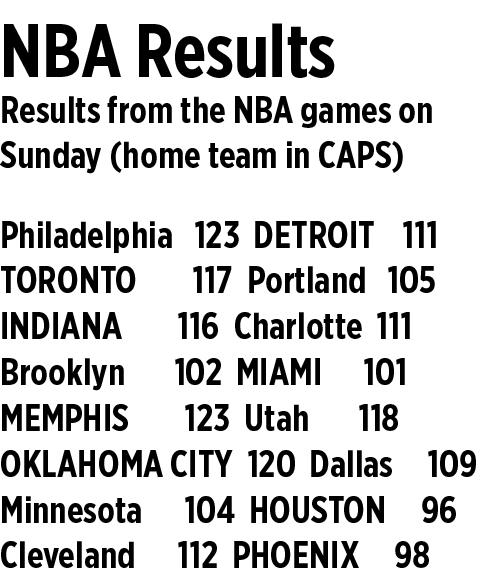
KYRIE Irving scored 29 points and dished six assists as the Brooklyn Nets overcame a second-half injury to Kevin Durant to beat the host Miami Heat 102-101 on Sunday night.

Brooklyn’s Royce O’Neale scored the go-ahead basket on a putback with 3.2 seconds left. He rebounded an Irving 3-point miss.

Miami’s Jimmy Butler missed a contested drive in the lane off the backboard as time expired. The Heat wanted a foul on an O’Neale bump at the end of the play.

Mr. Durant left in the third quarter due to a bruised right knee. He appeared to get hurt when Mr. Butler accidentally rolled onto his leg. Mr. Durant finished with 17 points, four rebounds and two assists. He entered the game averaging 30.0 points.

The Nets, who have won 14 of their past 15 games, also got 13 points, 11 rebounds and three blocks from Nic Claxton.

Mr. Butler led Miami with 26 points along with eight rebounds. Tyler Herro, who returned after missing one game due to back spasms, added 24 points.

Miami’s Bam Adebayo was limited to 28 minutes due to a thigh injury. Mr. Adebayo finished with 10 points and eight rebounds. He entered the game averaging 21.8 points.

Brooklyn led by as many as nine points early on, but the Nets held just a 31-30 advantage at the end of a wild first quarter. Brooklyn’s T.J. Warren made a 3-pointer with 1.6 seconds left, and Miami’s Gabe Vincent answered with his own trey at the buzzer as he was falling out of bounds.

Miami’s Haywood Highsmith made a fortuitous 3-pointer earlier in the quarter, banking his bucket in off the side of the backboard with the shot clock near zero.

Mr. Irving led all first-quarter scorers with 11 points as Brooklyn shot 57.1 percent from the floor, including 5-of-8 on 3-pointers.

The Nets extended their halftime lead to 66-64. Mr. Irving led all second-quarter scorers with 13 points, and Brooklyn shot 61.1 percent from the floor, including 4-of-8 on 3-pointers.

The Heat ended the third quarter on a 12-3 run, taking an 82-79 lead into the fourth. Both teams cooled off in the third quarter as Miami shot just 25 percent, and Brooklyn made 27.8 percent.

Brooklyn held on in the fourth and finished the game shooting 51.3 percent from the floor, including 12-of-33 on 3-pointers.

Miami shot 41.3 percent, including 13-for-35 on 3-pointers. — Reuters

Jalen Hurts, Eagles land top playoff seed in National Football Conference by beating NY Giants

JALEN Hurts passed for 229 yards with an interception, Boston Scott ran for a touchdown and A.J. Brown caught four passes for 95 yards. — REUTERS

JALEN Hurts returned after a two-game absence, Jake Elliott kicked five field goals and the Philadelphia Eagles finally clinched the No. 1 seed in the National Football Conference (NFC) with a 22-16 win Sunday over the visiting New York Giants.

Hurts had missed the last two games, replaced by Gardner Minshew in losses to Dallas and New Orleans as the Eagles (14-3) failed to secure the top seed. Sunday’s win also locked up the NFC East title for Philadelphia.

Mr. Hurts led six scoring drives and the Eagles never trailed the Giants (9-7-1), who had already sewn up the No. 6 seed and opted to rest quarterback Daniel Jones, Pro Bowl running back Saquon Barkley and other starters.

Philadelphia secured a first-round bye and homefield advantage throughout the playoffs and also broke a franchise record for wins set in 2004 and 2017 (both 13-3). That 2017 squad also earned the No. 1 seed and went on to win Super Bowl LII.

Mr. Hurts passed for 229 yards with an interception, Boston Scott ran for a touchdown and A.J. Brown caught four passes for 95 yards.

The Giants will kick off their first postseason since 2016 on the road next weekend with a wild-card game against the Minnesota Vikings.

Davis Webb, who had never even attempted a pass since entering the league in 2017, made his first career start and completed 23 of 40 passes for 168 yards.

Mr. Webb’s 14-yard TD run in the fourth quarter pulled New York within 19-9 and his 25-yard touchdown pass to Kenny Golladay made it 22-16 with 1:38 remaining.

The Eagles recovered the ensuing onside kick and ran out the clock.

Mr. Elliott’s 32-yard field goal gave Philadelphia a quick 3-0 lead. On his first snap since Dec. 18, Mr. Hurts began the drive with a 35-yard completion to Mr. Brown.

Mr. Scott’s 8-yard touchdown run- —his 10th score in eight career games against the Giants — made it 10-0.

Mr. Elliott added two field goals in the second quarter (52 and 39 yards) for a 16-0 lead at halftime. It was 19-0 when he struck from 54 yards midway through the third quarter.

New York got on the board with Graham Gano’s 24-yard field goal late in the third quarter.

Mr. Elliott’s 22-yarder, his career-best fifth field goal of the game, came with 3:21 remaining in the game.

Mr. Brown finished the season with 1,496 yards, breaking Mike Quick’s 1984 single-season Eagles record of 1,409. — Reuters

Rahm storms back to win Tournament of Champions

JON Rahm overtook Collin Morikawa with a 10-under 63 in the final round to win the Sentry Tournament of Champions on Sunday in Kapalua, Hawaii.

The Spanish star went five under over a four-hole stretch on the back nine and Mr. Morikawa fumbled his lead by bogeying Nos. 14, 15 and 16. He had played the entire tournament to that point without a bogey, explaining his six-stroke lead on the field entering Sunday.

Mr. Rahm finished at 27-under 265 for the week, with Mr. Morikawa shooting a 72 and having to settle for second at 25-under 267. Tom Hoge (64 on Sunday) and Max Homa (66) tied for third at 23 under. Mr. Rahm, in fact, began his round with a bogey 5 at No. 1, falling seven behind Mr. Morikawa before completing the largest comeback in tournament history.

“You never want to see somebody have a bad day down the stretch,” Mr. Rahm said. “But I feel like with that lead he had, I needed to play really good and he needed to make a couple mistakes.”

Mr. Rahm bounced back with a 12-foot birdie putt at the par-3 second and made three more birdies at Nos. 4-6, including a nearly 21-footer at No. 4, and one more birdie at the ninth.

But the key for Mr. Rahm was holing birdies at the par-4 12th, 13th and 14th holes and converting an eagle at the par-5 15th. Mr. Rahm stuck his approach at No. 12 to about 2 feet and chipped onto the green inside a foot at No. 14. His eagle putt dropped from 11 1/2 feet.

“At that point I got in the thick of things and never did I think that going into my third shot on 17 I was going to have a one-shot lead,” Mr. Rahm said. “That’s when I had to change a bit of the mindset of chasing and needing birdies to, ‘All right, let’s get this up-and-down, hopefully birdie 18 and give ourselves the best chance.’”

Mr. Rahm did birdie No. 18, but a par would have been enough to beat Mr. Morikawa.

After three birdies on the front nine, Mr. Morikawa skulled his shot out of the sand at No. 14 en route to his first bogey. His third shot on the par-5 15th, a pitch shot uphill toward the green, only traveled 7 yards.

By that point, Mr. Rahm was in the lead, and Mr. Morikawa missed a 7-foot par save at No. 16 to add to his misery.

“You work so hard and you give yourself these opportunities and just bad timing on bad shots and kind of added up really quickly,” said Mr. Morikawa, who had at least a share of the lead after the first rounds. “Don’t know what I’m going to learn from this week, but it just didn’t seem like it was that far off. It really wasn’t. — Reuters

What are energy REITs?

AMERICAN PUBLIC POWER ASSOCIATION-UNSPLASH

Many investors stick to blue chip stocks, real estate, and telcos usually, as these are proven to have a high demand and limited supply. Besides these two categories, food and beverage — despite the challenges to agricultural products — remain a top favorite of investors. Sexy businesses like restaurant chains have lots of appeal as consumers feel their ownership, especially when they directly patronize the very establishments their stockholdings support.

But what about the new breed of investments called real estate investment trusts (REITs)? First, they are a new category worth a deeper look because they live on incomes of the chosen sector — be it real estate and, in the case of the even newer subcategory, energy REITs. Take solar, for example.

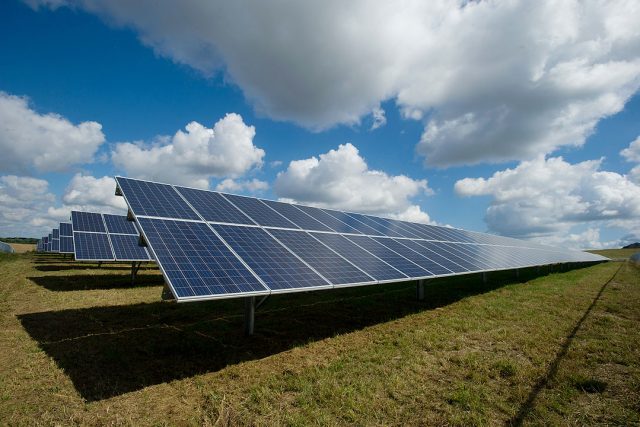
I recently went on a field trip to see how a solar farm works and how important it is to build more of these farms. I got very interested because solar farms seem to be like lifeless industrial farms, yet they also can create value with agricultural crops growing around the property. Root crops like turmeric, for example, can grow around the solar panels without changing the output of each panel. Other free areas can be planted to sun-hungry vegetables, even high-value arugula or the lowly pechay (bok choy).

What are other advantages of solar farms?

FIT IS A FIXED PAYMENT
As explained by experts in the team during our field trip, the electricity generated from solar, wind, run-of-river hydro, and biomass power plants approved by the Department of Energy (DoE) and Energy Regulatory Commission (ERC) are delivered to us consumers to our homes immediately through different transmission and distribution lines. These renewable energy (RE) plants then receive payments from the market operator in the spot market and the National Transmission Corp. (Transco) under the Feed-In Tariff (FIT) system of government for a fixed period of 20 years.

The ERC has approved FIT rates for each of these RE projects based on a reasonable return of investment in these RE projects. If the payments of the market operator are not enough, then the remaining FIT cost of generated electricity shall be paid by consumers through the FIT-allowance (FIT-All) charge per kilowatt hour (kWh) in our electricity bills.

So, there is in fact a sure taker or buyer for the electricity generated by these solar farms: us electricity consumers.

FITs then become a sure winner and the ERC-approved margin becomes a sure profit for the investing public. This is why REITs in solar power can promise certain returns for the next 20 years. That’s sure income for a long period of time.

ENERGY DEMAND WILL REMAIN HIGHER THAN SUPPLY
Electricity demand rises during the summer months as more people use air conditioners, electric fans, air coolers, and even ref and freezers run on overtime. Why do brownouts or power outages occur? There just is not enough power supply available, whether from coal or renewables. Why did this happen? We sat on our power choice decisions too long, too late. And in the past, the focus was all about the supposed cheaper coal.

So, for the next five to six years, unless half of us decide to live elsewhere where we do not need air-conditioning, the power supply will be negative. And this is why solar farms need to be multiplied many times over.

But for those who will only invest now, profits may not be as handsome as those of the first-movers, who were able to get into the FIT program. But still, there are profits to be made.

AGRO-SOLAR FARMING IS A REALITY
When you put up solar farms, you need a whole village to maintain and protect the hard assets while looking for soft profits like community engagement, livelihood opportunities and agriculture production. This will be the case in every project as agricultural land will need soil regeneration and projects that contribute to biodiversity.

Besides using the soil as the surface for the installation of the solar panels, helping dry acidic soil recover is another plus point for solar farming. You can watch soil recover, you can actually make soil while watching the solar panels do their work. The regenerated soil can then be a medium for various crops that the community can consume as well as sell, if they have any extra production.

What is the downside you might ask?

I really cannot find any, except it was too easy for people to just choose coal and oil as they were more familiar with these old traditional polluting energy sources.

It was also something unfamiliar to invest in, except for forward-thinkers and first movers.

When something is so new, it takes a gutsy entrepreneurial mindset to enter a new field — literally a new energy field. Putting up solar also poses challenge in terms of finding large tracts of land. The government needs to make sure that we also keep enough land for agriculture and our food security.

With coal prices now at P9-P11/ kilowatt and solar at P3.50-P4/ kilowatt, you will not need rocket science to know where to invest your money. Solar and even wind power are the better choices.

Maintenance-wise, you just need to wipe these panels clean of dust, like cleaning your glass windows or your walls. And if you have plants growing around the panels, you will even have less dust and more vegetables.

If the demand is there for the next five to six years until we play catch up, it is worth investing in solar energy for your home, for your plant, or even just for your portfolio. Diversifying your portfolio and adding some renewable energy REITs may do well for your financial planning.

It is amazing to hear about the state of our energy demand and supply from experts I met from the DoE. It is worth sitting down with your board on how to participate in this opportunity to not only stay away from coal and oil, but to do Mother Nature a favor. In our own manufacturing plant, we installed solar panels on the roof and so far, we have already reduced our electric bill by 10%. Imagine a whole farm — tracts of land as far as your eyes can see — which can generate free power.

As I was on a road trip in Spain recently, I googled their use of renewable energy and found out it is a happy 45% because I saw a lot of wind farms and solar farms along the way. We could do this, too.

In the meantime, you can also join the joyride by supporting companies who invest in renewable energy and watch your profits grow while taking care of the environment, too.

It’s time to ask your investment counselor about energy REITs.

This article reflects the personal opinion of the author and does not reflect the official stand of the Management Association of the Philippines or MAP.


Chit U. Juan is a member of the MAP Diversity & Inclusion Committee and the MAP Agribusiness Committee. She is the chair of the Philippine Coffee Board, and a councilor of Slow Food for Southeast Asia.

map@map.org.ph

pujuan29@gmail.com

China’s well ahead in the rare-earth race. That’s a problem

DARMAU-UNSPLASH

“THE Middle East has oil. China has rare earth metals.” So said Deng Xiaoping, the architect of China’s post-Maoist opening and rise, in the 1980s, with remarkable foresight and precision. The rest of the world is only now grasping the implications of his insight for geopolitics in the 21st century.

The natural resource that shaped world politics in the long 20th century — which, for these purposes, started in the late 19th and hasn’t quite ended yet — has been oil. When the Japanese attacked Pearl Harbor, they were — at least as they saw it — reacting to a Western oil embargo on them. When Adolf Hitler sent the Wehrmacht to Stalingrad, he was eyeing the black gold of the Caucasus. When the Americans started holding hands with the House of Saud, they were after the crude of Arabia and the wider Middle East. Oil shocks, Iraq wars, and any number of other events have kept reminding the world that much of its economic, diplomatic, and political superstructure has been based on the substructure of this hydrocarbon.

World leaders who — in contrast to Deng — look backwards in time have tended to draw the wrong conclusions from this history. Russian President Vladimir Putin has built his own rise during the 21st century on the assumption that he could turn Russia from a petrostate into a superpower that’s simultaneously his personal fief. For decades he laid pipelines for Russian oil and gas with the intention of making countries from Ukraine to Germany dependent on these flows, and thus subject to his geopolitical blackmail. A year into his attack on Ukraine, it appears that he miscalculated.

The Chinese, since the 1980s, have followed a different strategy, mining those rare earths Deng was talking about. They include 17 elements most ordinary people have never heard of, and could barely find on the Periodic Table — in part because 15 of them, the so-called lanthanides, are banished to their own exclave on the chart. They have exotic names — ytterbium, erbium, praseodymium, neodymium, samarium, dysprosium — that sound like the cast of villains in a bad Star Wars sequel.

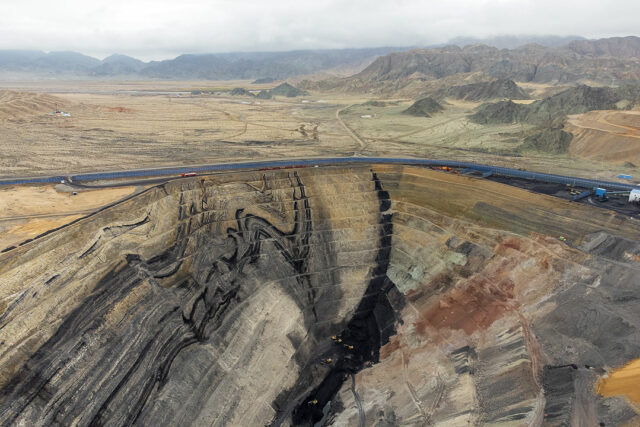
Despite their label, these “earths” are not actually all that rare. Some, such as cerium, are more abundant than copper or lead, and even one of the scarcest, thulium, is more common than gold. But they’re much harder to mine, because they tend to be spread out in their ores. Building the infrastructure to get them out of the ground and apart from other rock takes decades. Even then, the process is expensive, messy, and bad for the environment.

China, starting with Deng, decided to tolerate all of this. It has about a third of the world’s deposits, most of them in one gigantic lode in Inner Mongolia. Patiently investing in all parts of the production process, it displaced the former market leader, the US, in the 1990s. By 2010, China in effect had a global monopoly on supply, with market shares above 90%.

That rang alarm bells in Western capitals. Rare earths are used in everything from fiber optics and lasers to medical scanners and the hard discs in our computers — they’re the building blocks of the modern world. They’re also inside state-of-the-art weapons systems, and thus a prerequisite to military prowess. Each American F-35 fighter plane, for example, contains about 920 pounds of rare earths.

Above all, some of the 17 elements are crucial for success in the coming green revolution. To phase out fossil fuels — that is, to exit the era of oil, gas, and coal — we need to harness vastly more energy from wind and use the resulting electricity to power our cars and trucks. But turbines and electric vehicles run on super magnets made in part from praseodymium, neodymium, samarium, and dysprosium.

A rare-earth shock, therefore, could in the 21st century kneecap economies, armies, and countries as much as — or more than — the oil shocks of the 1970s did. Beijing knows and likes that prospect. In 2010, after the Japanese detained a Chinese trawler that had sailed through a disputed island group, China halted all rare-earth exports to Japan until Tokyo set the boat free. A decade later, after the US offered Taiwan a defense deal, Beijing threatened to stop supplying Lockheed Martin, the maker of the F-35, and other American companies. 

The good news is that the penny has dropped and more countries are now trying hard to unearth their own supplies and diversify away from China. The US is back in the business, as are Australia, Myanmar, Canada and others. Japan has discovered a huge lode, although it’s under the sea bed and hard to get to. Turkey has found its own trove in central Anatolia. But building the infrastructure and know-how takes years.

While China’s market share in rare earths is trending down, it’s still huge — amounting to 60% of world extraction as of 2019, and 87% of processing. From the US to the European Union, governments are working on adding new supply chains. Countries like Germany, still smarting from its naive submission to Putin’s pipeline diplomacy, are reconsidering their reliance on China.

As well they should. Now that Putin, as part of his barbaric assault against Ukraine and decency in general, has declared energy war on the West, it seems prudent not to stumble right into the next dependency on an autocratic regime with irredentist grudges. As Western spooks like to say, “Russia is the storm, China is climate change.” The 21st century is young. It would be a pity if we allowed rare earths to do to it what oil did to the 20th.

BLOOMBERG OPINION

Ten predictions on energy markets in 2023

Continuing this column’s “Top 10” economic series, this 4th installment will cover energy projections for 2023, five global and five national predictions.

1. World oil demand will reach 102 million barrels per day (mbpd).

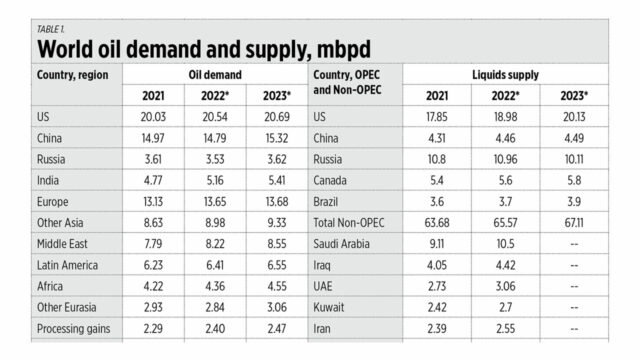
Data from the Organization of the Petroleum Exporting Countries (OPEC) show that world oil demand was 100.18 mbpd in 2019, 91.16 mbpd in 2020, and 97.01 mbpd in 2021. OPEC projects 99.56 mbpd in 2022, and 101.77 mbpd in 2023. Big demand will come from the US and China, with a combined 36 mbpd next year.

2. World oil supply will likely reach 102 mbpd too.

The liquids supply — crude, non-gas liquids or NGLs, other non-conventional liquids — from non-OPEC countries, which include the USA, Russia, and Canada, will reach 67.1 mbpd. OPEC crude and other liquids will likely reach 35.5 mbpd, so this column predicts a world supply of 102.6 mbpd this year. All oil-producing countries except Russia are expected to have a continued rise in output (see Table 1).
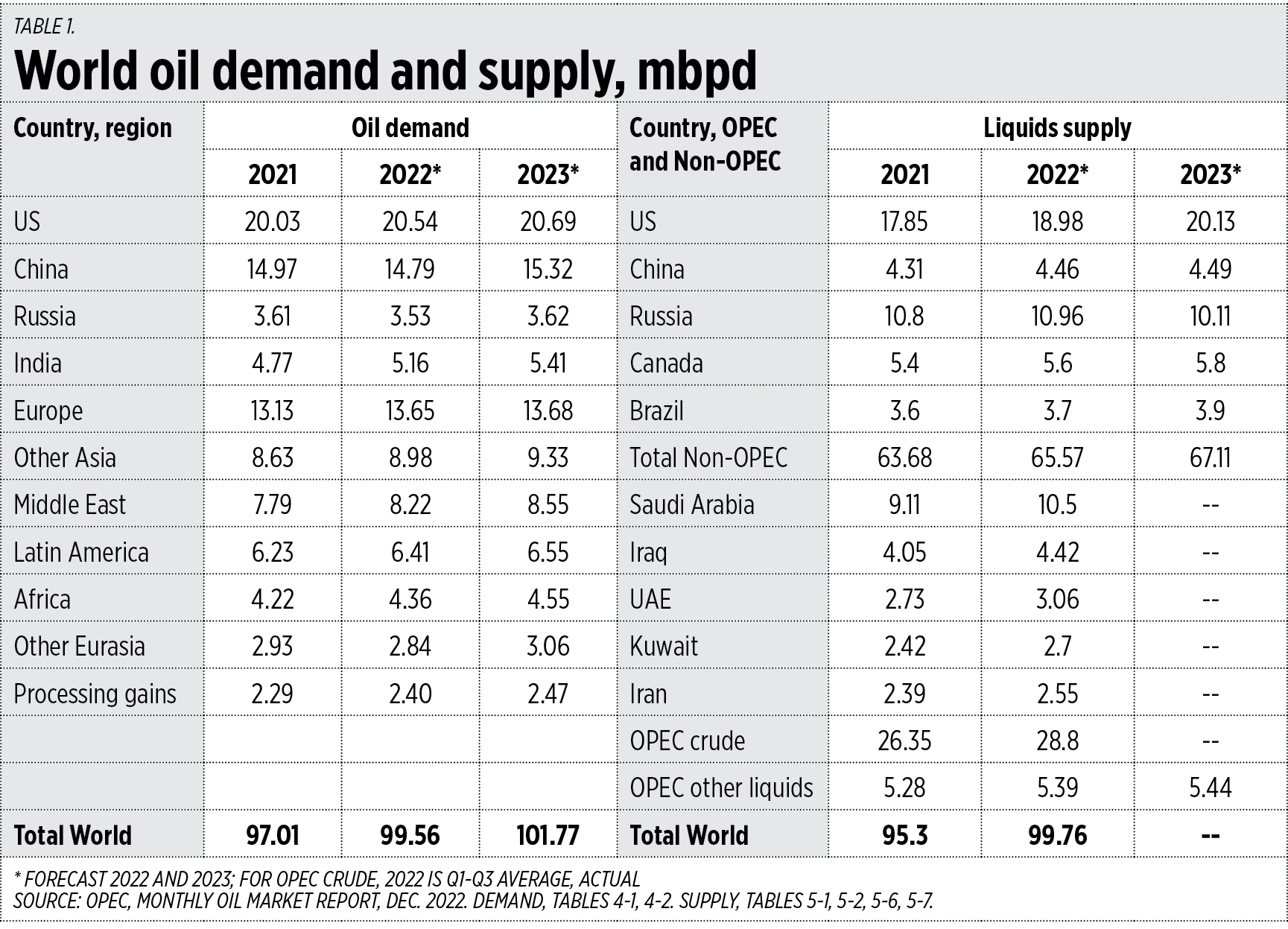
3. The decline in fossil fuel (FF) consumption by rich countries will continue.

Using the data in Table 2 of this column’s “Top 10 energy stories/ideas 2022” (Dec. 19, 2022) to make projections for 2023, the USA and Canada — with a projected consumption of 223-230 petajoules (PJ) per million population — will soon be overtaken by South Korea and Taiwan with 202-214 PJ this year. Singapore will remain the most fossil-fuel intensive country in the world with about 660 PJ this year.

4. China will overtake Germany in kilowatt hours (kWh) per capita power generation.

In 2021, China saw power generation of 6,042 kWh/person while Germany had 7,026 kWh/person. This year, China will have about 8,076 kWh/person while Germany will have 7,021 kWh/person. Because China and most Asian countries will expand their fossil fuel use, their power generation per capita keeps rising, which is not happening in Germany and the industrialized west.

5. The industrialized west will slowly realize the folly of ditching fossil fuel plants and relying on intermittent power production.

Germany, the largest economy in Europe, is currently led by the politically socialist Social Democratic Party (SPD), and the ecological socialist Greens Party. Their smaller partner, the Free Democratic Party (FDP), will try to inject some sanity into economic and energy policies but both SPD and Greens ran on a strong anti-fossil fuel, anti-nuclear power platform. Such an ideology is detached from the reality of possible blackouts in winter, so Germany has begun to run their old coal power plants again to void blackouts. This trend will continue in many other industrialized countries.

6. The Philippines will finally reach 1,000 kWh/person in power generation.

From 589 kWh/person in 2000 and 982 in 2021, we should reach around 1,044 kWh/person in power generation this year — the first time that we will reach the 1,000 kWh/person mark. It should be clear that we should aspire to expand power generation in megawatt-hours (MWH), not just megawatts (MW). A 1,000 MW solar farm will have a dependable capacity of only around 180 MW, while a 1,000 MW coal or gas plant will have a dependable capacity of around 800 MW. So, power generation in 24 hours is much higher under fossil fuel plants than intermittent solar or wind power.

7. But yellow-red alerts, and near blackouts will continue this year.

Until December 2022, both the Luzon and Visayas grids experienced yellow alerts due to thin and insufficient power reserves. A lot of the incoming capacity will be from intermittents and non-power generating batteries.

The abolition of electricity price control or primary and secondary price cap (SPC) at only around P6.25/kWh will likely be discussed this year. From September-December 2022, an SPC was imposed about 60% of the time at the spot market. Such a high incidence of price control means that no new big peaking plants will provide the necessary reserves when demand is very high or supply is down significantly.

8. Carbon taxation will be re-introduced but will fail.

The first big attempt at imposing carbon taxation was back in 2017 when a former National Economic and Development Authority (NEDA) Secretary lobbied that the coal tax should rise from P10/ton to P600/ton. This was carried out in the Tax Reform for Acceleration and Inclusion (TRAIN) Law of 2017 (RA 10963) with the coal tax raised to P150/ton. As shown in Table 2, the Philippines’ fossil fuel consumption per capita is the lowest in the ASEAN 6, far behind the economic tigers of North Asia and the industrial world. Penalizing Philippine businesses and households with higher power prices via a carbon tax will only attract political and economic backlash.

9. Nuclear power will get piecemeal approval in the country.

Last December, two stories in BusinessWorld reported that: 1.) Meralco will look into small nuclear reactors, and, 2.) AboitizPower is eyeing nuclear project. Then there was a recent report, “Energy department designates RE, nuclear as 2023 priorities” (Jan. 2, 2023). Nuclear power, at least small modular reactors (SMRs), is a good long-term solution both for off-grid island provinces and the main grids.

10. Solar streetlights, solar rooftop will continue expansion.

Many electric cooperatives, protected by the National Electrification Administration (NEA), are wasteful. For instance, some friends in Central Pangasinan pay about P19/kWh under CenPelco versus the Meralco rates of P10/kWh as of the December billing. So, many rural people and barrio officials put up lots of solar street lights, solar fence lights, etc. This trend will continue in 2023 and beyond.

I got importation data from the Philippine Statistics Authority (PSA) — 2020 to October 2022. Here are the numbers for solar panels, solar lights, and lamps and lighting fittings, average per month. Volume: 9.37 tons in 2020, 8.27 tons in 2021, and 11.91 tons in 2022. Value: $25.28 million in 2020, $28.92 million in 2021, and $38.69 million in 2022.

Average monthly volume declined — 11.8% in 2021-2022, an increase of only 27% in 2022 over 2020. Since there was a large expansion in solar farms last year, it is possible that illicit/smuggled solar street lights are coming in high volumes.

Meanwhile, the first of the quarterly Ruperto P. Alonzo (RPA) lecture series sponsored by the University of the Philippines School of Economics (UPSE) Program in Development Economics (PDE) Alumni Association, will be held on Feb. 8 at the UPSE auditorium. The speaker will be Cynthia Hernandez, Executive Director of the Public-Private Partnership (PPP) Center. Ms. Hernandez will talk about 28 years of the build-operate-transfer law and the way forward. She is an engineer-economist from UP, an alumna of PDE batch 33, and a former student of Prof. RPA (RIP).


Bienvenido S. Oplas, Jr. is the president of Bienvenido S. Oplas, Jr. Research Consultancy Services, and Minimal Government Thinkers.

minimalgovernment@gmail.com.

Harnessing the power of duration

BOB GHOST-UNSPLASH

THE investment landscape now is very different to 12 months ago, when there really was no alternative to equities, and investors were locked into a desperate search for yield across all asset classes. The US Federal Reserve’s (Fed’s) singular focus on controlling inflation last year resulted in an aggressive cycle of rate rises, which in turn tightened financial conditions, leading to a sharp rise in yields and spreads on fixed income assets.

A year ago, yields on high-quality credit did not seem attractive to us, prospects for total returns were poor, and bonds were not acting as a diversifier. Today, we believe the positive correlation with stocks is also breaking down, allowing fixed income to offset equity market volatility. As a result, Franklin Income Investors continues to invest with a preference for fixed income, moving closer to a 60/40 split in favor of bonds over equities.

Moving forward, our allocation decisions will be driven by what happens with interest rates and inflation this year. We believe the move higher in rates is likely almost done, but we expect a long pause from the Fed before any pivot, meaning our attention will be focused on the effect rate hikes have on the economy and inflation. The uncertainty lies in whether the lagged effect of tightening financial conditions and a more challenging growth environment results in a real pullback in fundamentals.

IMPROVED TOTAL RETURN POTENTIAL WITHIN FIXED INCOME
Allocation within the fixed income asset class will also depend upon where markets go, although investment-grade credit is currently our preferred asset class in terms of total return, income and risk management. In a positive economic scenario, we believe these assets have the potential to make double-digit returns as rates move lower and spreads narrow, while they should also outperform other risk assets should fundamentals deteriorate.

However, our assessment of US Treasuries has also improved as interest rates have risen, given they currently offer attractive yields and downside protection should a recession increase equity market volatility. When 10-year Treasury yields were around 2% they were unattractive to us, but extending duration to lock in yields at 4% is much more compelling from an income perspective. This means US Treasuries will form a core part of our ongoing strategy this year.

Elsewhere, the HY bond sector is, in our view, more resilient than many investors believe, absent a significant negative impact on corporate earnings. Most HY issues won’t need to be refinanced in the next few years, and therefore a recession this year with a modest pullback doesn’t overly concern us. As a result, while the investment community focuses on whether spreads are wide enough to justify a move into credit, we see opportunities at current yields, which have shot up to levels not seen for 15 years. We don’t think spreads are likely to rise significantly, which means we are very comfortable being in the credit space, particularly at such low prices.

Against this background, we believe it is a relatively straightforward call to add selectively to HY credit at the expense of higher volatility equity holdings that, in a recessionary scenario, should underperform credit. In a worst-case scenario, a prolonged period of higher rates or further tightening would eventually put pressure on over-levered companies that need to refinance their debt. Under those circumstances, it is possible to engage with public companies to help them refinance their debt on a private basis, however, we believe the opportunities for healthy returns in the public markets are currently so attractive that private investments would likely not be adequately compensated for the additional illiquidity premium.

MANAGING EQUITY UNCERTAINTY
We still see opportunities for selective investment in equities to maximize yield and total return while navigating increased volatility. For equities to rally, we believe it would take a favorable trajectory around inflation and economic growth, while earnings would also need to remain relatively robust. We would also want to see the Fed pause rate hikes, move into a position to normalize rates, and get back to a neutral setting. Alternatively, there could be further downside for equities if the economy feels the impact of tightening this year and earnings suffer.

In our opinion, equity-linked notes (ELNs) offer a way to manage this uncertainty, while expanding the universe of stocks available for investment. ELNs enable investors to derive income from exposure to equities that offer little or no dividend and can be used in conjunction with common stocks to access both yield and price upside potential. These instruments can also be used to smooth volatility and hedge exposure.

THE POWER OF DURATION
In summary, we believe the current investment environment promises to provide much greater potential for yield and total return than we saw last year. In our analysis, locking in attractive yields through duration is the best way to achieve income goals, while investing in fixed income assets at attractive prices should deliver robust returns if rates fall and spreads narrow due to looser Fed policy.

Additionally, we think higher-quality bonds offer significant downside protection should any recession prove deeper than expected. Elsewhere, in our opinion, broad equity exposure remains important should an improvement in economic sentiment trigger an equity market rally.

This document is for information only and does not constitute investment advice or a recommendation and was prepared without regard to the specific objectives, financial situation or needs of any particular person who may receive it.


Ed Perks is the chief investment officer at Franklin Income Investors.

Brazil investigates who led anti-democratic riots

Security forces operate as supporters of Brazil’s former President Jair Bolsonaro demonstrate against President Luiz Inacio Lula da Silva, outside Brazil’s National Congress in Brasilia, Brazil, January 8, 2023. — REUTERS

BRASILIA — Brazil’s Supreme Court late on Sunday removed the governor of Brasilia from office for 90 days due to flaws in security in the capital, after thousands of backers of far-right former president Jair Bolsonaro ransacked government buildings.

Supreme Court Justice Alexandre de Moraes also ordered social media platforms Facebook, Twitter and TikTok to block coup-mongering propaganda.

Brazilian authorities have begun investigating the worst attack on the country’s institutions since democracy was restored four decades ago, with President Luiz Inacio Lula da Silva vowing to bring those responsible for the riot to justice.

Tens of thousands of anti-democratic demonstrators on Sunday invaded the Supreme Court, Congress and the presidential palace and smashed windows, overturned furniture, destroyed art works and stole the country’s original 1988 Constitution. Guns were also seized from a presidential security office.

Leftist president Mr. Lula, who took office on Jan. 1, said the local militarized police force that reports to Brasilia Governor Ibaneis Rocha, a former Bolsonaro ally, did nothing to stop the advance of the protesters.

Mr. Lula decreed federal intervention of public security in the capital and promised exemplary punishment for the leaders of the “fascist” assault that was aimed at provoking a military coup that could restore Mr. Bolsonaro to power.

“All the people who did this will be found and punished,” Mr. Lula told reporters from Sao Paulo State.

The assault raised questions among Mr. Lula’s allies about how public security forces in the capital were so unprepared and easily overwhelmed by rioters who had announced their plans days ahead on social media.

Mr. Lula blamed Mr. Bolsonaro for inflaming his supporters after a campaign of baseless allegations about election fraud after the end of his rule marked by divisive nationalist populism.

From Florida, where he flew 48 hours before his term ended, Mr. Bolsonaro rejected the accusation, tweeting that peaceful demonstrations were democratic but the invasion of government buildings “crossed the line.”

The invasion, which recalled the assault on the US Capitol two years ago by backers of former President Donald Trump, was quickly condemned by world leaders, from US President Joseph R. Biden and France’s Emmanuel Macron to Latin American heads of state.

HUNDREDS ARRESTED
Police retook the damaged public buildings in the iconic futuristic capital after three hours and dispersed the crowd with tear gas.

Justice Minister Flavio Dino said 200 demonstrators had been arrested, but governor Rocha put the number at 400.

Dino said investigations will aim to uncover who financed the several hundred buses that brought Bolsonaro’s supporters to Brasilia and also probe Mr. Rocha for not preparing security.

The occupation of the government buildings had been planned for at least two weeks by Mr. Bolsonaro’s supporters in groups on social media messaging platforms such as Telegram and Twitter, yet there was no move by security forces to prevent the attack, called by one group “the seizure of power by the people.”

Messages seen by Reuters throughout the week showed members of such groups organizing meeting points in several cities around the country, from where chartered buses would leave for Brasilia, with the intention to occupy public buildings.

The plan included camping in front of the army command’s headquarters, where groups of coup-mongers had camped out since Mr. Lula narrowly won the election in October.

In the early afternoon of Sunday, when the protesters began to arrive on Brasilia’s esplanade, instead of being contained, they were escorted by Military Police cars with flashing lights.

Riot police only arrived on the scene two hours after the invasions began.

Mr. Bolsonaro faces legal risks from several investigations before the Supreme Court in Brazil and his future in the United States, where he traveled on a visa issued only to sitting presidents, is in question.

“Bolsonaro should not be in Florida,” Democratic Congressman Joaquin Castro said on CNN. “The United States should not be a refuge for this authoritarian who has inspired domestic terrorism in Brazil. He should be sent back to Brazil.” — Reuters

Prince Harry says UK royals got into bed with tabloid press ‘devil’

REUTERS

LONDON — Prince Harry has said he had made public his rifts with the British royal family and taken on the press to try to help the monarchy and change the media, the latter described by his father King Charles as a “suicide mission”.

In the first of a series of TV interviews broadcast on Sunday ahead of the launch of his memoir, Harry accused members of his family of getting into bed with the devil — the tabloid press — to sully him and his wife Meghan to improve their own reputations.

He told Britain’s ITV he had fled Britain with his family for California in 2020 “fearing for our lives” and said he no longer recognized his father or his elder brother Prince William, the heir to the throne.

“After many, many years of lies being told about me and my family, there comes a point where, going back to the relationship between certain members of the family and the tabloid press, those certain members have decided to get in the bed with the devil … to rehabilitate their image,” he said.

“The moment that, that rehabilitation comes at the detriment of others, me, other members of my family, then that’s where I draw the line.”

On Thursday, Prince Harry’s book Spare mistakenly went on sale in Spain five days before its official release, chronicling not only hugely personal details, such as how he lost his virginity and took illegal drugs, but more intimate private instances of family disharmony.

His elder brother had knocked him over in a brawl, and both siblings begged their father not to marry his second wife, Camilla, now the Queen Consort, the book says.

Commentators say the book has plunged the monarchy into its biggest crisis since the days of the royal soap opera in the 1990s around the break-up of Charles’ marriage to his late first wife Princess Diana, the mother of William and Harry.

It all comes just four months after Queen Elizabeth died and Charles acceded to the throne.

In the ITV interview, Harry repeated and elaborated on accusations that he and Meghan have made since they left royal duties; that the royals and their aides not only failed to protect them from a hostile and sometimes racist press, but actively leaked stories about them via anonymous sources.

CONFLICT
“The saddest part of that is certain members of my family and the people that work for them are complicit in that conflict,” he said, indicating that included both Charles and Camilla.

So far, there has been no comment from Buckingham Palace. Harry said he didn’t think his father or brother would read his book.

An unnamed friend of William told the Sunday Times that the Prince of Wales was “burning” with anger, but would not respond “for the good of his family and the country”.

Harry told ITV he wanted reconciliation with his family members but said they had shown no interest, giving the impression it was better to keep him and Meghan as villains.

“I genuinely believe, and I hope, that reconciliation between my family and us will have a ripple effect across the entire world. Maybe that’s lofty, maybe that’s naive,” he said.

Harry, in an interview with CBS’ 60 Minutes that aired later on Sunday, said the ball was in his family’s court to heal the rupture.

“This all started with them briefing, daily, against my wife with lies to the point of where my wife and I had to run away from our count — my country,” he said.

Harry also told ITV he hoped his multiple legal actions against newspapers would help change the media, saying it was “at the epicenter of so many of the problems across the UK”.

“My father said to me that it was probably a suicide mission to try and change the press,” he said.

Prince Harry told 60 Minutes that what Meghan went through with the press was similar in some ways to what Camilla and William’s wife Kate went through, but that the circumstances were very different.

“The fact that she was American, an actress, divorced, Black, biracial with a Black mother. Those were just four of the typical stereotypes that is — becomes a feeding frenzy for the British press,” he said.

Polls suggest many Britons are becoming bored of the whole royal melodrama, and further revelations are unlikely to shake their views, whether sympathetic to Harry and Meghan, or to those they criticize.

“I love my father. I love my brother. I love my family. I will always do. Nothing of what I’ve done in this book or otherwise has ever been to … to harm them or hurt them,” he said. — Reuters

ADVERTISEMENT
ADVERTISEMENT