Home Blog Page 5414

ICTSI rises on prospects for 2023, acquisition news

SHARES in Razon-led International Container Terminal Services, Inc. (ICTSI) moved upward last week as investors assessed the port operator’s financial performance as well as its subsidiary’s agreement to buy ownership interest and subscription rights in a terminal operator.

Data from the Philippine Stock Exchange (PSE) showed ICTSI ranking 10th in value turnover with P383.72 million worth of 1.92 million shares exchanging hands from Dec. 27 to 29.

ICTSI shares closed at P200 apiece on Thursday, lower by 2% from its Dec.23 close. Year to date, the stock retained its share price.  Local financial markets were closed on Dec. 26 due to a special non-working holiday and on Dec. 30 due to a national holiday.

“ICT has been moving in a generally upward bias the past few weeks as many investors are betting heavily on the company to outperform for 2023,” Regina Capital Development Corp. Head of Sales Luis A. Limlingan said, referring to ICTSI’s ticker symbol.

“Though [last] week did see some consolidation which was due to market weakness as a whole as trading volumes were depressed because of the holiday season and shortened trading week,” he added.

In a separate e-mail, Philstocks Financial, Inc. Senior Research Analyst Japhet Louis O. Tantiangco said ICTSI’s stock movement reflected investors’ expectations for the global economy for 2023.

Mr. Tantiangco highlighted worries about a lingering global economic slowdown, risks of global recession due to rising interest rates, and the adverse effects of Russia’s prolonged war on Ukraine and China’s coronavirus disease 2019 (COVID-19) situation.

“Given ICT’s dependence on the performance of the global economy, in particular global trade, a global economic slowdown, much worse, a recession, poses downside risks on the company’s financial performance,” he said.

In the last week of 2022, the Enrique K. Razon, Jr.-led company saw developments that include the signing by its subsidiary IWI Container Terminal Holdings, Inc. of an agreement to buy the ownership interest and subscription rights of Marubeni Corp., a Japan-based integrated trading and investment business, in Bauan International Port, Inc. (BIPI).

IWI Container Terminal is acquiring 2.05 million BIPI shares held by Marubeni representing a 20% stake for around P507.41 million.

BIPI, the operator of the Bauan terminal, supports cargo movements in and out of the Calabarzon (Cavite, Laguna, Batangas, Rizal, and Quezon) region.

For Mr. Limlingan, the acquisition is another positive update for the company. He noted, however, that the market’s reaction might be delayed as fund managers were mostly on a break last week.

Mr. Tantiangco said the move to acquire an additional 20% stake through its subsidiary wasn’t given much attention by investors as the focus was more on the global economic prospects for 2023.

In the third quarter, ICTSI reported a 42.6% rise in attributable net income to $170.66 million. Its consolidated revenues from port operations during the period grew by 20.4% to $595 million.

Claire T. Alviar, a research analyst at Philstocks, projects ICTSI’s earnings per share in 2022 to reach $0.31, which would be 71% higher than the 2021 figure if realized.

An improvement in the global economic outlook could entice investors to consider the port operator, Mr. Tantiangco said.

“This would include global demand being able to withstand the rise in interest rates so as to keep the flow of global trade healthy. The solving of problems weighing on the world economy such as the Russia-Ukraine war and China’s COVID-19 situation is also seen to help,” he added.

“Immediate support is seen at P190.00. Immediate resistance is seen at the P205.00-P207.00 range.”

For Mr. Limlingan, investors are always ready to buy into the company, thus any market correction would provide the opportunity to do so.

He pegged support and resistance levels at P196.00 and P208.00, respectively. — Abigail Marie P. Yraola
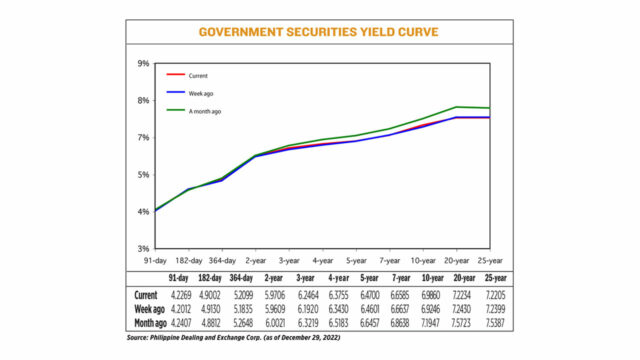
Yields end mixed amid lack of leads

YIELDS on government securities (GS) were mixed last week amid a lack of catalysts and as investors took positions ahead of the new year.

GS yields at the secondary market went up by an average of 1.48 basis points (bps) week on week, based on the PHP Bloomberg Valuation (BVAL) Service Reference Rates as of Dec. 29 published on the Philippine Dealing System’s website.

Financial markets were closed on Dec. 30 in observance of Rizal Day.

The 91- and 364-day Treasury bills (T-bills) saw their yields go up by 2.57 bps and 2.64 bps to 4.2269% and 5.2099%, respectively.

Meanwhile, the rate of the 182-day T-bill dropped by 1.28 bps week-on-week to 4.9002%.

Almost all rates at the belly of the curve increased. Yields on the two- and five-year Treasury bonds (T-bonds) inched up by 0.97 bp and 0.99 bp to 5.9706% and 6.47%, respectively. The rates of the three- and four-year papers also climbed by 5.44 bps and 3.25 bps to 6.2464% and 6.3755%, respectively.

Meanwhile, the yield on the seven-year paper inched down by 0.52 bp to 6.6585%.

At the long end of the curve, the 10-year T-bond rose by 6.14 bps to 6.986%, while the 20- and 25-year papers fell by 1.96 bps  (7.2234%) and 1.94 bps (7.2205%).

Total GS volume traded reached P7.227 billion on Friday, lower than the P5.204 billion recorded on Dec. 23.

“The main driver for the movement (or lack thereof) [last] week was the shortened three-day work week. Given this, market activity was fairly limited, with most investors already having repositioned previously and winding down towards the holidays. Given the focus on the long-end of the yield curve, we saw bids get more defensive,” ATRAM Trust Corp. Head of Fixed Income Jose Miguel B. Liboro said in an e-mail.

“Not a lot of actual selling activity given the reduced market liquidity, but we expect market bids to remain defensive in January, especially with expectations for December CPI (consumer price index) to remain above the 8% handle over the short term,” Mr. Liboro said.

Headline inflation likely settled within the 7.8% to 8.6% range in December due to higher electricity rates and rising food prices, the Bangko Sentral ng Pilipinas (BSP) said last week.

The BSP’s month-ahead forecast range indicates that inflation may have been faster than the 14-year high of 8% in November.

The upper end of the forecast or the 8.6% would also be the fastest pace since the 9.1% print during the Global Financial Crisis in November 2008.

If the 8.6% forecast is realized, this would bring the full-year average inflation to 5.9%, slightly above the BSP’s 5.8% average forecast for 2022.

December would also be the ninth straight month that inflation surpassed the BSP’s 2-4% target range.

Mr. Liboro said yields climbed in 2022 amid a volatile trading environment.

“Rates moved up across the yield curve by 250-300 basis points from a year-on-year standpoint. Similar to other markets both locally and globally, Philippine fixed income had a challenging 2022. However, this has put it in a decent position for much brighter prospects for 2023, given where yield levels currently are,” he said.

“We are likely to see a defensive bias initially in January as the combination of likely still-above 8% CPI, long-end auction focus, a resumption of the trend upwards in global yields and a large potential supply injection in the form of a jumbo RTB (retail Treasury bond) to weigh on the market. Despite these short-term headwinds, we expect Philippine fixed income to deliver a stronger performance in 2023 given the current starting levels.

The government plans to borrow P200 billion from the domestic market in January, higher than the P135-billion program in December. It will raise P60 billion via T-bills and P140 billion from T-bonds. — A.O.A. Tirona

Revenge spending to extend into 2023

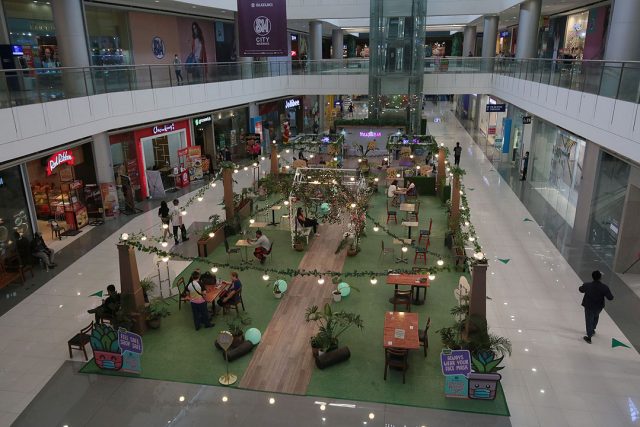
PHILIPPINE STAR/ MICHAEL VARCAS

(This is the second of a two-part property market outlook by Colliers Philippines)

MALL OPERATORS should brace for more foreign and local retailers as consumer confidence and foot traffic pick up this year. 

Major mall developers have been reporting that consumer traffic has now reached between 85%-95% of pre-COVID levels in the third quarter of 2022 from only 40% a year ago.

In 2023, we see more retailers (foreign and local) taking up physical mall space to take advantage of rising consumer traffic and anticipated increase in purchasing power.

Colliers sees the approval of the amendments to the Retail Trade Liberalization Act (RTLA) as paving the way for the entry more foreign retailers in the country. Based on our mall scans, the food and beverage (F&B) segment will account for 50% of the upcoming retailers followed by fashion accessories and beauty and health at 27%.

Colliers recommends that mall operators reactivate their event spaces or activity centers by organizing events such as trade fairs, exhibits and concerts to attract more mallgoers. F&B and clothing & footwear retailers should also consider opening pop-up stores, especially those testing the feasibility of the Philippine retail market.

We also encourage mall operators and retailers to continue implementing regular sanitation and other health and safety protocols, especially in high-density retail spaces.

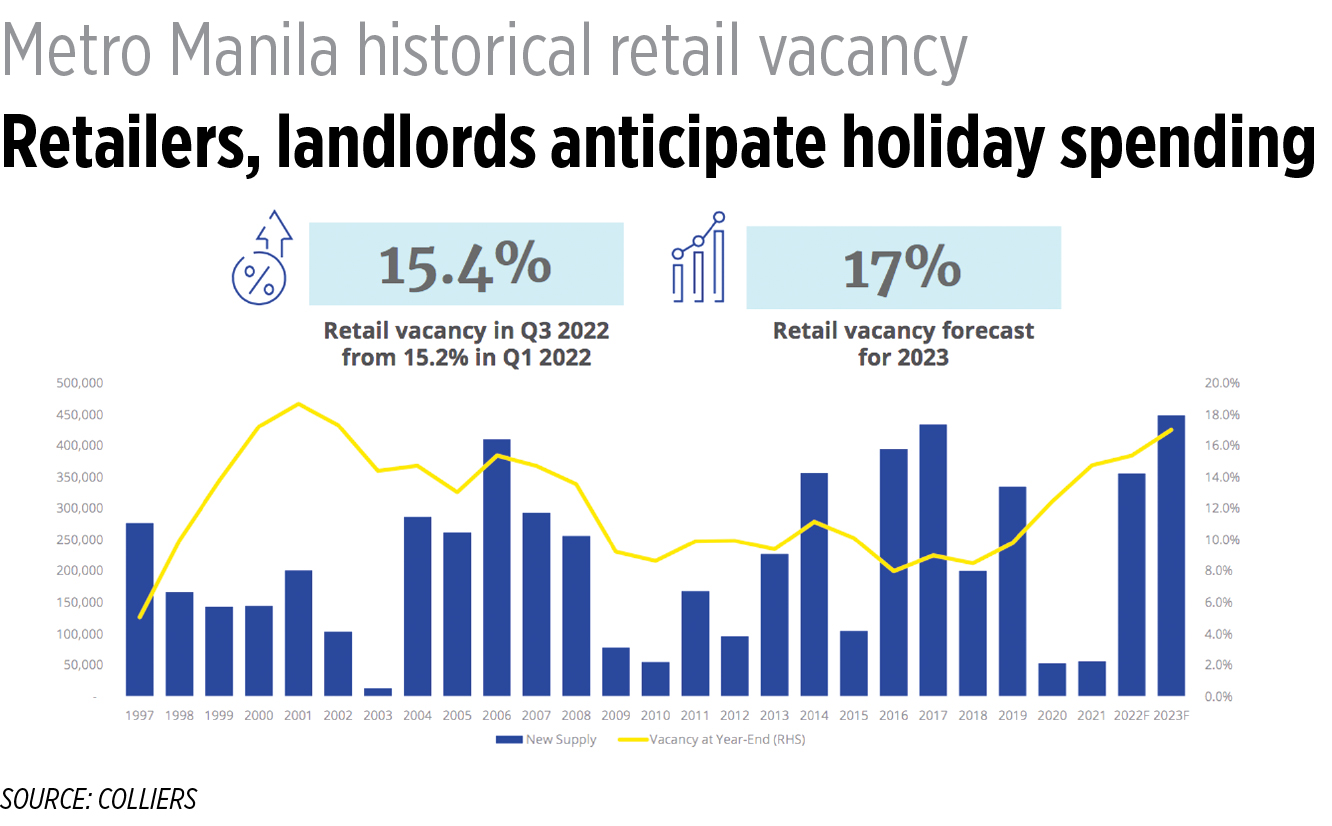
In 2023, we see vacancy marginally rising to 17% from a projected 16% vacancy in 2022 due to the substantial delivery of 448,900 square meters (sq.m.) (4.8 million square feet) of new supply. Despite record-high new supply, we expect greater retail space absorption from brick-and-mortar shops following the improved consumer traffic as reported by mall operators and the consumer confidence index of the Philippine central bank.

Colliers encourages developers to reassess the ideal sizes of upcoming retail developments as they welcome more consumers back to their properties.

From 2024 to 2026, Colliers sees the completion of 62,000 sq.m. (667,100 sq.ft.) of new retail space annually, only a fifth of the annual delivery of 327,200 sq.m. (3.5 million sq.ft.) of new supply that we recorded from 2017 to 2019.

Colliers believes that online shopping will remain popular as Filipinos continue to put a premium on convenience. In our view, this will likely complement brick-and-mortar shopping which we see receiving a boost from the dropping of mask mandates.

Colliers encourages mall operators and retailers to further strengthen their omni channel strategies to support brick-and-click shopping.

LEISURE: DOMESTIC TOURISTS TO JUMPSTART RECOVERY
Data from the Department of Tourism (DoT) showed that foreign arrivals as of Nov. 14, reached 2 million, already exceeding the full year target of 1.7 million arrivals. The United States, South Korea and Australia were the top source markets during the period.

Meanwhile, hotel occupancies in the capital region as of H1 2022 reached 47% from 44% in H2 2021 as we saw the return of business travel and resumption of MICE activities.

The DoT also reported that visitor arrivals from February to September 2022 generated P100.7 billion ($1.7 billion) in visitor spending, higher than the P4.94 billion ($8.4 million) a year ago.

Meanwhile, data from the Philippine Statistics Authority (PSA) showed that the tourism sector’s share to the country’s economy reached 5.2% in 2021 from 5.1% in 2020. Domestic tourism expenditures also reached P783 billion ($13.2 billion), up 39% year on year after reporting 37.3 million trips in 2021 (from 27 million in 2020).

The DoT is optimistic that the removal of mask mandates will likely attract more travelers to visit the country. In our view, this is likely to stoke demand for hotels across the country and help raise occupancy levels.

However, the Philippine Hotel Owners Association (PHOA) is “cautiously optimistic” for 2023 as rising inflation and higher airfares as well as global geopolitical tensions are likely to affect customers’ travel decisions.

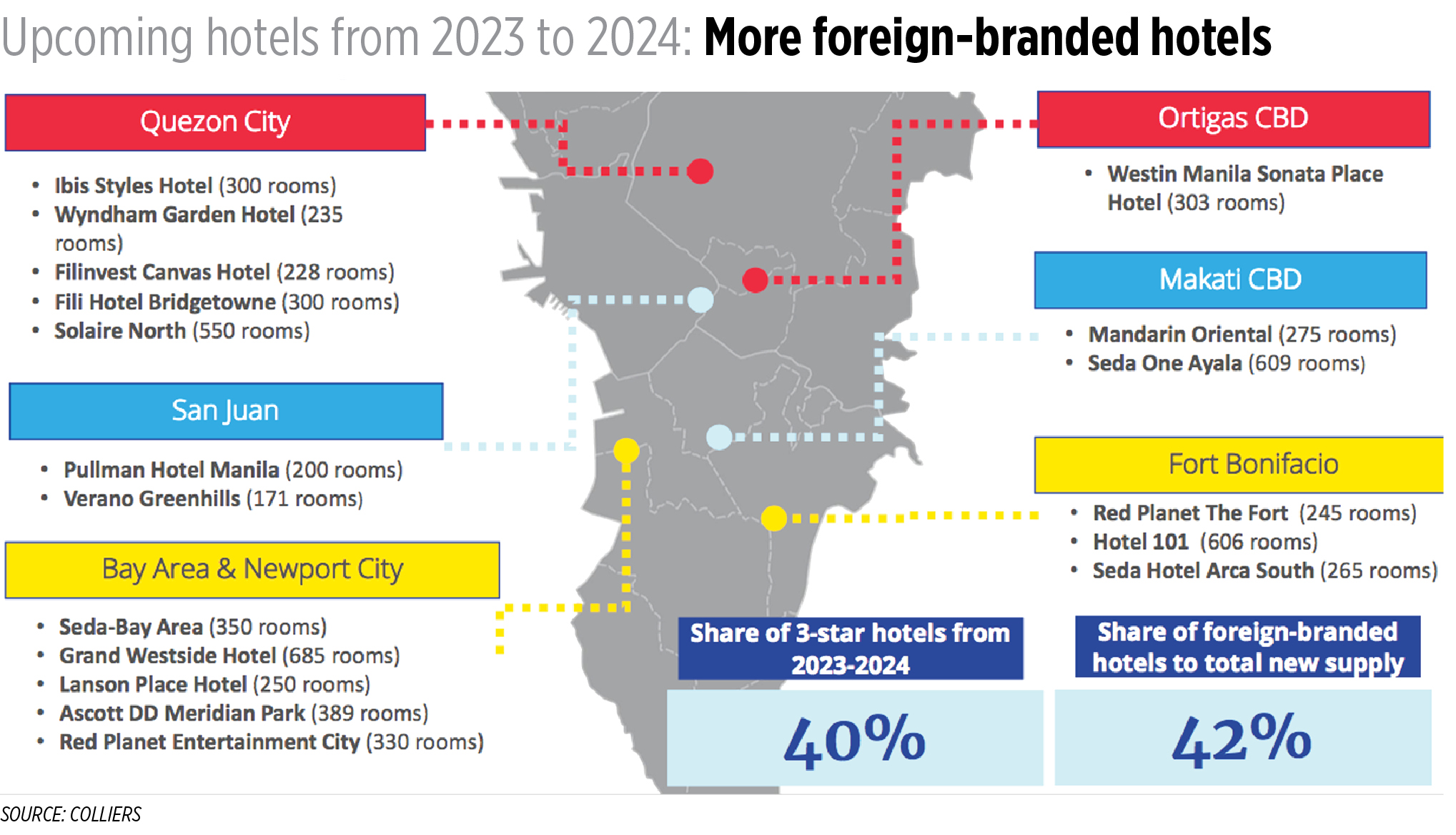
For 2023, Colliers projects the completion of a record-high 3,900 rooms as developers anticipate the projected recovery in global travel. From 2023 to 2025, Colliers expects the annual delivery of 2,120 rooms, higher than the 720 rooms completed yearly from 2020 to 2022. We expect more foreign-branded hotels opening in the next 12 to 36 months. From 2023 to 2025, about 42% of the new supply are foreign brands and are likely to open in the Bay Area, Makati and Ortigas central business districts.

Colliers sees average daily rates (ADRs) rising by about 15% in 2022 after recording a cumulative drop of 20% in 2020 and 2021. ADRs are likely to continue to improve in 2023 following the projected rise in local and foreign tourists.

The ADRs of selected high-end resorts have either held firm or increased versus the previous half. Colliers attributes this to continued revenge travel across the country. In our view, the increase in rates is likely to be sustained as the country attracts more international travelers, especially the long-haul and high-spending ones.

INDUSTRIAL: Industrial parks to support manufacturing’s revival
The industrial sector is likely to benefit from the Marcos administration’s push for industrialization. Prioritizing job-generating manufacturing activities was among then-candidate Ferdinand Marcos, Jr.’s priorities. Colliers believes that improving manufacturing competitiveness should result in greater inflow of investments and these should benefit industrial parks, especially those located in northern and central Luzon.

In June 2022, the Department of Trade and Industry (DTI) highlighted that it is expecting more than P500 billion ($8.4 billion) worth of investments in the Philippines in the next 18 months. According to DTI, the manufacturing sector will likely be a major recipient of these pledges. Colliers believes that this will play a vital role in industrial space absorption once these investments materialize.

We also see the cold chain sector sustaining demand for industrial and warehouse assets, especially with the growing preference for online groceries and same-day deliveries. Recently, the German-Philippine Chamber of Commerce and Industry (GPCCI) disclosed that there are seven German companies which are seeking local partners in the cold chain industry. The Board of Investments (BoI) aims to increase cold storage capacity in the country to 650,000 pallets by 2023 from 500,000 pallets in 2020.

In our view, data centers are potential industrial locators beyond 2022. Industrial parks are ideal locations for data centers because of their power capacity that can support data centers’ electricity requirements. Developers should be proactive in cornering the demand from data centers by highlighting features of industrial parks such as the potential for customization and subsidized utility costs. Upcoming data centers located inside industrial parks include YCO Cloud Centers in Light Industry and Science Park 4 in Batangas and Dito Telecommunity in Clark Global City in Pampanga.

Industrial parks in Central Luzon will likely remain as popular alternative options to CALABA (Cavite-Laguna-Batangas). From 2023 to 2024, we see the delivery of 210 hectares (520 acres) of new industrial space particularly in Tarlac and Subic. The DTI is currently pitching Central Luzon as a manufacturing and logistics hub, highlighting growth opportunities in Pampanga’s New Clark City, Bataan’s Freeport Area, and Tarlac’s Luisita Industrial Park. Singaporean firms are also keen on investing in the Filinvest Innovation Park in New Clark City.


Joey Roi Bondoc is associate director and head of research at Colliers Philippines.

Andrew Tate’s detention extended

Andrew Tate during a fight in March 2014 — LUMARED/EN.WIKIPEDIA.ORG

Former professional kickboxer was detained in Bucharest

By Luiza Ilie and Octav Ganea

BUCHAREST — A Romanian court agreed late on Friday to extend the detention of Andrew Tate by 30 days, after the divisive internet personality was arrested on suspicion of human trafficking, rape and forming an organized crime group.

The former professional kickboxer and his brother Tristan were detained on Thursday for an initial 24 hours alongside two Romanian suspects, prosecutors from the anti-organized crime unit said after raiding their properties in Bucharest.

Prosecutors had then petitioned the court to extend their detention.

Commenting on the court decision, Mr. Tate’s lawyer Eugen Constantin Vidineac told reporters: “From our perspective, there are no grounds… for taking this most drastic preventive measure, but it is the judge’s prerogative.”

Prosecutors said the Tate brothers had been under criminal investigation since April.

“The four suspects … appear to have created an organized crime group with the purpose of recruiting, housing and exploiting women by forcing them to create pornographic content meant to be seen on specialized websites for a cost,” the prosecutors said in a statement late on Thursday.

“They would have gained important sums of money.”

Prosecutors said they had found six women who had been sexually exploited by the suspects.

Mr. Tate, who was born in the United States, holds US and British nationality. The US State Department confirmed that it was aware of the case. Britain’s Foreign Office said it had not been approached for consular assistance over the case.

NOTORIETY
Mr. Tate gained notoriety for misogynistic comments and hate speech. He has said women are partially responsible for being raped and that they belong to men.

His promotion on social media of an ultra-masculine, luxurious lifestyle has earned him a large online following among mostly young men. He has often appeared in videos with expensive sports cars, on private jets and on exotic holidays.

Many social media platforms banned him over his comments but his Twitter account became active again in November after Elon Musk took over the platform. In one of his tweets following his return to Twitter, Mr. Tate said he was flying to California to tell Mr. Musk he was “a legend”.

Climate activist Greta Thunberg told Mr. Tate on Twitter this week before his arrest to “get a life” after he told her he owned 33 cars with “enormous emissions”.

Mr. Tate hit back on Wednesday with a video in which he asked somebody out of shot to bring him pizza and to make sure the boxes were “not recycled”.

Following online speculation that the brand of pizza featured in the video helped police confirm Mr. Tate’s presence in Romania, Ms. Thunberg quipped on Twitter that “this is what happens when you don’t recycle your pizza boxes”.

However, the anti-organized crime unit representative said it was not the case that Tate’s arrest had been made as a result of the pizza boxes.

Mr. Tate, a former contestant on the UK reality show Big Brother, operates the ‘Hustler’s University,’ which claims to have over 160,000 users who pay a subscription to learn about topics such as cryptocurrencies, investing and business. — Reuters

Top 1000 Corporations in the Philippines: Comparison of sectoral performance in 2021

THE PHILIPPINES’ top 1,000 corporations bounced back in 2021, with their combined gross revenues hitting P13.44 trillion as the economy slowly recovered from the coronavirus pandemic. Read the full story.

Top 1000 Corporations in the Philippines: Comparison of sectoral performance in 2021

Peso to move sideways ahead of data releases

BW FILE PHOTO

THE PESO is expected to move sideways to start 2023 as the market waits for leads.

The local currency closed at P55.755 versus the greenback on Dec. 29, up by 44.50 centavos from its P56.20 finish on Dec. 28, data from the Bankers Association of the Philippines showed.

Week on week, the peso weakened by 60.50 centavos from its P55.15-a-dollar finish on Dec. 23.

Philippine financial markets were closed on Dec. 30 and Jan. 2 due to official holidays.

For this week, Rizal Commercial Banking Corp. Chief Economist Michael L. Ricafort said in a Viber message that the market will take its cue from economic data to be released this week.

These reports include the December 2022 manufacturing purchasing managers’ index to be released on Jan. 3, the December 2022 consumer price index (Jan. 5), the November 2022 Monthly Integrated Survey of Selected Industries (Jan. 6) and December 2022 gross international reserves data (Jan. 6), Mr. Ricafort said.

Philippine headline inflation is seen to have settled within the 7.8% to 8.6% range in December due to higher electricity rates and rising prices of agricultural goods, the Bangko Sentral ng Pilipinas (BSP) said on Thursday.

If realized, December would mark the ninth straight month that inflation surpassed the BSP’s 2-4% target range.

Mr. Ricafort added that the “tail-end of the seasonal surge in OFW (overseas Filipino workers) remittances and conversion to pesos to finance the seasonal increase in holiday spending” could also affect peso-dollar trading this week.

He said the local currency may move between P55.55 and P56.05 per dollar this week.

PHL stocks may rise on bullish economic outlook

PHILIPPINE SHARES may climb this week amid thin trading after the holidays as investors expect a better year for corporates and the economy in 2023.

The bellwether Philippine Stock Exchange index (PSEi) inched down by 0.15 point to close at 6,566.39 on Dec. 29, while the broader all shares index rose by 12.71 points or 0.36% to 3,462.04.

Week on week, the PSEi closed higher by 25.36 points or 0.39% from 6,541.03 on Dec. 23.

Philippine financial markets were closed on Dec. 30 and Jan. 2.

“On a shortened trading week and ahead of 2023, the PSEi moved sideways, ending the week a little bit higher… Save for industrials (-0.10%) and holdings (-0.16%), most sectors rallied, primed by mining & oil (+2.36%), and property (+1.82%),” 2TradeAsia.com said in a market report.

For this week, Philstocks Financial, Inc. Senior Research Analyst Japhet Louis O. Tantiangco said the market may move with an upward bias amid market optimism.

“In the last five years, from the previous year’s close to the first trading Friday of the current year, the local market has gained by 1.46% on average… The period observed shows that investors have greeted the new year with optimism attributed to positive economic and corporate outlooks. For the same reasons, we may see the market move with an upward bias in its first week this 2023,” he said.

“However, a strong rally may not be seen yet as investors also deal with risks that tempers growth prospects. This includes the country’s inflation situation, rising interest rates, and a possible global economic slowdown amid lingering headwinds from the US’ monetary tightening, to the Russia-Ukraine war, to China’s COVID-19 (coronavirus disease 2019) situation,” Mr. Tantiangco added.

Philippine headline inflation is seen to have settled within the 7.8% to 8.6% range in December due to higher electricity rates and rising prices of agricultural goods, the Bangko Sentral ng Pilipinas (BSP) said on Thursday.

The Philippine Statistics Authority will release December and full-year 2022 inflation data on Jan. 5.

The BSP has raised benchmark interest rates by 350 basis points (bps) since May in its fight against rising inflation. Meanwhile, the US Federal Reserve has raised borrowing costs by 425 bps since March.

Both are expected to continue tightening this year as inflation remains elevated amid supply constraints.

2TradeAsia.com said the main catalyst for trading this week will be the December inflation report.

“This information dump early in the year may usher broad-based volatility, but also forces monitoring of other key inputs, such as labor data, forex (foreign exchange) and crude oil, both of which can complicate stories for 2023,” 2TradeAsia.com added.

2TradeAsia.com put the PSEi’s support at 6,350 to 6,400 and resistance at 6,600, while Philstocks Financial’s Mr. Tantiangco placed the PSEi’s immediate resistance at 6,600. — J.I.D. Tabile

Rice, pork shortages expected in 2023

PHILIPPINE STAR/MICHAEL VARCAS

By Ashley Erika O. Jose, Reporter

THE PHILIPPINES will likely experience shortages of rice and pork this year, with growers impacted by high costs for key inputs as well as climate change, analysts said.

“We will be in short supply of rice by more than three million metric tons this year due to the high fertilizer and fuel costs and the continuing threat of climate change,” former Agriculture Undersecretary Fermin D. Adriano said in a Viber message last week.

According to the United States Department of Agriculture’s (USDA) Foreign Agricultural Service, the Philippines is expected to import up to 3.8 million metric tons (MT) of rice this year to meet an expected shortfall.

The USDA added that Philippine milled rice production was estimated at 11.98 million MT in 2022, well short of the initial forecast of 12.41 million MT.

“Fertilizer imports showed a decline from April to July 2022, periods when it is most needed for growing crops,” it said.

According to the Fertilizer and Pesticide Authority (FPA), the average price of urea, the most commonly used fertilizer, was between P2,861.64 and 2,759.92 per 50-kilogram bag in the April to July period.

According to the latest FPA data, the price of urea has since eased to P2,538.27.

Last week, oil companies cut the pump price of diesel by P0.20 per liter while gasoline and kerosene prices increased by P0.95 and P0.50, respectively.

Year-to-date total adjustments to fuel prices are net increases of P14.90 per liter for gasoline, P27.30 for diesel, and P21.30 for kerosene.

Aside from rice, Mr. Adriano warned that there will also be a shortage of pork due to the continuing disruptions to grower operations posed by African Swine Fever (ASF).

“We lost three million head of swine to ASF from our hog population of 12 million. Assuming repopulation 400,000 hogs per year, it will take more than five years to repopulate our stock to pre-ASF levels,” he said.

Mr. Adriano added that avian flu is also a concern for the poultry industry as it continues to spread in Europe and US. He added that “we are not very sure how far our anti-avian flu campaign has gone.” 

United Broiler Raisers Association President Elias Jose M. Inciong said in a Viber message to BusinessWorld that climate change, supply chain disruptions and geopolitical tensions will continue to affect agricultural commodities.

“The basic assumption is that there may be a global recession next year so there is less pressure on the demand side. It is expected that prices will remain high and may even increase,” he said.

Philippine international arrivals hit 2.65M in 2022

PHILSTAR

THE Department of Tourism (DoT) said the Philippines logged 2.65 million international arrivals in 2022, beating the 1.7 million target and raising hopes for the arrivals goal to be met in 2023.

In a statement on Monday, the DoT said that of the 2.65 million international arrivals in 2022, 2.02 million were foreigners while 628,445 were returning Filipinos.

Of the foreigner arrivals, the US accounted for 505,089, South Korea 428,014, Australia 137,974, Canada 121,413, the UK 101,034, Japan 99,557, Singapore 53,448, India 51,542, Malaysia 46,805, and China 39,627.

The data cover arrivals between February and December. The Philippines reopened its borders with easier quarantine requirements on Feb. 10.

“The holidays have delivered further gains for the Philippine tourism industry as it breached its 1.7 million target by year-end with 2.65 million international visitor arrivals as of Dec. 31,” the DoT said.

The DoT added that tourism-related jobs in 2022 numbered 5.23 million. The department tallied 11,989 DoT-accredited tourism enterprises as of Dec. 29.

It added that some 25,770 tourism stakeholders were also trained last year. Revenue generated from tourism in 2022 hit P208.96 billion, up 2,465.75% from a year earlier.

“We have overcome a global pandemic, survived various calamities, and thrived through a host of many other challenges. Yet, the Philippine tourism industry has managed to exceed expectations and our tourism partners and frontliners continue to offer the best of Filipino grace and hospitality to the world,” Tourism Secretary Maria Esperanza Christina G. Frasco said.

For 2023, Ms. Frasco has said that the DoT target is 4.8 million international visitors, which she said the department is confident of hitting.

“We welcome 2023 with gratitude and excitement for Philippine tourism to bounce back stronger than ever,” Ms. Frasco said.

“We look forward to the continued convergence and collaboration of our tourism stakeholders — travelers, tourism players, national agencies, local government units, and host communities —in propelling our industry to the heights of becoming a tourism powerhouse in Asia,” she added. — Revin Mikhael D. Ochave

Energy dep’t designates RE, nuclear as 2023 priorities

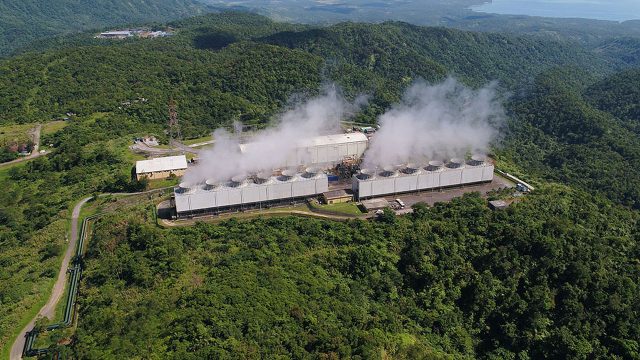
THE Department of Energy (DoE) said its priority areas for 2023 are to develop renewable energy (RE) resources and draft a nuclear power roadmap, apart from dealing with an expected power shortage during the dry season.

In a yearend report on Monday, the DoE said it will have various contingency plans in place to ensure adequate power supply for the critical periods of 2023.

“The Department… will ensure that committed power projects, transmission line facilities, and liquefied natural gas infrastructure are completed and delivered on time,” the DoE said.

It said it is also working to ensure the timely completion of transmission projects to support the entry of an additional 711.54 megawatts (MW) of RE capacity and supporting facilities that will enable more RE use such as battery energy storage systems for the Luzon power grid.

The transmission lines are the Mindanao-Visayas Interconnection Project (MVIP), the Cebu-Negros-Panay project and the Hermosa-San Jose Transmission line.

MVIP aims to connect the three main grids to ensure the sharing of energy across the network. It was initially expected to be completed in 2020, but was postponed due to the pandemic.

The Cebu-Negros-Panay Interconnection Project will enable the transmission of up to 85 MW in surplus power from the Western Visayas, while the Hermosa-San Jose Transmission line in Bataan is expected to support stranded power capacity.

The DoE said it will continue to develop the policy framework for emerging RE technologies.

The impending nuclear power roadmap will be prepared in collaboration with experts, the private sector, and the International Atomic Agency.

The DoE said it will study the possible inclusion of nuclear power to the power mix by developing small-scale nuclear power plants.

The nuclear power roadmap will guide the Nuclear Energy Program Implementing Organization and the Nuclear Energy Program Inter-Agency Committee in rolling the nuclear power program.

The DoE is also hoping to formulate a national total electrification roadmap through the implementation of the Microgrid Systems Act to accelerate the electrification of off-grid areas.

As of June, the household electrification rate was 95.8%.

The DoE said it also hopes to launch the Mindanao Wholesale Electricity Spot Market by Jan. 26. — Ashley Erika O. Jose

Consumption unlikely to remain resilient as inflation bites

PHILSTAR

By Luisa Maria Jacinta C. Jocson, Reporter

HOUSEHOLD consumption is not likely to sustain its growth in 2023 amid rising inflation and signs of further policy tightening by the Bangko Sentral ng Pilipinas (BSP), analysts said.

“The overly aggressive tightening of the BSP this year is a big headwind for growth in 2023. We also continue to believe that the resilience in consumption this year will eventually buckle, as there’s been little progress towards the rebuild in household savings post-pandemic,” Pantheon Chief Emerging Asia Economist Miguel Chanco said in an e-mail.

“We believe that the Philippine economy ‘cashed in its chips early,’ front-loading growth to 2022 with revenge spending powering growth well past target to 7.8% full-year growth. (2023), however, could see households rebuilding savings even after the tax break from the Tax Reform for Acceleration and Inclusion (TRAIN) as inflation stays above target and the negative fallout from multi-year high interest rates finally surfaces,” ING Bank N.V. Manila Senior Economist Nicholas Antonio T. Mapa said in an e-mail.

In the third quarter, household consumption was one of the main drivers of gross domestic product (GDP) growth.

The Philippine Statistics Authority reported that household consumption rose 8% year on year, accelerating from 7.1% a year earlier. Quarter on quarter, household final consumption grew by 5.7%.

This was mainly due to “revenge spending” in restaurants, travel, and tourism amid eased mobility, according to the National Economic and Development Authority.

“Much of the household consumption increases we have seen this year is part of the effects coming from the reduced restrictions from the pandemic. This is particularly true when classes were opened. In fact, the increases in GDP growth as well as employment rates can be attributed solely to the resumption of face-to-face classes (and the easing of restrictions on) other sectors like transportation and construction… none of this growth or so-called recovery can be traced to government programs,” Leonardo A. Lanzona, who teaches Economics at the Ateneo de Manila, said in an e-mail.

Mr. Mapa said according to a BSP study, consumers initially dipped into savings to fund the recent pickup in expenditure but have since diverted funds to rebuild decimated savings, citing a BSP study.

“The survey also indicates that households are postponing big-ticket purchases and taking on less debt, possibly showcasing the initial fallout from the lagging impact of rate hikes carried out this year,” he said.

Mr. Chanco added that the boost in spending this year was mainly temporary, citing the boost in remittances due to the peso’s decline.

John Paolo R. Rivera, an economist at the Asian Institute of Management, said that inflation and the weakening of the peso could lead to further losses in purchasing power.

Earlier this month, BSP Governor Felipe M. Medalla signaled further tightening in 2023 to contain inflation.

The central bank has raised borrowing costs by 50 basis points (bps) to 5.5%, bringing the policy rate to the highest level since November 2008.

Since May, the BSP has raised rates by 350 bps.

Headline inflation accelerated to a 14-year high of 8% in November, breaching the BSP’s target range for an eighth straight month.

In the first 11 months of the year, inflation averaged 5.6%, against the 4% posted a year earlier. The average was still below the BSP’s full-year forecast of 5.8%.

“As a result of these discombobulations, including revenge consumption, the effects of inflation have not been felt. Nonetheless, the high rate of invisible underemployment is a clear manifestation that inflation is clearly affecting the economy,” Mr. Lanzona said.

“But it has been known all over the world that these discombobulations dissipate over time. Eventually, the negative impact of inflation will be greater than the positive effects brought about by the so-called ‘economic recovery,’” he added.

Mr. Mapa said that most consumers have been willing to look past high prices this year, but this may constrain consumption next year.

“Inflation, unlike previous surge episodes, will not likely drop off quickly and face only a steady grind lower. The saying that inflation will be sticky downward should hold sway next year given how pervasive price pressures have become. Some would tie this to vibrant domestic demand but the true reason for the proliferation of second order effects would be the protracted supply side shocks emanating from the ongoing war in Ukraine,” he said.

Mr. Rivera added that instead of relying on revenge spending, the government should focus on ramping up investment, prioritizing manufacturing and services, and increasing agricultural production to drive growth.

Rural women denied opportunity due to connectivity shortcomings

PHILSTAR FILE PHOTO

LACK of access to technology is holding back rural women from pursuing job opportunities, according to a study by the Philippine Institute for Development Studies (PIDS).

“Limited access to devices, erratic power supply, connectivity issues, and digital anxiety among users hound efforts to make rural areas and their residents digitally ready for online jobs. Some respondents admitted being hesitant about learning and using computers even if they knew how to use a smartphone,” PIDS said in a statement.

While digital platforms are intended to “democratize access to opportunities,” the study found that cultural barriers, including misconceptions about perceived innate strengths, skills, and appropriate jobs for women, led women to take on less complex and lower-paying jobs.

“They were more likely to perform tasks related to business services, sales, and marketing, not technology and data analytics tasks,” it added.

Women also earn 18.4% less than men in digital jobs, according to the study.

PIDs said online platforms allow more women to enter the labor force, especially mothers who prefer online work’s “flexibility in terms of time management” over full-time employment.

“However, women have less time spent on platform work and their careers because of the unequal gender division of labor: working women are still expected to perform house chores and care work, and many women have given up on their jobs because they cannot do both. Even among male and female entrepreneurs with the same responsibilities, women still face more care work,” it added.

According to the study, the demand for information technology and business process management related onsite jobs is also low in rural areas.

“Those who found online freelance projects start as general virtual assistants, some of whom work for below-market rates to undercut competitors. Freelance workers from rural areas may be tempted to set even lower rates just to secure a project. Others are subjected to dubious offers or fraudulent jobs that leave them unpaid for completed work,” it added.

The study recommended policies such as the full implementation of the Free Internet Access in Public Places Act, the passage of the Freelance Workers Protection Act, and a review of policies on competitive pricing for contracting work.

“Policy actions must be supported by efforts to digitize essential public services, especially in rural areas, which will boost confidence in digital technologies, develop local government-led plans for ICT infrastructure development and upskilling that prioritize women from low-income households, and ensure that the supply meets the demand for internet connectivity,” the think tank said. — Luisa Maria Jacinta C. Jocson