Home Blog Page 5379

DHL Express opens larger service center in Pasig City

DHL.COM

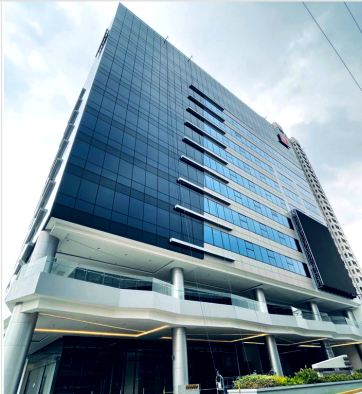
LOGISTICS firm DHL Express has opened a larger facility in Pasig City in a bid to address customer demand and improve its operations in the country.

In a statement, the firm said it invested P254 million in the relocation of its Ortigas Service Center to a larger 4,768 square-meter lot at the Good Harvest Complex, a few minutes from the company’s old facility along C. Raymundo Ave., both in Pasig City.

“With this facility, DHL Express will continue to serve the needs of new and regular customers in Pasig City, Mandaluyong, Quezon City, San Juan, Marikina, Cainta and Taytay, Rizal. Walk-in customers can easily book or drop their shipments at the DHL retail outlet conveniently located at the entrance of the facility,” the company said.

According to DHL Express, the newly relocated Ortigas Service Center features three warehouses, a customer retail outlet, and state-of-the-art material handling equipment.

The facility is also equipped with 94 closed-circuit television (CCTV) cameras equipped to track shipments across the entire process within the service center. The facility also has an x-ray machine to improve the inspection of shipment content.

“Our investment in the Ortigas Service Center reaffirms our commitment to enhancing our services to meet the needs and changing demands of our customers with the highest standard of excellence,” DHL Express Philippines Country Manager Nigel Lockett said.

“This also demonstrates our commitment to sustainability and decreasing our carbon footprint with the installation of solar panels, LED lights and battery-operated forklifts for energy conservation and the deployment of electric vehicles to serve the area,” he added.

Meanwhile, DHL Express Philippines Senior Director for Operations Promod George said that the new Ortigas Service Center also features improved amenities such as an employee lounge and gym.

“We continue to upgrade our services with advanced infrastructure at our new Ortigas Service Center. With increased capacity and state-of-the-art equipment, our customers can be assured that their shipments are handled with the utmost care and security, which will support their growth in international markets,” Mr. George said. — Revin Mikhael D. Ochave


JLL Philippines launches Fly Ace’s real estate companies

Fly Ace Group announces the launch of Happy Coral Way Realty and Endurance Realty Corporation at JLL Philippines’ head office

JLL Philippines and Fly Ace Corporation held a partnership event with an office and logistics market overview at NEX Tower, Makati City.

Ernesto Manansala, Senior Executive Vice President and CFO / COO of Fly Ace Holdings, Inc., announced the launch of two new real estate ventures from Fly Ace—Happy Coral Way Realty and Endurance Realty Corp. “We will continue to put into these new ventures the same effort, commitment, and dedication that we have poured into our FMCG business.”

Joey Radovan, Country Head of JLL Philippines, moderated the event. “We are very honoured to have Fly Ace Holdings Inc. with us today. Fly Ace Holdings Incorporated (FAHI) is the parent company of Fly Ace Corporation, CLE Ace Corporation, Happy Coral Way Realty Corporation and Endurance Realty Corporation,” said Radovan.

The program included market overview presentations from Janlo de los Reyes, JLL Philippines’ Head of Research and Strategic Consulting; and Charlie McNaught, JLL Philippines Director for Logistics & Industrial.

JLL Philippines is currently the exclusive leasing agent for two of Fly Ace Group’s properties, namely:

Doña Elena Tower – Sta. Mesa Manila

Doña Elena Tower is a 12-storey mixed-use building by Happy Coral Way Realty Corporation with a floor area of 1600sq.m per floor, located near Mandaluyong City’s border in the bustling district of Sta. Mesa, Manila. It is connected to major thoroughfares and is accessible via public transportation with proximity to a variety of enterprises, giving tenants the opportunity to work in a community where their needs are readily available.

ELC Center – Sta. Rosa, Laguna

ELC Center is a campus-type, PEZA-registered facility ideal as a business process outsourcing (BPO) hub located in Sta.Rosa, Laguna. This spacious property is a two-storey bare shell building with a floor area of around 5600 sq.m.

To know more about these properties, visit jll.com.ph/en/contact-us.


Spotlight is BusinessWorld’s sponsored section that allows advertisers to amplify their brand and connect with BusinessWorld’s audience by enabling them to publish their stories directly on the BusinessWorld Web site. For more information, send an email to online@bworldonline.com.

Join us on Viber to get more updates from BusinessWorld: https://bit.ly/3hv6bLA.

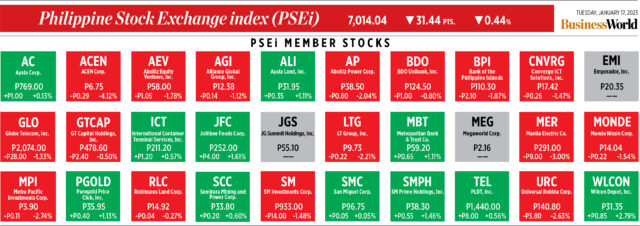
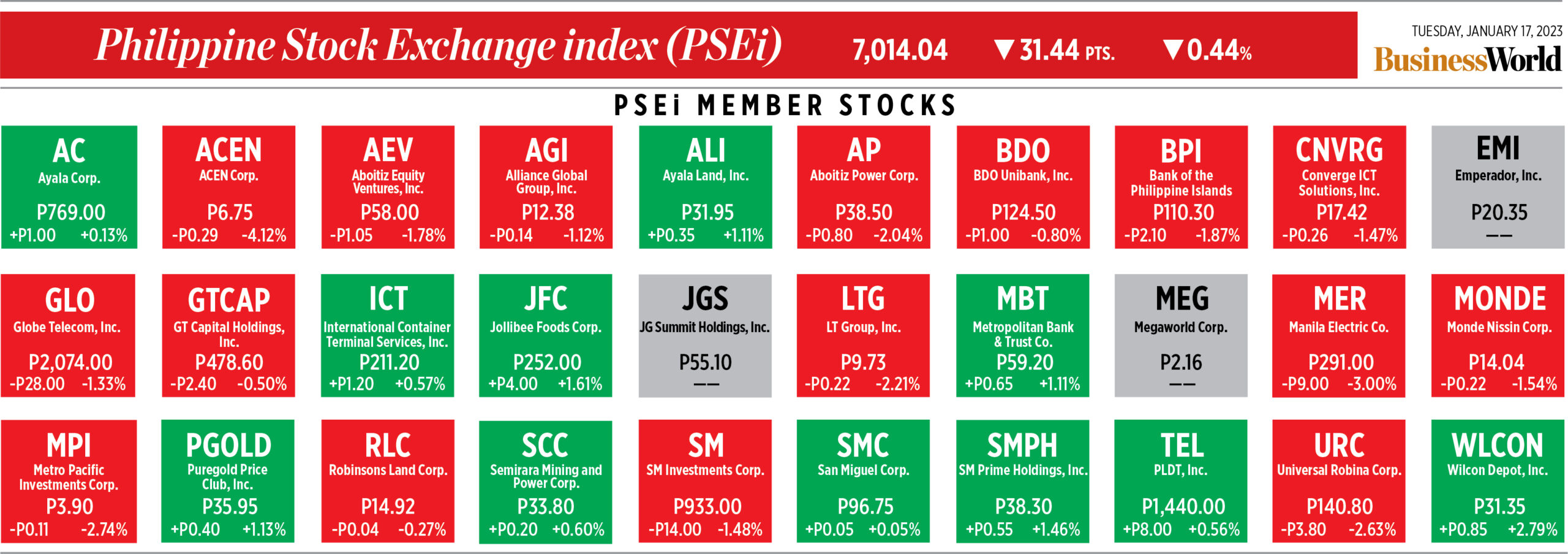
How PSEi member stocks performed — January 17, 2023

Here’s a quick glance at how PSEi stocks fared on Tuesday, January 17, 2023.


Peso weakens on China GDP data

BW FILE PHOTO

THE PESO declined against the dollar on Tuesday as economic growth in China was stronger than expected in the fourth quarter, boosting the greenback and global oil prices.

The local currency closed at P54.82 versus the greenback on Tuesday, declining by 24.50 centavos from Monday’s P54.575 finish, data from the Bankers Association of the Philippines showed.

The peso opened Tuesday’s trading session slightly weaker at P54.60 per dollar. Its worst showing was at P54.93, while its intraday best was at P54.55 against the greenback.

Dollars traded rose to $1.373 billion on Tuesday from $1.27 billion on Monday.

“The peso weakened amid increased global activity prospects following the stronger-than-expected fourth-quarter Chinese GDP (gross domestic product) growth report,” a trader said in an e-mail.

The dollar index bounced from a seven-month low of 101.77 made a day ago, holding at 102.30, Reuters reported.

China’s economic growth in 2022 slumped to one of its worst levels in nearly half a century as the fourth quarter was hit hard by strict coronavirus disease 2019 (COVID-19) curbs and a property market slump, raising pressure on policy makers to unveil more stimulus this year.

China GDP grew 2.9% in October-December from a year earlier, data from the National Bureau of Statistics showed on Tuesday, slower than the third-quarter’s 3.9% pace.

The rate still exceeded the second quarter’s 0.4% expansion and market expectations of a 1.8% gain.

Meanwhile, Rizal Commercial Banking Corp. Chief Economist Michael L. Ricafort said in a Viber message that the peso weakened as oil prices remained elevated.

US crude fell 0.69% to $79.32 a barrel, paring some morning losses, while Brent rebounded to gain 0.25% at $84.67 a barrel, still near their highest levels this month as easing COVID-19 restrictions in China raised hopes of a demand recovery in the world’s top crude importer.

For Wednesday, the trader said the peso may rebound against the dollar on expectations of a weak US producer inflation report.

The trader sees the peso moving between P54.70 and P54.95 per dollar on Wednesday, while Mr. Ricafort gave a slightly narrower forecast range of P54.75 to P54.95. — AMCS with Reuters

Stocks drop on profit taking after Monday rally

BW FILE PHOTO

PHILIPPINE STOCKS closed lower on Tuesday on profit taking after the main index hit the 7,000 level for the first time since April 2022 on Monday and ahead of the resumption of trading on Wall Street.

The benchmark Philippine Stock Exchange index (PSEi) went down by 31.44 points or 0.44% to close at 7,014.04 on Tuesday, while the broader all shares index lost 17.23 points or 0.46% to end at 3,657.92.

“Investors cashed in after the index touched the 7,000 level [on Monday] and ahead of the resumption of trading in the US,” Regina Capital Development Corp. Head of Sales Luis A. Limlingan said in a Viber message.

On Monday, the PSEi closed at 7,045.48, which was its best finish since 7,061.49 on April 21, 2022.

Wall Street was also closed on Monday in observance of Martin Luther King, Jr. Day.

“Despite selling pressure coming from the three-day rally, the PSEi managed to stay just above the 7,000 level, as positive market sentiment continues following expectations that central banks would slow interest rate hikes throughout the year,” Unicapital Securities, Inc. Equity Research Analyst Neil Andrew L. Maderaje said in a Viber message.

Slower US consumer inflation in December has boosted hopes that the US Federal Reserve could consider slower rate increases as early as its first meeting for the year on Jan. 31 to Feb. 1.

The US central bank raised borrowing costs by 425 basis points (bps) last year, which brought the federal funds rate to 4.25-4.5%.

Meanwhile, at home, Bangko Sentral ng Pilipinas (BSP) Governor Felipe M. Medalla last week said the central bank is likely to raise benchmark interest rates by 25 or 50 bps at its meeting on Feb. 16 amid the need to anchor inflation expectations.   

The BSP raised borrowing costs by a total of 350 bps last year to tame inflation. This brought its policy rate to a 14-year high of 5.5%.

Most sectoral indices closed lower on Tuesday except for property, which went up by 34.26 points or 1.11% to 3,098.25, and services, which gained by 3.81 points or 0.22% to 1,729.07.

Meanwhile, industrials lost 133.23 points or 1.33% to close at 9,872.57; holding firms went down by 71.09 points or 1.03% to 6,799.43; financials decreased by 13.39 points or 0.72% to 1,828.07; and mining and oil slipped by 63.73 points or 0.55% to end at 11,393.90.

Value turnover went down to P10.14 billion on Tuesday with 1.25 billion shares changing hands from the P10.23 billion with 1.11 billion issues traded on Monday.

Decliners outnumbered advancers, 111 versus 77, while 38 names closed unchanged.

Unicapital Securities’ Mr. Maderaje said global economic developments will continue to drive the market, with the investors also waiting for the release of full-year 2022 Philippine gross domestic product data on Jan. 26.

“We expect the PSEi to move sideways this week, further testing 6,800 points as a new support level,” he added. — Justine Irish D. Tabile

Aboitiz, Zobel de Ayala headline PHL business delegation to Davos 

REUTERS

THE Philippine business delegation to the Davos conference in Switzerland was led by the heads of some of the country’s biggest blue-chip companies representing the energy, property, consumer goods, transportation, and logistics industries, the Palace said in a statement.

Joining President Ferdinand R. Marcos, Jr. at the World Economic Forum (WEF) at the Swiss mountain resort were Sabin M. Aboitiz, CEO of the Aboitiz Equity Ventures, Inc. and Jaime Augusto Zobel de Ayala, CEO of Ayala Corp. 

Other members of the business delegation were Lance Y. Gokongwei, CEO of JG Summit Holdings, Inc.; Ramon S. Ang, CEO of San Miguel Corp.; Enrique K. Razon, CEO of International Container Terminal Services, Inc.; Kevin Andrew L. Tan, CEO of Alliance Global Group; and Teresita Sy-Coson, vice chairman of SM Investments Corp., the Presidential Communications Office (PCO) said. 

The PCO identified the top executives accompanying the President after reports that the business delegation consisted of about 70 people.

Mr. Marcos arrived in Davos on Sunday afternoon.

The forum is hosting a country strategy dialogue featuring the Philippines, whose economy is expected to grow by 6-7% this year.  

Mr. Marcos has said he will promote the country as “leader and driver of growth and a gateway to the Asia-Pacific region.”

“One that is open for business — ever ready to complement regional and global expansion plans of both foreign and Philippine-based enterprises anchored on the competent and well-educated Filipino workers, the managers and professionals,” he said earlier.

In a briefing with the Palace press corps en route to Switzerland, the President said much of the business will take place in separate meetings away from the forum proper.

“Aside from the question-and-answer with the audience, the President is also looking forward to the ‘pull-aside’ or ‘pull-away’ meetings on the sidelines of the WEF annual meeting,” the PCO said. 

The Philippines faces challenges arising from elevated inflation, rising borrowing costs, and the follow-on impact of a global recession which will affect many of its export and labor markets.

According to the World Bank, the economy’s growth will likely slow to 5.4% this year from an estimated 7.2% last year.

The government has lowered its own economic growth target for 2023 to 6-7% from 6.5-7.5%.

A member of the government delegation, Trade Secretary Alfredo E. Pascual, said he is focused on companies at Davos with active operations in the Philippines, pitching them on potential expansions.

In a statement on Tuesday, the Trade department said that Mr. Pascual held bilateral meetings with companies with Philippine operations on the first day of the WEF on Jan. 16.

These include Chevron Corp., US online education firm Coursera, Inc., Chevron Corp., US satellite firm Astranis, and global woman-focused startup platform She Loves Tech.

Mr. Pascual also met with the WEF’s Executive Committee and Head of International Trade and Investment regarding potential partnerships with the Philippines. 

“We have presented our country as an ideal investment destination in Asia. Similarly, we shared with them our improved business climate, which was fueled by the recent economic policy reforms that facilitate ease of doing business,” Mr. Pascual said.

“We see WEF as an opportunity to gather more foreign direct investment (FDI) that will complement our country’s economic recovery initiatives,” he added.  

The Department of Trade and Industry (DTI) said Mr. Pascual will join the CEO dialogue on the Philippines with President Ferdinand R. Marcos, Jr. as the keynote speaker.

“The dialogue will highlight the administration’s initiatives on energy, food security, and digitalization to add resilience and growth momentum to the country’s economy through public-private collaboration,” the DTI said.  

Aside from the CEO dialogue, Mr. Pascual will also represent the Philippines in several World Trade Organization (WTO) Ministerial-level meetings on e-commerce, investment facilitation for development, and climate change ahead of the WTO Ministerial Conference set on February 2024. — Kyle Aristophere T. Atienza and Revin Mikhael D. Ochave

Film industry bats for reduced taxes in Congress

PHILSTAR FILE PHOTO

THE film industry told Congress it is too heavily taxed, and added that reducing the tax burden would encourage filmmakers to produce more movies of higher quality.

At a hearing of the House committee on creative industry and performing arts, producer Josabeth V. Alonso proposed a reduction in the amusement tax on movies to 5% from 10% as well as tax holidays for the industry.

Ms. Alonso also cited a 2010 decision by the Supreme Court (SC), which found that entities charged an amusement tax are not obliged to pay value-added tax.

According to Ms. Alonso, film producers pay both.

She said that incorporating the ruling into an amendment to the tax code would clarify enforcement and “be a big help to the producers because that would reduce the breakeven target by 12%.”

In 2019 the SC ultimately decided in an en banc resolution to reject the Film Development Council of the Philippines’ motion to grant films amusement tax privileges, saying this violated “the principle of local fiscal autonomy,” with the denial of amusement taxes to local government units (LGUs) could be detrimental to LGUs. 

Dennis N. Marasigan, artistic director of the Cultural Center of the Philippines, told the panel, “If we are able to take out a lot of the taxation that filmmakers and producers (are subject to), then that would encourage producers to produce more quality films rather than to cater to the (mass market).”

In her presentation, Ms. Alonso noted that a film with P100 million in box office revenue and production costs of P50 million will generate net revenue of P37.62 million after 10% amusement tax, 12% value-added tax, and a 5% distribution fee, resulting in a P12.38 million net loss.

“Just because a film grosses a hundred million and above, doesn’t necessarily equate to profit,” Ms. Alonso said.

Ms. Alonso noted that none of the locally-produced films released in 2022 hit P10 million in gross sales. She estimated that films need to gross roughly 270% of production cost to break even.

Currently, only the city governments of Las Piñas and Quezon City do not charge amusement taxes, while Pasay reduced its rate to 5%. Other LGUs still collect a 10% amusement tax. — Beatriz Marie D. Cruz

SRA calls for sale of smuggled sugar at Kadiwa stores

A MAN repacks sugar in packets at a public market in Taguig City, Aug. 27, 2008. — REUTERS/CHERYL RAVELO

THE Sugar Regulatory Administration (SRA) said sugar seized from smugglers should be sold to the public via the Department of Agriculture’s (DA’s) Kadiwa stores.

In a statement on Tuesday, SRA Administrator David John Thaddeus P. Alba said the SRA will recommend to President Ferdinand R. Marcos, Jr., the sale of 80,000 bags of sugar seized at the Port of Batangas.

Last week, the Bureau of Customs seized about 4,000 metric tons (MT) of refined sugar valued at P240 million shipped from Thailand on the MV Sunward.

In December, the DA said it is expediting the import of 64,050 MT of refined sugar to address high sugar prices allegedly caused by tight supply.

The DA said it is convening the minimum access volume (MAV) advisory council to facilitate imports via the MAV mechanism.

In a virtual media briefing on Monday, Food security and livelihood advocacy group Tugon Kabuhayan offered to help the government with its anti-smuggling efforts, blaming the ready availability of smuggled goods for depressing farm incomes.

Association of Fresh Fish Traders of the Philippines President Roderic C. Santos said food producers are the main victims of food smuggling and must be involved in the enforcement of anti-smuggling laws.

Asis G. Perez, convenor of Tugon Kabuhayan, said that the DA is scheduled to file charges against smugglers within this week.

He added that while the group supports the creation of a DA inspectorate and enforcement group, he noted that the problem with the government’s anti-smuggling campaign is that “the group that goes after smuggling is ad hoc, without personnel.”

Mr. Perez said the continued smuggling of onions, rice, corn, sugar, fish, and pork continues to be a burden to farmers.

 “The persistent entry of these undocumented products is also threatening our economy in terms of revenue loss and untaxable commodities,” he said.

United Broiler Raisers Association President Elias Jose M. Inciong said the Agriculture and Fisheries Modernization Act of 1997, especially its provisions on data and quarantine, must be enforced.

Meanwhile, Leonardo Q. Montemayor, chairman of the Federation of Free Farmers, said that the DA should distribute the P5,000 cash transfer to all rice farmers, not only for those farming two hectares or less.

“When prices of palay (unmilled rice) go down due to imports, it affects all farmers, not only those that farm two hectares of land or less. For the sake of those affected by imports, all should benefit from the P5,000 income transfer,” he said.

The government’s rice farmer financial assistance program grants preference to rice farmers tilling between 0.5 hectares and two hectares. — Ashley Erika O. Jose

Government generates P681M in procurement savings

BW FILE PHOTO

THE GOVERNMENT generated savings of P681.2 million from procurement efficiencies in 2022, up 21.8% from a year earlier, the Department of Budget and Management (DBM) said.

“For the past three years, the government has attained significant cost savings through bulk procurement and market price monitoring and validation,” the DBM said in a statement on Tuesday.

Savings are defined as the difference between the market price of common-use supplies and equipment (CSE) and the acquisition price obtained by the DBM.

The DBM Procurement Service (PS) is the government’s central procurement office. It recently decided to focus on CSE following a backlash against the prices it obtained for an order of laptops for the Department of Education.

“We look forward to achieving ‘procurement transformation,’ not only in processes, procedures and products that we procure, but the overall transformation of PS-DBM relative to its structure, system and human resources,” Procurement Service Executive Director Dennis S. Santiago added. — Luisa Maria Jacinta C. Jocson

BSP notes improvement in accuracy of household inflation views

A supermarket is seen in Quezon City, March 4 2022. — PHILIPPINE STAR/MICHAEL VARCAS

THE Bangko Sentral ng Pilipinas (BSP) said household estimates of inflation have been improving in accuracy since 2014, possibly influencing monetary policy because household expectations are a factor in policy decisions.

In an economic newsletter written by Alan Chester T. Arcin and Michael Lawrence G. Castañares, the BSP’s Department of Economic Research said household views on inflation have been demonstrating a narrower upside bias, first noted during the 2008 financial crisis, when high inflation may have conditioned their expectations.

According to the study, inflation was high between 2005 and 2008, possibly skewing households’ inflation expectations upwards.  

Inflation peaked at 9.1% in November 2008, at the height of the Global Financial Crisis.

“However, from 2014 onwards, this bias was considerably reduced, coinciding with more favorable inflation outturns,” the study found, adding that inflation was mostly within target in 2014 to 2020.

Household inflation expectations are tracked in the central bank’s Consumer Expectations Survey (CES). The BSP also conducts a Business Expectations Survey (BES), and Survey of Professional Forecasters (SPF). The survey findings ultimately serve as inputs for monetary policy setting.

“This improvement may be due to the inclusion of reference inflation rates in the CES questionnaire, some gains in the BSP’s advocacy for economic and financial literacy, improved inflation environment, and better anchoring of inflation expectations with increased credibility of the BSP,” according to the study.

According to the central bank, inflation expectations of businesses also tend to exhibit a bias to the upside, possibly reflecting companies’ sensitivity to changes in production costs.

Meanwhile, private-sector economists produce more accurate inflation forecasts compared with households and businesses, with a margin of error closer to zero. 

The data analyzed in the study is from the CES surveys between the first quarter of 2020 and the first quarter of 2022. BES surveys studied were from the fourth quarter of 2018 to the second quarter of 2022.

The SPF results are from between January 2014 and August 2022.

“Expectations of future inflation can influence the consumption and savings decisions of households as well as the price-setting behavior of firms,” the study added.  

“For instance, expectations that future prices would increase could entice households to purchase sooner rather than later, translating to stronger current demand. In turn, firms could raise prices in response to the observed pick-up in sales,” it said.

“Moreover, if households continue to anticipate faster inflation in the future, clamor for wage hikes could emerge and further fuel the inflationary process. Inflation expectations, therefore, are an important determinant of actual inflation as they shape the decisions of economic agents,” it added.  

In the central bank’s latest CES and BES survey, consumer and business sentiment declined in the fourth quarter due to elevated prices of goods, higher interest rates, and a weakening of the peso.

The consumer confidence index slipped to -14.6% from -12.9% in the third quarter, the 10th straight quarter when the survey returned a pessimistic view. The business confidence index fell to 23.9% from 26.1% in the prior quarter, marking a second straight decline. 

Last week, BSP Governor Felipe M. Medalla said the central bank is likely to raise benchmark interest rates by 25 or 50 basis points (bps) next month, citing the need to anchor inflation expectations. 

The Monetary Board has raised rates by a total of 350 bps last year to tame inflation and slow the peso’s decline. This brought the policy rate to a 14-year high of 5.5%.

Monetary authorities are scheduled to meet on Feb. 16 for their first policy meeting this year. — Keisha B. Ta-asan

PHL mangrove losses second worst in region

THE PHILIPPINES lost 10.5% of its mangrove trees between 1990 and 2010, trailing only Myanmar’s losses of 27.6%, which are reckoned for the separate period of 2000 and 2014, the University of the Philippines said in a study.

The study surveyed 300 mangrove sites across Southeast Asia with the goal of filling “large gaps in our understanding of the current and future state of these already dwindling natural resources.”

The study recommended priority action on mangrove restoration as a climate change adaptation and mitigation measure; monitoring the recovery of biodiversity and ecosystem services; and strengthening of the ASEAN network.

The research also highlighted the need for new technology and innovation to effect a sustainable recolonization of mangrove areas. 

“As a region vulnerable to natural disasters such as typhoons and tsunamis, restoration programs should be designed to adapt to and mitigate climate change impacts. Technological innovation for science-based green-gray coastal engineering are critical for facing changing climatic conditions,” the study concluded. — Ashley Erika O. Jose

PHL looks to US, Japanese tech to improve connectivity

REUTERS

THE Department of Information and Communications Technology (DICT) said on Tuesday that it hopes to tap US and Japanese technology to improve connectivity in the Philippines.

The department will work to bring in “low-orbit satellites from the US and high-altitude platform stations from Japan, among others,” DICT Undersecretary for Public Affairs and Foreign Relations Anna Mae Y. Lamentillo told reporters via chat. 

Ms. Lamentillo has yet to confirm whether the department is in talks with other US satellite companies. Starlink Internet Services Philippines, Inc., a unit of Elon Musk’s Space Exploration Technologies Corp. is expected to start serving remote communities in the Philippines by the middle of 2023.

About 65% of the country still has no access to the internet, according to Ms. Lamentillo.

Separately, the DICT announced that it hopes to collaborate with Singapore’s Ministry of Communications and Information on e-governance and cybersecurity.

Ms. Lamentillo met with Singapore’s Ambassador to the Philippines Gerard Ho Wei Hong on Monday to discuss further the areas of cooperation in relation to the recently signed memorandum of understanding (MoU) on digital cooperation.

“We discussed with Ambassador Ho how we can implement this MoU and which areas we should focus on. Singapore has so much experience in the area of e-governance and cybersecurity and they can share with us their best practices in these areas,” Ms. Lamentillo said.

The department said that the MoU on digital cooperation was signed on Sept. 7 during the state visit to Singapore of President Ferdinand R. Marcos, Jr.

“The MoU covers digital cooperation, including digital connectivity, particularly in inter-operable systems and frameworks that enable electronic documentation; cybersecurity, such as organizing training courses and technical programs through the ASEAN-Singapore Cybersecurity Centre of Excellence to develop and enhance skills related to cybersecurity; and digital government/e-governance, such as in the areas of digital government strategy, digital government services, and digital identity,” the DICT said. — Arjay L. Balinbin

ADVERTISEMENT
ADVERTISEMENT