Home Blog Page 5378

Gov’t upsizes T-bond award amid strong demand

BW FILE PHOTO

THE GOVERNMENT upsized the volume of the Treasury bonds (T-bonds) it awarded on Tuesday amid strong demand as investors were looking for high-yielding instruments to park their cash.

The Bureau of the Treasury (BTr) raised P49 billion from the reissued 20-year papers on Tuesday, higher than the original P35-billion program, as bids for the offering reached P133.947 billion.

The bonds, which have a remaining life of 19 years and 10 months, were awarded at an average rate of 6.525%, with accepted rates ranging from 6.49% to 6.6%.

The average rate of the paper was 148.7 basis points (bps) lower than the 8.012% quoted for the series when it was last offered on Nov 22, 2022 and also 160 bps below the 8.125% coupon for the issue.

It was also 54.45 bps lower than the 7.0695% quoted for the same bond series but 10.2 bps higher than the 6.423% seen for the 10-year tenor at the secondary market prior to the auction, based on PHP Bloomberg Valuation Service Reference Rates data provided by the BTr.

“The Auction Committee decided to fully award the reissued 20-year Treasury bonds (FXTN 20-25) at today’s auction… The bonds were 3.8 times oversubscribed, attracting P134 billion in total tenders compared with the P35-billion offering, which prompted the committee to double the allocation for non-competitive bids,” the BTr said in a statement on Tuesday.

“With its decision, the Committee raised P49 billion, bringing the total outstanding volume for the series to P76.6 billion,” it added.

A trader said in a Viber message the offer was met with strong demand as the market is looking for investment outlets yielding above 6%.

“Investors tried to catch up with the recent rally… [there was] fear of losing an opportunity to invest,” the trader said.

Meanwhile, Rizal Commercial Banking Corp. Chief Economist Michael L. Ricafort said in a Viber message that demand for long-tenored government securities continued to be boosted by appetite for higher yields.

Mr. Ricafort added that the issue’s average rate eased on expectations of slower tightening by both the US Federal Reserve and the Bangko Sentral ng Pilipinas (BSP) following dovish signals from officials and slower US consumer inflation in December.

The US consumer price index (CPI) slipped by 0.1% last month, the first decline since May 2020 and coming from a 0.1% rise in November.

On an annual basis, the CPI increased 6.5%, easing from the 7.1% print seen in November 2022.

The data bolstered bets that the Fed will deliver smaller rate hikes as early as its first meeting for the year, which will be held from Jan. 31 to Feb. 1.

The Fed increased borrowing costs by 425 basis points (bps) last year.

Meanwhile, Bangko Sentral ng Pilipinas (BSP) Governor Felipe M. Medalla last week said the central bank is likely to raise benchmark rates by 25 or 50 bps at its meeting on Feb. 16 as it still needs to anchor inflation expectations.    

The BSP hiked rates by 350 bps in 2022 in its fight against inflation.

The BTr plans to raise P200 billion from the domestic market in January, or P60 billion through Treasury bills and P140 billion via T-bonds.

The government borrows from domestic and external sources to finance its budget deficit, which is capped at 6.1% of gross domestic product this year. — A.M.C. Sy


Rephrase your New Year’s resolutions to keep them

PIXABAY

NEW YEAR’s resolutions fall to the wayside around this time. To avoid being a statistic on Quitter’s Day, one must reformulate their resolutions into specific, measurable, and approach-oriented statements, experts say.  

Quitter’s Day, said to be the day when most people quit on their New Year’s resolution, falls on the second week of January. Strava, a social network for athletes, studied 800 million user-logged activities in 2019 and deduced that the second Friday of January was the day motivations begin to decline for those who made resolutions at the start of the year.  

“In order for us to be able to keep our resolve in doing our New Year’s resolutions, it would be helpful to just think of one goal that will be doable and keep it simple. We also need to come up with specific action steps that will help us achieve our goal,” said Myrlinda Rose A. Ngo, a psychologist and counselor at the Well-Being Center of De La Salle-College of Saint Benilde.  

Those who want to lose weight, Ms. Ngo said in a Jan. 11 e-mail, can phrase their goal as “I am going to lose three kilos and maintain a weight of 45 kilos.” They can further break this goal down into action steps:  

  1. I am sleeping every day at 10 p.m. so I can have at least six to seven hours of sleep.  
  2. I am not eating any junk foods but I am allowing myself to eat a small piece of my favorite chocolate once a week.  
  3. I am exercising or doing Fitness Walk at least 30 minutes to an hour every Monday, Friday, and Sunday at 6 a.m.  
  4. I am lessening my intake of processed food such as canned goods and noodles but I will eat two pieces of hotdog (or any comfort food) twice a month.  

“If we are able to do our action steps for 21 days without skipping a beat, then our goal becomes a habit which leads to personal growth,” Ms. Ngo added.  

Rephrasing one’s goals to make it approach- instead of avoidance-oriented (i.e., “I will start to…” instead of “I will quit…”) ups the chance of these goals being reached, said Per Carlbring, a psychologist at Stockholm University in Sweden.  

Mr. Carlbring co-authored a study, published December 2020 in the peer-reviewed journal PLoS ONE, that found that 58.9% of those with approach-oriented goals considered themselves successful a year after making their resolutions, compared with 47.1% of those with avoidance-oriented ones.  

In a Jan. 13 e-mail, Cat C. Triviño, co-founder and speaker of MindNation, a Singapore-based well-being company with a mental health app, said that “it’s okay to revisit old resolutions — but rephrasing them to be more relevant and realistic excites and encourages us to keep with these goals.”  

“You can work with a psychologist or a wellbeing coach to help you craft better resolutions, too!” she added.  

Most resolutions involve either diet or exercise, and people tend to make the same resolutions year after year.  

Seventy-four percent of Filipinos said they will change to better themselves in the new year, per a December 2022 survey conducted by the Social Weather Stations (SWS). Health (31%) is the most common focus of personal betterment in Metro Manila and the rest of Luzon, added SWS. — Patricia B. Mirasol
 

UPS Healthcare launches specialized shipping in PHL

US-BASED UPS Healthcare launched a highly specialized shipping service for patient-critical, time- and temperature-sensitive shipments in the Philippines.

According to the firm, the shipping service’s track and trace technology, and global quality system are well-suited to meet today’s complex logistics demands for the pharmaceutical, medical device, and laboratory diagnostic industries.

“Visibility and traceability are essential to prioritizing the life-saving medications our customers ship, and their customers need,” UPS Healthcare President Wes Wheeler said in a press release.

“The difference between life and death for patients often hinges on the ability to quickly ship and precisely track, monitor and locate medications,” he added.

The shipping service has three levels available globally, with UPS Premier Gold now present locally. It will offer acceleration and “first-in first-off” prioritization.

Package labels of the shipping service will also have mesh sensors which will allow near real-time monitoring and narrow visibility down to three meters within the UPS network.

UPS Premier can expedite the recovery process for packages that need special handling. It also has the capacity for same-day redelivery.

“The entire process is overseen 24/7 by live agents with intimate knowledge of the shipment’s requirements ensuring medications remain compliant, preventing spoilage and loss of product, and reducing costs associated with reshipments,” said UPS Healthcare.

UPS Healthcare is a healthcare logistic provider which has more than 11 million current good manufacturing and good distribution practice-compliant healthcare distribution space globally.

Its services include inventory management, cold chain packaging and shipping, storage and fulfillment of medical devices, and lab and clinical trial logistics. — Justine Irish D. Tabile

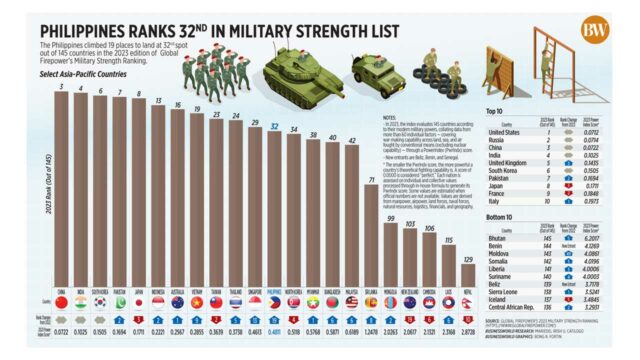
Philippines ranks 32nd in military strength list

The Philippines climbed 19 places to land at 32nd spot out of 145 countries in the 2023 edition of Global Firepower’s Military Strength Ranking.

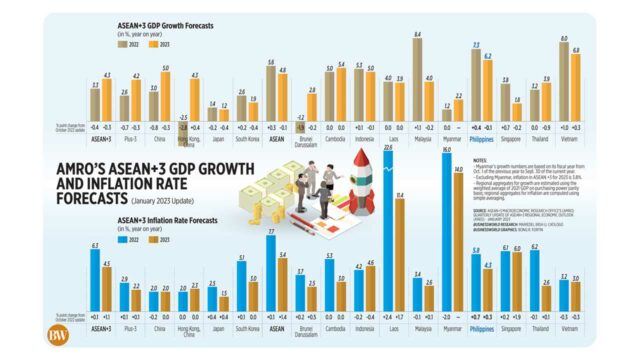
AMRO'S ASEAN+3 GDP growth and inflation rate forecasts

BPI expects merger with Robinsons Bank to boost income, revenues

BW FILE PHOTO

BANK of the Philippine Islands (BPI) expects its net income to climb by 5-6% and its revenues to rise by around 7% once its planned merger with Robinsons Bank Corp. takes effect, its top official said.

“Robinsons Bank is expected to expand BPI’s key balance sheet metrics by between 6.5%, maybe 7%. As mentioned over the past years, Robinsons Bank has been really steadily growing its deposit and loan books at a pace much faster than industry,” BPI President and Chief Executive Officer Jose Teodoro “TG” K. Limcaoco said in a special stockholders’ meeting on Tuesday.

Shareholders of the Ayala-led bank owning 79.69% of total outstanding stocks approved the planned merger on Tuesday.

Mr. Limcaoco said the main advantage Robinsons Bank has that was factored into the projected revenue growth is its customer base’s strong digital adoption, with over 35% of their retail clients enrolled in its online app.

“So, we think that Robinsons Bank can potentially add about 7% to our revenues, and 5 to 6% to our net income,” he said.

Mr. Limcaoco added that the merger is expected to immediately improve BPI’s industry ranking in terms of deposits to second place from third currently.

He noted that Robinsons Bank’s current and savings (CASA) ratio of 83% is higher than BPI’s by 4% and it has “manageable asset quality,” which is not seen to have a negative impact on BPI’s.

The official said they see growth opportunities in Robinsons Bank’s lending book, including in the housing, salary, motorcycle and teachers loan segments and its “unique” credit card portfolio, and that he expects these to help in achieving BPI’s target to have consumer credit comprise 30% of its loan portfolio.

“They have a significant portion of their loan book as consumer loans, but really, their loan book is about 6% of the combined loans of BPI and Robinsons Bank. So, if the merger in and of itself will not really bring us to our aspirations of 30% consumer loans, what we will be doing is taking some of their products, some of their approaches, utilizing their ecosystem,” Mr. Limcaoco said.

He added that the merger is expected to take effect on Jan. 1, 2024 as they still need to secure some approvals from government agencies.

BPI booked a net income of P10.1 billion in the third quarter of 2022 amid higher revenues.

This brought the bank’s bottom line for the first nine months of 2022 to P30.5 billion, backed by higher revenues and lower provisions for loan losses.

BPI’s shares dropped by P2.10 or 1.87% to close at P110.30 apiece on Tuesday. — AMCS

Dior names K-pop star Jimin global brand ambassador

PARK JI-MIN aka Jimin of BTS — INSTAGRAM.COM/DIOR

PARIS — French fashion house Dior on Monday named K-pop star Jimin a global brand ambassador, broadcasting the tie-up on social networks with images of the BTS singer in sporty looks with an outdoor flair, designed by Kim Jones.

The move comes as European luxury houses look to tap into the global popularity of K-pop stars, particularly with younger shoppers.

The LVMH-owned label has also forged links with K-pop star Jisoo, of Blackpink, drawing crowds of screaming fans to Paris when she attends the label’s runway shows.

Jimin, 27, whose full name is Park Ji-min, is one of the seven-member group BTS, which sparked a worldwide K-Pop frenzy with catchy, upbeat music and dance moves following its debut in 2013.

South Koreans have become the world’s biggest spenders per capita on personal luxury goods, splashing out an average of $325 a year, according to analysts at Morgan Stanley.

The bulk of household wealth in the country, 76%, is held in the real estate market, while housing prices increased considerably in the past couple of years, noted the analysts. — Reuters

KonsultaMD offers diabetes screening package 

KONSULTAMD, a health app that connects AC Health’s healthcare provider network and Globe’s digital solution ecosystem, offers a diabetes screening package for individuals who are suspected to have diabetes or are experiencing its symptoms.  

The all-in-one screening package includes at-home lab tests necessary in the screening for diabetes: fasting blood sugar, complete blood count, creatine, lipid profile, urinalysis, and HBA1c (or glycated hemoglobin). It also includes a video consultation with a doctor for the interpretation of the said lab tests.  

“We recognize the difficulties many people experience in finding the right tools to address their health problems. So we are helping them take the first step in achieving a healthier lifestyle,” said Cholo A. Tagaysay, KonsultaMD chief executive officer, in a Jan. 11 press statement.  

 “This new offer is perfect for those who may be at risk of diabetes or are experiencing symptoms consistent with diabetes,” he added.  

The package is P3,999 and comes with a one-month unlimited Concierge access, which is a service within the app where a customer representative handles all appointments and bookings. Input the code KMDDiabetes on the app’s homepage to talk to a customer representative.  

Globe says P16.5B released for capex, loan repayments

GLOBE TELECOM, INC. on Tuesday said it has used P16.46 billion for capital expenditures (capex) and loan repayments from the net proceeds of the company’s stock rights offering.

As of Dec. 31, the balance of the proceeds was P279.68 million, the company said in a regulatory filing.

Based on its disbursement report, Globe has released P6.7 billion for loan repayments and P9.76 billion for capex.

Globe’s capex covers P4.52 billion for mobile, P3.41 billion for common infrastructure, P1.51 billion for broadband, and P322.94 million for its enterprise group.

The company announced in October last year that it sold 10.12 million common shares worth nearly P17 billion.

The proceeds would be used for “pre-payment or repayment, repurchase of all or a portion of certain borrowing, including interest, and other liabilities availed of by the company for capital expenditures,” Globe said.

A portion was intended for the company’s capital expenditure plans.

Globe released its third-quarter income in November showing a 38.6% increase to P6.82 billion from P4.92 billion in the same quarter in 2021. Its nine-month income reached P26.5 billion, a 47.6% increase from P17.96 billion a year earlier.

Globe Telecom shares closed 1.33% lower at P2,074 apiece on Tuesday. — Arjay L. Balinbin

AMRO’S ASEAN+3 GDP growth and inflation rate forecasts

THE ASEAN+3 Macroeconomic Research Office (AMRO) trimmed its growth outlook for the Philippines this year amid deteriorating global economic conditions. Read the full story.

AMRO'S ASEAN+3 GDP growth and inflation rate forecasts

UnionDigital books P4.8B in loans, P9B in deposits

UNIONDIGITAL Bank, the digital lender of UnionBank of the Philippines, Inc., recorded P4.8 billion in loans and P9 billion in deposits just five months after its commercial launch and sees continued growth this year on expectations of improved demand for credit.

UnionDigital Bank President and Chief Executive Officer Arvie de Vera said in an e-mail interview with BusinessWorld that the “record-breaking” numbers seen as of November 2022 came in cooperation with its parent lender.

“We are parented by UnionBank, who has a 40-year-old track record in banking, financial services, and lending. As well as being grand-parented by the Aboitiz Group, a 100-year-old ‘techglomerate’ who has deep roots in various ecosystems and participates in various value chains,” Mr. De Vera said.

“It’s really an ‘unfair’ advantage because we, and only we, have access to these potential customers and are able to maximize the data within the group, part of which are a lot of underserved customers — whom we decided to tap first,” he added.

UnionDigital is the listed lender’s digital bank and was granted a license by the Bangko Sentral ng Pilipinas in July 2021. It began operating in July 2022.

Mr. De Vera said the digital lender was able to harness its parent’s “decades of deep financial data,” allowing them to target UnionBank’s underserved segments.

“Unlike other lenders who are trying to lend based on new data, trying to determine their capacity and willingness to pay, we take a more sure path to lending by using existing transactional data,” he said.

“This, together with the ability to use new and innovative banking underwriting models where we can apply and monetize all the data we have, contributed to our success and growth so far.”

BANKING CONVENIENCE
Asked what trends the digital bank has seen among customers in the first five months of its operations, Mr. De Vera said there is growing preference for efficiency and faster services that only financial technology or fintech players have been able to provide. 

“People want things faster. They want things more immediate, more cost-effective — an overall better customer experience. They want things more digitally enabled rather than paper-based, not manual and one-size-fits-all. It’s about being more personalized, really,” he said. 

“Before, traditional banks could only lend based on income or collateral. Now, you can use alternative sources of data to determine someone’s willingness and capacity to pay — and this became possible because of the digital transformation,” he said.

He added that digitalization is an enabler of economic growth, as it allows people to transact more efficiently.

Mr. De Vera also said more digital tools are accessible now, which have enhanced security to prevent any illicit banking activities online and boost volume growth and usability.

“As a digital bank from day one, we have a better starting point for security and to prevent fraud. Our orientation is immediately on cybersecurity, whereas traditional banks have to pivot to that. We have embedded within us a world-class digital security program, complete with cybersecurity controls into the customer online experience,” Mr. De Vera said.

Some of the tools that the digital lender uses to protect its clients are multi-factor and risk-based authentication, encryptions, threat aware apps, text message or e-mail alerts, as well as fraud and anti-financial crime monitoring, he said.

LENDING TO DRIVE GROWTH
This year, UnionDigital is looking to offer more loans to its clients, the official said.

“Our strategy focus would really be to lend and maximize the learnings we get from our ecosystem. This is really the main point of financial inclusion and of a bank — to lend and to have a balance sheet,” Mr. De Vera said.

“Since we already have a successful loan growth portfolio to date, we plan to continue and focus on this [this] year. At the core of a digital bank should be the ability to lend,” he said.

He added that despite elevated inflation, the bank is expected to sustain its growth this year because of the economy’s rebound.

“We really see that loans are going to be our driver, not just in terms of profitability but also in terms of focus and growth. It’s with the challenging 2023 environment, not just in the Philippines but globally, that we’re even more encouraged to focus on loans — because loans generate revenues and actual profit — and that’s more sustainable,” he said. 

“We don’t want to waste our resources on things that will not bring us revenue. We want to focus our capital on where we can earn the most revenue because it will drive profitability and sustainability to allow us to scale for the future,” Mr. De Vera added. — Keisha B. Ta-asan

Kevin Spacey hails Italy museum for having ‘the guts’ to honor him

ACTOR Kevin Spacey awarded by the National Museum of Cinema of Turin with the “Stella della Mole Award.” — TWITTER/MUSEOCINEMA

TURIN — Kevin Spacey picked up a career award in Italy on Monday, despite controversy over the sex crime allegations that have tarnished the reputation of the Oscar-winning American actor.

The Museum of Cinema in Turin said it handed the prize in recognition of Mr. Spacey’s “personal aesthetic and authorial contribution to the development of the art of drama.”

For the occasion, the 63-year-old was invited to speak at the museum.

“I am surely blessed and grateful and humbled and my heart is very full tonight toward the Museum of Cinema for having had le palle (the guts) to invite me tonight,” he said.

Spacey won Oscars for performances in American Beauty and The Usual Suspects, but his career largely ended a few years ago, after more than 20 men accused him of sexual misconduct.

In the run-up to the award ceremony, the Turin-based La Stampa newspaper ran an editorial headlined “Italy, land of plenary indulgence.” Last week, Mr. Spacey appeared by video link before a court in London, pleading not guilty to several charges of sexual misconduct against one man about 20 years ago.

The charges were joined to an earlier five-count indictment related to alleged sex offenses against three men between 2005 and 2013, for which Mr. Spacey previously professed his innocence. In another case that played out in the United States, Spacey defeated in October a sexual abuse claim brought against him by actor Anthony Rapp. — Reuters

Enabling access through technology

PIXABAY

Achieving the goals of universal health coverage (UHC) in low- and middle-income countries requires a structured, collaborative effort that ensures health systems use resources effectively and efficiently.  

In this regard, governments, payers, and clinicians need to consider a range of decision-making tools to prioritize healthcare interventions and ensure patients have access to quality healthcare products and services to prevent, diagnose, and treat diseases, the International Federation of Pharmaceutical Manufacturers & Associations (IFPMA) said. 

According to the IFPMA, international and national agencies should consider several key policy principles in considering how to make evidence-based decisions on healthcare.  

Evaluation systems should be holistic and consider all impacts of medical technologies, including medicines, assessing both the benefits as well as costs; consider national health systems and circumstances and tailor the use of medical technologies to local circumstances; have transparent processes that involve all stakeholders; have as an objective to increase access to new medical technologies; inform and promote patient choice; and encourage innovation and experimentation. 

While there are many evidence-informed decision-making tools available, some governments and payers use health technology assessment (HTA) to help inform health policy decisions.  

The World Health Organization (WHO) defines HTA as a systematic, multidisciplinary and transparent evaluation of the properties of health technologies and interventions covering both their direct and indirect consequences. It aims to determine the value of a health technology and to inform guidance on how these technologies can be used in health systems around the world. 

According to the WHO 2015 Global Survey on Health Technology Assessment by National Authorities, high-income countries are much more likely than low-income countries to use HTA for determining reimbursement or to decide what to include in a benefits package. Middle-income countries tend to use HTA to inform clinical practice guidelines and protocols more often (85%) than high- and low-income countries (46% and 50%, respectively). Less than 60% of countries in any income category used HTA for pricing of health products. 

The most conventional form of HTA is at the “micro-level,” which focuses on the assessment of individual health technologies such as drugs and medical devices. However, “micro-level” HTA of individual technologies is unlikely to address the systemic challenges faced by healthcare systems in low- and middle-income countries.  

In contrast, “macro-level” HTA specifically addresses patient access to high quality medical care by assessing the effectiveness and efficiency of interventions within the whole health system and informing the prioritization of healthcare services.  

“Macro-level” HTA can inform payers’ decisions on what products and services to cover in benefits packages as countries progress towards UHC and expand beyond basic benefits packages toward comprehensive coverage. 

The innovative biopharmaceutical industry believes evidence-informed benefits design that is patient-centered and takes into account the healthcare delivery system as a whole can help promote long-term sustainability and flexibility in meeting UHC objectives. This, at the same time, while ensuring that priority setting reflects social values and preferences for investment in healthcare. 

The Universal Health Care Act of 2019 created the Health Technology Assessment Council (HTAC), an independent advisory body with the overall role of providing guidance to the Department of Health (DoH) and the Philippine Health Insurance Corp. (PhilHealth) on the coverage of health interventions and technologies to be funded by the government.  

HTAC is mandated to undertake technology appraisals by determining their clinical and economic values in the Philippine healthcare system, with the aim to improve overall health outcomes and ensure fairness, equity, and sustainability of coverage for all Filipino citizens. Ethical, legal, social and health system implications are also considered in the assessments. 

The HTAC Core Committee is responsible for the development and submission of final recommendations to policy- and decision-makers, based on the evidence appraisal of the different subcommittees. 

As the country’s HTA works toward assessing medicines and technologies, it is important to consider the patient perspective and overall impact to improving health outcomes of the individual, and in the healthcare system. An ideal HTA is one which enables access to life-saving medicines and technologies for each and every patient who urgently needs them. 


Teodoro B. Padilla is the executive director of the Pharmaceutical and Healthcare Association of the Philippines (PHAP), which represents the biopharmaceutical medicines and vaccines industry in the country. Its members are at the forefront of research and development efforts for COVID-19 and other diseases that affect Filipinos. 

ADVERTISEMENT
ADVERTISEMENT