Home Blog Page 5376

Deloitte Philippines launches investigation and compliance services with appointment of new forensic leader

Neal Ysart joins the firm as Deloitte Forensic Philippines Leader

In a demonstration of its commitment to investing in the Philippines, Deloitte has announced the appointment of Neal Ysart as Managing Director to lead and expand the footprint of its forensic and financial crime advisory practice in the Philippines and across Southeast Asia.

Neal joined Deloitte Philippines on Dec. 1 and brings over 38 years of investigative experience to the Philippines, including a 16-year stint in law enforcement at the UK’s Scotland Yard, and over 15 years working at leading professional services firms in the UK and the Middle East. His extensive experience also includes leading a 140-strong team as regional head of KYC (Know Your Customer) at HSBC and as Lead Regulatory and Investigations Advisor at Clyde & Co LLP, a leading international law firm.

Neal regularly works with regulators and specialises in helping companies investigate and manage financial crime and other issues such as bribery and corruption, sanction violations, fraud, cyber security breaches, trade-based money laundering, supplier risk, whistleblowing disclosures, and serious employee malpractice.

“The combination of Neal’s seasoned strategic global experience together with the depth and breadth of our services throughout the region will provide companies in the Philippines with a local capability to help address serious forensic and financial crime business issues quickly and effectively,” said Marc Anley, Deloitte Southeast Asia Forensic Lead Partner.

Deloitte’s forensic services include financial crime advisory, forensic technology and analytics solutions, discovery and data management, and investigations and crisis support. Neal will lead a team of professionals committed to helping businesses navigate and resolve crises, controversies, and transactions using highly specialised analytics and investigative toolsets and techniques.

Neal said, “I am delighted to join Deloitte and become part of a team with such a strong regional and global reputation for innovative forensic services. Businesses globally are facing increasingly complex and sensitive issues that often require independent and confidential investigation. I’ve worked in the area of investigations and compliance all my career and I’d welcome the chance to share that experience with any company in the Philippines that needs help.”


Spotlight is BusinessWorld’s sponsored section that allows advertisers to amplify their brand and connect with BusinessWorld’s audience by enabling them to publish their stories directly on the BusinessWorld Web site. For more information, send an email to online@bworldonline.com.

Join us on Viber to get more updates from BusinessWorld: https://bit.ly/3hv6bLA.

Pag-IBIG releases record-high P118-B home loans in 2022; over 100,000 members with new homes

Pag-IBIG Fund released a record-high P117.85 billion in home loans to finance the housing units of 105,212 members in 2022, its top officials announced on Jan. 18.

For 2022, the amount of home loans released by the agency increased by 21% or P20.57 billion compared to the P97.28 billion released in 2021. With the amount, Pag-IBIG financed the acquisition and construction of 105,212 homes for its members, or an increase of 11% from the 94,533 homes financed in 2021.

“We are happy to report that Pag-IBIG Fund has once again set a new record-high in home loan releases in 2022. This is very good news because as the amount of home loans we release increases, so does the number of Filipinos who now have homes of their own. Pag-IBIG Fund’s performance is a testament to our united and unwavering efforts to resolve the country’s housing backlog, in line with the objective of President Ferdinand Marcos, Jr. under the Pambansang Pabahay Para sa Pilipino Program,” said Secretary Jose Rizalino L. Acuzar, who heads the Department of Human Settlements and Urban Development (DHSUD) and the 11-member Pag-IBIG Fund Board of Trustees.

Pag-IBIG Fund Chief Executive Officer Marilene C. Acosta, meanwhile, noted that the 105,212 housing units financed in year 2022 is also a record-high, and marks the first time that the agency has financed more than 100,000 housing units in a single year. She further stated that out of the total housing units financed by the agency last year, 18,657 or 18% were socialized housing units which are now owned by members from the minimum-wage and low-income sectors.

“We at Pag-IBIG Fund have always strived to provide our members – the Filipino workers, the means to have their own homes through affordable shelter financing. That is why we take great pride in achieving a record-high number of housing units financed in 2022 because it means that we have empowered even more Filipinos in gaining their own homes. And, as we embark on yet another year, our members can continue to rely on Pag-IBIG Fund to provide them the most affordable home loan in the market, so that they too can achieve their dream of homeownership. That is the Lingkod Pag-IBIG pledge,” Acosta added.


Spotlight is BusinessWorld’s sponsored section that allows advertisers to amplify their brand and connect with BusinessWorld’s audience by enabling them to publish their stories directly on the BusinessWorld Web site. For more information, send an email to online@bworldonline.com.

Join us on Viber to get more updates from BusinessWorld: https://bit.ly/3hv6bLA.

BoJ defies market bets for policy tweaks, sending yen tumbling

The Bank of Japan (BoJ) on Wednesday maintained ultra-low interest rates, including a bond yield cap it was struggling to defend, defying market expectations it would phase out its massive stimulus program in the wake of rising inflationary pressure. 

The surprise decision sent the yen skidding against other currencies and bond yields tumbling the most in decades, as investors unwound bets they made anticipating the central bank would overhaul its yield control policy. 

Instead of overhauling its stimulus program, the BoJ crafted a new weapon to prevent long-term rates from rising too much — a move some analysts took as a sign Governor Haruhiko Kuroda will hold off on making big policy shifts during his term that ends in April. 

At a two-day policy meeting, the BoJ kept intact its yield curve control (YCC) targets, set at -0.1% for short-term interest rates and around 0% for the 10-year yield, by a unanimous vote. 

The central bank also made no change to its guidance that allows the 10-year bond yield to move 50 basis points either side of its 0% target. 

Underscoring its resolve to keep defending the cap, the BoJ beefed up a key market operation tool to more effectively curb rises in long-term interest rates. 

“Widening the yield band or dismantling YCC now would have made the BoJ even more vulnerable to market attack,” said Izuru Kato, chief economist at Totan Research. 

“By showing its resolve to use market tools more flexibly, the BoJ wanted to signal to markets it won’t make big monetary policy changes under Kuroda.” 

Mr. Kuroda’s last policy meeting will be held on March 9–10, ending a decade at the helm of the bank that brought about radical monetary stimulus. 

The decision follows the BoJ’s surprise move last month to double the yield band, a tweak that analysts say has failed to correct market distortions caused by its heavy bond buying. 

The dollar rose 2.4% to 131.20 yen on the BoJ’s announcement, marking its biggest one-day jump since March 2020, while the Nikkei stock average jumped by more than 600 yen. 

Japanese government bond (JGB) yields tumbled across the curve with the benchmark 10-year yield sliding to 0.37%, well below the BoJ’s 0.5% ceiling and posting the biggest one-day decline since November 2003 at one point. 

DIMMING GROWTH PROSPECTS
Since December’s action, the BoJ has faced the biggest test to its YCC policy since its introduction in 2016 as rising inflation and the prospects of higher wages gave traders an excuse to attack the central bank’s yield cap with aggressive bond selling. 

Mr. Kuroda has repeatedly said the BoJ was in no rush to dial back stimulus, let alone raise interest rates, until wages rise enough to boost household income and consumption, allowing firms to lift prices. 

In a quarterly report released on Wednesday, the BoJ raised its core consumer inflation forecast for the current fiscal year ending in March to 3.0%, from 2.9% projected in October. 

It also revised up the inflation forecast for the fiscal year ending March 2024 to 1.8%, from 1.6% seen three months ago. 

But the inflation forecast for fiscal 2023 was maintained at 1.6%, a sign the board is sticking to the view that prices will moderate as the effect of past surges in raw material costs dissipate. 

The BoJ also slashed its economic growth projections for fiscal 2023 and 2024, amid worries slowing global growth will weigh on the export-reliant economy. 

Japan’s core consumer inflation has exceeded the BoJ’s 2% target for eight straight months, as companies raised prices to pass on higher raw material costs to households. 

Data due out on Friday is likely to show inflation hit a fresh 41-year high of 4.0% in December, according to a Reuters poll, although analysts expect price growth to moderate later this year reflecting recent declines in global commodity prices. — Reuters

FTX reports $415M in hacked crypto, Bankman-Fried says FTX US is solvent

PIXABAY

Bankrupt crypto exchange FTX said in a report to creditors on Tuesday that about $415 million in cryptocurrency had been stolen in hacks. 

FTX has said it had recovered over $5 billion in crypto, cash, and liquid securities, but that significant shortfalls remained at both its international and US crypto exchanges. FTX attributed some of the shortfall to hacks, saying that $323 million in crypto had been hacked from FTX’s international exchange and $90 million had been hacked from its US exchange since it filed for bankruptcy on Nov. 11. 

Indicted founder Sam Bankman-Fried later challenged aspects of the company’s report in a blog post. 

Mr. Bankman-Fried, who has been accused of stealing billions of dollars from FTX customers to pay debts incurred by his crypto-focused hedge fund, Alameda Research, pushed back against FTX’s calculations late Tuesday, saying that the company’s lawyers at Sullivan & Cromwell had presented an “extremely misleading” picture of the company’s finances. 

Mr. Bankman-Fried said FTX has more than enough money to repay US customers, whom he says are owed between $181 million and $497 million based on his “best guess.” Mr. Bankman-Fried has not had access to FTX records since stepping down as CEO in November. 

A spokesperson for Sullivan and Cromwell declined to comment. Attorneys at the firm said in a recent court filing that they have rebuffed Mr. Bankman-Fried’s efforts to stay involved in the company’s bankruptcy proceedings. 

Mr. Bankman-Fried has pleaded not guilty to fraud charges, and he is scheduled to face trial in October. 

FTX did not provide an estimate of the amount owed to FTX’s US or international customers, and it did not immediately respond to questions about Mr. Bankman-Fried’s blog post. 

FTX provided some additional details about its recovery efforts on Tuesday, saying it had recovered $1.7 billion in cash, $3.5 billion in liquid cryptocurrency and $300 million in liquid securities. 

“We are making progress in our efforts to maximize recoveries, and it has taken a Herculean investigative effort from our team to uncover this preliminary information,” CEO John Ray said in a statement. 

The crypto assets recovered to date include $685 million in Solana, $529 million in FTX’s proprietary FTT token, and $268 million in bitcoin, based on crypto prices on Nov. 11, 2022. Solana, which was lauded by Mr. Bankman-Fried, lost most of its value in 2022. 

During FTX’s initial investigation into hacks of its system, it uncovered a November asset seizure by the Securities Commission of the Bahamas, which led to a dispute between FTX’s US-based bankruptcy team and Bahamian regulators. 

The two sides settled their differences in January, and Mr. Ray said on Tuesday that the Bahamian government was holding $426 million for creditors. 

Bahamas Prime Minister Philip Davis referenced the dispute during a Tuesday event at the Atlantic Council in Washington, saying Mr. Ray’s team had “come around” and accepted that the Bahamian asset seizure “was appropriate and perhaps has saved the day for many of the investors in FTX.” — Reuters

China’s pessimistic Gen Z poses challenge for Xi post-COVID

Reuters

SHANGHAI — The first weekend after coronavirus disease 2019 (COVID-19) restrictions ended last month, dozens of young Chinese jostled in the dark at a heavy-metal concert in a tiny Shanghai music venue that reeked of sweat and hard liquor.

It was the kind of freedom young Chinese had demanded in late November in protests against the zero-COVID policy that became the biggest outpouring of public anger in mainland China since President Xi Jinping took power a decade ago.

After three years of lockdowns, testing, economic hardship and isolation, many of China’s Generation Z — the 280 million born between 1995 and 2010 — had found a new political voice, repudiating their stereotypes as either nationalist keyboard warriors or apolitical loafers.

Pacifying a generation faced with near-record youth unemployment and some of the slowest economic growth in nearly half a century presents a policymaking challenge for Mr. Xi, who is just beginning a precedent-breaking third term. Improving young people’s livelihoods without abandoning the country’s export-led growth model poses inherent conflicts for a government that prioritizes social stability.

This generation is the most pessimistic of all age groups in China, surveys show. While the protests succeeded in hastening the end of COVID curbs, the hurdles Chinese youth face in achieving better living standards will be harder to overcome, some analysts say.

“As the road ahead for the youth gets narrower and tougher, their hopes for the future evaporate,” said Wu Qiang, a former politics lecturer at Tsinghua University who is now an independent commentator in Beijing. Young people no longer had “blind confidence and adulation” towards China’s leaders, he added.

Some Chinese youth who spoke to Reuters reflected the sense of frustration.

“If they didn’t change the policy, then more people would protest, so they had to change,” said 26-year-old Alex, who declined to give her last name for fear of retribution from the authorities, in an interview before the Shanghai concert.

“But I don’t think young people will go back to thinking that nothing bad ever happens in China.”

‘EDUCATED PESSIMISM’

Young people, especially in cities, are often at the forefront of protests globally; students led China’s biggest pro-democracy uprising in 1989, which Beijing crushed in a military crackdown.

But China’s Gen Z has its own characteristics that present a dilemma for Mr. Xi, some analysts said.

In recent years, some young Chinese social media users have drawn international attention for their ferocity in attacking critical views about China online, including of Beijing’s COVID policies. They became known as “little pinks,” a term associated with the color of a nationalist website, and drew comparisons with China’s aggressive “wolf warrior” diplomats and the Red Guards of Mao Zedong’s Cultural Revolution.

With the economy slowing under the weight of pandemic restrictions, a countertrend emerged, but not quite of the liberal type that pushes against growing nationalism in the West. Many young Chinese have been choosing to “lie flat,” a term used to describe people who have rejected the corporate rat race by adopting a minimalist lifestyle and doing just enough to get by.

There is no data on how many Chinese are inclined towards those perspectives. Brewing under the surface before the protests, however, was one unifying factor: growing discontent with their perceived economic prospects.

A survey of 4,000 Chinese by consultancy Oliver Wyman found Gen Z to be the most negative about China’s economic outlook of all the age groups. Their peers in the United States, by contrast, are more optimistic than most preceding generations, according to a study by McKinsey.

Some 62% of China’s Gen Z worried about job security and 56% worried about prospects for a better lifestyle, far more than older generations, according to the Wyman survey conducted in October and released in December.

In the United States, the study released in October showed 45% of 18-to-24-year-olds worried about job stability, but scored better on McKinsey’s gauge of perceptions of future economic opportunities than all groups except those aged 25-34.

Earlier in the Xi era, things were looking brighter.

In 2015, a Pew Research Center study found seven in 10 of Chinese people born in the late 1980s felt positively about their economic situation. A whopping 96% felt their living standard was better than their parents’ at the same age.

“It’s educated pessimism. It’s based on the facts and the reality that they’re witnessing,” said Zak Dychtwald, founder of research firm Young China Group, which examines trends among Chinese youth, of the mood among young adults.

“I don’t think these protests would have happened ten years ago, but this young generation believes they ought to be heard in a way that older generations didn’t.”

He said further unrest appeared unlikely in the near term, but the ruling Communist Party was under pressure to offer “some hope and direction” to the country’s youth at an annual legislative meeting in March.

Failure to deliver such solutions could reignite protests in the long term, he said.

FIXING THE YOUTH

In a New Year speech, Mr. Xi acknowledged the need to improve the prospects of China’s youth, without mentioning the protests against his zero-COVID approach.

“A nation will prosper only when its young people thrive,” Mr. Xi said, without elaborating on potential policies.

For China’s stability-obsessed Communist Party, giving Gen Z more political agency is unthinkable.

Instead, analysts say Chinese policymakers need to create well-paid jobs for young people and ensure they thrive economically, like their parents’ generation, who accepted limited freedoms in exchange for promised prosperity.

But achieving that is harder in a slower economy, and some of the policies that could improve living standards for younger Chinese are in conflict with other priorities for the world’s second-largest economy: ensuring the engines behind its 15-fold expansion over the past two decades keep running, some political analysts and economists say.

Meeting Gen Z’s expectations for higher wages would make Chinese exports less competitive. Making housing more affordable could mean allowing a sector responsible for a quarter of China’s economic activity in recent years to collapse.

Mr. Xi’s second-term crackdown on tech and other private sector industries has also led to job losses and fewer opportunities for young people.

For all the government’s talk about “common prosperity”, leveling the playing field for this new generation seems impossible, said Fang Xu, an urban sociologist at the University of California, Berkeley.

“Their parents were able to accumulate such a massive amount of wealth from the housing market, from private entrepreneurship, and that leap is not likely to be repeated,” Ms. Fang said.

“Leveling the playing field means devaluing the property market enough that it’s not impossible for young people to buy a house, but that would be a huge blow to older generations.”

URGE TO LEAVE

Given the risk of arrest, most of those who took part in the protests against COVID restrictions are laying low. It is unclear what their hopes and plans are or how they vary. But some young people feel driven to pursue their ambitions elsewhere.

University student Deng, 19, who spoke to Reuters on the condition of partial anonymity because of the sensitivity of the situation, has little hope that she will be able to thrive in China.

“If I want to stay in China, I have these two choices: stay in Shanghai to work and take an average office job or listen to my parents, return to my hometown, take the public servant exam, lie flat,” said Deng, adding she planned to emigrate instead.

Data from internet giant Baidu shows online searches for studying abroad were five times the 2021 average during the two-month lockdown of Shanghai’s 25 million residents last year. Another spike occurred during the November protests.

Neither Deng nor Alex see much room for further dissent in the near future.

“You can either accept the system or leave China. You can’t change the system here, the authorities are too powerful,” Alex said.

A few days later, at the Shanghai venue, Alex found a vantage point among fellow metal fans for the first time since COVID rules eased. She took in the sounds of the band, Rat King, her concerns for the future put aside for one night. — Reuters


China reopens its doors with investment pitch to global elite

A WOMAN walks across the street during morning rush hour in Chaoyang District, Beijing, China Nov. 21, 2022. — REUTERS

DAVOS, Switzerland — China’s Vice-Premier Liu He welcomed foreign investment and declared his country open to the world on Tuesday after three years of pandemic isolation.

Mr. Liu’s explicit pitch to global leaders gathered in Davos made it clear China wants international investors to play a key role in Beijing’s attempts to revive its slowing economy.

“Foreign investments are welcome in China, and the door to China will only open up further,” Mr. Liu, a top economic tsar and confidant of President Xi Jinping, said.

His speech to the World Economic Forum’s (WEF) annual meeting mentioned “strengthening international cooperation” and “maintaining world peace” 11 times.

Mr. Liu made his speech as the release of new population data sounded an alarm on a demographic crisis with profound implications for the world’s second largest economy.

New GDP data also showed economic growth slumped in 2022 to the worst level in nearly half a century.

Mr. Liu’s visit to the Swiss ski resort is the first trip abroad by a high-level Chinese delegation since Beijing abruptly began dropping its “zero-COVID” curbs that shielded its 1.4 billion people from the coronavirus last month.

That policy also cut off China from the rest of the world for the past three years, stifling foreign investment.

At Davos, Mr. Liu is sitting down with CEOs of finance, tech, consumer, and industrial companies, a Chinese official familiar with the matter told Reuters. He will also meet other world leaders.

In his speech, Mr. Liu said he had caught up with many old friends, having last attended Davos in 2018. Former US Treasury Secretary Lawrence Summers told Reuters he spoke with Mr. Liu on Monday for more than an hour, without giving details.

On Wednesday, Mr. Liu will meet US Treasury Secretary Janet Yellen in Zurich for their first in-person meeting, although they have met virtually three times since she took office.

Mr. Liu’s speech was another sign of Beijing’s increased engagement with other countries in recent weeks. A recent thawing of relations with Australia paved the way for China to resume imports of Australian coal after a three-year halt.

And in November, Chinese President Xi Jinping and US President Joseph R. Biden, Jr., met on the Indonesian island of Bali where they agreed to follow-ups, including a planned visit to China by Secretary of State Antony Blinken in early 2023.

The visit by the high-level Chinese delegation to Davos also contrasted with the conspicuous absence of Russia, a key ally whose invasion of Ukraine China has refused to condemn.

WILL THE WEST BITE?

China’s relations with the US and its allies have grown more tense throughout the coronavirus disease 2019 (COVID-19) pandemic, with Beijing and Washington sparring on issues from technology to Taiwan.

The bosses of global investor Fidelity International and accountancy giant EY on Tuesday were among the business leaders attending Davos who voiced concern about a potential decoupling of the two economies.

Mr. Liu’s speech was aimed at addressing investor concerns, said Xingdong Chen, Chief China Economist and Head of BNPP Markets.

“Liu He, on behalf of Xi, wants to clarify the policy confusion and misunderstanding, and to reassure the world China will continue the market-oriented reform and opening.”

The speech, he said, explained key concepts the ruling Communist Party has been pushing, such as the Chinese model of modernization and common prosperity.

“It seems the new leaders are reversing leftward policy changes and re-embarking on Deng Xiaoping’s line of reform and opening,” he added.

Whether global investors and leaders buy into China’s new sales pitch remains to be seen.

US Congressman Seth Moulton, also in Davos, said he was highly worried about China’s stance on Taiwan. Mr. Moulton, a Democrat, said the shift in tone did nothing to allay his fears.

Earlier, European Commission President Ursula von der Leyen said Europe must seek to work and trade with China, rather than decouple from it.

But she cautioned that Chinese subsidies were restricting access to the clean tech sector for European companies.

In addition to zero-COVID, the Chinese economy has been squeezed by a crisis in its vast property sector and a wide-ranging regulatory crackdown on sectors from technology to education, which have in turn hit foreign investment sentiment.

Mr. Liu referred to efforts by Chinese authorities to resolve a liquidity crunch in its real estate sector. He also said the country would continue to promote entrepreneurship and support the private sector, echoing recent signals from top Chinese officials that they would ease the crackdown.

Beijing was confident that China’s economy would likely return to its normal growth trend in 2023 and was expecting more imports, corporate investment and consumption, he added.

He also called for more international cooperation, saying that more attention should be paid to the negative spillover effect of major countries’ rate hikes on emerging markets and developing countries. He did not name the United States or the ECB, which have both hiked interest rates to stem inflation.

Asked about China’s current COVID situation, Mr. Liu said that it was now steady and described the speed at which people were recovering as a surprise.

After lifting curbs, China has been hit by a wave of COVID cases that has emptied pharmacies, overwhelmed hospitals in many parts of the country and prompted some countries to impose entry restrictions on travelers from China. — Reuters

Global growth to bottom out this year — IMF’s Georgieva

Kristalina Georgieva, International Monetary Fund (IMF) Managing Director and Member of Board of Trustees of the World Economic Forum (second from right), flanked by Børge Brende, President of the World Economic Forum; Mohammed Bin Abdulrahman Al Thani, Deputy Prime Minister and Minister of Foreign Affairs of Qatar; Pekka Haavisto, Minister for Foreign Affairs of Finland; H.H. Prince Faisal bin Farhan Al Saud, Minister of Foreign Affairs of Saudi Arabia; and Christopher A. Coons, Senator from Delaware (D), US. — World Economic Forum/Michael Calabro

DAVOS, Switzerland — International Monetary Fund (IMF) Managing Director Kristalina Georgieva said on Tuesday global economic growth was expected to bottom out in 2023 despite the continued Ukraine war and rising interest rates.

Speaking at a World Economic Forum panel in Davos, Ms. Georgieva affirmed an IMF forecast for global growth to decelerate to 2.7% this year from around 3.2% last year.

“Since the beginning of the year we do see some good news. We also expect in 2023 growth to bottom out, to start the process in which we go up rather than down,” she said.

Ms. Georgieva said the three very significant challenges were the Russia-Ukraine war, the cost-of-living crisis and interest rates at a level unseen in decades. The world must manage the adjustment to more security of supply smartly, she added.

“The context is: It is not great,” she added. — Reuters

Aqua SmartGuard: The only water dispenser in the world purified by FirewallTM Technology

Aqua SmartGuard countertop cube model

Committed to serve Filipinos with ‘Better Water, For Better Life’

We want to live in a world where everyone has access to the safest and most purified drinking water possible. Aqua SmartGuard’s commitment to innovation is the driving force towards realizing this dream. With every glass of purified drinking water served by our water dispensers, we take one step closer towards the world we envision. The water treated by Aqua SmartGuard’s water dispensers is the safest and most purified you can drink— tested and certified to the highest safety and purification performance standards.

Aqua SmartGuard adopts a patented and advanced Firewall UVC technology to guarantee to 99.99% protection against bacteria, viruses and cysts such as salmonella, E.coli and COVID-19. This water purifier features a unique quartz double helix that ensures targeted light waves reach each drop of water at the point of dispense for protection. The UVC Firewall acts as a barrier to prevent pathogens from infecting the water. Water flows up and down through the Firewall, exposing it to the UVC light and freeing it from harmful bacteria as soon as it leaves the nozzle. The purifier also uses BioCote which is for antimicrobial defense. Biocote uses silver ion technology that keeps microbial cells from growing on the cube’s external surfaces. It decreases the presence of microbes on the machine in just 15 minutes and reduces up to 99.5% of bacteria in 2 hours.


The BioCote cannot be washed or rubbed off as it is infused during the manufacturing process and is therefore chemically bonded to the material. BioCote is able to provide continuous and lasting protection throughout the product’s life span.

Clean and pure drinking water is essential for human health and well-being. Consuming contaminated water can lead to a variety of illnesses, including diarrhea, cholera, and typhoid fever. Access to clean drinking water also helps to prevent the spread of waterborne diseases, which can have a particularly severe impact on vulnerable populations such as young children, pregnant women, and the elderly. In addition to its health benefits, clean water is also essential for agricultural production, economic development, and environmental conservation. It is the foundation for human survival and development.

Aqua SmartGuard’s Water Revolution brings you a healthy, sustainable and affordable way to drink probably the best water in the world.

Aqua SmartGuard’s countertop unit is now available and is priced at a monthly subscription of P1,490 plus a one-time installation fee!


Spotlight is BusinessWorld’s sponsored section that allows advertisers to amplify their brand and connect with BusinessWorld’s audience by enabling them to publish their stories directly on the BusinessWorld Web site. For more information, send an email to online@bworldonline.com.

Join us on Viber to get more updates from BusinessWorld: https://bit.ly/3hv6bLA.

PHL seen to expand 6.5% this year

PROSPERITY FRUITS are displayed at a stall in Binondo, Manila, Jan. 17. — PHILIPPINE STAR/WALTER BOLLOZOS

By Luisa Maria Jacinta C. Jocson, Reporter

THE PHILIPPINES will likely grow by around 6.5% this year, even with a potential global economic slowdown, Finance Secretary Benjamin E. Diokno said.

“That’s still one of the highest if not the highest growth projection in the Asia-Pacific region,” Mr. Diokno said in a statement that quoted his speech at an event in Davos, Switzerland.

Economic managers are targeting 6-7% gross domestic product (GDP) growth for the Philippines in 2023.

Forecasts given by the World Bank and the ASEAN+3 Macroeconomic Research Office (AMRO) showed the Philippines may post the second-fastest GDP expansion among key Southeast Asian countries this year, after Vietnam. AMRO sees the Philippines’ GDP growing by 6.2%, while the World Bank expects 5.4% GDP expansion.

Mr. Diokno said the economy in 2022 likely expanded “much faster” than the government’s 6.5-7.5% goal.

He noted manufacturing sector growth, low unemployment levels, and a stable banking system will help the economy withstand external headwinds.

“Further, opening economic sectors to foreign equity, improving the ease of doing business and allowing for modern transformative industries to take root and grow will further sustain the economy,” he added.

Mr. Diokno said that the government is also planning to boost investments through public-private partnerships (PPPs), noting that it plans to spend at least 5-6% of GDP on infrastructure.

Due to current challenges, the Philippines is taking steps to launch the Maharlika Investment Fund (MIF), the country’s first sovereign wealth fund, Mr. Diokno said.

“The fund, which will be established in keeping with the highest standards of accountability and sound fiscal management, aims to diversify the country’s financial portfolio,” he said, adding that he would discuss the MIF during the World Economic Forum (WEF).

The House of Representatives in December approved the bill creating the wealth fund. It is currently part of the Senate’s priority bills this year.

IMPACT OF GLOBAL RECESSION
While the Philippines may be among the least affected by a potential global recession this year, analysts said it may still find it difficult to meet the government’s 6-7% growth target.

“The Philippines would be least affected by a global recession because it has the lowest export-to-GDP ratio compared to other Southeast Asian economies. This won’t mean we will remain unaffected because exports would also suffer and the trade deficit will widen, but the negative impact of a global recession won’t be as much,” Calixto V. Chikiamco, Foundation for Economic Freedom (FEF) president, said in a Viber message.

The World Bank expects global growth to decelerate sharply to 1.7% this year, reflecting worsening financial conditions, policy tightening and impact of the Russia’s invasion of Ukraine. Negative shocks, such as higher inflation, tighter policy and financial stress, may push the world economy into a recession, the World Bank said.

“Fortunately for the Philippines, it isn’t as reliant as its peers in Southeast Asia in terms of trade, so the impact of a potential global recession this year will be felt less acutely domestically,” Pantheon Chief Emerging Asia Economist Miguel Chanco said in an e-mail.

The Philippines is a net importer, with its trade balance primarily in a deficit for more than two decades. The last time the country was a net exporter was in 2000, when it had a trade surplus of $3.587 billion.

Mr. Chikiamco also noted remittances from overseas Filipino workers (OFWs) remain resilient and “can’t be dispensed with even in a recession.”

However, the Philippine economy is expected to feel this year the delayed impact of the Bangko Sentral ng Pilipinas’ (BSP) recent aggressive tightening.

“I still think that the economy will struggle to hit the government’s 6-7% target, partly because the lagged damage caused by the BSP’s overly aggressive rate hikes in the second half of last year will start to surface more noticeably in the economic data,” Mr. Chanco said.

“Moreover, the resilience exhibited by households last year will be hard to replicate, as it was down to an unsustainable surge in consumer credit growth, as well as a renewed reliance on still-thin household savings,” he added.

The BSP has not ruled out further rate hikes this year after raising the benchmark rate by a total of 350 basis points last year to tame inflation.

Mr. Chikiamco likewise said the Philippines will likely grow below the government’s target amid rising food prices and food insecurity.

Rizal Commercial Banking Corp. Chief Economist Michael L. Ricafort said that GDP growth will likely range between 6% and 6.5% amid a heightened risk of a recession in the United States.

“This would realistically lead to slower global economic growth and recovery in terms of reduced global exports, investments, employment, and other economic activities,” he said in a Viber message.

The Philippines may have performed better than expected in 2022, but growth momentum appears to have waned in the latter part of the year, Mr. Chanco said.

The economy expanded by 7.6% in the third quarter of 2022, bringing the nine-month average to 7.7%.

UnionBank of the Philippines, Inc. Chief Economist Ruben Carlo O. Asuncion said there is heightened uncertainty surrounding global economic prospects, particularly the impact of China’s reopening.

“One glaring challenge is, once the reopening moves on, China domestic demand is seen to accelerate and result to higher prices of global oil, not to mention other commodities that are connected to China’s economy like coal, rice, etc.,” he said in a Viber message.

Mr. Chanco said the government should focus on its fight against inflation, which averaged 5.8% in 2022. The BSP expects inflation to ease to an average of 4.5% for 2023, and 2.8% in 2024.

“At most, the government should continue to consider inflation-fighting measures to help cushion private consumption, including measures that may be particularly unpopular, such as lowering trade barriers on key commodities,” Mr. Chanco said, adding that allowing more imports would help ease supply shortages.

The Philippine Statistics Authority (PSA) is set to release fourth-quarter and full-year 2022 GDP data on Jan. 26.

AMRO cuts PHL growth outlook

A worker installs LED light bunnies in front of a shop in Manila on Jan. 12. — PHILIPPINE STAR/MIGUEL DE GUZMAN

THE ASEAN+3 Macroeconomic Research Office (AMRO) trimmed its growth outlook for the Philippines this year amid deteriorating global economic conditions.

In its Regional Economic Outlook Update released on Tuesday, the Philippine economy is expected to expand by 6.2% this year, slightly lower than the 6.3% projection given in October.

The AMRO’s 6.2% forecast is within the government’s 6-7% growth target this year, and the second-fastest growth in the region behind Vietnam’s 6.8%.

AMRO'S ASEAN+3 GDP growth and inflation rate forecasts

The gross domestic product (GDP) growth projection for 2023 will be much slower than last year when GDP likely expanded by 7.3% according to AMRO’s latest projection.

“The Philippines had a very strong year last year. It was very resilient and that’s why we revised up to 7.3% (from 6.9% previously). This year, we expect growth to revert back to 6.2%, so this is still a very strong growth rate, the economy has done well overall,” AMRO Chief Economist Hoe Ee Khor said at a virtual briefing.

The Philippine Statistics Authority is scheduled to release full-year GDP data on Jan. 26.

AMRO slashed its 2023 growth forecast for the ASEAN+3 region to 4.3% this year from 4.6% previously. The region is composed of the 10-member Association of Southeast Asian Nations (ASEAN), plus China, Japan and South Korea.

For the ASEAN region, AMRO also trimmed its growth projection to 4.8%, slightly lower than its earlier 4.9% estimate.

“The weakening global environment has taken the wind out of the sails of the region’s external trade momentum. The drag on economic activity from aggressive monetary policy tightening in the United States and euro area will be felt more fully this year, translating to softer export orders,” AMRO said in its report.

The think tank said that the global economy is projected to expand at a more “lackluster pace,” citing risks from a spike in energy prices, slower-than-expected recovery from China, and the possibility of more virulent coronavirus disease 2019 (COVID-19) variants.

While the risks weigh on the region’s outlook, China’s reopening may provide a counterbalance. The resumption of tourism, particularly the return of Chinese tourists, will boost the region’s growth.

“Tourist arrivals have picked up quite strongly. On a monthly basis, it has reached 40% of pre-pandemic levels and we expect it to continue to spike up with the reopening of China. Many countries depend on China for tourist arrivals,” Mr. Khor said.

INFLATION
While inflation has moderated, Mr. Khor said it still remains above target for most economies in the region.

AMRO raised its inflation forecast for ASEAN+3 this year to 4.5% from 3.4% previously. In 2022, inflation was projected to have averaged 6.3% in the region.

“Central banks in the region are very proactive in tightening. In any case, the level has already exceeded pre-pandemic levels. Central banks are very mindful of the need to anchor inflation. Because of that, they have been quite aggressive. Most of them have reached the end of the tightening cycle,” Mr. Khor said.

AMRO raised its inflation forecast for the Philippines to 4.3% this year, from 4% previously. Inflation averaged 5.8% in 2022, a 14-year high. The Bangko Sentral ng Pilipinas (BSP) expects inflation to ease to an average of 4.5% for 2023.

“Unlike other countries, the Philippines has no price subsidies to contain inflation. This is passed through commodity prices, and as a result inflation went up very quickly. The central bank has been very proactive in tightening aggressively, and because of that, now as you can see the policy rate has exceeded pre-pandemic levels,” Mr. Khor said.

The BSP raised rates by a total of 350 bps last year, bringing its policy rate to a 14-year high of 5.5%.

“Our recommendation is that once the economy has recovered strongly and growth is entrenched, then the central bank should focus on inflation and that is what the BSP has been doing,” Mr. Khor added.

The Philippines also needs to ramp up infrastructure investment.

“Infrastructure is a major weakness for the Philippines…I think the Philippines has to address the infrastructure problem to sustain its growth. We know that in tourism, there’s a lot of potential, but they need infrastructure to get tourists to come to the country. That’s one area I think they are focusing on to develop the industry,” Mr. Khor said. — Luisa Maria Jacinta C. Jocson

Flight fuel surcharge to further decline in February

Airplanes are seen on the runway at the Ninoy Aquino International Airport. — PHILIPPINE STAR/ MICHAEL VARCAS

THE CIVIL Aeronautics Board (CAB) is further lowering the fuel surcharge for domestic and international flights for February, reflecting the drop in jet fuel prices.

In an advisory, CAB said the fuel surcharge for Feb. 1-28 will be lowered to Level 6, after the average price of jet fuel stood at P38.92 per liter between Dec. 10 and Jan. 9.

The average jet fuel price during the period was 6% lower than the average of P41.50 per liter between Nov. 10 and Dec. 9, 2022, which corresponded to Level 7 in the matrix.

Under Level 6, passengers will have to pay a fuel surcharge of between P185 and P665 for domestic flights, and between P610.37 and P4,538.40 for international flights.

At the current Level 7, passengers are paying a fuel surcharge of between P219 and P739 for domestic flights and between P722.71 and P5,373.69 for international flights.

“Airlines wishing to impose or collect fuel surcharge for the same period must file their application with this office on or before the effectivity period, with fuel surcharge rates not exceeding [Level 6],” CAB Executive Director Carmelo L. Arcilla said in an advisory released on Tuesday.

Sought for comment, low-cost carrier AirAsia Philippines welcomed the CAB’s decision to lower the fuel surcharge.

“The lowering of the fuel surcharge, along with AirAsia’s regular promotions such as the ongoing a-Access which enables AirAsia guests to enjoy exclusive offers from our partner merchants in select destinations, are proven effective in sustaining the pent-up demand for air travel as reflected in the forward bookings for 0-90 days,” the airline said in a statement.

The low-cost airline also said that its load factor for the month of January is now at 85% and “still increasing.”

“We expect to sustain the momentum next month as we continue growing our fleet.”

Flag carrier Philippine Airlines said separately that it will implement the lower fuel surcharge.

“We appreciate our customers’ loyalty, and we are committed to continuing supporting the nation as its flag carrier,” Philippine Airlines Spokesperson Cielo C. Villaluna said in a phone message.

Cebu Pacific President and Chief Commercial Officer Xander Lao said this is the second consecutive month that the fuel surcharge has dropped.

“It is a very promising trend, which signals increased affordability of air travel,” he said in a statement when sought for comment.

“We hope this encourages passengers and their families and friends to travel more in 2023. Cebu Pacific is excited to offer even lower fares for EveryJuan,” he added.

The Department of Tourism is hoping to attract 4.8 million international visitors this year. The Philippines logged 2.65 million international arrivals last year 2022, beating the 1.7 million target. — Arjay L. Balinbin

Global slowdown may hurt OFW remittances

PHILIPPINE STAR/ MIGUEL DE GUZMAN

REMITTANCES from overseas Filipino workers (OFWs) will continue to rise this year, but may fall short of the central bank’s 4% growth projection amid a looming global economic slowdown, analysts said.   

In a research note on Tuesday, UnionBank of the Philippines, Inc. (UnionBank) said remittances may grow by 2.8% this year.

“We maintain our bearish year-end estimate of remittances for a 2022 growth of 2.7% while upholding our sober growth forecast of 2.8% this year. In our updated trajectory, we expect solid gains in the (first half of 2023) particularly during our summer months of April to May,” UnionBank said. 

“Growth turns lackluster in (the third quarter of 2023) perhaps consistent with the timing of offshore recession risk, before resumption of an upbeat pace in November to December during the peak remittance season,” the bank said.   

UnionBank’s forecast is below the BSP’s 4% remittance growth projection for 2022 and 2023.

For the first 11 months of 2022, cash remittances sent through banks rose 3.3% to $29.38 billion, from $28.43 billion a year earlier.   

UnionBank Chief Economist Ruben Carlo O. Asuncion estimated that remittances declined by 3.6% in December 2022 due to the higher base in the same month of 2021.

“We think that (December remittances) is still going to be robust, but the previous year is going to be a higher base. Our expectation for December 2022 is $2.88 billion, while for December 2021 it was $2.99 billion,” Mr. Asuncion said in a Viber message.

In November, cash remittances grew by 5.7% to $2.644 billion but this was the lowest amount in six months or since the $2.43 billion in May 2022.

Meanwhile, Security Bank Corp. Chief Economist Robert Dan J. Roces said remittance levels seem to be back to its pre-pandemic growth rate.

“We expect full-year 2022 (remittances) to may have grown to $32.2 billion given its resilience, which also did much to support the peso in the latter period of the year,” he said in a Viber message.

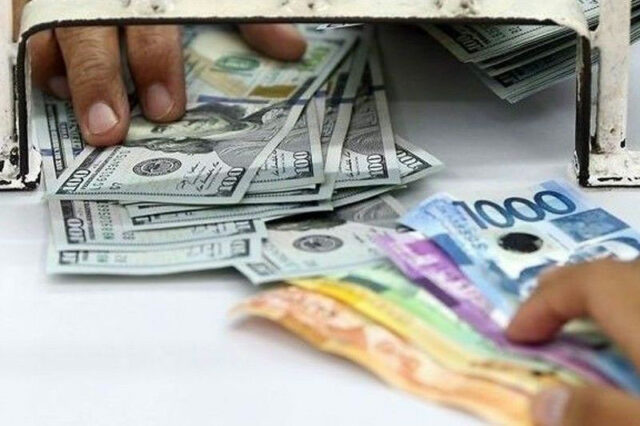
The peso has rebounded against the dollar in the fourth quarter last year, closing at P55.75 on Dec. 29, 2022, up by P3.25 or 5.8% from its record low of P59 a dollar on Oct. 17, 2022. 

“We also expect 2023 levels to improve year on year, albeit at a much slower pace on the back of a looming economic slowdown in the US and globally,” Mr. Roces said.   

The Philippines may see about $33 billion in remittance inflows in 2023, which Mr. Roces said is “slower because of headwinds, but growing nonetheless.” — K.B.Ta-asan

ADVERTISEMENT
ADVERTISEMENT