Home Blog Page 5317

NCR retail price growth in Dec. steady vs Nov., still highest since 2008

BW FILE PHOTO

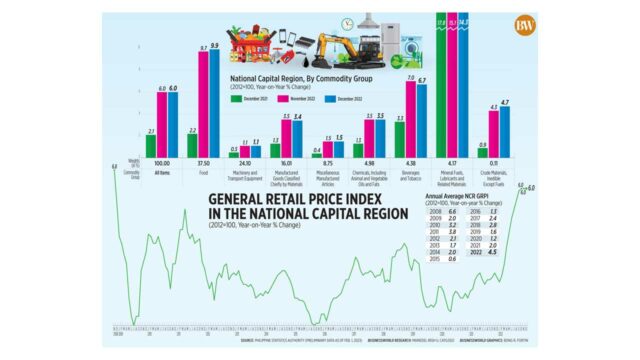
THE December price growth in retail goods in Metro Manila was 6%, unchanged from the two preceding months and still the highest reading in 14 years, led by the food segment, according to preliminary data from the Philippine Statistics Authority (PSA).

The PSA said on Wednesday that the general retail price index (GRPI) in the National Capital Region (NCR) was still significantly higher than the year-earlier level of 2.1%.

December marked the third consecutive month that retail inflation hit the 6% level. These months’ readings were the highest since the 6.8% posted in November 2008.

General Retail Price Index in the National Capital Region

This brought full-year retail inflation to an average of 4.5%, more than double the 2% pace in 2021. With 2012 prices as the base, 2022 retail inflation was the highest since the 6.6% recorded in 2008.

Union Bank of the Philippines, Inc. Chief Economist Ruben Carlo O. Asuncion said in an e-mail that GRPI data track the price movements seen in the December consumer price index (CPI).

“The rise of prices in general has contributed to changes in retail prices bought by end-consumers. In 2021, movements of the GRPI were characterized by either small rises or minuscule declines,” Mr. Asuncion said.

Headline inflation in December, which uses 2018 prices, also hit a 14-year high of 8.1% as food grew more costly. The December outcome was higher than the 8% logged in November and the 3.1% in December 2021.

Inflation averaged a 14-year high of 5.8% in 2022, in line with the Bangko Sentral ng Pilipinas (BSP) 2022 inflation forecast but breaching the bank’s 2% to 4% target range.

“Food inflation was the biggest source of movement for headline inflation, and it is not surprising that GRPI of food for NCR is also the highest,” Mr. Asuncion said.

The statistics agency said food price growth accelerated to 9.9% in December from 9.7% in November. Also posting higher growth was crude materials, inedible except fuels (4.7% from 4.3%).

Price growth eased in manufactured goods classified chiefly by materials (3.4% from 3.5%); beverages and tobacco (6.7% from 7.0%); and mineral fuels, lubricants and related materials (14.3% from 15.1%).

December retail price growth was unchanged month on month in machinery and transport equipment (1.1%); miscellaneous manufactured articles (1.5%); and chemicals, including animal and vegetable oils and fats (3.5%).

“As expected for headline inflation in 2023, we do expect the GRPI to also decline,” Mr. Asuncion said.

The BSP expects headline inflation to fall within the 2-4% target range by the second half of 2023. — Ana Olivia A. Tirona

Tax refund requirements: Are they ever enough?

Is the Bureau of Internal Revenue (BIR) inclined to approve refund claims? At a time where the government’s budget is dedicated to reviving the economy after the COVID-19 pandemic, granting tax refunds would put the agency in a pickle. However, rejecting such refund applications due to these considerations would be arbitrary on the part of the BIR.

The rules are clear. For tax refunds of unutilized excess creditable expanded withholding tax (CWT), three essential conditions must be met: (i) the timeliness of the refund application, (ii) the fact of withholding is established, and (iii) that the income upon which the taxes were withheld was included in the return of the recipient/claimant. To prove that these three conditions were satisfied, the refund application should be accompanied by complete documentary support for the BIR’s verification.

Since claims for refund are construed strictly against the taxpayer and in favor of the government, the documents supporting a CWT refund application are carefully scrutinized by the BIR. In Merck Sharp & Dohme (I.A.) LLC – Philippine Branch vs. Commissioner of Internal Revenue (CTA Case No. 9803, 25 June 2021), the BIR alleged that the instant claim for tax refund is tainted with procedural infirmity due to the taxpayer’s failure to submit complete documents in support of its administrative claim for refund. According to the BIR, taxpayers must prove compliance with both Revenue Memorandum Order (RMO) No. 53-98 and Revenue Regulations (RR) No. 2-2006 to support the validity of their claim for unutilized CWT.   

In relation to the aforementioned RMO and RR, the BIR particularly insisted that the submission of proof of actual remittance is indispensable in claims for refund or issuance of a tax credit certificate for unutilized excess CWT for purposes of proving the CWT withheld.

With the BIR holding firm on the requirements, what would count as sufficient evidence in proving tax refund claims?

RMO No. 53-98 prescribes the documents that a taxpayer is required to submit to the BIR upon audit of his tax liabilities, as well as the different mandatory audit reporting requirements to be prepared, submitted and attached to a tax audit docket by a Revenue Office. On the other hand, RR No. 2-06 prescribes the mandatory attachments of the Summary Alphalist of Withholding Agents of Income Payments Subjected to Tax Withheld as Source (SAWT) to tax returns with claimed tax credits due to CWT at source.

The Tax Court ruled that the non-submission of the documents enumerated in RMO No. 53-98 should not result in an outright denial of the tax refund claim. It is not fatal to the claim for refund since the RMO is merely a guide to revenue officers as to what documents they may require taxpayers to present during an audit. Nothing stated in the issuance would show that it was intended as a benchmark in determining the completeness of the submitted documents to support a taxpayer’s claim for tax refund.

What is more critical is that the taxpayer should be able to establish the fact of withholding through a copy of the withholding tax statement duly issued by the payor (withholding agent) to the payee, showing the amount paid and the amount of tax withheld therefrom.

The Tax Court cited the case of Commissioner of Internal Revenue vs. Philippine National Bank (G.R. No. 180290, 29 September 2014) where the Supreme Court clarified that the certificate of creditable tax withheld at source (BIR Form 2307) is the competent proof to establish the fact that taxes were withheld, and upon presentation of a withholding tax certificate complete in its relevant detail and with a written statement that it was made under the penalties of perjury, the burden of evidence shifts to the Commissioner of Internal Revenue to examine.

Further, contrary to the BIR’s claim that the proof of actual remittance should be submitted, the aforementioned Supreme Court case clarified that proof of actual remittance of the withholding tax is not a prerequisite to claim a refund of unutilized tax credits, since it is the payor-withholding agent, and not the payee-refund claimant who is vested with the responsibility of withholding and remitting income taxes.

Similar to this instant case, taxpayers are generally intent on presenting adequate proof of their claim for refund. However, if the BIR were to demand undue requirements, refund claims at the administrative level would naturally result in a denial. As taxpayers are keen to recover their losses, I hope that the BIR would conscientiously evaluate submitted documents for refund applications. At the end of the day, both the government and the taxpayer are on the same boat in seeking to revive the economy.

The views or opinions expressed in this article are solely those of the author and do not necessarily represent those of Isla Lipana & Co. The content is for general information purposes only, and should not be used as a substitute for specific advice.


Edelweiss Chua is an assistant manager at the Tax Services department of Isla Lipana & Co., the Philippine member firm of the PwC network.

edelweiss.chua@pwc.com

General Retail Price Index in the National Capital Region

THE December price growth in retail goods in Metro Manila was 6%, unchanged from the two preceding months and still the highest reading in 14 years, led by the food segment, according to preliminary data from the Philippine Statistics Authority (PSA). Read the full story.

General Retail Price Index in the National Capital Region

Philippines shares FIDE PWD Chess Olympiad lead in Serbia

FIDE Master Sander Severino outplayed Milan Orsag in 38 moves of a Queen’s Gambit Exchange Variation to power the Philippines to a 2.5-1.5 win over the Czech Republic. — FIDE

FIDE Master Sander Severino outplayed Milan Orsag in 38 moves of a Queen’s Gambit Exchange Variation to power the Philippines to a 2.5-1.5 win over the Czech Republic and a six-country share of the lead after two rounds of the 1st FIDE Chess Olympiad for People with Disabilities in Belgrade, Serbia on Tuesday.

Mr. Severino, a former world champion for the physically disabled, used his inventiveness in outmaneuvering his bedazzled foe and gaining a positional edge for the match-clinching victory on top board.

Henry Lopez, Darry Bernardo and Cheyzer Mendoza all drew their games from boards two to four to seal the duel and a place on top alongside tournament giants India, Israel, Poland, Serbia 2 and FIDE, a team comprising of chessers from different countries.

The day before, the Filipinos, skippered by playing coach James Infiesto, shocked Uzbekistan, 3.5-.5, on wins by Messrs. Severino, Lopez and Bernardo on boards one to three and split by Mr. Mendoza on board four.

It was a massive win for the country against a nation that shocked the world by topping the World Chess Olympiad in Chennai, India last year.

The Filipinos tackle the Serbian’s second team of Mile Bjelanovic, Stefan Mitrovic, Luka Bulatovic and Vladan Petrovic in the third round at press time of this six-round tournament that chose the top 26 teams in the globe via their average rating. — Joey Villar

PHL Strong Group braces for Arakji-led Dynamo of Lebanon

WITH a perfect 3-0 card in Group A, Strong Group has already booked a ticket in the quarterfinals regardless of its last assignment against Lebanon’s Dynamo with a similar slate. — UAE BASKETBALL ASSOCIATION

UNBEATEN Strong Group braces for a possible gigantic collision against powerhouse Lebanese squads, including Al Riyadi led by ace guard Wael Arakji, in the next stage of the 32nd Dubai International Basketball Championship.

With a perfect 3-0 card in Group A, Strong Group has already booked a ticket in the quarterfinals regardless of its last assignment against Lebanon’s Dynamo with a similar slate.

The Philippine representative and Dynamo were to clash for the group lead last night (11 p.m. Manila time), serving as the team’s primer for a steeper climb in the knockout rounds.

There, the squad owned by Frank and Jacob Lao, may cross paths with other but equally formidable Lebanese squads bannered by Al Riyadi, which has a bevy of Lebanon national team players in its fold.

Joining Mr. Arakji, who is the reigning Best Point Guard in Asia after anchoring Lebanon to a runner-up finish in the Asia Cup and into the FIBA World Cup this year, are Amir Saoud, Hayk Gyokchan and ex-NBA cager AJ Majok.

Mr. Arakji also served as a thorn for Gilas Pilipinas in the previous window of the 2023 FIBA World Cup Asian Qualifiers, making it an extra spicy match-up if ever for Strong Group that also features Philippine national team campaigners led by Kevin Quiambao, Jerom Lastimosa and Lebron Lopez.

Al Riyadi is currently in top spot of Group B with a 2-0 card followed by Club Africain of Tunisia (2-1), Sports Club Beirut of Lebanon (1-1) and Sale of Morocco (0-3), which may pose problems for Strong Group in the playoffs.

“All teams are very tough,” said coach Charles Tiu, whose wards are led by former NBA campaigners and PBA imports in Shabazz Muhammad and Renaldo Balkman.

Ex-NBA champion Nick Young is also in the fray for Strong Group but he is nursing a knee injury as Mr. Tiu is banking on the steady contributions of his locals led by Messrs. Quiambao, Lastimosa and Fil-American Sedrick Barefield.

Strong Group bested the United Arab Emirates (UAE) national team, 91-87, before drubbing Libya’s Al Nasr, 93-76, and Syria’s Al Wahda, 87-61. — John Bryan Ulanday

Battle of Grandmasters kicks off in Malolos City

RAFAEL REX FELISILDA-UNSPLASH

THE COUNTRY’S top Grandmasters (GMs), a group of young guns eyeing fame and glory and the two top-notch lady woodpushers spice up the Battle of the Grandmasters chess tournament that was unveiled on Wednesday at the Malolos City Auditorium.

GMs John Paul Gomez, Darwin Laylo and Joey Antonio will try to separate the men from the boys as they battle wits with teeners International Master (IM) Daniel Quizon (19 years old), IM Michael Concio, Jr. (18) and Mark Jay Bacojo (17) as well national women’s championship top two finishers WIM Marie Antoinette San Diego and WGM Janelle Mae Frayna.

Also seeing action in the nine-round tournament staking a total cash pot of P322,000 including P100,000 to the winner courtesy of Malolos City Mayor Christian Natividad are IMs Paulo Bersamina and Jan Emmanuel Garcia.

The top-seeded Mr. Gomez was battling Mr. Concio while the second-ranked Mr. Laylo was clashing Ms. Frayna at press time.

The other opening-round duels of this event backed by the Philippine Sports Commission, National Chess Federation of the Philippines and Philippine Olympic Committee pitted Mr. San Diego with Mr. Garcia, Mr. Bersamina with Mr. Antonio, and Mr. Quizon with Mr. Bacojo.

Mr. Laylo is hoping to add another crown jewel to his title conquests in 2004 and 2006.

Mr. Quizon, for his part, is hoping to successfully defend the title he won in the last staging two years ago in Lapu Lapu, Cebu as well as to earn rating points as he chases the GM title.

For Ms. San Diego and Ms. Frayna, they hope to become the first females to win the annual event. — Joey Villar

Chelsea FC complete record signing of Benfica’s Fernandez

ARGENTINAS’s Enzo Fernandez going against Mexico’s Hector Moreno (15). — TASNIM NEWS AGENCY/WIKI COMMONS

LONDON — Premier League side Chelsea completed the signing of Argentina midfielder Enzo Fernandez from Benfica for a British record £106.8 million ($131.46 million) on Wednesday after a day of complex negotiations between the clubs.

As the clock ticked down on deadline day it appeared a deal might not be reached but a statement from Benfica confirmed that it had been agreed shortly before 2300 GMT on Tuesday.

It said Chelsea would pay the contract release fee for the 22-year-old, who has signed an eight-and-a-half year deal with the London club. It takes Chelsea’s transfer spending in January alone to more than £300 million.

Chelsea were still to officially confirm the completion of the record-breaking deal but according to Sky Sports the paperwork had been submitted on time and before the deadline.

According to media reports, Chelsea will pay the fee in several installments.

“Sport Lisboa e Benfica — Futebol, SAD informs that it has reached an agreement with Chelsea FC for the sale of all the rights of the player Enzo Fernandez, for an amount of €121,000,000,” a Benfica statement read.

The fee eclipses the £100 million Manchester City paid Aston Villa for England midfielder Jack Grealish in 2021.

Mr. Fernandez was instrumental in Argentina’s World Cup-winning campaign in Qatar, breaking into the starting lineup and playing every game, scoring one of the goals in a vital victory over Mexico in the group phase.

He capped off the tournament by bagging the Young Player Award.

Mr. Fernandez joined Benfica from Argentine side River Plate in July 2022 and has scored four goals in 29 appearances.

Benfica boss Roger Schmidt was not keen on seeing Mr. Fernandez leave but had said their hands would be tied if a club paid the player’s release clause.

Mr. Fernandez is Chelsea’s eighth recruit in the mid-season transfer window after the London club signed Mykhailo Mudryk, Benoit Badiashile, Noni Madueke, Andrey Santos, David Fofana and Malo Gusto while Joao Felix arrived on loan from Atletico Madrid. All of them are 23 or younger.

On Tuesday, Chelsea sold experienced midfielder Jorginho to Premier League leaders Arsenal for £12 million.

Mr. Fernandez’s transfer takesChelsea’s total outlay on players since last May’s takeover by an investment group led by American Todd Boehly and Clearlake Capital to around £600 million as they try to rebuild their squad.

Chelsea are 10th in the Premier League, 10 points adrift of a top four spot. They next host local rivals Fulham on Friday. — Reuters

Ukraine on mission to ban Russia from 2024 Paris Games

KYIV — Ukraine hopes to secure widespread international support for banning Russian and Belarusian athletes from the Paris Olympics due to Moscow’s invasion, the sports minister said on Tuesday.

The International Olympic Committee (IOC) is open to including Russian and Belarusian athletes as neutrals at the 2024 Games and has opened a door to them competing in qualifiers.

“This is unacceptable for us,” Sports Minister and former Olympic champion Vadym Huttsait told Reuters at his offices in Kyiv, beside a wall with portraits of athletes killed in the war launched by Moscow a year ago with assistance from Belarus.

“It is impossible for us at a time when the full-scale war is going on, when our athletes, our soldiers are defending our homeland, our land, defending their homes, their families, their parents.”

The 51-year-old won an Olympic fencing team gold in 1992, was junior sabre champion in the old Soviet Union four years before that, and coached Ukraine’s winning team at the 2008 Games.

At least 220 Ukrainian athletes and coaches have died in the war, Mr. Huttsait said, with over 340 sports facilities damaged or ruined.

“Ukraine will unite with many countries in Europe and the world … and it (Russians competing) will not be allowed,” he added, saying 40 nations had given Ukrainian athletes housing and training assistance abroad during the war.

However, there has been little public support yet from other nations for an outright ban on Russians at Paris.

Moscow says its “special military operation” in Ukraine is to protect its own security, denies accusations of atrocities, and says any push to squeeze it out of global sport will fail.

‘LIVES MORE IMPORTANT THAN MEDALS’
The IOC’s previous recommendation to ban Russians and Belarusians has been applied by many sports federations.

But last week, it backed a proposal by the Olympic Council of Asia to allow them to compete in Asia, which could potentially include Olympic qualifying events.

Should that happen, Ukraine’s sporting authorities and athletes will face a “very difficult decision” whether to boycott Paris, Mr. Huttsait said.

“When we lose so many people, so many athletes, the lives of Ukrainians are more important to us than any medal at international competitions,” he said.

Ukrainian officials have turned on the IOC in recent days for promoting “violence, mass murders, destruction” with the idea of giving Russia a “platform to promote genocide.”

The IOC has called that defamatory and said such words do not promote constructive discussion.

On Tuesday, ex-boxing champion Vladimir Klitschko, brother of Kyiv’s mayor, called on IOC head Thomas Bach not to betray the Olympic spirit and become an “accomplice in this abominable war” by letting Russia compete.

Moscow is trying to turn the page on years of doping scandals after its teams were forced to compete without their flag or anthem at the Olympics and major international events. — Reuters

Geopolitical challenges loom for WTA after Sabalenka’s Aussie win

MELBOURNE — Aryna Sabalenka’s long-awaited confirmation as a Grand Slam champion and a corker of an Australian Open final were a welcome balm for the WTA as the women’s tour seeks to move on from a bruising loss of star power.

Challenges lie ahead, however, as the circuit negotiates a tricky geopolitical landscape and a scheduling impasse with the lucrative Chinese market.

After years of struggling with nerves on the biggest stage, 24-year-old Ms. Sabalenka’s three-set win over Wimbledon champion Elena Rybakina in the final at Melbourne Park gave the big-hitting Belarusian her first Grand Slam title.

Now world number two and boasting one of the most powerful games in women’s tennis, she looms as a major threat to top-ranked Pole Iga Swiatek, who she beat at the WTA Finals.

The development of a proper rivalry between the pair would be a tonic for the WTA which has produced few of note in recent years and recently lost Serena Williams, a player that transcended the sport, to retirement.

Ms. Sabalenka’s hopes of shaking up the women’s game may be taken out of her hands at Wimbledon, however, if Russian and Belarusian players remain banned from the grasscourt Grand Slam.

Ms. Sabalenka, along with all Russian and Belarusian players, missed Wimbledon last year after organizers controversially excluded them as a consequence of Russia’s invasion of Ukraine, which Moscow calls a “special operation”.

With the conflict in Ukraine showing no sign of ending, a decision about Russian and Belarusian players competing at the All England Club is pressing.

The ban had other consequences that are still being felt today, with players who competed at Wimbledon unable to earn ranking points from the tournament after it was sanctioned by both the WTA and the men’s ATP tour.

The loss of points was a setback for some players, not least champion Ms. Rybakina, who would have had a much higher seeding than 22 at the Australian Open.

The 23-year-old had to knock out Ms. Swiatek and two other Grand Slam champions in a tough draw at Melbourne Park to reach the final.

Her ranking has now jumped 15 places to 10th as a result of that run, which should help the Russia-born Kazakh’s bid for a second Grand Slam title to add to her Wimbledon trophy.

The Australian Open provided another reminder of the strength of Chinese women’s tennis as Zhang Shuai and Zhu Lin reached the last 16 of the women’s singles.

The Chinese men’s game, long overshadowed by the success of the country’s women, also showed promise as teenager Shang Juncheng became the first Chinese man to win a main draw match at the Australian Open in the professional era.

China’s abandonment of its zero-COVID policy is expected to pave the way for the return of international tennis after a three-year hiatus, and the ATP has three events in the country listed in its 2023 calendar.

The WTA’s schedule remains blank after the US Open, however, with no clarity on tournaments to be held in China pending a resolution to the Peng Shuai issue.

Former world number one doubles player Ms. Peng accused a senior Chinese government official of sexual assault in 2021 in a post on social media that was soon removed from the country’s internet.

She later denied having made the accusation.

The WTA has called for a formal investigation into Ms. Peng’s allegations and wants to meet with her privately to discuss her situation, a spokesperson told Reuters this month.

With China having hosted nine WTA events in 2019, including the season-ending WTA Finals in Shenzhen, the women’s circuit has suffered without the Asian powerhouse’s participation in recent years and has plenty more to lose if the stand-off continues. — Reuters

Junior Altas squeak past Arellano Braves in NCAA juniors basketball

THE PERPETUAL Junior Altas kicked off their campaign in the NCAA Juniors Basketball tournament notching their first win against the Arellano University Braves Wednesday afternoon.

In a hotly contested game at the Emilio Aguinaldo College Gymnasium in Paco, Manila, the Junior Altas hung on in the final seconds of the game to eke out a 71-69 win.

Lebron Daep led the team with 18 points, eight rebounds, four blocks and one steal. Amiel Acido also shone, pitching in a double-digit game with 14 points, 13 rebounds and six assists.

The Junior Altas dominated the first three quarters. But facing down a fourth quarter Braves push, the Junior Altas kept the Braves at bay showing poise and character to secure the victory.

The Perpetual Junior Altas will face the College of San Benildo Junior Blazers next on Friday, Feb. 3.

The NCAA juniors basketball tournament is returning this season after a three-year hiatus due to the pandemic.

Pakistan moves toward deal-or-default endgame

STOCK PHOTO | Image by Uzairmaqbool from Pixabay

ISLAMABAD/LONDON — Pakistan’s full-blown economic turmoil, from its biggest ever currency devaluation to a rash of emergency spending cuts, offers the clearest sign yet that the nuclear-armed nation faces the risk of a default unless it receives massive support.

Pushed to the brink by last year’s devastating floods, the South Asian nation has reserves of just $3.7 billion remaining, or barely enough for three weeks of essential imports, while hotly contested elections are due by November.

It desperately needs the International Monetary Fund (IMF) to release an overdue tranche of $1.1 billion, leaving $1.4 billion remaining in a stalled bailout program set to end in June.

Although an emergency IMF mission has arrived in Pakistan, there are no guarantees amid a growing number of headaches after November’s suspension of disbursements from the current package, which was topped up to $7 billion after the floods.

A devaluation of 15% in the Pakistani rupee and a rise last week in fuel prices could help eliminate some key snags, particularly as tax measures are apparently imminent.

Yet pressure is building as the bailout program cannot be extended beyond June and the elections loom.

“If they don’t get those (IMF) funds, default risk increases materially,” said Kathryn Exum, the co-head of sovereign research at distressed debt specialist fund Gramercy, which expects more of a debt “reprofiling” rather than mass write-off.

Pakistan’s former finance minister, Miftah Ismail, who successfully negotiated an extension to last year’s program before being sacked in the political tumult, also thinks the IMF is the only logical option.

“If the IMF doesn’t come in, we’re looking at a default,” Ismail said, adding that another support package, the country’s 24th, would then be needed. “I can’t imagine Pakistan not going on a back-to-back IMF program.”

Prime Minister Shehbaz Sharif’s main election challenger is former cricket star Imran Khan, who was removed from the job last April but retains popularity. Each blames the other for the crisis, although finances have long been strained.

With Pakistan’s debt-to-GDP ratio in a danger zone of 70%, and between 40% and 50% of government revenues earmarked for interest payments this year, only default-stricken Sri Lanka, Ghana, and Nigeria are worse off.

“There is just a long-term indebtedness problem,” said Jeff Grills, the head of emerging markets debt at Aegon Asset Management, who held Pakistan bonds until the floods hit.

“It is more a question of when they need to restructure, rather than if.”

Most of Pakistan’s bonds are still trading at less than half their face value.

DIFFICULT TIMES
Such a restructuring of Pakistan’s bonds would represent its first international default since 1999, according to the Bank of Canada-Bank of England Sovereign Default Database.

With just $8.6 billion worth of such bonds, compared to the $30 billion Pakistan owes to China, Ismail said Islamabad might be better off “just going to those countries that we owe a lot, or to the institutions we owe a lot, and trying and get some more long-term loans.”

Mr. Sharif is optimistic that the IMF will resume disbursements. “An agreement with the IMF, God willing, will be done,” he said at an event last week in Islamabad, the capital. “We will soon be out of difficult times.”

Multilateral and bilateral financing pledges for Pakistan’s rebuilding efforts after the floods also depend on a green light from the IMF.

But even domestic analysts believe the government will find matters tough, as the IMF is likely to demand significant belt-tightening that is bound to be unpopular with voters already grappling with decades-high inflation and fewer job prospects.

IMF officials have been eager to support poorer countries and Pakistan promises to be a crucial partner for the West, but paying out gets trickier when a program is close to its end and a new government could come in and try and tear up a deal.

If the disbursements do not arrive by June, there could be a six-month gap before the new government takes office during which Pakistan would be starved of funds, effectively pushing its population of 220 million to the brink.

The lack of reserves will make it too tough to stay afloat.

Just $500 million of interest or ‘coupon’ payments are due on Pakistan’s international bonds this year, but the chief of the central bank chief has said $3 billion is needed to meet overall external debt payments.

The political timing is also critical. After the government’s tenure ends in August, a special caretaker government will take charge for up to 90 days to ensure free and fair elections.

However, the caretaker government is not empowered to sign an IMF pact, raising the question of whether the government and opposition can cooperate on a joint pledge to push through any IMF demands in order to avert a default.

“If something happens with the disbursement and then the elections get in the way, they might have a problem,” Gramercy’s Ms. Exum added. — Reuters

France protests raise pressure against Macron’s pension reform

A MAN rides a bicycle along a bike path on the Pont de Bir-Hakeim bridge near the Eiffel Tower in Paris, France, Jan. 19, 2023. — REUTERS

PARIS — Huge crowds marched across France on Tuesday to say “non” to President Emmanuel Macron’s plan to make people work longer before retirement, with pressure in the streets intensifying against a government that says it will stand its ground.

Opinion polls show a substantial majority of the French oppose increasing the retirement age to 64 from 62, a move Mr. Macron says is “vital” to ensuring the viability of the pension system.

The French Interior ministry said that a total of 1.272 million people took part in the protests nationwide, up slightly from the first nationwide demonstration on Jan. 19. In Paris, a total of 87,000 people marched, compared to 80,000 on Jan. 19, it added.

“It’s better than on the 19th. … It’s a real message sent to the government, saying we don’t want the 64 years,” Laurent Berger, who leads CFDT, France’s largest union, said ahead of the Paris march.

Union leaders at a joint news conference at the end of the march said they would organize more strikes and demonstrations against the reform on Feb. 7 and 11.

Marching behind banners reading “No to the reform” or “We won’t give up,” many said they would take to the streets as often as needed for the government to back down.

“For the president, it’s easy. He sits in a chair … he can work until he’s 70, even,” bus driver Isabelle Texier said at a protest in Saint-Nazaire on the Atlantic coast. “We can’t ask roof layers to work until 64, it’s not possible.”

Striking workers disrupted French refinery deliveries, public transport and schools, even if, in several sectors, fewer walked off the job on Tuesday than on the 19th as a cost-of-living crisis makes it harder to skip a day’s pay.

MORE STRIKES?
For unions, the challenge will be maintaining walkouts at a time when high inflation is eroding salaries.

A union source said some 36.5% of SNCF rail operator workers were on strike by midday — down nearly 10% from Jan. 19 — even if disruption to train traffic was largely similar.

On the rail networks, only one in three high-speed TGV trains were operating and even fewer local and regional trains. Services on the Paris metro were thrown into disarray.

Utility group EDF said 40.3% of workers were on strike, down from 44.5%. The education ministry also said fewer teachers walked off their job.

Unions and companies at times disagreed on whether this strike was more or less successful than the previous one. For TotalEnergies, fewer workers at its refineries had downed tools, but the CGT said there were more.

In any case, French power supply was down by about 5% or 3.3 gigawatts (GW) as workers at nuclear reactors and thermal plants joined the strike, EDF data showed.

And TotalEnergies said deliveries of petroleum products from its French sites had been halted, but customers’ needs were met.

‘BRUTAL’
The government has said that pushing the retirement age to 64 is “non-negotiable.”

And with the reform posing a test of Mr. Macron’s ability to push through change now that he has lost his working majority in parliament, some felt resigned amid bargaining with conservative opponents who are quite open to pension reform.

“There’s no point in going on strike. This bill will be adopted in any case,” said 34-year-old Matthieu Jacquot, who works in the luxury sector.

The pension system reform would yield an additional 17.7 billion euros ($19.18 billion) in annual pension contributions, according to Labor Ministry estimates. Unions say there are other ways to raise revenue, such as taxing the super-rich or asking employers or well-off pensioners to contribute more.

“This reform is unfair and brutal,” said Luc Farre, the secretary general of the civil servants’ UNSA union.  Reuters

ADVERTISEMENT
ADVERTISEMENT