Home Blog Page 5291

Italy gets cold feet over EU greener buildings plan

A general view of UniCredit Tower and the Bosco Verticale residential tower in Milan, Italy, March 8, 2020. — REUTERS

ROME — Italy is pushing back against a major European Union (EU) directive aimed at improving the energy efficiency of buildings, seeking to delay and offer exemptions to renovations it says neither the government nor homeowners can afford.

The EU directive is aimed at slashing greenhouse gas emissions and creating a building sector that is climate neutral by the middle of the century. EU countries and the European Parliament are set to negotiate binding legislation this year.

In one of its first acts after taking power last October, Italy’s right-wing government gave its blessing to the endeavor, but it got cold feet after realizing that the cost of compliance could be enormous in a country which has older and less energy-inefficient housing than many of its neighbors.

“Europe would like to impose on us a directive on energy efficiency that would be a disaster for our housing stock,” former Prime Minister Silvio Berlusconi, head of the co-ruling Forza Italia party, said on Monday.

The European Commission, which drafts EU laws, has proposed that the worst 15% of residential buildings in each country be improved by 2030 and again by 2033. Non-residential buildings face a similar timetable.

Italy’s national building association ANCE estimates that to meet these goals, some 1.8 million residential buildings will have to be upgraded over the next 10 years at a cost of €400 billion ($435 billion). A further €190 billion will be needed to bring business properties to the required standards, it has forecast.

Italian government officials want deadlines pushed back and have indicated Italy will offer exemptions to a broad swathe of its older homes.

“We will take the necessary steps to ensure that the final text of the directive contains provisions that are compatible with the peculiarities of the Italian building heritage and that allow for gradual redevelopment,” European Affairs Minister Raffaele Fitto told parliament last month.

LOW-GRADE HOUSING
Environmental activists say the sudden opposition from Rome to a long-standing project risk undermining an initiative that is crucial if the 27-nation bloc is to meet its goal of becoming the first climate-neutral continent by 2050.

The European Commission estimates that the bloc’s buildings account for 40% of the EU’s energy consumption and 36% of its CO2 emissions, making the sector crucial in the fight against climate change.

However, some 74% of Italians own the house or flat they live in, against 65% in France and 50% in Germany. This leaves Italians particularly exposed and its ageing housing adds to the problem, experts say.

“Italy’s building stock is more obsolete. In fact, 60% of buildings here are in the two worst energy classes, against, for example, 17% in France and 6% in Germany,” said Federica Brancaccio, head of ANCE, referring to Energy Performance Certificate (EPC) gradings.

Despite the high costs, the Buildings Performance Institute Europe (BPIE), an independent think-tank based in Brussels, said Italy had much to gain from the EU plan given the surge in energy prices following Russia’s invasion of Ukraine.

“If Italy just insulated the roofs and walls in its least efficient buildings, it would save 49% of its gas consumption,” said Mariangiola Fabbri, head of research. “I can only see good reasons to embrace this vision.”

WHO WILL PAY?
Critics say the pushback against the directive shows Prime Minister Giorgia Meloni’s administration is less committed to tackling climate change than its predecessor.

“The government wants to stay with the status quo when it comes to climate and energy,” said Eva Brardinelli, a buildings policy coordinator at the Climate Action Network in Brussels.

“I understand in a period of crisis people like staying with the status quo, but that doesn’t work when our activities are endangering our planet.”

Ms. Meloni has promised that Italy will play its part in fighting global warming, but has said that this effort should not harm the economy or be done by the state alone.

Under a deal struck with the EU by the previous government, Rome will use €15.3 billion from a post-COVID EU recovery fund to improve the energy efficiency of buildings.

This is just a fraction of what is needed.

Italy had been in the vanguard of efforts to green its buildings, offering homeowners since 2020 tax rebates worth 110% of the cost of the building work — a popular measure that turbocharged the number of renovations to around 360,000 in 2021-2022 from just 2,900 a year between 2018 and 2020.

But the so-called superbonus cost the Treasury more than €60 billion. The new government, anxious to spend what limited resources are available on policies closer to its own heart, such as tax cuts, has reduced the rebate to 90% and has drastically restricted the number of people who can apply.

Ministers say that in future the EU will have to help pay for subsidies.

The BPIE think-tank says eventually a broad mix of financing will have to be tapped if the EU wants to achieve its ambitious targets in Italy and beyond.

“I could not imagine a situation where private owners have to pay for all the renovations out of their own pockets. That would represent a failure of the project,” said Ms. Fabbri. — Reuters


AirAsia Philippines set to resume flights to China

NEWSROOM.AIRASIA.COM

AIRASIA Philippines is set to operate flights to three cities in China between February and March amid the foreign country’s partial reopening to leisure travelers.

In a press release, the carrier said that it will be operating weekly flights to Guangzhou, Shenzhen, and the special administrative region of Macao.

“The final piece of the puzzle that will complete the recovery process of the aviation industry is here. Now that China is opening its borders to the world, a new era of tourism, trade and commerce is set to emerge,” AirAsia Chief Executive Officer Ricardo P. Isla said.

Before the pandemic, the low-cost carrier flew over 750,000 guests to and from China, according to Mr. Isla.

AirAsia will operate three-times-a-week flights to Guangzhou starting Feb. 15, every Monday, Wednesday, and Saturday.

Meanwhile, the carrier will be flying four times weekly to Shenzhen every Tuesday, Thursday, Friday, and Sunday beginning March 2.

For Macao, AirAsia will be returning with its thrice-weekly flights every Tuesday, Thursday, and Saturday on March 2.

AirAsia also announced a “Buy 1, Take 1” promo which will go as low as P158 one-way base fare for domestic flights, and P828 one-way base fare for international travel until Sept. 30.

The promo will apply to AirAsia members and will run from Feb. 6 to 12 from Manila, Cebu, and Clark airports.

AirAsia is one of the top low-cost airlines in the Philippines. It flies a total of 15 domestic destinations and 15 international destinations as of April last year.

It offers all its flight and ancillary products on its integrated platform airasia Super App, in which guests can book flights and hotels, deliveries, cabs, and do online shopping. — Justine Irish D. Tabile

IC eyes talks on planned hike in catastrophe risk premiums

BW FILE PHOTO

THE Insurance Commission (IC) will hold discussions with stakeholders on the proposed increase in catastrophe risk premiums for a more “inclusive” approach after the delay in its implementation.

“The newer Circular Letter was issued to allow the conduct of necessary consultations with other interested stakeholders, thereby allowing for a more inclusive approach on the issue,” the IC said in an e-mail to BusinessWorld last month.

In Circular Letter 2022-54 issued in December, the IC halted its planned hike in risk catastrophe premiums that was initially set to take effect on Nov. 1.

The premium increase would have included all insurance policies covering earthquake and typhoon and flood risks for both new and renewal businesses.

“The adjustment to these higher rates was viewed as necessary for the more frequent and severe catastrophe perils experienced by identified zones in recent years,” the IC said.

Insurance Commissioner Dennis B. Funa earlier said that the implementation would depend on whether questions from Congress are sufficiently addressed. AGRI Party-list Rep. Wilbert T. Lee previously said the hike in premiums could lead to inflationary pressures.

The IC said the current premium rates are too low as they were last set in 2006.

“Because of these low rates, non-life insurers are effectively penalized for writing catastrophe risks by making them operate at a loss to write such risks. However, nonlife insurers continue to charge the low, unadjusted rates simply to retain their respective market shares,” the regulator said.

It said feedback from the industry showed foreign reinsurers are finding it less attractive to reinsure local catastrophe risks due to the low rates.

The rate adjustments were also aimed at achieving affordability and marketability in risk zones, ensuring the success of the catastrophe insurance business and its responsiveness to large loss events that may happen in the future, the IC said.

The adjustments were based on historical data on catastrophe losses and applied cross-subsidization in certain risk zones.

“​​The adjustment of the rates was originally aimed to arrive at a more sustainable and technically viable rate structure that will align the amount of premiums charged with the catastrophe risks undertaken by nonlife insurers,” the regulator added.

It said earthquake risk rates for some zones have either remained the same or decreased by 53% from the original minimum rate of 0.10% in the initial phase of the implementation.

Earthquake premium rates that were supposed to be implemented in 2025 in certain risk zones could still be lower than the current rates, it added.

However, some zones could see an increase of as much as 100% for typhoon and flood risks. — Aaron Michael C. Sy

EntertainmentNews (02/07/23)


GMA Regional TV launches morning news programs

GMA Network’s GMA Regional TV (RTV) is launching its morning news shows on Feb. 6, 8 a.m. Covering North Central Luzon is Mornings with GMA Regional TV, anchored by regional news producer Joanne Ponsoy with presenter Harold Reyes. GMA Regional TV Live!, anchored by GMA Regional TV Balitang Bisdak regional correspondent Nikko Sereno and veteran news presenter Cecille Quibod-Castro, will deliver the news for Central and Eastern Visayas. Meanwhile, the unified Hiligaynon TV morning program, GMA Regional TV Early Edition, delivers the latest news for Western Visayas. Viewers in Mindanao can catch At Home with GMA Regional TV, anchored by Davao-based regional correspondent Jandi Esteban, Cagayan de Oro-based regional news producer Cyril Chaves, Zamboanga-based regional news producer Krissa Dapitan, and General Santos-based regional news producer Abbey Caballero. “We start 2023 with the launch of GMA Regional TV morning news programs as we remain steadfast in our mission to enriching the lives of Filipinos everywhere with the responsible delivery of news and information in various communities across the Philippines, solidifying GMA Integrated News as the ‘News Authority of the Filipino,’” said Oliver Victor Amoroso, First Vice-President and Head of GMA Regional TV and Synergy, and Acting Head of GMA Integrated News in a statement.


The CompanY has new album, holds Valentine’s show

SINGING group The CompanY — composed of Annie Quintos, Moy Ortiz, OJ Mariano, and Sweet Plantado —  has announced that it will release an album, and will hold a Valentine’s Day concert. “It’s no secret that most Filipinos are natural singers. It’s because of this that we decided to release the minus one/backing tracks of half of the Gitna album so that it gives our audience a chance to sing lead vocals on these beautiful OPM songs,” Mr. Ortiz said in a statement. The group’s 29th studio album, released under Star Music, consists of 10 original and reimagined tracks. The album’s CD version also features a bonus track. “Our campy/novelty disco song, ‘Disco Plantito, Disco Plantita,’ has a new remix entitled ‘Discoteca Pandemica,’ a remix that harks back to the flamboyant days of disco,” Mr. Ortiz added. “So, the minus ones and the bonus remix make the Gitna CD album a very special collectible for OPM lovers and audiophiles alike.” The CompanY will also hold the Open Hearted Valentine’s concert at the Music Museum on Feb. 14. The group will perform tracks from Gitna as well as other audience favorites. They will be joined by guests Davey Langit and Nica Del Rosario. Tickets are available via ticketworld.com.ph and through The Music Museum at 0917-513-0909 and (02) 8721-6726. Ticket prices range from P1,000 to P3,000. For more details, follow Star Music on Facebook, Twitter, Instagram, Tiktok, and YouTube.


Globe promo offers Blackpink concert tickets

K-POP fans are looking forward to the upcoming Blackpink World Tour: Born Pink concerts on March 25 and 26 at the Philippine Arena in Bulacan. For those who have yet to purchase concert tickets, Globe is giving away VIP with Soundcheck event tickets, among others, through various promos until Feb. 15. Fans can acquire the concert tickets in five ways: subscribe to GO+400 via the GlobeOne app (for Globe Prepaid customers); apply to or renew their ONEPlan 1799 or 1999 (for Globe Postpaid customers); apply for Globe Platinum ONEPlan or GPlan Plus (for Globe Platinum customers); subscribe to FamSURF999 via the GlobeOne app (for Globe At Home Prepaid WiFi customers); or apply for GFiber Plan 1699 (for Globe At Home Postpaid customers). This is open to all Globe Prepaid, Postpaid, Platinum, Home Prepaid Wifi, and Globe At Home Postpaid subscribers nationwide. For more information, visit http://glbe.co/BORNPINK.


Polymerase releases new album

FILIPINO rock band Polymerase — composed of Vincent Jose on vocals and guitars, Bobby Legaspi on bass, and Eugene Castro on drums — released their new album, Dreams & Realities I, on Feb. 3 via Electric Talon Records, Sliptrick Records, and Prince of the Arrow Records. Dreams & Realities I is the first part of a double release. The eight-track album features tracks with lyrics, while part II will feature instrumental versions of the songs. Dreams & Realities I is available in digital format on Electric Talon Records. The band released its first extended play, Unostentatious, on March 2021 in the audio platform Bandcamp. They were able to release a music video for their single, A Night With A Succubus, and collaborated with metal producer Misstigq from Australia.


Klingande and Vargen collaborate on track

KLINGANDE kicks off 2023 with “Kids On The Run,” a nostalgic house anthem that sees the multi-platinum French DJ and producer collaborating with rising producer Vargen. The song draws from 1970s rock music as well as upbeat, catchy EDM. Vargen, Swedish for “wolf,” is the first act to sign on KIDDO’s (Tiesto, Wiz Khalifa, Alan Walker, Robin Schulz to name a few) newly formed record label Tolv Records. Klingande, French producer and tropical house champion, has been breathing new life into the electronic music world with his productions and uplifting sound for nearly half a decade.


Channing Tatum returns in Magic Mike’s Last Dance

CHANNING Tatum reprises his iconic role as stripper Mike Lane in Warner Bros. Pictures’ new musical comedy Magic Mike’s Last Dance. In the film, “Magic” Mike Lane (Tatum) takes to the stage again after a lengthy hiatus, following a business deal that went bust, leaving him broke and taking bartender gigs in Florida. For what he hopes will be one last hurrah, Mike heads to London with wealthy socialite Maxandra Mendoza (Salma Hayek Pinault) who lures him with an offer he can’t refuse… and an agenda all her own. A Warner Bros. Pictures Presentation, Magic Mike’s Last Dance will show in Philippine theaters beginning Feb. 8.

Japanese artist turns heads with freaky flesh-like accessories

Masataka Shishido —INSTAGRAM.COM/DOOOO_CDS/

A JAPANESE DJ has found a new calling making freaky flesh-like accessories such as severed finger ink stamps, pendants with blinking eyes, and purses with gaping mouths and stubble, inspired by horror movie special effects.

After his first artwork in 2017 was pictured on the cover of his debut album — a music mixer wrapped in a silicon flesh coating — Masataka Shishido, also known as DJ Doooo, has been commissioned to make dozens of other offbeat creations.

“In the beginning almost everyone felt it was gross,” Mr. Shishido, 36, told Reuters, wearing a disco ball with a blinking eye on a chain around his neck.

“Once people learnt that it’s an artwork with some specific function, they started saying that it’s cute and interesting.”

Mr. Shishido says his art is often made-to-order by customers who request their own body parts on the items. He draws the designs by hand before a Tokyo studio called Amazing Studio JUR takes up to two months to turn the concept into reality.

The bespoke items do not come cheap: USB devices and the ink stamps in the shape of fingers cost around ¥150,000 ($1,166), while the disco ball he wears costs about ¥580,000 ($4,500).

His art has caught the attention of celebrities, Mr. Shishido said. American rapper Lil Yachty posted a video of himself clutching one of his blinking balls on social media in 2021.

Out on the streets of Tokyo, his creations also turn heads.

“It’s like so realistic that it definitely takes you by surprise,” said Laura Teale, 22, an Australian tourist who stopped to ask Masataka about the artwork hanging from his neck near the capital’s bustling Shibuya Crossing.

“I feel it’s too real. I feel a little bit gross, but it’s really cool,” she said. — Reuters

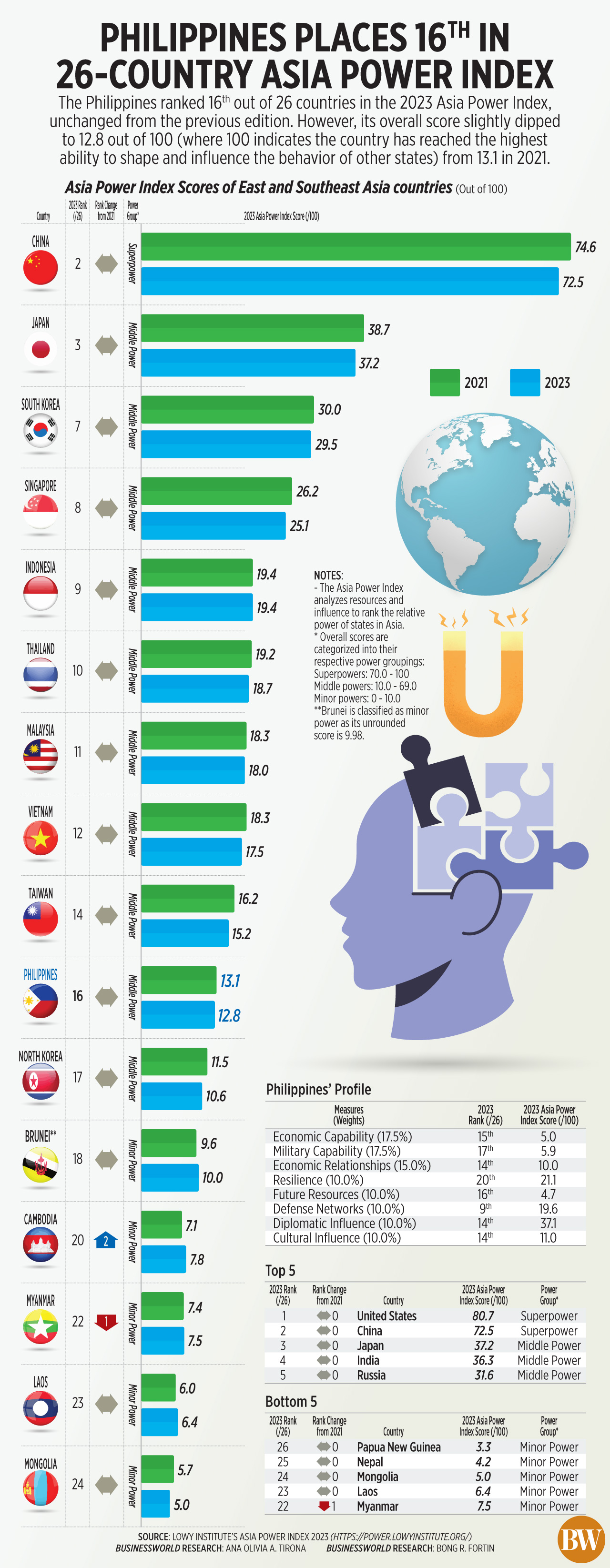
Philippines places 16th in 26-country Asia Power Index

The Philippines ranked 16th out of 26 countries in the 2023 Asia Power Index, unchanged from the previous edition. However, its overall score slightly dipped to 12.8 out of 100 (where 100 indicates the country has reached the highest ability to shape and influence the behavior of other states) from 13.1 in 2021.

Philippines places 16th in 26-country Asia Power Index

How PSEi member stocks performed — February 6, 2023

Here’s a quick glance at how PSEi stocks fared on Monday, February 6, 2023.


Stocks decline on profit-taking before key data

BW FILE PHOTO

PHILIPPINE STOCKS dropped on Monday, with the benchmark index settling below 7,000 on profit-taking as investors await the release of key economic data at home and in the United States.

The bellwether Philippine Stock Exchange index (PSEi) went down by 90.77 points or 1.29% to close at 6,936.61 on Monday, while the broader all shares index dropped by 30.78 points or 0.83% to end at 3,674.68.

“Philippine stocks were sold ahead of the January inflation print tomorrow, and investors kept cash with many awaiting the latest economic updates globally,” Regina Capital Development Corp. Head of Sales Luis A. Limlingan said in a Viber message on Monday.

A BusinessWorld poll of 15 economists conducted last week yielded a median estimate of 7.6% for January headline inflation, close to the lower end of the 7.5% to 8.3% forecast given by the Bangko Sentral ng Pilipinas.

If realized, this will be slower than the 14-year high of 8.1% in December 2022 but faster than the 3% print seen in January 2022 and the central bank’s 2-4% target.

Aside from the inflation report, employment and foreign direct investments data will also be released this week, he said.

Investors are waiting for US data on trade, mortgage and consumer sentiment.

“The local stock market gauge corrected lower for the second day in three days, considered healthy profit taking, after the dollar-peso exchange rate corrected…,” Rizal Commercial Banking Corp. (RCBC) Chief Economist Michael L. Ricafort said in a Viber message.

On Monday, the peso closed at P54.39 versus the greenback, declining by 71 centavos from Friday’s P53.68 finish, data from the Bankers Association of the Philippines showed.

Mr. Ricafort said the market also priced in the government’s offer of retail Treasury bonds that starts on Tuesday, as it “could siphon off some of the excess liquidity from the financial markets and from other alternative investments.”

All sectoral indices closed lower on Monday. Services went down by 23.58 points or 1.33% to 1,747.51; financials lost 22.49 points or 1.21% to end at 1,827.91; property retreated by 36.88 points or 1.2% to 3,020.59; holding firms declined by 70.39 points or 1.03% to 6,703.81; industrial dropped by 78.98 points or 0.78% to 9,932.95; and mining and oil slid by 36.50 points or 0.33% to 10,992.54.

Value turnover dropped to P9.95 billion on Monday with 1.24 billion shares changing hands from the P20.12 billion with 1.89 billion issues traded on Friday.

Decliners outnumbered advancers, 103 versus 79, while 51 names closed unchanged.

Net foreign selling stood at P1.45 billion on Monday, a reversal from the P351.51 million in net buying seen the previous trading day.

Mr. Ricafort placed the PSEi’s immediate major support at 6,650-6,750 and immediate resistance at 7,000-7,100, while Mr. Limlingan put immediate support at 6,800 and resistance at 7,050. — J.I.D. Tabile

Peso down vs dollar on strong job data

BW FILE PHOTO

THE PESO slumped against the dollar on Monday following the release of stronger-than-expected US labor data.

The local currency closed at P54.39 versus the greenback on Monday, declining by 71 centavos from Friday’s P53.68 finish, data from the Bankers Association of the Philippines showed.

The peso opened Monday’s trading session at P54.15 per dollar. Its weakest showing was at P54.47, while its intraday best was at P54.12 against the greenback.

Dollars traded went down to $1.053 billion from $1.165 billion on Friday.

“The peso depreciated following the stronger-than-expected US employment reports for January 2023 released last Friday,” a trader said in an e-mail.

The peso weakened “after the healthy upward correction of the dollar versus major global currencies to new three-week highs” amid the strong jobs data, Rizal Commercial Banking Corp. Chief Economist Michael L. Ricafort said in a Viber message.

The survey of establishments showed nonfarm payrolls surged by 517,000 jobs last month, the most in six months. Economists in a Reuters poll had expected a gain of 185,000. Data for December was revised higher to show 260,000 jobs added instead of the previously reported 223,000. Employment growth last month was well above the monthly average of 401,000 in 2022.

The US unemployment rate also hit a 53-and-a-half-year low of 3.4%, slower than December’s 3.5%.

However, average hourly earnings only increased by 0.3% last month, compared to 0.4% in December.

This lowered the year-on-year increase in wages to 4.4% from 4.8% in December, the smallest rise since August 2021.

The dollar held firm on Monday after the strong US jobs report suggested the US Federal Reserve could stay hawkish for longer.

Against a basket of currencies, the US currency touched a nearly four-week high of 103.22 and was last at 103.03. The index had gained 1.1% on Friday.

Mr. Ricafort said the peso also weakened due to geopolitical concerns as the US military shot down an alleged Chinese spy balloon over the weekend, fueling renewed tensions between Washington and Beijing.

For Tuesday, the trader said the peso could rebound against the dollar on expectations of slower Philippine headline inflation in January.

Both the trader and Mr. Ricafort see the peso moving from P54.25 to P54.50 against the greenback on Tuesday. — A.M.C. Sy with Reuters

‘Costly’ missed opportunities from RCEP delay

PHILSTAR FILE PHOTO

THE Department of Trade and Industry (DTI) said the Philippines cannot afford further delay in joining the Regional Comprehensive Economic Partnership (RCEP) trade agreement.

“The Philippines is the remaining signatory state that has yet to participate in this important trade deal, and this time the Philippines cannot afford not to join. It will be costly, we will miss a lot of opportunities,” Trade Secretary Alfredo E. Pascual said in a statement on Monday.

“Our neighbors in South East Asia are already enjoying the advantages and benefits of the agreement, and further delay can result in… missed investment opportunities,” he added.

Touted as the world’s largest free trade agreement (FTA), the RCEP started coming into force in the various signatory countries on Jan. 1, 2022. The participants include the 10 members of the Association of Southeast Asian Nations (ASEAN), Australia, China, Japan, South Korea, and New Zealand.

The Philippines is the only country that has yet to ratify RCEP, as the Senate was unable to give its concurrence in the previous Congress over concerns from the agriculture industry over lack of protections from competing imports.  

Former President Rodrigo R. Duterte signed the RCEP agreement in September 2021, leaving the Senate to provide its concurrence. 

The Senate Committee on Foreign Relations is set to conduct a hearing on RCEP on Feb. 7.

According to Mr. Pascual, reluctance to join the RCEP gives off a negative impression of Philippine trade policies.

“The Philippines has only a few FTAs compared with other competing ASEAN countries. Suppose our country is seen as reluctant to join this regional trade agreement spearheaded by ASEAN itself, such reluctance would raise many questions about the direction of trade policy.”

He added that participation in RCEP assures foreign investors about the government’s commitment to free trade, adding that the FTA will enhance the Philippines’ bid to position itself as an “ideal investment destination in the East and Southeast Asian region.”  

“The Philippines cannot afford not to be part of this mega free trade agreement,” Mr. Pascual said.  

“Our country has already implemented game-changing economic reforms. RCEP will complement these reforms and strengthen the country’s enabling environment for business. This regional pact will open a wide range of market opportunities for investors, particularly in export-oriented enterprises, in this era where the center of economic activities is in the region,” he added.

“Our approach to trade and investment policy is holistic, and we cannot afford to just focus on certain sectors. Our goal is a vibrant, sustainable, and resilient economy not only for businesses and investors but for the general welfare,” Mr. Pascual said.

Trade Assistant Secretary Allan B. Gepty said that the concerns of the agriculture industry are addressed by the RCEP deal, which permits resort to trade remedies prescribed by the World Trade Organization (WTO).

He noted the availability of RCEP transitional safeguards to address increased imports and protect domestic industry.

Participating countries are allowed to suspend the further reduction of customs duties or increase such duties following a surge in imports to address injury or even the threat of injury to a domestic industry.

Mr. Gepty added that there are also anti-dumping and countervailing measures that reaffirm the participating countries’ rights and obligations under relevant WTO agreements. 

“In the course of negotiation, we made sure that concerns of stakeholders are well covered and appropriate flexibilities or policy space are provided in the agreement,” Mr. Gepty said

“As we move forward, our local industries, including the agricultural sector, should look at RCEP as a platform of more and bigger opportunities. These opportunities can range from improved market access in the RCEP region, wider cumulation area, cheaper access to raw materials, trade facilitative measures, innovation, and more investments, especially in smart agriculture and research and development,” he added. — Revin Mikhael D. Ochave

Microgrid firms, NEA in talks over off-grid power crisis

PHILSTAR FILE PHOTO

THE National Electrification Administration (NEA) said it is in talks with the Department of Energy (DoE) to allow microgrid operators to step in and help resolve the looming power shortage in off-grid areas caused by high diesel prices.

“A lot of private parties have approached the NEA office. We are in talks with the DoE for seamless coordination for QTP (qualified third party) microgrids,” Antonio Mariano C. Almeda, NEA administrator, said at a recent briefing.

The Microgrid Systems Act authorizes QTPs to accelerate the electrification of off-grid areas that are deemed underserved. Microgrids typically use a combination of renewable energy and batteries to power remote communities, reducing their reliance on diesel generators.

The arm of the National Power Corp. (Napocor) that serves off-grid areas, known as the Small Power Utilities Group, has warned of service reductions in remote communities reliant on generator power, following the depletion of the Napocor’s diesel budget because of higher-than-expected prices for the fuel.

Mr. Almeda added that other measures being considered are requesting the more financially capable power cooperatives to make advance fuel payments.

The DoE and Napocor have proposed raising the universal charge for missionary electrification (UCME) to sustain services in areas served by Napocor. The Energy Regulatory Commission said it is currently reviewing the application to raise UCME.

Republic Act No. 9136 or the Electric Power Industry Reform Act authorizes a UCME charge to be collected from on-grid electricity end-users to fund Napocor’s electrification programs and projects, particularly in remote areas not connected to the grid. — Ashley Erika O. Jose

ADB considering providing financing for Dali discount grocery expansion in PHL

DALI EVERYDAY GROCERY FACEBOOK PAGE

THE Asian Development Bank (ADB) said it is considering providing financing for the Philippine expansion of Dali Modern Food Retail, a discount grocery chain, to increase access to groceries for the poor and boost female employment.

“The project is expected to provide access to affordable food and non-food products in rural and peri-urban areas in the Philippines. It also aims to provide more than 4,000 additional jobs, 45% of which will be for women,” the ADB said in a document uploaded on its website.

The “Dali Modern Food Retail Expansion Project” proposal provided no details on the project’s total cost or financing options.

Dali is a discount grocery chain that currently has over 200 branches in the Philippines. It calls itself a “hard discount” retailer, offering affordable prices and a limited but quality product line.

“By establishing new stores, more people will have access to basic food and non-food products. Those in the lower class will especially benefit as Dali offers these products at discounted prices. Establishing new stores will also generate jobs for the neighboring communities as Dali prioritizes hiring locally,” the ADB added.

From 2019 to 2021, 43.8% of households in the Philippines were deemed moderately or severely food insecure, more than double the average in Southeast Asia (18.8%). Filipinos spend an average of 41.9% of their household income on food, one of the highest ratios in the world, according to the ADB.

The bank said that the project is consistent with its goal of scaling up agribusiness, address remaining poverty, reduce inequality, and promote rural development and food security. 

“The project also aligns with ADB’s Country Partnership Strategy on accelerating infrastructure and long-term investments, promoting local economic development, and investing in people,” it added.

The ADB said that the project also boosts opportunities for women producers, in line with its goal of equal participation in the labor force.

“The project has strong potential to enhance gender equality standards in the company’s environmental, social and governance (ESG) provisions. Gender due diligence will look at gender design features that would enhance gender sensitization in the company’s culture and among staff, improve on gender sensitivity in the corporate policy framework,” it added. — Luisa Maria Jacinta C. Jocson

ADVERTISEMENT
ADVERTISEMENT