Home Blog Page 5274

Shares drop on profit taking, rate hike worries

LOCAL STOCKS declined on Thursday on profit taking and fears that the central bank will deliver a big rate hike next week following faster-than-expected inflation in January.

The benchmark Philippine Stock Exchange index (PSEi) went down by 80.29 points or 1.16% to close at 6,842.79 on Thursday, while the broader all shares index dropped by 31.51 points or 0.85% to end at 3,643.50.

“The local bourse dropped on the higher possibility that the Bangko Sentral ng Pilpinas (BSP) will be aggressive on its upcoming meeting and might raise interest rates by 50 basis points (bps),” Philstocks Financial, Inc. Research Analyst Claire T. Alviar said in a Viber message.

“Other than the rate hike, investors were also concerned about the high inflation in the country that triggers the BSP to tighten the monetary policy. The January’s inflation came in higher than the forecast of the BSP. This shows robust demand, especially with the strong labor data,” Ms. Alviar said.

Rizal Commercial Banking Corp. Chief Economist Michael L. Ricafort said in a Viber message that the PSEi dropped on Thursday to track Wall Street’s decline overnight following policy signals from US Federal Reserve officials.

“Headline inflation accelerated to a fresh 14-year high of 8.7% in January as food prices continued to surge, faster than the 8.1% print in December 2022 and 3% in the same month last year and fueling rate hike bets.”

BSP Governor Felipe M. Medalla earlier said the central bank could hike borrowing costs by 25 or 50 bps at their policy meeting on Feb. 16 to anchor inflation expectations.

Meanwhile, on Wednesday, the Dow Jones Industrial Average fell 207.68 points or 0.61% to 33,949.01; the S&P 500 lost 46.14 points or 1.11% to 4,117.86; and the Nasdaq Composite dropped 203.27 points or 1.68% to 11,910.52.

Fed officials on Wednesday said more interest rate rises are in the cards as the US central bank moves ahead with efforts to control inflation. None hinted though that January’s strong jobs report could drive more aggressive policy actions, Reuters reported.

Back home, all sectoral indices closed lower on Thursday. Industrials declined by 169.70 points or 1.71% to 9,744.61; property lost 38.61 points or 1.27% to end at 2,993.22; holding firms went down by 65.88 points or 0.98% to 6,612.26; financials retreated by 15.12 points or 0.82% to 1,824.29; services decreased by 5.88 points or 0.33% to 1,726.5; and mining and oil dropped by 25.64 points or 0.22% to 11,409.03.

Value turnover went down to P5.62 billion on Thursday with 940.9 million shares changing hands from the P6.28 with 1.15 billion issues traded on Wednesday.

Decliners outnumbered advancers, 112 versus 81, while 45 names closed unchanged.

Net foreign selling rose to P808.79 million on Thursday from P113.85 million the previous trading day. — J.I.D. Tabile with Reuters

Japan’s economic leverage to undercut China, analysts say

PRESIDENTIAL COMMUNICATIONS OFFICE

By Kyle Aristophere T. Atienza, Reporter

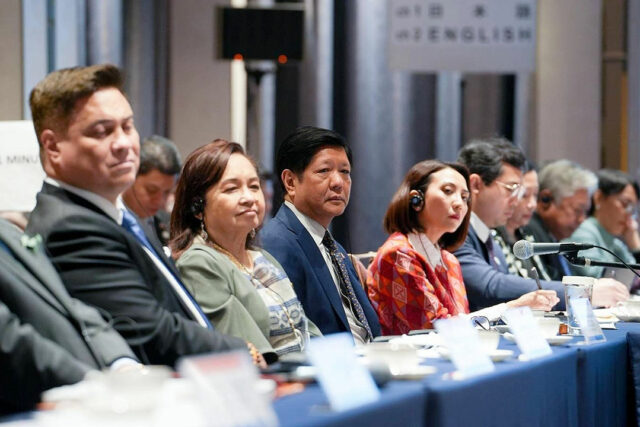
THE JAPANESE government might be using its economic power to boost defense ties with the Philippines and other countries locked in territorial disputes with China in response to growing Chinese militarism in the region, political analysts said on Thursday.

“Japan is leveraging its economic and financial wherewithal to promote its expanding security interests,” Lucio Blanco Pitlo III, a research fellow at the Asia-Pacific Pathways to Progress Foundation, said in a Facebook Messenger chat.

“It is providing support to the maritime capacity building of coastal states, including those with longstanding disputes with its neighboring rival China,” he said. “Manila is an obvious target of those overtures.”

Japan, which is upgrading the Philippines’ coast guard, wants more patrols in the South China Sea, President Ferdinand R. Marcos, Jr. told reporters on his way for a working visit to Tokyo on Wednesday. He added that Japanese support for the Philippine Coast Guard is nothing new.

He said Japan might be interested in upgrading the former Subic Naval Base for the Philippine Coast Guard. “Naturally, the reason behind all these is they would like to have more patrols along, up and down the South China Sea so that we can assure the freedom of passage.”

Mr. Marcos Jr. said Japan has been helping develop the agency, having built two brand-new multi-role response vessels for the Philippines. The Philippines also bought four Mitsubishi air surveillance radars from Japan last year. 

“In 2018, for the first time since the end of World War II, Japanese armored vehicles rolled out in foreign soil as Japanese soldiers took part in the Philippine-United States Kamandag exercises,” he added.

The Philippines has given the United States, one of Japan’s key allies, access to four new military bases under the Enhanced Defense Cooperation Agreement (EDCA), which was signed in 2014 under the late President Benigno S.C. Aquino III.

“As the US gains greater military access to Philippine locations through the implementation and expansion of EDCA, it is likely that Japan will follow suit,” Mr. Pitlo said, noting that the country could enter into a reciprocal access agreement with Japan.

“Japan may dangle more market access, infrastructure finance and capital to secure access to strategic Philippine real estate through the deal,” he said. Japan may also co-locate with the US for agreed EDCA sites and help finance the construction of related military infrastructure.

On Wednesday, Mr. Marcos said there were no formal talks yet between Manila and Tokyo on a reciprocal deal. “I don’t know if the prime minister will bring it up with me in this trip.”

“Japan itself is also in the middle of its continuing economic contractions, so that also ultimately puts a cap on what it can actually give us,” Hansley A. Juliano, a political economy researcher studying at Nagoya University’s Graduate School of International Development in Japan, said via Messenger chat.

The level of security ties between the two countries could be measured by looking at how Japan treats the Philippines after giving military equipment.

“You do not only give away hardware, you ensure that people are trained to maintain them, make them useful throughout the hardware’s natural lifespan, and hopefully also enable us to develop and manufacture them ourselves,” he said.

Mr. Juliano said Japan, like the Philippines, is also tied with the US in terms of security. “Any presence of the Japan Self-Defense Forces and any potential partnerships with the Philippine government is ultimately tied to American strategic goals, and will probably not happen unless American strategy is needed.”

Mr. Juliano said Japan has been struggling to convince its people about the scope of its military’s international operations. The Japanese Constitution forbids the use of force in settling international disputes and bars Japan from maintaining an army, navy or air force.

The constitutional limitation on Japan’s defense expansion makes the Tokyo-Manila security ties “tricky,” said policy analyst Michael Henry Ll. Yusingco. “Any possibility of doing joint patrols or entering into a visiting forces agreement will have to factor in this limitation,” he said in a Messenger chat. 

He said Mr. Marcos should be wary of the possibility of Japan using “our troubles” in the South China Sea “as a way to circumvent the constitutional limitation.”

“Hawkish elements in the Japanese government may use our troubles in the South China Sea as a justification to strengthen their military capability without contravening their Constitution.”

In 2016, a United Nations-backed tribunal voided China’s claim to more than 80% of the South China Sea based on a 1940s map. 

Japan and the US are seen as major obstacles to China’s global ambitions.

Herman Joseph S. Kraft, who teaches political science at the University of the Philippines, expects the Marcos government to seek the help of Japan in developing the former military base at the Subic Freeport “as a port that can host maintenance capability.”

“Whether this would eventually lead to Japanese coast guard ships berthing there, and eventually operating jointly in patrols with the Philippine Coast Guard, will require other agreements to come into place, such as a kind of status of forces agreement with Japan,” he said via Viber.

The deal lays down the rights and privileges of foreign forces in a host country.

“If the Philippines enters into such an agreement with Japan, it would allow for a deepening of operational cooperation between them,” Mr. Kraft said, noting that Filipinos could oppose the deal.

ASEAN WORRIES
A firmer foothold by Japan and the US in the Philippines is expected to raise concerns for China, Mr. Pitlo said. “This is especially so if Manila agrees to conduct joint patrols with both allies in the contested South China Sea. This can add complications to Manila’s ties with its largest trade partner, Beijing.”

Critics also worry that the Philippines might be dragged into Washington’s conflict with China, which claims sovereignty over self-ruled Taiwan.

Increased tensions in the Taiwan Strait and unresolved disputes with China are the “biggest potential flashpoints” affecting Southeast Asia, according to a survey by the ASEAN Studies Centre at the ISEAS-Yusof Ishak Institute in Singapore.

In a report, the center said 43.3% of the respondents feared that hostilities in the Taiwan Strait could destabilize the region, while 28.7% felt that member countries of the Association of Southeast Asian Nations could be forced to take sides. Of the 1,308 Southeast Asian respondent, 7.6% were Filipinos.

More than 15% felt it would reduce economic cooperation with either China or Taiwan. “Only 3.4% of the respondents say that it will not affect the region at all.”

Increased military tensions arising from potential flashpoints ranked third on the list of concerns of Filipinos at 50.5%. Their top concern was climate change at 76.8%, followed by unemployment and recession at 60.6%.

For ASEAN, unemployment and recession was the top concern (59.5%), followed by climate change (57.1%) and the widening socioeconomic gaps and military tensions (tied at 41.9%).


Senators say Charter change unnecessary, duplicates recent laws

THE INAUGURAL session of the Constitutional Commission of 1987 presided over by Vice-President Salvador Laurel. — OFFICIALGAZETTE.GOV.PH

A PROPOSAL to change economic provisions of the Philippine Constitution to make it more investor-friendly is unnecessary and duplicates recently enacted legislation, according to several senators.

The latest Public Service Act, Retail Trade Liberalization Act and Foreign Investments Act are all the country needs to attract foreign investments, Senator Maria Lourdes Nancy S. Binay said in a statement on Thursday.

“The economic reforms we have introduced are a response to the lack of provisions in the Constitution, and an answer to the issues of foreign equity limitation in utilities, power, telecommunications, transport and aviation, infrastructure and other sectors,” she said in a statement in Filipino.

“The country is still recovering from the impact of the pandemic, but we’re confident these reforms are sufficient to encourage investors and help revitalize our economy,” she added.

Ms. Binay said Charter change would be “too divisive.”

“What we need is unity to prepare for a possible global recession,” she said. “We should focus on issues that are directly connected to the stomach such as the price of basic commodities and problems in agriculture.”

“Our people are too preoccupied with daily living struggles,” Senator Aquilino Martin D. Pimentel III said in a separate statement. “Although we need constitutional changes to improve our system of government, this can wait as we should first address the basic daily living problems like where to get food to feed the family, the continued increase in prices, where to get a job, corruption, the high cost of living and even of dying, and many more basic problems.”

“Also, why prioritize changing economic provisions of the Constitution when what needs to be changed are the political provisions?” he asked.

Senator Mary Grace S. Poe-Llamanzares, who heads the economic affairs committee, said the Charter change push is suspicious.

“There’s no need at the moment for a constituent assembly,” she told reporters in Filipino, according to a transcript sent by her office. “Unless the proponents are pushing for another agenda.”

“But if there is another reason, like term extension — maybe that’s the reason — that needs to be debated. Is the length of the term of a person serving the government more important or how well he served the government?”

“I can’t really say if it will make that much of an impact, probably marginal,” Percival Peña-Reyes, director of the Ateneo de Manila University’s Center for Economic Research and Development, said by telephone.

“We won’t really get to see that much response in terms of foreign direct investment (FDI) inflow,” he said. “More work needs to be done, and if you really want to attract more FDIs, there are many recommendations on how to do it.”  

John Paolo R. Rivera, an economist at the Asian Institute of Management, said he supports economic liberalization, but the Charter change push could just duplicate the amended Public Service Act, for one.

“The best way to attract foreign investments is for the Philippines to demonstrate strong economic leadership and ensure that the conduct of business in the country is efficient,” he said. “Once this is established, we can liberalize further so that safety nets are still in place.”

PUBLIC SENTIMENT
Senator Robin C. Padilla on Wednesday filed a resolution seeking to amend the Constitution through a constituent assembly.

“To accelerate economic growth and fulfill its international commitment, the Philippines must amend its Constitution by removing these restrictive economic provisions to allow foreign businesses to directly invest in a more conducive landscape,” he said in a statement.

Among his proposals is to allow the state to undertake exploration, development and the use of natural resources or enter into co-production, joint venture or production-sharing agreements with corporations at least 60% Filipino-owned.

He also proposed to disallow private companies from holding alienable lands of the public domain except by lease for at most 25 years, renewable for not more than 25 years, and not to exceed 1000 hectares.

Antonio A. Ligon, a law and business professor at De La Salle University, said the Constitution should only be changed when “the Filipino people, in their sovereign capacity, finds the need to change it.” Reducing corruption might be a more effective solution to attract foreign investments, he added.

“Any moves for Charter change must be grounded on the sentiments of the public, not simply the politicians or the business lobby,” Jan Robert R. Go, who teaches political science at the University of the Philippines, said in a Facebook Messenger chat.

President Ferdinand R. Marcos, Jr. on Wednesday said the 1987 Constitution, which was crafted after his late father and namesake was ousted by a popular street uprising in February 1986, remains dynamic and flexible.

It is capable of adapting to the changing times and circumstances, he said in a statement released on Philippine Constitution Day.

“That is merely a perfunctory statement meant to evade any attempt to trap him about his stand on Charter change,” Arjan P. Aguirre, a political science professor at the Ateneo De Manila University, said via Messenger chat.

Mr. Go said the president should clarify his stance on any charter change push “because it will reflect his priorities.” “If he does not have Charter change in mind, then whatever actions done in Congress may not actually fly.” — Alyssa Nicole O. Tan and Kyle Aristophere T. Atienza

JERA assures Marcos of stable LNG supply 

Japanese power generator JERA Co., Inc. on Thursday assured the Philippine government of stable supply of liquefied natural gas (LNG) to support economic growth.  

Company President Satoshi Onoda told President Ferdinand R. Marcos, Jr. at a meeting in Tokyo they have been working with the Aboitiz group, represented by Sabin Aboitiz, to support the Philippine economy, the palace said in a statement.  

“In order to secure a stable supply, we are working with Aboitiz and Sabin-san’s team on many fronts,” Mr. Satoshi said.  

“We are procuring more than 30 million tons of LNG per year. Therefore, we will be able to contribute to the Philippines in the supply of LNG as transition fuel,” he added.  

“We will be working on co-firing ammonia technology as well. Therefore we would like to be able to provide this technology as well in a timely manner.”  

Meanwhile, Mr. Marcos cited the need to prepare for future developments, especially with the issue of clean renewable energy sources.  

“I do not need to illustrate or to explain the critical situation around the world when it comes to fuel, fuel supply, supply chain problems,” he said. “All of these are requiring a great deal of thought for the planning for the Philippine side so as to be able to ensure that our forecasted and aspirations for development are well supported by an adequate power supply,” he added. 

Also on Thursday, Mr. Marcos and Japan Prime Minister Fumio Kishida agreed to boost defense relations. 

In a joint statement, both resolved to “increase the defense capabilities of their own countries, and further strengthen overall security cooperation.” 

The two countries will have strategic reciprocal port calls and aircraft visits, transfer of more defense equipment and technology, continuous cooperation on previously transferred defense equipment, and capacity building, the palace said in a separate statement. 

Mr. Marcos is on a working visit to Japan until Feb. 12.Kyle Aristophere T. Atienza 

Senate leader pushes for PHL-Japan military agreement; Marcos asks for easing of travel advisories

JAPAN and Philippine air force officers during a bilateral training on humanitarian assistance and disaster relief held at Clark Air Base in Pampanga in June 2022. — JAPANESE EMBASSY PHOTO

THE PHILIPPINES Senate leader is pushing for a military agreement with Japan, which will broaden ongoing exchange programs on maritime and emergency response operations.     

Japan is already offering vital support to our coast guard, not just through vessels and equipment but also through other capacity-building opportunities such as training,Senate President Juan Miguel F. Zubiri said in a statement on Thursday.   

Mr. Zubiri, who is part of President Ferdinand R. Marcos, Jr.s delegation to Japan this week, is proposing a Visiting Forces Agreement (VFA) between the Philippines and Japan, which he said will strengthen our partnership even further.  

A VFA gives one nations military force access to its partner country. The Philippines has one with the United States.  

Peaceful diplomacy remains our foremost move toward conflict resolution, but we also have to be prepared for any eventuality,he said, alluding to tensions in the contested South China Sea.   

With Japan on our side, we will be able to empower our Coast Guard and Armed Forces in times of conflict,” he added. 

Mr. Marcos on Wednesday said there have been no formal talks yet about establishing a VFA with Japan. 

We havent had formal talks about that yet,Mr. Marcos told the press in Filipino. I dont know if Prime Minister Kishida will take it up with me on this trip. But, so far, there have not been any formal proposal in that regard.  

Mr. Zubiri said he pitched the idea to Japanese Ambassador to the Philippines Koshikawa Kazuhiko last year.  

Apart from the VFA being crucial to building up our security and defense, it will also be massively helpful to us in times of natural calamities and disasters,he said. 

Let us remember that Japan is just as disaster-prone as we are, and so they have made it a priority to ensure that their armed forces are well-equipped to conduct disaster management efforts and rescue operations,he added. 

TOURISM
Meanwhile, the Philippine government will ask Japan to lift or limit its travel advisories against tourism destinations in the country, according to the Department of Tourism. 

President Ferdinand R. Marcos, Jr. made the announcement during  a meeting with Japanese tourism stakeholders in Tokyo on Thursday, the Tourism department said in a statement.  

We are working on lobbying to the Japanese government for the lifting or limiting of its travel advisory against the Philippineskey travel destinations,Mr. Marcos said, noting that the two countries must first be open to each others peopleto further deepen ties.  

The Philippine leader also pushed for educational tourism between the two countries with special focus on the exchange of students and professionals in tourism-related institutions,the Presidential Communications Office said in a separate statement.  

Mr. Marcos invited Japanese students to study English in the Philippines, it said.  

The tourism industry has shifted its gaze to becoming more than just a promotion arm of the government, but also to ensuring that travel is not only convenient, connected, and equal for travelers, but as well as for locals who are living and preserving our invaluable key and emerging tourist destinations,he said at the meeting.   

With this in mind, this government has set the direction to harness the development of tourism in key tourism destinations,he added.   

As of Jan. 30, Japan ranked sixth in the list of Philippinesforeign visitors, according to Mr. Marcos.  

In 2019, before the coronavirus pandemic disrupted global travel, Japan was the Philippines fourth biggest source of foreign visitors after South Korea, China, and the US.Alyssa Nicole O. Tan and Kyle Aristophere T. Atienza

Seafarers’ rights bill passes House panel 

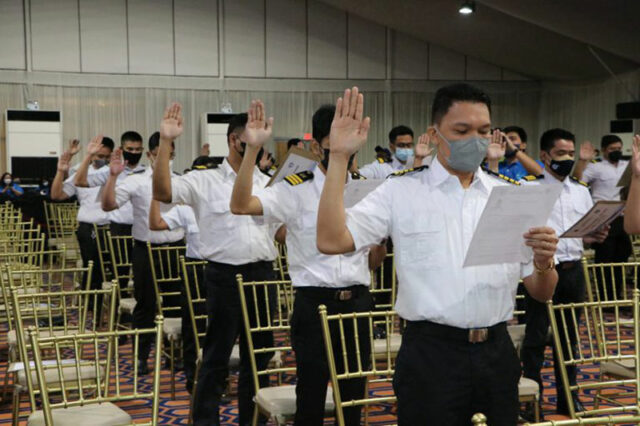
SEAFARER OATHTAKING — MARINA.GOV.PH

A BILL establishing the rights of seafarers and a certification system that meets international standards was approved by a House of Representatives committee on Thursday.   

The still unnumbered bill, one of the Houses priority measures for 2023, institutes a magna carta for the countrys maritime workers and provides for a system of education, training, certification, and licensing to ensure a sustainable pool of competent and world-class seafarers.  

Kabayan Party-list Rep. Ron P. Salo, chair of the overseas workers affairs committee that approved the measure, said the bill aims to address the recent findings of the European Maritime Safety Association or EMSA on audits of Philippine compliance to the international convention standards of training, certification and watchkeeping.  

In a November 2022 House panel meeting, Department of Migrant Workers Assistant Secretary Jerome T. Pampolina reported that the Philippines failed to comply with the international training standards for seafarers, with EMSAs audit citing 13 shortcomings and 23 grievances.  

The bill provides that sailors are entitled to a safe and secure workplace under safety standards; fair terms and conditions of employment; decent working and living conditions onboard a ship; and medical care and other forms of social protection.   

Sailors also have the right to affordable education and training.  

Female seafarers are also protected in the proposed measure in terms of equal pay, opportunities for promotion, training, and scholarships. Beatriz Marie D. Cruz 

Several Filipinos in Turkey still unaccounted for in earthquake’s aftermath 

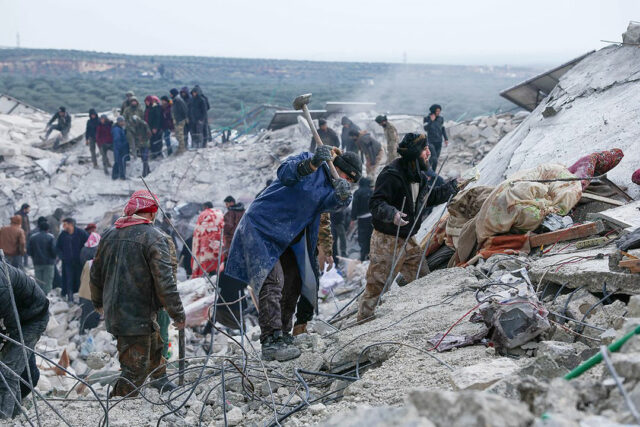
THE DOCTORS Without Borders, which already has a team in northwest Syria, was among the first groups to provide assistance in earthquake-hit areas. — PHOTO COURTESY OF DOCTORS WITHOUT BORDERS

THE PHILIPPINE Embassy in Ankara on Thursday said it is still receiving reports of affected Filipinos, with some out of reach, after a magnitude 7.8 earthquake that struck Turkey on Feb. 6. 

The embassy continuously receives a steady stream of confirmed and unconfirmed reports of Filipinos experiencing varying degrees of distress,it said.  

These included two confirmed reports of injured Filipinos, who are now recovered,it added. We are thankful that a number of our kababayans (countrymen) are safe and we will not give up hope for those that cannot be contacted.  

Meanwhile, the embassy has also been contributing to the disaster response efforts through the distribution of relief goods to Filipinos in the cities of Adana and Iskenderun.  

We are continuing to utilize our invaluable network of Filipino community leaders from across the country to get in touch with those in need, such as four Filipinos that the team evacuated from Adana to the safer city of Mersin,the embassy said.  

Cherilyn Santos, president of the Filipino community in Ankara, on Thursday told Super Radyo dzBB that a Filipino reported dead earlier has been rescued. However, four other Filipinos living in the same building remain missing.  

There are 245 Filipinos residing in the affected regions, according to embassy consular records.  

There have been over 15,000 confirmed deaths across Turkey and neighboring Syria, according to a Thursday report from Reuters, as public anger brews over the slow arrival of rescue teams.  

The Philippines has sent an 85-man response team to Turkey to help in rescue and relief operations. Alyssa Nicole O. Tan

Lawmakers call for swift passage of anti-union interference bill

PHILIPPINE STAR/MICHAEL VARCAS

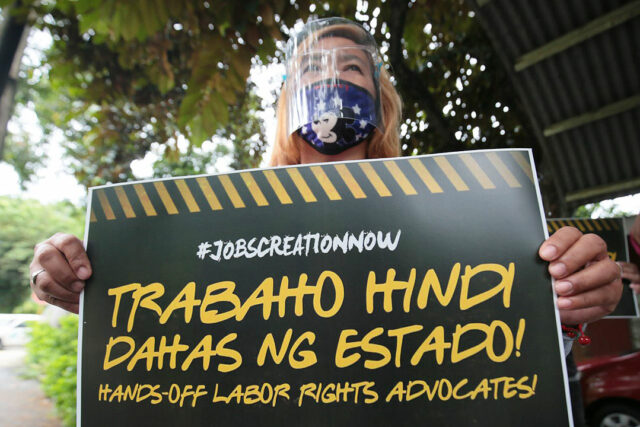
AUTHORS of a bill allowing workers to organize without interference from employers and armed authorities have called for its immediate passage, citing that the measure complies with the recommendations of the International Labor Organization (ILO) on addressing abuses faced by labor groups.

House Bill No. 407 passed the committee level on Wednesday and is set for plenary deliberations.  

Kabataan Party-list Rep. Raoul Danniel A. Manuel, one of the authors, said in a press conference on Thursday that the administration is expected to report back to the ILO by June 5, 2023 regarding its progress on implementing (its) recommendations.  

ILO representatives visited the Philippines in January to assess and give policy recommendations on the conditions and treatment of trade unions.  

The bill definitively establishes the prohibited acts that will violate the right to organize, that has always been explicitly allowed under the Bill of Rights and the Labor Code,Mr. Manuel said.  

Deputy Minority Leader France L. Castro told the same briefing that the passage of the bill is also relevant because only less than 10% of industries and factories are unionized.  

Under the bill, workers should not be stopped from joining labor organizations or carrying out their duties as members.  

Workers or workersorganizations also cannot be vilified or tagged as subversives or terrorists by the military, police, and the anti-communist task force. Beatriz Marie D. Cruz 

Supreme Court: Fathers can seek protection for kids abused by mothers 

PHILIPPINE STAR/MICHAEL VARCAS

MOTHERS can be sued for abusing their children, the Philippine Supreme Court (SC) ruled, as it granted a plea by a father to protect his daughter from physical abuse by his estranged wife. 

In a decision dated July 12 last year and made public on Feb. 1, the tribunal said mothers can be offenders under a law that protects women and children against violence. 

“Logically, a mother who maltreated her child resulting in physical, sexual, or psychological violence defined and penalized under the law is not absolved from criminal liability notwithstanding that the measure is intended to protect both women and their children,” Associate Justice Mario V. Lopez said in the ruling.  

“The court refuses to be an instrument of injustice and mischief perpetrated against vulnerable sectors of the society such as children victims of violence.”  

It noted that while the law excludes men from being victims, the law does not deny fathers from filing legal remedies for their children.  

Under the law, parents or guardians of the victim may file a petition for protection orders.  

In 2017, a Taguig trial court denied Randy Michael Knutson’s petition for a protection order in favor of his daughter.  

The trial court ruled that the protection order could not be issued against Rosalina Knutson, his wife, since it said remedies under the law were not available to Mr. Knutson because he was not a “woman victim of violence.”  

The Supreme Court said the law explicitly allows “parents” of the victim to apply for protection orders. 

“The fact that a social legislation affords special protection to a particular sector does not automatically suggest that its members are excluded from violating such law,” the tribunal said. John Victor D. Ordoñez 

DPWH completes P100-M road projects in 4 provinces  

DPWH

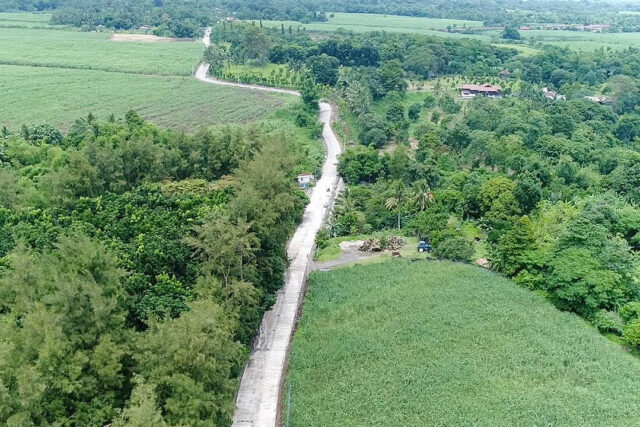
ROAD projects worth P100.34 million in four provinces that improve farmersroute to trading centers and access to tourism spots have recently been completed, according to the Department of Public Works and Highways (DPWH).  

In separate press releases, DPWH said the roadworks are in Negros Occidental, Southern Leyte, Nueva Ecija, and Aklan.  

The P34-million project in Talisay City, Negros Occidental covered the reconstruction of a 1.17-kilometer (km) two-lane concrete road that supports the agri-tourism industry in the area.  

It is a part of a 13.02-km road project amounting to P295 million.   

With the improvement of the whole stretch of the access road, both tourists and locals will have a smoother, faster, and safer transportation access going to various tourist destinations in Talisay City and Bacolod City such as the famous Campuestohan Highland Resort, Bantug Lake Ranch, and USLS Eco Park,DPWH said.  

In Maasin City, Southern Leyte, the completed project worth P15 million consists of a two-lane 1.58-km road that will benefit farmers and entrepreneurs in the area of Libhu.   

Meanwhile, the widening works in Tablang-Gabaldon Road in Laur, Nueva Ecija was also completed this week, with the project costing P21.94 million.  

In Makato, Aklan, paving of the six-kilometer West Road was completed at a cost of P29.4 million.  

DPWH said paving of another 12.31-km road in the area is ongoing, with a projected cost of P79.5 million.  

With Makato considered as the main producer of copra in the province and Ibajay boasting various tourist attractions, the road improvements will benefit both Aklanons and visitors as it enhances the transport system along the national road,the department said. Justine Irish DP. Tabile 

Bill seeks farm consolidation, clustering to make agri sector more productive, competitive 

BW FILE PHOTO

A HOUSE bill that supports farm consolidation and crop clustering has been filed, aiming to make the Philippine agricultural sector more efficient and globally competitive.   

Agriculture is always an issue of scale,TINGOG Party-list Rep. Jude A. Acidre, one of the authors of House Bill 7077, said in a statement on Thursday.  

The measures explanatory note says farm consolidation willopen opportunities for people working in the agricultural sector to gain access to modern and developing technologies needed for sustainable agriculture and enable them to have a competitive advantage in the market.”   

Under the bill, special agricultural growth zones (SAGZ) will be developed by merging adjacent farmlands within 50 hectares for a synchronized production of a particular crop. 

Most Philippine farmers are smallholders, including beneficiaries of the agrarian reform program that limits ownership to three hectares.    

Each special zone will focus on staples such as rice, corn, and sugarcane, or high-value crops such as coconut.    

The SAGZ and designated crops will be identified based on the areas climate and environmental conditions; presence of agrarian reform communities and other smallholders; and strategic location for domestic and international shipments.   

The bill also proposes the creation of a Philippine Agricultural Zone Authority under the Agriculture department.  

The measure is pending at the government enterprises and privatization committee. Beatriz Marie D. Cruz

Estrada tells DMW to go after foreign-owned recruitment agencies   

A SENATOR called on the Department of Migrant Workers (DMW) to go after foreign-controlled recruitment agencies that use Filipinos as front owners to hire employees abroad.    

Senator Jose JinggoyE. Estrada said his office has received information on allegedly foreign-owned placement agencies, which violate the licensing and regulation rules of the Philippine Overseas Employment Administration and the Labor Code of the Philippines.  

Filipinos posing as dummy incorporatorswas apparently common knowledgein the industry, he said in a statement on Thursday.   

The senator said there are suspicions that some of these illegal recruitment agencies may be responsible for the deployment of workers who end up being abused, such as Jullebee Cabilis Ranara who was recently slain in Kuwait.   

Initial investigation conducted by the DMW showed that Ms. Ranaras local and foreign recruitment agencies failed to comply with the mandatory monitoring requirements to ensure the well-being of their deployed workers.  

It might be tedious for this committee to summon all the incorporators or the board of directors of the recruitment agencies,Mr. Estrada said. Lets just request the DMW to scrutinize the recruitment agencies, whether the proprietors of these recruitment agencies have the financial capability to run its operations.  

DMW officials have assured senators that once the licenses of recruitment agencies are revoked or canceled due to violations, all of its officers and incorporators are placed on a derogatory list and are disqualified to operate any other recruitment activities. Alyssa Nicole O. Tan 

ADVERTISEMENT
ADVERTISEMENT