Home Blog Page 5229

iPeople awaits more signups after new educational offering  

LISTED education company iPeople, Inc. expects more students to sign up in August this year on the back of a new education offering under a partnership between its Mapua schools and Arizona State University (ASU).

“The official signing was in May [last year], then we announced it publicly in June. The first classes were in August [last year]. But then we’ve not really had the chance to market or discuss it much,” iPeople President Alfredo I. Ayala told reporters on the sidelines of a press conference in Makati City on Monday.

“This coming year, we’re hoping to see significant signups,” he said, citing the collaboration with ASU.

Mr. Ayala said the company is sharing “more proactively everything there is to offer.”

“We also wanted to get off the ground and run a few courses. Make sure that we are doing everything properly,” he added.

In 2022, iPeople’s Mapua University and daughter schools Mapua Malayan Colleges Laguna and Mapua Malayan Colleges Mindanao entered into a collaboration with ASU to improve and focus on the business and health sciences programs.

The partnership allowed Mapua schools to be members of global network ASU-Cintana Alliance, which consists of 15 higher education institutions in the Americas, Europe, and Asia. Some of the alliance’s other members are Galala University in Egypt, The NorthCap University in India, and Universidad Internacional del Ecuador in Ecuador.

Under the collaboration, students will have access to ASU’s content in all enhanced courses, participate in the global signature courses from professors at member universities of the alliance via virtual classrooms, and interact with foreign classmates without leaving the Philippines.

Students could also participate in classes co-lectured by ASU faculty and gain opportunities to participate in student exchange and summer immersion programs at ASU-Cintana schools.

“Our collaboration with global leader ASU and being part of the ASU-Cintana Alliance enable us to take these to a higher level for our students, by giving them numerous opportunities to learn with a top-ranked US university, and other leading education institutions around the world,” iPeople Chairman and Mapua University President Reynaldo B. Vea said.

iPeople owns seven educational institutions consisting of Malayan Education System, Inc. operating as Mapua University, Mapua Malayan Colleges Laguna, Mapua Malayan Colleges Mindanao, and Malayan High School of Science in Manila; the University of Nueva Caceres in Bicol; National Teachers College; and APEC Schools.

iPeople is an education company under Ayala Corp. and the House of Investments of the Yuchengco group of companies, which hold a stake of 33.5% and 51%, respectively.

On Monday, shares of iPeople at the local bourse dropped 13 centavos or 1.71% to end at P7.49 apiece. — Revin Mikhael D. Ochave

Manila Water secures P3-B term loan

BW FILE PHOTO

MANILA WATER Co., Inc. has signed a P3 billion 10-year term loan facility with the Land Bank of the Philippines, the water concessionaire said on Monday.

In a regulatory filing, Manila Water said the loan will fund its general corporate requirements and capital expenditures.

The east zone water concessionaire has said that it is targeting to spend about P181 billion for its capital investments until 2027.

Separately, Manila Water said it is optimistic about the construction of the P4.18-billion Aglipay sewerage treatment plant in Mandaluyong City.

The Aglipay plant has a treatment capacity of about 60 million liters per day (MLD), which is expandable to 120 MLD of wastewater to be collected from its catchment area in the cities of Mandaluyong, San Juan and Quezon. The sewerage system is expected to serve 720,000 by 2037.

The water concessionaire serves Metro Manila’s east zone network, which comprises Marikina, Pasig, Makati, Taguig, Pateros, Mandaluyong, San Juan, portions of Quezon City and Manila, and several towns of nearby Rizal province.

At the local bourse on Monday, shares in the company closed four centavos or 2.03% higher at P20.10 apiece. — Ashley Erika O. Jose

Converge to serve Boracay residents by March

CONVERGE Information and Communications Technology Solutions, Inc. will be extending its coverage to the residents of Boracay Island by the end of the first quarter of 2023.

“We are here to serve the connectivity needs of both local and foreign tourists, as we know internet connection is a value-adding service to any tourist hot spot,” said Dennis Anthony H. Uy, chief executive officer and co-founder of Converge.

“With this, hopefully we can meaningfully contribute to Boracay’s tourist-driven economy,” he added.

The move is part of the company’s strategy of expanding its fiber footprint across the country.

“Converge has been working hard to further expand our fiber footprint in the Philippines so we can reach the unserved and underserved,” Converge Chief Operations Officer Jesus C. Romero said.

According to the company, it is aiming to provide connectivity to the island’s hospitality industry, which could increase profit and bring customer loyalty.

“Businesses will enjoy the benefits of dedicated, hyper-secured, and uninterrupted connectivity services for continuous business productivity, which will lead to increased profit and customer loyalty,” the company said.

Converge is also eyeing to service island-hopping entrepreneurs as entrepreneurial tourists work remotely in hotels, cafes, co-working spaces and temporary housing.

“One of the foremost needs of the modern traveler is having a stable and fast internet connection, while businesses require a reliable and better partner in connectivity. We are confident that our products and services will help cement the island’s luxurious reputation,” Converge Regional General Manager for Visayas and Mindanao Michael Maquiran said. — Justine Irish D. Tabile

Gov’t partially awards Treasury bill offer

BW FILE PHOTO

THE GOVERNMENT partially awarded the Treasury bills (T-bills) it auctioned off on Monday as rates went up across the board after the central bank hiked borrowing costs anew last week.

The Bureau of the Treasury (BTr) raised just P13.05 billion from its offer of T-bills on Monday, below the P15-billion program, even as bids reached P30.328 billion or more than twice the amount on the auction block.

Broken down, the Treasury borrowed only P3.55 billion via the 91-day T-bills, below the P5-billion program, despite tenders reaching P7.33 billion. The average rate of the three-month papers rose by 18.3 basis points (bps) to 4.413% from the 4.23% quoted for the tenor last week, with accepted rates ranging from 4.325% to 4.5%.

The government also made a partial P4.5-billion award of the 182-day securities versus the P5-billion plan, even as demand for the tenor reached P10 billion. The six-month T-bill was quoted at an average rate of 5.06%, rising by 11.1 bps from 4.949% the previous week, with accepted rates ranging from 5.025% to 5.1%.

Meanwhile, the BTr raised P5 billion as planned from the 364-day debt papers as demand for the tenor reached P12.988 billion. The average rate of the one-year T-bill climbed by 15.70 bps to 5.455% from the 5.298% fetched for the tenor last week. Accepted yields were from 5.375% to 5.55%.

National Treasurer Rosalia V. de Leon said in a Viber message to reporters after the auction that the Treasury made a partial award of its T-bill offer as rates rose following the Bangko Sentral ng Pilipinas’ (BSP) policy decision last week.

“The committee decided to keep rates aligned with secondary market levels, thus the partial awards for the 91- and 182-day T-bills,” Ms. De Leon said.

Rizal Commercial Banking Corp. Chief Economist Michael L. Ricafort likewise said in a Viber message that auction yields posted a bigger increase week-on-week after the central bank’s rate hike and hawkish signals from the BSP chief.

A trader also said in a Viber message that the auction result was “expected due to the recent policy rate hike.”

The BSP last week hiked benchmark rates by 50 bps for a second straight meeting, and hinted at further tightening to help bring down elevated inflation.

The latest move brought the central bank’s policy rate to 6%, the highest in nearly 16 years or since May 2007 when it stood at 7.5%.

It has now raised borrowing costs by 400 bps since May 2022.

BSP Governor Felipe M. Medalla said after Thursday’s policy meeting that a third or fourth rate hike is likely this year, adding that they could look at a 25-bp or 50-bp increase at their March 23 review.

Mr. Ricafort added that rates also rose amid policy signals from US Federal Reserve officials, which fanned market expectations of two or three more rate hikes to bring down elevated US inflation.

Cleveland Fed President J. Loretta Mester and St. Louis Fed President James Bullard both said they would back a 50-bp hike in the next Federal Open Market Committee meeting following stronger-than-expected US consumer inflation in January.

The US consumer price index (CPI) increased 0.5% last month after gaining 0.1% in December. In the 12 months through January, the CPI increased 6.4% following a 6.5% rise in December.

The US central bank this month hiked its fed funds rate by 25 bps to a 4.5%-4.75% range, bringing cumulative increases since March 2022 to 450 bps. Its next policy meeting is on March 21-22.

On Tuesday, the BTr will offer P35 billion in reissued 10-year Treasury bonds (T-bonds) with a remaining life of nine years and six months.

The Treasury wants to raise P130 billion from the domestic market this month, or P60 billion via T-bills and P70 billion via T-bonds.

The government borrows from domestic and external sources to finance its budget deficit, which is capped at P1.47 trillion this year or 6.1% of gross domestic product. — A.M.C. Sy

DICT sticks to SIM card registration deadline

A VENDOR shows different SIM cards for sale at a stall in Quiapo, Manila, Oct. 8, 2022. — PHILIPPINE STAR /KRIZ JOHN ROSALES

THE Department of Information and Communications Technology (DICT) said it will not extend the deadline for the mandatory registration of subscriber identity module (SIM) cards.

“We are not yet looking at the possibility of an extension. We are still sticking with the April 26 deadline and all hands are on deck to ensure the registration of as many users as possible,” DICT Undersecretary for Public Affairs and Foreign Relations Anna Mae Y. Lamentillo said in a media briefing on Monday.

Ella Blanca Lopez, the commissioner of the National Telecommunications Commission (NTC), said the agency is confident of meeting the deadline.

“We are hoping that SIM subscribers will register by April 26 though as of now only 19.71% are registered. But we still have time,” Ms. Lopez said.

Data from the DICT show that there are about 168.98 million subscribers nationwide. The SIM card registration process started on Dec. 27, 2022

Republic Act No. 11934 or the SIM Registration Act is said to combat worsening text scams and fraud in the country. 

Ms. Lopez said four months before the implementation of the law, the NTC had been receiving complaints through its hotline for text scams.

“We reviewed the complaints that we received and there are 51,874 complaints or roughly 1,500 per day,” she said.

She said since the start of the SIM card registration, the complaints were down to 8,700.

Meanwhile, Ms. Lopez said that the NTC is now addressing the concerns over the slow progress in the registration of SIM cards.

“Yes, we have received the letter from Infrawatch,” Ms. Lopez said, referring to the public policy think-tank. “We are internally discussing how to address the matter.”

In a letter to the NTC dated Feb. 7, Infrawatch PH expressed concern over the slow pace of registration, warning that if the current pace continues, the number of registered subscribers would only be at around 69.52% of the total subscribers.

Meanwhile, Globe Telecom, Inc. rolled out assistance desks in over 500 locations in the country to assist and make it easier for customers to register their SIM cards.

“It is a momentous initiative that will bring together Filipinos across the country to register their SIMs and move us closer to our goal of reducing spam and scam text messages, which is the intent of the SIM Registration Act. It’s a historic moment for Globe as we endeavor to get closer to our customers through online channels and on-site booths,” Darius Delgado, head of Globe’s channel management group, said. — Ashley Erika O. Jose

Haraya Residences set to rise in Bridgetowne Estate

HARAYA Residences will rise within the Bridgetowne Estate in Pasig City. — COMPANY HANDOUT

UPSCALE developer Shang Robinsons Properties, Inc. (SRPI), a joint venture between Shang Properties, Inc. and Robinsons Land Corporation (RLC), recently unveiled a high-rise condominium project in Pasig City.

Haraya Residences, described as a “vertical gated village for the modern era,” will rise within RLC’s master planned 31-hectare district Bridgetowne Estate.

The company launched on Saturday the first of two towers, the South Tower which will feature 558 units on 57 storeys. The North Tower has no target launch date yet.

Haraya Residences offers one-bedroom units (67 square meters), two-bedroom units (104-142 sq.m.) and three-bedroom units (187 sq.m.).

A one-bedroom unit “reimagines” a traditional one-bedroom layout with flexible spaces and a loggia that expands the living room.

As a low-density residence, the two towers will only have ten units to a floor for exclusivity and privacy.

“Haraya in Filipino means ‘imagination,’ so we hold our mission sacred, to envision new possibilities for homeowners, introduce meaningful innovation, and develop inventive spatial configurations that provide comfort, freedom, and inspiration,” SRPI Executive Vice-President Jose Juan Z. Jugo said at the Feb. 15 media launch.

Haraya Residences will have 2,270 sq.m. of indoor amenities including a movie room, a library, function rooms, a private dining room, a game room, a playroom, a gym, and a lounge with a view of the skyline.

It will also have 2,500 sq.m. of outdoor amenities which include green spaces, swimming pools, and play areas.

“Haraya Residences is really a project that will transform normal urban living into something very special. We want to be a landmark project that improves the way people live,” Mr. Jugo said.

SRPI is targeting young urban professionals that want to upgrade their lifestyle.

“We’re a very young country. I believe today the average age of the Filipino is 24 or 25 years old. A 24-year-old will be in the workforce for the next 40 years,” said Mr. Jugo.

“These young people need homes and they’re in the workforce, so they might start with a simple home, a modest one, and as they get older, they upgrade. That’s the market Haraya Residences is targeting — people who are upgrading their lifestyle,” he added.

SRPI aims to complete Haraya Residences by 2028.

The residential development is expected to be surrounded by office towers and other premium developments in Bridgetowne Estate.

Bridgetowne Estate is a few minutes away from the Ortigas business district and accessible via C-5, Ortigas Avenue Extension, and Amang Rodriguez Avenue.

Offices and the upscale Opus mall are expected to open in Bridgetowne Estate this year. — B.H. Lacsamana

Pandemic drives demand for life insurance among new small business owners

BW FILE PHOTO

MAJORITY of new business owners in the country bought life insurance products for protection and security during the coronavirus pandemic, according to a study by The Manufacturers Life Insurance Co. (Phils.), Inc. (Manulife Philippines).

The study, titled “Filipino entrepreneurship and the bayanihan spirit: The resurgence of micro and small businesses in the Philippines,” was conducted in partnership with research firm InSites Consulting, Manulife Philippines said in a statement on Monday.

It surveyed 500 Filipinos nationwide aged 18 to 55 in May 2022.

Manulife Philippines said 40% of the respondents said life insurance was the top financial product they bought in the last 12 months, with 41% of the respondents also saying they planned to buy life insurance in the next 12 months.

This was followed by medical/health/accident insurance (36%) and nonlife insurance (17%) as the top financial products Filipino bought.

“These new business owners… became more conscious about preparing for financial challenges or crises, encouraging them to seek to buy life protection and security for themselves, and indicating their openness to consider financially protecting their employees,” Manulife Philippines said.

According to the survey, 41% of respondents started micro and small businesses during the pandemic, and 50% said they are very likely to continue their operations in the new normal.

The survey showed earning income was the top reason for starting a business at 43%, followed by maintaining financial stability (34%), and providing convenience and accessibility to people (8%).

The nature of their businesses also reflected market needs during the pandemic, with most of them going into food preparation and processing (41%), retail (30%), or delivery of essential goods and services (24%).

“The pandemic emphasized the vital role of micro and small businesses in sustaining our local and national economies, especially in times of crisis. Manulife aims to help Filipino entrepreneurs to protect their businesses by securing their most valued asset — their employees,” Manulife Philippines President and Chief Executive Officer Rahul Hora said.

“With our customizable insurance solutions, entrepreneurs can empower their employees with confidence and a sense of security in the midst of financial setbacks,” he added.

The life insurer said these businesses have “flourished” amid support from communities in the country.

Majority or 65% of respondents said they availed of products and services from local small and micro businesses, with 32% doing so more than once a week. The top reasons for their patronage were to support the economy (66%) and the community (63%).

“This study’s findings coincide with our previous studies that show how the pandemic spurred significant behavioral shifts among Filipinos, including business owners, regarding their finances. The socioeconomic disruptions Filipinos experienced in the past two years drove increased interest in purchasing life insurance as a financial safety net,” Manulife Philippines Chief Marketing Officer Melissa L. Henson said.

“Manulife aims to respond to this growing demand by offering relevant and affordable solutions that can give them the protection and financial security that they deserve,” Ms. Henson added.

Manulife Philippines said they offer group insurance products to help business owners provide their employees protection, such as “Group Protect,” a comprehensive life and accident insurance package with benefit add-ons.

The company was ranked eighth among life insurers in terms of premium income in 2021 with P17.51 billion, based on Insurance Commission data. It also booked a net income of P2.86 billion in 2021. — A.M.C. Sy

Global hotel industry likely to withstand headwinds in 2023

MARK WILLIS, global chief executive officer of Fairmont Hotels & Resorts — BW FILE PHOTO

By Arjay L. Balinbin, Multimedia Editor

THE global hotel industry will remain resilient and continue its recovery in 2023, thanks to the resurgence of international travel, according to an industry expert.

For 2023, “we see global recovery,” Mark Willis, global chief executive officer of Fairmont Hotels & Resorts, told BusinessWorld earlier this month.

“Yes, there has been a lot of negativity around a possible global recession and a return to 2008-2009 (global financial crisis), but that has been an ongoing discussion for some months… For the most part, it’s been delayed and delayed, and I wonder if it will come because most of the locations around the world are recovering,” he said.

The global hospitality had an “uplifting year” in 2022, driven by leisure demand and various international tourism events such as the World Expo Dubai, Formula One Grand Prix and FIFA World Cup, according to real estate services company JLL.

In its “Global Hotel Investment Outlook 2023” report, JLL said occupancy rates have recovered around the world. For instance, occupancy rates in the Americas have recovered to 95% of the pre-pandemic levels, while those in Europe and Asia have regained 89% and 77%, respectively.

“The industry has bounced back after an appalling period. I don’t think anybody was hit as hard as the travel and hospitality sector,” Mr. Willis said.

Pent-up travel demand is expected to remain resilient in 2023, JLL said, “particularly as China and other international borders reopen and consumers consistently demonstrate a desire to travel.”

“Inflation, cost of goods, cost of payroll…, and power… have all been elements of business that have been under a lot of pressure in the past 18 months,” said Mr. Willis.

Although hotel rates have gone up, demand has also gone up, he noted.

“Supply has slowed down a little as we come through COVID, and there is a desire to travel, particularly from those locations that have been under lockdown.”

In the Philippines, travel agencies are likewise expecting international visitor arrivals to approach pre-pandemic levels.

International visitor arrivals will reach seven million this year, Michelle G. Taylan, chair of the Philippine Travel Agencies Association’s 30th Travel Tour Expo 2023, told BusinessWorld last month.

The Department of Tourism has set a target of at least 4.8 million tourist arrivals this year. While this is below the 8.26 million foreign arrivals in 2019, it is still an improvement from the 2.65 million international arrivals in 2022.

Despite the economic challenges, Fairmont’s Mr. Willis is confident that the luxury hotel brand will “remain strong.”

“The brand is wonderfully strong; it’s a heritage brand with a hundred-year-plus history,” he noted.

Fairmont is part of Accor, a global hospitality group that operates in more than 5,000 locations across 110 countries. The Fairmont Makati celebrated its 10th anniversary earlier this month.

Mr. Willis said that Fairmont is set to open more than 30 hotels in the next 36 months, nine of which will be in Asia.

“If you have the right product, the right service, and you can personalize what you are doing and reach and exceed people’s expectations, people are prepared to pay a fair price for that,” he added.

Mr. Willis is responsible for the luxury brand’s portfolio of more than 100 hotels in operation and under development globally. Prior to taking the helm at Fairmont, he was the chief executive officer for India, Middle East, Africa and Turkey at Accor, overseeing a portfolio of more than 520 hotels in operation and development across 20-plus diverse brands.

The goals for Fairmont include modernizing or digitalizing its processes, as well as “making sure that you are attracting the next generation… and that they are coming, utilizing and enjoying our fabulous portfolio of hotels.”

A trip to Jakarta: The Big Apple in Southeast Asia

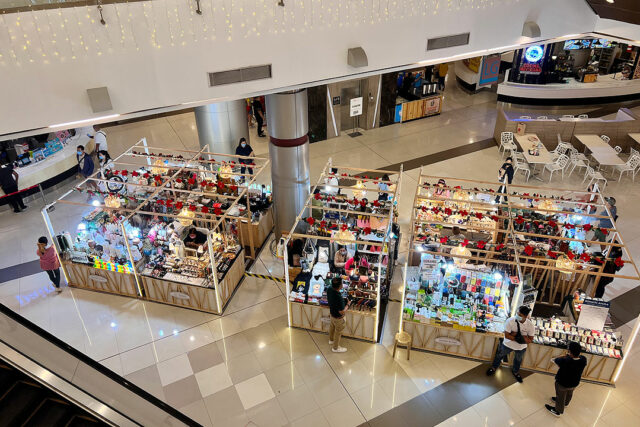
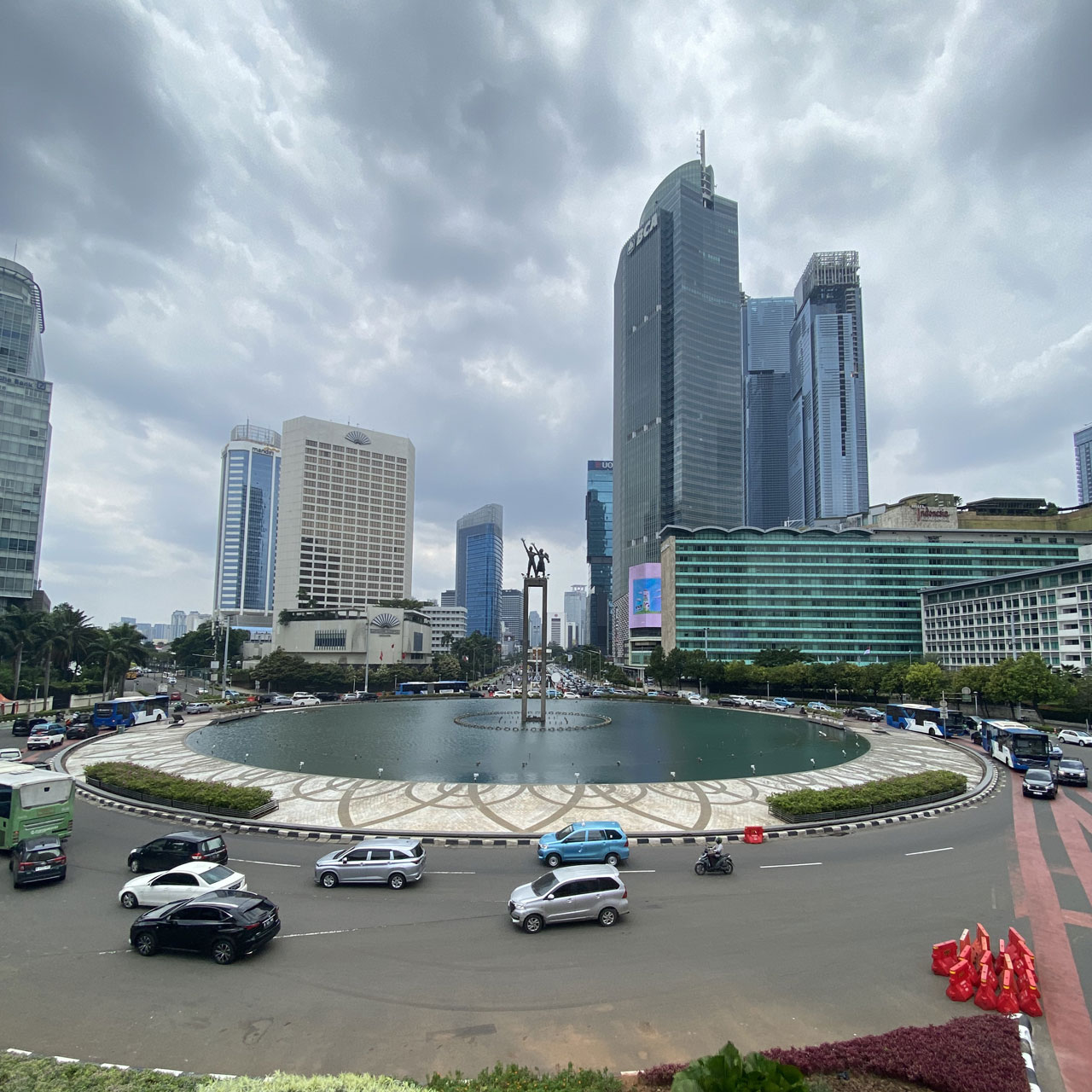
JAKARTA City Center

By John Victor D. Ordoñez, Reporter

JAKARTA, Indonesia — People consider Bali as the premier travel destination in Indonesia, but the bustling city of Jakarta should not be overlooked.

“The Big Apple, the city that never sleeps is not just in New York, but exists right here in Jakarta,” Hari Wibowo, who heads the Marketing and Attraction Division of the Tourism and Creative Economy Office of the Jakarta provincial government, told BusinessWorld earlier this month in Jakarta during a dinner with media representatives from the Philippines.

“Name a type of business and the city is sure to have it.”

Jakarta is a city that boasts of modern innovations while remembering its history as a former Dutch colony.

One could get lost in the endless towering skyscrapers, state-of-the-art malls, and historical monuments that take you back to the 17th century.

CULTURAL ACTIVITIES
My first day exploring the city started on an early Sunday morning when I witnessed Jakarta’s “car-free day.”

Every Sunday, city roads are closed to encourage people to exercise and ride bikes to reduce pollution.

The first stop of our cultural tour of Jakarta was the Kota Tua, which translates to Old Town in Indonesian. The area is a historic district that is filled with colonial-era buildings and cobblestone streets that reflect 17th-century Dutch architecture.

The town also had world-class art galleries featuring both modern and classical pieces in their collections.

For lunch, we headed to the residence of Ethys Mayoshi, owner of Batik Gobang, a traditional Indonesian garment shop in West Jakarta. There, we were introduced to a spread of Indonesian cuisine staples such as nasi goreng, pempek, and satay skewers.

Ms. Mayoshi then walked us through how to craft our own batik designs by drawing outlines of different flowers on white cloth and then tracing them in with melted wax.

The next stop on our tour was Indonesia’s National Monument, also known as Monas, which stands at a towering 433 feet.

The monument, which finished construction in 1975, commemorates Indonesia’s 1949 independence from Dutch occupation.

We were brought to the top of the obelisk in Central Jakarta through its built-in elevator, which gave us an unobstructed view of the city’s skyline.

MODERN CITY SPOTS
It is not hard to get to where you need to be in the city thanks to its integrated public transportation system.

We hopped on Jakarta’s new train and bus transit systems, which are both accessed through the all-in-one Jaklingko card. The card can also be used for various transactions at selected establishments around Indonesia.

After getting off at our last bust stop for the day, we explored the PT Sarinah department store, a state-owned establishment that showcases local businesses.

The store, which opened in 1966, was named after President Sukarno’s childhood nanny. It was made in response to soaring inflation at the time.

The PT Sarinah was the first skyscraper built in Jakarta and has undergone several renovations.

There visitors can shop for traditional Indonesian garments and enjoy dining at restaurants that offer both local cuisine and food from around the world.

We particularly enjoyed a scoop of handcrafted, artisan ice cream from Honest Spoon.

The next stop in our Jakarta shopping expedition was the Thamrin City Mall, which is located beside Grand Indonesia and Plaza Indonesia — two of Jakarta’s biggest shopping centers.

There we experienced bargaining for deals with the little Bahasa Indonesian we had learned. Some of our finds at the market included traditional batik polos and tops, as well as modern iterations of the fabric used in batik kimonos.

THOUSAND ISLANDS
Travelers can also enjoy an island paradise experience which is just a boat ride away from mainland Jakarta.

Kepulauan Seribu — which translates to the Thousand Islands — is a chain of about 342 islands and beaches stretching 45 kilometers into the Java Sea. The islands boast white sand beaches that can rival some of the best in Southeast Asia.

Tidung Island’s Love Bridge is a popular spot for hopeless romantics. Locals believe that a person that jumps into the water from the bridge seven times in a row would soon find their soulmate.

PRIME URBAN DESTINATION
We wrapped up the short tour of Jakarta with dinner at the Tugu Kunstkrin Paleis, which translates to “art circle palace,” a high-end Indonesian restaurant that also has a rich history dating to Indonesia’s colonial past.

The establishment previously served as an immigration office for central Jakarta until the late 1990s. It was then converted into a world-class art gallery that exhibited iconic works by artists such as Vincent Van Gogh and Pablo Picasso.

The restaurant’s interior reflects old Batavia, — Indonesia’s name under Dutch occupation — with antique paintings and accouterments decorating the place.

The restaurant’s menu includes Indonesian classics such as Tempeh, deep-fried soybean cakes, and Satay Lembt Betawi, skewers of spicy minced beef mixed with coconut.

At the dinner, Mr. Wibowo said Jakarta’s tourism office aims to promote the city as a prime urban destination for both business and leisure travelers.

“We see our city as the place to be doing business and leisure as we have many new establishments that tourists can look forward to,” he said at the venue.

Even though tourism numbers are still far from pre-pandemic levels, the easing of travel and health restrictions makes him hopeful that more tourists will be coming to Jakarta, he said.

Jakarta is known for attracting art and music enthusiasts as it routinely holds the Jakarta International Java Jazz Festival, one of the largest jazz festivals in the world.

The city also boasts the largest stadium complex with a retractable roof in Asia — the Jakarta International Stadium which has a seating capacity of 82,000 people.

VISITOR ARRIVALS
Last year, Jakarta reported 14,890 visitor arrivals from the Philippines, significantly more than the 2,540 in 2021, according to data from the Jakarta provincial government.

This is still a far cry from the 57,593 Filipinos who visited Jakarta in 2018 and 2019, before the coronavirus pandemic.

“Hopefully, with more collaborative projects between our two countries this year, we hope to have more Filipino tourists in Jakarta,” Mr. Wibowo said.

Indonesia attracted 5.47 million foreign visitors last year, more than three times the number a year earlier. However, this is still well below the 16.1 million visitors it welcomed in 2019.

The Southeast Asian nation is targeting attracting between 3.5 and 7.4 million foreign tourists this year.

BusinessWorld took part in the Indonesian Embassy’s Jakarta Familiarization trip on Feb. 4-8.

CTA affirms Titanium’s canceled tax liabilities 

CTA.JUDICIARY.GOV.PH

THE Court of Tax Appeals (CTA) has affirmed its ruling that canceled Titanium Corp.’s tax liabilities worth P9.22 million inclusive of interests for the taxable year 2011.

In a 26-page decision dated Feb. 13 and made public on Feb. 16, the CTA full court agreed with its third division that said the commissioner of internal revenue (CIR) did not afford the firm due process when it did not address its arguments in the final assessment notice.

“A party’s fundamental right to due process includes the right to be informed of the various issues involved in a proceeding and the reasons for the decision rendered by the quasi-judicial agency,” Associate Justice Lanee S. Cui-David said in the ruling.

The tax court said Titanium was left unaware of how its arguments disputing the tax assessment were considered.

In a 2020 resolution, the CTA Third Division voided the tax assessment representing the firm’s alleged deficiency income tax, value-added tax, extended withholding tax, withholding tax on compensation, and documentary stamp tax for 2011.

Citing Supreme Court jurisprudence, the tax court said the final decision on the disputed assessment must be canceled since revenue officers were not authorized through a new letter of authority to recommend the issuance of the decision. 

The CIR argued that it duly notified the firm of the factual and legal basis of its issuance of the subject tax assessment. The official said the firm was able to file its protest but did not present any relevant documents to support its defenses against the deficiency tax findings.

The CTA disagreed, saying the final assessment only reiterated the same findings it said in its preliminary notice, without explaining why it rejected the firm’s arguments.

“It is true that the Commissioner is not obliged to accept the taxpayer’s explanations; however, when he or she rejects these explanations, he or she must give some reason for doing so,” the tax tribunal said.

“He or she must give the particular facts upon which his or her conclusions are based, and those facts must appear in the record.” — John Victor D. Ordoñez

Philippines ranks 33rd in economy diversification

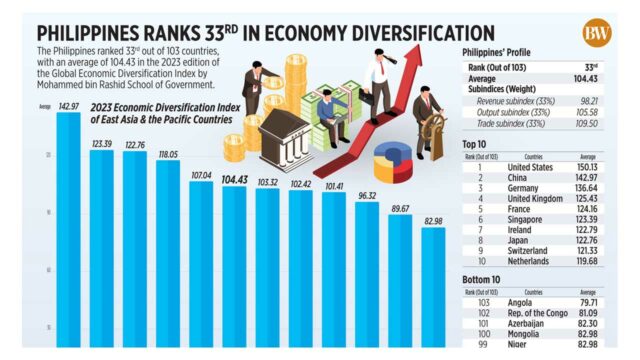
The Philippines ranked 33rd out of 103 countries, with an average of 104.43 in the 2023 edition of the Global Economic Diversification Index by Mohammed bin Rashid School of Government.

Philippines ranks 33<sup>rd</sup> in economy diversification

Two entities barred from securing money service business licenses

BW FILE PHOTO

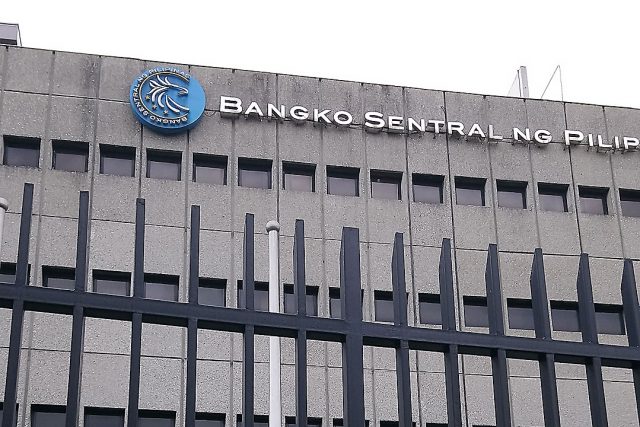
THE BANGKO SENTRAL ng Pilipinas (BSP) has disqualified two firms from securing a money service business (MSB) licenses after they were found operating as such without proper registration.

A circular letter signed by BSP Deputy Governor Chuchi G. Fonacier dated Feb. 15 said the Monetary Board has disqualified Kidlat Fast Cash, Inc. and Tong’s Money Changer from registering with the central bank.

The two firms were disqualified from obtaining a license to engage in any activity supervised by the BSP after operating as MSBs without prior BSP registration.

Any sole proprietorship owned and controlled by their owners has also been banned from registering with the BSP.

Kidlat Fast Cash, Inc. was located in Dumaguete City, Negros Oriental with Ernesto R. Ramas-Uypitching as one of the owners, while Tong’s Money Changer is located in Panglao, Bohol, with Jered Jane Yap as the point person.

The disqualification is in accordance with Section 901-N of the BSP’s Manual of Regulations for Non-Bank Financial Institutions.

The central bank earlier said that disqualifying firms is part of its efforts to address the proliferation of entities operating unauthorized MSBs.

Pawnshops, along with foreign exchange dealers, money changers, and remittance agents, are considered as MSBs by the BSP.

As of end December 2022, BSP-registered money service businesses had 7,584 head offices and branches nationwide.

Pawnshops and MSBs are seen by the BSP as access points for the financially unserved and underserved areas in the country. — K.B. Ta-asan