Home Blog Page 51

The growing cybercrime economy: Why business defenses must evolve

STOCK PHOTO | Image by Hack Capital from Unsplash

By Subhalakshmi Ganapathy

CYBERCRIME now operates like a legitimate, profit-driven economy. Organized groups mirror corporate structures and have specialized roles such as research and development, marketing, and customer support. As a result, cyberattacks are more scalable, efficient, and accessible than ever, transforming the threat landscape for businesses.

An example of this transformation is the rise of subscription-style cybercrime offerings such as ransomware-as-a-service (RaaS). The ready-made attack tools sold on underground marketplaces offer structured pricing tiers, user dashboards, and technical support that have effectively lowered the traditional entry barriers confronting budding cybercriminals.

While individuals with limited technical expertise can purchase exploit kits, stolen data, or phishing services to immediately launch attacks, the developers of these tools relentlessly refine their products, similar to legitimate technology companies.

This growing industrialization is expected to drive global cybercrime losses to around $10.5 trillion annually, according to Cybersecurity Ventures. Meanwhile, Deloitte’s Center for Financial Services estimates that synthetic identity fraud alone could generate global losses of at least $23 billion by 2030.

Countries like the Philippines are already seeing the impact. In the third quarter of 2025, over 52 million personal credentials were exposed in data breaches, representing a 49% increase compared with earlier in the year. At the same time, about 52% of Filipinos report having been scammed at least once in their lifetime, compared to the ASEAN regional average of 45%.

The financial implications are not to be taken lightly. In 2024, cyberattacks cost financial institutions some P5.82 billion, a 2.6% year-on-year increase according to the Bangko Sentral ng Pilipinas (BSP).

MODERNIZATION RISKS
The growing precarity comes as digital transformation continues in the Philippines. Growing cloud adoption, rapid expansion of financial technology platforms, and more public services moving online come as the country jumps to 137 million active mobile cellular connections, or about 117% of the population.

While this connectivity fuels innovation and is an economic growth driver, it also expands the attack surface for cybercriminals; digitizing more operations inevitably increases the number of potential entry points into corporate networks.

The government, to its credit, has recognized the need for a nationwide approach by introducing the National Cybersecurity Plan 2023-2028, but that will require enterprises to take these risks seriously and not treat them as a mere box to check.

RESILIENCE REQUIRES MORE THAN JUST BUDGETS
While the national cybersecurity market is expected to reach $282.68 million this year and expand further to $417.12 million by 2031, cyber resilience requires more than just spending on advanced security tools.

This is due to the borderless nature of cybercrime today. Cyber attackers operate across jurisdictions by sharing intelligence, tools, and techniques in online communities that allow them to collaborate globally and innovate faster than many traditional corporate security teams.

The writing is on the wall: Reactive cybersecurity strategies are no longer sufficient. Organizations must move toward proactive and layered defenses designed to anticipate and mitigate threats before they escalate.

BUILDING PROACTIVE CYBERSECURITY
A key tenet of proactive cybersecurity is the adoption of Zero Trust. Under this cybersecurity model, network location and assumed trust are earned and not given automatically. Instead, every user, device, and request is authenticated and verified continuously before access is granted.

Automation is another critical capability. With the sheer volume and speed of cyberthreats today, manual monitoring alone is insufficient. Automated threat detection and response systems improve agility, curbing incidents before they spread across the network. This also allows IT teams to focus on higher-level analysis and strategic decision-making rather than routine monitoring.

SECURITY: THE NEW LEADERSHIP MANDATE
Identity and access management must be tightly integrated into the broader security framework. As distributed environments render perimeter-based defenses less effective, controlling who can access systems under what conditions becomes increasingly important.

Central to the fight today is visibility. Continuous monitoring across endpoints, networks, and identities enables organizations to detect subtle warning signs that an attack may already be underway. With better visibility, security teams can identify unusual behavior patterns early and respond before significant damage occurs.

Ultimately, the expanding cybercrime economy is transforming cybersecurity from a purely technical concern into a strategic leadership issue. Protecting digital assets is now directly tied to revenue protection, regulatory compliance, business continuity, and long-term customer trust.

As cybercriminals continue to evolve and operate with increasing sophistication, businesses must respond with equally advanced defenses. Proactive, automated, and identity-driven security strategies are essential for Philippine financial players seeking to compete and grow safely in today’s increasingly digital economy.


Subhalakshmi Ganapathy is the chief IT security evangelist at ManageEngine.
Megaworld expands LEED portfolio to 32 with Iloilo office tower

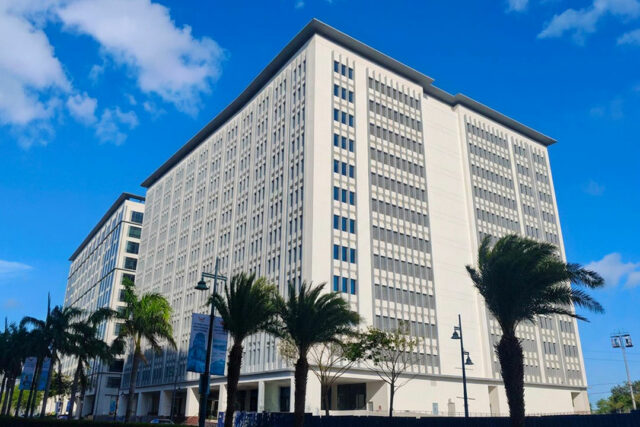
ENTERPRISE TWO in Iloilo Business Park — MEGAWORLD CORP.

TAN-LED Megaworld Corp. has expanded its portfolio of Leadership in Energy and Environmental Design (LEED)-certified and registered office properties to 32 after its new office tower in Iloilo City secured LEED Gold certification.

In a disclosure on Wednesday, the company said its 12-storey office tower, Enterprise Two, located within the 72-hectare Iloilo Business Park, received LEED Gold certification from the US Green Building Council (USGBC).

Enterprise Two offers 39,000 square meters (sq.m.) of gross leasable space, making it one of Megaworld’s larger office developments in Western Visayas. The building has floor plates of up to 4,000 sq.m., which can accommodate information technology and business process management (IT-BPM) firms and other companies expanding in the region.

The tower is the second LEED Gold-certified office building in Western Visayas, following Enterprise One, which was the first in the region to receive the certification.

Megaworld now has 24 LEED-certified office buildings, including 12 with Gold certification and 12 with Silver. Other developments remain registered for LEED certification, with additional approvals expected this year.

“Designed with sustainability at its core, the building [Enterprise Two] incorporates a range of green features, including a rainwater harvesting system, double-glazed windows for improved energy efficiency, a highly reflective roof coating to reduce heat island effect, and low-flow water fixtures in restrooms,” Megaworld said.

“It also promotes eco-friendly mobility through electric vehicle charging stations, bicycle racks, and convenient access to public transportation,” it added.

LEED, developed by the USGBC, is a global building rating system used to assess the environmental performance and efficiency of buildings.

Megaworld’s LEED Gold-certified office buildings include 8 Campus Building A, B, and C and Southeast Asian Campus in Taguig; 10 West Campus and One Le Grand Tower in McKinley West; Worldwide Plaza (JPMorgan Chase Tower) and Uptown Eastgate in Uptown Bonifacio; One Paseo in Pasig; No. 1 Upper East Avenue in Bacolod; and Enterprise One in Iloilo City.

LEED Silver-certified buildings include Uptown Place Towers 1, 2, and 3; Alliance Global Tower; International Finance Center (JPMorgan Chase Center) in Uptown Bonifacio; Le Grand Avenue Towers 5, 9, 11, 15, 19, and 21 in McKinley West; and Pasudeco Tower in San Fernando, Pampanga. — Alexandria Grace C. Magno

Dining In/Out (04/09/26)


Michelin-starred six-hands collab at Crystal Dragon

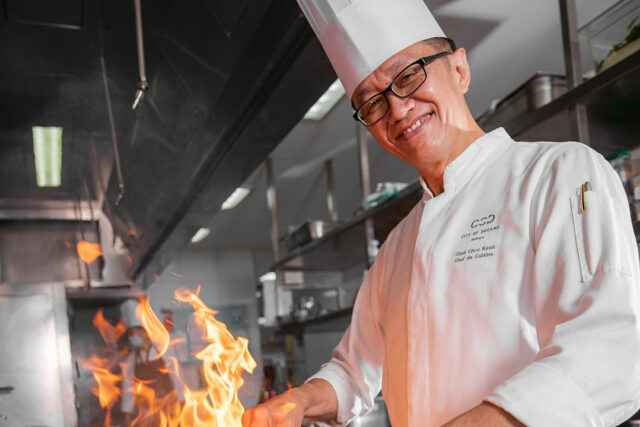
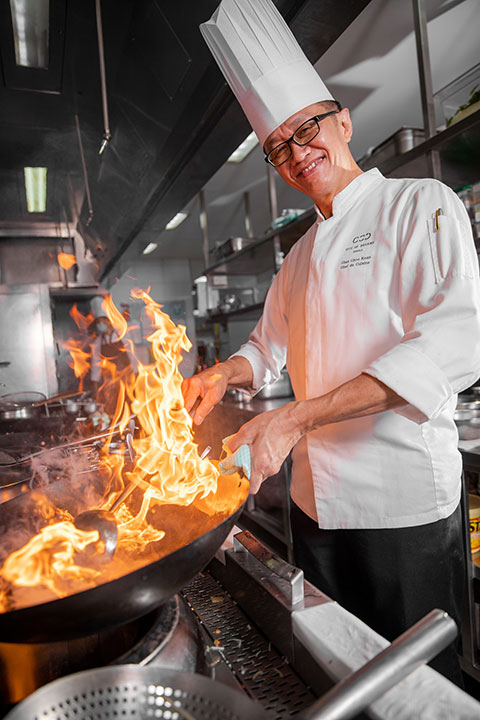
AN EXTRAORDINARY culinary collaboration unfolds at City of Dreams Manila as Crystal Dragon hosts “The Dragons’ Ascent.” This is a one-night-only Michelin-starred six-hands dinner on April 11 at 6 p.m. The 72-seat event brings together the culinary masters behind Melco Resorts & Entertainment’s acclaimed Dragon restaurants: Macau’s three-Michelin-starred Jade Dragon, and one-Michelin-starred Pearl Dragon, and the multi-awarded Crystal Dragon in Manila, for a first-ever collective gastronomic showcase. The evening features a six-course tasting menu presenting the signature modern Cantonese dishes of each restaurant, along with a special co-creation dish exclusively for this event: The Collaboration Appetizer is a fried Iberico pork and spring onion roll, chilled Mantis prawn with yellow bean sauce and Oscietra caviar, and crispy goose liver and tangerine-peel bean curd. The Three-Star Exports include Jade Dragon’s hot and sour soup with fish maw and leopard coral grouper, and baked stuffed crab shell with mushroom and black truffle. The Manila Showcase is Crystal Dragon’s steamed Australian lobster with egg white and aged Hua Diao wine, while Pearl Dragon presents a South African dried abalone and Wagyu beef cheek puff, ending with a Sweet Finale of Chocolate Kalamansi Cremeux with Moringa Sherbet. Leading the culinary symphony is Jade Dragon Executive Chef Kelvin Au Yeung at City of Dreams Macau, and Pearl Dragon Executive Chef Otto Wong at Studio City Macau. The special dinner is at P11,888 net per person inclusive of pre-dinner cocktails and canapés, from 6 to 7 p.m., with the option for dinner wine-pairing at P2,500 net per person. For reservations, call 8800-8080, call/message Viber 0917-550-2587, e-mail crystaldragon@cod-manila.com, or visit https://www.cityofdreamsmanila.com/en.


DTI’s National Food Fair ongoing at Megamall

THE Department of Trade and Industry (DTI) mounts the 2026 DTI-Bagong Pilipinas National Food Fair (NFF) from April 8 to 12 at the Megatrade Halls of SM Megamall. The event features over 320 micro, small, and medium enterprises from across the country which are engaged in food manufacturing, processing, and related enterprises. The NFF will showcase a wide range of regional flavors and culinary innovations from Luzon, Visayas, and Mindanao. These include food concepts developed by former overseas Filipino workers who have transitioned into entrepreneurship. This year’s Fair will highlight the coconut industry, one of the country’s priority agricultural sectors. A dedicated Halal segment features certified and Halal-ready products. The fair is open to the public, with free admission.


Hanabishi holds major clearance sale

CURRENTLY ongoing at the brand’s official website (https://myhanabishi.com/collections/on-sale) while stocks last, the Hanabishi Summer Clearance Sale offers up to 43% discount on kitchen essentials, cooling solutions, home products, and more. Those who are planning summer barbecues can consider adding the Hanabishi Smokeless Infrared Griller, a no-smoke and no-grease indoor barbecue; Hanabishi Electric Grill, which has a non-stick marble ceramic coating cooking plate; and the Hanabishi Smokeless Indoor Grill, which has a non-stick ceramic grill plate with a built-in exhaust fan to their cart now, as they are available at big discounts. Other additions to the kitchen would be the Hanabishi Inverter Chest Freezer 3.6 Cuft and the Hanabishi Hand Mixer, which are available at much lower prices. The clearance sale also includes the Hanabishi 1.5L Pink Rice Cooker – Glass Lid, Hanabishi Oven Toaster in red and white, and the Hanabishi Water Kettle. Those who are looking to replace or add a new fan or air conditioner for their home can check out the Hanabishi Industrial Wall Fan and the Hanabishi Split Type Airconditioner (Zen Series and Standard models) that are now available at significant price drops. Other home essentials included in the sale are the Hanabishi Twin Tub Washing Machine 8.5Kg Capacity, now available at 43% off, and cleaning and sterilizing products such as the Hanabishi Air Purifier, Hanabishi Dish Washer, Hanabishi Dish Washer With UV Sterilizer, Hanabishi Portable UVC Sterilization Bag, and Hanabishi Portable UVC Sterilization Wand. Also on sale are anti-mosquito products like the Hanabishi Indoor Mosquito Trap, Hanabishi Indoor Mosquito Trap, and Hanabishi Outdoor Mosquito Trap.


DQ releases Belgian Chocolate Cake collection

THIS SEASON, DQ’s latest Blizzard of the Month offer is the new Belgian Chocolate Cake Delights collection, available for a limited time only. These include the Belgian Chocolate Black Forest Blizzard (starts at P129), made with Belgian chocolate soft serve mixed with real cherries and chocolate chunks, and then topped with whipped cream and more cherries; Belgian Chocolate Black Forest Tin Cake (P499), a 100% ice cream cake made with Belgian chocolate soft serve, real cherries, and chocolate chunks, all contained in a reusable tin. There’s also the new Belgian Chocolate Black Forest Blizzard Cake (starts at P949), a 100% ice cream cake made with Belgian chocolate soft serve, signature cake crunch, and chocolate fudge, real cherries and chocolate chunks, all wrapped in frosting sprinkled with chocolate shavings and topped with more cherries and a DQ sandwich wafer. The new Belgian Chocolate Cake Delights collection also comes with other treats: Belgian Chocolate Campfire Blizzard (starts at P129), Belgian chocolate soft serve mixed with caramel fudge, marshmallows, graham crackers, and chocolate chunks, topped with whipped cream and caramel fudge drizzle; Belgian Chocolate Mudpie Blizzard (starts at P129) is made with Belgian chocolate soft serve infused with coffee concentrate, chocolate fudge, and brownies, and topped with whipped cream and a drizzle of chocolate fudge; and Belgian Chocolate & Vanilla Parfait (P209), made with chocolate fudge and cake crunch in between layers of vanilla soft serve and Belgian chocolate soft serve, topped with whipped cream and a DQ sandwich wafer.


Jollibee launches budget-friendly summer treats

JOLLIBEE has introduced its “Summer Delights,” headlined by the Strawberry Burst Choco Sundae (P65), combining chocolate and strawberry with popping boba. Customers can also opt for familiar coolers such as Iced Mocha and Soda Float. Complementing these are the Fries Snack Combos which pair fries with a choice of Choco Sundae, Mini Choco Sundae, or a Soda Float. The combinations are available in different sizes to suit both individuals and groups. The Summer Delights products are now available nationwide in all Jollibee stores for dine-in, takeout, and drive-through.

Ushering the EV era

STOCK PHOTO | Image from Freepik

For ordinary Filipinos who take public transportation, drive to work, haul goods, or run a business, the arithmetic has changed. And when the arithmetic changes at the fuel pump, people begin to look for alternatives. In the last several weeks, electric and hybrid transportation have become very attractive.

In a column in December 2024, I noted four future trends: Chinese EV brands would dominate; charging infrastructure would be the main bottleneck in EV adoption; hybrids would outsell full battery electric vehicles in the short term; and rising fuel prices could accelerate the entire process.

True enough, the unexpected oil shock that resulted from the ongoing Middle East conflict has just pushed all four trends into sharper view. What looked then to me like an emerging pattern is now marking the beginning of a market shift. And the shift, in my opinion, will continue even as oil prices eventually stabilize.

Official industry data showed electric vehicle sales rose by 18% month on month in February, and by 70% from a year earlier. Hybrids accounted for most of the volume, with battery EVs and plug-in hybrids also posting strong gains. Full March industry figures are not yet out.

But the number of EV dealerships opening up is an early sign of a mainstream shift, driven not by environmental idealism but by the urgent desire to mitigate surging fuel prices. BusinessWorld and Reuters have both reported that the fuel crisis is driving EV demand, especially in oil import-dependent markets.

And what is leading the surge are hybrids, not pure EVs. A hybrid keeps a gasoline engine as backup and does not depend entirely on a charging network that remains thin outside major urban centers. It addresses range anxiety without requiring a quick solution to the charging infrastructure problem.

A hybrid is a transition technology, a bridge between the world we have and the one we are trying to build. And for the practical Filipino buyer looking for quick relief from surging fuel prices, that bridge is the most sensible choice right now. That practicality is shown in the present sales mix.

Reuters reported that BYD is targeting 1.5 million overseas sales in 2026, and that overseas markets accounted for about 45.8% of its first-quarter sales. Chinese EV makers are pushing into import-dependent Asian markets when high fuel prices are making their value proposition easier to explain.

Locally, BYD Cars Philippines reported over 26,000 sales in 2025, up over 440% from the previous year. VinFast has been expanding its Philippine footprint as well, pairing dealership growth with pricing and financing structures aimed at lowering the upfront cost of ownership. Locally, affordability always comes first. And the company that can offer a credible vehicle at a lower monthly cost has the advantage.

Japanese carmakers are not absent from this transition. But they are arriving through a different door. Toyota has entered the battery EV conversation from the higher end of the market. Its Urban Cruiser BEV starts at over P2 million, which makes it credible but still beyond the reach of many Filipino buyers.

Mitsubishi Motors, meantime, said that subject to approval under the government’s Electric Vehicle Incentive Strategy program, Mitsubishi Motors Philippines would produce a new hybrid electric vehicle model at its Santa Rosa, Laguna plant around the middle of 2028.

That move will involve investment in facilities and equipment, expansion of the local supply chain, and additional jobs, which is more important than a showroom launch. It also suggests that at least one major Japanese manufacturer now sees where Philippine sales data already points: hybrids, not pure EVs.

However, I believe that trust remains a real issue for newer EV brands. Many Filipino buyers are still building familiarity with BYD, VinFast, and their peers. Concerns about battery life, long-term durability, resale value, and after-sales support remain, especially outside Metro Manila where service networks are still thinner. This is not a fatal problem, but it is a real one. Low sticker prices can open the door. But they do not, by themselves, close the trust gap.

The harder constraint is infrastructure. The Department of Energy said in 2025 that the country had nearly 1,100 charging stations, mostly in urban areas, while the target is around 7,300 nationwide by 2028. That gap is enormous. Until that network exists, hybrids will continue to hold the stronger hand.

It is also not just a question of quantity. It is a question of geography. Chargers in malls and premium urban districts are useful, but they do not solve the problem for the truck driver on a Luzon highway, the transport operator in Iloilo, or the family in Cagayan de Oro weighing whether to go electric. The charging network the country needs runs along national roads and into secondary cities, not only into parking basements.

The Philippines also lags its neighbors in attracting EV manufacturing investment, and that has a direct cost to consumers. Thailand and Indonesia have used industrial policy, incentives, and scale to position themselves as regional EV production hubs.

The Philippines has relied more on import liberalization, including zero tariffs on certain EVs and components through 2028. Only one carmaker, Mitsubishi, is making the leap so far.

This proves that the country can still build a domestic foothold in the transition, if appropriate policies are put in place.

Also a consideration is how much the EV transition will cost the government in foregone fuel tax revenue, and is that a problem worth worrying about. The longer structural question is what replaces fuel tax revenue (excise and value-added taxes) as transport operators and motorists shift to EVs.

That fuel tax base will shrink for sure, and the present oil shock may simply speed up the process, especially with the President having the authority to temporarily suspend or reduce fuel excise taxes if the world crude price exceeds a certain threshold.

Reports cited by BusinessWorld said a tax suspension from May to December could cost the government about P136 billion in foregone excise taxes, excluding additional VAT effects, for that period. And if tax erosion is made permanent by the EV transition, what happens to government spending?

Long-term thinking tells me that pouring more political capital into defending a revenue line that is bound to erode is the wrong fight. The better approach is to design the replacement now. While fuel taxes raise significant revenues today, the decline is coming. Meantime, many EV incentives end in 2028.

In the transition, perhaps Congress should consider a road-use charge for EVs that reflects their actual use of infrastructure; rational taxation of commercial charging; and, a public policy framework that extends charging beyond the profitable urban core. These can start as soon as EV incentives end.

The EV transition in the Philippines is no longer just a policy ambition or an environmental slogan. It is becoming an economic response to a crisis. The current oil shock may prove to be more than a temporary disruption. It may become the event that changed consumer behavior for good.

The driver watching the meter spin at the pump, the family postponing a gasoline car purchase, the logistics company recalculating its fuel bill for the next quarter, all of them are doing the same math now. The market is moving. The infrastructure and the fiscal framework need to move with it.


Marvin Tort is a former managing editor of BusinessWorld, and a former chairman of the Philippine Press Council.

matort@yahoo.com

Peso surges on US-Iran ceasefire deal

BW FILE PHOTO

THE PESO jumped to the P59-a-dollar level on Wednesday, logging a near one-month high after Iran agreed to a two-week ceasefire with the United States and reopened the Strait of Hormuz.

The local unit surged by 90 centavos to end at P59.43 against the greenback from its P60.33 finish on Tuesday, data from the Bankers Association of the Philippines showed.

This was its largest one-day gain since it advanced by 96 centavos on Nov. 11, 2022 to close at P57.23.

This was also the peso’s strongest close in almost a month or since it ended at P59.385 on March 12.

The currency opened Wednesday’s session sharply stronger at P59.661 per dollar. It traded at the P59 level the entire day, with its intraday best at P59.291 and its weakest showing at P59.70 against the greenback.

Dollars traded surged to $2.479 billion from $1.68 billion on Tuesday.

The peso strengthened as Iran’s deal with the US and the reopening of the Strait of Hormuz caused the greenback and global oil prices to retreat, the first trader said in a phone interview.

“The peso rebounded significantly back to the P59 level from market optimism following the two-week military ceasefire, which was mutually agreed on by the US and Iran,” a second trader said in an e-mail.

The US dollar index, which measures the greenback’s strength against a basket of six currencies, weakened for a third consecutive day to lows of 98.838, its weakest since March 11, Reuters reported.

Brent crude slid 13.4% to $94.68 a barrel but was still well above prewar levels.

Philippine financial markets are closed on Thursday (April 9) for the Day of Valor holiday.

For Friday, the first trader said players could remain cautious as they watch developments between the US and Iran. The first trader sees the peso moving between P59.20 and P59.70 per dollar, while the second trader expects it to range from P59.30 to P59.55. — Aaron Michael C. Sy

TikTok to build a second billion-euro data center in Finland

REUTERS

HELSINKI/STOCKHOLM — TikTok plans to invest €1 billion ($1.16 billion) to build a second data center in Finland in less than a year as it moves data storage for European users to the continent, company officials said on Wednesday.

The announcement comes as TikTok’s Chinese parent ByteDance in January avoided a US ban over data protection concerns and as European nations ratchet up pressure on social media companies to protect children from their addictive algorithms.

TikTok said it was making a new €1-billion investment in a data center with an initial capacity of 50 megawatts (MW) and a total potential capacity of 128 MW in Lahti, located in southern Finland.

The investment is part of the company’s “12 billion (euro) European data sovereignty initiative delivering industry-leading protections for the data of over 200 million European users,” it told Reuters.

CONCERNS OVER DATA PROTECTION
Finland has become a magnet for data centers as companies including Microsoft and Google look to curb energy costs and meet climate goals, drawn by the country’s cold climate, low-cost and low-carbon electricity, and a stable, business-friendly regulatory environment within the European Union.

But Finnish politicians were alarmed by TikTok’s plan for its first data center in Finland after Reuters revealed it in April last year.

While Finland’s defense ministry had approved the investment in 2024, politicians had not been informed. Finland’s then-minister of economic affairs Wille Rydman last year called for the project to be “reconsidered” due to security concerns and lack of openness around the company’s plans.

“At the very least, I would hope that this property development company would reconsider once more whether it really wants TikTok as its tenant,” Mr. Rydman told Finland’s public broadcaster Yle, referring to TikTok’s local partner.

TikTok said its European user data is currently stored with enhanced safeguards across three data centers in Norway, Ireland, and the US. Its first Finnish data center in Kouvola is to be operational by the end of this year, with the second one up by 2027.

The mayor in Lahti celebrated the fresh investment decision.

“In the context of Lahti, the investment is substantial. We are pleased that a main tenant agreement has been signed and that the project is progressing as planned,” Lahti Mayor Niko Kyynarainen said in a statement. — Reuters

SEC orders catering firm to stop alleged investment solicitation

BW FILE PHOTO

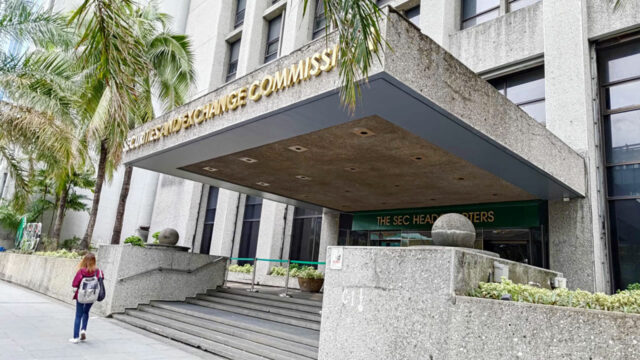
THE SECURITIES and Exchange Commission (SEC) has issued a cease-and-desist order (CDO) against Melot’s Catering Services, its point person, and its agents for the alleged unauthorized solicitation of investments from the public.

In an order dated March 14, the SEC’s Enforcement and Investor Protection Department (EIPD) directed Melot’s Catering Services, its point person, and its agents to immediately stop selling or offering unregistered securities until they secure the required Commission approvals.

The order also directed them to take down their online presence related to the investment scheme.

“They were also prohibited from transacting any business involving funds in its depository banks and from transferring, disposing and conveying real and personal assets, including bank deposits, to preserve the assets for the benefit of investors,” the Commission said in a statement on Wednesday.

The SEC issued the CDO after reports that Melot’s Catering Services, through its point person, had been soliciting investments from the public to fund kitchen expansion and renovations.

An EIPD probe found that the firm is not registered with the SEC as a corporation or partnership and does not have a license to offer securities.

The Commission said Melot’s Catering Services promoted the investment scheme on social media, requiring a minimum placement of P50,000 and promising a 10% monthly return over six to 12 months.

“[T]he act of Melot’s Catering Services through a point person and its agents in selling/offering unregistered securities operates as a fraud to the public which, if unrestrained, will likely cause grave injury or prejudice to the investing public,” the order read.

“Unless restrained, the act of Melot’s Catering Services through its point person and its agents in selling/offering unregistered securities constitutes a continuing violation of the provision of the SRC and the FCPA,” it added.

Section 8 of Republic Act No. 8799, or the Securities Regulation Code (SRC), prohibits the sale, offer, or distribution of securities unless a registration statement has been filed with and approved by the Commission. Section 28 requires that persons engaged in the buying or selling of securities be registered with the SEC as a broker, dealer, or salesperson.

The SEC said the alleged unauthorized investment scheme may constitute financial fraud under Republic Act No. 11765, or the Financial Products and Services Consumer Protection Act (FCPA).

In October 2025, the Commission issued an advisory warning the public against investing in schemes linked to Melot’s Catering Services.

BusinessWorld was unable to reach Melot’s Catering Services. Its website and Facebook page were not accessible as of writing. — Alexandria Grace C. Magno

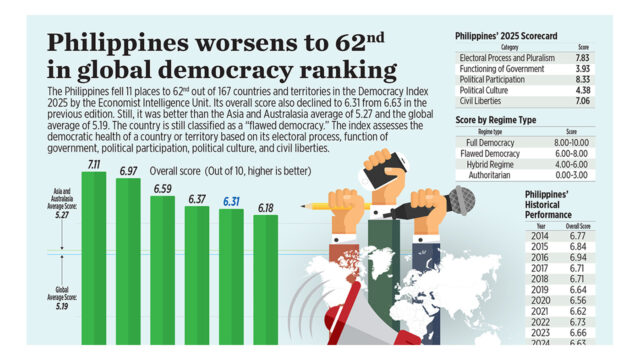
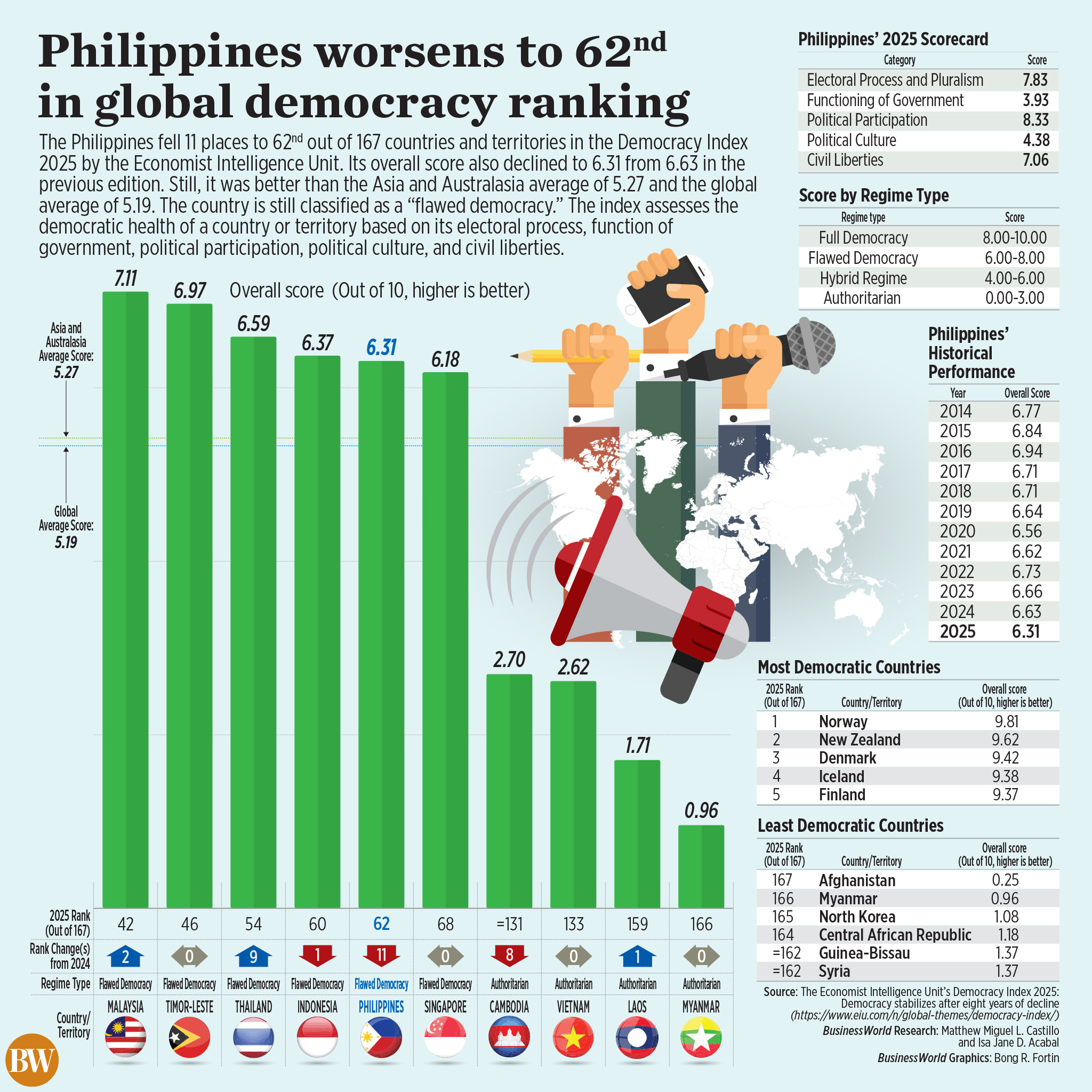
Philippines worsens to 62nd in global democracy ranking

THE PHILIPPINES fell sharply in a global democracy ranking, signaling deeper institutional strain even as democratic conditions elsewhere show signs of leveling off, according to the 2025 Democracy Index by the Economist Intelligence Unit (EIU). Read the full story.

The Testaments series follows a new generation of girls growing up in Gilead

The Testaments (2026)

LOS ANGELES — Blue Jean actor Lucy Halliday says the bonds formed between young girls in times of adversity are at the heart of what makes the Hulu drama series The Testaments special.

“We see that in our show, and it’s a really beautiful thing — that friendship can flourish even in the darkest of places,” Ms. Halliday said of the coming‑of‑age drama, which continues the story of Hulu’s The Handmaid’s Tale.

“Sisterhood and community have always been important, and they’ve always been a means of survival,” she added.

Created by Bruce Miller and based on Margaret Atwood’s 1985 novel, The Handmaid’s Tale depicts the totalitarian society of Gilead, a religious extremist regime ruled by powerful men who subjugate women following war and collapsing fertility rates. Some women, known as handmaids, are forced into reproductive servitude for elite, infertile families.

The Testaments is set years later and follows two teenage girls — Agnes, played by One Battle After Another actor Chase Infiniti, and Daisy, portrayed by Ms. Halliday — as they come of age within the same oppressive system.

Agnes has spent most of her life in Gilead, raised to be pious and obedient, while Daisy arrives from Canada as a recent convert.

The girls meet at a Gilead preparatory school for future wives, overseen by Aunt Lydia, played by Ann Dowd, reprising her role from The Handmaid’s Tale.

Ms. Dowd said viewers will see a subtly changed Lydia this time around compared to her explosive and violent-tempered demeanor in the original series.

“I think we see a gentler Lydia, someone who has changed inwardly,” she said, teasing the character’s new mission to reform Gilead as headmistress of a school for daughters of the regime’s most powerful families.

Ms. Infiniti cautioned, however, that The Testaments continues to explore the same cycle of subjugation that defined both the original novel and series.

“Everything that she (Margaret Atwood) writes is pulled directly from history, so unfortunately none of it is new,” said the Golden Globe‑nominated actor.

“Going to set every day and seeing what these girls have to go through — and how their stories unfold — made us feel incredibly fortunate to be able to tell this story,” she added.

The Testaments premieres on Wednesday on Hulu. — Reuters

Gold keeps winning the battle with economists

FREEPIK

By Aaron Brown

GOLD is trading near $5,000 an ounce. And yet, in the middle of the US and Israeli war on Iran and as foreign central banks sell Treasuries to defend their currencies and bond yields rise instead of fall, the precious metal has barely budged even as the world’s monetary authorities — the very institutions built to make gold obsolete — buy it at the fastest pace in a generation.

This is not supposed to be happening. The economics profession declared gold a “barbarous relic” a century ago and has spent most of the time since trying to make that verdict stick. It keeps losing.

The opening shot was fired by John Maynard Keynes in 1924. The gold standard, he wrote, was a primitive monetary technology that enlightened modern economies had outgrown. The future belonged to managed currencies, run by expert institutions. His view largely prevailed at Bretton Woods in 1944, where gold was kept as a nominal anchor — convertible to dollars at $35 an ounce — but effectively demoted to figurehead status.

Round one to the economists. Gold was caged.

Or was it?

On Aug. 15, 1971, President Richard Nixon announced that the dollar would no longer be convertible to gold. Economists mostly cheered. Milton Friedman had long argued that floating exchange rates managed by disciplined central banks were superior to the gold standard’s rigidities. The profession was nearly unanimous: Gold was a historical curiosity. You couldn’t run a modern economy tethered to something you dug out of the ground.

Gold’s revenge was swift and embarrassing. Within nine years it had risen from $35 to $850 an ounce — a gain of more than 2,300%. The 1970s, which were supposed to demonstrate the superiority of managed currencies, produced instead stagflation and a dollar that lost more than half its purchasing power. Investors who held cash lost 87% of their real wealth. Those who held the barbarous relic quadrupled theirs.

Round two to gold.

Federal Reserve Chairman Paul Volcker came out swinging in 1979 and soon raised interest rates to 20%, crushing inflation and restoring the credibility of managed money. Gold collapsed — from $850 in 1980 to $255 by 1999, an 85% real loss over two decades. European central banks, in the ultimate act of institutional contempt, began actively selling their reserves. The Bank of England sold 395 tons between 1999 and 2002, at almost the exact bottom — a transaction that became known in the British press as “Brown’s Bottom” after Chancellor Gordon Brown, who ordered it.

Round three to the economists, decisively.

Then came 2008 and the global financial crisis. Lehman Brothers Holdings, Inc. collapsed, governments deployed trillions of dollars in emergency stimulus, and real interest rates turned negative. Gold remembered its lines. From $800 at the depths of the crisis, it climbed to $1,921 by 2011. The economists’ institutions were visibly struggling. Gold, which has no management, no board of directors, and no leverage, sat there looking smug.

But the most consequential round in the modern era had nothing to do with inflation. It was about something more fundamental: whether dollar-denominated assets are truly safe.

On Feb. 26, 2022, two days after Russia invaded Ukraine, the US and its allies froze $300 billion of Russian central bank reserves held in Western institutions. Every non-aligned central bank got the message. Assets held in dollars, euros, or pounds could be confiscated. There was precisely one major reserve asset that could not be frozen by SWIFT, seized by court order, or inflated away by someone else’s monetary policy. It cannot be hacked and it doesn’t require trusting any institution or government.

Which explains why central banks bought a record 1,080 tons of gold in 2022, the most since the gold standard era, and have maintained that pace since. The buyers were China, India, Turkey, Poland, Singapore — countries that watched the Russian sanctions and drew their own conclusions.

For the first time since 1996, global central banks now hold more gold in aggregate than US government bonds. That milestone arrived quietly, with little fanfare, but it represents a structural shift in how sovereign institutions think about reserves.

This is what separates the current gold rally from previous ones. Earlier bull markets were driven by retail investors and inflation fears. This one is being driven by sovereign institutions making a deliberate, long-term strategic choice. It is not inflation hedging. It is geopolitical insurance. And it is a vote of no confidence in the system Keynes and his successors built.*

Which brings us back to the Iran war, and to gold near $5,000.

The conventional haven trade in every previous crisis since the financial crisis — the global COVID-19 pandemic, Russia’s war on Ukraine, the European debt crisis — was into US Treasuries. Yields fell, the dollar strengthened, and the system worked as designed. In the Iran war, foreign central banks have sold $82 billion in Treasuries in five weeks. Yields have climbed. The petrodollar recycling loop — Gulf oil revenues flowing back into US government debt — has seized up as the Strait of Hormuz closes. And gold has held near record highs throughout.

The pattern is now legible. Gold doesn’t perform best when inflation is high. It performs best when trust in monetary institutions is low — when the world’s central banks look at their reserve assets and quietly conclude they would prefer something no government can confiscate. That condition predates the Iran war and will survive it.

Keynes was right that gold’s monetary role is a convention, not a law of nature. What he underestimated is how hard it is to replace a convention that combines liquidity, neutrality, durability, and freedom from political risk — especially when the institution maintaining the alternative is also the world’s largest debtor, the issuer of its own reserve currency, and the aggressor in a major war.

Gold has been making this argument for 5,000 years. The economists have been rebutting it for about 300. The current score, on points, favors the metal.

BLOOMBERG OPINION

*Gold’s argument for the monetary throne has acquired an unlikely understudy. Bitcoin was invented in 2008 and its founding logic mirrors gold’s exactly: a fixed supply, immune to debasement, beyond the reach of any government.

RCBC raises P20.5B via three-year bonds

BW FILE PHOTO

RIZAL Commercial Banking Corp. (RCBC) has raised P20.5 billion from the sale of three-year ASEAN Sustainability bonds, marking its largest peso debt issuance so far.

The Yuchengco-led bank on Wednesday listed the latest bond issue on the Philippine Dealing and Exchange Corp. (PDEx), it said in a disclosure to the stock exchange.

“This is a significant milestone as RCBC’s largest peso-denominated issuance to date. The bonds saw robust demand from retail and institutional investors resulting in an orderbook more than four times the announced minimum issue size of P5 billion,” the bank said.

The strong demand allowed RCBC to end the public offer period on March 17, just five days after the start date and well ahead of the original March 27 schedule.

The notes carry a coupon rate of 6.08% and were offered at a minimum investment of P100,000, with additional increments of P10,000.

Proceeds will be used to finance or refinance eligible green and social projects under the bank’s Sustainable Finance Framework.

RCBC tapped Standard Chartered Bank and RCBC Capital Corp. as joint lead arrangers and bookrunners, with both also serving as selling agents.

The bonds were drawn from the lender’s P200-billion bond and commercial paper program, which was expanded in 2022 from the P100 billion initially approved in 2019.

The issuance brought RCBC’s total bond issuances under its peso fundraising program to P119.5 billion.

The bank last tapped the domestic debt market in July last year, raising P12.21 billion from a 2.5-year sustainability bond offering priced at 6%.

RCBC also raised $350 million from a five-year sustainability bond issuance in January 2025, priced at 5.375%, under its $4-billion medium-term note program.

The bank reported an 11% increase in its net income to P10.6 billion in 2025.

Its shares closed at P24.10 each on Wednesday, climbing by 10 centavos or 0.42%. — Aaron Michael C. Sy

Anker’s new soundcore outdoor speakers now available in the Philippines

ANKER INNOVATIONS
ANKER INNOVATIONS

ANKER INNOVATIONS’ premium audio brand soundcore has launched its latest outdoor speakers in the Philippines.

The Boom 3i and Boom Go 3i are priced at P2,995 and P5,995, respectively, and can be purchased through the brand’s website and official stores on Lazada, Shopee, and TikTok Shop.

The Boom 3i is a Bluetooth 5.3 speaker that has an IP68 water and dust resistance rating. It features a floating design that keeps the speaker upright in the water and promises up to 16 hours of playtime.

It is available in three colors: Jungle Green, Deep Ocean Blue, and Adventurer Black.

“Additionally, it can withstand immersion to a depth of 1.5 meters for 30 minutes. Designed with a protective coating, the Boom 3i offers five times the saltwater resistance of conventional speakers and has been tested for up to 2,400 hours of salt spray without corrosion. It can also withstand being dropped from up to 1 meter onto concrete, ideal for rowdy beach parties,” the brand said.

The Boom 3i features a 40-watt, 3.7 x 2-inch woofer combined with a 10-watt, 0.65-inch tweeter and a pair of bass radiators.

“Equipped with soundcore’s BassUp 2.0 technology, when enabled, the Boom 3i increases bass output by 3dB — delivering two times more bass than similarly sized competitive models… To make things even more immersive, it supports TrueWireless Stereo pairing, allowing users to connect two speakers for true left-right stereo sound and double the volume.”

The speakers also have a user-programmable LED light show on the bass radiators on the left and right sides of the unit. With the soundcore app, users can access EQ customization, lighting controls, and smart functions like the emergency alarm and voice amplifier.

On the other hand, the Boom Go 3i is a palm-sized speaker designed for on-the-go use. It has up to 22 hours of battery life, IP68 water and dust resistance, and a dual-mode mount strap system. — BVR

ADVERTISEMENT
ADVERTISEMENT