THE Asian Development Bank (ADB) is earmarking $4 billion worth of loan financing for the Philippines this year to support development projects.
In a press briefing on Tuesday, ADB Philippines Country Director Kelly Bird said this year’s lending program will be focused on eight projects and programs.
“Our 2023 lending program will be approximately $4 billion and we are focusing on eight programs and projects for approval this year, four of which are what we call policy-based loans,” Mr. Bird said.
The first two projects of the ADB were approved earlier in January, in which the lender aimed to support post-pandemic business recovery, and reforms in the agriculture sector.
“We have two policy-based loans that are going through consideration, the next one is the ‘Inclusive Finance Development Program’ of $300 million. This is the third and final program in our inclusive finance,” Mr. Bird said.
The loan aims to boost financial inclusion, specifically for the bottom 30% households in the country.
The next policy-based loan is the ADB’s Build Universal Healthcare Program Subprogram 2 worth $400 million. The first subprogram was approved in 2020 and this would support the government’s reforms in the health sector.
Also, the ADB is looking to finance four infrastructure programs. These include the Davao City Public Transport Modernization Project ($1 billion), Integrated Floods Protection Resilience and Adaptation Project – Phase 1 ($303 million), the Bataan Cavite Interlink Bridge Project, and the Infrastructure Preparation and Innovation Facility ($300 million).
The ADB is planning to submit these projects for board consideration in June.
The Davao City project would introduce modern bus system, including electric buses. The government plans to procure 1,000 buses of different sizes, of which 40% would be e-buses.
Mr. Bird said this is ADB’s first project in the Philippines that will replace the fossil fuel transport system with a modern public transport system with ticketing system.
“The National Government and the City of Davao developed a very comprehensive program for impacted persons, particularly jeepney drivers, owners, and their families. This will ensure that the movement away from fossil fuel transport system to a more modern one is also adjusted for those who are impacted by the reform,” Mr. Bird said.
The next project focuses on building infrastructure for flood protection in three river basins in the country, two in Mindanao and one in Luzon. The goal of the project is to prevent floods in towns and farm areas around those three river basins.
“We have been working with the Department of Public Works and Highways on doing feasibility studies for river basins. The Philippines has 18 major river basins. So, we’re providing assistance on most of those basins and these projects are critically important for climate change adaptation,” Mr. Bird said.
Meanwhile, the first tranche of the Bataan Cavite Interlink Bridge Project will be about $650 billion and will be co-financed with the Asian Infrastructure Investment Bank. The ADB is hoping to have this approved in the third quarter of this year.The project is part of the government’s strategy to decongest Manila.
Mr. Bird also said the ADB has a standby $30-million lending program for Project Development and Monitoring Facility for Public-Private Partnerships. — Keisha B. Ta-asan
THE Court of Appeals (CA) has upheld its decision to consolidate the cases filed by units of San Miguel Global Power Holdings Corp. one of which earlier secured an indefinite suspension of a power supply deal priced way lower than prevailing electricity prices.
It denied a motion for reconsideration filed by the Energy Regulatory Commission (ERC), which wanted the cases to be tried separately because a decision in one case is likely to affect the other.
“The Court does not find merit in respondents’ supposition. Although the petitioners are different in the cases before Us, and conflicting resolutions have already been issued by the different divisions of the Court, it cannot be denied that the legal issues are so closely related to warrant the consolidation of the petitions,” the appellate court said in a resolution promulgated on April 3.
ERC Chairperson and Chief Executive Officer Monalisa C. Dimalanta said in a Viber message to BusinessWorld that for now, the ERC will defer to the Office of the Solicitor General (OSG) for its next move.
“What we filed is already a motion for reconsideration, we are waiting for OSG’s advice,” Ms. Dimalanta said on Tuesday.
To recall, the ERC appealed the decision of the appellate court to consolidate the cases filed by San Miguel Energy Corp. (SMEC) with that of South Premiere Power Corp. (SPPC) on their separate power supply agreements (PSA) forged in 2019 with Manila Electric Co. (Meralco).
Meanwhile, the CA also upheld its decision granting a writ of preliminary injunction (WPI) in favor of SPPC, denying the motion for reconsideration both filed by Meralco and the ERC.
“After a re-examination of the records, this Court finds that the arguments and issues raised by the respondents in their motions for reconsideration are the same arguments and issues that have already been considered in the Resolution dated January 25, 2023 being sought to be reconsidered. Considering that no new matters had been raised by the movants, there is no cogent reason to disturb this Court’s resolution,” the CA said.
ERC filed a motion for reconsideration arguing that the issuance of a WPI prejudged the disposition of the main petition and that only the Supreme Court (SC) has the power to issue injunctive relief against the implementation of Republic Act No. 9136 or the Electric Power Industry Reform Act (EPIRA) of 2001.
In its January decision, the CA granted the WPI sought by SPPC on its PSA with Meralco, thereby suspending its PSA with the power distributor.
SPPC is the administrator of the gas-fired power plant in Ilijan, Batangas while SMEC is the administrator of the coal power plant in Sual, Pangasinan. The two sought a rate increase from the ERC last year, with San Miguel Global Power saying that both incurred a combined loss of P15 billion. The rate increase was meant to recover part or P5 billion of their losses.
The company cited a “change in circumstance” when surging fuel costs breached the price range contemplated during the execution of the contracts with Meralco. However, the ERC denied the petition, saying this had no basis as the PSA is a fixed-rate contract.
Meanwhile, the ERC has directed Meralco and San Miguel Global Power to not terminate their PSAs under two other power generation companies.
“The applicants are reminded to refrain from taking any action implementing any termination until the Commission has acted on any appropriate pleading that may be filed by the applicants seeking specific reliefs relative to the notice of termination,” the ERC said in its order.
In March, Meralco announced that the two subsidiaries of San Miguel Global Power — Excellent Energy Resources, Inc. (EERI) and Masinloc Power Partners Co. Ltd. (MPPCL) — had terminated their PSAs with Meralco.
EERI proposed to supply capacity from its natural gas-fired power plant starting in 2024 for P4.1462 per kilowatt-hour (kWh), while MPPCL offered 600 megawatts from its coal-fired power plant for P4.2605 per kWh by 2025.
San Miguel Global Power terminated the deal as the PSA application went past the date during which it should have been approved by the ERC.
“Considering that the PSA is a contract imbued with public interest, the Applicants are reminded that any termination thereof cannot take effect without prior approval of the Commission,” the ERC said.
S&P Global Ratings said that it is expecting up to P22 billion of PLDT Inc.’s capital expenditure (capex) budget overrun to be reflected in the listed telco’s results this year.
The remaining P10 billion of the post-2022 capex commitment amounting to P33 billion could be reflected in its 2024 results, the US credit rating agency added.
“We forecast around P20-22 billion of the P33 billion to enter in 2023, which will increase our projected cash capex to P85-P87 billion in 2023. And the remaining of about P10 billion of the capex overrun will be reflected in 2024,” S&P Associate Director Spencer Ng said in a briefing on Tuesday.
S&P earlier lowered its credit rating for PLDT to BBB from BBB+, and revised its assessment of the company’s management and governance score to “fair” from “satisfactory.”
A BBB rating means that the company has “adequate capacity to meet financial commitments, but more subject to adverse economic conditions.”
“We also view the capex budget overrun as a signal of shortcomings in the company’s management and governance,” Mr. Ng added.
Mr. Ng said the capex budget overrun originating in 2019 signals that the issue has not been detected more timely by PLDT management.
Meanwhile, S&P Associate Director Yijing Ng said that S&P downgraded its rating on PLDT as it now operates above 2.5x debt-to-EBITDA (earnings before interest, taxes, depreciation, and amortization) ratio.
According to Ms. Ng, PLDT’s debt-to-EBITDA ratio is expected to peak in 2023 at 2.8x to 3.0x and remain above 2.5x through 2025.
“We previously expected PLDT’s tower sales in 2022 to alleviate some of the balance sheet pressure but it proved to be insufficient,” Ms. Ng said.
Ms. Ng said that she expects PLDT’s capex to remain elevated this year, which will continue to weigh on the telco’s leverage.
“Together with this would be our expectations that earnings will continue to turn upwards and therefore we expect leverage to ease from 2024 but nonetheless for the debt-to-EBITDA ratio to remain above 2.5x through 2025,” she added.
S&P saw PLDT’s prepayments and advances rising, which she said could mean more cash outflow for the telco.
However, Ms. Ng said that PLDT’s rising earnings will provide some cushion against its rising debt.
“Overall, we expect [PLDT] revenues to be up by 4% to 5% annually through 2025 and this is supported by rising fixed-line service revenues,” Ms. Ng said.
She said the fixed line segment is expected to rise 9-10% in 2023, and 8-10% in 2024 mainly due to the growing adoption of home broadband. She added that S&P expects PLDT’s EBITDA margin to remain weak through 2023.
“We expect EBITDA margin to remain weaker before recovering in 2024 benefiting from cost-cutting measures,” she added.
Beginning in 2024, S&P expects PLDT’s EBITDA margin to rise and reach 49% to 51%.
On the stock market on Tuesday, PLDT shares closed lower by P57 or 4.26% at P1,280 apiece.
Hastings Holdings, Inc., a unit of PLDT Beneficial Trust Fund subsidiary MediaQuest Holdings, Inc., has a majority stake in BusinessWorld through the Philippine Star Group, which it controls. — Justine Irish D. Tabile
CENTURY Pacific Food, Inc.’s net income climbed by 6% to P5 billion in 2022 after the food and beverage manufacturer recorded higher revenues driven by the company’s branded segment.
“On the profitability side, because of the branded segment’s outperformance, we saw a favorable mix impact, which allowed us to sustain gross margins in 2022,” Century Pacific Food Chief Financial Officer Richard Kristoffer S. Manapat said in a press release on Tuesday.
The company said that net income for the year was impacted by higher costs of products due to “inflationary pressures.”
It reported that its topline grew by 14% to P62.2 billion driven by the performance of its branded business, which is composed of marine, meat, milk, and other emerging businesses. The business segment grew by 16% in 2022.
“Our affordable and accessible brands like Fresca and Lucky 7 allowed the company to serve the needs of value-seeking consumers, especially during an inflationary time,” said Mr. Manapat.
Mr. Manapat said local demand remained resilient as more jobs were reported due to the economy’s reopening in the previous year.
Operating expenses also increased by 14% driven by higher logistics costs. Earnings before interest, taxes, depreciation, and amortization rose by 6%, the company said, without giving comparative figures.
Century Pacific Food’s original equipment manufacturer (OEM) exports business grew 4% from its high base reported a year prior.
“Despite a slow start, the exports business saw improvements in the second half of 2022 due to favorable movements in freight rates, forex, and commodities,” the company said.
Century Pacific Food allocated P1.4 billion in capital expenditures for 2022, which it used to complete a 50% expansion of its coconut OEM facility.
The company also acquired the asset and intellectual property of the canned food company behind the Ligo brand.
“We approach 2023 with cautious optimism focused on delivering top-line and bottom-line growth but cognizant of our consumers’ plight, considering persistent inflationary pressures,” Mr. Manapat said.
On Tuesday, shares in Century Pacific Food fell by 1.8% or 45 centavos to end at P24.50 apiece. — Adrian H. Halili
THE FIRE was so fierce that the firemen had to detour to reach the conflagration at Calle San Miguel.
OUR Lady of the Rosary capillita
By the time they arrived at the scene however, the fire had already extinguished itself after having devoured everything in its path.
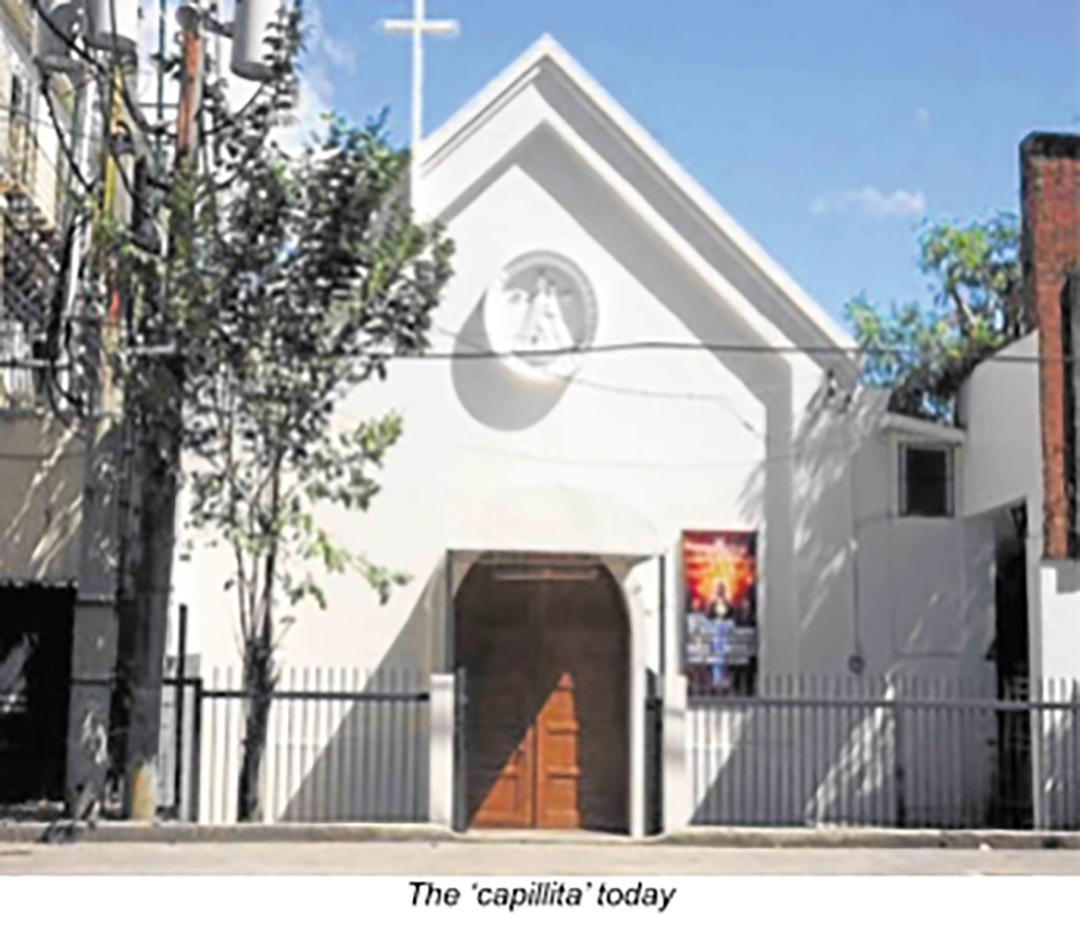
Totally surrounded by burned homes and structures, standing alone and unscathed was the humble bamboo and nipa capillita (a small chapel)of Our Lady of the Rosary. Its surrounding grass remained fresh and green.
To ascertain that the event had been a miracle as San Miguel’s parishioners claimed, the Archbishop of Manila, Francisco G. Ortiz, ordered an investigation led by the Reverend Parish Priest Domingo Azorin, “so that it may be consigned to the truth by the competent authority to prevent being distorted with arbitrary and false traditions,” he said.
Witnesses claimed that the vigorous fire, and strong winds blowing in the fire in its direction nevertheless died down just before reaching the capillita.
Among the witnesses, a principales (noble)of the barrio, Don Bonifacio Jose de Vera, noted how “As one of the neighbors of the community in which the hermitage situates, I saw and witnessed the horrible fire, my house being one of those that were burned, and became more astounded when, as the fire started to come near the ermita (hermitage), the fire suddenly was extinguished, leaving the ermita without any damage; and what is more surprising, is that grass that surrounded the ermita did not lose its freshness, evoking everyone’s admiration; and no one could say that the ermita could be delivered from the fire’s fury without neither firemen, nor by any human help.”
“I was astounded to learn that this chapel of nipa was spared by the fire, because the wind went on her with great force with no aid of water pumps that would help to save it, in spite of the fact that the passages on either side of San Miguel and Quiapo were impossible to penetrate, and that the truth is, rarely has the area been as distressed as much as in the moments of the fire that day,” a Spanish peninsular* and businessman, Don Antonio de Ayala, said. His impassioned testimony, a testament to faith, like the rest of the witnesses’ accounts, concluded that “I believed that only God, who can do everything, would save the camarin (shrine).”
A Spanish mestiza, Doña Isabel Frias, said that “My house, which was burned, was eight yards from the side of the ermita or visita (shrine) of Our Lady of the Rosary, and (I) saw that the flames from my house and the other houses beside the ermita were about to fall on the roof of the chapel, and some sparks of fire also died by the strong wind and indeed it is admirable to see that the ermita was saved from the fire, even if there had not been any help, for when the firemen approached the place, the fire was already extinguished. That from the day after the fire, perhaps because the news of this even had already spread, there was this sudden rush of people who gave alms and others, candles, plucking some grass in the vicinity of the visita for the medicine.”
“I rushed to the site of the conflagration in order to assist the people as much as possible, and in fact, I was surprised to see the ermita, and that there was no other help from other people, and that only a few that dealt with much work at that moment; that when the firemen arrived, the fire was almost out; that the houses nearest to the ermita to the east and to the north were all consumed by the fire; that when the fire was out, many people came from all over and were astonished by what had happened, and everyone said that it was a miracle,” the erstwhile gobernadorcillo (municipal judge or governor), Don Fruto Sanchez, testified, not having witnessed the fire himself.
Assistant to the European English Engineers, Don Juan de Martin y Arevalo, described how “It was a true miracle that the aforementioned ermita was saved from the fury of the flames. On the occasion of the conflagration of the house adjacent to the hamlet by the east, the direction from where the fresh wind came, the houses at the back of the ermita were also burned; that due to the intensity of the fire, it crossed the adjacent stone house of Mr. Tomas Fuentes, and it was impossible for him to go to the Quintana Bridge with the firemen that the declarant had in his charge, by which they had to go with the firemen to San Sebastian Causeway toward Malacañan, and from there to the town of San Miguel, and when they arrived, they saw that the ermita was intact and the fire had died down.”
The morning after the fire, the second lieutenant of San Miguel, Don Sinforoso Victorino, said that as he approached the site, “(I) saw with awe that the ermita had been spared, and also saw a great number of people gathered to witness the fire’s aftermath.”
Don Pedro de Alcantara testified that “I indeed saw with admiration that the ermita had not been burned, when the fire was almost upon its roof, having all the houses that were on both sides of the ermita razed to the ground, a strong wind that came from the east whipped around that chapel, and most puzzling here, is that the fire extinguished itself without the help of any person or any firemen that, at that moment, had not yet arrived at that place. When the firemen arrived, the fire was almost over; so much so that the day after the fire there was a gathering of people around the said ermita, which caused so much joy, and this lasted for more than a week, and all were amazed at the hermitage or chapel, and the admiration of those who were there was so great that some offered candles to the Mother of God, and others, alms and some pulled the grass that surrounds the hermitage and said that it could be used for medicine.”
On the parish priest’s submission of his findings, the Archbishop ordered the original document kept in the Archbishop’s Archives in the parish. The University of Santo Tomas Archives also keeps a document of the event.
Deeply impressed by what had been regarded as miraculous intercession, the Spanish Governor-General Manual Pavia y Lacy ordered the chapel’s reconstruction to stone, replacing the nipa visita.
A map from 1898 marks the street as Calle del Rosario. In later years, it was renamed Echague.
In the late 1940s, fearing that the stone chapel could disintegrate, Doña Florencia G. Barretto, the owner of the visita built amid her vast lumberyard, rebuilt the chapel in concrete. Her granddaughter, Carmencita Legarda Cu Unjieng, is the capillita’s custodian.
A story handed down from long ago tells of a Spanish high government official who sat in a tub of warm water to relieve stomach troubles, as his physician had advised. Suddenly, out of nowhere, a lovely lady carrying an infant appeared. What he needed, she said, was grass growing around a particular nipa hut which, when boiled and drank, would help him recover. With that, the lady disappeared.
The official rushed to ask whether the guard had seen a lady come through the gate, but the guard said he had not. The official then sent for the grass, followed the mysterious lady’s instructions, and recovered. He himself then went to the visita, the nipa hut, where he found the same lovely lady and child at the altar. It was Our Lady of the Rosary.
Our Lady of the Rosary’s nine-day feast is celebrated from April 15 to April 23. This year, the Novena and Mass to Our Lady of the Rosary will be held on April 15 and 17 up to 22 (Saturdays and weekdays) at 6 p.m., and April 16 and 23 (Sundays) at 8 a.m.
April 16 is the Anniversary of the Miracle of the Fire.
To get to the capillita, traveling north on Ayala Bridge, turn left at its foot which is Carlos Palanca St. (formerly Calle del Rosario, then Echague). The white concrete chapel is 200 meters away on the right-hand side.
* A Spaniard born in the Iberian peninsula. This was to differentiate from Spaniards born in the Philippine colony who were referred to as insulares.
A UNIT of Philippine-listed Del Monte Pacific Ltd. is seeking regulatory approval from the US Securities and Exchange Commission (SEC) for its initial public offering (IPO) of ordinary shares, the company announced on Tuesday.
In a disclosure to the stock market, the company said its US unit Del Monte Foods Holdings Ltd. intends to “confidentially” submit a draft registration statement on Form F-1 to the US SEC for the IPO.
According to the US regulator, “Form F-1 is used for the registration of foreign private companies that intend to sell securities in a registered offering in the US for the first time.”
The company said that the number of ordinary shares to be offered in the proposed IPO and the offer price range are yet to be determined.
“The proposed offering is subject to, among other things, completion of the SEC review process, market and other conditions, including any required shareholders’ approval,” the company said.
Del Monte Foods Holdings is the parent company of Del Monte Foods, Inc. which handles Del Monte Pacific’s food production and distribution in the US.
Del Monte Pacific, together with its subsidiaries, is a global branded food and beverage company engaged in growing, processing, and selling packaged fruits and vegetables. It also sells sauces, condiments, pasta, broth, and juices.
On Tuesday, Del Monte Pacific shares rose by 11.71% or P1.30 to close at P12.40 apiece. — Adrian H. Halili
FRANCISCO V. COCHING’s Rendition of Gabriela Silang Charging on a Mount, 1986 (Ayala Museum).
IT was around this time of year back in 1763 that Filipino rebels rode into Sinait on horseback, shouting “in God’s mercy, the time has come to leave our slavery!”
The residents of this coastal village in Ilocos were among the tens of thousands of peasants across the big northern island of Luzon who joined the armed revolt against Spanish colonial rule that year. The insurgency attracted men and women from diverse ethno-linguistic groups. They were Ilocanos, Pangasinanes, Cagayanes, and Tagalogs. Theirs was the biggest rebellion to erupt in the Philippines in the 18th century. It was simultaneously a very radical and profoundly Catholic social movement.
The rebellion coincided with the Christian season of Lent: the 40 days of sombre prayer and self-discipline leading up to Holy Week and Easter, when Christians remember the death and resurrection of Jesus Christ. Did this sacred time of year make ordinary Filipinos more willing to challenge the empire?
The British invasion of Manila at the end of 1762 triggered the revolt. The walled city had been the seat of the Spanish government in the islands since 1571, until British forces attacked and drove the Spanish governor into exile in the countryside.
This humiliating defeat of the Spanish struck many Filipinos as a rare opportunity to demand a better colonial bargain, or even to try and permanently overthrow the Spanish empire which had intruded into their lives.
Mobs of protesters raided government and convent armories and marched on government buildings, brandishing weapons and demanding urgent change. They wanted to abolish the tribute, the annual head tax that Indigenous Filipinos (whom the Spaniards called indios) and Chinese migrants were forced to pay to the Crown. They also wanted to get rid of the polo, the system of forced labor that funneled native men into stints of grueling work for the state, building forts and cutting down trees to build galleons.
Colonial officials refused to negotiate, and the rebels decided to go to war to secure their demands. Battles broke out between rebel militias and those that remained loyal to Spain.
Lent inspired peasants to join the revolt against the empire. The British invasion of the year before had destabilized the colonial government and prompted the armed rebellion. But it was Lent that inspired many peasants to join the rebel uprising.
The rebellion’s leaders included the husband-and-wife team Diego and Gabriella Silang. The couple are well known in the Philippines today, where they are celebrated as heroes.
Diego Silang urged his followers to observe Lent. He encouraged fighting men to pray the Rosary, and prohibited them from getting drunk, having sex, or gambling on playing cards or cockfights during this sacred season. Silang was evidently trying to curry God’s favor through these collective sacrifices and devotions, hoping to secure a heavenly intervention that would protect his army and deliver them victory.
Like many Indigenous people in the islands, Silang would have also viewed asceticism in the Lenten season as a method of transferring power to people and to protective amulets known as anting anting, which they believed could potentially shield bodies from enemy cannon shot and arrows. Lots of different objects could be anting anting, including crucifixes and other religious medals or pieces of metal engraved with Catholic images, as well as pieces of paper inscribed with prayers. In this sense, Lent was the perfect time to spiritually prepare for revolution.
Convictions in such potent objects blended Filipino conceptions of power as a real force that could be physically accumulated in physical things, and European Catholic traditions of miraculous objects, including those that purport to cure sickness or protect soldiers in battle.
The Catholic character of the Silang rebellion manifests in other ways. Diego Silang declared that the life-sized wooden statue of Jesus Christ whose sanctuary was in Sinait was the general of the rebel army.
This was a famous miraculous statue. It sweated scented oils and cried salty tears, and locals believed it had ended devastating epidemics. These feats were inexplicable by the laws of nature and were therefore attributed to a divine agency. Silang’s followers fashioned a scepter and small golden helmet for this image of Christ — symbols of military and political power in the islands — to acknowledge and honor its role in their war.
This statue of Jesus became a defining element of Silanista culture. Soldiers in the rebel Catholic army marched into battle under flags bearing its image. They also wore tiny carved copies of the statue tied to rope necklaces into battle.
The Silang rebellion was ultimately defeated by force. Militant missionaries opposed the rebellion. Priests went on strike, denying Catholic sacraments to communities that supported the revolt. They also helped the Spanish government rally a huge loyalist army that beat the enemy in battle.
Loyalists also believed God was on their side. At the decisive battle of Vigan in Ilocos, the spires of churches appeared as the sails of tall ships carrying an army that was coming to defeat the rebels, terrifying them into submission. This was another miracle.
The Spanish empire would endure in the Philippines until 1898, when the United States invaded and supplanted Spain as the ruling colonial power.
Lent could inspire Catholic anti-colonial uprisings in the early modern Philippines, yet this special religious season also energized movements to destroy them.
Kristie Patricia Flannery is a Research Fellow at the Institute for Humanities and Social Sciences, Australian Catholic University. She receives funding from the Australian Research Council.
MINING firm Sagittarius Mines, Inc. targets to go full swing with the operations of the Tampakan copper-gold project in South Cotabato province by 2026.
“We would like to have it maybe 2026 for us to really say that under the technical definition, it’s really operating,” Sagittarius Mines President and Chief Executive Officer Roy O. Deveraturda told reporters at a media lunch on Monday.
Mr. Deveraturda said the construction of facilities as well as engineering and design works have started.
The Tampakan project is said to be among the largest untapped minefields in Southeast Asia. The site is estimated to contain 15 million tons of copper and 17.6 million tons of gold.
“Tampakan project is one of the best projects in the world, meaning in terms of resource, in terms of the cost of operating,” Mr. Deveraturda said, also citing its capital expenditure and sustained spending.
Under the terms of a Financial and Technical Assistance Agreement (FTAA), Sagittarius Mines’ project covers 25,371 hectares. The project was halted in 2010 after the provincial government’s ban on open-pit mining.
Mr. Deveraturda said 10 years ago, the company was ready to proceed with the project.
“We have all the permits and approvals necessary for operating the company. However, there are of course some issues,” he said.
In May 2022, the provincial government lifted the ban, which paved the way for the project to continue.
Mr. Deveraturda said the mining site is “ready to operate” but developing it before the full operation will take two to three years.
He also said the requirements for the project have been completed such as feasibility studies and permits, including the environmental compliance certificate.
“It takes a long time. Akala nila (They thought), once it starts, you just dig. No, it’s not like that. It’s been a very complicated stage,” he said. “It requires big work and a lot of technical expertise and financial muscle.”
Sagittarius Mines External Affairs and Communications Manager Roy D. Antonio said the company had invested P32 billion in the project since 1995.
Of the investment, P2 billion was allocated for corporate social responsibility initiatives as well as social development and management program. Funds also went to the technical, environmental, and social aspects of the project.
“It’s a substantial amount,” Mr. Deveraturda said about the investments and the expenses. “But the big portion of the investments will go to the development and production.” — Sheldeen Joy Talavera
THE GOVERNMENT fully awarded the reissued seven-year Treasury bonds (T-bonds) it auctioned off on Tuesday at a lower average rate amid strong demand for high-yielding longer tenors.
The Bureau of the Treasury (BTr) raised P25 billion as planned from the reissued seven-year bonds it offered on Tuesday as total bids reached P50.979 billion or over twice as much as the amount on the auction block.
The bonds, which have a remaining life of two years and 10 months, were awarded at an average rate of 5.883%, with accepted yields ranging from 5.8% to 5.939%.
The average rate of the issue was 91.3 basis points (bps) lower than the 6.796% quoted for the series when it was last offered on July 5, 2022 and 36.7 bps below the 6.25% coupon for the issue.
This was also 18.9 bps below the 6.072% seen for the seven-year tenor but 1.03 bps higher than the 5.8727% quoted for the same bond series at the secondary market prior to the auction, based on PHP Bloomberg Valuation Service Reference Rates data provided by the Treasury.
The Treasury made a full award of its T-bond offer amid strong demand and as rates were lower than secondary market levels, National Treasurer Rosalia V. de Leon said in a Viber message to reporters after Tuesday’s auction.
The accepted rates were “well within expected levels as some of those who are looking for T-bills (Treasury bills), especially the rejected ones, wanted yield pickup,” a trader said in a Viber message.
“It’s interesting to note, however, that the one-year T-bill average yesterday was higher than today’s auction average,” the trader said on Tuesday.
The BTr on Monday raised P5 billion as planned from the one-year T-bills as bids reached P9.815 billion. The average rate of the one-year paper went down by 1 bp to 5.977% from 5.987% last week. Accepted yields were from 5.43% to 6%.
Tuesday’s T-bond offer was fully awarded as rates declined amid expectations of slower inflation in March, Rizal Commercial Banking Corp. Chief Economist Michael L. Ricafort noted in a Viber message.
The Philippine Statistics Authority will release March inflation data on April 5, Wednesday.
A BusinessWorld poll of 16 analysts yielded a median estimate of 8.1% for March headline inflation, near the upper end of the 7.4% to 8.2% forecast of the Bangko Sentral ng Pilipinas (BSP) for the month.
If realized, this will be down from the 8.6% in February, but faster than the 4% print in March 2022.
March would also be the 13th straight month that inflation was above the BSP’s 2-4% target for the year.
The Treasury wants to raise P160 billion from the domestic market this month, or P60 billion via T-bills and P100 billion via T-bonds.
The government borrows from local and external sources to help fund its budget deficit, which is capped at 6.1% of gross domestic product this year. — AMCS
Mother and Child from “Woman: Thesis and Antithesis” exhibit
ARTWORKS from “Woman: Thesis and Antithesis” exhibit
MAESTRO Herminigildo Ranera —PHOTO BY KIKO CABUENA
SOPRANO Mheco Joy Manlangit
Tenor Radnel Del Rio Ofalsa
NATHANIEL San Pedro’s Whiskered Treeswift
NATHANIEL
CASA San Miguel presents Haydn’s Seven Last Words
IT HAS been an annual tradition of violinist Coke Bolipata and the Pundaquit Virtuosi to present Joseph Haydn’s Seven Last Words of Christ during Holy Week since 1993. This year it will be held on Good Friday, April 7, at 5 p.m., at CASA San Miguel, Evangelista St., Barangay San Miguel, in San Antonio, Zambales. To reserve tickets, call 0907-082-6692 or 0917-838-2752 or send a message via Facebook and Instagram @casa.sanmiguel.zamblaes.
Stations of the Cross at Capitol Commons
FOR the Catholic faithful who want to do the Stations of the Cross, Capitol Commons has provided a space for them to reflect on their faith. Capitol Commons will have the 14 Stations of the Cross spread out over the Park from April 4 to 9. The Stations of the Cross is a Catholic tradition of prayerful meditation on Good Friday. The faithful commemorate the Passion of Christ at 14 stations that have pictures or carvings of these events. This devotion is done by individuals, families and groups as they visit and pray at each station depicting Christ’s journey, from the time He is condemned to death to when He is crucified, and finally put inside a sepulcher.
Women in arts at the CCP touring exhibit
WHO and what defines women’s image? These are the questions that are explored in the touring exhibit of the Cultural Center of the Philippines (CCP), titled “Woman: Thesis and Antithesis”. Curated by Yuchengco Museum director Jeannie Javelosa, the exhibit features artworks that highlight women as subject matter and celebrate women artists amidst the evident gender divide in the field of visual arts in the Philippines. The exhibit is divided into two sections: the Women in Society collections displayed at the ground floor, and the Women Expressions exhibited at the third floor of Yuchengco Museum. The exhibit is part of the CCP touring exhibit series and also marks its first collaboration with the Yuchengco Museum in Makati City. The exhibit runs until June 24 at the Yuchengco Museum located at the RCBC Plaza, corner Ayala Avenue and Senator Gil J. Puyat Avenue in Makati City. Visiting schedule is Monday to Sunday, from 10 a.m. to 6 p.m. Entrance fee for adults is P100, with a discounted price of P50 for students, seniors, and PWDs. Free admission days are April 29, May 20, and June 24, when there are public programs. On April 29, 3 p.m., there will be an open dialogue on the history of the CCP Visual Arts Collection, as written in the 2018 publication Cultural Cache, and its current status as the CCP 21AM Collection.On May 20, 3 p.m., there will be a forum of art educators will converse on how the image of the woman is portrayed by artists across different periods in Philippine art history and in different mediums. Using the works featured in the exhibition, guests will discuss common themes and depictions in relation to gender representation in art. Selected Thirteen Artists Awards women recipients, who foreground woman and womanhood as subject matter, will gather on June 24, 3 p.m., to talk about generational differences in artmaking and expressions of the feminine.For more information on the exhibit, check out the official CCP and CCP Visual Arts and Museum Division Facebook accounts.
PPO holds final concert of 38th season
THE RESIDENT and associate conductor of the Philippine Philharmonic Orchestra (PPO) Herminigildo Ranera takes the dais and performs with the Philippine Philharmonic Orchestra (PPO) for the finale concert of its 38th concert season on April 28, 8 p.m., at the CCP Live at the Metropolitan Theater. The PPO, under his baton, will premiere his very own music, the Lola Basyang Miniature Suite, alongside with Dmitri Shostakovich’s Festive Overture, Christoph Willibald Gluck’s L’espoir renait dans mon ame from Orphee et Eurydice, and Gaetano Donizetti’s Prendi, per me sei libero from L’elisir d’amore. The CCP resident orchestra continues its repertoire for its season’s Concert VIII with Gioacchino Rossini’s Si, ritrovarla io giuro from La Cenerentola, Georges Bizet’s Je dis que rien ne m’epouvante from Carmen, and Gaetano Donizetti’s Quio! Vous m’aimez? from La fille du regiment, and Antonin Dvorak Symphony no. 9, op. 95, E minor (“from the New World”). The PPO shares the stage with young singers, soprano Mheco Joy Manlangit and tenor Radnel Del Rio Ofalsa. Dubbed Metamorphosis, the 38th concert series serves as the battleground for the five shortlisted conductors vying for the musical director position. Tickets for the concert range in price from P500 to P1,500. For inquiries and tickets, call CCP Box Office at 8832-3704 or e-mail customercare@culturalcenter.gov.ph.
Nayong Pilipino opens exhibit in Tarlac
THE NAYONG Pilipino Foundation (NPF), in partnership with the Tarlac Provincial Government, opened the Nayon sa Diwa: Bringing Cultural Communities Closer to the Heart exhibit at the Diwa ng Tarlac Museum, on March 30. This marks the Foundation’s first exhibit outside of Metro Manila. The exhibit displays items from different communities in the country. It also highlights the works of the Abelling Aeta(s) who display their traditional items. The exhibit is part of the NPF’s Travelling Museum Project, an initiative meant to bring culture and heritage closer to the public. The exhibit is open to the public for free at Diwa ng Tarlac, Tarlac City from 8 a.m. to 5 p.m. until the last week of May.
Silverlens now represents Syjuco, Anading, Havini
SILVERLENS gallery has announced that it is now representing the artists Stephanie Syjuco, Poklong Anading, and Taloi Havini. Dedicated to representing Southeast Asian Diaspora artists, Silverlens continues to increase global awareness and access to the narratives and histories of these artists and this region. In 2024, Ms. Syjuco will present a solo exhibition at Silverlens Manila, while Ms. Havini will hold her first-ever exhibition with Silverlens in its New York location. Mr. Anading will hold an Online Viewing Room presentation with the gallery later this year.
Wandering wings at Artablado
WHILE interested in art since childhood, Nathaniel San Pedro instead took a Bachelor of Science in psychology and started working in the corporate world as a recruitment specialist. Now, the artist is back on his chosen path as Robinsons Land ARTablado presents Nathaniel San Pedro’s latest exhibition titled “Wanderers: Exhibition of Diverse Beauty of Philippine Birds,” on view until April 15 at the ARTablado space in Robinsons Galleria. “For two years, I got serious in art and thoroughly studied painting,” he says. “I came to know the basics of painting, the process of paint application, the mixing of tonal values of paints, the combination of colors and right proportion of drawings. I took up an associate degree in fine arts at Global Knowledge in Boni, Mandaluyong City. I tried to study and enhance my painting skill even while working in the corporate world. After studying the basics in oil painting, the rest was self-taught…” Mr. San Pedro had his first solo exhibition in 2020 which was about the passion and journey of Jesus Christ and the Virgin Mary. The idea for his follow-up show began when he received a Christmas gift: a book titled Birds of the Philippines. Awe-struck by the variety and beauty of the winged creatures we have in our country, birds became a symbol for the artist, of how beauty in this world is becoming truly fleeting because of how humans are destroying the environment. According to the artist, his art serves a greater purpose: an eye-opener for people to start taking care of the world we live in and all the creatures we share it with.
ABS-CBN Corp.’s over-the-top (OTT) content platform has partnered with streaming service provider Vooks to expand its product offering.
Under the partnership, OTT platform iWantTFC will be able to stream 35 titles from Vooks that the media company expects to enrich the reading comprehension skills of children.
Vooks is an international streaming app that offers a collection of animated children’s story books. It turns educational children’s books into bite-sized and watchable content by featuring read-aloud narration of animated story books.
Vooks has more than 40 publishing partners and is available in more than 175 countries worldwide. Some of its titles that will be streaming on iWantTFC are “Little Girl Big Dream: The Story of Olympian Samantha Peszek,” “Irving Berlin (The Immigrant Boy Who Made America Sing),” “A Boy Like You,” and “I’ll Love You For Always.”
According to iWantTFC, the partnership will allow its customers to stream Vooks’ titles for free on its app and website.
In select countries, iWantTFC can be streamed on a larger screen through VEWD, ROKU, and Amazon Fire streaming devices, Android TV, Samsung Smart TV, Telstra TV, and VIDAA.
iWantTFC also streams ABS-CBN shows, iWantTFC Originals, classic movies, OPM, live TV, and live-streamed shows.
On Tuesday, shares in ABS-CBN slipped by 1.11% or 8 centavos to finish at P7.0 each. — Justine Irish D. Tabile
THE POLICY-SETTING Monetary Board of the Bangko Sentral ng Pilipinas (BSP) has amended its foreign exchange (FX) regulations make permanent most of the operational relief measures for FX transactions adopted during the coronavirus pandemic.
BSP Circular No. 1171, signed by BSP Deputy Governor Eduardo G. Bobier as officer-in-charge on March 29, amends the provisions of the Manual of Regulations on Foreign Exchange Transactions.
“The amendments are in line with the BSP’s thrust to further streamline procedures and documentary requirements for FX transactions,” the central bank said in a statement late on Monday.
The major amendments include the issuance of International Operations Department (IOD) documents in electronic form and allowing the digital submission of BSP-IOD issued documents to authorized agent banks (AABs)/AAB subsidiary or affiliate forex corporations (AAB forex corps) and to the central bank.
“For BSP-issued documents in electronic form, AABs/AAB forex corps shall verify with the BSP, through the IOD, the authenticity of said documents submitted by the client prior to FX sale/deposit of funds to a peso deposit account of non-resident, as applicable,” the circular read.
“The required verification with the BSP, through the IOD, shall apply to initial submission by the client to the Head Office or each branch of AAB/AAB Forex Corp. of BSP-issued document in electronic form covering the specific underlying transaction/s, as applicable,” it said.
The BSP also waived the processing fee for non-compliance within the prescriptive period for submission to BSP-IOD of registrations or requests for various FX transactions.
The Monetary Board also lifted the notarization requirement for some supporting documents on trade and non-trade current account transactions as well as foreign investments.
The central bank said electronic documents issued by the BSP-IOD starting March 27, 2020 will remain valid even after the period covered by BSP Circular No. 1080.
The BSP will no longer issue original hardcopies to replace documents.
Meanwhile, the waiver of penalties for delays in the submission of reports to the BSP-IOD will remain in effect until June 30, unless extended by the central bank. — Keisha B. Ta-asan