Home Blog Page 5

Rates of Treasury bills, bonds may drop on BSP policy bets

BW FILE PHOTO

RATES of the Treasury bills (T-bills) and Treasury bonds (T-bonds) on offer this week could end lower as investors price in their bets for the Bangko Sentral ng Pilipinas’ (BSP) next policy move.

The Bureau of the Treasury (BTr) will auction off P27 billion in T-bills on Monday or P9 billion each in 91-, 182-, and 364-day papers.

On Tuesday, the government will offer P30 billion in reissued seven-year T-bonds with a remaining life of five years and four days.

Yields on the T-bills and T-bonds placed on the auction block could go down and track the week-on-week decline seen at the secondary market on signals from the BSP Governor Eli M. Remolona, Jr. that another rate cut remains on the table next month, Rizal Commercial Banking Corp. Chief Economist Michael L. Ricafort said in a Viber message.

This came as headline inflation picked last month but remained below target, which would support further easing, he said.

A trader said in an e-mail that the reissued seven-year bonds could see good demand and fetch rates of 5.675% to 5.725%.

“The government securities (GS) market will likely be stuck in a range until we get more traction on the potential 25-basis-point (bp) rate cut in February,” the trader added.

At the secondary market on Friday, yields on the 91-, 182-, and 364-day T-bills went down by 5.38 bps, 6.72 bps, and 6.29 bps week on week to end at 4.8009%, 4.9097%, and 4.9746%, respectively, based on PHP Bloomberg Valuation Service Reference Rates data as of Jan. 9 published on the Philippine Dealing System’s website.

Meanwhile, the seven-year bond’s rate eased by 5.69 bps week on week to 5.884%, while the five-year paper, the tenor closest to the remaining life of the T-bonds on offer this week, declined by 6.91 bps to yield 5.7273%.

Last week, Mr. Remolona said a rate cut is “on the table” at the Monetary Board’s Feb. 19 meeting, but could be “unlikely” even as inflation remains benign.

“I can say that we’re very close to where we want to be in terms of policy,” he said. “There’s a chance that we may cut some more, and there’s also a chance that we may not move at all. But there’s not a lot of probability that we will raise in 2026.”

The Monetary Board ended last year with a fifth straight 25-bp cut at its Dec. 11 meeting, bringing the policy rate to 4.5%. It has delivered 200 bps in reductions since it began its rate-cut cycle in August 2024.

The BSP chief has signaled since December that their easing cycle was nearing its end, with further cuts — if any — likely to be limited and data-dependent.

Meanwhile, analysts have said that the central bank could still ease further to help support domestic demand as growth prospects have weakened due to a wide-ranging corruption scandal that has stalled both public and private investments, dragging economic growth.

Last week, the BTr raised P34.2 billion via the T-bills it auctioned off, higher than the P27-billion plan, as the offer was more than four times oversubscribed, with total tenders reaching P108.1 billion.

The BTr doubled its acceptance of noncompetitive bids for the 91- and 182-day T-bills to P7.2 billion each due to strong demand and as average yields were all lower than secondary market rates, it said.

Broken down, the government awarded P12.6 billion in 91-day T-bills, above the P9-billion plan, as demand for the tenor reached P36.235 billion. The three-month paper fetched an average rate of 4.755%, up by 2.4 bps from the previous auction. Yields accepted were from 4.69% to 4.78%.

The Treasury also increased the award for the 182-day debt to P12.6 billion from the P9-billion program as tenders hit P41.15 billion. The average rate of the six-month T-bill was at 4.895%, down by 0.8 bp from the previous week. Tenders awarded carried yields from 4.83% to 4.923%.

Lastly, the BTr sold P9 billion as planned in 364-day securities as the tenor attracted bids totaling P30.715 billion. The one-year paper’s average yield was at 4.937%, up by 1.3 bps from the previous auction. Accepted rates were from 4.875% to 4.937%.

Meanwhile, the reissued seven-year T-bonds to be offered on Tuesday were last auctioned off on April 2, 2024, where the government raised P30 billion as planned at an average rate of 6.299%, above the 6.125% coupon rate.

The BTr is looking to raise P180 billion from the domestic market this month, or P110 billion via T-bills and P70 billion through T-bonds.

The government borrows from local and foreign sources to help fund its budget deficit, which is capped at P1.647 trillion or 5.3% of gross domestic product this year. — Aaron Michael C. Sy

Upstream oil, gas sector upbeat as work programs start

BW FILE PHOTO

By Sheldeen Joy Talavera, Reporter

THE upstream oil and gas sector is starting the year on an optimistic note, with industry players set to begin their work programs after securing new petroleum service contracts from the government.

“The year 2026 marks a new era for the Philippines’ upstream oil and gas industry — one of renewed exploration, energy innovation, and investor confidence,” Edgar Benedict C. Cutiongco, president of the Philippine Petroleum Association, told BusinessWorld.

He said newly awarded onshore and offshore petroleum service contracts are expected to begin their approved exploration and development activities this year, “bringing in vital investments and reinforcing the country’s role in regional energy security.”

Last year, the government awarded eight new petroleum service contracts, representing potential investments of about $207 million over seven years of exploration.

Areas with identified potential petroleum and hydrogen resources include the Sulu Sea, Cagayan, Cebu, Northwestern Palawan, Eastern Palawan, and Central Luzon.

Under their service contracts, companies may undertake work programs that include geological and geophysical studies, seismic surveys, and drilling activities, as appropriate, to assess resource potential.

The government has also recently granted a new contract to PXP Energy Corp. and its partners, allowing them to continue production at the Galoc Oil Field off northwest Palawan.

The new contract replaces Service Contract 14C-1, which expired on Dec. 17 and covered the exploration, development, and production of petroleum resources in the Galoc field.

Since the issuance of Presidential Decree (PD) No. 87 in 1972, which promotes the discovery and development of the country’s indigenous petroleum resources, a total of 65 million barrels of oil have been discovered from various oil fields, Mr. Cutiongco said.

“PD 87 remains a cornerstone of fiscal stability for the upstream sector. Any future adjustments to PD 87 will be carefully considered to enhance incentives and maintain the Philippines’ competitiveness as an investment destination,” he said.

He added that the awarding of the development and production petroleum service contract for the Galoc field ensures that remaining reserves are developed and resources are not stranded.

“Fiscal stability remains the bedrock of growth. Strong interest in recent bidding rounds signals renewed confidence, even as global risks persist,” Mr. Cutiongco said. “The shift from globalization to regionalism will define energy strategies — and the Philippines is ready.”

There is always hope

Will 2026 finally be the year the local auto industry breaks the 500,000-unit sales mark? — PHOTO BY JOYCE REYES-AGUILA

A confluence of natural events and government misadventures tampered with 2025

LET THE NEW YEAR begin. Before anything else, though, allow me to take this opportunity to wish everyone a meaningful and hopeful 2026. Though anxieties are running high, I am reasonably optimistic that the year ahead will bring some welcome respite from the body blows that pummeled the Philippine economy in the second half of 2025.

The past year started on a very confident note on the back of supply chain stabilization and rising consumer spending. It turned guarded in the third quarter due to disruptions wrought by natural calamities. And then things turned downright wobbly in the last quarter as significant irregularities in government spending surfaced. While the economic numbers tumbled, the country still fared better than other economies in the ASEAN region. As they say, we got knocked down, but not knocked out. The final numbers are yet to be reported but, in all likelihood, GDP will fall short of 5%, probably closer to Singapore’s higher-than-expected 4.8% growth rate that was buoyed by exports of semiconductors due to exceedingly strong artificial intelligence (AI)-related demand.

The Philippine automotive industry was counting on another banner year in 2025. To be sure, it will get one. Yearend estimates place auto industry sales between 490,000 to 495,000 vehicles, likely beating 2024 sales of 475,000 units, and chalking up a new record high. This includes sales of non-affiliated auto companies of the Chamber of Automotive Manufacturers of the Philippines, Inc. (CAMPI), Truck Manufacturers Association (TMA), and Association of Vehicle Importers and Distributors, Inc. (AVID). Having said that, the industry was looking to break the 500,000 sales level last year. It came within clear reach but will have to wait another day for that milestone to be achieved. To get to 500,000, the total sales volume in December should be 56,000 units, which is not likely.

So as we look ahead to 2026 and beyond, I decided to look back. Interestingly, I found an article from The Philippine STAR dated Dec. 27, 2015. The headline: “Philippines to become major car market by 2020.” It paraphrased Dante Santos, then Mitsubishi Motors Philippines Corp. (MMPC) First Vice-President and Corporate Secretary as saying, “The Philippines… will become an important automotive market growth area in the region as volume of vehicles sold is expected to zoom to 500,000 units by 2020.” At that time, the market had only broken the 300,000-unit mark. To project 67% growth in five years seemed pretty audacious. Yet, by 2017, the industry recorded sales of 473,000 units and was within 5% of that 500,000 mark. And then COVID happened and the figure was scaled back to 240,000 units — a seriously major setback in the country’s trek to motorization.

But the mobility needs of the country would not be denied. It seems that the projection of the MMPC executive to break 500,000 unit sales within five years was just reset to 2020 instead of 2015. Indeed, five years hence, the Philippine automotive market is on the verge of crossing 500,000. Therefore, the prospects for 2026 are tantalizing.

As mentioned, I have a reasonably optimistic outlook for the industry this year. Overall, I think that the first half of the year will be dominated by supply-side growth with the various auto brands resorting to new model introductions, marketing events, and sales promotions to keep units moving off the showroom floor. The second half, on the other hand, will be more demand-led, resulting from a regularization of government spending and a restoration of consumer confidence.

My source of optimism is that the Philippine auto market continues to expand despite the dizzying domestic economic tremors and even as sales in perennial ASEAN large markets — Thailand and Indonesia — continue to languish. To underscore this, I estimate average monthly vehicle sales in Q4 of 2025 to be around 42,000 units, higher than in any of the three quarters before it. Of course, seasonally, the last quarter usually sees the highest volume, but given the extraordinary downward macro pressures, the auto industry seems to have climbed the down staircase, so to speak. This fuels my constructive confidence in the outlook for the new year.

There is good reason to believe that the recent political brouhaha hounding the halls of government will not completely undermine the strong economic fundamentals of the country. Reforms in the bureaucracy are in the making, the 2026 Government Appropriations Act has been signed into law, inflationary pressures have stabilized, interest rates continue to lower, employment remains high and rural development is strong. All this on top of the fact that the business sector is wanting to do business. This is a fairly strong recipe for growth. Indeed, I would be so bold as to venture that the Philippine economy will grow faster this year than last.

Granted, the volume ramp-up for vehicles in the first quarter may be lukewarm versus the high base of 2025. I suspect the second quarter will be more vibrant with auto retailers dialing up their sales deals. In the third quarter, accelerated government spending from the first half will hopefully flow into the economy, leading to a rise in demand for vehicles, though the weather will remain a significant variable. Barring any further political turmoil, 2026 should see a strong sales finish, including the return of capital expenditure spending by corporate fleet accounts.

My only caveat: We will have a more steady social and political environment.

Some would say that the wind has been taken out of our sails; I say the winds of growth remain strong. We just need to reposition our sails so we can catch those winds and sail ahead to better days. This might be the year the Philippine automotive market finally breaks the 500,000 mark. I hope I do not jinx it.

The teachings of Warren Buffett

STOCK PHOTO | Image by Vectorjuice from Freepik

At the end of last year, Warren Buffett retired as the Chief Executive Officer of Bershire Hathaway after 60 years of service. His record as an investment manager has not been and may never be equaled.

Over 60 years, Berkshire Hathaway’s compounded growth was nearly double that of the S&P 500, with a 19.9% annual return compared to the S&P 500’s 10.4%. This resulted in a vastly greater total return for Berkshire Hathaway stockholders, growing 5,502,284% versus the S&P 500’s 39,054% from 1965 to 2024. This means that $1,000 invested in Bershire Hathaway in 1965 would amount to $55,000,000 in 2024 while the same amount invested in S&P 500 stocks would amount to only $390,000.

Outstanding though this was, we would argue that the greater legacy of Warren Buffet would be as a teacher. A teacher has been defined as a person who believes that imparting knowledge is not a zero-sum game where the gain of the pupil is the loss of the teacher. A teacher sees the imparting of knowledge not only as a gain for the student but also for the teacher, his knowledge not lost but even enhanced and expanded, a win-win situation.

Unlike most investment managers who prefer to keep their winning strategies secret, Buffett has been the most open in sharing his knowledge, in the annual letters he sent to his stockholders, in the answers he gave during the question period at the stockholders meetings, in the speeches he delivered, and in the interviews he gave.

Encouraged by his example, we are sharing the lessons we have learned from the teachings of Warren Buffett.

Buffet’s first lesson is to explain why we should have an investment portfolio:

“If you don’t find a way to make money while you sleep, you will work until you die.”

The idea is that if you are a professional, you will stop earning when you retire. Thus, you must have an investment portfolio so that when your professional income stops, you can then draw on the income from your investment. Thus, you will not suffer a loss in your financial standing.

Moreover, Buffett suggests that when young you can be more aggressive and concentrate in a few stocks in investing your portfolio given that you need to speedily build up your investment. And being young you can still have time to recover from your investment mistakes. However, as you near retirement age, you have to start being conservative and diversify from stocks to bonds such that the sure income from the interest from the bonds will allow you to achieve your desired portfolio size upon retirement. Again, from Buffet, “Diversification may preserve wealth, but concentration builds wealth.”

The next lesson is when to sell your stock. This is based on the principle that one should have an exit strategy when one wages war, sets up a business, or invests in a stock. After all, only when you have exited from these endeavors can you judge if they were successes or failures.

The conventional wisdom is one sells a stock to lock in profits, i.e., sell the stock above acquisition cost; cut losses, i.e., sell the stock below acquisition cost or to exit from a stock which does not move at all.

Buffett argues that this is the wrong approach as the decision is determined by your acquisition cost. And the market does not care at what cost you bought a stock.

Instead, Buffet suggests answering two questions. The first: If I did not own the stock, would I still buy it? This raises the question of whether the conditions which initially led to buying the stock have changed. These could be changes in the industry structure, changes in management, or arrival of strong competition. For example, Buffett divested his investment in the media company, The Washington Post when he realized the rise of the internet posed a risk to the traditional newspaper.

The second question, especially applicable to small portfolios: Is there another stock which has better prospects than the stock I currently own? If so, I would sell the stock I own and use the proceeds to buy the more attractive stock. Technically, this is called rebalancing your portfolio.

We now come to stocks that Buffett is not interested in. He does not want to invest in assets which generate income only when sold, more specifically commodities. For example, when you buy gold, you do not generate income until you sell the gold. Moreover, as you do not physically hold the gold, you have to pay for somebody to have custody of your gold.

Related to this is the “greater fool” theory. I may be a fool to buy this asset but a greater fool will come along and buy it from me at a higher price. The problem with the theory is that you could be the greater fool buying from the lesser fool.

With respect to buying stocks, Buffets follows certain rules.

The first and foremost rule is “never invest in a business you do not understand.” This simply means knowing why or how a business makes money. A simplified approach would say “Coca Cola is a company selling sugared water at a price much higher than the combined price of the water and the sugar.” And then proceed to understand how it does so, i.e., adding a secret ingredient, carbonizing the drink, attractive packaging, and a vast distribution system.

From understanding the business logic, Buffett then examines how the company defends itself from others copying its successful formula. Buffet looks for “economic moats” in companies.

Buffett views a business as an “economic castle.” The value within the castle represents the company’s profits and market share, which are constantly under “siege” from competitors. The moat acts as a protective barrier, making it difficult for rivals to erode the company’s position. A wider, deeper, and more durable moat signifies a stronger business.

Buffett elaborates, “We’re trying to find a business with a wide and long-lasting moat around it, surrounding and protecting a terrific economic castle — with an honest lord in charge of the castle… For one reason or another, it can be because it’s the low-cost producer in some area. It can be because it has a natural franchise or because of its service capabilities, its position in the consumer’s mind, or because of a technological advantage. For any kind of reason at all, it has this moat around it.”

If based on the above, Buffet concludes that it is an excellent company, he then proceeds to determine the value of the stock. As he says, “Price is what you pay; value is what you get.”

There are two basic approaches to determining the value of a company, the Price/Earnings approach and the Discounted Cash Flow approach which we will not discuss here.

Assuming the value of a stock has been determined, then Buffett argues, “It’s far better to buy a wonderful company at a fair price, than a fair company at a wonderful price.” In short, look for wonderful companies to invest in and be satisfied with buying the stock at a fair price.

Moreover, Buffett times the buying of these stocks. He is a contrarian or, as he says, “Be fearful when others are greedy. Be greedy when others are fearful.” What this means is that while others (the greedy) aggressively buy when the market is at its peak (a bull market), thus depleting their cash reserves, Buffet (the fearful) refrains from buying. Instead, he starts building up his cash position.

With his large cash position, Buffett (now greedy) starts buying his selected stocks when the market goes down (a bear market) while the others (now fearful) start selling. This is difficult to execute but highly rewarding. As Buffett says, “Cash combined with courage in a time of crisis is priceless.”

We end with one final teaching which relates not to investing but in leaving a legacy: “Someone is sitting in the shade today because someone planted a tree a long time ago.”

Warren Buffet could be referring to the hundreds of thousands of stockholders of Berkshire Hathaway who benefitted immensely from their investment in the company. We would argue that it should also refer to the millions of investors who followed the teachings of Warren Buffet and so invested wisely and well.


Dr. Victor S. Limlingan is a retired professor of AIM and is a fellow of the Foundation for Economic Freedom. He is presently chairman of Cristina Research Foundation, a public policy adviser, and Regina Capital Development Corp., a member of the Philippine Stock Exchange.

City Savings Bank and Khan Academy empower Filipino teachers through AI-powered tools

Over 300 participants from DepEd Sta. Rosa and Calamba completed the Khan Academy Philippines training program in partnership with City Savings Bank on Nov. 28 and Dec. 4.

City Savings Bank (CitySavings) has officially partnered with Khan Academy Philippines to strengthen professional development for teachers across the country.

The initiative is intended to provide educators with access to digital learning tools, including artificial intelligence-powered resources available through the Khan Academy platform. The partnership attempts to address the gaps in learning, particularly in remote communities.

The program aligns with the Department of Education’s (DepEd) education initiatives, including Brigada Eskwela and Brigada Pagbasa. CitySavings has previously supported DepEd through donations of learning equipment and technology to schools and regional divisions.

“Our partnership with Khan Academy Philippines is a significant step in CitySavings’ commitment to elevating the Philippine education sector. By providing teachers with AI-powered resources like Khanmigo, we are not just supporting their current professional development, but actively co-creating a sustainable, future-ready learning environment where both educators and students can thrive and lead in the digital age,” CitySavings Assistant Vice-President for Reputation and Brand Management Head Paula Ruelan said.

Under the initiative, teachers are given access to Khanmigo, which is designed to assist with lesson planning, generate assessments, and provide real-time instructional support. The platform allows students to engage with learning materials at their own pace, while teachers are able to focus more on instruction and mentoring, according to the organizers.

Training sessions held on Nov. 28 and Dec. 4, 2025, were attended by more than 300 teachers from the Sta. Rosa and Calamba school clusters in Laguna.

CitySavings said the partnership forms part of its broader community development efforts, following earlier programs that included the donation of laptops and school equipment to public schools. The bank said it aims to continue supporting initiatives that expand access to education and technology for teachers and students.


SparkUp is BusinessWorld’s multimedia brand created to inform, inspire, and empower the Philippine startups; micro, small and medium enterprises (MSMEs); and future business leaders. This section will be published every other Monday. For pitches and releases about startups, e-mail to bmbeltran@bworldonline.com (cc: abconoza@bworldonline.com). Materials sent become BW property.

ACEN shares climb on Palauig expansion, RE deal

ACENRENEWABLES.COM

By Abigail Marie P. Yraola, Deputy Research Head

SHARES of ACEN Corp. rose last week on news of its Palauig solar farm expansion and a renewable energy (RE) supply agreement with Schneider Electric, developments that analysts said offset profit taking.

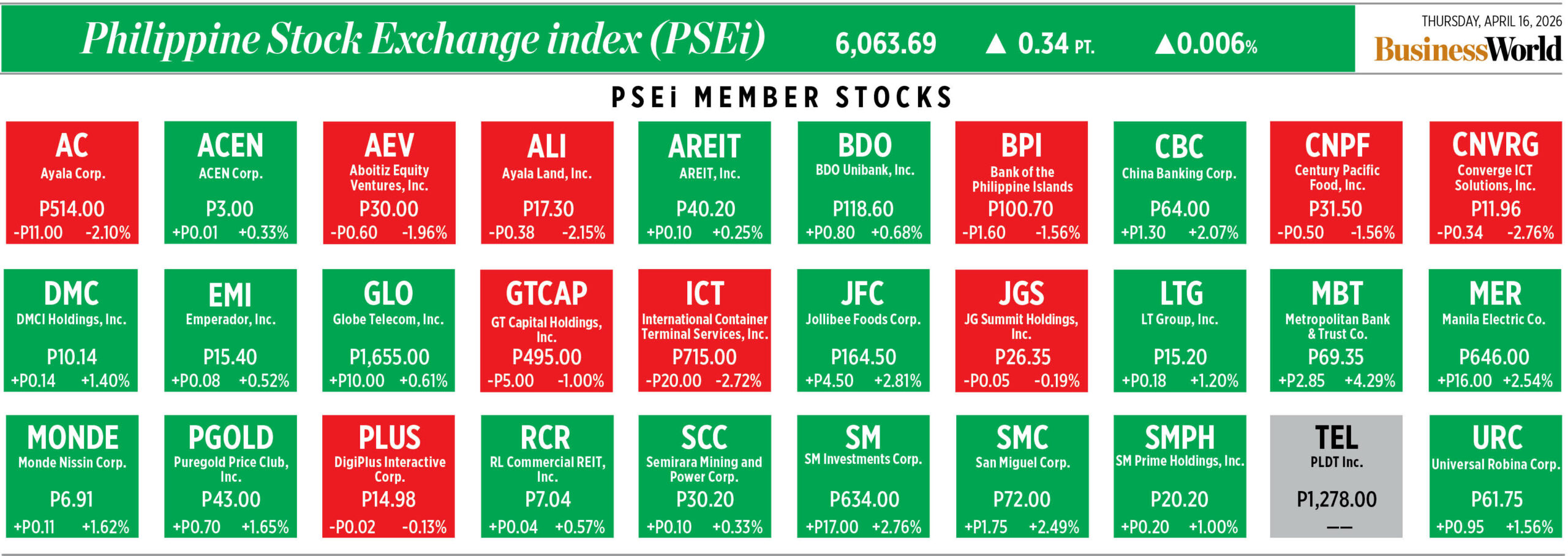
The Ayala-led listed energy platform recorded a value turnover of P350.61 million, with 116.18 million shares traded from Jan. 5 to 9, Philippine Stock Exchange (PSE) data showed.

ACEN shares closed at P2.97 apiece on Friday, up 2.1% week on week. In comparison, the industrial index rose by 3.3%, while the benchmark PSE index gained 3.5%.

Year to date, ACEN’s share price is up 9.2%. The industrial sector advanced by 5.2%, while the broader market declined by 2.8%.

Toby Allan C. Arce, head of sales trading at Globalinks Securities and Stocks, Inc., said ACEN’s price movement reflected cautious but selective positioning by investors.

“The early trading days of 2026 were characterized by moderate liquidity and mixed investor sentiment due to lingering macroeconomic headwinds such as inflation pressures, higher energy input costs, and cautious global risk appetite,” he said in a Viber message.

He added that these conditions tempered enthusiasm for growth-oriented stocks, including those in the renewable energy sector.

For Andrei Jorge G. Soriano, research associate at China Bank Securities Corp., ACEN’s mixed price performance may be partly due to profit taking, “given that ACEN’s stock price has already rallied 18% since the start of December.”

Still, ACEN remained among the most actively traded stocks by value during the week, ranking 19th overall, Mr. Arce said. He attributed this to continued institutional positioning and speculative activity tied to the company’s operational updates and RE expansion plans.

“Investors also tracked developments in the broader energy sector amid ongoing regulatory reforms and the accelerating shift toward sustainable energy solutions, both of which reinforced ACEN’s relevance in the market,” he added.

ACEN earlier disclosed that its unit, Giga Ace 8, Inc., plans to begin commercial operations of the P26-billion expansion of the Palauig solar farm in Zambales by the first quarter of 2027. The project aims to raise capacity to 420 megawatt-peak (MWp) from the initially proposed 300 MWp.

The expansion will include a battery energy storage system with a capacity of up to 347 megawatts, designed to supply electricity during periods of peak demand or supply shortfalls.

Lithium-ion batteries will be used due to their high energy density, longer lifespan, and environmental advantages, the company said.

Giga Ace 8 is a special purpose vehicle for renewable energy projects and previously secured an Environmental Compliance Certificate for a 246-MWp solar facility.

“This planned expansion is a milestone for the company’s renewable portfolio,” Mr. Arce said.

“This expansion will not only enhance production efficiency but also consolidate ACEN’s foothold in large-scale solar generation, distinguishing it from competitors with smaller or more regionally concentrated portfolios.”

Mr. Soriano likewise viewed the development positively, saying it “reinforces the company’s long-term initiative to expand its RE portfolio.”

Separately, ACEN and American Power Conversion Corp. entered into an RE supply agreement through ACEN RES, the company’s retail electricity supply arm operating under the government’s Green Energy Option Program (GEOP).

The GEOP allows electricity users with an average monthly demand of at least 100 kilowatts to choose renewable energy as their power source. ACEN RES holds about 57% of the GEOP market and sources power from ACEN’s solar, wind, and geothermal assets.

“[This] marks a strategic step in expanding its commercial customer base… With ACEN RES already commanding 57% of the GEOP market, the deal underscores its dominant position in supplying renewable power to qualified customers,” Mr. Arce said.

He added that the agreement could generate recurring revenues while strengthening ACEN’s position as a renewable energy partner for multinational firms pursuing sustainability targets.

“This collaboration could modestly lift near-term earnings through stable retail energy margins and may also strengthen market share in corporate green energy solutions.”

Mr. Soriano said the agreement should help maintain ACEN’s strength in the local retail electricity supply market.

“Moreover, securing bilateral offtake agreements should also help support financial performance stability,” he added.

In the third quarter of 2025, ACEN’s net income declined by 44.5% to P1.03 billion from P1.85 billion a year earlier. This brought its nine-month net income to P1.79 billion, down 78% from P8.14 billion in the same period in 2024.

Consolidated revenues in the third quarter fell by 17.6% year on year to P7.24 billion. For the January-to-September period, however, revenues rose by 22.2% to P28.08 billion from P22.99 billion.

“ACEN’s lackluster 3Q25 financial results could be partially attributed to softer spot prices and power demand, alongside ongoing maintenance in some local assets,” Mr. Soriano said. He added that nine-month earnings were also weighed down by one-off impairment charges related to some international projects.

Mr. Soriano projects full-year 2025 earnings before interest, taxes, depreciation, and amortization (EBITDA) at P13 billion.

Mr. Arce expects earnings to recover modestly as seasonal factors normalize and new generation assets come online toward the end of 2025.

“Full-year 2025 net income may reach around P6.1 billion, reflecting a rebound trajectory amid ongoing portfolio diversification,” he said.

He added that ACEN remains financially stable, with manageable leverage and steady cash flows supported by its parent, Ayala Corp.

“The company’s fundamentals point toward gradual earnings recovery as renewable projects transition to commercial operation.”

Mr. Arce placed near-term support at P2.90 and resistance at P3.10.

“A sustained close above the resistance level could invite momentum buying that could push it to P3.30, while failure to hold support may lead to a short-term retest toward P2.70,” he said.

Mr. Soriano gave the same support and resistance levels, adding that investors may be drawn to ACEN’s continued capacity expansion both domestically and overseas, with substantial incremental renewable capacity scheduled for completion this year.

“Moreover, the absence of substantial one-off impairment charges this year could support profit expansion prospects,” he said.

Peso may weaken with Fed seen pausing rate cuts

BW FILE PHOTO

THE PESO could weaken further against the dollar this week as US jobs data bolstered expectations that the US Federal Reserve could choose to pause its easing cycle this month.

On Friday, the local unit closed at P59.245 per dollar, declining by 7.5 centavos from its P59.17 finish on Thursday, data from the Bankers Association of the Philippines showed.

Week on week, the peso fell by 40.4 centavos from its P58.841 close on Jan. 2.

“The dollar-peso moved within a familiar range on cautious trading ahead of the US nonfarm payrolls (NFP) data release,” a trader said in a phone interview on Friday.

The dollar was also generally stronger on Friday due to higher global crude oil prices and as players await the US Supreme Court’s (SC) ruling on the legality of the increased tariffs implemented on Liberation Day, Rizal Commercial Banking Corp. Chief Economist Michael L. Ricafort said in a Viber message.

For this week, the trader said the market will react to the US jobs data released after market hours on Friday.

“There is also a US SC decision on Trump tariffs, so that could be a factor. Market participants will continue to monitor developments with Venezuela,” the trader added.

The trader sees the peso moving between P59 and P59.40 per dollar this week, while Mr. Ricafort expects it to range from P58.90 to P59.40.

The dollar gained on Friday after data showed slower than expected US jobs growth, suggesting the Federal Reserve could leave interest rates unchanged later this month, Reuters reported.

The unemployment rate fell to 4.4% last month from a revised 4.5% in November, the US Labor department reported on Friday, even as employers added 50,000 jobs in the month. Economists polled by Reuters had forecast a gain of 60,000.

The latest job market data appears to give the central bank a bit of breathing room to leave short-term borrowing costs where they are, as Federal Reserve Chair Jerome H. Powell last month signaled policymakers are inclined to do at least in the near term.

Financial markets had been bracing for a possible Supreme Court decision that could strike down President Donald J. Trump’s sweeping tariffs. But the court did not issue that ruling on Friday, though a decision could still come this week.

The US economy added 50,000 jobs in December, according to Labor department data released on Friday. That was lower than an estimated increase of 60,000 jobs forecast by economists in a Reuters poll.

The dollar was up 0.2% to 0.801 against the Swiss franc, headed for the second straight week of gains.

The dollar index rose 0.25% to 99.13 and was set for the second consecutive week of gains.

Fed funds futures are pricing an implied probability of 95% that the central bank holds interest rates at its next two-day meet on Jan. 27-28, up from 68% a month ago, the CME Group’s FedWatch tool shows. — A.M.C. Sy with Reuters

Style (01/12/26)


Lecture on role of fashion in Philippine history

HOW did clothing become a tool of power and resistance in colonial Philippines? Dr. Stephanie Coo will be giving a talk on this — “Thread of Empire: Fashion, Power, and Resistance in Colonial Philippines” — will explore how fashion became a complex site of negotiation, adaptation, and agency in the colonial Philippines. It will also offer a fresh perspective on José Rizal’s Noli Me Tángere by discussing how the author’s sartorial descriptions functioned as sophisticated political commentary. The lecture is open to the public but requires registration, on-site or online. It will take place on Jan. 21, 2 p.m., with on-site registration opening at 1:30 p.m., at the Auditorium of the National Museum of Fine Arts at Luneta, Manila. Go here to register online: https://tinyurl.com/4fyb23ek.


Clearance sale in Araneta City malls

THERE is a Grand Clearance Sale ongoing until Jan. 15 at Araneta City malls — Gateway 1 and 2, Ali Mall, and Farmers Plaza — with items sporting discounts of up to 70%.


L’Oréal harnesses light for hairstyling, facemask

JUST recently at CES 2026 (an annual tradeshow formerly known as the Consumer Electronics Show), the L’Oréal Groupe introduced two breakthrough technologies that bring the power of light to haircare and skincare: Light Straight + Multi-styler and LED Face Mask. Both have been recognized as CES 2026 Innovation Award honorees. For over a century, hair straighteners have been an essential part of styling routines, but ordinary heating plates can reach temperatures of 400°F and higher — above the threshold at which keratin denatures, leading to weakened cuticles, breakage, and reduced shine. This is a concern for consumers; according to a 2024 US consumer study conducted by L’Oréal, 58% of women surveyed claimed their damaged hair had resulted from heat. Developed by L’Oréal Research & Innovation, Light Straight + Multi-styler uses patented infrared light technology to help provide styling results at lower temperatures, to better protect the health of the hair. Light Straight + Multi-styler’s glass plates effectively straighten hair while never exceeding 320°F — a significant reduction compared to most traditional straighteners. According to instrumental tests conducted by L’Oréal, the styling product works faster, and leaves hair smoother than leading premium hair stylers. The handheld device uses near-infrared light to reshape internal hydrogen bonds — the molecular structures that determine hair’s shape and texture — to help preserve the hair, keeping the natural hair cuticle smoother, shinier, and stronger while achieving desired styling results. As for the LED Face Mask, it is an ultra-thin, flexible silicone mask, currently in prototype form, that delivers light directly to the face. L’Oréal’s LED Face Mask was developed with I-Smart Developments, a global leader in LED device innovation. L’Oréal believes its testing will show that LED Face Mask combats visible signs of aging like fine lines, sagging, and uneven tone through targeted red light and near-infrared light. The lightweight, flexible, and non-invasive design will integrate seamlessly into daily skincare routines, with each 10-minute session automatically timed. L’Oréal believes the key to the mask’s effectiveness is its advanced, transparent support, which integrates a skin-safe microcircuit to precisely control the emission of two selected wavelengths of light — red light (630 nm) and near-infrared light (830 nm) — each of which work to visibly firm and smooth skin while evening skin tone. Both will be made available in 2027.


Montblanc Meisterstück now comes in white

MONTBLANC introduces a new chapter in the story of its most celebrated writing instrument with the launch of the Meisterstück White collection. The Meisterstück White is presented in the Classique size, available as a fountain pen, rollerball, and ballpoint pen. Its familiar silhouette features a cap and barrel crafted from white resin, contrasted with platinum-coated fittings and a metal cone. The metal cap top is crowned with the Montblanc emblem in black and white resin, while the heart of the fountain pen, the Au 585/14K rhodium-coated gold nib, is decorated with the signature Meisterstück motif, handcrafted by Montblanc’s artisans at its Hamburg manufacture. The Montblanc Meisterstück White collection has been available since December in Montblanc boutiques worldwide and online. For more information, visit www.montblanc.com.


New Balance has new models at Foot Locker

NEW BALANCE introduces new models, the Fresh Foam X 1080 v14 and the FuelCell Rebel v5. The New Balance FuelCell Rebel v5 features a streamlined, race-inspired mesh upper with reflective accents giving it a sleek, fast look even when standing still. Meanwhile, the Fresh Foam X 1080 v14 introduces a triple jacquard mesh upper with increased breathability in key zones, paired with a soft, premium feel. Both pairs are finished with reflective accents and color-shifting details that catch the light. The New Balance Fresh Foam X 1080 v14 and FuelCell Rebel v5 are now available at select Foot Locker branches.


Pinoy pimple patch now available in Singapore

POSH SKIN CO., a pimple patch brand from the Philippines, is now in Singapore, with its three top-selling designs available in 7-Eleven. This launch marks a milestone for Posh Skin Co., which made its debut last November and is now available in over 700 retail outlets in the Philippines. Singapore becomes Posh Skin Co.’s second market in Southeast Asia, with plans underway to expand into Malaysia, Thailand, Hong Kong, Dubai, and East Africa in the near future. Formulated in South Korea, each Posh Skin Co. patch features a triple-action approach. The core hydrocolloid layer works by gently absorbing impurities, significantly reducing swelling, and creating a protective barrier against external abrasions and infection. Complementing this is the infusion of salicylic acid, which gently exfoliates the skin’s surface to reduce redness and speed up healing. Finally, tea tree oil is included for its powerful anti-inflammatory and anti-microbial properties, ensuring pimples are gently and effectively targeted. The patches are topped off with a subtle aloe vera scent. The Posh Skin Co. pimple patches, are available now for SG$5 at 300 select 7-Eleven stores in Singapore (only for 28 days in 100 of those stores).

Cutting off our nose to spite our face?

Government help needed: At the Toyota Tamaraw production plant in Sta. Rosa, Laguna — PHOTO BY KAP MACEDA AGUILA

Vetoing fiscal support for CARS is not how to make amends for the flood control mess we’ve found ourselves in

IT’S NO SECRET that many of our public servants are wont to erase — at the very least downplay or dim — the legacy of those previously in power. For whatever motivation, it seems that attributable good deeds are the only ones worth mentioning or pursuing. When I say attributable, I mean attributable to the incumbent. There’s no malice to that statement; only an observation of someone who’s seen it happen again and again — from the barangay level to the highest positions in the land. I’ll get back to this thesis later.

Last week, President Ferdinand “Bongbong” Marcos, Jr., as reported by BusinessWorld’s Chloe Mari A. Hofana with Justine Irish D. Tabile, signed the year’s P6.793-trillion national budget while vetoing “around P92 billion worth of unprogrammed appropriations amid heightened scrutiny over public spending as authorities probe a graft scandal.” According to BBM, the move is to “ensure that public funds are expended in clear service of national interests.”

If you’ve been following the news, it’s easy to understand what brings about the judiciousness and prudence (i.e., extra care). Confidence in government — if satisfaction ratings are to be believed — is at an all-time low, particularly for the Chief Executive. ABS-CBN News reported last December that public opinion firm WR Numero, in a non-commissioned survey, revealed an approval rating score of 21% — a 14-point freefall from a similar poll in August 2025. The same survey of 1,412 Filipinos also showed a dissatisfaction rate of 47% in BBM’s performance.

Despite the small sample size, this is still distressing, and should be disturbing enough for a government still far from running its final lap.

If we take this pronouncement on its face, it does make sense: Excise the tumor, get on the path to health. But the thing is, what if a cut takes out a vital organ?

That certainly appears to be the case with Republic Act No. 12314 or the 2026 General Appropriations Act (GAA), which “vetoed the allocation for fiscal support under the CARS program,” reported BusinessWorld.

As a refresher, the CARS program (or Comprehensive Automotive Resurgence Strategy) was signed into law as EO 182 in 2015 by the late President Benigno “Noynoy” S.C. Aquino III — a move seen to boost the Philippine automotive industry by “attracting new investments, stimulate demand, and effectively implement industry regulations that will revitalize the Philippine automotive industry,” according to the Board of Investments then. Significantly, CARS was also intended to “develop the country as a regional automotive manufacturing hub.”

Two companies signed on for the program; no surprise that these are the two biggest-selling auto marques in the country, Toyota Motor Philippines Corp. (TMP) and Mitsubishi Motors Philippines Corp. (MMPC). In exchange for locally producing at least 200,000 vehicles of enrolled vehicles (the Toyota Vios and Mitsubishi Mirage) each over a period of six years, Toyota and Mitsubishi were qualified to receive fiscal incentives totaling about P27 billion.

The six-year duration of the program unfortunately ran through the gauntlet of the COVID-19 pandemic, which severely curtailed activities across all aspects of life — including auto manufacturing and sales. While this was a major blow, TMP was still able to cross the 200,000 finish line in April 2024. On account of the pandemic, the prescribed period of completion was moved to the end of that year.

A day after learning of the veto, TMP President Masando Hashimoto delivered a statement. “Toyota Motor Philippines (TMP) shares and supports the same objectives with the Philippine government on nation-building through its participation in the CARS Program,” he began. “TMP made major investments to meet the target of 200,000 units of the Toyota Vios within the… time frame… We believe it has been a win-win concept between government and private sector in attracting foreign direct investments and at the same time provided benefits to the manufacturer and the consumers.”

This declaration revisits and reiterates the virtues of CARS not just for TMP itself but for countless people who benefited from the manufacturing activity — not to mention the contribution to national coffers.

Obviously, we won’t be expecting TMP to straight up and ask the government to give it what it is owed, even if the company has the right to do so. To be honest, it shouldn’t be a dealbreaker for TMP, the country’s leading automaker by a mile. But, hey, a promise is a promise, right?

I also reached out to MMPC for a comment on the matter and an executive said that they “will issue a statement soon.” It would be reasonable to anticipate a similar line from company leadership.

Meanwhile, a recent press release from the Philippine Parts Makers Association (PPMA) was a laser beam, saying it is “sounding the alarm following the President’s veto of the proposed budget for (CARS) and (even) the Revitalizing the Automotive Industry for Competitiveness Enhancement (RACE) programs.” The decision to do so “threatens what remains of local vehicle manufacturing in the Philippines” and “directly affects whether cars will continue to be built in the country at all.”

RACE, the current government’s version of CARS (though yet to be signed), promises similar fiscal support for local manufacturers of enrolled vehicles. The target this time is 100,000 per participating company. A source from TMP maintained that the company is still keen on joining the program — primarily through the Tamaraw — if it pushes through, but Toyota will go on producing the workhorse here “with or without the incentives.”

Meantime, PPMA President Ferdi Raquelsantos averred, “CARS and RACE are critical to the survival of local car manufacturing. Without sustained production volumes, there is no viable auto parts industry, and without parts makers, vehicle assembly cannot survive.”

Even the Chamber of Automotive Manufacturers of the Philippines, Inc. (CAMPI), the country’s biggest and preeminent automotive group representing almost 30 car brands, has weighed in on the development, stressing the “importance of collaboration between government and industry in securing the future viability of the Philippine auto manufacturing sector.” It added, “Such is crucial in creating a positive environment for future investments and help develop a more robust local auto parts manufacturing industry.”

CAMPI also stressed how “(CARS) participants should be able to receive their incentives based on their actual performance that already generated economic benefits.”

A ray of hope exists in the pronouncement of Board of Investments (BoI) Managing Head Ceferino Rodolfo, stated Context.ph. The agency is “coordinating closely with other government offices, particularly the Department of Budget and Management (DBM), to identify a mechanism that will ensure the payment of outstanding fiscal support amounting to P3.9 billion.” The “unprogrammed appropriations” take into account the delivered performance commitments in order to find funding through excess funds or savings.

I’m sure we can all agree that Filipinos want justice served for those guilty of filching funds meant to help us wage a war versus the effects of climate change — namely, flooding. The obscene level of corruption could have helped so many in high-risk areas, but instead lined the filthy pockets of a few and enabled them to live like royalty.

But to save up (and save face) by reneging on legitimate obligations made by the state — regardless of who was in power at the time these were forged — perpetuates and promotes the tired practice of legacy erasure — not to mention curtailing trust in the government whose main concern, particularly at the moment, should be to restore confidence in it. The government can’t maintain a “what, me, worry” attitude at this point because it feels it has no ownership of a running program. I’m not saying this is the case but, given the lessons of history, there’s always that niggling doubt.

At the end of the day, who would want to invest in a country whose government makes promises it can’t deliver on?

“Automotive manufacturing has always been a core industry in Southeast Asia,” Mr. Raquelsantos continued. “When you lose local assembly, you lose the ecosystem that supports it. That includes tooling, testing, engineering, and thousands of skilled manufacturing jobs.”

Concluded Mr. Hashimoto: “We would like to underscore how sustained government support through industry development programs such as CARS is critically important for competitiveness as observed in the region. We hope for continued mutual trust and collaboration with the government to attract future investments, generate employment, enhance technology transfer, strengthen domestic parts makers and ensure a vibrant manufacturing environment in the Philippines.”

That’s not a hard scenario to sign up for.

Domestic preference for molasses expected to boost sugar industry

VICTORIAS MILLING COMPANY, INC. FB PAGE

SUGAR PRODUCERS said the requirement that molasses users prioritize domestically produced supplies over imports will boost farmer profits and improve competition among importers.

“We are very elated with this development. We have been asking for this from many administrations. They always favored the big alcohol distillers. It is about time they give the profits to the farmers,” Manuel R. Lamata, president of the United Sugar Producers Federation of the Philippines, told BusinessWorld via Viber, referring to an order by the Sugar Regulatory Administration (SRA).

The SRA’s Molasses Order (MO) No. 2, which took effect on Jan. 8, requires traders and importers to purchase domestically produced molasses before importing.

The industry group described the policy as a long-overdue step to strengthen demand for domestic molasses, which has suffered from weak prices amid excess supply.

The SRA reported that the average millgate price of domestically produced molasses was P7,110.46 per metric ton in December, down 56.31% from a year earlier.

Mr. Lamata said the new rules could give farmers greater bargaining power while forcing importers to compete for import privileges.

“This order will surely bring prices up because they have to compete with each other for the right to import. Hopefully, the government will permanently implement this,” Mr. Lamata said.

The Philippine Sugar Millers Association (PSMA) has expressed support for the policy, which “strengthens domestic value chains and safeguards downstream industries,” according to PSMA President Terence S. Uygongco.

MO 2 allows importers and traders to import one kilo of molasses for every three kilos they buy from Philippine producers.

Mr. Lamata said the scheme is “more than fair,” noting that importers have been bringing in volumes far exceeding domestic production.

“They have been importing more molasses than we can produce. Let them buy local first; when all that is exhausted, then they can import,” he said.

Domestic molasses purchased by prospective importers must be withdrawn from sugar mills or storage tanks within a month of approval. Compliance will be monitored through weekly reports and on-site verification by the SRA.

The SRA said that the moratorium on molasses imports will be in effect until March and may be extended depending on domestic inventory levels. — Vonn Andrei E. Villamiel

Unprogrammed appropriations and the quiet erosion of budget discipline

STOCK PHOTO | Image by Vectorjuice from Freepik

In public finance, control of the budget is control of policy. This is why the Constitution vests the power of appropriation exclusively in Congress. It is not a procedural technicality but the Legislature’s primary check on executive power and the foundation of fiscal accountability in a presidential system.

Yet this constitutional design is increasingly strained by the growing reliance on Unprogrammed Appropriations (UA) in the General Appropriations Act (GAA). In 2016, UA only had an allocation of P67.5 billion. In 2023, this ballooned to P807.2 billion, then to P724.4 billion and P363.2 billion in 2024 and 2025, respectively. Often defended as a tool for flexibility, UA in fact raises deeper concerns about budget discipline, institutional balance, and fiscal credibility.

The earliest time of a recorded debate on the UA was in the enactment of the 1989 General Appropriations Act (GAA). The proponents early on justified the UA as a tool for management — for efficiency and convenience: you do not have to go back to Congress every time you have extra or new money to spend on programs that the prior year’s and current budget could not fund. The Executive itself could just be authorized by the GAA to identify the specific public purpose and allocate the needed funding.

The unprecedented abuse of the UA the past three years is an eloquent example of the dire consequences of weakening the safeguards and creating opportunities for personal financial and political gain.

An appropriation is not simply permission to spend. Constitutionally, it requires Congress to decide — at the time the budget is enacted — two essential things: what specific public purposes will be funded and how much will be spent. These decisions reflect prioritization and trade-offs that belong exclusively to the Legislature. The Executive’s role begins only after these parameters are set, in the implementation of the budget.

The abuse of UA departs from this sequence.

Under UA, Congress approves spending authority without fully determining its final allocation. Releases depend on future fiscal developments — such as excess or new sources of revenues or loan proceeds — but the choice of which programs, projects, or activities will be funded and in what amounts is deferred until after enactment, and made by the Executive.

From a fiscal management perspective, this effectively creates a two-stage budget process: one approved by Congress with unresolved allocations, and another completed by the Executive during budget execution. This is not merely a legal concern. It affects transparency, predictability, and the credibility of the budget as a fiscal plan.

First, the current abusive practice weakens budget transparency. At the time the GAA is passed, neither the legislators nor the public can clearly identify which UA items will ultimately be funded or the opportunity costs involved.

Second, institutional accountability is blurred. Decisions that should be debated and owned by Congress are shifted to post-enactment executive discretion, making it harder to trace responsibility for spending outcomes.

Third, budget discipline is diluted. The Constitution already provides a clear mechanism for new or additional spending needs: a supplemental appropriation law, which requires renewed legislative approval and public justification. UA function, in effect, as a standing substitute for this process.

The past three years took the turn for the worse when a select small group of legislators, likely with the acquiescence of or in collusion with high executive officials, exploited this device to transfer de-funded priority projects in the General Appropriation Bill (GAB) to the UAs during Bicameral Conference Committee meetings and diverted their funding to pork and patronage projects. This instantly bloated the UA like never before. (During the deliberations on the 2026 budget, the leaders of both chambers committed to end this irregularity).

Supporters of UA argue that, without the anomalous diversion of priority funds by the legislators, it promotes efficiency and flexibility. But constitutional design deliberately prioritizes accountability over speed. Flexibility in implementation is permissible. Flexibility in deciding what to spend on and how much to spend is not.

If allowed to expand unchecked, Unprogrammed Appropriations risk turning Congress’s power of the purse into a formality, while granting the Executive increasing latitude to reshape spending priorities after the budget has been enacted. Over time, this alters the constitutional balance not through amendment, but through practice.

The Supreme Court of the Philippines has previously intervened when budgetary mechanisms threatened constitutional structure and fiscal accountability. Remember the Priority Development Assistance Fund (PDAF) and Disbursement Acceleration Program (DAP) cases? Clarification is again warranted.

An appropriation that leaves the final choice of purpose and amount to post-enactment discretion is, constitutionally and fiscally, no appropriation at all. Restoring discipline over Unprogrammed Appropriations would strengthen — not weaken — public finance, institutional balance and democratic accountability.


Florencio “Butch” Abad was vice-chair and chair of the House Committee on Appropriations from 1995 to 2004, and Secretary of Budget and Management from 2010 to 2016.

Bob Weir, Grateful Dead co-founder and rhythm guitarist, 78

VETERAN rock musician Bob Weir, the Grateful Dead’s rhythm guitarist who helped guide the legendary jam band through decades of change and success, has died at age 78, according to a statement posted to his verified Instagram account on Saturday.

He was diagnosed with cancer in July and “succumbed to underlying lung issues” surrounded by loved ones, the statement said. It did not mention when or where he died.

Along with his late fellow Grateful Dead co-founder and lead guitarist Jerry Garcia, who was at the center of the Deadhead universe, Mr. Weir was one of the group’s two frontmen and main vocalists for most of the band’s history.

It was Mr. Weir who sang the verses on the band’s trademark boogie anthem, “Truckin’” and who wrote such key songs as “Sugar Magnolia,” “Playing in the Band,” and “Jack Straw.”

The youthful, ponytailed “Bobby” grew into an eclectic songwriter whose handsome appearance and diverse musical influences helped broaden the band’s appeal. British newspaper The Independent called Mr. Weir “arguably rock’s greatest, if most eccentric, rhythm guitarist.”

After Mr. Garcia’s death at age 53 in 1995, Mr. Weir carved out an interesting if somewhat neglected solo career — much of it with his band, RatDog — and participated in reunions of surviving Dead members in different configurations.

LONG STRANGE TRIP
“As the one good-looking guy in the Dead, baby-faced Weir was always what passed for the band’s sex symbol,” the San Francisco Chronicle’s Joel Selvin wrote in 2004. “He didn’t care about that, either. In fact, he always seemed to secretly relish subverting that image.”

Mr. Weir was the subject of the 2014 documentary The Other One: The Long, Strange Trip of Bob Weir, which made a case for the Dead’s “other” guitarist as a musical force. Though some diehard Dead fans, or “Deadheads,” adopted the trappings of tie-dyed psychedelia, the group itself was deeply attached to American roots music and was credited with bringing experimental improvisation to rock music.

Mr. Weir’s own musical tastes ranged from Chuck Berry to cowboy songs to R&B and reggae.

Thanks to relentless touring, constant musical evolution and a passionate fan base, the Grateful Dead — who existed from 1965 to 1995 — did not have to rely on producing hit records.

“Bob was the wild one,” journalist Blair Jackson wrote in 2012. “He was the rock ‘n’ roller, but also the confident, smooth-voiced narrator on all those dramatic country-rock numbers about desperadoes and fugitives; a perfect fit for those tunes. He was the guy who would screech and scream himself hoarse at the end of the show, whipping us into a dancing frenzy.”

Mr. Weir, whose birth name was Robert Hall Parber, was born on Oct. 16, 1947, and raised by adoptive parents in Atherton, California. He did not excel in school, due in part to his undiagnosed dyslexia. In 1964 at age 16, he met Bay Area folk musician Mr. Garcia, with whom he formed the Warlocks, who soon morphed into the Grateful Dead.

THE KID
The athletic Mr. Weir, who enjoyed football, was the youngest member of the original band and was sometimes referred to as “the kid.”

He was still in high school when he joined up with Mr. Garcia, bass guitarist Phil Lesh, organist-vocalist-harmonica player Ron “Pigpen” McKernan, and drummer Bill Kreutzmann.

Mr. Lesh recalled in his 2005 autobiography that he and Mr. Garcia had to make a promise to young Bob’s mother. “The long and short of it was that if Jerry and I promised to make sure that Bob got to school every day, and that he got home all right after the gigs, she would allow him to remain in the band,” wrote Mr. Lesh, who died in October 2024 at age 84. “We somehow convinced her that we would indeed see that he got to school every day. In San Francisco. At 8 a.m.”

Eventually Mr. Weir moved into the communal Dead house at 710 Ashbury St. in San Francisco. The group’s first album, The Grateful Dead, was released in March 1967.

According to some accounts, Mr. Weir was briefly fired from the band in 1968 because his guitar skills were deemed lacking. But he either redoubled his efforts or the others had second thoughts, because he was soon back in. By the time of the band’s two famous 1970 albums, Workingman’s Dead and American Beauty, Mr. Weir was a key contributor.

His 1972 solo album, Ace, was a de facto Grateful Dead album that featured Mr. Garcia and the others and included well-regarded Weir songs including “Cassidy,” “Black-Throated Wind,” “Mexicali Blues,” and “Looks Like Rain.” Many of his best-known songs were co-written with his old school friend, John Perry Barlow, who died in 2018.

As the band’s rhythm guitarist, Mr. Weir often played little fills, riffs, and figures instead of straight chords. “I derived a lot of what I do on guitar from listening to piano players,” he told GQ magazine in 2019, citing McCoy Tyner’s work with saxophonist John Coltrane. “He would constantly nudge and coax amazing stuff out of Coltrane.”

Even decades after Mr. Garcia’s death, Mr. Weir never forgot the influence of his old friend. He told GQ that Mr. Garcia was still present when Mr. Weir played guitar. “I can hear him: ‘Don’t go there. Don’t go there,’ or ‘Go here. Go here,’” Mr. Weir said. “And either I listen or I don’t, depending on how I’m feeling. But it’s always ‘How’s old Jerry going to feel about this riff?’ Sometimes I know he’d hate it. But he’d adjust.”

In 2017, Mr. Weir was appointed as a United Nations Development Program goodwill ambassador to support the agency’s work to end poverty while fighting climate change.

Mr. Weir married Natascha Muenter in 1999. They had two daughters.

“Looking back,” Mr. Weir once said, “I guess I have lived an unusual life.” — Reuters