Home Blog Page 499

ACEN completes full transition to renewable energy

ACENRENEWABLES.COM

ACEN CORP. has successfully transitioned its entire generation portfolio to renewable energy, the Ayala-led energy company said on Monday.

“This milestone reflects our long-term strategy to align ACEN with the future of the energy system, while supporting decarbonization in a commercially disciplined way,” ACEN President and Chief Executive Officer Eric T. Francia said in a media release.

ACEN’s renewable energy portfolio now totals 7 gigawatts (GW) of attributable capacity, including operational projects, those under construction, and projects backed by signed agreements.

The company manages assets across the Philippines, Australia, Vietnam, India, Indonesia, Laos, and the United States.

The company said its diversified portfolio includes 4,634 megawatts (MW) of solar, 1,957 MW of wind, 115 MW of geothermal, and 304 MW of battery energy storage.

“Recognizing the growing urgency of climate change and the long-term risks associated with carbon-intensive assets, ACEN made a deliberate pivot toward renewable energy,” it said.

“The company reshaped its strategy, redirected capital, and built the capabilities needed to scale clean energy across multiple markets — while taking measured steps to reduce and ultimately exit coal.”

In September, ACEN completed the divestment of its diesel power assets, part of its plan to fully transition to renewables. The company aims to achieve net zero greenhouse gas emissions by 2050.

In a separate regulatory filing on Monday, ACEN said it is increasing its stake in ENEX Energy Corp. by subscribing to 17.40 million preferred shares at P1 each, totaling P17.40 million.

ENEX Energy, a unit of ACEN, focuses on crude oil and natural gas exploration. The shares represent 1.3% of ENEX Energy’s total outstanding shares and will fund its operations.

ACEN plans to allocate over P80 billion in capital expenditures next year to fund large-scale renewable energy projects both locally and abroad.

The company reported a consolidated net income of P1.8 billion for the first nine months of 2025, down 78% from a year ago due to non-recurring items, while revenues fell 18% to P23 billion, affected by lower spot market prices and reduced output in the Philippines and Australia.

At the local bourse on Monday, ACEN shares fell two centavos, or 0.73%, to close at P2.72 apiece, while ENEX Energy shares closed eight centavos, or 2.34%, lower at P3.34 each. — Ashley Erika O. Jose

Deepfakes leveled up in 2025 — here’s what’s coming next

STOCK PHOTO | Image from Freepik

Over the course of 2025, deepfakes improved dramatically. AI-generated faces, voices, and full-body performances that mimic real people increased in quality far beyond what even many experts expected would be the case just a few years ago. They were also increasingly used to deceive people.

For many everyday scenarios — especially low-resolution video calls and media shared on social media platforms — their realism is now high enough to reliably fool nonexpert viewers. In practical terms, synthetic media have become indistinguishable from authentic recordings for ordinary people and, in some cases, even for institutions.

And this surge is not limited to quality. The volume of deepfakes has grown explosively: Cybersecurity firm DeepStrike estimates an increase from roughly 500,000 online deepfakes in 2023 to about 8 million in 2025, with annual growth nearing 900%.

I’m a computer scientist who researches deepfakes and other synthetic media. From my vantage point, I see that the situation is likely to get worse in 2026 as deepfakes become synthetic performers capable of reacting to people in real time.

DRAMATIC IMPROVEMENTS
Several technical shifts underlie this dramatic escalation. First, video realism made a significant leap thanks to video generation models designed specifically to maintain temporal consistency. These models produce videos that have coherent motion, consistent identities of the people portrayed, and content that makes sense from one frame to the next. The models disentangle the information related to representing a person’s identity from the information about motion so that the same motion can be mapped to different identities, or the same identity can have multiple types of motions.

These models produce stable, coherent faces without the flicker, warping, or structural distortions around the eyes and jawline that once served as reliable forensic evidence of deepfakes.

Second, voice cloning has crossed what I would call the “indistinguishable threshold.” A few seconds of audio now suffice to generate a convincing clone — complete with natural intonation, rhythm, emphasis, emotion, pauses and breathing noise. This capability is already fueling large-scale fraud. Some major retailers report receiving over 1,000 AI-generated scam calls per day. The perceptual tells that once gave away synthetic voices have largely disappeared.

Third, consumer tools have pushed the technical barrier almost to zero. Upgrades from OpenAI’s Sora 2 and Google’s Veo 3 and a wave of startups mean that anyone can describe an idea, let a large language model such as OpenAI’s ChatGPT or Google’s Gemini draft a script, and generate polished audio-visual media in minutes. AI agents can automate the entire process. The capacity to generate coherent, storyline-driven deepfakes at a large scale has effectively been democratized.

This combination of surging quantity and personas that are nearly indistinguishable from real humans creates serious challenges for detecting deepfakes, especially in a media environment where people’s attention is fragmented and content moves faster than it can be verified. There has already been real-world harm — from misinformation to targeted harassment and financial scams – enabled by deepfakes that spread before people have a chance to realize what’s happening.

THE FUTURE IS REAL TIME
Looking forward, the trajectory for next year is clear: Deepfakes are moving toward real-time synthesis that can produce videos that closely resemble the nuances of a human’s appearance, making it easier for them to evade detection systems. The frontier is shifting from static visual realism to temporal and behavioral coherence: models that generate live or near-live content rather than pre-rendered clips.

Identity modeling is converging into unified systems that capture not just how a person looks, but how they move, sound and speak across contexts. The result goes beyond “this resembles person X,” to “this behaves like person X over time.” I expect entire video-call participants to be synthesized in real time; interactive AI-driven actors whose faces, voices, and mannerisms adapt instantly to a prompt; and scammers deploying responsive avatars rather than fixed videos.

As these capabilities mature, the perceptual gap between synthetic and authentic human media will continue to narrow. The meaningful line of defense will shift away from human judgment. Instead, it will depend on infrastructure-level protections. These include secure provenance such as media signed cryptographically, and AI content tools that use the Coalition for Content Provenance and Authenticity  specifications. It will also depend on multimodal forensic tools such as my lab’s Deepfake-o-Meter.

Simply looking harder at pixels will no longer be adequate.

THE CONVERSATION VIA REUTERS CONNECT


Siwei Lyu is a professor of Computer Science and Engineering, and the director of the UB Media Forensic Lab at the University at Buffalo.

Metro Manila Film Festival 2025: A love story that is so bad

By Brontë H. Lacsamana, Reporter

Movie Review
Love You So Bad
Directed by Mae Cruz-Alviar
Produced by ABS-CBN Film Productions, GMA Pictures, and Regal Entertainment
MTRCB Rating: PG

A YOUNG WOMAN named Savannah (a.k.a. Vanna) finds herself torn between two men: bad boy LA (played by Dustin Yu) who picked her up when she was at her worst, and achiever Vic (Will Ashley) who challenges her to be her best. Bianca De Vera stars as the sassy hot mess at a crossroads very well, and those rooting for one or the other of the two men to fill out her love team for this film will be giggling and kicking their feet, but even her star power can’t save this from all the fanservice cliches that weigh it down.

For the uninitiated, De Vera, Yu, and Ashley are among the many young stars that captured fans’ hearts when they appeared in Pinoy Big Brother: Celebrity Collab Edition earlier this year. Bianca De Vera and Will Ashley’s tandem, also known as Willca, was particularly popular. Here, they prove just what it is that people love about them.

The three play college seniors, and everything goes wrong pretty quickly. LA is a chick magnet who has left Vanna, now falling apart drinking and partying as she laments their relationship. Meanwhile, student council president Vic attempts to get Vanna to take their group thesis project seriously so that they can get a good grade, their closeness immediately fueling controversy at school. One ridiculous cliche scenario after another unfolds until it’s clear that the film only has one goal in mind: to put these three in increasingly ghastly and intimate situations to invoke gasps and giggles galore.

Yu does a decent job as LA, with dramatic scenes showcasing his capable acting. Ashley is equally commendable for playing cute and worried, his every action believable despite the ludicrous story. They make for a perfect stoic bad boy, and a perfect strait-laced boyfriend. Squealing fans in the audience can take their pick. But make no mistake: De Vera is definitely the star, her range veering towards fierce and dramatic with ease.

Director Mae Cruz-Alviar, coming from the other year’s blockbuster family drama Rewind, isn’t as effective helming this one. It has the frenetic energy of play-acting what young people are like, complete with silly school scenarios and typically evil parental figures to blame for everything going wrong in their lives. What that offers up in exchange is the depth of how young adults struggle with discerning their paths in life coming from their respective traumatic pasts — one from abandonment by a parent, another from unfair expectations, and the last from neglect and even abuse.

Though the core conflicts they each grapple with are with their parents, it all manifests in their twisted behavior dancing around each other. While it can be relatable and engaging, especially as the drama ramps up, it does little to actually make us feel for every character, since it all depends on whose perspective we are prioritizing in a given scene. The result is a bit of a mess.

Love You So Bad is occasionally fun, sweet, and frustrating to watch, but those who are sick of the romcom tropes that have plagued school set films should probably give this a pass.

SEC urges private hospitals to tap capital markets for expansion

BW FILE PHOTO

THE Securities and Exchange Commission (SEC) is urging more private hospital operators to tap the capital market through the Securing and Expanding Capital for Hospital Entrepreneurs (SEC HOPES) program to support their expansion needs.

As of date, 18 private hospitals have registered under SEC Memorandum Circular No. 11, or SEC HOPES, since its issuance in 2017, with total registered shares amounting to P19.95 billion and a total issue value of P17.05 billion.

“While the public sector continues to lead major investments in infrastructure and service delivery, the private sector plays an equally important role — especially in areas of healthcare where there is a strong business case for expansion,” SEC Chairman Francisco Ed. Lim said in his opening remarks at a conference in November.

“Public and private investments must complement each other to ensure that Filipinos across the country gain access to safe, modern, and adequate health facilities.”

Mr. Lim said that open and accessible capital markets are essential across sectors, including healthcare.

“By providing hospitals with the ability to raise funds efficiently and transparently, we empower them to modernize facilities, scale operations, and bring quality care closer to communities that need it most,” he added.

The SEC HOPES program streamlines the securities registration process for hospitals seeking to access capital markets to fund healthcare facility construction.

It shortens the Commission’s review period to 28 days from the standard 45 days through the use of a Simplified Registration Statement (SRS).

The Commission said improved access to capital will help address the country’s hospital shortage.

“Currently, the hospital bed-to-population ratio stands at 0.5 beds per 1,000 population, which should be raised to 2.7 beds per 1,000 population to meet the country’s rising healthcare demands, according to the Department of Health’s Philippine Health Facility Development Plan 2020-2040,” the corporate regulator said in a statement on Monday.

The November conference brought together medical entrepreneurs and healthcare professionals for discussions on SEC HOPES requirements led by SEC Commissioner McJill Bryant T. Fernandez, along with representatives from the Markets and Securities Regulation Department, the Company Registration and Monitoring Department, the Financial Analysis and Audit Department, and the Office of the General Accountant. — Alexandria Grace C. Magno

The Top 10 economic and commodity stories of 2025

The current holiday season and possibilities in the coming year give us joy and hope despite continuing gloom in our political establishment. These recent reports in BusinessWorld give us hope for the future: “ASEAN chairmanship to boost 2026 growth prospects, biz chamber says” (Dec. 21), “Go: Economy back on track by Q1” (Dec. 23), “Recto touts gov’t record in containing inflation” (Dec. 28).

Here is my list of the Top 10 economic and commodity stories of 2025.

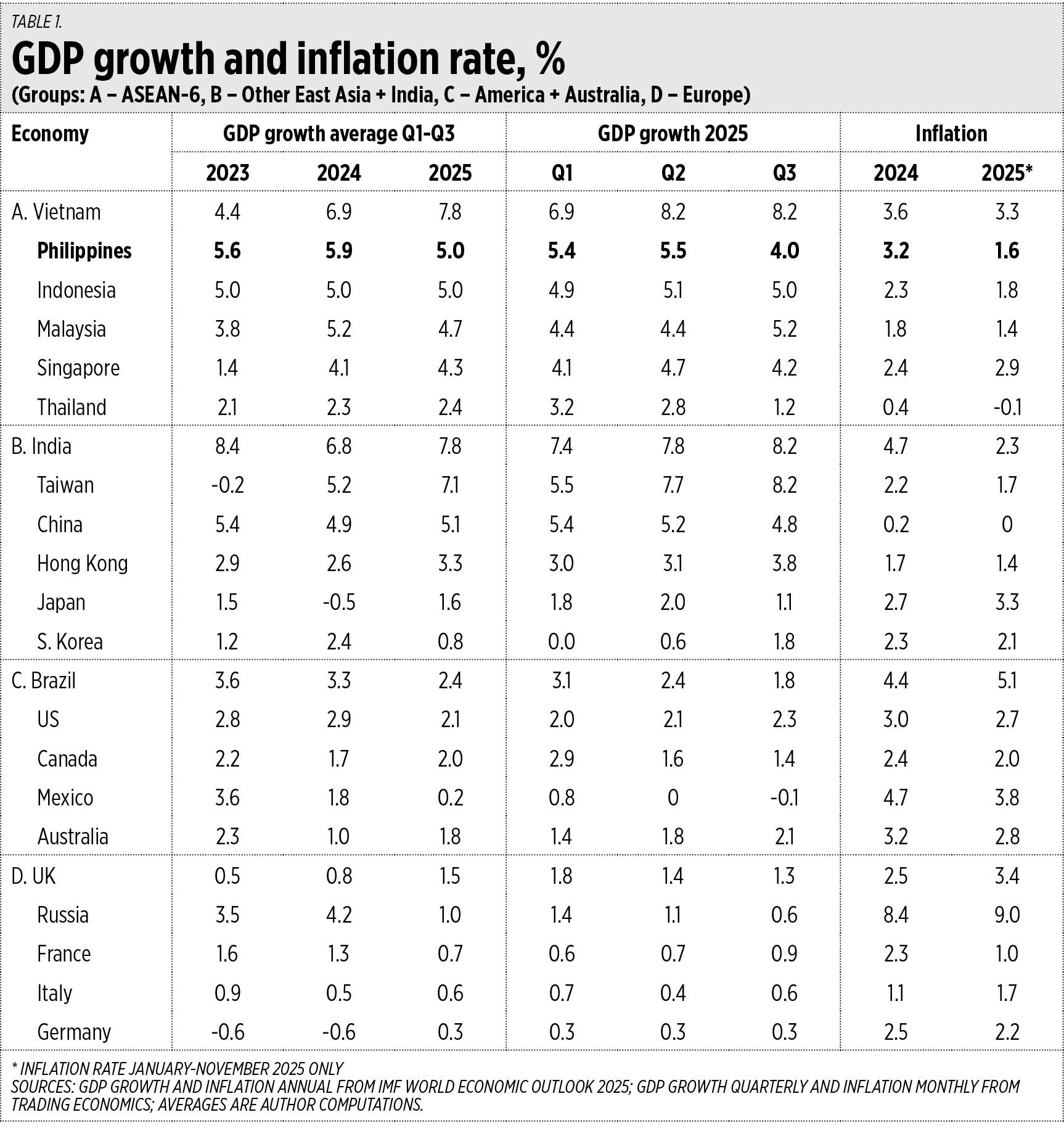
1. Most Asian nations have seen rising GDP growth from 2023 to 2025 in the first three quarters (Q1-Q3) of each year; in particular: Vietnam, Malaysia, Singapore, Thailand, Taiwan, and Hong Kong. Those with flat or showing a slight decline in growth are: the Philippines, Indonesia, India, China, Japan, and South Korea.

2. Most countries in America and Europe have had declining growth, particularly: the US, Brazil, Canada, Mexico, Russia, and also Australia. Those with very low growth are the UK, France, Italy, and Germany.

3. The fastest growing countries in 2025 in the list of the top 50 largest economies in the world are all Asian nations — India and Vietnam with 7.8% growth, Taiwan with 7.1%, China with 5.1%, and Indonesia and the Philippines with 5%. Yes, the Philippines still has high growth compared to many countries in the world.

4. All the pessimistic growth scenarios for 2025, especially for Asia because of Trump’s imposition of high tariffs starting April, failed to materialize.

5. There is overall price stability across many countries around the world, with inflation below 3.5% in 2025. Two Asian nations have seen deflation: Thailand and China. Instead of trade disruption, trade diversion is what has happened, with China exporting more to Asia and other countries at low prices, contributing to the low inflation of those countries.

6. The Philippines managed to cut inflation by half, from 3.2% in 2024 to only 1.6% in 2025. Low inflation is a good reason for the Bangko Sentral ng Pilipinas to cut interest rates (see Table 1).

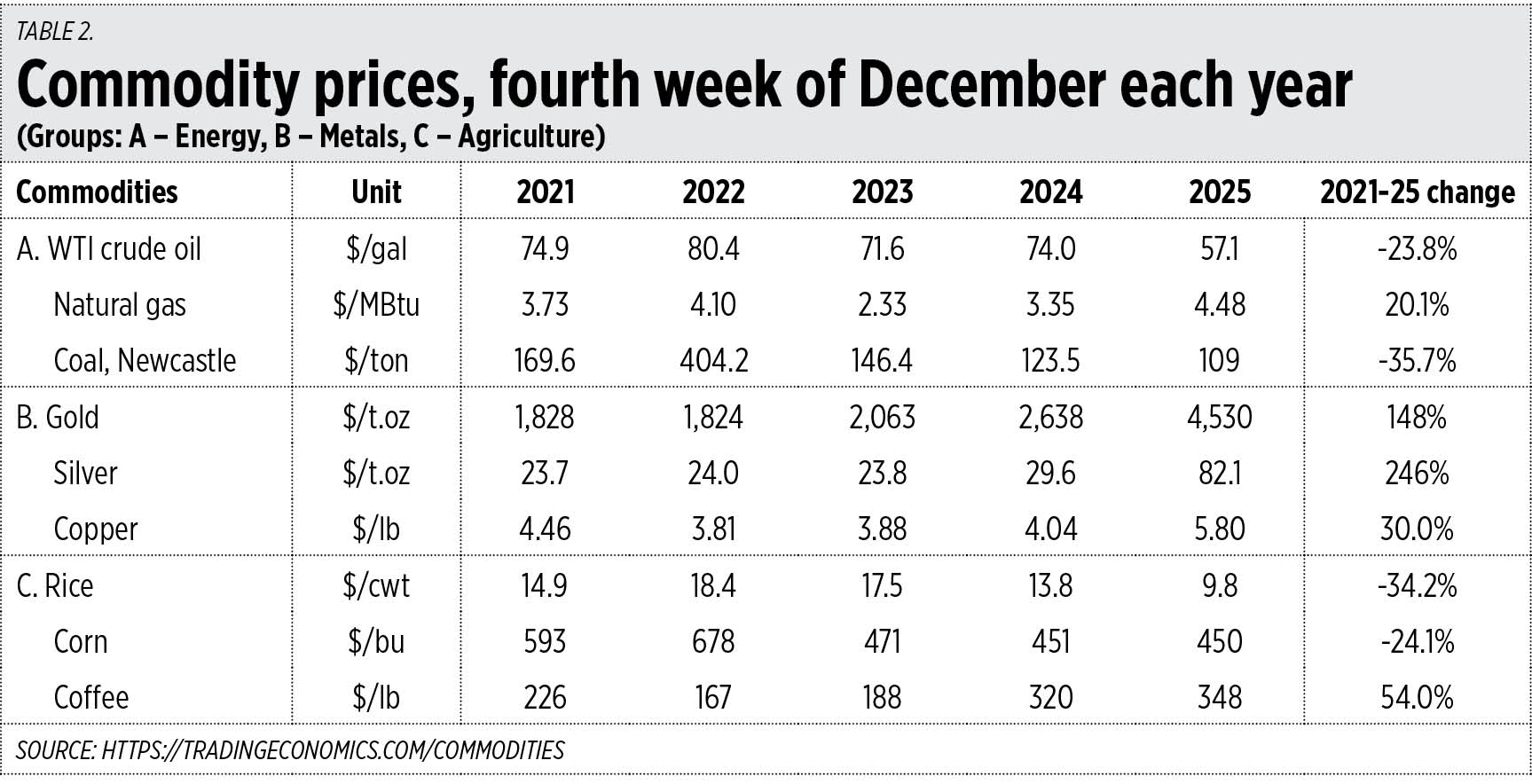
7. Global energy prices have stabilized at lower levels. Looking at prices of WTI crude oil from 2021 to 2025, they are down by 24%, while coal is down by 36%. So, claims of “spiraling” fossil fuel prices are wrong. US natural gas prices are high this month because of a very cold early winter.

8. Gold and silver prices are through the roof. In 2025, they are 148% and 246% higher than 2021 prices, respectively. Copper showed a modest price increase. Several Philippine mining companies, like Philex, are producing gold, silver, and copper, a revenue bonanza for them and a tax bonanza for the government.

9. Agricultural commodities like rice and corn also experienced price declines this year. Coffee prices are up due to rising demand, while supply was affected by bad weather in major coffee producers like Brazil and Vietnam, rising logistic costs, etc. (see Table 2).

10. Humanity (especially in Asia) is still on a continuing march to economic prosperity this year, thanks to rising incomes, declining overall inflation, and lower energy prices. Many European nations though continue their march to deindustrialization and degrowth.

The Philippines chairmanship of the Association of Southeast Asia Nations (ASEAN) in 2026 will help spur more high-level business and economic partnerships with the country. Not only with other member-countries of the association, but also with the largest economies in the world since bilateral summit meetings are scheduled between the ASEAN and the US, China, Japan, India, South Korea, and the EU, which will be held in Manila sometime in October or November.

The various Cabinet Secretaries, led by Executive Secretary Ralph Recto, will incorporate many items in the national agenda with regional and global agenda. Press Secretary Dave Gomez will have a big challenge communicating nationwide the significance of those meetings and agreements to the Filipino people.

Have a happy and prosperous new year, dear readers.


Bienvenido S. Oplas, Jr. is the president of Bienvenido S. Oplas, Jr. Research Consultancy Services, and Minimal Government Thinkers. He is an international fellow of the Tholos Foundation.

minimalgovernment@gmail.com

Bank Indonesia set to revamp benchmark for money market

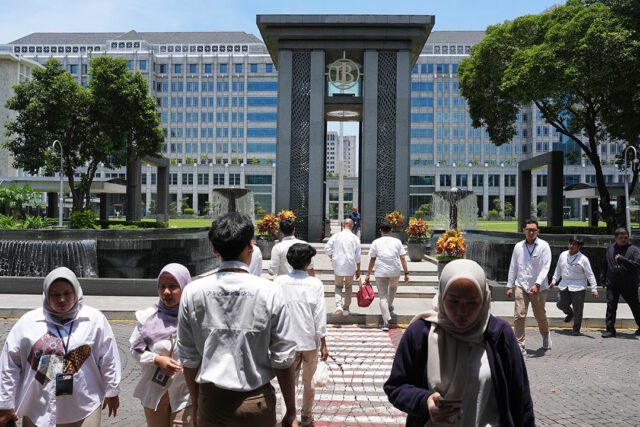
The Bank Indonesia headquarters in Jakarta, Indonesia. — DIMAS ARDIAN/BLOOMBERG

INDONESIA is set to phase out a key money-market benchmark this week, concluding a years-long transition to align with global standards.

Bank Indonesia (BI) will retire the Jakarta Interbank Offered Rate (Jibor) and fully replace it with the Indonesia Overnight Index Average, known as Indonia, on Jan. 1, as it aims to improve transparency and deepen the domestic funding market. Local institutions have been using the alternative reference rate as part of the transition process since August 2018.

The shift comes at a timely moment, as Bank Indonesia pushes for lenders to pass through aggressive interest rate cuts to households and businesses to support growth. It also brings the Southeast Asian country in line with a global move toward transaction-based benchmarks.

Institutions use Jibor to determine interest rates for bank deposits, swaps and consumer loans, among other things. Bank Indonesia has introduced compounded Indonia to match the tenors offered by Jibor and overnight index swap as a hedging instrument after the old benchmark is retired.

“Indonia is considered to better reflect interest rate movements in the market,” said Benny Aroeman, head of markets at Citibank Indonesia.

“This supports more effective monetary policy transmission because the benchmark used is in line with the conditions and dynamics of the money market.”

Earlier this month, BI Governor Perry Warjiyo said credit demand remained weak amid persistently high borrowing costs. While the central bank has lowered the benchmark interest rate by 125 basis points (bps) so far this year, lending rates have only fallen 24 bps.

With Indonesia’s money market transactions set to rise to 81 trillion rupiah ($4.8 billion) per day by 2030, according to Mr. Warjiyo, from 54 trillion rupiah in October, a more market-driven benchmark will be key for transmission of lower interest rates.

The transition is an important step in making the money and foreign exchange markets work more efficiently and ensure they are more modern and internationally standardized, said Agustina Dharmayanti, BI’s executive director of financial market development.

Authorities around the world are moving from interbank offered rates toward benchmarks based on real transactions to improve transparency and reliability. Jibor, for instance, is determined by quotations from 17 contributing banks, while Indonia is based on all transactions that occurred in the overnight interbank money market. Average daily interbank transactions reached 15.4 trillion rupiah — or around 63.5% of total money market transactions — throughout 2025, according to the central bank.

Others in Southeast Asia have also introduced alternative market reference rates. Thailand proposed its overnight repurchase rate in 2020 before phasing out the Thai Baht Interest Rate Fixing in 2023, while Malaysia unveiled its overnight rate in 2021 with plans to stop its Kuala Lumpur Interbank Offered Rate in 2029.

While some customers still have a preference for the forward-looking reference interest rates, “the transition process is going well,” said Wiwig Santoso, head of treasury at PT Bank SMBC Indonesia. “So far, only a few clients are still in the process of finalizing the addition of a fallback clause to their current contracts.” — Bloomberg

Pump-priming industrial, leisure sectors seen to aid inclusive growth

ALEXES GERARD-UNSPLASH

PHILIPPINE PROPERTY has been experiencing some headwinds. Despite this, potential for exponential growth beyond 2025 looks promising.

Two sectors we need to focus on are hotel and industrial sectors. It can’t be denied that the country has been having a difficult time welcoming more international visitors post-covid. But the growth prospects being seen by foreign hotel brands as well as local hospitality players are immense, especially given the government’s promise of modernizing more airports. Attracting more tourists bodes well for the country, as the sector is one of the key job-generating segments  of our economy, benefiting  a souvenir seller and conglomerates building hotels.

The industrial sector, on the other hand, has shown resilience even at the height of covid restrictions. But the challenge of attracting more high-value manufacturers remains, especially if the government wants to provide more employment opportunities in the countryside. While there’s ample industrial space for locators as developed by private players, the public sector needs to do its part and improve business registration systems, further simplify tax rules, honor sanctity of contracts, efficiently build more infrastructure, and improve the Philippines’ global anti-corruption rankings.

GOVERNMENT UNLIKELY TO MEET TOURIST ARRIVAL TARGET,  AS LOCAL TRAVELERS LIFT HOTEL DEMAND
Foreign arrivals reached 4.8 million as of the first 10 months of 2025, down 2.3% year on year and behind the government’s full-year target of 7.7 million set in 2024. The Tourism department is looking at other foreign markets (India, Canada and France) to fill the void left by subpar arrivals from South Korea and China. The Philippine government’s goal is to attract 12 million international tourists in 2028.

Meanwhile, Metro Manila occupancy rates are likely to hover above 60% (vs. 72% in 2019) despite lower foreign arrivals. Local tourists are likely to partly offset lower than expected foreign arrivals. Meanwhile, in-person events will continue driving the demand for meetings, incentives, conferences and exhibition (MICE) facilities. This should also raise daily rates and occupancies.

There is a strong case for the Philippine leisure sector to diversify its tourism markets and expand MICE facilities especially now that conferences and business events continue to flourish. Colliers believes that the domestic market will likely help fill the void left by plummeting South Korean and Chinese tourists so it’s pivotal for hotel operators and other leisure-related businesses to continue innovating to corner more domestic travelers.

CENTRAL LUZON’S NEW INDUSTRIAL SUPPLY TO OUTPACE SOUTH LUZON’S
From 2026 to 2028, Colliers sees the delivery of 870 hectares of new industrial supply in Central Luzon, more than quadruple compared to the 200 hectares of expected new supply in Southern Luzon during the same period.

With an improving business environment and bullish prospects for the region, we see more high-value manufacturers locating in Central Luzon, especially in Pampanga, Tarlac, Bulacan, and Bataan.

Industrial park and modern warehouse developers in Central Luzon should be mindful of the requirements of new and expanding locators in the region. We also encourage industrial developers to build more PEZA-accredited warehouses in Central Luzon, especially in Clark in Pampanga and Capas in Tarlac due to their strategic locations and proximity to the Clark International Airport.

HIGHER-VALUE LOCATORS TO DRIVE INDUSTRIAL SPACE ABSORPTION
Colliers expects a downward pressure on pricing (land leasehold and warehouse rates) in South Luzon due to rising vacancy as a result of sizable new supply, as well as slowdown in demand for big-box warehouses. The rise in vacancy should be partly tamed by previous investment commitments likely to materialize over the next 12 months.

Overall,  we see manufacturers of semiconductors, consumer goods, cosmetics, renewable energy components and automotive firms including electric vehicles (EVs) driving industrial demand over the next 12 months.

LAND LEASE EXTENSION A BOON TO INDUSTRIAL SECTOR
In August 2025, President Marcos signed into law Republic Act (RA) No. 12252, liberalizing the lease of private lands by foreign investors. The law extends the stability of long-term lease contracts for industrial estates, factories, agro-industrial ventures, tourism, agriculture, agroforestry, and ecological conservation from 50+25 years to up to 99 years. In our opinion, the law’s implementation will be crucial in attracting more foreign manufacturers into the country.

Developers with expansive industrial footprint should also take advantage of the entry and expansion of manufacturing locators by enticing them to put up facilities within their industrial parks. With more investments in the country given the land lease term extension, Colliers sees the creation and expansion of more industrial parks in Central Luzon and the Cavite-Laguna-Batangas (Calaba) corridor.


Joey Roi Bondoc is the director and head of Research of Colliers Philippines.

joey.bondoc@colliers.com

Metro Manila rental yields may stay flat in 2026 — analysts

Condominium and office buildings are seen in the Ortigas Business District, April 4, 2025. — PHILIPPINE STAR/MIGUEL DE GUZMAN

By Beatriz Marie D. Cruz, Reporter

RENTAL YIELDS in Metro Manila’s residential market are expected to remain flattish next year amid weak investor demand and lingering condominium oversupply, property consultants said.

“Yields will likely remain flat for the year 2026, with core central business districts (CBDs) recovering faster,” Roy Amado L. Golez, Jr., director for research, consultancy, and valuation at Leechiu Property Consultants (LPC), told BusinessWorld in an e-mail.

“Rents in Bonifacio Global City and Taguig have already exceeded pre-pandemic numbers, while other locations remain at a significant discount. This situation will persist until supply is taken up,” he said.

Joey Roi H. Bondoc, director and head of research at Colliers Philippines, said rental yields will likely stay flattish next year as residential demand is driven mainly by end-users rather than investors.

“I think one reason why the ready-for-occupancy promos, for example, of certain developers are working is because the demand is actually end-user driven,” he said in a phone interview.

In Metro Manila, residential rental yields averaged 4.1% in the primary market, or properties sold by developers to end-users, LPC said in its fourth-quarter property market report.

Meanwhile, secondary market yields — which cover pre-owned units offered for sale or for rent by their owners — averaged 4.8%, based on LPC data.

“Secondary market units will continue to generate higher yields versus primary market units, since buyers will be acquiring units from sellers who bought these units at much lower prices,” Mr. Golez said.

Mr. Bondoc added that Metro Manila’s primary residential market continues to face an oversupply of 30,400 unsold units, equivalent to about eight years’ worth of inventory.

Most of the region’s condominium inventory falls under the affordable to lower middle-income segment, with units typically priced between P2.5 million and P6.99 million, Colliers data showed.

“Current prices of condominiums are on the high side, and with challenging rents, this results in lackluster yields. To boost rental yields, prices should remain flat — since we don’t really see widespread price cuts — to allow the market to catch up,” Mr. Golez said.

Joe Curran, chief executive officer at Savills Philippines, expects rental yields in the region to be “broadly stable to slightly firmer” next year, at around 4% to 6%.

He said lower interest rates, return-to-office mandates, and the long-term stay of expatriates and students could help lift rental demand in Metro Manila’s residential market.

To improve rental yields, developers should adopt a more disciplined launch pipeline for condominium projects, Mr. Curran said.

He also cited the need for stronger marketing and proactive maintenance to make unsold condominium units more attractive for leasing.

“While Metro Manila stock continues to grow, supply that remains aligned with genuine end-user and rental demand should support stronger pricing power over the medium term,” Mr. Curran said in an e-mailed reply to questions.

For 2026, Colliers projects residential vacancy to ease to 26% from 26.5% as of end-2025, as developers slow the launch of residential projects in Metro Manila.

WTC Manila bets on MICE growth in 2026

WTCMANILA.COM

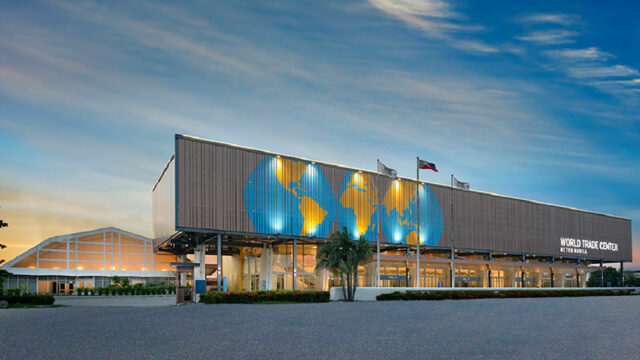
WORLD TRADE CENTER Metro Manila (WTCMM) expects robust demand next year as the Philippines rises as a meetings, incentives, conventions, and exhibitions (MICE) destination, its chief executive officer (CEO) said.

“The year 2026 is shaping up to be a strong year for WTCMM, and we see this growth increasingly consistent in recent years,” WTCMM Chairman and CEO Pamela D. Pascual said in an e-mailed reply to questions.

For 2026, a mix of trade shows, consumer events, and industry conferences and meetings will be held at the exhibition center, she added.

“With the Philippines gaining visibility as a MICE destination and our location in Pasay giving us a clear accessibility advantage, steady growth across multiple sectors keeps us optimistic,” Ms. Pascual said.

Other demand drivers include the development of hotels and malls in Pasay City, as well as the center’s proximity to Ninoy Aquino International Airport and seaports, she noted.

According to its website, WTCMM has an 8,300-square-meter (sq.m.) ground level, 8,200 sq.m. of gated outdoor space, and a 1,400-sq.m. pre-function lobby.

Ms. Pascual said the company is investing in “targeted upgrades” to keep its facilities MICE-ready.

“Expanding the WTC brand in regional locations where there is a budding, if not ripe, market for MICE is also in the pipeline,” she said.

Since opening in 1996, WTCMM has hosted global events including the Asia-Pacific Economic Cooperation (APEC) Summit, the Association of Southeast Asian Nations (ASEAN) Summit, and the Southeast Asian Games. It also hosted the National Women’s Summit, where former US First Lady Hillary R. Clinton was the keynote speaker.

The venue has been used for major trade shows in Manila across sectors such as food and beverage, automotive, and construction.

Challenges, according to Ms. Pascual, include competition from other MICE venues, climate disruptions, and growing demand for sustainability.

“Our response is to double down on service quality, invest in resilience and reliability, and embed practical sustainability measures that matter to our clients, exhibitors, and buyers,” she said.

Ms. Pascual also serves as a board director of the World Trade Centers Association, which owns the World Trade Center trademark.

WTCMM is managed and partly owned by the Investment & Capital Corp. of the Philippines (ICCP), a medium-sized conglomerate with interests in investment banking, venture capital, industrial estate development, and township development. — Beatriz Marie D. Cruz

Your Mom and Dad are influencers now, too

AKI AND KOICHI — AKIANDKOICHI INSTRAGRAM

By Andreea Papuc

YOU MAY never have heard of Aki and Koichi, but this sartorial couple in their ’70s from California are a hit on social media. They are part of a wave of influencers who are going viral in their ’50s, ’60s and beyond.

After years of boomer-bashing, it’s the ultimate flex. From fashion to beauty to fitness and lifestyle, the rise of the silver content creator is sending a powerful message: Age is no barrier to having cachet.

These trendsetters are a much-needed counterpoint to the youth-obsessed, anti-aging culture whose overriding narrative has been that our worth diminishes with every passing year.

They are not only a potent spending force, due to the substantial net worth they’ve accumulated (Australia’s roughly $3 trillion pension pool is on track to become the second largest in the world), but are helping redefine what we associate with aging. With graduates finding it harder to get a job, perhaps it’s no surprise that after a long time of catering to Gen Z and millennials, brands are courting mature-age and retired digital creators with money in their pockets and huge online followers.

But more importantly, this phenomenon is providing an avenue for women — who continue to face gendered discrimination in employment (it’s extraordinary that we’re even debating whether they’ve ruined the workplace) — to reclaim their voice and visibility. That’s become urgent with the advent of AI. A recent study published in Nature found that large language models are perpetuating and intensifying harmful stereotypes about older women already pervasive online.

Many of these newly minted internet personalities are relatable. They might exude sass and confidence, as well as the savviness to parlay their passions into compelling content, but their backgrounds are decidedly normal: Before becoming online sensations, Aki and Koichi, who are grandparents, had careers in education and medicine; there are trained microbiologists and accountants. One of my favorite accounts on Instagram is Sciuraglam*, which celebrates Milan’s glamorous older women just going about their day (mostly shopping, lunching, and standing around chatting).

The trend was also on display at Paris Fashion Week, with celebrities including Helen Mirren (80), Jane Fonda (88), and Laura Dern (58) appearing on the catwalk.

This might all seem superficial — it will take more than a bunch of influencers to dismantle unconscious bias in the workplace that limits women’s career progression. But let’s not be too quick to dismiss the impact of the simple act of showing off daily outfits on Instagram, TikTok, and YouTube. As populations age and people delay retirement, these third-age influencers are restoring some relevance and legitimacy to age groups sidelined in many professions. And it signals to those born after 1980 that shaping tastes, sparking trends, and driving product interest online doesn’t have to fizzle out as the years pass; you can continue to have digital clout for decades to come.

Jane Evans, an advertising executive and entrepreneur in her ’60s, has been campaigning for years to bring visibility back to middle-aged women, frustrated by her own experience of trying to get a job after a hiatus. “I went to see a creative director and he was like ‘Jane, I’d give you a job, but you would end up at the back of the department doing the s–t that nobody else wants.’ The ageism was to my face,” Evans said on the Power of Women podcast. (Lately, Evans and Cindy Gallop, an advertising veteran and outspoken advocate for gender equality in business, have taken on the LinkedIn algorithm, urging females to change their profile gender to male, after they noticed that men consistently received greater engagement with fewer followers.)

Evans also co-authored a book — Invisible to Invaluable: Unleashing the Power of Midlife Women — that describes the stages of a woman’s life as little girl; troubled teenager; sex object; career woman; mum; old woman waiting to die. “We are taught to fear the passage of time, not celebrate it,” the authors wrote.

The latest crop of influencers are doing just that, despite the online hate and misogyny they experience.

Supermodel Paulina Porizkova, 60, who has become an outspoken advocate for aging authentically, has been open about the abuse she has received. Some just become disenchanted when social media commodifies them. Lyn Slater, who became widely known as the Accidental Icon, went viral about 10 years ago in her ’60s, when “the word influencer wasn’t used.” After the pandemic, the former professor of social welfare reassessed her life, stopped doing sponsored posts on Instagram (@iconaccidental), and now has a Substack documenting her reinvention.

Like youth, trends are fleeting and never more so than in the digital age. Some of you are glad when they are over — and, yes, this one might also fade away. But for now, it’s worth basking in its moment as we roll into a new year, and another, and another…

BLOOMBERG OPINION

*Sciura is the feminine form of sciur, which is the Lombard word for mister.

Yen stages partial recovery as BoJ hikes, intervention risks weighed

CULLEN CEDRIC-UNSPLASH

TOKYO — The yen recovered some ground on Monday following a steep drop at the end of last week as markets weighed the timing of more interest rate hikes in Japan and the possibility of intervention in thin end-of-year trading.

Bank of Japan (BoJ) policymakers debated the need to continue raising rates, a summary of opinions at their policy meeting in December showed on Monday. The euro was supported after US President Donald J. Trump signaled optimism in talks to reach a peace deal to end the war in Ukraine.

Japan has a free hand in dealing with excessive moves in the yen, Finance Minister Satsuki Katayama said last week. Those intervention warnings have helped keep a lid on dollar-yen positions, but pessimism about Japan’s currency is showing up in other foreign exchange crosses, said Bart Wakabayashi, Tokyo branch manager at State Street.

“I think a long position in yen is quite painful,” Mr. Wakabayashi said. “We’re seeing some expression of yen shorts against these currencies, particularly Aussie-yen.”

“The market is still trying to figure out what kind of role the yen plays now in terms of being a safe haven,” he added.

The yen strengthened 0.3% to 156.14 per dollar after a 0.5% slide on Friday. The yen traded at 105.02 versus the Aussie, just below the 17-month low of 105.08 that it touched on Friday.

The dollar index, which measures the greenback against a basket of currencies, was little changed at 98.03. The euro held steady at $1.1770. Sterling was a shade weaker at $1.3491.

The BoJ raised its policy rate to a 30-year high of 0.75% from 0.5% at its December meeting. The summary of opinions released on Monday showed many board members saw the need for further increases to the rate, which remained significantly negative in inflation-adjusted terms.

The rate hike failed to halt depreciation of the yen, which slid to as weak as ¥157.78 per dollar on Dec. 19, prompting intervention warnings. Japan last stepped into markets to defend its currency in July 2024, buying yen after the currency hit a 38-year low of ¥161.96.

With few data points this week and thin trading ahead of New Year’s holidays in many markets, geopolitical developments are taking center stage. President Trump said on Sunday that he and Ukrainian President Volodymyr Zelensky were “getting a lot closer, maybe very close” to an agreement to end the war in Ukraine, though both leaders acknowledged that some of the thorniest details remain unresolved.

French President Emmanuel Macron said in an X post that progress was made on security guarantees and that a “Coalition of the Willing” would meet in Paris in early January to finalize their “concrete contributions.”

Saber-rattling continued in Asia, with China positioning military units around Taiwan in preparation for live-fire drills on Tuesday. And North Korean state media said leader Kim Jong Un oversaw the launch of long-range missiles on Sunday, with South Korea’s Yonhap reporting that more tests could occur around New Year’s Day.

The main data focus this week will be Tuesday’s release of minutes from the Federal Open Market Committee’s meeting earlier this month. The US central bank cut rates at the gathering and projected just one more reduction for next year, but traders have priced in at least two more.

The Australian dollar was little changed at $0.6717. New Zealand’s kiwi weakened 0.2% to $0.582.

In cryptocurrencies, bitcoin jumped 2.2% to $89,463.23, while ether rose 2.6% to $3,012.41. — Reuters

Brigitte Bardot, icon of French cinema, 91

Brigitte Bardot in a scene from the 1960 film The Truth.

PARIS — Actress Brigitte Bardot shot to international fame dancing the mambo barefoot in And God Created Woman, her tousled hair and fierce energy radiating a sexual magnetism rarely before seen in mainstream cinema.

A global icon was born.

At just 21, she scandalized censors and captivated audiences. Her free-spirited performance in the 1956 film, shot by her husband Roger Vadim, marked a decisive break from the demure heroines of the previous era.

Brigitte Bardot, often referred to in France simply as “B.B.” and whose later years were marked by animal rights campaigns and far-right political sympathies, has died at the age of 91, her foundation said on Sunday. The cause was not immediately known.

“Her films, her voice, her dazzling fame, her initials, her sorrows, her generous passion for animals, her face that became Marianne — Brigitte Bardot embodied a life of freedom. A French existence, a universal radiance. She moved us. We mourn a legend of the century,” said French President Emmanuel Macron, referring to the fact that Ms. Bardot’s face was used as the model for an official bust of Marianne, an allegorical female figure who symbolizes the values of the French Republic, which was installed in town halls across the country from the late 1960s onward.

‘SHE FOLLOWS HER INCLINATIONS’
Born in Paris on Sept. 28, 1934, Ms. Bardot grew up in an upper-middle-class household. She described herself as a shy, self-conscious child who “wore spectacles and had lank hair.”

By 15, however, she graced the cover of Elle magazine, launching a modelling career that soon led to film.

Ms. Bardot’s character in And God Created Woman was the embodiment of liberated femininity. The controversy only fueled her appeal. Ms. Bardot became a symbol of 1950s and ’60s France.

Her allure extended far beyond French cinema. At 15, Bob Dylan is said to have written his first song about her, the never-released “Song for Brigitte,” while Andy Warhol painted her portrait.

Ms. Bardot’s ability to subvert traditional gender roles made her not just a sex symbol, but a pop culture icon and a touchstone for shifting social attitudes.

In 1959, Simone de Beauvoir penned an article for Esquire magazine in which she lionized Ms. Bardot’s conspicuous sense of freedom. “B.B. does not try to scandalize,” the feminist philosopher wrote. “She follows her inclinations. She eats when she is hungry and makes love with the same unceremonious simplicity.

“Moral lapses can be corrected, but how could B.B. be cured of that dazzling virtue — genuineness? It is her very substance.”

Ms. De Beauvoir concluded: “I hope she will mature, but not change.”

‘I’VE BEEN LET DOWN TOO OFTEN’
Despite her influence, Ms. Bardot found celebrity life isolating. She often spoke of being a prisoner of her own fame, unable to enjoy life’s simple pleasures.

“Nobody can imagine how horrific it was, such an ordeal,” she reflected decades later. “I couldn’t go on living like that.”

Her personal life was shaped by four marriages, widely reported affairs, and well-documented struggles with depression.

On her 26th birthday she was found unconscious at a house on the French Riviera after trying to take her own life. Rumors of another attempted suicide surfaced years later when she mysteriously canceled a 49th birthday party then appeared in hospital.

Alongside her acting, Ms. Bardot enjoyed a successful music career. Her collaborations with singer-songwriter Serge Gainsbourg, including the erotic “Je t’aime … moi non plus” (“I Love You … Neither Do I”), drew both acclaim and controversy.

In the late 1960s she modeled for a bust of Marianne, the personification of the French Republic.

But she found little satisfaction in the praise she garnered.

“I have been very happy, very rich, very beautiful, much adulated, very famous and very unhappy,” she told the magazine Paris Match around the time of her 50th birthday. “I’ve been let down too often. I’ve had really terrible disappointments in my life. That is why I’ve chosen to withdraw, to live alone.”

‘THIS IS MY ONLY BATTLE’
Ms. Bardot made the last of her 42 films in 1973. Disenchanted with the industry, she declared the world of cinema “rotten” and left public life.

“I will have given 20 years of my life to cinema, that’s enough,” she said in a TV interview at the time.

She settled in the fashionable French resort of Saint-Tropez, where she found solace among animals and the Mediterranean landscape.

There, she began a passionate defense of animal welfare. “This is my only battle, the only direction I want to give my life,” Ms. Bardot said in 2013.

Her devotion to animals became legendary. In 1986, she established the Brigitte Bardot Foundation for the Welfare and Protection of Animals, auctioning off personal souvenirs the following year to raise funds for her cause.

Ms. Bardot supported high-profile activists, such as anti-whaling campaigner Paul Watson, and campaigned vigorously against animal cruelty, at times threatening to leave France over animal welfare disputes.

When actor Gérard Depardieu accepted Russian citizenship after a public spat with French authorities, in 2013, Ms. Bardot threatened to follow suit if France euthanized two sick circus elephants.

For much of the latter part of her life, Ms. Bardot lived alone behind high walls in Saint-Tropez, surrounded by a menagerie of cats, dogs, and horses.

This passion, she often suggested, was an antidote to her disappointing relationships. “I gave my beauty and my youth to men,” she once said. “I am going to give my wisdom and experience to animals.”

“From her rescued pigeons in Saint-Tropez to her beloved dogs, PETA will miss Brigitte, an angel for animals who went to bat and to court to protect them all,” said Ingrid Newkirk, founder of People for the Ethical Treatment of Animals or PETA.

‘FEMINISM ISN’T MY THING’
As her advocacy intensified, so too did the backlash to her political statements.

Ms. Bardot’s public remarks on immigration, Islam, and homosexuality led to a string of convictions for inciting racial hatred.

Between 1997 and 2008, she was fined six times by French courts for her comments, particularly those targeting France’s Muslim community.

In one case, a Paris court fined her €15,000 ($17,000) for describing Muslims as “this population that is destroying us, destroying our country by imposing its acts.”

In 1992, she married Bernard d’Ormale, a former adviser to the far-right National Front, and later publicly endorsed the party’s successive leaders, Jean-Marie Le Pen and his daughter Marine Le Pen. Ms. Bardot called the latter “the Joan of Arc of the 21st century.”

Yet, for all her polarizing views, Ms. Bardot’s influence endured, whether in fashion — with media noting regular comebacks of her trademark hairstyle — or through regular documentaries and coffee‑table books celebrating her rare impact on French cinema.

Asked by French channel BFM TV in May 2025 if she considered herself a symbol of the sexual revolution, she said: “No, because before me, plenty of wild things had already happened — they didn’t wait for me. Feminism isn’t my thing; I like men.”

In the same interview, she was asked how often she reflected on her film career. “I don’t think about it,” she said, “but I don’t reject it, because it’s thanks to it that I’m known everywhere in the world as someone who defends animals.” Reuters

ADVERTISEMENT
ADVERTISEMENT