Home Blog Page 4982

DFA: US can’t invoke EDCA to aid Taiwan from China attack

ARMED FORCES OF THE PHILIPPINES

By Beatriz Marie D. Cruz
and John Victor D. Ordoñez, Reporter

THE US can’t invoke its Enhanced Defense Cooperation Agreement (EDCA) with the Philippines to defend Taiwan from China, according to Manila’s top envoy.

“If the United States tries to invoke the EDCA, it would be inconsistent,” Foreign Affairs Secretary Enrique A. Manalo told the Senate committee on foreign affairs on Wednesday. “I don’t think they could use the EDCA because it’s quite clear what purpose EDCA activities are for.”

He issued the remark after Senator Maria Imelda “Imee” R. Marcos, who heads the committee, asked if the US could use EDCA sites to go up against China if it invades Taiwan.

Mr. Manalo said the US could invoke its Mutual Defense Treaty with the Philippines, but this would still be subject to congressional review.

“If the US were to ask us, we could not immediately take a decision unless we go through the constitutional processes,” he said. “That would mean at least going through the legislative bodies.”

He said the EDCA is “not aimed at any third country” and is “meant for the use of the Philippines and of course in connection with our treaty with the United States.”

National Security Council spokesman Jonathan E. Malaya last week said the Philippines adheres to the One China Policy, which recognizes Taiwan as part of China and “subscribes to the Association of Southeast Asian Nations principle of noninterference in approaching regional issues.”

EDCA was built on the 1951 Mutual Defense Treaty and the 1999 visiting forces agreement between the Philippines and US.

The main principle of the Mutual Defense Treaty is “to have collective defense,” Defense Officer-in-charge Carlito G. Galvez, Jr. told the same hearing.

“The Philippines fully subscribes to the principle of noninterference in the affairs of states and respect for sovereignty and that’s also enshrined in the UN charter which we fully subscribe to,” Mr. Manalo told senators.

Citing then-US House Speaker Nancy Pelosi’s visit to Taiwan in August last year, Mr. Manalo said: “When tensions rose between the United States and China over Taiwan last August, our position has always been to urge the parties concerned to maintain a level of communication to avoid escalating tensions. I think that’s as far as we can really go.”

Ms. Marcos said putting up a credible self-defense posture is “very difficult” and far-fetched for the Philippines.

She cited the need to modernize the Philippine Armed Forces, which remains “underarmed and completely abject in the face of any external threats.”

Mr. Galvez said his agency is set to present to the president a plan to buy radar systems, multi-role fighters, missile systems and offshore vessels under the Armed Forces of the Philippines (AFP) modernization program.

President Ferdinand R. Marcos, Jr. last month ruled out the use of Philippine military bases, access to which by American troops under a 2014 military pact has been widened, to launch offensives.

“We will not let our bases be used for whatever offensive actions,” he told reporters on the sidelines of a commemoration event for Filipino heroes of World War II.

The president said sites under the Philippines’ 2014 Enhanced Defense Cooperation Agreement (EDCA) with the US are aimed to help the Philippines.

In February, Mr. Marcos gave the US access to four more military bases under EDCA on top of the five existing sites.

China has criticized the EDCA expansion, accusing the US of endangering “regional peace and stability.”

MISINTERPRETED
Three of the four new EDCA sites are in northern Philippines — Naval Base Camilo Osias in Sta Ana, Cagayan; Lal-lo Airport, also in Cagayan; and Camp Melchor dela Cruz in Gamu, Isabela.

Cagayan is about 1,000 kilometers away from self-ruled Taiwan, which China claims as part of its territory.

Ms. Marcos, the president’s sister, questioned the locations of the EDCA sites.

Mr. Galvez said the instruction from Mr. Marcos was to prepare for external defense, citing that the northern part of the country as the most vulnerable.

He added that the locations of the EDCA sites were based on their “multi-use capability.”

“We still have majority of our units in Mindanao,” Armed Forces of Chief of Staff General Andres C. Centino told Wednesday’s hearing. “We are in fact deploying our marines from the south to the northern part of the Philippines.”

Also on Wednesday, Mr. Marcos said the Chinese ambassador’s remarks on overseas Filipino workers (OFW) in Taiwan might have been misinterpreted since English is not his first language.

“I interpret it as him trying to say that you should not — the Philippines should not — provoke or intensify the tensions because it will impact badly on Filipinos,” he told a livestreamed news briefing.

“That’s how I take it, but I will be talking to the ambassador soon and I am sure he will be very anxious to give his own interpretation of what he was trying to say.”

Chinese Ambassador to the Philippines Huang Xilian last week asked Manila to oppose Taiwan’s independence if the country “cares genuinely” about the more than 150,000 overseas Filipino workers (OFWs) living there.

Taiwan’s Ministry of Foreign Affairs (MOFA) on Monday said the statement showed “brazen threats [that] are unacceptable to the civilized world.”

“The MOFA maintains close communication and engages in frequent exchanges of opinions on regional developments with foreign representative offices in Taiwan,” it said in a statement. “When appropriate, MOFA also provides necessary assistance to countries to protect their citizens.”

Mr. Marcos on Tuesday asked the Department of Foreign Affairs to ensure the safety and welfare of OFWs in Taiwan.

Last week, Mr. Huang said the United States seeks to take advantage of the new military bases under the EDCA to interfere with the Taiwan situation “to serve its geopolitical goals and advance its anti-China agenda at the expense of peace and development of the Philippines and the region at large.”


Marcos assures steady supply of food products

PRESIDENT Marcos Jr. brought the Kadiwa ng Pangulo to the city of San Jose del Monte, Bulacan on April 19, 2023. — PNA PHOTO BY ALFRED FRIAS

PRESIDENT Ferdinand R. Marcos, Jr. on Wednesday assured the steady supply of low-cost food supplies being sold at so-called Kadiwa outlets, according to the presidential palace.

“We are going to ensure that we will continue to have a good supply and that we won’t have to worry about running out of products,” the president, who also heads the Department of Agriculture (DA), said in Filipino during the launch of a Kadiwa branch in San Jose del Monte, Bulacan.

The Agriculture department’s Kadiwa program allows farmers and small entrepreneurs to sell products such as rice, fish, poultry, fruits and vegetables at low prices through pop-up stores or online platforms.

The stores were rolled out in various provinces at the height of the coronavirus pandemic to help farmers sell their products amid lockdowns.

Total sales of the more than 500 Kadiwa branches have reached P415 million, the Presidential Communications Office said in a statement on Wednesday.

It said more than a million families and 26,000 farmers and fishermen have benefited from the program.

“Many of them (small businesses) have depleted their savings and were forced to close shop,” Mr. Marcos said. “This is why we are giving our micro, small, and medium enterprises the opportunity to have their own place and market where they can sell their products.”

The Agriculture department in February said it would set up permanent Kadiwa stores in Metro Manila’s public markets to give more farmers a chance to sell their products directly to consumers.

“One of the things we’re looking at is having accredited Kadiwa retailers inside the market itself for our countrymen to have access to cheaper agricultural commodities — especially now that we have identified cooperatives that are ready to supply the market,” Agriculture Assistant Secretary Kristine Y. Evangelista told reporters on Feb. 10. — John Victor D. Ordoñez

Apo Agua in final testing stages of Davao bulk water supply system

APOAGUA.COM

ABOITIZ-LED Apo Agua Infrastructura, Inc. is now in the final stages of system checks for its bulk water supply project in Davao City, which is targeted for partial operations within the month.   

In a presentation before the city council on Tuesday, Apo Agua President Anna Victoria M. Lu said they had to move the January target of water delivery due to several factors, including rains that triggered flash floods and pipelines that was damaged by another utility project.   

Leaks were encountered during the flushing,said Ms. Lu, who is also head of Aboitiz InfraCapitals water business.  

She also cited extraordinary raw water conditions due to successive heavy flash floods at the source, the Tamugan River. 

Highly turbid water cannot be fed into the system to protect the filtration and water distribution network, she explained.  

Meanwhile, the water treatment plant facilities needed for partial operations have been tested and commissioned, and the system for operations automation is undergoing testing.   

The chemical and microbiology laboratory has also been audited by the Department of Health (DoH) for accreditation.   

Preparations are also underway for the hydro testing of pipelines to the off-take points of distributor Davao City Water District (DCWD).  

The over P13-billion project will deliver 300 million liters of water daily to DCWD.   

Apo Aguas bulk water supply system adopts the water-energy nexus concept, where a run-of-river hydroelectric plant will power the water treatment facilities. Maya M. Padillo

AG&P gets approval from city marine resources council for Ilijan LNG terminal

AG&P COMPANY

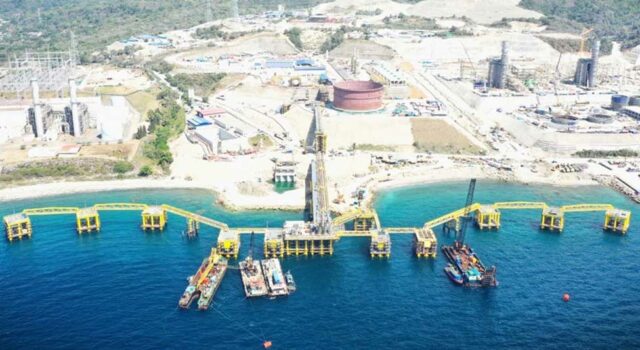
AG&P International Pte. Ltd. has secured the approval of the local marine resources council for its liquefied natural gas (LNG) terminal facility in Ilijan, Batangas City.

In a statement on Wednesday, the company said the City Fisheries and Aquatic Resources Management Council (CFARMC) “passed a binding resolution supporting the construction, commissioning and operation” of AG&P’s import terminal.

“We will work in collaboration with CFARMC towards our shared responsibilities for our fishing communities to enable diverse livelihood and income opportunities, while simultaneously bringing clean energy into the country and improving the quality of life for many thousands of Filipinos,” Anupam Ahuja, AG&P Group’s senior vice-president for Strategic Services, said in the statement.

The CFARMC’s resolution recognizes AG&P’s facility as a contributor to jobs generation and sustainable progress in Batangas.

“The development and industrialization along the municipal waters will greatly help in the economic growth of Batangas City. It is also necessary to address the thinning supply of natural gas which is needed by power plants in the city,” the resolution said.

AG&P said it has partnered with government agencies and academic institutions to deliver various skills training in coastal villages for alternative livelihoods as well as providing on-the-job training for the emerging LNG/natural gas industry and building a pool of employable talents for clean energy networks being developed in the country. — Ashley Erika O. Jose

Anti-graft court denies plea to junk charges vs ex-PAGCOR exec

PHILSTAR FILE PHOTO

THE PHILIPPINES’ anti-graft court has rejected a plea to junk the charges against a former chairman of the Philippine Amusement and Gaming Corp. (PAGCOR) over the anomalous use of funds for movie tickets worth P26.7 million in 2008.  

In a six-page resolution dated April 9, the Sandiganbayan said former PAGCOR chair Efraim C. Genuino did not raise any new arguments to dismiss the case. 

“We become repetitive,” Associate Justice Amparo M. Cabotaje-Tang said in the ruling. “The court is not inclined to embark on another extended discussion of the same issue again.”  

Mr. Genuino’s official Facebook page did not immediately reply to a Facebook Messenger chat seeking comment.  

Last year, the Supreme Court junked the ex-PAGCOR chairman’s plea to dismiss the graft charges since he prematurely brought the case to the High Court before the anti-graft court could hand down its final verdict.  

He argued that PAGCOR’s income is not considered “public funds” and was not subject to the Commission on Audit’s (CoA) jurisdiction, which flagged the anomalous disbursement. 

Mr. Genuino added that the purchase of movie tickets did not result in any “under injury to the government or any private entity.”  

The anti-graft court disagreed saying the Supreme Court had affirmed CoA’s disallowance of the release of funds for the 89,000 movie tickets amounting to P26.7 million.   

The Sandiganbayan noted that the High Court only decided on whether the CoA abused its discretion when it disallowed the amount, not on the ex-PAGCOR official’s guilt or innocence. John Victor D. Ordoñez

Marcos calls for healthcare program support from private sector, medical professionals 

PHILIPPINE STAR/KRIZ JOHN ROSALES

PRESIDENT Ferdinand R. Marcos, Jr. on Wednesday called on the private sector to partner with public healthcare institutions to help improve the delivery of medical services, especially in remote areas.   

“We need support from all sectors of society the government, the private sector and our citizens in order to improve our health care services,” he said in Filipino during the groundbreaking ceremony for the St. Bernadette Children and Maternity Hospital in San Jose del Monte, Bulacan. 

He also urged medical professionals to support the governments health programs.   

“Through our collaboration, we will surely see a progressive Philippines, where no one will be left behind.”  

The president also urged the Department of Health to work with local government units to make sure public hospitals adhere to healthcare standards. 

The St. Bernadette Children and Maternity Hospital was built in line with the Philippine Health Facility Development Plan, the Presidential Communications Office (PCO) said.  

It will be a Level-1 medical facility, with 65 hospital beds and equipped with an operating room, maternity and isolation facilities, clinical laboratory, imaging facility, and pharmacy.   

HOUSING
In a separate news briefing, Mr. Marcos said his administration had broken ground for around 1.2 million housing units nationwide after he led a ceremony for six housing projects in Bulacan.  

These six projects will provide 12,563 housing units, the PCO said.  

“With this project, we can fulfill the needs of thousands of residents in Bulacan to have affordable houses they can call their own homes,” Mr. Marcos said at the ceremony.  

“The housing program is an important component of the government’s initiative to address housing backlog in the country.” John Victor D. Ordoñez

Senate bill seeks jail time, fine for nuisance candidates 

SENATE.GOV.PH

A SENATOR has filed a bill seeking to penalize nuisance candidates, prompted by a case in the May 2022 elections for a governor in Negros Oriental, where the declared winner was killed in a shooting at his residence in March.    

The proposed measure could potentially defuse political tensions,Senator Sherwin T. Gatchalian said in a statement on Wednesday.  

Senate Bill No. 1061 seeks to amend the Omnibus Election Code, which currently does not punish nuisance candidates.   

Section 69 of the code provides that the Commission on Elections (Comelec) can cancel the certificate of candidacy of someone who is proven to have the intention of putting the election process in mockery or disrepute or to cause confusion among the voters by the similarity of the names of the registered candidates or by other circumstances or acts which clearly demonstrate that the candidate has no bona fide intention to run for the office.”   

The bill proposes that any person found guilty of being a nuisance candidate will pay a fine of P50,000 as well as be imprisoned for up to six years without a chance for probation.   

This bill seeks to curb the emerging unethical electoral practice of individuals profiting from the elections by using their names or resources with the end goal of abusing the system,Mr. Gatchalian said in the bills explanatory note.  

Comelec Chairman George Erwin M. Garcia told a Senate hearing on Monday that there were 205 nuisance candidates during the 2022 national and local elections.  

A certain Ruel Degamo ran for Negros Oriental governor last year, a position that was eventually awarded to the murdered Roel R. Degamo.   

Comelecs en banc resolution dated Sept. 1, 2022 prompted the transfer of votes from the nuisance candidate Degamo to the late Mr. Degamo, voiding the victory of Pryde Henry A. Teves brother of Negros Oriental Rep. Arnolfo A. Teves, Jr. as governor.    

Rep. Teves has been linked to the killing of Mr. Degamo.  

Its high time we criminalize nuisance candidacy in order to further protect the integrity of electing public officials and hoping that the process will put an end to political violence in the country,Mr. Gatchalian said. Beatriz Marie D. Cruz

Maguindanao electric co-op exec killed in ambush

AN EXECUTIVE of an electric cooperative was killed in an ambush Wednesday in the town of Datu Odin Sinsuat, Maguindanao del Norte, the police reported.  

Al-Hassan Maongco, manager of the Institutional Services Department of the Maguindanao Electric Cooperative, Inc. (MAGELCO), died on the spot from multiple bullet wounds.  

Datu Odin Sinsuat police chief Regie Albellera told the media that Mr. Maongco was driving his silver Toyota Fortuner when gunmen opened fire at his vehicle while at a stretch of a highway in Barangay Upper Capiton.  

Mr. Maongco lost control of his vehicle, hitting a tree along the route head-on.  

His attackers managed to escape before responding policemen and village security officers could reach the scene.  

MAGELCO provides electricity supply to Maguindanao, which has recently been divided into two provinces.  

The electric cooperative official was killed barely a day after two men shot dead Desmon Daglok Silongan, a popular municipal councilor in the restive Salibo town in Maguindanao del Sur. John M. Unson

What Filipino students are saying about ChatGPT

PHILSTAR FILE PHOTO

By Miguel Hanz L. Antivola

FILIPINO students weighed in on ChatGPT, an artificial intelligence (AI) chatbot developed by San Francisco-based AI research lab OpenAI that can produce essays and answer questions in seconds.

“ChatGPT has proven to be an invaluable tool for me in many ways,” graduating computer science student Wanders from Davao City said in an interview. “I found it helpful in generating ideas, assisting with research, and providing summaries.”

He said that he uses ChatGPT to organize information and develop ideas, rather than relying solely on the bot to write essays for him. 

Law student Jake from Quezon City said that he has used ChatGPT as a research tool in drafting legal advice for a school requirement.

“It helped me by speeding up the process of generating leads and summaries of US cases which talked about the topic, rather than me manually typing keywords in Google search… I verified the information by looking at the actual case text,” he said.

Meanwhile, AJ, a humanities college student from Quezon City, said that he uses ChatGPT occasionally for idea generation or exploring new concepts, citing inaccuracies as a challenge.

“The responses I got from ChatGPT never made it to the work I turn in… After I get a grasp of something using AI, I go on actually engaging with the texts. I find that most results from AI are inaccurate,” he said. 

“There is this one time that I’m looking for sample academic essays on a very specific topic. After getting interesting results, I asked ChatGPT to provide me with external links so I could see them for myself. They gave me fake links to academic journals. I’ve also seen posts about ChatGPT making up citations that don’t exist.” 

Some educators have become more cautious about academic dishonesty, as they have noticed an increase in the use of ChatGPT and other AI tools by students for their assignments. 

“They expressly prohibit consulting AI bots in exams. Our exam outputs are subject to AI detection services in order to uphold academic honesty,” Jake, the law student, said.

Elementary school teacher Bea said, “In our school, we acknowledge the use of ChatGPT. However, we are against it because it is still considered plagiarized work.” 

ChatGPT can be thought of as an automatic text summarizer rather than a tool that plagiarizes,said Ralph Vincent J. Regalado, chief executive officer and founder of Senti AI, a local AI solutions and services company. 

AJ, the college student from Quezon City, said that AI can only supplement information and optimize processes at best, recognizing that it lacks “human sensibilities,” 

A cautious outlook on AI in Philippine education grounded students and educators alike.

“AI definitely does not have a human touch to it, but considering how rapid technological advancements are unraveling, it is indeed something to be wary about,” AJ said. 

“ChatGPT will surely continue progressing speedily. Its development will not be hampered by state measures. I think the burden rests on academic institutions to implement measures that prevent its abuse and misuse,” Jake said. 

For his part, Wanders, the college student from Davao City, said: “It is essential that all stakeholders work together to find a way forward that balances the benefits and risks of AI technology in the academe.”

Mr. Regalado, the AI expert, offered a different view, “I do believe that we shouldn’t shy away from using new technologies to improve how we do things. Teaching students how to properly use tools such as ChatGPT for research… can definitely help them adjust to the changing landscape once they leave school.” 

He stressed the need for human intervention in AI development for a sustainable future, citing “human in the loop” and the importance of input quality in AI output. 

“Depending on the course objectives, students can be encouraged to use ChatGPT for school work as a supplementary resource, learn to use it wisely and validate the content it generates. When in doubt — turn to your teachers, and use your own critical thinking skills,” he said. 

He also said that educators should make it a point to instill academic honesty, critical thinking, and creativity when students use AI tools for their school work, alongside clear policies with appropriate consequences if improperly used.

Stalemate?

AZERBAIJAN_STOCKER-FREEPIK

The leak of classified US intelligence information and the almost immediate arrest of a suspect, 21-year-old Air National guardsman Jack Teixeira, has triggered discussions on the impact of the unauthorized release of data on the security and intelligence establishment of the US.

Fears have been expressed about the volume of information about US military capabilities and what the US knows about secrets even of allies like the UK, Germany and South Korea. At this point, there is certainly a lot of weeping and gnashing of teeth at the Pentagon and, of course, the White House on the custody of sensitive information. The fallout from this intelligence lapse continues as even the Democratic allies of President Joe Biden would like to ask questions like how did Teixeira, apparently a junior level staffer, have access to such sensitive information he shared in social media; which staff are entitled to have access to sensitive information; and are there background checks conducted of potential hires?

One cause for concern is the assessment of the US of the status and, more important, the direction the Ukraine war is taking. No doubt, the war has affected the global economy, especially with respect to oil and commodity prices and the worldwide inflation both have caused.

On the military front, the classified US information revealed that the war could be headed for a stalemate which is in stark contrast to earlier announcements that the Russian military was well on its way to being roundly beaten. It does appear that on the ground the Russian military has already been defeated and continues to be humiliated because of poor leadership, and lack of discipline and commitment of troops especially Russian convicts and other forced conscripts. There is also the well-known conflict between the Russian defense establishment and the Wagner mercenary group headed by Yevgeny Prigozhin who tries to upstage Russian military officials at every turn. Prigozhin had bragged a few months ago that if he had taken over the lead role in the war against Ukraine, Wagner would have overrun half of the country by then. Recent reports show that in a blog, Prigozhin however said on April 16 that “the ideal option” would be the end of the war. Considering that Prigozhin, whose para-military group is supported by the Kremlin (although there are rumors of a fall out), is purportedly a close ally and crony of Putin, the war advocate could have just been floating a position that Putin cannot publicly articulate. Or Prigozhin is simply playing his role of maverick to the hilt.

Whatever Prigozhin’s motives, the comment tends to validate the frustration felt by everyone involved in the war which has dragged on for more than a year and could very well slide into 2024. Such an eventuality could cause complications for the Democrats during the presidential elections.

The war has stretched the munitions resources and assets of Ukraine which is dependent on the US and NATO countries and possibly other countries, if one were to believe the leaked intelligence report.

(Even Taiwan’s air defense systems were, noted by the US military, very vulnerable to a Chinese air attack, according to the intelligence reports. As expected, the Taiwan’s Ministry of Defense took exception to a report by foreign parties.)

Much of the American frustration is engendered by it carrying the major load of the war effort which has political costs. In the first week of March, the US continued to exert pressure on its European allies to assume more of the collective burden and increase allies’ defense spending.

With or without the US intelligence report, the military of most countries, including Russia and its cohorts, are very much aware that Ukraine is running out of war supplies as Russia, too, is hard pressed to sustain its “special operations” in Ukraine.

In a March 3 report, writers Phil McCausland and Dan De Luce state that, in an obvious response to US pressure, Estonia proposed that Europe increase 155-millimeter artillery shell production by seven times, moving manufacturing capacity from 240,000 to 300,000 shells per year to up to 2.1 million shells annually. The US is actively campaigning with its allies to increase the latter’s defense spending, hoping that its own financial burdens will be alleviated. Even neighboring Canada was requested by President Biden in a recent visit to increase Canada’s defense spending.

The McCausland and De Luce report adds that the estimated cost of the proposal would be nearly $4.25 billion for the joint acquisition effort that would be shared by the European Union member states. If fulfilled, Europe would produce Ukraine’s ammunition needs in six months or in the summer, rather than the four years it would take at current production. With arms procurement and manufacturing a key agenda item for the Biden administration, and even as the Estonian proposal is being discussed, the US is increasing its production five-fold, according to the authors of the article.

The need to increase Ukrainian munitions is necessary and crucial as the Russians and Wagner have no qualms about sending thousands of troops to the warfront, knowing with certainty that these convicts and forced conscripts have little or no hope of coming out of the war alive.

To Ukraine, the production of shells in Europe and the US is at a crisis point, according to McCausland and De Luce. “If production remains at the same level or slightly higher, we will run out of shells,” according to Andriy Zagorodnyuk, former defense minister who now advises the Ukrainian government on arms procurement.

Should this increase in munitions supply to Ukraine materialize within the planned timeline, it could create a tremendous advantage for the embattled former member of the USSR, especially if one considers that coupled with Germany’s decision early this year to send tanks to the war in the next few months was a key turning in Europe’s commitment to the war against Russia. Modern warfare experts say the use of the German-made and other European-manufacture tanks could alter the complexion of the war in favor of Ukraine.

The US intelligence report on the possibility of a stalemate, however, remains to be a big question. US military experts predicted, in a CNN interview, that “there will be no war win for Ukraine in 2024.”


Philip Ella Juico’s areas of interest include the protection and promotion of democracy, free markets, sustainable development, social responsibility and sports as a tool for social development. He obtained his doctorate in business at De La Salle University. Dr. Juico served as secretary of Agrarian Reform during the Corazon C. Aquino administration.

Filling rice bowls

MDJAFF-FREEPIK

The Marcos II Administration wants the country to achieve rice self-sufficiency in four years. It aims that by 2027 the Philippines can produce all its rice needs without having to import from abroad. A laudable target. But rice self-sufficiency has been a government objective for more than 60 years now. It has been a moving target, obviously.

It remains uncertain whether the four-year timeline is driven by science or politics. For sure, the Administration will want to achieve the target within its term, which ends in 2028. But while the objective deserves support, one cannot help but be skeptical. Most governments since the post-war era had targeted food self-sufficiency. It was never achieved consistently in the long-term.

There have been some good years, but overall, our total food import bill continues to grow. Obviously, there are more mouths to feed now given the ever-growing population. And farmlands have not expanded, being a finite resource. The weather, meantime, has been less predictable due to climate change. And irrigation remains a challenge because of limited water production.

Controlling rice production and ensuring 100% adequacy for domestic needs is highly dependent on one’s ability to control the weather and other variables. This, of course, is impossible. Moreover, while self-sufficiency can be achieved in a particular harvest year — with good weather — the challenge is to ensure consistency in production over the long term.

What is more concerning is the point of view of some sectors that rice production and liberalized importation cannot go hand in hand. Their call is for the repeal of the Rice Liberalization Law, and the return of government controls over rice imports. This, I believe, will actually be a step back. After all, if domestic supply is sufficient, and affordable, then importation will be unnecessary.

Rice self-sufficiency is not the objective but simply one of the means to attaining food self-sufficiency. The challenge is how to feed the growing population and ensure food security. Food security ensures national security as it promotes political and social stability. As long as people, including the poor, get to eat properly, then the development battle is half won.

In this line, importation should be an option, precisely as a way to fill the gap between local supply and demand. Of course, importation is not always easy. During hard times, there won’t be much to import either. And, importation relies heavily on the country’s capacity and ability to pay the import bill, as well as the willingness of foreign suppliers to sell to us.

Food importation is a stop-gap measure, not a long-term solution, to ensuring food security. Although, a policy that relies heavily on free trade in food remains highly susceptible to risks: foreign exchange supply and rate fluctuations; trade disputes; regime changes; and supply disruptions caused by adverse weather conditions or war, famine, or plague, among others.

We cannot always expect the rest of the world to have food to sell to us. In times of bad weather, war, famine, or even trade disputes, global food can be in short supply. We should be able to fend for ourselves. But how can we do that if we continue to lose farms and farmers to “progress” and “development”? Technology can do only so much in improving farm productivity and efficiency. Food production will always need farmlands and farmers. We need long-term solutions to ensure food security.

Data indicates that since the late 1960s, farm yields have actually increased substantially because of the cultivation of high-yielding rice varieties, with average productivity reportedly increasing from 1.23 metric tons per hectare in 1961 to 3.59 metric tons per hectare in 2009. The area under irrigation also grew from under 500,000 hectares in the mid-1960s to about 1.5 million hectares in 2009.

But self-sufficiency, particularly in rice production, is no longer likely, given the rate we have been losing land to development, seemingly stagnating yields, and given that farmers are now a dying breed. Data from the Philippine Statistics Authority (PSA) indicate that in second quarter 2018, the harvested area for rice fell to 939,790 hectares, from 947,190 million hectares in the quarter in 2017. Yields have also reportedly remained flat in the second quarter at 4.38 tons per hectare.

A more important factor, to me, is that the population is over 100 million people now, and it seems that consumption growth has been outpacing harvest growth, resulting in a supply gap. This is where importation plays a more crucial role, and the right timing of importation and distribution is key to ensure supply and price stability.

But, considering the rate of development, and the rate of population growth, it is not likely for the trend of supply gaps to disappear or to reverse any time soon. I believe it will remain with us for years to come and may in fact worsen in the future. In 1960, there were only 27 million of us. Today, we are more than 100 million. The rate of population growth from the 1960s to the 1980s was about one million per year, but since the 1990s it has been about 1.6 million annually.

And while in 2013-2017, according to the National Food Authority, rice production averaged 12.019 million metric tons (MT) annually, consumption averaged at a higher rate of 12.850 million MT. The resulting supply gap made it necessary for us to import rice during the period. In 2022, palay (unmilled rice) production was at 19.76 million MT. It was at a record high of 19.96 million MT in 2021.

In 2022, demand forced us to import a record high 3.8 million MT of rice, mostly from Vietnam. In 2021, despite the record harvest, we still imported 2.7 million MT of rice. The PSA also reported that in 2021, rice self-sufficiency was down to 81.5%, from 85% in 2020. This year, the import forecast is for another 3.8 million MT of imported rice to cover an expected production shortfall. And this shows, simply, that despite the best harvest, importation is still necessary.

We need not abandon rice self-sufficiency, as long as we make the effort to improve and modernize rice farming. But we cannot shun importation just yet, and perhaps even after we achieve self-sufficiency. To do so, the average annual agricultural sector growth of 1.1% should be significantly higher than average population growth of 1.8%. Otherwise, agriculture will always have to play catch up just to meet the food needs of a growing population.

Weather is the most unpredictable factor in all this, and adverse weather affects not only local harvest but global supply and prices as well. Loss of land to development, with farms lands becoming cities and residences and commercial areas, also significantly affect supply. This is especially true if productivity or yields do not go up. And then, there is the declining number of farmers and farming communities. It is a complex problem that cannot be solved by Agriculture alone.


Marvin Tort is a former managing editor of BusinessWorld, and a former chairman of the Philippine Press Council

matort@yahoo.com

GDP expansion and an irrational lobby

Last week, the country’s economic team went to Washington DC to hold the Philippine Economic Briefing (PEB) and joined meetings with multilateral agencies and corporate investors and lenders. The economic team has one important goal — to attract more investments and create more businesses and jobs here as more liberal economic policies are implemented.

Also last week, the IMF released the World Economic Outlook (WEO) 2023. I was curious about the economic expansion of the Philippines and other countries over the past four decades, so I checked the database and got the excel file.

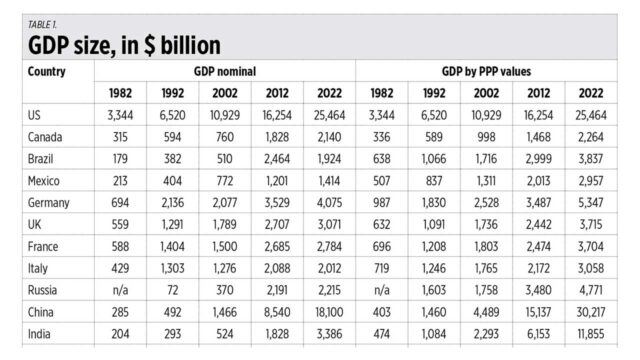
I show here different countries’ gross domestic product (GDP) size, both nominal (current GDP values in national currency multiplied by average exchange rate with the US$) and by purchasing power parity (PPP) values, which attempts to remove price level differences of goods and services between countries.

In PPP values of GDP, China overtook the US in 2016 with $18.7 billion. Indonesia overtook Italy in 2011 with $2.23 billion, then France in 2019 with $3.33 billion. And Vietnam had overtaken the Philippines in 2018 with $936 million. Nonetheless, the Philippines has expanded its GDP-PPP tenfold from 1982 to 2022 (see Table 1).

A FISCAL SURPLUS
On the fiscal side, the Department of Finance (DoF) and Department of Budget and Management (DBM) labor hard to raise revenues without creating new taxes, and limit spending somewhere because other sectors just keep expanding their share of the annual budget. In particular, the local government units (LGUs), which have higher revenue share after the implementation of the Mandanas ruling, and the military and uniformed personnel (MUP) pension that just keeps expanding, now about P160 billion/year from taxpayers because the previous and current personnel contribute zero to this fund.

Every January, the DoF secures big borrowings to help finance expenditures in the first quarter. Last January, it raised $3 billion from its second global bond offering under the Marcos Jr. administration. Target borrowings for 2023 is P2.21 trillion.

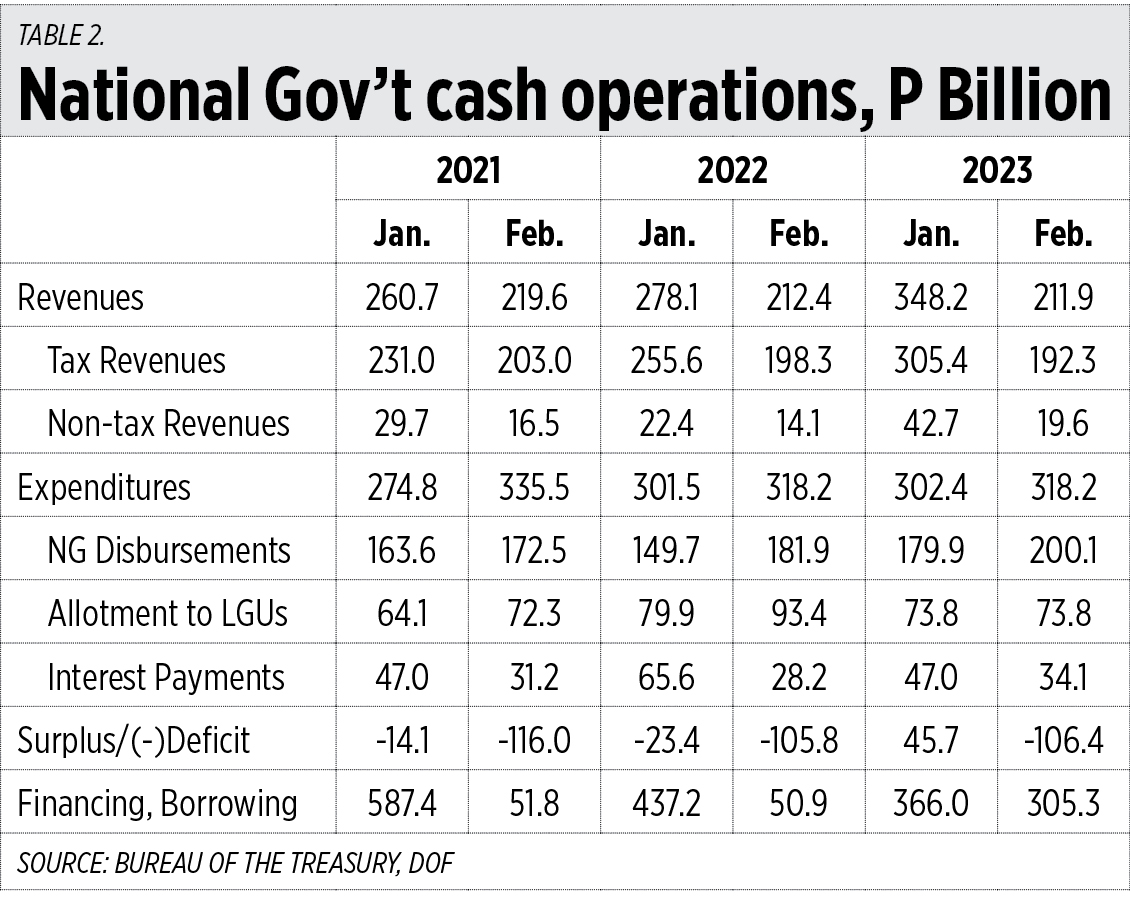
Also last January, the DBM had a good accomplishment — it controlled spending to the January 2022 level while revenues have expanded, resulting in a fiscal surplus of P46 billion (see Table 2). Congratulations, DBM.

Consider also these recent reports in BusinessWorld: “Budget gap widens in February as revenue collections decline” (April 4), “DBM calls on agencies to prioritize infrastructure, human capital, food security in budget proposals” (April 5), “DBM releases P43B for senior citizen health insurance” (April 11), “Gross borrowings jump in Feb.” (April 17).

ABOLISH OR RECALL EO 12
There is an ongoing noisy lobby that says hybrid cars, e-motorcycles, and e-tricycles should be tax-free too under an expanded Executive Order No. 12 (EO 12), signed by the President last January. For me this is shameless for three reasons.

One, EO 12 itself is wrong in the first place. Those electric vehicles (EVs) — e-cars, e-buses, e-trucks will also add to traffic congestion and road depreciation but contribute zero or little for road maintenance because they are imported tax free.

Two, there is a continuing fiscal burden with high public debt, high annual deficit and borrowings, and high pressure to raise taxes somewhere — and yet many rich sectors want to contribute zero for their vehicles. A small sedan worth P0.5 million is taxed, but e-cars — which should cost at least P1.5 million — hybrid cars — at least P1.2 million — will not be taxed. That is lousy.

Three, the rule of law should prevail. The law applies equally to unequal people, unequal businesses and vehicles. If certain cars should be tax-free, then all cars should be tax-free too. Otherwise, all cars, EVs or gasoline, should be taxed.

The DoF should either ignore or oppose this new lobby to expand tax-free favoritism to hybrid cars and e-tricycles. Or the DoF should convince the President to pull out, to recall EO 12. All cars, all trucks, all motorcycles must either pay taxes, or pay nothing. No exemptions.


Bienvenido S. Oplas, Jr. is the president of Bienvenido Oplas, Jr. Research Consultancy Services, and Minimal Government Thinkers

minimalgovernment@gmail.com

ADVERTISEMENT
ADVERTISEMENT