
Low-skilled migrant Filipino workers earn 248% more in the US
MIGRATION must be viewed through the lens of capital and knowledge transfers to properly harness it for poverty reduction, the World Bank said. Read the full story.
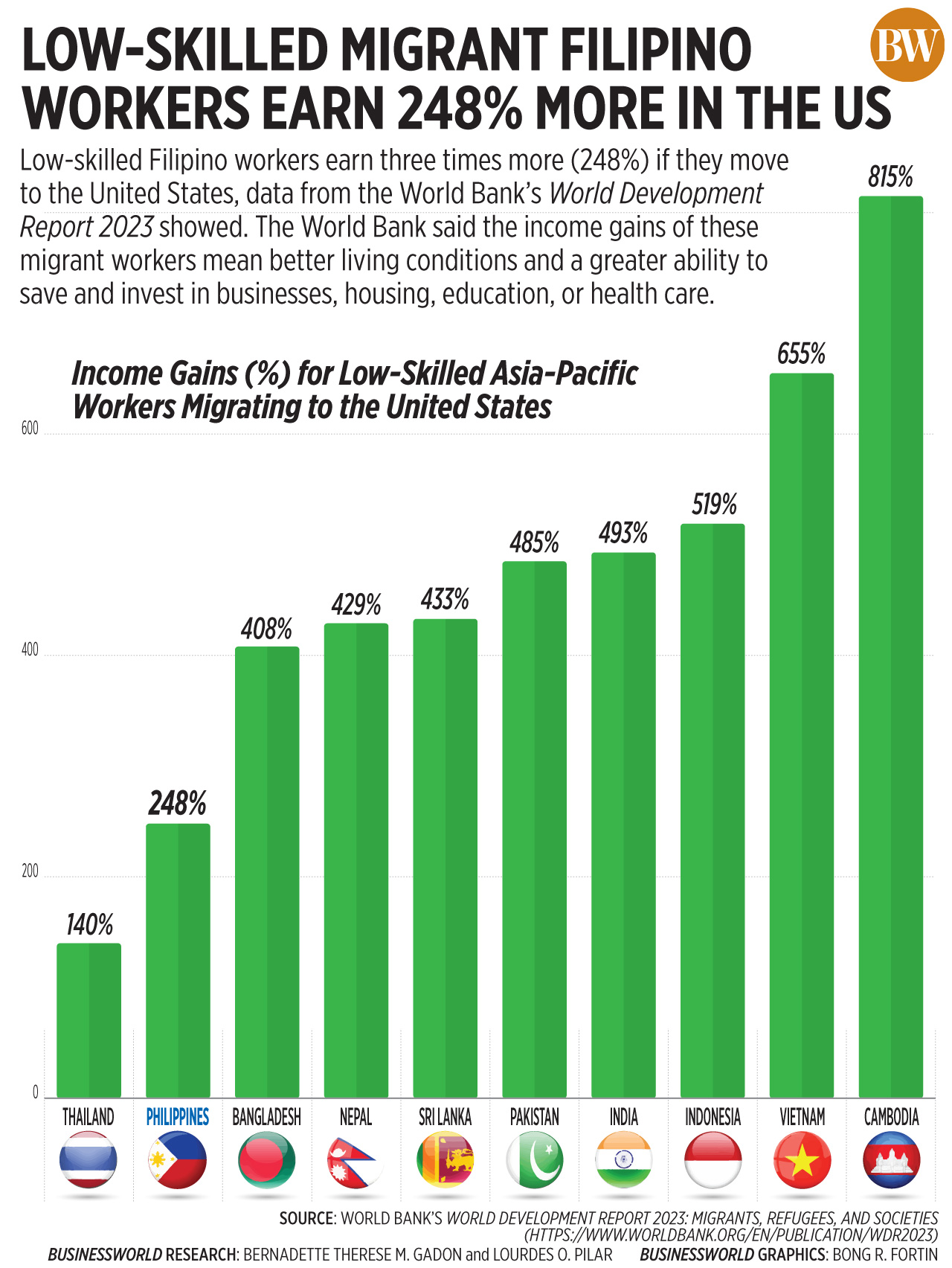
MIGRATION must be viewed through the lens of capital and knowledge transfers to properly harness it for poverty reduction, the World Bank said. Read the full story.


Spotlight is BusinessWorld’s sponsored section that allows advertisers to amplify their brand and connect with BusinessWorld’s audience by enabling them to publish their stories directly on the BusinessWorld Web site. For more information, send an email to online@bworldonline.com.
Join us on Viber at https://bit.ly/3hv6bLA to get more updates and subscribe to BusinessWorld’s titles and get exclusive content through www.bworld-x.com.

RADISSON Hotel Group (RHG) is targeting to expand its presence in the Philippines after it signed an agreement with SM Hotels and Conventions Corp. (SMHCC) to put up 14 new hotels in the next five years.
“We are certain that this new milestone between SMHCC and RHG will complement the vibrant tourism landscape locally and set a new benchmark in the hospitality industry. SMHCC looks forward to benefiting from RHG’s vast global resources,” Peggy E. Angeles, executive vice-president of SMHCC, said during a media briefing.
On Wednesday, representatives from Radisson Hotel Group and SMHCC sealed a master development plan to expand hotels under the Park Inn by Radisson brand to 20 hotels by 2028. Currently, there are six operating Park Inn by Radisson hotels in the Philippines.
In a statement, Radisson Hotel Group said the first of these new properties will be a 516-room dual-branded property in Cebu, which is scheduled to open in 2027.
“We are delighted to embark on the latest phase of our expansion, which will offer outstanding opportunities for our diverse portfolio of brands in the Philippines while creating shareholder value to our trusted partners,” said Ramzy Fenianos, chief development officer for Asia Pacific at Radisson Hotel Group.
Aside from Cebu, Ms. Angeles also identified Isabela, Olongapo, Laoag, Fairview, Dasmariñas in Cavite, and Sta. Rosa in Laguna as target sites for Park Inn hotels. She said there is a need to provide “good quality” hotels outside Metro Manila.
She said the sites were chosen to complement development in these areas. “We develop where there is a [presence of] SM [mall] already, to complement the city,” she said.
Ms. Angeles estimated that one hotel would cost between P700 million to P800 million.
SMHCC develops and manages the hotel and convention properties of SM Prime Holdings, Inc., while Park Inn by Radisson is the hotel group’s midscale to upper-midscale brand. — Ashley Erika O. Jose
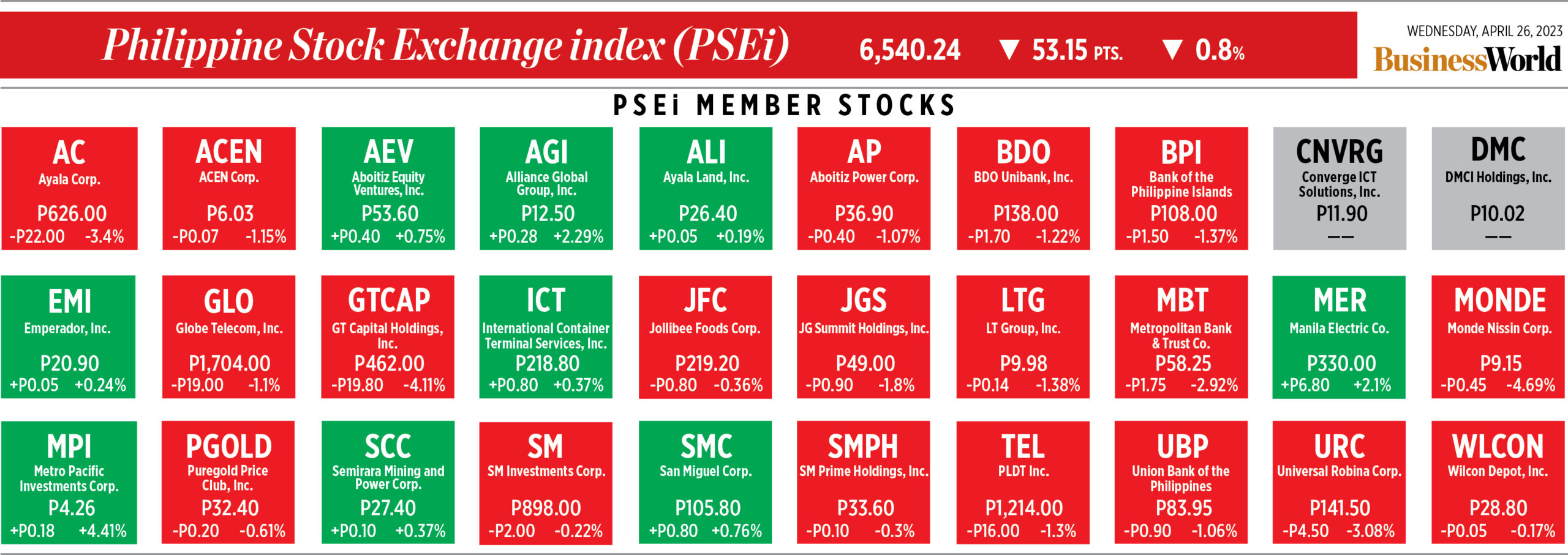
Here’s a quick glance at how PSEi stocks fared on Wednesday, April 26, 2023.


THE PESO went down against the dollar on Wednesday on safe-haven demand for the greenback due to concerns over the US financial sector and economy.
The local currency closed at P55.62 versus the dollar on Wednesday, declining by eight centavos from Tuesday’s finish of P55.54, data from the Bankers Association of the Philippines’ website showed.
The local unit opened Wednesday’s session at P55.57 per dollar. Its worst showing was at P55.71, while its intraday best was at P55.54 versus the greenback.
Dollars traded went down to $1.23 billion on Wednesday from the $1.27 billion recorded on Tuesday.
The peso appreciated “after the recent slight upward correction in the gauge of the US currencies versus major global currencies,” Rizal Commercial Banking Corp. Chief Economist Michael L. Ricafort said in a Viber message.
The dollar strengthened “after mostly softer-than-expected US economic data lately… [and as] First Republic Bank stock price declined by 49% after disappointing earnings, rekindling fears over the health of the US banking sector,” Mr. Ricafort said.
The dollar was generally stronger overnight, a trader said likewise in a Viber message.
The US dollar and the yen were steady on Wednesday, holding onto overnight gains as concerns over the US banking sector and economy hit sentiment, while the Australian dollar slid after easing inflation suggested less pressure to raise interest rates, Reuters reported.
The dollar index, which measures the currency against six major rivals, nudged 0.01% higher to 101.80 after a 0.5% increase overnight. The index is down 0.76% for the month.
Shares of First Republic Bank slid nearly 50% on Tuesday after it reported a more than $100-billion plunge in deposits in the quarter, battered by lost confidence in the banking sector.
It faces dwindling and tough options to turn around its business with the creation of a “bad bank” or asset sales possibilities, a source familiar with the matter told Reuters.
Also weighing on sentiment was fresh economic data. US consumer confidence dropped to a nine-month low in April, data overnight showed, heightening the risk that the economy could fall into recession this year.
The US Richmond Fed manufacturing index slid as well, down to -10 in April, the fourth straight month of contraction.
For Thursday, the trader sees the peso trading between P55.25 and P56 against the dollar, while Mr. Ricafort expects it to move from P55.50 to P55.70. — AMCS with Reuters
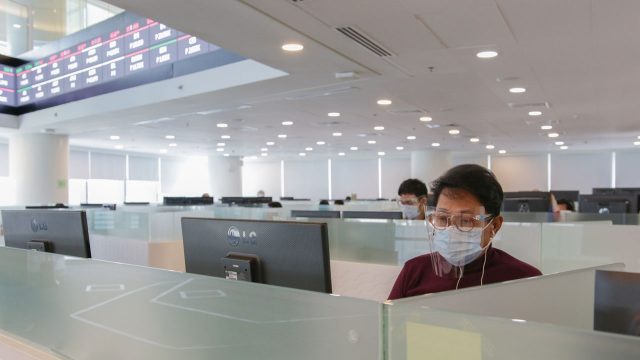
PHILIPPINE SHARES declined on Wednesday amid renewed US banking sector and coronavirus disease 2019 (COVID-19) worries.
The benchmark Philippine Stock Exchange index (PSEi) fell by 53.15 points or 0.8% to close at 6,540.24 on Wednesday, while the broader all shares index went down by 14.53 points or 0.41% to 3,492.26.
“The local bourse lost 53.15 points (0.8%) to 6,540.24 following the negative spillovers from the US markets overnight as the banking fears resurfaced,” Philstocks Financial, Inc. Research Analyst Claire T. Alviar said in a Viber message.
“Philippine shares edged lower following First Republic Bank’s statement that its deposits dropped 40% year on year to $104.5 billion in the first quarter, which reignited concerns about the banking sector,” Regina Capital Development Corp. Head of Sales Luis A. Limlingan said in a Viber message.
Shares of First Republic Bank slid nearly 50% on Tuesday after it reported a more than $100 billion plunge in deposits in the quarter, battered by lost confidence in the banking sector, Reuters reported.
Wall Street’s major averages suffered their deepest declines so far this month as a downbeat UPS forecast exacerbated investor concerns about a slowing US economy on Tuesday while plunging deposits at regional First Republic Bank added to jitters about the bank sector’s health.
The Dow Jones Industrial Average fell 344.57 points or 1.02% to 33,530.83; the S&P 500 lost 65.41 points or 1.58% to end at 4,071.63; and the Nasdaq Composite dropped 238.05 points or 1.98% to 11,799.16.
“Meanwhile, local investors braced for a potential window dressing this Friday. Another factor that caused investors to stay on the sidelines was the detection of the first case of Omicron sub-variant XBB1.16 or Arcturus,” Mr. Limlingan added.
The Philippines detected its first case of the new COVID-19 Omicron subvariant, a patient in Western Visayas, the Department of Health said on Tuesday.
The majority of sectoral indices closed lower on Wednesday, except for mining and oil, which increased by 139.06 points or 1.3% to 10,833.33, and services, which climbed by 2.09 points or 0.13% to 1,604.51.
Meanwhile, financials went down by 27.11 points or 1.41% to 1,885.42; industrials dropped by 83.90 points or 0.89% to 9,308.24; holding firms fell by 43.79 points or 0.68% to 6,315.73; and property declined by 3.61 points or 0.13% to 2,705.30.
Value turnover inched up to P5.45 billion on Wednesday with 766.97-million shares changing hands from the P5.23 billion with 741.13-million issues traded on Tuesday.
Decliners beat advancers, 101 versus 95, while 47 names closed unchanged.
Net foreign selling dropped to P192.87 million on Wednesday from P224.66 million on Tuesday. — A.H. Halili with Reuters
BANGKOK — The World Trade Organization (WTO) warned against rolling back the tide of globalization, saying that such a process will make the world poorer, and added that the Asia-Pacific region’s prominent role in global trade will result in an outsized impact should trade become less seamless.
“(Southeast Asia and the Pacific) are important players in global trade and central to some of the issues which we are now grappling with,” WTO Director-General Ngozi Okonjo-Iweala said in a recorded message to participants at a WTO-organized conference in Bangkok on Tuesday.
“As the world navigates the polycrisis of climate change, pandemic, economic slowdown, inflation, food insecurity, and depletion of the oceans’ resources, we need multilateral cooperation and solidarity more than ever,” she added.
Ms. Okonjo-Iweala said the fragmentation of trading arrangements “would be costly for all economies, particularly poorer ones. WTO economists estimate that if the global economy decouples into two self-contained blocs, long-term global gross domestic product (GDP) would decrease by at least 5% — worse than the damage from the financial crisis of 2008-09.”
“Your region, where global supply chains are an important contributor to economic success, would no doubt be also impacted,” she added.
Ms. Okonjo-Iweala added that food security issues will be addressed during the WTO’s 13th Ministerial Conference (MC13) in February in Abu Dhabi, and called for a “pragmatic” approach to trading agricultural commodities.
“We need to look at how the growing concerns regarding food security can be incorporated and addressed holistically in the discussions. I do hope we can find a sensible and pragmatic approach to food security that will set members on the path to further progress in the years ahead,” Ms. Okonjo-Iweala said.
She was referring to the protectionist direction some countries have taken in keeping their agricultural goods from being exported as supplies of key commodities tightened in the wake of the Russian invasion of Ukraine.
“We also need to make progress on reforming agriculture trade. We’ve been negotiating on this for more than two decades, with success in eliminating export subsidies. But big issues related to farm subsidies and tariffs remain unresolved,” she added.
Ms. Okonjo-Iweala urged members to move quicker in ratifying the fisheries subsidies agreement reached during MC12 in June 2022. The agreement seeks to restrict illegal, unreported, and unregulated fishing.
“(The agreement) will only enter into force once two-thirds of the WTO membership has accepted it,” Ms. Okongjo-Iweala said.
“We need to complete the ‘second wave’ of negotiations on fisheries subsidies by agreeing on new discipline (against) harmful subsidies that contribute to overfishing and overcapacity, while at the same time taking into account the needs of fishing communities in developing and least developed countries,” she added.
Ms. Okonjo-Iweala said MC13 is expected to focus on reforming the organization’s dispute settlement system.
“Many members have identified this as their top priority. Ministers agreed at MC12 to have a fully- and well-functioning dispute settlement system in place by 2024; discussions are under way, but this is a difficult issue and we don’t have a lot of time if we’re to engage in substantive negotiations and achieve results. Nevertheless, the ongoing work on this issue is moving in the right direction,” Ms. Okonjo-Iweala said.
She said the WTO is also hoping to deliver one or two accessions at MC13, while other issues that could be discussed in the conference include the effective application of special and differential treatment for developing and least developed members and access to COVID-19 therapeutics and diagnostics. — Revin Mikhael D. Ochave

RENEWABLE ENERGY (RE) capacity hit 8,255 megawatts (MW) in 2022, up from 7,914 MW a year earlier, with solar adding the most new capacity, the Department of Energy (DoE) said.
RE accounted for 29% of the energy mix by capacity at the end of 2022, the DoE said in its Renewable Energy Act implementation status report.
New solar projects in Luzon added 170.9 MW in capacity during the year, followed by biomass with 12 MW, and hydro 4.6 MW.
In the Visayas, biomass added capacity of 70 MW, and hydro 15.9 MW. In Mindanao, geothermal added 3.6 MW in new capacity and hydro 0.8 MW.
The DoE said 1,002 projects were awarded RE contracts last year, of which 216 are running and 786 under development with potential capacity of 80,399 MW.
The DoE said that following the implementation of the RE Act of 2008, investment in RE facilities hit P280 billion.
The DoE estimated the reduction in carbon dioxide emissions resulting from the RE projects at about 4,365 kilotons.
Under the Philippine Energy Plan, the Philippines is aiming to increase the share of renewables to 35% by 2030 and 50% by 2040. — Ashley Erika O. Jose

THE business process outsourcing (BPO) industry cannot delay talent development initiatives if it is to create 1.1 million new jobs by 2028, industry officials said.
“Our goal is not going to be easy and it will necessitate the coordinated efforts of a multi-stakeholder coalition across the next six years,” Jack Madrid, IT and Business Process Association of the Philippines President and Chief Executive Officer, said.
Speaking at the IT-BPM (Information Technology-Business Process Management) Talent Summit on Wednesday, Mr. Madrid added: “This is non-negotiable. We can’t delay any longer on getting a scalable, strategic, and sustainable talent attraction and development program off the ground if we want to see and feel its positive impact on the sector and the competitiveness and employability of Filipinos by 2028.”
In his speech, Trade Secretary Alfredo E. Pascual said an inter-agency technical working group has been formed to support the implementation of a five-year National Development Program for the IT-BPM industry.
“The signing of the statement of commitment serves as a testament to the Philippine government’s unwavering support and dedication to the growth and expansion of the IT-BPM industry,” Mr. Pascual said.
The statement of commitment’s other signatories were the departments of Education, Information and Communications Technology, Labor and Employment, Science and Technology, as well as the Commission on Higher Education and the Technical Education Skills and Development Authority.
“Our efforts to increase the industry’s full-time employees to 2.67 million by 2028 must be carefully coordinated and planned,” Information and Communications Technology Secretary Ivan John E. Uy said in a statement of support.
“A multi-stakeholder approach is required to ensure the development of a workforce-ready and globally competitive Filipino talent. With a workforce that possesses the necessary skills and competencies, we will be able to maintain our position as a top global destination for digitally-enabled and customer-centric services,” he added.
Mr. Madrid said the Philippines has secured a place in the IT-BPM industry and needs to work on the “talent crisis” to continue to grow.
“The biggest opportunity really for us to continue to grow and deliver the 1 million jobs is if we can address the talent crisis, and I use the word crisis, because this is really important to drive home the urgency of talent, because, you know, the Philippines is a world capital already in IT-BPM,” he told reporters on the sidelines of the event.
“This talent thing is really going to require the joint efforts of the government who have a hand in the educational reforms that are needed, then, of course, the private sector, because it is the private sector that needs the talent. These are the companies that will give jobs to the Filipinos,” he said. — Justine Irish D. Tabile

By Arjay L. Balinbin, Multimedia Editor
THE Department of Transportation is in talks to join the International Transport Forum (ITF), ITF Secretary-General Young Tae Kim said.
“We discussed the current questions in the mobility sector in the Philippines, but more broadly, we also discussed the possible joining of the Philippines into the ITF community,” Mr. Kim told BusinessWorld on Tuesday, referring to the outcome of his April 24 meeting with Transportation Secretary Jaime J. Bautista.
The ITF serves as a policy think tank for all modes of transport. It is an arm of the Organisation for Economic Co-operation and Development.
According to the ITF, only eight out of its 64 member countries are from Asia, including Cambodia, China, Japan, South Korea, and India.
Last year, Cambodia became the first Southeast Asian country to join the ITF after being unanimously voted in by the membership during the annual summit in Leipzig, Germany.
“To make more balanced discussions and to provide more balanced solutions, we need to have more non-European countries, because out of 64, 44 countries are from Europe, so the Secretary (Mr. Bautista) thought about this positively, and we will further discuss how we can arrange the Philippines joining the ITF in the future,” Mr. Kim said.
The ITF, through its members, aims to set the future direction of the mobility sector. It also hosts the largest meeting of transport ministers every year in Germany.
“If the Philippines becomes a member, it can officially participate in the discussion to set the orientation for the future mobility sector,” Mr. Kim said.
“Also, the Philippines can participate in our research projects. We publish between 30 and 60 reports every year that reflect the expectations and needs of member countries.”
According to the organization, it is implementing a four-year sustainable infrastructure program in Asia running until 2025 to encourage the transition towards cleaner energy, transport, and industrial systems, particularly in Central Asia and Southeast Asia.
“Existing members can (also) learn from the Philippines, the new member, because every region has a different context and… specific elements, and we have to take into account all the differences in terms of diversity and in terms of the relevance of the policy implementation, and I think, in this respect, the Philippines might benefit a lot from working more closely with the ITF,” Mr. Kim said.
The ITF also said that it aims to disseminate best practices for fostering low-carbon freight transport systems in the Philippines.
“In the Philippines, I know that all the supply chain really depends on freight transportation, which emits a lot of CO2 (carbon dioxide), and we cannot change everything immediately, but how we can set up a relevant governance system to make all the things possible…, how we can build consensus so that people can change their behavior…, and how other countries are doing, we have to know,” Mr. Kim noted.
Asked to comment on the state of Philippine transportation, he said: “You see on the roads, unlike the case in European countries, you have a lot of motorcycles, and you have a very specific transport mode in the Philippines, and I saw at a gas station that you still have octane 91, and I think everything should be upgraded and improved, but how we can do it quickly, that’s an issue or a question, but I think, first of all, the government should prepare a good regulation.”
The 2023 ITF summit will take place between May 24 and 26 in Leipzig.
Discussions will center on the role of transportation in improving social welfare, providing benefits to society, and promoting inclusion, while minimizing externalities such as traffic congestion, air and maritime pollution, and road crashes, the ITF said.
The summit will also cover how transport stakeholders can promote system resilience.
THE Bureau of Internal Revenue (BIR) said it has compiled a list of sellers and users of fake receipts, as well as the accountants who abet them.
BIR Commissioner Romeo D. Lumagui, Jr. said that the agency “will remain aggressive” in taking down the identified targets.
“I am challenging you to come clean and together let us be partners in nation-building,” he added in a statement on Wednesday.
The effort is led by the BIR’s Run After Fake Transactions task force.
In March, the BIR filed criminal complaints against four suspected “ghost” corporations behind the sale of fake receipts.
The revenue foregone as a result of fake-receipt usage has been estimated at around P25.5 billion.
Later that month, the BIR filed an administrative case against an accountant suspected of being behind the four “ghost” corporations.
In February, the BIR filed tax evasion cases against 74 individuals and corporate taxpayers over taxes evaded worth P3.58 billion. — Luisa Maria Jacinta C. Jocson

MODERNIZING the hog industry’s biosecurity practices will help growers more effectively contain future outbreaks of animal disease, Cargill Philippines said in a roundtable discussion on Wednesday.
“Modernization includes modern facilities, but of course it should also include modern methods around biosecurity and sharing best practices on how to do that inside the farm,” Sonny Q. Catacutan, Cargill Philippines managing director, said.
Mr. Catacutan said Cargill has a playbook for African Swine Fever (ASF) which it will detail in an upcoming Animal Nutrition Summit, where participants will discuss techniques for keeping farms healthy.
“Digitalization should be at the core of modern farming, allowing our farmers to have the right data that direct production decisions,” he added.
Cargill is a global leader in animal nutrition and a major trader of agricultural goods.
Ruth S. Miclat-Sonaco, director of the National Livestock Program at the Department of Agriculture, said that the department is focused on monitoring hog health and repopulating the depleted Philippine herd.
The repopulation program is known as the Integrated National Swine Production Initiatives for Recovery and Expansion, which in 2024 will focus on “providing additional equipment to further modernize facilities,” she added.
Rolando E. Tambago, president of the Pork Producers Federation of the Philippines, Inc., said modernization “should be driven by the private sector.”
“If really wanted to move forward and be competitive globally, then the private sector should lead the way,” he added.
Ms. Sonaco said the outlook for the hog industry is positive over the next two years, citing the turnaround in hog population trends starting in the second quarter of 2022 after a growth rate in the “low negatives” over the previous three years.
She said government budget constraints remain an issue.
“We were asking for approximately P33 billion (in 2021) for a three-year program to restore the base of breeding hogs.
The Bureau of Animal Industry estimates that as of 2022, ASF outbreaks have been detected in 4,418 barangays, up from 2,139 in 2021.
Alfred Ng, vice-president of the National Federation of Hog Farmers, Inc., said farmers are reluctant to repopulate, viewing it as a risky investment.
“Of course, farmers are enjoying higher farmgate prices right now, but still they think of the risk,” he said.
He estimated the cost of repopulation at P25,000 per breeder.
“We know it’s so difficult to get funding from the government. If the budget is really for repopulation, I think they should concentrate their (efforts) on purchasing breeders,” he said. — Sheldeen Joy Talavera
