Home Blog Page 4946

Speaking out on transgender issues

ALEXANDER GREY-UNSPLASH

Our series on transgender female athletes has prompted more discussions emanating from a variety of sources. One sports columnist from a broadsheet called to exchange notes and to point out the Philippines’ own history of transgender and suspected trans female athletes even before the term and concept were coined.

I told our friend, who heads a prominent National Sports Association (NSA), that each sport seems to have come up with its own guidelines, We will tackle that development in another part of this column. One would think that allowing sports administrators to formulate their own policies on trans athletes would help satisfy the supporters and opponents of this fairly new phenomenon. We had also thought the loud call for a separate trans athlete category would help still the waters. But no, there’s now a call for standard guidelines and not a per-sport policy.

As expected, the debate over transgender matters has spread to other parts of society, with some of our friends commenting in our chat group on the issue as a larger societal concern.

One friend asked, “Sad to say this (SOGI) is being taught in schools. What does SOGI stand for? What does SOGI mean? SOGI stands for Sexual Orientation and Gender Identity. Since we all have a sexual orientation and gender identity, it includes all of us. Every student understands and expresses their gender differently, with interests and choices that are common or less common for their biological sex.”

No one can disagree with my friend’s definition or understanding of SOGI — it is inclusive and therefore includes everyone regardless of how they identify themselves. What probably one can disagree with is the comment that “sad to say this SOGI is being taught in schools.”

I would think that the school is the best place for the youth to learn about this reality which makes life in the 21st century so different from the period when girls in so-called exclusive schools were prohibited from wearing sleeveless dresses or blouses. Would we rather that our youth become aware and be educated about SOGI on the street corners by people who were not trained to discuss such sensitive matters? Or should we just ignore them as if they don’t exist?

One colleague added that because of giving so much emphasis on SOGI and LGBTQ (lesbian, gay, bisexual, transgender, queer) issues, “‘Gender dysphoria’ appears to be reaching epidemic proportions among American pre-adolescent girls in a number of states.” Although no data was given to back up the claim, the fear expressed by the same colleague is that Filipinos are “trying to be sophisticated” and are known copycats.

Gender dysphoria is, per Google, “a term that describes a sense of unease that a person may have because of a mismatch between their biological sex and their gender identity. The sense of unease or dissatisfaction may be so intense it can lead to depression and anxiety and have a harmful impact on daily life.”

The county’s legal system and lawmakers were next on our colleagues’ agenda as they articulated what are really practical concerns. “We already have a law rejecting discrimination against LGBTQ. Also, there is a Supreme Court ruling that birth certificates cannot be altered unless there is manifest error.” Our colleagues warn that “the SOGI law hopes to change the law allowing gender amendments and possibly same sex marriage, etc.” As experienced businessmen, they add, “One area of potential major adjustments will be actuarials based on gender, i.e., insurance, pensions, etc. Another will be medical prescriptions some (dosages) based on gender. We are entering the complications of the ‘WOKE’ age.” Our colleagues could not resist lashing out at our lawmakers, when they ask, “Why is this (SOGI law) being given attention by our lawmakers? There are more pressing issues facing the country. Wrong model USA.” Another countered, “No, we have wrong lawmakers.” If one, however, brings up the concerns raised earlier, indeed there are so many consequences and problems that have to be addressed in order to respond to the interest and needs of a sector in society who has rights too.

The reference to “WOKE” is in reference to a way of thinking in America that cultivates a broader awareness of sexism, slavery, oppression of African Americans, white privilege, etc.

As mentioned earlier, sports bodies have come up with their own guidelines to respond to the needs and interests of the sports trans community.

Tennis produced the first high-profile trans athlete in the person of Renee Richards. According to reports, Richards underwent gender reassignment therapy in 1975 and started playing in women’s tournaments.

Richards’ reassignment was later discovered and sparked a massive wave of protest among cisgender tennis players. Twenty five out of 32 women who were to play in a warmup tournament to the US Open refused upon learning that Richards would take part. Wikipedia states that as a result, the United States Tennis Association (USTA) and the Women’s Tennis Association (WTA) introduced the Barr Body Test which identifies a person’s sex chromosomes. Richards refused to take the test and was banned from the US Open. She filed a lawsuit in 1977 claiming that her civil rights were violated, and that the policy was unfair. The New York Supreme Court ruled in her favor saying that the Barr Body test as the sole determinant of sex was “grossly unfair” and ruled Richards legally a female.

At the Olympics, in 2014, the International Olympic Committee (IOC) allowed transgender athletes to participate in the Olympic Games.

In 2015, the IOC changed its guidelines in acknowledgment that legal recognition of gender could be difficult in countries where gender transition is not legal, and requiring surgery may be a violation of the human rights of the athlete.

Debates on trans athletes will continue. We have a complex society which produces new ideas as new generations take over. We just have to conduct continuing dialogues and exercise patience and tolerance.


Philip Ella Juico’s areas of interest include the protection and promotion of democracy, free markets, sustainable development, social responsibility and sports as a tool for social development. He obtained his doctorate in business at De La Salle University. Dr. Juico served as secretary of Agrarian Reform during the Corazon C. Aquino administration.
Not a very simple registration

PHILIPPINE STAR/MIGUEL DE GUZMAN

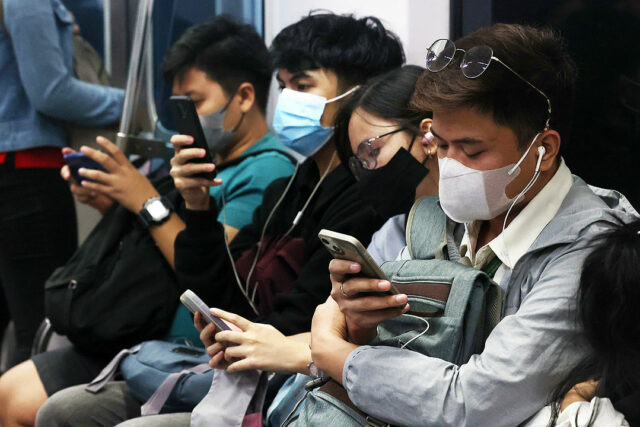
The Supreme Court had declined to restrain, even temporarily, the registration of mobile phone SIM cards as required by law. But while it exercised judicial restraint on the matter, its action was mooted by the Executive’s decision to extend the registration deadline by three months. A deadline previously set by law.

The extension considered estimates by the Department of Information and Communications Technology (DICT) that some 15 million to 20 million SIM cards already issued have yet to be registered. To date, roughly 82 million SIM card owners have complied with the registration requirement that was initiated more than four months ago.

Many failed to complete the registration process, lacking government-issued identification, or lacking internet access, or simply refusing to register for one reason or the other. Extending the deadline was perhaps the right decision. Public clamor for more time was addressed, while the Supreme Court is also given more time to resolve questions on the constitutionality of the SIM registration law.

Moving forward, however, my concern is this. If, for the sake of discussion, the Supreme Court finds reason and justification to nullify the SIM registration law and to invalidate the required registration, then what happens to all the registration data so far collected? How will the 82 million registered SIM users be affected?

The crux of the matter is the right to privacy, according to the petitioner against the SIM registration law. The National Union of Journalists of the Philippines, in its petition, wants the Court to stop the government and telecommunication companies from “using, storing, transferring, and processing all information gathered” during SIM registration and to get rid of all information already received.

The group claimed that requiring SIM registration violated the freedom of speech and was a violation of the right to privacy of communication, among others. I will not debate the merits of the petition and leave it to legal experts to discuss. Early resolution by the Court, perhaps within the 90-day extension period, will be best for all.

If the petitioners against SIM registration are the same petitioners against the use of a National ID, then I laud them for their consistency. On the other hand, to those who agreed to apply for a national ID but oppose SIM registration, I believe they should clarify themselves as to why one is acceptable as opposed to the other.

The data required for SIM registration is simple information that is already available in most government databases. These include full name, date of birth, gender, and home address. When using a photo ID to register, then the process captures an image or photo as well. The difference is that one’s personal information is now linked to a SIM serial number and a mobile number.

Is this difference enough to consider the SIM registration law unconstitutional? Does it constitute a form of “prior restraint” particularly on media persons from exercising their profession? Does it pose an obstacle, hindrance, or any form of restraint on the right to free speech and expression? Does it impinge on the freedom of the press? Does it violate the right to privacy? If one is not a media practitioner, or in the political opposition, should the issue matter at all? These questions as well as others raised by the petitioners require urgent resolution by the Court.

In this line, the 90-day extension was a master stroke. People get more time to decide on how to move forward on their SIM registration. The Court also gets more time to deliberate on the case. And the Executive doesn’t find itself butting heads meantime with journalists against SIM registration. It also pushes the deadline — and the controversy — past the congressional Easter break. Congress, if need be, can act on the matter after the opening in end-July.

The Court’s refusal to issue a temporary restraining order is indicative of its inclination on the matter, in my opinion. Moreover, if it views SIM registration as nothing more than collection of readily available personal data, then I also believe the SIM registration law will not be nullified. It is really a question of whether linking that personal data directly with the use of a mobile communication device can be considered a violation of any constitutional right.

On whether or not the collection of personal data during SIM registration is constitutional, I believe this will be upheld. After all, the same personal data and biometrics are collected during the processing and issuance of a National ID, or a driving license, or a passport, or any other government-issued identification.

As to linking such personal data to the ownership and use of a property like a mobile phone, again, I believe this can be justified. The same applies to those who register their ownership of real property or motor vehicles or firearms, among others. Even media entities go through some form of identification and registration of companies, properties, and vehicles used in their conduct of the business of media and in the practice of the media profession.

In a newspaper column in 2020, former Chief Justice Artemio Panganiban noted that the national ID law would “easily pass constitutional challenge because of the simplicity of the required personal data.” After all, “these simple personal data are already publicly disclosed in drivers’ licenses, passports, senior ID cards as well as in ID cards issued by the Social Security System (SSS) and the Government Service Insurance System (GSIS).” I believe this reflection will also have some bearing on the present case.

But as I argued in a column last December, I noted that the SIM registration database – matching names with pictures and mobile numbers as well as other personal information – will be another “digital footprint” that can be hacked, and the information possibly misused. And the Data Privacy Act is simply no match to those who intend to do harm. Moreover, whether such information can be used against journalists is anybody’s guess. It will depend largely on the fortitude of telecommunication companies to resist government attempts to unduly access such data.

Then couple this with the ability to track phones and their owners through GPS and cell sites, and match this with face-recognition software employed through public and private CCTV networks, then “Big Brother” is now more a reality than fiction. But “Big Brother” may no longer be the government watching us, but it is that network of computers and mobile phones and other electronic devices that develop, capture, and analyze digital footprints and allow those with legal and illegal access to our information to better understand us and to make “informed” decisions about how to either serve us, or steal from us.

In this line, if the SIM registration is deemed illegal by the Court, then purging all data collected should be the end of the issue. However, if the Court upholds the law, then the big challenge is how policymakers, regulators, and government and industry leaders can sufficiently and effectively protect the public, the government, and businesses from data breach and the illegal or improper use of that data to pursue political or business interests.


Marvin Tort is a former managing editor of BusinessWorld, and a former chairman of the Philippine Press Council

matort@yahoo.com

Growth projection, electricity generation and PPP Center

Last week, the Development Budget Coordination Committee (DBCC) held a press conference on the revised macroeconomic and fiscal targets from 2023-2028. The DBCC — or the economic team — is composed of the Secretaries of the Departments of Finance and Budget and Management (DoF and DBM), the National Economic and Development Authority (NEDA), and the Governor of the Bangko Sentral ng Pilipinas.

It is good that the economic team is keeping the original growth targets at 6-7% for 2023, and 6.5-8% for 2024-2028. As argued in this column last Monday, the Philippines’ quarterly GDP growth momentum in 2022 plus employment data as of February 2023 show that the domestic economy is dynamic, and local businesses can sustain a virtuous cycle of production-consumption at higher and rising levels.

I also think that the macroeconomic assumptions to make the growth projections are realistic. For instance, the Dubai crude price of $70-$90/barrel for 2023-2024, and $60-$80/barrel for 2025-2028. The actual Dubai prices from January 2023 to the present range from $75-$85/barrel, so there are four months of actual data that support the assumption already. Oil price pressure is stabilizing if not declining because many countries continue to buy cheap Urals or Russia oil, which is $10-$15/barrel cheaper than Dubai and other OPEC exporters. This competition is somehow good for us.

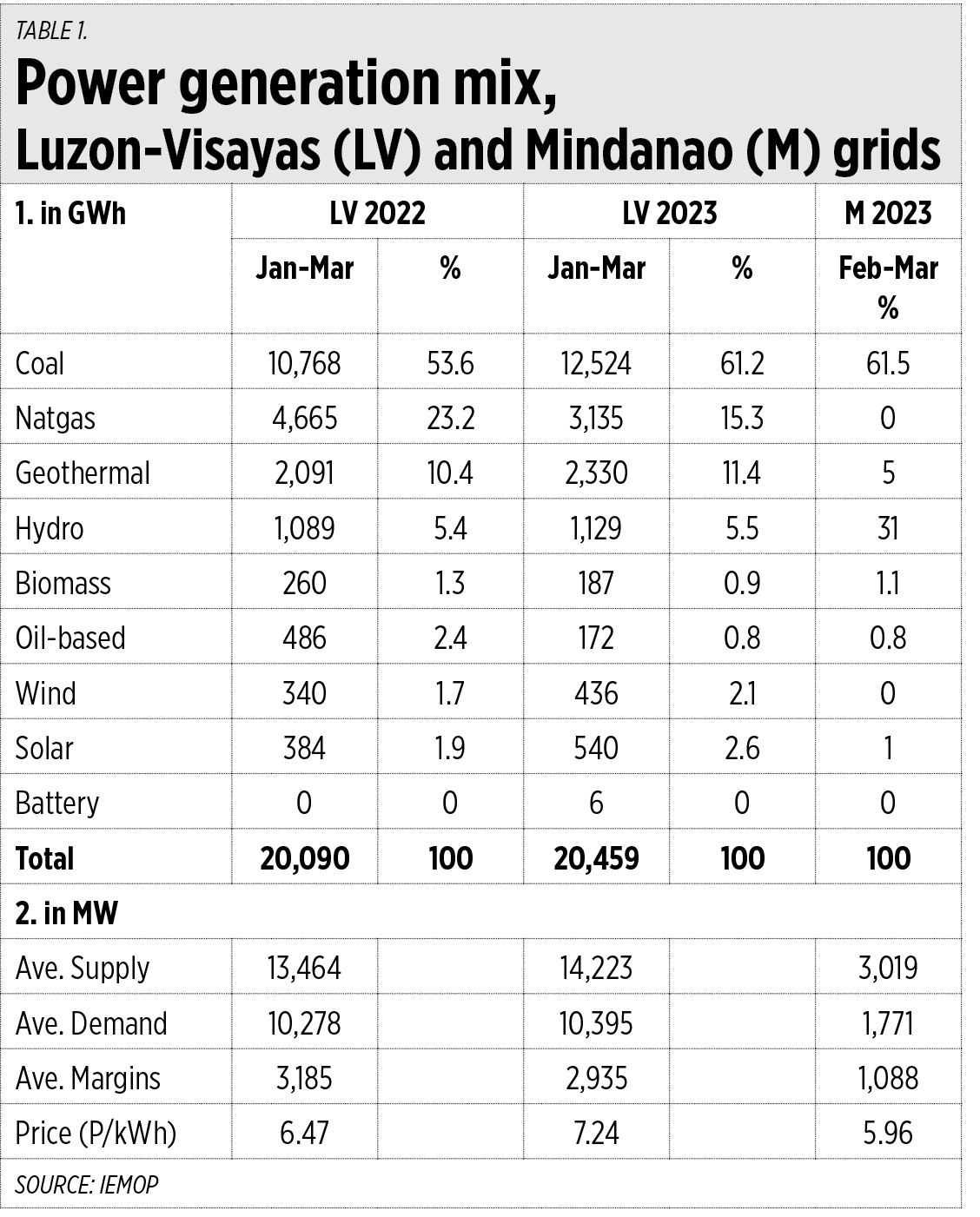
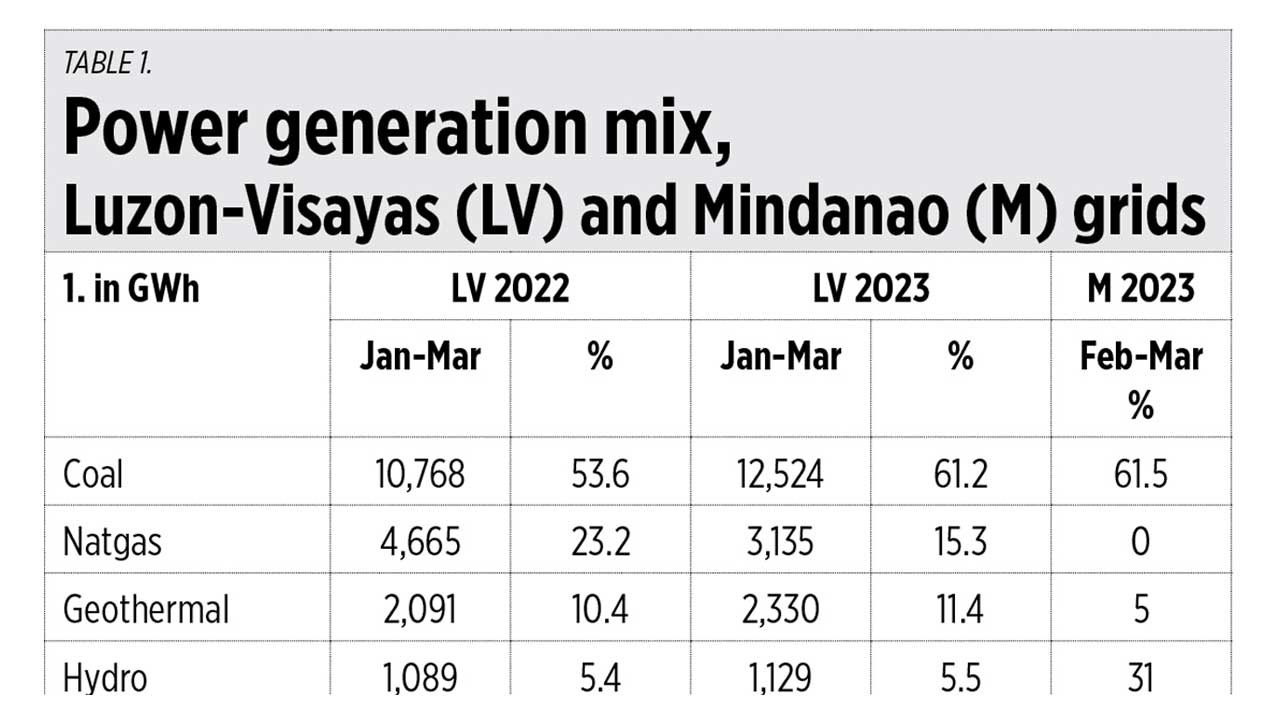
This week, the Independent Electricity Market Operator of the Philippines (IEMOP) released the mid-April update for power supply-demand prices. I computed the total power generation by source or technology, then averaged in supply-demand, January-March 2023, and compared them with same period last year.

The share of coal in installed capacity has not increased — roughly about 40% of the total — but actual power generation has increased from 54% in the first quarter 2022, to 61% of the total generation this year. So, it is unwise and dangerous for the country to listen to the climate lobby about restricting and even killing coal power because their beloved wind-solar can contribute only 4.7% of total generation.

Electricity prices have increased from an average of P6.47/kWh last year to P7.24/kWh this year mainly because of declining power margins; demand is picking up while supply is not rising at commensurate levels (see Table 1).

Meanwhile, in Boo Chanco’s column in the Philippine Star last week (April 24), “Cabinet Rigodon,” he wrote: “When the President says we need the private sector to partner with the government for big projects, he must make sure the NEDA, PPP Center, and all the other bureaucrats get the message and not add to the red tape for approvals. Proponents complain that there is so much back and forth on requirements that waste time…”

As stated earlier, I am following the work of the economic team including NEDA and the PPP Center (Public-Private Partnership Center of the Philippines) and I can say that Boo’s assessment of the bureaucracy at these two agencies, especially the PPP Center, is lousy. There are three reasons why I think so.

One, there is a robust number of PPP projects in the pipeline which are processing faster. I checked the PPP Center website — there are 100 projects costing P2.249 trillion in the pipeline already: 15 projects in transportation (airports, seaports, rail, terminal), 15 on toll roads, nine in property development, six in health, six in water and sanitation, five in information and communications technology (ICT), four in solid waste management, three in power/energy, and one in tourism.

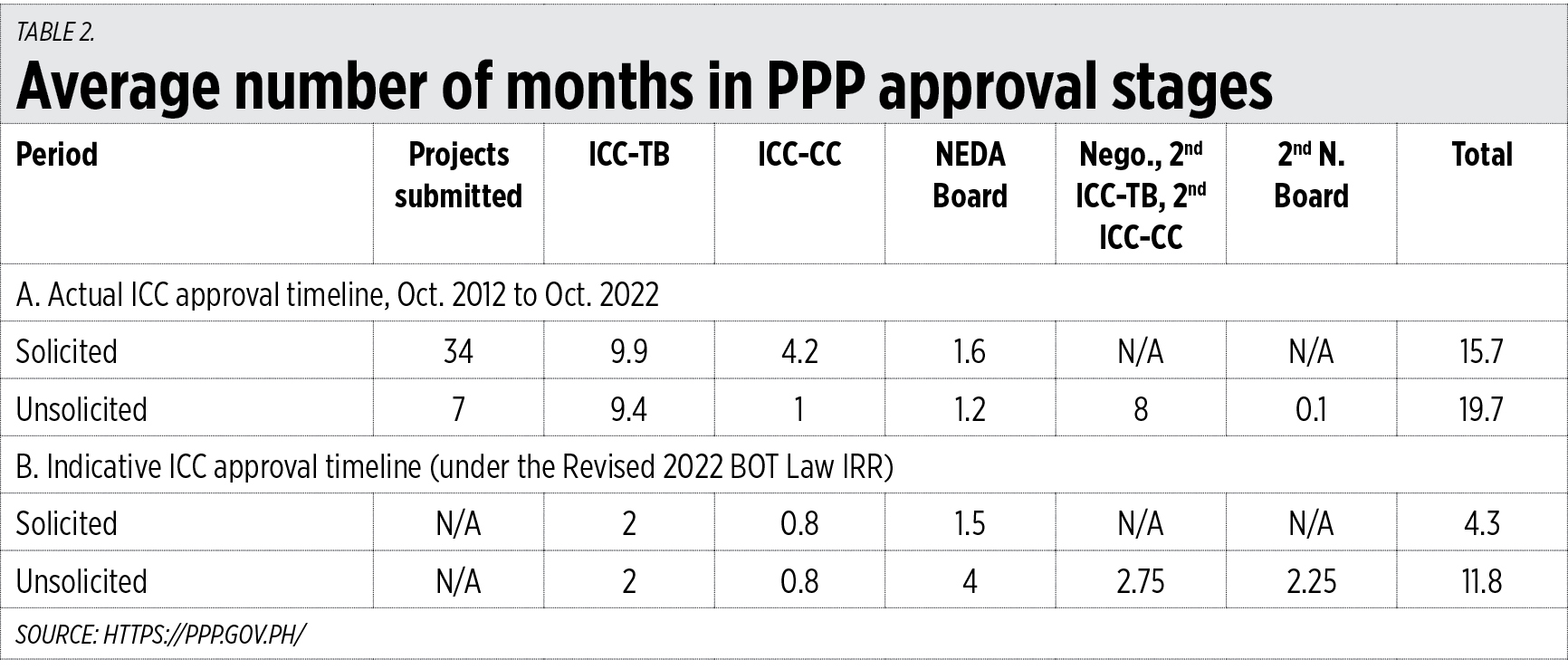
Two, the PPP Center has to observe and follow the project approval timelines of the 2022 Revised IRR of the Build-Operate-Transfer (BOT) Law, which addresses bottlenecks and seeks to streamline the process. If there is very fast approval, some people will complain of “undue haste,” that the projects are not well-studied, that there is no due diligence by government.

In the past, the actual Investment Coordination Committee (ICC) approval timeline, that passed through the Technical Board (TB) and Cabinet Committee (CC), was an average of 15.7 months for solicited projects and 19.7 months for unsolicited projects. Under the Revised 2022 BOT Law IRR, Indicative ICC approval timelines are projected to be down to only 4.3 months for solicited and 11.8 months for unsolicited projects. These indicative timelines could be shorter if all documents are sufficient to aid decision making, or longer if conditional approval is given (see Table 2).

Three, the economic team now holds regular meetings for the ICC-TB, ICC-CC, and the NEDA board. I asked some friends in NEDA about the frequency of meetings, they told me that in less than a year, the Marcos Jr. administration has already held 10 ICC-TB meetings, three ICC-CC meetings, and six NEDA board meetings with two PPP matters on the agenda. The PPP Center just makes sure that all the requirements are met and acts on them, it does not wait for schedules anymore.

There, the numbers speak for themselves — there is less bureaucracy, there is faster approval of projects that will help businesses and the economy overall.

Meanwhile, the BusinessWorld Economic Forum (BWEF) 2023 will roll out on May 25 at the Grand Hyatt Manila at Bonifacio Global City, Taguig. The theme this year is “The Digital Future: Accelerating Business and Sustainability.”

As an advocate of individual liberty and free market economics, I think more digital business can support this advocacy because there will be less bureaucratic and arbitrary interventions. And investors from abroad — or even digital workers in remote beach resorts in the country with access to the web — can follow the rules and status of their compliance. But safeguards should be in place so that future authoritarian governments will not harvest and use digital information on people and businesses for more dictatorial policies and impositions.

To see the speakers, agenda, and to register for the BWEF 2023, check here: https://www.bworldonline.com/bwefthedigitalfuture/.


Bienvenido S. Oplas, Jr. is the president of Bienvenido Oplas, Jr. Research Consultancy Services, and Minimal Government Thinkers

minimalgovernment@gmail.com

What’s in your pocket?

GEOFFREY CROFTE-UNSPLASH

EVEN with the digital wallet and online banking, we here in these parts still use a lot of cash and credit cards. Even in economic discussions, the phrase “share of wallet” (how we spend our disposable income and what we buy with it) indicates our penchant for the wallet in the pocket.

The pockets, at least for males, can be revealing in what they are used for.

A right-handed man usually carries his wallet in the right back pocket of his pants where constant wear (including sitting on it) bends it to the curve of that posterior cheek. Medical problems can arise from this habit. Intrusion of an unusually thick wad in the back pouch while driving can restrict blood circulation, even as it enhances our purchasing power.

A friend discovered this medical phenomenon after complaining of shooting pains in his hip. (It’s not always sciatica.) A number of doctors he consulted could not figure out the ailment. The last one asked to see his wallet and immediately knew what was wrong. The portable-bible heft of the wallet caused the hip aches, and the patient was asked to either switch to a thinner wallet or move its location to the front pocket. He did both and permanently rid himself of his pain.

Assorted plastic gives the wallet its heft. The small plastic rectangles include credit, discount, VIP, ATM cards, driver’s license, and memberships in clubs, and, for a time, the vaccination record. While wallets provide slots for plastic cards, these become quickly inadequate as more and more are wedged into the limited space.

What about calling cards? Even when few now ask for or exchange calling cards, these are kept in the wallet, just in case. Anyway, these cards no longer depict the accurate details of one’s position which changes even without a memo, or the cardholder’s knowledge. Only the contact numbers (not the land line) are useful. And these can easily be exchanged digitally anyway with the QR code.

The ideal wallet size is small, maybe 20% bigger than a calling card; thickness is limited to 2 cm. Compact wallets with their multiple folds for compactness are getting popular. These accordion-like leather accessories even allow for de-magnetizing finishes to protect ATM and credit cards. They also provide tags for pulling out stuff out of their tight hiding places. (Do not ask strangers for help.)

Changing wallets can cause confusion and a break in routine.

A third wallet is necessary for foreign trips. This is leaner and has less cards, only the internationally accepted ones. Foreign currency is best separated with money clips. One is told however that most countries one visits no longer accept cash. They prefer reloadable cards that are just tapped for transport, restaurants, and laundry.

Other items are found in a man’s pockets. Maybe a handkerchief or extra face mask? What about a bunch of keys with a few unaccounted for in terms of the locks they open? The cell phone too resides in the front pocket of the males. This placement persists, despite warnings of radiation affecting fertility and voice modulation. Nobody takes these fake news items seriously and for many anyway, the ability to sire children no longer matters.

Some may carry a multi-purpose Swiss knife that has a nail clipper and a corkscrew for opening a wine bottle. This can be part of the key ring earlier mentioned.

There’s a reason that the money one carries around is called “pocket money.” It does not represent even a fraction of one’s liquid assets. It’s supposed to cover expenses for the day until the next ATM visit. The cards are supposed to make up the gap for over-ordering in a restaurant or buying sneakers or ripped jeans on a whim.

The trend for following women’s fashion with “man bags” to put more stuff that pockets cannot accommodate without looking too excitable has not quite picked up. Men tend to forget they have bags and so tend to lose them. A hands-free lifestyle seems to be ingrained in the male. The hands need to hold other items than bags.

As for airport security, the pocket seems to be in the conversation. Does eliminating the portable pouch address filching of tourists’ valuables? Then there is no need to ask —what’s in your pocket?


Tony Samson is chairman and CEO of TOUCH xda

ar.samson@yahoo.com

FBI working with US firms to get war crime evidence in Ukraine

Army soldier figurines are displayed in front of the Ukrainian and Russian flag colors background in this illustration taken, Feb. 13, 2022. — REUTERS/DADO RUVIC/ILLUSTRATION

SAN FRANCISCO — Ukraine is working with the US Federal Bureau of Investigation (FBI)  and American companies to collect evidence of war crimes by Russians, such as geolocation and cellphone information, senior officials said on Tuesday.

Ukrainian authorities are collecting digital information from battlefields and Ukrainian towns ravaged by the war since Russia invaded the country last February, said Alex Kobzanets, a FBI special agent who previously worked as a legal attache for the agency in Ukraine.

“Collection of that data, analysis of that data, working through that data is something the FBI has experience working through,” Mr. Kobzanets said at the RSA cybersecurity conference in San Francisco.

That work includes looking into cellphone information, forensic analyses of DNA samples, as well as analysis of body parts collected off battlefields, he said.

“The next step is working with national US service providers, and transferring that information…obtaining subscriber information, obtaining geolocation information, where possible,” Mr. Kobzanets added.

The work reflects deepening collaboration between the US and Ukraine on the cyber front, where Russia has been a common adversary for both nations.

The Russian government did not immediately respond to a request for comment.

The agent added that the US FBI had for the past year and a half been working on helping Ukraine to also identify Russian collaborators and spies operating in Ukraine and the Russian forces that were operating outside of Kiev as the invasion was happening.

US security companies and officials have been a major partner of Ukraine in its efforts to fend off Russian cyberattacks, which it has battled since at least 2015.

Illia Vitiuk, head of the Department of Cyber Information Security in the Security Service of Ukraine, said that while the number of Russian attacks against Ukraine has grown in the last few years, in recent months they have become more targetted.

“It’s very difficult to prove in a criminal case who is responsible,” said Mr. Vitiuk. “It’s very important for us to get as much information about Russian cybercriminals…because we collect all this information and put it into our criminal cases.”

“We do believe that this case about cyber war crimes is something new,” he added. “This is where we have seen the first full scale cyber war.” — Reuters

Heat waves, cyclones impacting stock markets across Asia

BLOOMBERG

STOCK PICKERS in some of Asia’s key markets are being battered by a series of extreme weather events from heat waves to flooding, signaling the difficulties ahead as El Niño-related risks rise, and climate change accelerates.

In resource-rich Australia, Newcrest Mining Ltd.’s Telfer gold mine was closed earlier this month and the company’s shares fell from more than a two-year high after the biggest cyclone to hit the Western Australian coast in almost a decade made landfall. That followed heavy rain and flooding that hampered coal production for miners such as Whitehaven Ltd. and BHP Group late last year. 

Further west, India’s hottest February in more than a century, following a spike in cattle deaths caused by a viral skin disease, fueled a rare drop in dairy production in the world’s largest milk-producing nation. With more heat waves forecasts alongside peak summer demand, shares of dairy firms such as Parag Milk Foods Ltd. and Heritage Foods Ltd. are soaring.

Extreme weather has always been part of the cost of doing business, but the frequency of such events is increasing. And while volatility linked to them isn’t limited to Asia, it’s certainly the region where the impact on stock markets has been outsized so far this year. Researchers and analysts who track the impact of these events have a message for traders struggling with stock swings: get used to them.

“Its become complex to predict the demand and output trends and take sector or stock calls because weather is uncertain,” said Jigar Shah, the Mumbai-based head of research at Kim Eng Securities Pvt. “The agri and food chain is at significant risk if this goes uncontrolled.”

EL NIñO RISK
The possibility of an El Niño weather pattern forming — typically signaled by higher-than-normal water temperatures in the eastern Pacific — means hotter and drier conditions for Asia and Australia.

Shares of Thailand’s agricultural firms, drinks manufacturers and related companies have also become a focus after a local report flagged exactly those conditions for the Southeast Asian nation in the coming months.

A Bloomberg Intelligence (BI)  analysis suggested that Indian stocks with more exposure to rural areas may be harder hit by expectations of an El Niño than urban-oriented shares.

“Forecasts of El Niño conditions this year could lead to a monsoon rainfall deficit, impeding crop production and stalling the rural recovery,” BI analyst Nitin Chanduka wrote in a report on Monday.

Unpredictable weather, coupled with geopolitical issues including Russia’s war in Ukraine, has also led to more abrupt changes in supply and demand patterns.

Chamath De Silva, a senior fund manager for BetaShares Holdings in Sydney, said he sees insurance firms among the few possible longer-term winners in an era where climate continues to spark negative supply shocks, with the rising risk for such events eventually resulting in higher premiums.

Meanwhile, other sectors and markets will benefit as they help fill the gap when extreme weather or natural disasters undercut supply in another region, said Hebe Chen, an IG Markets analyst based in Melbourne.

‘MORE FREQUENT’
“Extreme weather events, regardless of their types and sizes, unstoppably ripple through the financial markets in both predictable and unpredictable ways. It is not uncommon that these ripples could turn into a tidal wave,” she said.

Researchers who use complex modeling to predict climate change say the more extreme events are here to stay.

“It is virtually certain there will be more frequent hot extremes and fewer cold extremes at the global scale and over most land areas in a future warmer climate,” the UN’s Intergovernmental Panel on Climate Change reiterated in its latest report. “It is very likely that heat waves will occur with a higher frequency and longer duration.” — Bloomberg

China asked to explain military peacetime buildup

MILITARY VEHICLES of the Ground Force under the Eastern Theatre Command of China’s People’s Liberation Army (PLA) take part in a combat readiness patrol and ‘Joint Sword’ exercises around Taiwan, at an undisclosed location in China in this handout image released on April 8, 2023. — EASTERN THEATRE COMMAND/HANDOUT VIA REUTERS

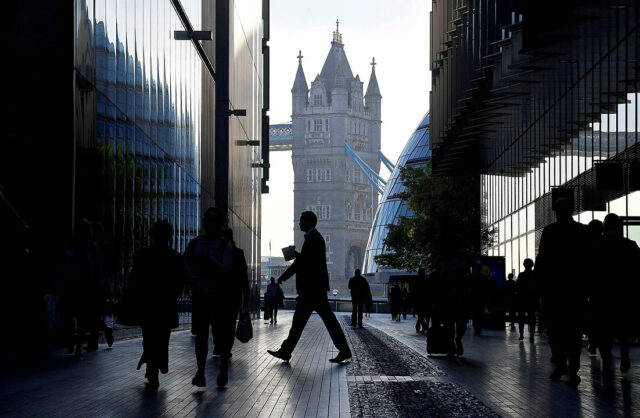
LONDON — British foreign minister James Cleverly urged China to be more open about what he called the biggest military build-up in peacetime history and said secrecy around its plans could lead to a “tragic miscalculation”.

Relations between Britain and China are the worst in decades after London restricted Chinese investment over national security concerns and expressed concern at Beijing’s increasing military and economic assertiveness.

In a speech at Mansion House in London’s historic financial district on Tuesday, Mr. Cleverly said Britain should engage “robustly and constructively” with China despite what he called “revulsion” over the treatment of Uyghurs in Xinjiang.

In a warning over the future of Taiwan, Mr. Cleverly said invading the island would destroy world trade, and distance would offer no protection from the “catastrophic blow” to the global and Chinese economy.

Mr. Cleverly’s speech is the clearest attempt to explain Britain’s approach to China under Prime Minister Rishi Sunak, who said at the end of last year that the so-called “golden era” of relations under former Prime Minister David Cameron was over.

In contrast to French President Emmanuel Macron’s attempts to distance Europe from any involvement in a conflict over Taiwan, Mr. Cleverly said “no country could shield itself from the repercussions of a war in Taiwan”.

Mr. Cleverly said Britain is open about deepening cooperation with allies in the Indo-Pacific and called for China to be clear about its military intentions.

“I urge China to be equally open about the doctrine and intent behind its military expansion, because transparency is surely in everyone’s interests and secrecy can only increase the risk of tragic miscalculation,” he said.

China claims the self-ruled island of Taiwan as its own and has not renounced the use of force to ensure eventual unification. It has also said it will defend its territorial sovereignty, maritime rights and interests.

The Chinese embassy in London did not respond to a request for comment.

NO ‘NEW COLD WAR’
While the leaders of France, Germany and Spain have visited China in the last six months and called for engagement with the world’s second-biggest economy, the US and Britain are taking a tougher approach to what they consider a growing threat from Beijing to their interests and values.

Britain has sought to limit national security threats posed by China while engaging in areas such as trade.

The foreign minister’s annual speech to Mansion House normally sets out a range of foreign policy issues. But Mr. Cleverly’s speech, apart from a few brief remarks on the evacuation of Sudan and Ukraine, focused solely on China, in what the foreign ministry said was recognition of its “huge significance” to global affairs.

Mr. Cleverly, who hopes to visit China this year, said it would be a mistake to isolate China and engagement is needed in areas such as climate change, pandemic prevention, economic stability and nuclear proliferation.

“It would be clear and easy – perhaps even satisfying – for me to declare a new Cold War,” he said. “Clear, easy, satisfying – and wrong.”

However, Mr. Cleverly said that Britain will protect its national security interests and call out Beijing if it breaks its international obligations or abuses human rights.

He used his speech to condemn the treatment of the Uyghur people in China’s Xinjiang region.

China has vigorously denied allegations of abuse in Xinjiang.

Mr. Cleverly said China was building “a 21st-century version of the gulag archipelago” and “locking up over a million people at the height of this campaign, often for doing nothing more than observing their religion”. — Reuters

US default on debt would trigger an ‘economic catastrophe’ — Yellen

WASHINGTON — US Treasury Secretary Janet Yellen on Tuesday warned that failure by Congress to raise the government’s debt ceiling — and the resulting default — would trigger an “economic catastrophe” that would send interest rates higher for years to come.

Ms. Yellen, in remarks prepared for a Washington event with business executives from California, said a default on US debt would result in job losses, while driving household payments on mortgages, auto loans and credit cards higher.

She said it was a “basic responsibility” of Congress to increase or suspend the $31.4-trillion borrowing cap, warning that a default would threaten the economic progress that the United States has made since the COVID-19 pandemic.

“A default on our debt would produce an economic and financial catastrophe,” Ms. Yellen told Sacramento Metropolitan Chamber of Commerce members. “A default would raise the cost of borrowing into perpetuity. Future investments would become substantially more costly.”

If the debt ceiling is not raised, US businesses will face deteriorating credit markets, and the government will likely be unable to issue payments to military families and seniors who rely on Social Security, she said.

“Congress must vote to raise or suspend the debt limit. It should do so without conditions. And it should not wait until the last minute.”

Ms. Yellen told lawmakers in January the government could pay its bills only through early June without increasing the limit, which the government hit in January.

Unlike most other developed countries, the US puts a hard limit on how much it can borrow. Because the government spends more than it takes in, lawmakers must periodically raise the debt ceiling.

Kevin McCarthy, leader of the Republican-controlled House of Representatives, last week floated a plan that would twin $4.5 trillion in spending cuts with a $1.5 trillion increase in the debt cap, calling it the basis for negotiations in coming weeks.

The White House insists the two issues should not be linked, and the Democratic-controlled Senate is likely to reject the proposal.

Financial markets are growing increasingly concerned about the standoff, sending the cost of insuring exposure to US debt to its highest level in a decade, with financial analysts warning about the increasing risk of default. — Reuters

Spain braces for scorching summer temperatures in spring

An aircraft flies over San Lorenzo beach in Gijon, northern Spain, July 24, 2016. — REUTERS/ELOY ALONSO

MADRID — Spain is bracing for a week of temperatures as high as 40C that are forecast to shatter records for April, as officials laid out plans to open public swimming pools early and adapt school schedules, while meteorologists warned of the risk of wildfires.

Coinciding with a long-running drought, the cause of the predicted temperatures is “the progressive entry of a very warm and dry air mass from Africa coupled with atmospheric stability (meaning unchangeable weather) and strong sunshine,” Spain’s weather agency AEMET said on Tuesday.

These unseasonable temperatures would be “typical of summer”, AEMET added, with the mercury expected to creep up to 38-40 degrees Celsius (100-104 Fahrenheit) in the southern Guadalquivir Valley that includes the city of Cordoba.

That would be the highest figure for April since Spanish meteorological official data-keeping began in 1961.

The heat means large parts of the country would be at high or extreme risk of wildfires, AEMET said.

Ricardo Torrijo, a senior meteorologist at the agency, told Reuters the weather was a thermal ridge – or wave of high temperatures – extending from Africa to the Iberian Peninsula.

He said it did not meet the official definition of a heatwave, which occurs when the maximum daily temperatures are unusually hot over an extended period.

The government of the central Madrid region on Monday announced an action plan, including allowing schools to adapt their timetables around peak temperatures and to ensure air conditioning at health centers.

Under the plan, Madrid’s many outdoor swimming pools will open a month earlier than usual, in mid-May.

The capital’s subway system is also set to increase air conditioning and make trains more frequent to avoid overcrowding.

In the hottest region of Spain, the southwestern city of Seville has boosted its emergency services budget and brought in extra healthcare worker numbers in case of heat exhaustion during the “Feria de Abril” (April, or spring, fair) that last year attracted an estimated 500,000 revelers.

PROLONGED DROUGHT
Spain has seen 36 consecutive months of below-average rainfall. Reservoirs at 50% of their capacity – slightly higher than last year, but below the average of the last decade.

Environment Minister Teresa Ribera said the coming months were likely to be “complicated”.

“Apart from extreme episodes such as the one we will experience this week in terms of temperature, we will probably see average rainfall in May, June and July; but given that in recent months rain has been well below average, this would lead to a scenario of concern,” she said.

In response to the drought, the government announced tax breaks worth 1.8 billion euros ($1.98 billion) for 828,000 farmers whose crops are depleted.

The rebates involve a general reduction in taxes of 25%, but if crops such as olives or almonds are particularly affected, they could reach 50%. — Reuters

Stung by losses, Filipino players ditch Axie Infinity crypto game

Image Source: https://axieinfinity.com/

 – At the height of cryptocurrency’s pandemic boom, migrant worker Gian Carlo McGlay thought he had found a way to ride out lockdowns and provide an income to dozens of jobless people from his hometown in the Philippines.

But Mr. McGlay’s dreams of leading a team of “play-to-earn” cryptocurrency gamers focused on the Axie Infinity game quickly fell apart as crypto prices crashed, leaving the 32-year-old with losses of one million Philippine pesos ($18,000).

“Nothing was left. My Axie Infinity assets became worthless so I just gave them away,” said Mr. McGlay.

One of a new breed of blockchain-based online games that blend entertainment with financial speculation, Axie Infinity also attracted investors who saw it as a way to introduce more people to cryptocurrency.

Axie players can earn cryptocurrency by cashing in tokens they win in the game – called smooth love potion (SLP). For a while, it was a lucrative business.

Mr. McGlay’s “scholars” – a term used for players who cannot afford to buy the game‘s characters themselves so instead rent them off so-called managers in exchange for a cut of their earnings – initially earned 5,000-10,000 pesos per week.

In contrast to other Axie managers, Mr. McGlay – who worked as a fisherman in Alaska before the pandemic – said he made zero profit from the enterprise, letting his scholars keep all of their earnings.


SCHOLARS AND MANAGERS

At its peak, Axie Infinity drew 2.7 million active daily users but those numbers have plunged to about 250,000, according to Cryptogambling.tv, a website focused on cryptocurrency games.

Half of the game‘s players came from the Philippines – and many others from developing countries such as Indonesia, Brazil, Venezuela and Peru.

Yield Guild Games (YGG), a group that invests in NFT games, said it “prioritized providing scholarships in emerging economies where job opportunities are lacking and government relief has been limited” during the pandemic.

But many managers like Mr. McGlay were left facing big losses as the value of the game‘s SLP tokens fell 99% from its February 2022 peak, mirroring a collapse in the price of cryptocurrencies.

Axie Infinity was dealt another blow in March 2022 when hackers stole about $615 million in cryptocurrency from a blockchain network that lets users transfer crypto in and out of the game.


POTENTIAL GAINS

While some Axie managers say their motives were philanthropic, other small investors were motivated by the potential gains.

Christopher Cruz, 36, a Filipino businessman and cryptocurrency trader who used to manage 200 Axie scholars, said he earned as much as 600,000 pesos a day from the game by taking a 60% cut of his players‘ income.

“I felt like a drug lord,” Mr. Cruz said. “I could buy everything I wanted – every item inside the mall was never too expensive – during that time.”

His scholars, who were mostly high school students and gig workers from poor provinces, earned a daily income of 450 pesos, just below the minimum wage of 470 pesos in regions outside the capital, Manila.

A Filipino doctor, who asked not to be named, said it was “extremely easy” to recruit players during the pandemic and that her earnings as a manager were similar to her income from her regular job.


‘GREED GOT THE BEST OF US’

SLP tokens were worth 3 pesos each when Mr. McGlay, Cruz and the doctor joined the game. The token’s value peaked at 20 pesos, before plunging steadily in late 2021. Today, it stands at about 0.16 pesos.

“It’s no longer worth it. The gameplay also became more difficult,” Mr. Cruz said, adding that it was now difficult to earn 50 SLP per day – down from 150 in its heyday.

Losing their new income source, legions of scholars abandoned the game, turning to gig work as delivery riders or online clothes seller or taking up full-time education.

The players who were motivated purely by the financial rewards of the game have moved on to other things now,” said YGG Philippines manager Luis Buenaventura.

He said YGG continues to rent out Axie‘s non-fungible token (NFT) characters to interested players, “but it’s not as necessary as it once was since those NFTs are all really affordable now”.

Axie‘s dizzying ups and downs should serve as a warning sign to potential investors in the volatile crypto world, said Elaine Tinio, a marketing professional in Manila who used to play the game for up to four hours a day to boost her income.

Thrilled by her initial profits, she spent more and more money on Axie characters before a sharp decline in the value of the game‘s SLP token left her facing a loss of 200,000 pesos, equivalent to about five months of her salary.

“Greed got the best of us,” she said. – Reuters

UK food banks give out record amount as rising living costs drive hardship

REUTERS/TOBY MELVILLE/FILE PHOTO

Britain’s biggest food bank network said the amount of emergency food parcels it distributed rose 37% to a record 3 million in the year to March as more people faced hardship in a cost-of-living crisis that shows little sign of easing.

The Trussell Trust, which supports a network of 1,300 food bank centers across the United Kingdom, said on Wednesday more than a million parcels were provided for children.

It said over the year, 760,000 people used a food bank in its network for the first time, an increase of 38% year-on-year.

This included an unprecedented rise in the number of employed people, who are no longer able to balance a low income against rising living costs.

Britons have been pressured for more than a year by high inflation which has outstripped pay growth for almost all workers.

Last month government forecasters estimated UK households were in the midst of the biggest two-year squeeze in living standards since comparable records started in the 1950s.

Official UK data published last week showed overall consumer price inflation fell to 10.1% in March. However, prices of food and non-alcoholic drinks were 19.1% higher in March than a year earlier, the biggest such rise since August 1977.

Grocery inflation in April was 17.3%, according to industry data.

The Trussell Trust also noted that the number of parcels provided in the year to March was more than double the annual amount distributed by food banks five years ago.

“The continued increase in parcel numbers over the last five years indicates that it is ongoing low levels of income and a social security system that isn’t fit for purpose that are forcing more people to need food banks, rather than just the recent cost of living crisis or the COVID-19 pandemic,” Emma Revie, the trust’s chief executive, said.

She called on the UK government to ensure the benefits system covers essential costs. – Reuters

Google parent announces stock buyback, modest beat on ad sales

REUTERS

Alphabet Inc. said on Tuesday it would buy back $70 billion in stock and posted first-quarter profit and revenue above estimates as demand rose for cloud services and ad sales held up better than expected.

Investors cheered the buyback plan, sending shares of the Google parent as much as 4% higher in after-hours trade before they pared gains to trade up 1.6%. Demand rose for cloud services and Google‘s ad sales held up better than expected.

Alphabet reported a slight dip in first-quarter ad sales from a year earlier to $54.55 billion, which nonetheless beat analyst estimates of $53.71 billion. It was the third such decline for the company since it went public in 2004, but was the second in a row following a fourth-quarter ad sales drop of 3.6%.

Excluding items, Alphabet reported earnings per share of $1.17, beating an average estimate of $1.07 per share.

Google exceeded both revenue and earnings per share expectations this quarter, but reasons for investor optimism are modest,” said Insider Intelligence senior analyst Max Willens.

He said turning a profit in cloud computing was “notable” but “the reality is that Google Cloud remains comfortably behind its two most important competitors, and its growth is slowing.” Sales for the unit rose to 28% to $7.41 billion.

As well, advertisers, who contribute the bulk of Alphabet’s sales, have curtailed their spending in response to a shift by consumers back to in-store shopping in the wake of eased masking and other restrictions. Marketers are experimenting more with new platforms like TikTok, which attracts a more youthful audience.

The company, meanwhile, has been looking to keep a tight control on costs amid recession fears and in January decided to cut about 12,000 jobs. Chief Financial Officer Ruth Porat told investors on a conference call that she expected capital expenditures this year to be “modestly higher” than in 2022.

Alphabet has otherwise sought to pare spending, including on employee perks and use of company resources. Porat told workers in an internal email in March that they should anticipate additional cost-cutting measures in the coming months.

She said on Tuesday’s call that Alphabet endeavors to “durably engineer our cost base” in order to invest in priorities like cloud computing and artificial intelligence.

Alphabet’s Google unit has been scrambling to keep pace with rivals, notably Microsoft Corp., in rolling out new artificial-intelligence software that can generate long-form responses to queries and other prompts. Microsoft committed $10 billion to OpenAI whose ChatGPT software has been the talk of Silicon Valley since a free version was introduced in November.

Microsoft on Tuesday also beat Wall Street estimates for third-quarter profit and revenue, driven by growth in its cloud computing and Office productivity software businesses, pushing its shares up 8.5% in after-market trading. Shares of rival tech companies Meta Platforms Inc. and Amazon.com Inc. were up 2.3% and 5.3%, respectively.

Alphabet’s revenue for the quarter ended March 31 stood at $69.79 billion compared with estimates of $68.95 billion, according to Refinitiv data.

It reported net profit of $15.05 billion for the first three months of the year compared with $16.44 billion a year earlier. – Reuters

ADVERTISEMENT
ADVERTISEMENT