Home Blog Page 4942

Makati Shangri-La starts hiring for third-quarter reopening

MAKATI Shangri-La Hotel has begun its hiring process, according to social media posts announcing an open house recruitment of hotel staff, in time for its reopening in the third quarter of 2023.

Sources said on Wednesday that the Shangri-La group is looking to reopen its luxury hotel located in the central business district amid the return of business and leisure travel this year.

In February 2021, the hotel announced its temporary closure due to financial pressures caused by the pandemic. With no news of a reopening since, many worried that Shangri-La’s accommodation in Makati City would be closed permanently.

Makati Shangri-La, which opened in 1993, had been keeping up with basic maintenance over the past two years despite not accepting guests.

Although the property was leased from the Ayala group, it is unclear if the lease is approaching expiration or will be renewed.

More news on the reopening may come after new staff are hired as a result of the May 5 and 6 job fair at the hotel, according to sources.

The Department of Tourism (DoT) said the Philippines had 2.65 million international arrivals in 2022. The target for 2023 is 4.8-million arrivals.

Recovery for the hotel sector means focusing on meetings, incentives, conferences, and exhibitions, with a mix of business and leisure travel — or “bleisure” — now the prevailing trend, according to the DoT. — Brontë H. Lacsamana

Global wine trade hits record-high value but volumes fall

TOBIAS RADEMACHER-UNSPLASH

PARIS — The global wine trade reached record-high value last year, supported by a sharp rise in prices, but the amount of wine sold fell due to weaker demand and logistical problems, an industry body said.

The International Organization for Vine and Wine (OIV) said last week that global wine exports in 2022 stood at 37.6 billion euros ($41.22 billion) as export prices rose 15% on average compared to 2021.

Global wine consumption fell 1% to 232 million hectoliters (mhl).

“The war in Ukraine and the associated energy crisis, together with the global supply chain disruptions, lead to a spike in costs in production and distribution,” the OIV said in a statement posted on its website.

Wine exports in 2022 were severely impacted by high inflation and global supply chain problems that led to a significant slowdown of sea freight, it added.

In terms of output the OIV slightly lowered its estimate for 2022 wine production to 258 mhl from its initial estimate of 259.9 mhl released last October, still about 1% below the previous year’s output. — Reuters

PAL Holdings, Inc. to hold annual stockholders’ meeting via remote communication on May 25


Spotlight is BusinessWorld’s sponsored section that allows advertisers to amplify their brand and connect with BusinessWorld’s audience by enabling them to publish their stories directly on the BusinessWorld Web site. For more information, send an email to online@bworldonline.com.

Join us on Viber at https://bit.ly/3hv6bLA to get more updates and subscribe to BusinessWorld’s titles and get exclusive content through www.bworld-x.com.

Meralco plans to collect nearly P8B in underrecoveries

MANILA Electric Co. (Meralco) has proposed to collect in the next 12 months a net underrecovery of P7.98 billion, which it accumulated in the past three years, an official of the company said.

“We have an estimated impact to customers of around 22 centavos per kilowatt-hour (kWh) but still dependent on ERC (Energy Regulatory Commission) approval with respect to the term if approved for a longer or shorter period,” Jose Ronald V. Valles, Meralco’s first vice-president and head of its regulatory management, said in a virtual briefing.

Underrecovery of the power generation charge, a cost passed on to consumers, occurs as a result of the lag in the collection of these costs from electricity users.

Mr. Valles said for the years 2020, 2021 and 2022, Meralco’s net underrecovery for the generation, transmission, system loss, and subsidies amounted to P7.78 billion. Including real property tax and local franchise tax underrecoveries for 2021 and 2022, Meralco’s net underrecovery amounted to P7.98 billion.

“Meralco will be proposing a recovery period of 12 months for all the charges, except for lifeline subsidy over-recovery, which will be refunded in one month,” he added.

Under ERC rules, distribution utilities in Luzon are scheduled to file their pass-through over/underrecoveries (OUR) by March 31, however, Meralco requested for an extension to file until April 30, citing “voluminous documents that need to be prepared and validated.”

ERC Chairperson and Chief Executive Officer Monalisa C. Dimalanta has given her assurance that the agency will review Meralco’s underrecoveries and will only allow reasonable costs for recovery.

“The P7.98-[billion] appears to be Meralco’s initial calculation for the collection of its underrecoveries for the period 2020 to 2022. The over-under (OU) [recovery] application however is not yet filed with ERC, after filing we will still evaluate and only allow validated reasonable costs for recovery,” Ms. Dimalanta said in a Viber message.

Meanwhile, the power utility giant said that its distribution rate true-up (DRTU) refund will be completed next month. The amount represents the difference between the actual weighted average tariff and the ERC-approved interim average rate for distribution-related charges.

Mr. Valles said that as of March, Meralco has refunded 93% or P44.7 billion of the P48.3 billion DRTU refund.

Meralco’s controlling stakeholder, Beacon Electric Asset Holdings, Inc., is partly owned by PLDT Inc. Hastings Holdings, Inc., a unit of PLDT Beneficial Trust Fund subsidiary MediaQuest Holdings, Inc., has an interest in BusinessWorld through the Philippine Star Group, which it controls. — Ashley Erika O. Jose

Yields on term deposits go down

BW FILE PHOTO

YIELDS on the central bank’s term deposits went down further on Wednesday as global fuel prices declined and as the peso has returned to the P55 level this week.

The term deposit facility (TDF) of the Bangko Sentral ng Pilipinas (BSP) fetched bids amounting to P281.481 billion on Wednesday, below the P300-billion offering and the P329.972 billion seen a week ago.

Broken down, tenders for the seven-day papers reached P149.549 billion, below the P170 billion auctioned off by the central bank and the P184.251 billion in bids seen the previous week.

Banks asked for yields ranging from 6.4% to 6.62%, narrower than the 6.3% to 6.6288% band seen a week ago. This caused the average rate of the one-week deposits to decrease by 0.04 basis point (bp) to 6.5898% from 6.5902% previously.

Meanwhile, bids for the 14-day term deposits amounted to P131.932 billion, a tad higher than the P130-billion offering but down from the P145.721 billion in tenders seen on April 19.

Accepted rates for the tenor were from 6.54% to 6.645%, slimmer than the 6.5% to 6.64% margin seen a week ago. With this, the average rate for the two-week deposits slipped by 0.58 bp to 6.6095% from 6.6153% logged in the prior auction.

The BSP bank has not auctioned off 28-day term deposits for more than two years to give way to its weekly offerings of securities with the same tenor.

The term deposits and the 28-day bills are used by the BSP to mop up excess liquidity in the financial system and to better guide market rates.

“The results of today’s TDF auction reflected the anticipated lower liquidity this week as eligible counterparties allocated funds for tax remittances, loan availments and month-end client requirements. Nevertheless, financial system liquidity remains ample,” BSP Deputy Governor Francisco G. Dakila, Jr. said in a statement on Wednesday.

Term deposit yields went down due to the downtrend in global oil prices which could lead to lower local pump prices and ease inflation worries, Rizal Commercial Banking Corp. Chief Economist Michael L. Ricafort said in a Viber message.

Oil dropped 2% to its lowest this month on Tuesday after two sessions of gains amid deepening concerns of an economic slowdown, Reuters reported.

Brent crude fell by $1.96 or 2.4% to settle at $80.77 per barrel, its lowest close since March 31, before the Organization of the Petroleum Exporting Countries and its allies announced plans to cut production. US West Texas Intermediate (WTI) crude dropped $1.69 or 2.2% to close at $77.07, also its lowest this month.

However, oil futures rose early on Wednesday amid robust demand. Brent crude climbed by 30 cents or 0.4% to $81.07 a barrel while US WTI crude gained 39 cents or 0.5% to $77.46 a barrel.

Market players are tracking the peso’s rebound against the dollar, which could help ease inflationary pressures as well, Mr. Ricafort said.

The peso hit the P56-per-dollar level last week amid recession fears, but has since returned to the P55 range.

Philippine headline inflation eased to 7.6% in March from 8.6% in February. For the first quarter, inflation averaged 8.3%, higher than the central bank’s forecast of 6% and 2-4% target for the year. 

BSP Governor Felipe M. Medalla earlier said that if inflation slows further in April, the Monetary Board may opt to keep rates on hold at its next meeting on May 18.

On Wednesday, Mr. Medalla said the BSP may match the US Federal Reserve’s future rate hikes as Philippine inflation is seen to return within its target range by the end of the year.

“If inflation will fall down to 3% [by the end of the year], how can you justify an interest of 6.25%? From that point of view, we should at least not match the Fed. Even if they raise theirs, we may not have to raise ours,” Mr. Medalla said in mixed English and Filipino.

“Now, will that cause an overly weak peso? Maybe not, because the markets know we have more than enough reserves,” he said, adding that the central bank can participate in the foreign exchange market to mitigate volatility from a strong dollar.

The BSP has raised borrowing costs by a total of 425 bps since May 2022, with its policy rate now at to 6.25%, the highest in nearly 16 years or since the 7.5% print in May 2007.

Meanwhile, the US central bank has hiked rates by 475 bps since March 2022, with the fed funds rate now at 4.75-5%. It is set to discuss policy on May 2-3. — Keisha B. Ta-asan

No dancing, judge tells jury at Ed Sheeran copyright trial

SINGER Ed Sheeran exits the Manhattan federal court for his copyright trial in New York City, US, April 25. —REUTERS/EDUARDO MUNOZ

NEW YORK — With Ed Sheeran on the witness stand in Manhattan federal court on Tuesday during a copyright trial, jurors were warned to keep their composure while watching a video of the British pop star performing a medley of his hit song “Thinking Out Loud” and the classic Marvin Gaye tune “Let’s Get it On.”

“We don’t allow dancing,” US District Judge Louis Stanton instructed the seven-member jury.

Lawyers for heirs of songwriter Ed Townsend, Mr. Gaye’s co-writer on the 1973 hit, showed the video to bolster their allegation that Mr. Sheeran, his label Warner Music Group and music publisher Sony Music Publishing owe them a share of the profits for allegedly copying the song.

Ben Crump, a lawyer for the heirs, said in his opening statement that the performance amounted to a “confession” by Mr. Sheeran.

Under questioning from Keisha Rice, another lawyer for the plaintiffs, Mr. Sheeran said many pop songs use the same three or four chords, and that he performs “mash-ups” of many songs at his concerts.

“You could go from ‘Let it Be’ to ‘No Woman, No Cry’ and switch back,” Mr. Sheeran testified, referring to the Beatles and Bob Marley classics. “If I had done what you’re accusing me of doing, I’d be a quite an idiot to stand on a stage in front of 20,000 people and do that.”

The trial is the first of three Mr. Sheeran could face from lawsuits over similarities between the two hits.

In her opening statement, Mr. Sheeran’s lawyer Ilene Farkas, said the two songs are distinct and told jurors that the plaintiffs should not be allowed to “monopolize” a chord progression used in countless songs.

Mr. Sheeran at one point grew frustrated when Ms. Rice cut off his response about the medley.

“I feel like you don’t want me to answer because you know that what I’m going to say is actually going to make quite a lot of sense,” he said.

Mr. Sheeran is expected to testify again later in the trial as part of the defense case.

If the jury finds Mr. Sheeran liable for copyright infringement, the trial will enter a second phase to determine how much he and his labels owe in damages. The first trial is expected to last about a week. — Reuters

Samsung to launch QLED and OLED televisions

SAMSUNG Electronics Philippines Corp. unveiled its 2023 flagship television (TV) lineup of Neo QLED 8K/4K and OLED TVs in a press preview event on Tuesday.

The new portfolio of TVs will feature the Neo QLED TVs featuring the latest Quantum Mini LED technology with 8K and 4K artificial intelligence (AI) enhanced image resolutions and the Samsung OLED TV with a 144Hz refresh rate and full control Game Bar 3.0, marketed for gamers.

The 2023 TVs feature new synergy with audio through Q-Symphony 3.0, where the Dolby Atmos Soundbar works with the multi-directional firing speakers of the new TVs to deliver an immersive sound experience.

Filipinos value two things for their TVs: lifelike picture quality and cinematic sound quality, said Allaine Victor E. Dela Paz, audio-visual product marketing manager at Samsung.

“We want to enhance the experience,” Mr. Dela Paz said.

The Neo QLED 8K TV QN900C and QN800C models come in 65”, 75”, and 85” screen sizes, while the 4K variant in the QN85C model is available in 55”, 65”, 75”, and 85”.

Meanwhile, the Samsung OLED TV S95C and S90C comes in screen sizes of 55”, 65”, and 77”.

The 2023 Samsung TVs are priced at P105,999 to P489,999 for the Neo QLED models and at P107,999 to P199,999 for the OLED models.

An upgrade from last year’s flagship set, the new Neo QLED TVs harness the latest advancements in AI to upscale image resolution up to 8K. The neural analyzer will choose from 64 networks to improve quality and uses deep learning from Real Depth Enhancer Pro to produce more life-like details.

Alongside Q-Symphony 3.0, the Neo QLED TV also makes use of 8K AI Remastering with Dolby Atmos technology to optimize sound based on the room condition and audio content.

Meanwhile, the new OLED TV, a foray into gaming-optimized displays, features 4K AI Upscaling with a smooth 144Hz refresh rate and special aspect ratio controls through the Game Bar 3.0.

Samsung released the OLED TV to cater to the active gaming market in the Philippines and deliver the best gaming experience in different sizes, Mahir-Al Rubah, head of audio-video product marketing at Samsung, told reporters.

Samsung’s OLED TV comes with FreeSync Premium Pro certification from Advanced Micro Devices.

AI also engineers the OLED TV with real-time analysis for perfect hue expressions validated by global color expert Pantone through a new technology called Perceptional Color-Mapping Technology.

“Consumers really prefer a bigger, better screen,” Mr. Al-Rubah said. “We value personal and shared entertainment experience in our products.”

The coronavirus pandemic allowed the experience of cinema and entertainment to transition into the home, he added.

“People will see the importance of home in their lives,” Mr. Al-Rubah said.

The early order period for the new Samsung TVs runs from May 1-21 and can be done online or at any authorized Samsung dealer.

Early orders will include a Dolby Atmos Soundbar and one-year premium access to entertainment service Disney+. — Miguel Hanz L. Antivola

Filinvest Land appoints Las Marias as chief executive

FILINVEST Land, Inc. (FLI) has named Tristaneil D. Las Marias as its chief executive officer, a post he will service concurrently with his existing designation as president of the listed property developer.

He will take over the chief executive position previously held by Lourdes Josephine Gotianun-Yap, who said she is confident of Mr. Las Marias’ capability to sustain the company’s legacy.

“I have worked closely with Tristan and have no doubt that his leadership and unwavering dedication to our vision and organization will not only enable us to grow as planned, but more importantly, accelerate innovations that will take our real estate business to the next level,” she said in a statement.

In a press release, the real estate subsidiary of Filinvest Development Corp. described Mr. Las Marias as a 27-year veteran of FLI and instrumental in the firm’s strength in the Visayas and Mindanao areas.

As business group head, he is said to have led FLI’s public-private partnership projects, including the 50-hectare City di Mare township in Cebu. Before he became FLI president in 2022, he was head of the residential business and chief strategy officer.

Mr. Las Marias, a graduate of the Advanced Management Program of the Harvard Business School, said he is “honored and humbled” to be given his dual roles. He earned his bachelor’s degree in Management Economics from the Ateneo de Manila University.

“I look forward to working with the FLI management team, most of whom I’ve worked with for many years, to unlock our company’s full potential. This year, our priorities are to sustain the growth of our core businesses, optimize the returns from our assets, unlock land values through township developments, and develop additional sources of revenues from new businesses,” Mr. Las Marias said.

“As we build the Filipino dream, we are prioritizing sustainability, making it a part of the way we do business.  Our efforts also aim to ensure that we protect the interests of our homebuyers and our tenants, as well as our business partners, shareholders, stakeholders, and the communities we operate in,” he added.

His new appointment was announced during the company’s organizational meeting on April 24.

Poor literacy, infrastructure may hamper fintech sector’s growth

TRUSTPAIR.COM

THE lack of digital literacy and poor infrastructure are among the main hurdles to growth for the Philippine financial technology (fintech) sector, the Philippine Institute for Development Studies (PIDS) said.

“On the consumers’ side, technical know-how on the procedural requirements to access financial products and services and using digital platforms and technology may hinder the interest in fintech and digital platforms,” it said in a study released on Tuesday.

“Low levels of interest and knowledge can be associated with more reliance on traditional sources and less complex forms of financial products. This may also result in financial institutions’ reluctance to offer products and services digitally,” it added.

It also cited poor connectivity and high internet costs as challenges faced by the sector.

As of October 2021, the country ranked 67th in the global mobile download speed ranking at only 38.12 megabits per second, lower than the global average, PIDS said.

It also ranked 67th in terms of broadband download speed and 32nd among countries having the costliest monthly internet subscription rate.

There are also gaps in the current policies for fintech firms in the Philippines, it added.

“For instance, the lack of formal regulation or policy on fintech/insurtech (is) the sector’s weakness because it makes the approval process for fintech services solely reliant on the regulator. Instead, a regulation/policy should set the principles or conditions for prospective fintech players to follow,” it said.

The think tank also cited other challenges for the sector, which are the lack of access points and distrust towards technologies.

Access points are regulated entities where both cash-in and cash-out transactions can be performed, according to the Alliance of Financial Inclusion.

PIDS cited a study that showed that 37% of Filipino adults who transacted with access points in 2019 encountered issues, including long lines and queues, long service time, and personal data privacy issues.

“Although 84% of the issues encountered were resolved, a noticeable 16% were not addressed. Of those who encountered issues, only 10% contacted the regulators, as many of them either were not aware that regulators can be contacted (40%), did not know how to contact the regulators (35%), wanted to avoid the hassle (35%), or do not know the regulators’ contact information (32%),” it said.

“About half of mobile phone and internet users were unaware that these could be used for financial transactions, while others distrusted using these technologies. Some experienced unreliable internet connection, and others preferred to transact at the branch or through ATM,” it added.

PIDS also noted how there is no official definition of fintechs in the Philippines.

“Because of this lack of law or policy defining fintech, there is also difficulty in obtaining official indicators on the performance of the sector, it said.

On the other hand, it also cited bright spots, such as coherent government initiatives and plans, the implementation of the national identification system, and less stringent maintaining balance requirements.

To drive growth in the fintech sector, PIDS said that these firms must upskill and provide adequate training for its workers. 

“The availability of highly skilled, technical financial services and entrepreneurial workers and stakeholders through academia and organizational development ensures that the industry can expand with low search costs,‚“ it said.

“Thus, the continuous formation of skills for all individuals to fill in the demands of fintech is an important aspect of talent formation,‚“ it added.

The study noted that enrollment in fintech-related disciplines has “fluctuated‚“ over the years.

“Meanwhile, data for business and technology-related graduates suggest a limited supply of fintech talent in the country. This is because the share of graduates from critical courses related to data science, such as engineering, mathematics, physics, and IT-related disciplines, has not improved since 2010,‚“ it said.

“The government should revisit its policies concerning higher education institutions and update the curriculum of related disciplines to prepare the graduates better and make them more competent, particularly those considering careers in fintech,‚“ it added.

Other opportunities for the sector are the country’s non-restrictive policy environment for cross-border data transfers and the growing adoption of fintech for market transactions.

“The sustained use of digital payments and fintechs in the country at the onset of the COVID-19 pandemic in 2020 has forced people to use alternative means of doing things, such as purchasing. The use of online marketplaces and e-money for buying items have increased, considering health and safety issues. Accordingly, this catalyzes the industry to grow faster than anticipated pre-pandemic,‚“ PIDS said.

From 2018 to 2019, e-money transactions rose by 36% while active e-money accounts increased by 76%.

“The fintech industry can also benefit from improving access to technologies, such as smartphones and internet, which are important infrastructural factors for people to get acquainted with more digital financial products and services,‚“ it added.

“While the sector benefits from a collaborative and forward-looking group of regulators, some policies and laws must be reviewed. In particular, there must be a policy that would define and monitor the progress of the fintech sector,‚“ it said.

PIDS said the government should create a concrete framework that “facilitates the reporting of transactions of platform operators to report product and transaction information which can be the basis for taxing digital transactions.‚“

The study said that the government should also boost financial inclusion to address the unequal access to fintech among Filipinos.

“The new administration must empower Filipinos in all socioeconomic strata by promoting fintech and providing an enabling environment for the sector to thrive,‚“ it added. — Luisa Maria Jacinta C. Jocson


Asian central banks told to remain watchful of risks from US turmoil

CENTRAL BANKS in Asia must continue monitoring risks that could arise from the US bank crisis, the Asian Development Bank (ADB) said.

“The recent bank turmoil in the US has awakened ghosts of past financial crises. While the likelihood of a fully fledged crisis seems limited, it cannot be ruled out. Policy makers in the region must act now to shield their economies from possible negative spillovers,” the multilateral lender said in a blog.

“Although the risk that we may be witnessing a period of financial turmoil in the US and Europe that may spill over into developing economies in Asia is currently small, it still warrants attention from policy makers,” it added.

Financial markets across the globe were rattled after the collapse of the Silicon Valley Bank and Signature Bank in the United States, marking one of the biggest banking failures since the 2008 global financial crisis.

On the other hand, Bangko Sentral ng Pilipinas (BSP) Governor Felipe M. Medalla earlier said that Philippine banks do not have exposure to the US bank failures as their foreign currency deposit units’ assets are mostly loans, Philippine dollar bonds and sovereign bonds of countries with high credit ratings, he added.

The ADB said financial issues in advanced economies are easily transmitted to the rest of the world due to contagion fears.

This would lead to dampened investor sentiment, financial institutions withdrawing funds from risky assets, and capital flows shifting away from economies considered more vulnerable.

“Asia would not be immune to these spillovers, which could lead to significant financial market stress and slower growth in the region as well,” it said.

“In addition to the potential impact associated with slower growth, financial turmoil in the US and Europe could also extend to global financial turmoil that brings financial instability or even a fully fledged financial crisis in the region,” it added, noting that these would be most felt by vulnerable groups.

The lender said financial authorities in Asia should ramp up risk monitoring and prepare macroprudential regulations.

“To address short-term liquidity difficulties, regional economies can also rely on local currency swaps, US dollar liquidity through swaps between central banks, and the Chiang Mai Initiative Multilateralization — a regional currency swap arrangement. All these instruments underscore that an internationally coordinated response to periods of financial turmoil has become more important than ever,” it added.

There is also a need to improve macroeconomic stability to retain foreign direct investment.

Economies with high external debts should also “work towards mobilizing more domestic resources and do so more efficiently.”

“For instance, many Asian economies are highly dependent on value added tax revenues, but these are typically relatively low as a share of gross domestic product, owing to various tax exemptions. Reforms aimed at rationalizing value added tax exemptions would boost fiscal revenue and reduce tax distortions,” it said.

The ADB said improved financial sector development will also reduce exposure to external risks.

“For instance, deeper local currency bond markets supported by domestic institutional investors decrease dependency on external borrowing and can channel savings into domestic assets, decreasing currency risk. More liquid currency hedging markets also limit external risk and provide better trade financing,” it said.

“Developing economies in Asia can, therefore, rely on a variety of tools to deal with the potential spillovers from the current financial turmoil. Policy makers in the region should act to strengthen financial systems. A severe crisis, though unlikely, could have significant consequences,” it added. — L.M.J.C. Jocson

Mattel introduces Barbie doll with Down’s syndrome

CORPORATE.MATTEL.COM

LONDON — Toy maker Mattel has introduced its first Barbie with Down’s syndrome in a bid to make its famous doll range more inclusive.

In a statement on Tuesday, Mattel said it had worked with the National Down Syndrome Society in the United States to make the doll, which has a shorter frame and longer torso than its other Barbies.

The new doll’s face is also a rounder shape, and has almond-shaped eyes, smaller ears, and a flat nasal bridge, Mattel said.

“The doll’s palms even include a single line, a characteristic often associated with those with Down’s syndrome,” Mattel said.

The doll is dressed in a puff sleeved frock adorned with butterflies and flowers in yellow and blue — colors associated with Down’s syndrome awareness.

She wears a pink necklace with three upward chevrons representing the three copies of the 21st chromosome as well as pink ankle foot orthotics, Mattel said.

“Our goal is to enable all children to see themselves in Barbie, while also encouraging children to play with dolls who do not look like themselves,” Lisa McKnight, Executive Vice-President and Global Head of Barbie & Dolls, Mattel, said in the statement. — Reuters

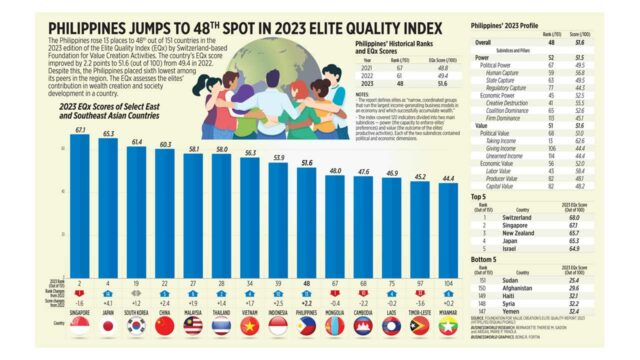
Philippines jumps to 48th spot in 2023 Elite Quality Index

The Philippines rose 13 places to 48th out of 151 countries in the 2023 edition of the Elite Quality Index (EQx) by Switzerland-based Foundation for Value Creation Activities. The country’s EQx score improved by 2.2 points to 51.6 (out of 100) from 49.4 in 2022. Despite this, the Philippines placed sixth lowest among its peers in the region. The EQx assesses the elites’ contribution in wealth creation and society development in a country.

Philippines jumps to 48<sup>th</sup> spot in 2023 Elite Quality Index

ADVERTISEMENT
ADVERTISEMENT