Home Blog Page 4861

Music streaming has a $2-B fraud problem that goes beyond AI

VIKTOR FORGACS-UNSPLASH

STARING at his computer screen, Kristoffer Rom couldn’t believe the numbers rolling in from Spotify.

A year and a half earlier, in 2018, his independent music label, Tambourhinoceros, had released a languid, synth-pop song, titled “Hey Kids,” by Molina, a Danish-Chilean singer. The initial reception was modest. But then, months later, it started taking off on TikTok and YouTube as creators embraced the song as a catchy, mood-setting score for all manner of emotive videos and animations.

From there, the momentum spread to Spotify, Apple Music, and other streaming services. By March 2022, the song was generating more than 100,000 streams per day. “It was amazing to see all that traction,” Mr. Rom said.

But his team’s initial excitement was soon tempered by an unsettling realization. The growing popularity of “Hey Kids” had not only caught the attention of TikTok and YouTube performers but also another more pernicious, if less widely recognized, mainstay of the modern media ecosystem — streaming music scammers. Taking advantage of the loose restrictions in an age of automated music distribution, such scammers have learned how to rake in money from mainstream music platforms, either by circulating minimally altered, copycat versions of popular songs and collecting the resulting per-stream payouts or by getting listeners to inadvertently consume their own music or ads by mislabeling uploaded content.

Much to Mr. Rom’s growing dismay, ripped-off versions of “Hey Kids” — slightly modified but largely indistinguishable from the real thing — were suddenly proliferating across the streaming music landscape, siphoning listeners away from Molina and unfairly pocketing the resulting streaming royalties. Worse yet, nobody at the major services appeared to be doing anything effective to stop the spread of the knockoffs.

“You have the ecstatic joy of people doing creative, great things with the music you’ve put out, on the one hand,” Mr. Rom said. “And the total frustration and anger of witnessing people trying to exploit it.”

Currently, much of the music industry is preoccupied with the newest threat — or maybe opportunity — to emerge from Silicon Valley. With artificial intelligence (AI)-generated songs of mysterious provenance already going viral on streaming platforms, industry executives, most notably Spotify Technology SA Chief Executive Officer Daniel Ek, have been quick to promise heightened vigilance on behalf of labels, artists, and copyright holders. But while the platforms are warily sizing up the shiny new disruptive force, labels and managers say that fraud of a more prosaic nature is already rampant.

Beatdapp, a company that works with services to detect and remove fraud, estimates that at least 10% of streaming activity is fraudulent.  Applied across a vast scale of digital music, what can at first appear as small-time, garden-variety trickery adds up to sizable theft. Beatdapp said that the streaming subterfuge could amount to roughly $2 billion in misallocated revenue every year.

People in the music industry who spoke with Bloomberg say the majority of the problems they grapple with tend to surface on the biggest global streaming platforms, Spotify and Apple Music. By contrast, they say, Alphabet, Inc.’s YouTube Music has been much cleaner. That’s in part because YouTube has for years maintained a powerful content ID system that often identifies infringing content and then allows rightsholders to either remove the fraudulent content entirely or monetize it themselves. (Unauthorized versions of “Hey Kids” on YouTube, for example, now divert any resulting ad revenue back to Molina’s team at Tambourhinoceros.)

A Spotify spokesperson said via e-mail that “stream manipulation and content misrepresentation are industry-wide issues,” which it “takes seriously” and are “against our policies.”

“We have robust, active mitigation measures in place that identify bad actors, limit their impact and penalize them accordingly, including withholding royalties,” the spokesperson wrote. “We are continuously evolving our efforts to limit the impact of such individuals on our service.”

Apple Music didn’t respond to a request for comment.

Ben Gaffin, an artist manager and founder of Sound Advice, a music-services business that represents producers, artists and media companies, said he often encounters a particular type of streaming scam. Someone will make a track and distribute it across the streaming services while intentionally tagging it with the name of another, more successful artist. Afterward, thanks to the fallacious metadata, the platform’s algorithms will start automatically serving up the mislabeled track to the legions of fans of the real musician and incorporating it into popular playlists, generating a surge of unwarranted streams.

Sometimes, lesser-known artists will use this trick to try and draft attention from a popular act. Other times, the deceptively tagged track isn’t even a song but rather a speaker urging listeners to buy something on a particular website. Basically, a rogue ad.

During a recent interview with Bloomberg, Mr. Gaffin began hunting around for an example and quickly found one such track “featuring” his artist Clams Casino. By the time Mr. Gaffin happened upon it, the mis-tagged track had already tallied up over 55,000 plays on Spotify. Mr. Gaffin said he typically only finds out about counterfeits when he gets a notification from Spotify For Artists alerting him to new music being ready for release when, in fact, no new work is planned — or, when fans start posting angrily about a new track they dislike.

“It’s a vulnerability in the system that is being exploited,” Mr. Gaffin said.

Talya Elitzer, co-founder of the label Godmode Music, sees the same tactic targeting her artists a couple times a month. Often, she said, it takes streaming platforms up to a week to process her takedown requests.

“It seems like a fairly easy fix that every artist should have a code or security thing,” Ms. Elitzer said. “By the time you see it, it’s too late.”

Part of the challenge is that in the streaming age, more or less anyone can get tracks uploaded onto major streaming platforms with little scrutiny or oversight. There are many services, such as DistroKid, CD Baby, and TuneCore, that empower users to distribute their songs to the big platforms using do-it-yourself software. The process of distributing new music to retailers, which not long ago was a labor-intensive, hands-on process, has grown largely automated.

“Way, way, way back in the day, we had a team of people that listened to every CD that came in the door,” said Christine Barnum, the chief revenue officer at CD Baby.  “Operating at this scale, that’s not feasible.”

As the amount of amateur content being uploaded to streaming services has exploded, businesses like Spotify that were originally set up as outlets for professional musicians have started to look more like user-generated content platforms. Spotify said over 100 million songs exist on its service, and as of February 2021, 60,000 tracks per day were being uploaded. Apple Music and Amazon Music also, recently said they offer listeners a 100-million-song catalog.

Vickie Nauman, founder and CEO of CrossBorderWorks, a music and technology consultancy, said that the growing scale at which streaming services operate is making it much easier for dishonestly labeled tracks to slip through.

“Certainly in the world before we had 100,000 songs uploaded a day, it was easier to monitor,” she said.

For the most part, the task of swatting down scammers falls on rightsholders who must manually submit takedown requests for each problematic track they identify, a process that can be particularly burdensome for small, independent labels.

To this day, executives at Tambourhinoceros continue to find new uploads ripping off “Hey Kids.” On some, the fraudsters have changed the name of the song, luring in unsuspecting listeners with variations of hashtags used on TikTok. Others feature slightly sped-up or slowed-down versions, seemingly tweaked to avoid fraud detection software while still sounding almost identical to the original work. 

The most popular bogus upload they uncovered had accumulated more than 700,000 plays, possibly accounting for over $2,000 in lost revenue.

“That’s a lot of money for anybody but especially us, an independent label from Denmark,” Mr. Rom said. “We really need to get the money from what we actually do.”  Bloomberg

Robinsons Homes unveils new Bulacan project

ROBINSONS LAND CORP. recently broke ground for Springdale Baliwag in Baliwag, Bulacan. — COMPANY HANDOUT

ROBINSONS Land Corp. (RLC) recently broke ground for a new residential housing project in Baliwag, Bulacan.

RLC is developing Springdale Baliwag, a new 11-hectare subdivision that will offer affordable house and lots units, amenities, and green open spaces.

“Our goal in Robinsons Homes is to provide not just houses but homes — comfortable and well-designed living spaces that promote the well-being of our homeowners. We take pride in our commitment to quality, and we look forward to welcoming new families into the vibrant community of Springdale Baliwag,” Teddy V. Bernas, Robinsons Homes general manager, said in a statement.

Springdale Baliwag offers buyers two modern contemporary house models, the two-storey Atlanta townhouse units and two-storey Boston single attached units.

The Atlanta house model will feature two bedrooms, a living room, dining room, kitchen, and toilet and bath over a total floor area of 42 square meters (sq.m.).

The Boston house model has a total floor area of 57 sq.m., and offers three bedrooms, a living room, dining room, kitchen, and two toilets and baths. Lot areas for Boston units range between 96 sq.m. and 154 sq.m.

“Our goal at Springdale Baliwag is to offer families the chance to start living The Good Life they deserve. We strive to create an unparalleled living experience with our wide array of lifestyle amenities, including swimming pools, multipurpose court, parks, play area, and village clubhouse. Our community provides a peaceful and secure living environment, setting a new standard for residential communities in Bulacan,” Mr. Bernas said.

The Springdale Baliwag showroom and model units are now open to interested homebuyers.

RLC’s Springdale residential brand was given the award for Best Mid-End Housing Development (Central Luzon) by PropertyGuru Philippines in 2021 for Springdale at Pueblo Angono.

Appropriate toolkit needed to stem financial stability risks

MACTAN, CEBU — The Bangko Sentral ng Pilipinas (BSP) and the International Monetary Fund (IMF) said there is a need to build the appropriate toolkit to mitigate risks in financial stability.

IMF Deputy Director May Khamis of the Monetary and Capital Markets Department said in her opening remarks at the 2023 International Conference on Financial Stability being held here that there are a lot of uncertainties in financial markets recently.

“In the wake of a global pandemic, we have seen an unexpected rise in inflation across the globe, with central banks scrambling to raise rates and contain inflation. As everyone knows, rate rises have had an impact on the financial sector, some of it unforeseen,” Ms. Khamis said.

She cited the recent banking turmoil in the US and Europe, where deposits flowed out of regional banks amid the aggressive policy tightening of central banks. 

“Even though spillovers to the region have been limited, these recent events are powerful reminders of the challenges posed by the interaction between tighter monetary conditions and the vulnerabilities built up since the global financial crisis,” Ms. Khamis said.

“After years of low interest rates, tighter monetary policy is challenging banks’ effective risk management in securities portfolios and of loan exposures,” she added.

In the Philippines, the BSP has raised borrowing costs by 425 basis points (bps) to 6.25% since May last year, being one of the most aggressive central banks in the region.

“With few signs of underlying inflation abating, many central banks are expected to continue tightening; within the region, the hiking cycle is expected to be completed or near-complete in many countries, but monetary conditions may need to be tighter for longer if inflation pressures remain persistent,” Ms. Khamis said.

However, monetary tightening has created a challenging environment for bank and nonbanks alike, and some institutions were unprepared for the higher rate environment, she said, adding that tighter monetary policy may result in further episodes of financial instability. 

For his part, BSP Governor Felipe M. Medalla said regulators should continue to encourage innovation in designing tools that would help safeguard financial stability.

“It’s finding the middle where there’s enough creativity [encouraged] but without thinking in terms of the public cost of mistakes,” Mr. Medalla said during his keynote address.

“We will take the state of play on systemic risk management, how stakeholders will cope with changing market conditions, and the latest tools available. We want to have the tools ready before [financial instability] happens,” he said.

Meanwhile, at a press briefing during the conference, IMF Mission Head to the Philippines Shanaka Jayanath Peiris said household and corporate debt in the country is manageable amid higher borrowing costs.

“In the Philippines, on average, corporate debt is manageable, but there are some sectors where its probably higher than the others, including real estate,” Mr. Peiris said, adding that aside from banks, it would be good to subject corporates to stress tests, as well.

In response, Mr. Medalla said regulators lack complete data that could help address emerging vulnerabilities amid higher borrowing costs.

“We are not really sure that our data on their exposure and their investment abroad is complete. Right now, we actually wish we had even more complete data,” the BSP chief said. “We’re exerting efforts so that we’ll be able to catch up on the data gaps here. I’ll be lying if I told you that I’m satisfied with our current level of granularity.”

The BSP said the ongoing conference aims to focus on Asia as a collective body in light of the systemic risk issues affecting the global economy.

In 2019, the BSP and the IMF co-hosted the inaugural regional dialogue on financial stability in Manila.

For this year, around 142 individuals are participating in the discussions, coming from 14 central banks, six regional and global organizations, and 31 market institutions. — Keisha B. Ta-asan

Nickel Asia income slips on foreign exchange losses

Nickel Asia Corp. (NAC) on Monday reported an attributable net income of P969.69 million in the first quarter, down 8% year on year, brought about by foreign exchange losses.

Based on its unaudited financial statement, the listed mining firm’s income decline came despite its revenues growing by 5.7% to P3.51 billion from P3.32 billion in the same period last year, on higher nickel ore prices and favorable exchange rates.

“Foreign exchange losses of P202 million attributed to NAC’s financial assets contributed to the decline in net income,” the company said.

NAC President and Chief Executive Martin Antonio G. Zamora said in a statement that the 25% increase in electric car sales in the first quarter and the higher demand “will continue to be the main driver of the nickel sector over the long term.”

During the first quarter, the company exported 604,000 wet metric tons (WMT) of saprolite and limonite ore at an average price of $50.37 per WMT, 6.09 % higher than the $47.48 per WMT recorded previously.

It also sent 1.79 million WMT of limonite ore to its Coral Bay and Taganito high-pressure acid leach (HPAL) plants, which had an average price of $11.98 per pound of payable nickel, higher than the 1.74 million WMT at $11.80 per pound last year.

The three-month average price of the deliveries to the HPAL plants slipped slightly to $18.84 per WMT from the $19.58 per WMT posted in the previous year.

Likewise, the weighted average nickel ore sales price went down 1.4% to $26.80 per WMT from $27.19 per WMT last year.

“The company realized P54.80 per US dollar from nickel ore sales, a 6.4% increase from P51.51 year on year,” the NAC said.

On Monday, shares in Nickel Asia rose seven centavos or 1.14% to close at P6.22 each. — Sheldeen Joy Talavera

EntertainmentNews (05/16/23)


Freestyle marks 25 years with concert

AFTER numerous sold-out concerts since the relaunching of Freestyle with original frontman and songwriter Top Suzara last year, the iconic OPM band is set to take the big stage with a 25th anniversary concert on May 20 at the Music Museum at the Greenhills Shopping Center, San Juan. Entitled Giving It All This Time, the concert is a retrospective of 25 years of Freestyle’s music and officially mark a new chapter of the band with Ian Tan, Lerod Cailao, Bouy Manalo, and IJ Garcia joining Mr. Suzara. “This is my 25th year in the industry and this show will, one, be the first official show in a concert setting where we will celebrate with all original songs, and, two, be the resurgence of Freestyle as we make good on the promise to continue together where I left off many years ago, when writing and sharing original songs was what drove us. This concert will be a story-telling journey through songs,” said Mr. Suzara in a press release. The band is known for its hits “Before I Let You Go,” “So Slow,” “Para Sayo,” “Bakit Ngayon Ka Lang?,” and “Once In A Lifetime,” among many others. Concert tickets are available at TicketWorld and Music Museum. For reservations, text or call PPMPI at 0928-510-6000.


TV5 launches romance The Rain in España

TV5 BRINGS to life the love story of Kalix and Luna in The Rain in España, based on the hit web novel that has had over 140 million reads online, and grabbed the No. 1 spot on Twitter’s trending topics. The 10-part series kicked off on May 15 on TV5. The series follows the love story of Kalix (Marco Gallo) and Luna (Heaven Peralejo) as they navigate young love despite the pressures of school, family, and ambition. But when Luna discovers Kalix’s infidelity, their relationship ends. Ten years later, their paths cross again when Kalix becomes the Head Legal Counsel for Luna’s company. The former lovers must work together, and as they do, old feelings start to resurface. The story was brought to life by Gwy Saludes, who wrote the original work and serves as the creative consultant for the series. It is directed by Theodore “Ted” Boborol (Vince, Kath and James, Forevermore, and Make it With You.) Also in the cast are Gab Lagman, Bea Binene, Krissha Viaje, Nicole Omillo, Aubrey Caraan, Gabby Padilla, Andre Yllana, Frost Sandoval, and Leo Francis Magundayao. New episodes air on Sundays at 4 p.m. For more updates and the latest news, visit the official social media pages of TV5.


Matteo Guidicelli joins GMA Public Affairs

MATTEO Guidicelli signed a contract with broadcast company GMA Network on May 11. The actor, triathlete, and host is set to undertake a series of projects with GMA Public Affairs. “Your fans and supporters can definitely look forward to more of your projects in GMA, especially with Public Affairs,” said GMA Network Chairman and CEO Felipe L. Gozon in a message. “[It was] Not in my wildest dreams to be in the public affairs team because I started my career as an artista [actor]. I’m always on the entertainment side. When Ma’am Nessa (First Vice President of Public Affairs Nessa Valdellon) and Atty. Gozon-Valdes (SVP for Programming, Talent Management, Worldwide, and Support Group, and President of GMA Films, Annette Gozon-Valdes) approached me and told me that they think they have a spot for me in Public Affairs. I was like, okay, if you guys believe it, let’s go. I’m really excited to see what this journey will become, what kinds of doors will open and the things I’m going to do with Public Affairs,” said Mr. Guidicelli at the contract signing. Beginning May 15, he will be part of the long-running morning show Unang Hirit as one of its hosts. He will also be part of GMA Public Affairs’ upcoming action-drama primetime series Black Rider with Ruru Madrid, and will be part of a documentary special about nature.


We Are Imaginary releases new EP

THE 7-TRACK release turns internal monologues into generation-defining anthems as Filipino indie rock quartet We Are Imaginary marks their 15th year as a band with their fourth studio release, Swan Songs for Drifters now out via the label floppydisks. According to lead vocalist/guitarist Ahmad Tanji, the songs off the new EP capture long stretches of silence and reflection from 2018 to 2020 — a defining era in his personal life before the entire world shut down because of the COVID-19 pandemic. “It really brought a lot of existential questions about why we are doing this,” Mr. Tanji said in a statement. “For a moment after celebrating our 14th year as a band, I thought this is it; we are done. That moment also gave me the realization that everyone is lost — basically a drifter looking for the next pitstop.” Mr. Tanji decided to reassemble the group at the height of the new normal, record two new tracks from the original lineup of five, and close “that” chapter of his life with renewed perspective and wisdom. The result is a seven-track EP that is more of a vibe than an actual album, but leads listeners through on an otherwise colorful, redemptive journey. The EP contains “Dekada,” originally released in 2018, as well as the pensive tune “Kawalan,” which was initially considered to be part of their third album, Death to Romanticism. Other tracks are “Durden,” a melodic, 1990s alt-rocker with widescreen choruses and indie pop breakdowns on the verses; and “Swan Song,” a lilting folk number. All of the songs in Swan Songs for Drifters were written by Ahmad Tanji, except for “Shimmer” which was co-written by his brother Khalid Tanji. The new album was produced, mixed, and mastered by RJ Mabilin of Redverb Studio. We Are Imaginary, composed of Apa Rubio (drums), Khalid Tanji (guitars), Vhall Bugtong (bass, vocals), and Ahmad Tanji (vocals, guitars).

EastWest Bank’s net profit triples in Q1

EAST WEST Banking Corp. (EastWest Bank) saw its net income triple in the first quarter amid the economy’s continued recovery.

The Gotianun-led bank’s attributable net income surged to P1.578 billion at end-March from P507.558 million in the same period last year, its quarterly report disclosed to the local bourse on Monday showed.

This translated to a return on equity of 10.3% and a return on assets of 1.6%, higher than 3.4% and 0.5% in the same period a year prior, respectively.

“The bank is fortunate to ride the tailwinds of the country’s economic recovery and we are already seeing the results of our decision to accelerate lending activities last year. This resulted in core revenues growing by 26%. We expect this momentum to continue moving forward,” EastWest President Jackie S. Fernandez said in a statement.

“Our continued focus on redeploying our resources to higher earning assets has allowed us to gain ground as far as the bank’s earning capacity is concerned. Headwinds remain as we expect funding costs to stay elevated and the impact of a possible US recession to hit closer to home. We are prepared for this and remain vigilant on economic developments… We believe however, that our well positioned consumer-centric business model will still lead to better results this year,” EastWest Bank Chief Executive Officer Jerry G. Ngo added.

The lender’s net interest income climbed by 17.27% to P6.11 billion, driven by higher income from loans, rising by 28.38% to P6.447 billion.

Net interest margin rose to 7.4% from 6.3% “as consumer loans continued to increase, coupled with the buildup of high-yielding fixed-income securities.”

The bank’s total operating income rose by 34.45% to P7.806 billion from P5.806 billion amid higher foreign exchange gains and service fees and commission income.

Fee income surged by 71.31% to P1.178 billion, while foreign exchange gains tripled to P99.077 million from P32.197 million.

Gains from trading and securities stood at P111.142 million versus the P262.079-million loss in the previous year.

Meanwhile, operating expenses went up by 21.2% to P6.134 billion due to higher taxes, investments in manpower, IT development and business-related expenses.

EastWest Bank’s cost-to-income ratio was at 61% in the first quarter, down from 69.4% a year prior.

The bank’s loans and receivables slipped to P258 billion as of March from P258.1 billion at end-December 2022.

“Except for corporate loans, which decreased from normal business flows, all consumer loan products showed an increasing trend,” the lender said.

“Consumer lending was up by 6.16% year on year to P201.62 billion, driven mainly by auto loans, credit cards and salary loans. On the other hand, corporate banking posted a decrease of 14% to P59.2 billion,” it added.

On the funding side, deposit liabilities stood at P319.4 billion, down from the P329.2 billion seen as of December 2022.

“CASA (current and savings accounts) went down by P5.9 billion to P255 billion, while time deposits decreased by 5.9% from P65.8 billion to P61.9 billion. Long Term Negotiable Certificate of Time Deposits amounted to P2.5 billion. Deposits declined across all products with the drop in FCDU (foreign currency deposit unit) deposits attributable to the decrease in volume and revaluation,” the bank said.

Its CASA ratio improved to 80% from last year’s 76%.

The bank’s total assets stood at P403 billion at end-March, 4.4% lower than the P421.4 billion seen at end-2022.

Its capital rose to P63 billion from P61 billion at end-2022. Its capital adequacy ratio was at 14.4% and its common equity Tier 1 ratio stood at 13.6% as of March.

As of March 31, the bank had a total of 392 branches and 580 automated teller machines nationwide.

EastWest Bank’s shares went up by 17 centavos or 2.43% to close at P7.18 each on Monday.

Ex-DBP president joins Ovialand board

EMMANUEL G. HERBOSA
EMMANUEL G. HERBOSA

OVIALAND, Inc. on Monday said former Development Bank of the Philippines (DBP) President and Chief Executive Officer (CEO) Emmanuel G. Herbosa has joined its board as independent director.

“We welcome Mr. Herbosa to our board, with his expertise in the financial industry being crucial in our goal to expand throughout the Philippines. We look forward to working with him in identifying key areas where Ovialand can strategically maximize its growth for the long term,” Pammy Olivares-Vital, president and CEO of Ovialand, said in a statement. 

Mr. Herbosa has over 40 years of experience in the financial industry. He was the president and CEO of DBP from 2019 to 2023.

Prior to his DBP stint, he served as president and CEO of Philippine Import-Export Credit Agency, executive vice-president for Bank of Commerce, and chief operating officer of Ayala Insurance Group.

“I am thankful for the opportunity to serve as an independent board member of a fast-growing company that is yet to realize its full potential,” Mr. Herbosa said.

Ovialand recently filed a P2.2-billion initial public offering (IPO) plan with regulators. Proceeds from the IPO will go to land-banking initiatives in Laguna and Bulacan; and the development of real estate projects in Laguna, Batangas, Quezon, and Bulacan.

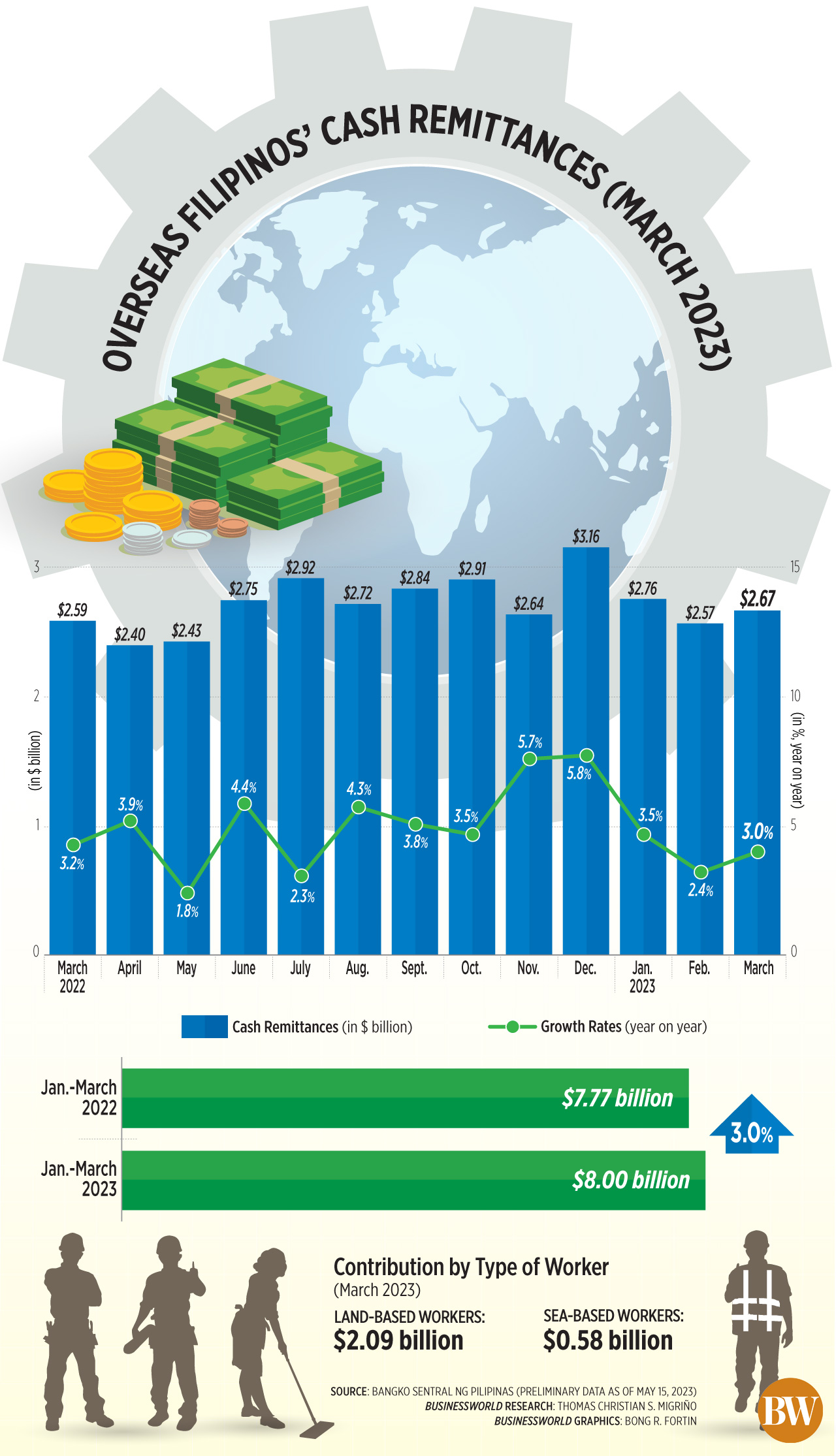
Overseas Filipinos’ cash remittances (March 2023)

MONEY SENT HOME by overseas Filipinos jumped by 3% in March amid the improving economic outlook in host countries. Read the full story.

Overseas Filipinos’ cash remittances (March 2023)

SC affirms granting part of Vestas’ refund

THE SUPREME COURT (SC) has upheld a tax court decision that partially granted Vestas Services Philippines, Inc.’s (VSPI) tax refund claim in the amount of P4.4 million representing its excess input value-added tax (VAT) traced to zero-rated sales for the fourth quarter of 2013.

In an 18-page decision made public on May 10, the High Court said the commissioner of internal revenue failed to persuade the court to overturn the partially refunded tax.

The company previously sought a VAT refund in the total amount of P41.66 million.

“Based on their appreciation of the evidence presented to them, the CTA (Court of Tax Appeals) unequivocally ruled that VSPI was only able to prove its entitlement to the refund or the issuance of a tax credit certificate for unutilized input VAT for the fourth quarter of 2013,” according to the ruling penned by Associate Justice Ramon Paul L. Hernando.

“We would like to stress that the findings of facts of the CTA when supported by substantial evidence, will not be disturbed on appeal.”

The tribunal ordered the Office of the Solicitor General, which serves as the legal counsel for the commissioner of internal (CIR), and VSPI to submit a verified declaration of its receipt of the High Court’s decision.

The firm is engaged in installation and construction activities, including subcontracting arrangements for wind power systems.

The tax court noted the CIR failed to provide evidence or raise timely objections on VSPI’s additionally presented evidence.

“A party who desires the court to reject the admission of any evidence formally offered must do so in the form of a timely objection,” it said, adding the firm’s judicial claim to the refund was timely submitted within the 120-day and 30-day period mandated under the law.

Under the country’s tax code, when the CIR denies or fails to act on a claim for a refund, the taxpayer is given 30 days from the receipt of an adverse decision or ruling to file a petition for review with the CTA.

The commissioner is given 120 days to act on a disputed tax assessment; otherwise, the decision would be final.

“Thus, we see no reason to delve into the factual findings of the CTA and review anew the evidence presented by VSPI,” the high tribunal said. — John Victor D. Ordoñez

Singapore home sales reach 7-month high as curbs introduced

BLOOMBERG

SINGAPORE’s home sales jumped to a seven-month high in April, underscoring why authorities introduced fresh measures to cool the market during the month.

Purchases of new private apartments rose to 887 units, figures from the Urban Redevelopment Authority showed on Monday. The 80% increase from a month earlier came as more projects were launched.

Surging home prices and rents are becoming a headache for Singapore’s government as it tries to mollify citizens and remain competitive as a financial hub. Authorities raised taxes on property purchases in late April, mainly targeting foreign and second-home buyers in a bid to maintain affordability.

While there could be a knee-jerk reaction, the measures should have little impact on purchases between S$1.8 million ($1.3 million) and S$4 million, said Tan Tee Khoon, Singapore country manager at PropertyGuru.

“Demand remains from the upgraders as households have a stronger liquidity position due to intergenerational wealth transfers,” Tan said. The risk of further curbs down the road may prompt some property seekers to bring forward their purchases, he added.

Last month saw the launch of developments including the 638-unit Tembusu Grand. The 275-unit Blossoms by the Park, which opened two days after the cooling measures, sold about 75% of its apartments on the first day. Eight went to foreigners — four Chinese and four American buyers, said Lim Yew Soon, a managing director of the project’s developer EL Development Pte.

Inflows of money from abroad have helped Singapore’s property sector remain buoyant even as soaring interest rates cool markets elsewhere. Last month’s increase in stamp duties included doubling the rate for foreign buyers to 60%, the highest among major markets.

There are signs that momentum in the market continued into this month. Sales at newly launched residential project The Continuum have been encouraging, according to property brokers. At agency PropNex, which served about half of the units sold on launch day, about 10% of the buyers were permanent residents, and the rest were Singapore citizens. There were no foreign buyers. — Bloomberg

San Miguel Food and Beverage, Inc. announces annual meeting of stockholders on June 7


Spotlight is BusinessWorld’s sponsored section that allows advertisers to amplify their brand and connect with BusinessWorld’s audience by enabling them to publish their stories directly on the BusinessWorld Web site. For more information, send an email to online@bworldonline.com.

Join us on Viber at https://bit.ly/3hv6bLA to get more updates and subscribe to BusinessWorld’s titles and get exclusive content through www.bworld-x.com.

Credit card billings rise to P410 billion in the first quarter

DCSTUDIO-FREEPIK

CREDIT CARD USE rose in the first quarter amid continued robust spending among Filipinos, the Credit Card Association of the Philippines (CCAP) said on Monday.

Data from the CCAP showed gross credit card billings of the industry jumped by 47% to P410 billion in the first quarter from P279 billion in the same period last year. This marked the fastest growth since the coronavirus pandemic started in 2020.

There were 11.8 million credit cards issued in the country as of end-March, data from the CCAP’s quarterly survey of its 17 member issuers showed. Around 64% or 7.5 million Filipinos own only one card. 

According to the CCAP, personal consumption may still not fade amid high interest rates and elevated inflation.   

“If at all, rising inflation may even push more cardholders to use their credit card to cope with the higher prices because a credit card is one way to extend your purchasing power,” CCAP Executive Director Alex Ilagan said in a statement.

“A credit card is basically a form of installment credit which the Filipino consumer has learned to utilize. As long as cardholders pay on time, it will have no negative impact on either the cardholder or the bank issuer,” Mr. Ilagan said.

Inflation slowed for a third straight month in April to 6.6% from 7.6% in March. For the first four months of the year, inflation averaged 7.9%.

To tame elevated inflation, the Philippine central bank has raised borrowing costs by 425 basis points (bps) since May 2022, bringing its policy rate to 6.25%, the highest in nearly 16 years.

Pent-up demand for goods and services will persist and feed into the growth of the economy, Mr. Ilagan added. 

“If the economy remains strong, more people will be employed and will qualify for a credit card, thus sustaining the growth in credit card ownership and usage. Credit card delinquency rate will also remain low and may even continue its downtrend in the last two years because cardholders will have the means to pay their bills,” he said.

Household consumption went up by 6.3% in the first quarter. This was slower than the 7% growth in the previous quarter, and 10% a year earlier.

Robust household consumption caused the Philippine economy to grow by 6.4% in the first quarter of the year.

“While Filipinos’ spending spree keeps the economic engine chugging along, we must bear in mind that a credit card is not ‘free money,’ All transactions charged to a credit card will have to be paid so be a responsible card user and don’t use your credit card beyond your capability to repay the amount at a later date,” Mr. Ilagan said. — K.B. Ta-asan

ADVERTISEMENT
ADVERTISEMENT