Home Blog Page 4848

Narrowing income inequality: How does the Philippines compare in the region?

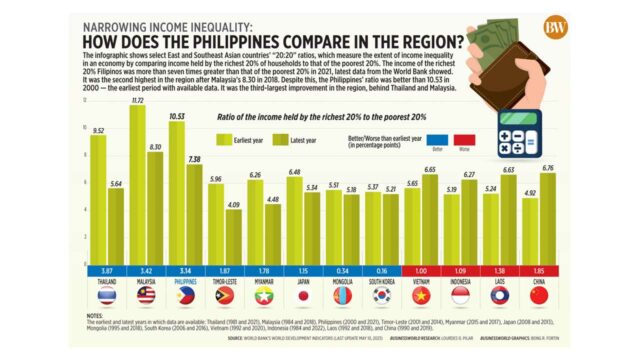
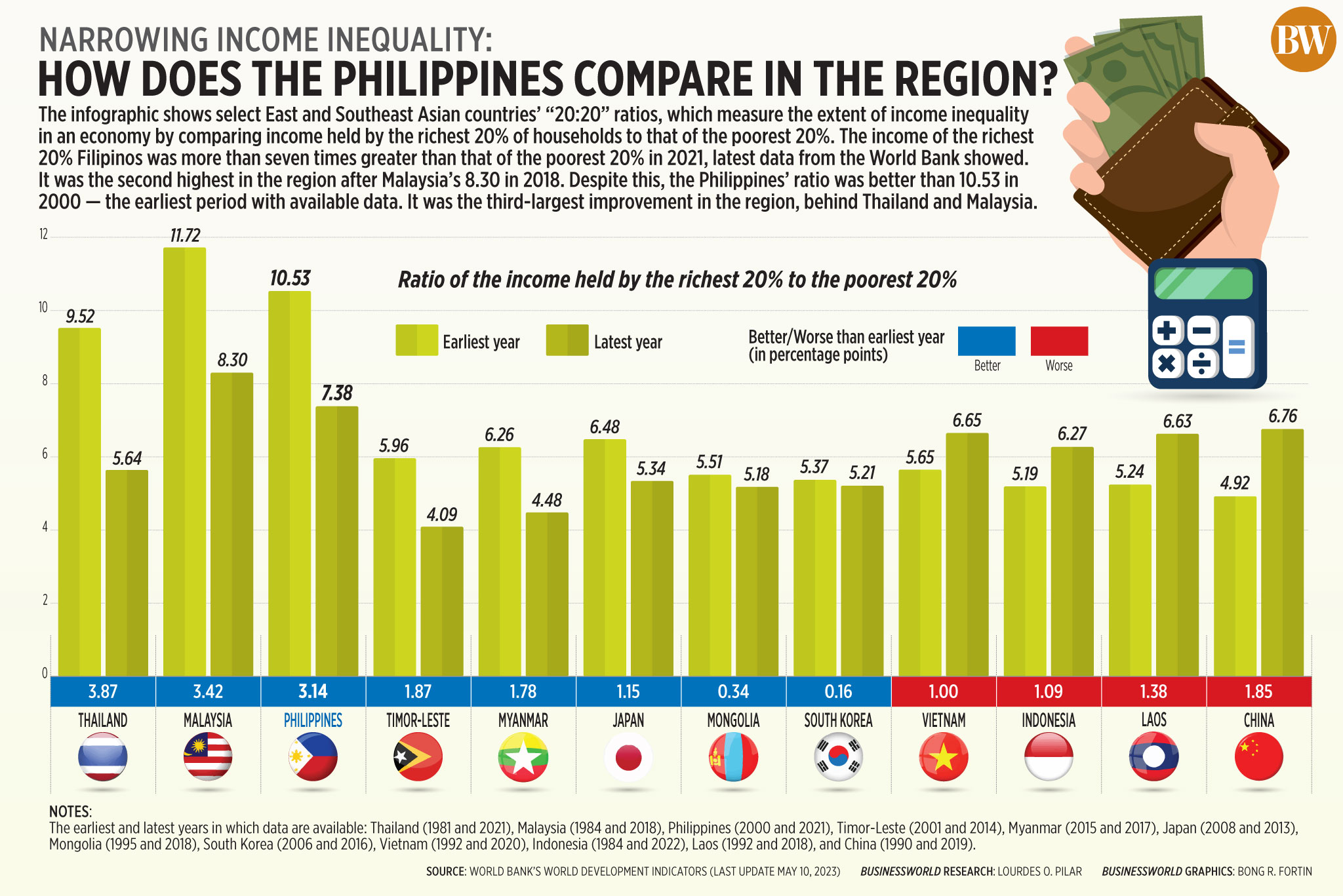
The infographic shows select East and Southeast Asian countries’ “20:20” ratios, which measure the extent of income inequality in an economy by comparing income held by the richest 20% of households to that of the poorest 20%. The income of the richest 20% Filipinos was more than seven times greater than that of the poorest 20% in 2021, latest data from the World Bank showed. It was the second highest in the region after Malaysia’s 8.30 in 2018. Despite this, the Philippines’ ratio was better than 10.53 in 2000 — the earliest period with available data. It was the third-largest improvement in the region, behind Thailand and Malaysia.

Narrowing income inequality: How does the Philippines compare in the region?

HMO industry posts net loss in 2022

THE health maintenance organization (HMO) sector swung to a net loss in 2022, Insurance Commission (IC) data showed.

The HMO industry posted a net loss of P1.435 billion in 2022 versus the net profit of P5.145 billion in 2021, IC data based on unaudited interim financial statements submitted by 26 out of 29 companies showed.

Revenues inched up by 6.05% to P56.508 billion, with revenues from total membership, enrolees, and administrative service fees rising by 6.06% to P55.514 billion.

Total capital stock also rose 33.48% to P5.058 billion.

Meanwhile, benefits and claims paid out by the industry increased by 33.74% to P43.759 billion.

Total invested assets went down by 41.01% year on year to P16.657 billion.

The sector’s combined assets declined by 12.04% to P54.288 billion.

Meanwhile, liabilities dropped by 8.85% to P43.219 billion.

Total equity stood at P11.069 billion, down 22.61% year on year.

IC data showed eight of the 29 licensed HMOs posted a net loss last year. — AMCS

Toyota expands dealership with Ilocos Sur outlet 

PHILSTAR FILE PHOTO

CAR MANUFACTURER Toyota Motor Philippines Corp. (TMP) has expanded its operations in the country following the groundbreaking of Toyota Ilocos Sur.

In a statement sent late Tuesday, TMP said that Toyota Ilocos Sur, located at Brgy. Langlangca II, Candon City, had its groundbreaking ceremony on April 11 and is set to be the company’s 74th outlet in the country.

“With the construction of Toyota Ilocos Sur, Toyota looks to maintain its position in the industry as the top-of-mind car brand. We are excited to welcome this new dealership as we create mobility and happiness for all our customers in the province of Ilocos Sur,” TMP Senior Vice-President for Marketing Division Masando Hashimoto said.

According to the carmaker, Toyota Ilocos Sur is situated in a 2-hectare lot and will have a total floor area of 5,868 square meters. It will provide sales, service, and spare parts. The outlet will also have a four-car display showroom and a workshop consisting of 37 general service and body repair bays.

“We are confident that with the strong guidance of our next generation leaders and their team, along with the supervision and partnership with TMP, we can lead in offering the best possible customer experience in Ilocos Sur and further expand our market in the whole of Region 1,” Toyota Dagupan Inc. Group President Rene So said.

In 2022, TMP bested all car brands in terms of sales as it sold 174,106 units, or 49.38% out of the 352,596 units sold, based on figures from the Chamber of Automotive Manufacturers of the Philippines, Inc. (CAMPI) and Truck Manufacturers Association (TMA).

As of end-April, TMP has the highest sales among car brands at 59,328 units sold, equivalent to a 46.38% market share. — Revin Mikhael D. Ochave

Transforming customer experience: what will the future look like?

TRUSTPAIR.COM

THREE years into the pandemic, organizations and employees have permanently adopted practices that will forever change the workplace as we know it. Meanwhile, brands have refined their services to ensure improved customer experiences. Customer experience (CX) is continuously changing.

We have ushered in a new era of CX. Customer service has expanded across different channels and has developed new practices to reach a wider audience. Many companies have strengthened their CX efforts to differentiate their brand from competitors who offer similar products and services and share the same audience.

Business leaders are beginning to determine which habits adopted during the pandemic will wither and which habits will stay. So, here are our predicted CX trends that will shape the interactions between businesses and their customers:

• CEOs will take the lead on digital transformation (DX).

While digital transformation has been underway for several years, the past two years have seen it faster than ever. Now more than ever, the urgency to prioritize DX was pushed to an existential challenge. It doesn’t apply to just the IT infrastructure to optimize internal operations anymore but has extended across the entire business ecosystem, primarily driven by how customers now consume content and make purchases. This has resulted in a fundamental transformation for the many organizations as a whole, especially as customers now prefer to interact with brands through digital channels.

According to a Consumer Insights report by PwC, among the top preferred channels of Singaporeans to purchase products are online via smartphones, online via smart home voice assistants, and online via tablets. As such, it is expected that, from a CIO’s responsibility, DX will likely transition to a CEO’s, having a strong focus on improving customer experiences. As customer consumption behavior is rapidly evolving, it is now up to the CEOs to articulate a technology-led and outcome-driven business strategy, rather than seeking how to support existing strategy with technology.

• BizOps will be elevated to a strategic level.

Digitalization and elevating business strategy go hand in hand. The pandemic has accelerated the adoption of BizOps, the strategic direction to unify the information flow from different business functions like sales, marketing and customer service, so that decision making is not done in silos, among businesses. It will soon be more common to utilize BizOps at a strategic level to optimize internal operations. As technology becomes a primary driver of growth, rather than being an afterthought, the importance of BizOps teams shall only increase further.

While companies have already adopted the BizOps model, they will soon leverage it to gain a better competitive advantage to improve customer services and create better customer experiences. Given the pace at which brands operate today, BizOps teams will complement business teams and IT teams to manage internal changes more smoothly and include customers into these positive changes.

• Self-serve and conversational experiences will be brands’ priority.

Brands have already begun implementing self-serve digital experiences, which are already preferred by customers for simple and transactional needs. From commerce and account management to compliance and personalization, customers now opt to have as much within their direct control as possible. All these will be simplified by conversational interfaces, which emulate a conversation with a real person to give a more convenient and more human interaction.

The era of Zero UI has begun. Invisible user interfaces that are triggered by natural gestures like movements, voices and gestures are already implemented, and it will soon receive and increased demand from more organisations. On the consumer front, the increased adoption of Zero UI in smart home setups are a sure indication of what will become the expectation for more consumer products in a few years.

• Trust-by-design will be an expectation from customers and an ultimate goal for brands.

According to Forrester, 59% of marketers in Asia-Pacific only fulfill minimum requirements in complying with data privacy regulations and only 30% have developed a dedicated strategy to communicate with their consumers about their data privacy. These numbers are likely to grow and consumers will begin to switch to brands that offer better privacy and take consumer data security more seriously. They are also likely to pay a premium for such offerings. This has already started for many consumers and will only get stronger as a trend.

• Unified technology platforms will be the de facto choice.

As organizations accelerate digital transformation, they are adopting unified technology platforms to ensure a seamless shift. Over a landscape of integrated best-of-breed applications, unified platforms will become the norm as they serve as a one-stop shop that allows businesses to perform several functions, like cross-referencing customer context, automation, gathering and analyzing customer data, within a single platform.

In the long term, a seamless unified platform mitigates the potential technology and financial risk of patchwork implementation of applications from different solution providers.

Overall, we are seeing brands raise their CX efforts several notches higher. Since customer expectations and behavior have changed, we brands now have an increased focus on refining customer digital experiences and making them as faultless as possible. At this stage, while we’re still adapting and coping with the rapid changes, we predict that the coming months will be significant for continuing, simplifying, and permanently incorporating the best CX practices adopted during its transformation journey amid the pandemic. These practices are paving the way of what CX will look like a few years down the line.


Gibu Mathew is vice-president and general manager for Asia-Pacific, Zoho Corp.

Cocktails to make at home

REMY MARTIN has come up with five cocktail recipes using its 1738 Accord Royal — a unique blend of cognac with a distinctive combination of flowery, fruity, and toasted tastes — which can be made at home.

RÉMY SIDECAR
A fresh, crisp, and well-balanced classic from the 1920s, the Rémy Sidecar uses only three ingredients: 30 ml of Rémy Martin 1738 Accord Royal, 20 ml of Cointreau, and 10 ml of lemon juice. Pour these into a shaker filled with ice, strain, and pour into a coupette glass. Add an orange peel for rich flavor or lemon peel for freshness.

ROYAL TOM COLLINS
For an outdoor party, this refreshing cocktail is best paired with warm weather and grilled flavors. Combine 45 ml of Rémy Martin 1738 Accord Royal, 20 ml of lemon juice, and 20 ml of simple syrup in an ice-filled cocktail shaker. Shake, strain, and add ice to a highball glass. Add club soda on top, then garnish with a lemon wheel and brandied cherry.

ROYAL MANHATTAN
This aromatic short drink can be prepared quick and easy. It will be ready to serve in five minutes by pouring 60 ml of Rémy Martin 1738 Accord Royal, 30 ml sweet vermouth, and a dash of Angostura bitters over ice in a mixing glass. Stir and strain into a martini glass and garnish with a brandied cherry.

THE RÉMY COQUITO
The creaminess and sweetness of The Rémy Coquito’s soft notes of toffee make perfect as a holiday after-dinner drink.

It is made with 45 ml Rémy Martin 1738 Accord Royal, 25 ml evaporated milk, 25 ml coconut cream, 15 ml sweetened condensed milk, and 1⁄2 teaspoon vanilla extract. Add all ingredients into a blender and blend until smooth. Transfer to an 8 oz rocks glass, and grate cinnamon and nutmeg on top before serving.

COSMOPOLITAN DELIGHT NO. 2
Cosmopolitan Delight No. 2 is one of the classic cognac cocktails, jazzed up with a red wine float for parties and girls’ nights out.

To make this cocktail, prepare 50 ml Rémy Martin 1738 Accord Royal, 10 ml Cointreau, 7 ml orgeat or 15 ml simple syrup, 15 ml lemon juice, and 20 ml red wine. Mix all the ingredients, shake, and strain over crushed ice, and top with a 20 ml (⅔ oz) red wine float.

To learn more about Rémy Martin and its products, visit www.remymartin.com, follow fb.com/RemyMartinPhilippines on Facebook and @remymartin on Instagram for updates and upcoming events. Rémy Martin is available at boozy.ph, singlemalt.ph, flasked.ph, boozeshop.ph, and clink.ph.

How PSEi member stocks performed — May 17, 2023

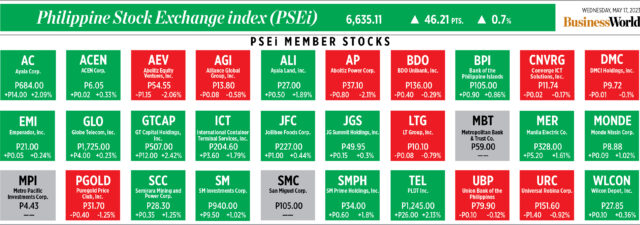
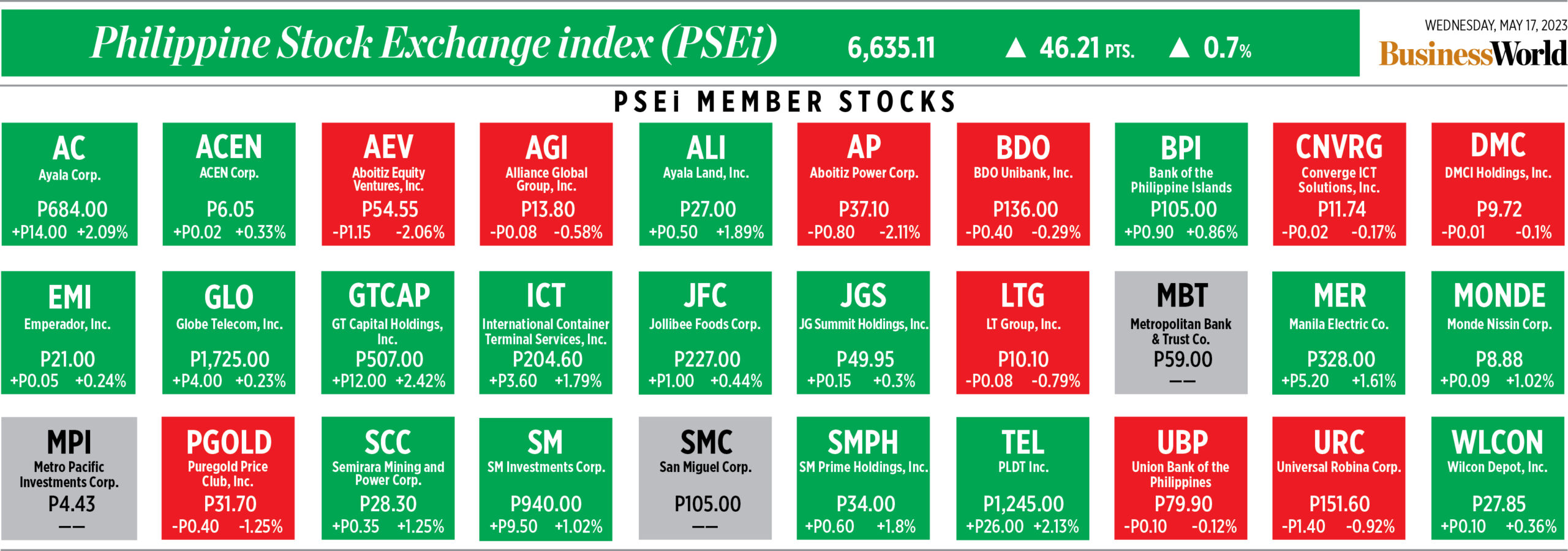
Here’s a quick glance at how PSEi stocks fared on Wednesday, May 17, 2023.


Peso hits one-month low before BSP meet

BW FILE PHOTO

THE PESO weakened anew against the dollar on Wednesday as investors awaited the Bangko Sentral ng Pilipinas’ (BSP) policy decision.

The local currency closed at P56.20 versus the dollar on Wednesday, declining 17 centavos from Tuesday’s P56.03 finish, data from the Bankers Association of the Philippines’ website showed.

This is the peso’s worst close in almost a month or since it finished at P56.21 on April 19.

The local unit opened Wednesday’s session sharply weaker at P56.15 per dollar. It traded lower than its Tuesday finish the entire day, with its best showing at P56.05 and its weakest point at P56.29 versus the greenback.

Dollars traded went up to $1.64 billion on Wednesday from the $1.295 billion recorded on Tuesday.

The peso was dragged down by expectations of a pause in the BSP’s tightening cycle at its meeting on Thursday, Rizal Commercial Banking Corp. Chief Economist Michael L. Ricafort said in a Viber message.

BSP Governor Felipe M. Medalla said on Monday that the central bank is likely to leave its key interest rate unchanged, possibly hitting the pause button after its most aggressive tightening cycle in two decades, Bloomberg reported.

A pause is the “most likely result” at the May 18 meeting, he said on the sidelines of a forum of the central bank and the International Monetary Fund in Cebu on Monday.

The BSP has raised borrowing costs by 425 basis points (bps) since May 2022 to help bring down elevated inflation, bringing its policy rate to a 16-year high of 6.25%.

“The peso weakened anew after BSP Governor Medalla hinted at possibly reducing the local reserve requirement instead of policy rate cuts this year,” a trader added in an e-mail.

The BSP might reduce banks’ reserve requirement ratio (RRR) as an alternative to loosening monetary policy, Mr. Medalla said on Tuesday.

The RRR for big banks is currently at 12%, one of the highest in the region.

For Thursday, the trader said the peso could depreciate further due to caution ahead of the BSP policy decision.

Both the trader and Mr. Ricafort see the peso trading between P56.10 and P56.30 versus the dollar on Thursday. — A.M.C. Sy

Stocks extend climb ahead of central bank meet

SHARES inched up further on Wednesday ahead of the Bangko Sentral ng Pilipinas’ (BSP) policy meeting.

The benchmark Philippine Stock Exchange index (PSEi) rose by 46.21 points or 0.7% to close at 6,635.11 on Wednesday, while the broader all shares index went up by 14.48 points or 0.41% to 3,533.84.

“The local bourse breached the 6,600 psychological level again, gaining 46.21 points to 6,635.11, ahead of the meeting of the Bangko Sentral ng Pilipinas,” Philstocks Financial, Inc. Research Analyst Claire T. Alviar said in a Viber message.

“Some investors were pricing in already the possibility that the BSP may pause hiking rates, especially after the statement of the BSP Governor Felipe Medalla,” Ms. Alviar added.

Regina Capital Development Corp. Head of Sales Luis A. Limlingan likewise said in a Viber message that the investors are awaiting the central bank’s rate decision.

The central bank is likely to keep policy rates unchanged this week as inflation continues to ease, Mr. Medalla said.

A BusinessWorld poll last week showed 13 out of 18 analysts expect the Monetary Board to pause its tightening cycle at its meeting on Thursday.

If realized, this would be the first time the BSP will leave interest rates untouched since it began hiking in May 2022.

The Monetary Board has raised borrowing costs by 425 basis points since May 2022 to help bring down elevated inflation, with its key rate now at 6.25%.

Headline inflation eased to an eight-month low of 6.6% in April, still above the BSP’s 2-4% target for the year.

“Moreover, the surge in total foreign investment pledges to the Philippines helped in lifting the sentiment,” Ms. Alviar said.

The value of foreign pledges approved by the country’s investment promotion agencies rose to P172.7 billion during the first quarter, preliminary data from the Philippine Statistics Authority released on Tuesday showed.

This was about 20 times higher than P8.98 billion the same period last year, but slightly lower than the P173.61 billion during the fourth quarter of 2022.

The majority of sectoral indices went up on Wednesday, except for mining and oil, which declined by 64.06 points or 0.62% to 10,142.37, and industrials, which fell by 1.30 points or 0.01% to 9,468.64.

Meanwhile, property rose by 35.78 points or 1.32% to 2,744.34; services increased by 18.64 points or 1.19% to 1,579.22; holding firms gained 40.50 points or 0.61% to end at 6,606.74; and financials went up by 1.76 points or 0.09% to 1,853.35.

Value turnover fell to P4.34 billion on Wednesday with 1.07 billion shares changing hands from the P5.18 billion with 2.7 billion issues traded on Tuesday.

Decliners narrowly outnumbered advancers, 97 versus 93, while 41 names closed unchanged.

Net foreign buying increased to P153.35 million on Wednesday from P30.77 million on Tuesday. — A.H. Halili

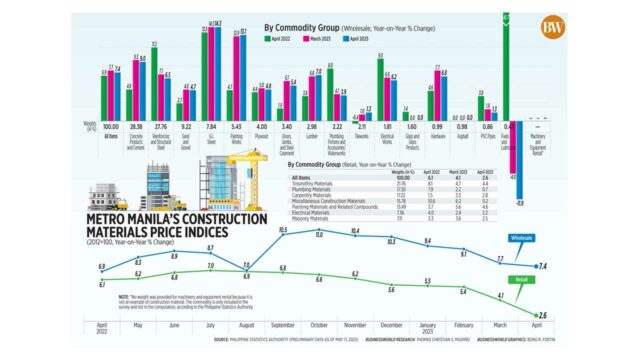
Metro Manila’s Construction Materials Retail Price Indices

PRICE GROWTH of construction materials in the National Capital Region (NCR) eased at both the retail and wholesale levels in April, the Philippine Statistics Authority (PSA) said on Wednesday. Read the full story.

Metro Manila's Construction Materials Retail Price Indices

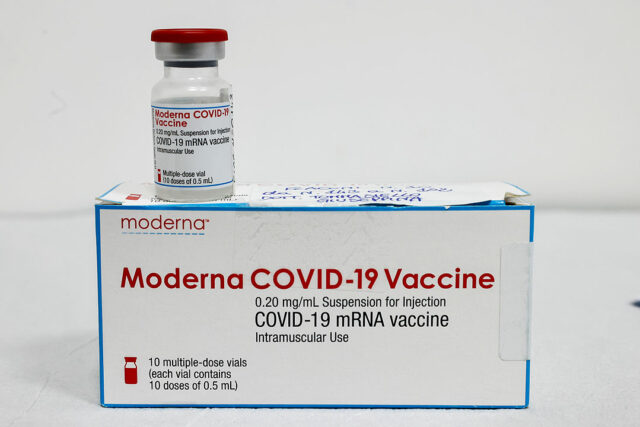
Moderna rules out vaccine production in PHL for now

REUTERS

MODERNA, Inc. said its establishment of a presence in the Philippines does not signal near-term plans to manufacture vaccines domestically.

Patrick Bergstedt, Moderna senior vice-president and general manager, told reporters in a virtual briefing on Wednesday that the company is still at the “crawling phase” of its Philippine operations, which currently consist of an upcoming shared services facility, which will handle some back-office and testing tasks for the company in the region.  

Mr. Bergstedt had been asked whether the facility being established in the Philippines is a prelude to local manufacturing.

“It is premature to talk beyond that at this point in time. I think we want to also be realistic to say that we need to crawl before we can (expand). And we’re still in the crawling phase,” Mr. Bergstedt said.

“The Philippine environment promotes innovation. You have many examples in the Philippines where businesses have innovated their sectors and really advanced the thinking, practices, processes, skills and technology. And we want to be part of that. Now that’s going to be the first phase,” he added.

However, Mr. Bergstedt noted the Philippines’ strategic location that might suit an expansion later on.

“Maybe a couple of years and then beyond that. The Philippines is also very well located from a distribution and logistics perspective. So, you can imagine strengthening and bringing some of the people in the facility that also provide that capability,” Mr. Bergstedt said.

“The message for the Philippines is that this is a large country of over a hundred million people. We went through a robust process to select the Philippines and we are here for a long-term commitment. We hope to continue to build upon that for the future,” he added.

Mr. Bergstedt said the shared service facility in the Philippines is expected to be completed by the end of this year and will result in the creation of 40 to 50 jobs.

The facility will house finance, pharmacovigilance, medical, human resources, and commercial offices. It will provide business services across the Asia-Pacific region.

Mr. Bergstedt said that Moderna is currently in the process of seeking the Philippine government’s approval for a bivalent coronavirus disease 2019 (COVID-19) vaccine, as well as other vaccines for respiratory syncytial virus infections, and combination vaccines that provides protection across various respiratory diseases.  

“The Philippines is well-located regionally. It’s relatively easy to get from Manila to a number of Asian countries where we are committed. Our expansion in the Philippines is an extension of a decision that we took in the beginning of 2022 to establish a presence in the ASEAN region,” Mr. Bergstedt said. — Revin Mikhael D. Ochave

PNOC-EC confident in continued viability of drilling in SC 38

THE Philippine National Oil Co.-Exploration Corp. (PNOC-EC) said the Malampaya field remains a viable resource for natural gas following the expiry and 15-year renewal of the field’s original service contract.

Candido M. Magsombol, a PNOC-EC vice-president with the company’s Management Services Division, told a Senate joint hearing that the company will continue its “active participation in SC (Service Contract) 38 Malampaya,” where the SC extension enables further well drilling to find and produce more gas.

“We believe that there is still gas there that we can still continue to produce,” Mr. Magsombol said.

PNOC-EC is a partner in SC 38, which has generated $12.4 billion for the government and $828 million for the company.

President Ferdinand R. Marcos, Jr. on Monday signed an agreement to renew the SC for Malampaya gas field in offshore Palawan running until 2039.

SC 38 was scheduled to expire on Feb. 22, 2024. Under the new agreement, the contract was extended to Feb. 22, 2039.

The Department of Energy (DoE) said on Tuesday that the Malampaya Consortium is expected to spend around $600 million on new drilling within SC 38.

The Malampaya Consortium is composed of Prime Energy Resources Development B.V., a subsidiary of Prime Infrastructure Capital, Inc. (Prime Infra), which has a 45% stake; UC38 LLC; and PNOC-EC, which own 45% and 10%, respectively.

The Malampaya gas field’s current well sites are expected to be commercially depleted by 2027. Mr. Magsombol said the PNOC-EC will “further explore other prospects outside the Malampaya prospect itself.”

Mr. Magsombol said PNOC-EC will work on the “drilling of Chico-1 Well and Workover of Mangosteen-1 Well in SC 37 in Cagayancillo, and the seismic data acquisition and processing in SC 57 in Calamian.”

“We (will) also coordinate with the Department of Energy on the award of new SCs,” he said.

It is also seeking to continue with its Mine 3 Coal Project, covered by COC (coal operating contract) 41, which is expected to produce coal in the second half of 2023. PNOC-EC will open another mine, Mine 4, within COC 41, which is expected to produce coal by the fourth quarter of 2024.

PNOC-EC has produced 757,000 metric tons from small scale coal mines within COC 41 since 2002, Mr. Magsombol said.

He added that PNOC-EC is looking at further exploration in COC 204 in Malangas, Zamboanga Sibugay.

“We just bored a hole there… we can call these explorator, just to check if there’s resources there.”

Mr. Magsombol told senators that PNOC-EC “is encountering challenges in pursuing exploration activities in the West Philippine Sea due to territorial issues.”

China claims more than 80% of the South China Sea, which is believed to contain substantial oil and gas deposits and through which billions of dollars in trade passes each year. A United Nations-backed arbitration court in July 2016 voided China’s claim to more than 80% of the sea based on a 1940s map.

China has ignored the ruling, which has failed to stop its island-building activities in areas also claimed by the Philippines, Vietnam, Brunei, Malaysia and Taiwan. — Beatriz Marie D. Cruz

Scams, potential privacy violations plague SIM registration process

A VENDOR shows different SIM cards for sale at a stall in Quiapo, Manila, Oct. 8, 2022. — PHILIPPINE STAR /KRIZ JOHN ROSALES

THE registration process for Subscriber Identity Module (SIM) cards has been beset by scams, potential violations of phone subscriber privacy, and technical issues, the non-profit Foundation for Media Alternatives (FMA) said.

“All the glitches, setbacks, and failures documented throughout the ongoing registration period demonstrate how unprepared, ill-equipped, and weak-willed the Philippine government is in establishing and maintaining another massive database of personal information,” the FMA, which advocates for information and communications technology users, said in a report.

FMA said the SIM card registration process, which was required under the Subscriber Identity Module Registration Act, also featured low turnout, function creep, surveillance, and the exclusion of some users.

The National Telecommunications Commission (NTC) estimated that as of May 15, only around 95.99 million subscribers or 57.13% of the total have registered.

“This problem is hardly surprising. Even before the system’s implementing rules took effect, one telco official acknowledged the ‘big challenge’ the industry was bracing for was how to encourage people to actually register,” FMA said.

It added that the NTC encountered many technical snags during the rollout, including unsuccessful registration, inaccessible registration portals, and the failure to send registrants their one-time PINs to proceed with registration.

“At any rate, the NTC became so concerned that it issued a memorandum directing telcos to report the problems encountered by their respective subscribers during registration. For its part, the Department of Information and Communications Technology launched a 24/7 complaint center meant to address SIM card registration issues and concerns,” FMA said. 

Once the registration began, reports surfaced about scammers offering to assist would-be registrants and asking for their personal details, according to FMA, in the face of warnings from telcos, the NTC, and the National Privacy Commission.

FMA said that the SIM registration could also be used by telcos for their own purposes such as for advertising and promotional offers.

“Controversy arose almost immediately after people complained of tick boxes put up by some telcos asking for their consent to the use of their personal data for marketing and profiling purposes, as well as the sharing of their personal data with third parties,” FMA said. 

“It is not inconceivable that the SIM card registration system will be weaponized and used as a tool of mass surveillance and authoritarianism,” FMA said.

FMA said the Philippine National Police has not given assurances that the data collected from the registration will solely be used to investigate SIM card-aided crimes.

“Like any ID mechanism, a SIM card registration system has that inherent potential to exclude, and, more often than not, impacts people that are already disadvantaged,” FMA said.

FMA said such disenfranchisement happened in Nigeria and Kenya after registration was required.

“Today, telcos appear to have made peace with that outcome given their full support for the system. They seem content with just ramping up their assisted registration initiatives,” it said.

“Despite these efforts, however, there remains no credible solution to the problem that a significant portion of the population do not have IDs or even civil registration papers needed for registration,” it added.

FMA said that the databases that will be created as a result of SIM registration will become security liabilities.

“Centralized databases are widely known to be honeypots that attract a lot of unwanted attention from bad actors,” it said.

“In the meantime, the responsibility of the NTC, the NPC, and other regulators to protect the people and their personal data, as well as to holding telcos and other stakeholders (including fellow government agencies) to account is going to be critical,” it added. — Justine Irish D. Tabile


ADVERTISEMENT
ADVERTISEMENT