Home Blog Page 48

DPWH on track to launch C5 rehab

THE DEPARTMENT of Public Works and Highways (DPWH) is on track to start the planned rehabilitation of Metro Manila’s Circumferential Road 5 (C5) this year.

“We will start the rehabilitation of C5 this year. We are now doing the planning for it,” Public Works Secretary Vivencio B. Dizon told reporters on the sidelines of Management Association of the Philippines General Membership Meeting on Wednesday.

The agency is implementing the rehabilitation of several road projects this year which include C5, Maharlika Highway, Epifanio de los Santos Avenue (EDSA), Andaya Highway, MacArthur Highway in Apalit, Pampanga, Buot-Taop Bridge in Cebu City, Oyungan Bridge in Iloilo, and Tubod-Nabuna Bridge in Aloran, Misamis Occidental.

The agency is still assessing the cost of upgrading C5, Mr. Dizon said, adding that the project will push through in 2026 as focus shifts to rehabilitating EDSA and the Maharlika Highway.

For this month, the DPWH is targeting to commence the bidding for phase 2 of EDSA upgrade project, and the Maharlika Highway.

The second phase of the EDSA project is expected to cost around P4 billion, Mr. Dizon said, noting that the entire EDSA rehabilitation project is estimated to cost P6 billion.

The agency, together with the Metropolitan Manila Development Authority, and the Department of Transportation, started the EDSA rehabilitation in December 2025. — Ashley Erika O. Jose

5,000 villages get P200,000 each in subsidies

PHILIPPINE STAR/EDD GUMBAN

AN INITIAL 5,000 villages received P200,000 each from the national government’s P8.08-billion program aimed at cushioning the economic fallout from the conflict in the Middle East, Executive Secretary Ralph G. Recto said on Thursday.

The “Bawat Barangay Makikinabang” initiative, which started on March 24, is designed to reach every village-level government with a fixed allocation of P200,000.

“Support will be given directly to the villages,” Mr. Recto said in a statement in Filipino.

“The President ordered that they be strengthened because these frontliners are closest to the people.”

The Philippines is exposed to the ongoing Middle East crisis as a net importer of oil. The war spiked its inflation rate to 4.1% in March, the fastest pace in almost two years.

Under the aid program, villages may allocate half of the P200,000 grant for projects selected from an approved menu.

The funding covers basic infrastructure and community needs, from street lighting and surveillance systems to emergency power supply, while also reserving half of each grant for education support.

The remaining P100,000 will be set aside for a “finisher program” aimed at helping college seniors in the community, ensuring their graduation is not disrupted by the economic fallout from the Middle East crisis.

The initiative is expected to support as many as 200,000 students nearing completion of their degrees, helping prevent financial strain from forcing them to drop out. — Chloe Mari A. Hufana

Women’s 3×3 team entertaining legit hopes for LA Olympics

FIBA

THE GILAS PILIPINAS women’s silver medal performance in the FIBA 3×3 Asia Cup in Singapore showed the country’s dream of making it to the 2028 Los Angeles (LA) Olympics in the event is no longer remote.

“To be the best Asian team in the Asia Cup is certainly a big honor,” said Samahang Basketbol ng Pilipinas (SBP) President Ricky Vargas. “They competed with skill, but you could really feel the passion in their game.”

“This is a big boost to SBP’s hopes of making it to the LA Olympics in 2028,” he added.

SBP Program Director Ryan Gregorio agrees.

“We’re looking at this event as a watershed moment for SBP’s 3×3 program. The women’s team has developed into a medal contender,” he said. “The key was the commitment from our partners in the professional and collegiate ranks in opening their doors to us, along with the support of our sponsors who believe in the program and our hopes of qualifying for the 2028 LA Olympics.”

The squad’s real mettle will be tested anew as it faces tougher competition in the FIBA 3×3 World Cup Qualifier this weekend in Singapore where the top three will advance straight to the World Cup set this June in Warsaw.

The Filipinas were bracketed in Pool B with the Brazilians and host Singapore.

Also fighting for Warsaw slots are Hungary, Lithuania and Egypt.

Kacey Dela Rosa, Mikka Cacho, Afril Bernardino and Cheska Apag should see action in Singapore although Reynalyn Ferrer was the one on the official list instead of Ms. Apag. — Joey Villar

90th Masters primed to challenge field at firm, fast Augusta National

AUGUSTA, Georgia — Patrick Reed said this week that there are “10 to 12 guys who have a really legitimate opportunity to win the green jacket.”

It doesn’t take a math major to determine that would eliminate more than 85% of this week’s 91-player field from winning the 90th edition of the Masters Tournament.

Told of Reed’s assessment, Bryson DeChambeau quipped, “I hope I’m one of those 12. That would be nice.”

Unlike Reed, DeChambeau has yet to claim a Masters title, but it’s still safe to assume he was among Reed’s short list.

The bigger point is that heavy underdogs rarely win at Augusta National. The first major of the year is the only one that is played at the same course every year. It’s a stiff test that lends itself best to those who are not only immensely talented with their ability to hit a variety of shots, but have experience with the different winds, course conditions and nuances that make Augusta National one of the most unique tests in golf.

And Reed explained that 10 to 12 are more players than he typically believes enter a Masters with a legitimate chance of winning.

“I just feel like with how deep golf has been, especially this past year to two years, that the fields are obviously getting a lot stronger,” he said. “I feel like the field this week is really strong like always. I feel like it used to be five or six, maybe seven guys.

“It just makes this event a little bit more special and even more fun going out there and playing against the best.”

Three of the past four Masters have been won by the current top two players in the world: Scottie Scheffler in 2022 and 2024 and Rory McIlroy last year, when the Northern Irishman completed the career grand slam in a dramatic playoff victory over Justin Rose.

Included in that stretch was the 2023 victory by former world No. 1 Jon Rahm.

The last player to win the Masters in his first attempt was Fuzzy Zoeller, who overcame a six-shot deficit and beat Ed Sneed and Tom Watson in a playoff 47 years ago.

On Thursday, McIlroy will begin his quest to become only the fourth player in history to win consecutive Masters. If successful, he would join Jack Nicklaus (1965-66), Nick Faldo (1989-1990) and Tiger Woods (2001-02).

“It’s arguably maybe not the largest field in golf, but it’s the strongest,” McIlroy said this week. “There’s so many great players and so many players with so much experience on this golf course, it’s not quite like some of the other major championships. It seems like you get a lot of the same guys contending year in and year out.”

The conditions could serve to increase that likelihood this year.

Augusta National has not seen a drop of rain this week. After some chilly and breezy conditions on Thursday morning, the forecast calls for mostly sunny — and completely dry — skies throughout the tournament.

That includes temperatures in the mid-80s over the weekend. That’s an equation for a firm and fast Augusta National, which will demand precision with all elements of players’ games.

“The forecast looks great,” Scheffler said. “It’s going to get firm and fast. I would imagine they would like the greens to get fast. I think that increases the challenge of the golf course.

“I’m excited to see how it plays this week. We might get a little bit of wind, too. The golf course is shaping up nicely.” Field Level Media via Reuters

Eala regroups in Germany after losing to Ostapenko

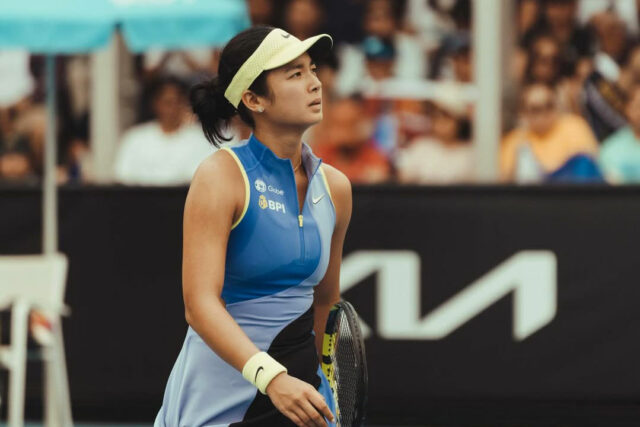
ALEX EALA — AUSTRALIAN OPEN/INSTAGRAM.COM/ALEX.EALA

AFTER yet another early exit from a clay tournament, Alexandra “Alex” Eala makes a quick turnaround to Germany for her debut in the Porsche Tennis Grand Prix in Stuttgart next week.

Ms. Eala melted down against Latvia’s Jelena Ostapenko in a Round 2 sweep in Austria but will have a chance to make up for it in the German tourney after gaining a last-minute main draw ticket for her second clay outing.

The 20-year-old advanced straight to the main tournament of the German tournament scheduled for April 13-19 as a replacement for Paris Olympic gold medalist and No. 37 Qinwen Zheng of China.

“Unfortunately, Qinwen has to withdraw due to injury but fans can now look forward to seeing Alexandra step in,” Porsche Tennis Grand Prix organizers said.

It will not be a walk in the park for the 46th ranked Filipina, who will also play in the Mutua Madrid Open on April 21 to May 3, leading up to the French Open on May 24 to June 7.

A taller mountain awaits Ms. Eala in Germany after crashing out of the Upper Austria Ladies Linz Open on Wednesday.

In the draw are No. 1 Aryna Sabalenka of Belarus, No. 2 Elena Rybakina of Kazakhstan, No. 3 Coco Gauff of the US, No. 4 Iga Swiatek of Poland, No. 7 Elina Svitolina of Ukraine and No. 8 Jasmine Paolini of Italy.

World No. 23 and reigning champion Ms. Ostapenko will also be in Stuttgart after slaying Ms. Eala for the first time in Linz.

Ms. Ostapenko, the 2024 Linz Open and 2017 French Open champion, flashed her veteran pedigree in scoring a 6-4, 7-5 come-from-behind win against Ms. Eala.

Ms. Eala, who scored a 6-4, 6-3 first-round win against Austria’s No. 1 player Julia Grabher (WTA No. 89), held the upper hand in both sets — 4-2 and 5-1 — only to get shut out by the 28-year-old Latvian the rest of the way.

“Thank you, Linz,” said Ms. Eala, looking to climb up the WTA rankings once more as she absorbed a 17-spot drop from a career-best No. 29 last month after falling short of replicating a Final Four finish in the Miami Open.

“Alex is a good player but this year, some good things are happening. I’m beating players who I never beat before so it means I’m on the right path,” said Ms. Ostapenko, who will face WTA No. 87 Elena-Gabriela Ruse of Romania, who posted a 4-6, 6-4, 6-4 comeback win over No. 49 Dayana Yastremska of Ukraine, in the quarterfinals.

Ms. Eala beat Ms. Ostapenko in their first two meetings last year with a 7-6 (7-2), 7-5 win in the Miami Open before repeating in the Lexus Eastbourne Open in England, 0-6, 6-3, 3-2.

On both occasions, Ms. Eala went on to deep runs by advancing all the way to the semifinals and the finals, respectively, as the first Filipina to do so in any WTA Tour level tournament.

But those tournaments were on hard and grass courts, respectively, with Ms. Eala continuing to struggle on clay.

Ms. Eala last year also bowed out early in four clay tournaments, including a 0-6, 6-2, 3-6 defeat to Colombia’s Emiliana Arango in her French Open main draw debut. — John Bryan Ulanday

Tanking is eroding faith in the NBA product

The National Basketball Association (NBA) has always sold hope as part and parcel of its principal product. Hope is in the nightly drama of competition. Hope also lies in the promise that even the worst of the worst of the league, given time and no small measure of lottery fortune, can rise and rub elbows with the established elite. What it did not intend to sell hope on, however, was the deliberate absence of effort. And yet, in recent months, the latter has become harder to ignore, with no less than Commissioner Adam Silver acknowledging a full-blown “tanking” problem. And he insists it will be addressed “full stop.”

As Silver himself admits, there is a need to distinguish between what he terms a “rebuild with integrity” and the calculated, corrosive strategy of deliberately taking one step backward in an effort to move two steps ahead. Once upon a time, tanking revealed itself late in the season, when the standings were largely settled and a playoff berth loomed farther than an opportunity to move up in the coming rookie draft.

These days, tanking arrives much earlier, sometimes as early as the turn of the year, and thus hollowing out the middle months of the calendar. Veterans have begun to feel it most acutely: benched not for poor performance, but for organizational intent, their competitive prime subordinated to meet long-term objectives.

The consequences are no longer abstract. They are most definitely visible, even jarring. Blowouts have proliferated, not merely as statistical anomalies but as symptoms of imbalance. Games are effectively decided before they begin. Contests are stripped of tension. Set-tos become ho-hum endeavors. And as conventional wisdom has aptly noted, the cost of tanking is increasingly borne by the product itself: lopsided scores, diminished urgency, and a viewing experience that irrationally expects fans to invest time in outcomes already preordained. In a league that thrives on narrative, this is the greater danger. Matches are losing meaning.

There is, to be sure, a temptation to view the problem as behavioral in nature, and one that can be corrected through fines, policies, or even moral suasion. Unfortunately, the incentives to the supposedly abhorrent tactic are structural; the draft, by design, rewards failure. And because a single transcendent player can alter the trajectory of erstwhile also-rans, losing becomes both rational and strategic. Which is why the conversation has shifted towards more radical solutions; among those being bandied about are flattened lottery odds, expanded pools that include play-in protagonists, and mechanisms that reward late-campaign victories. None of these options is perfect. All, in their own way, attempt to reconcile two competing truths: that parity requires assistance, and that competition demands sincerity.

The turn of events brings the league to an uncomfortable but necessary reckoning. Tanking is not an aberration; it is a feature of the system working as designed. To eliminate it is to alter the design, and to disturb the balance between hope and honesty, between future promise and present effort. There is, therefore, no easy fix; nor is there one that can be legislated away overnight.

All the same, the urgency is real. If the NBA sticks to the status quo, it gambles with much more than a few forgettable games in March. It risks eroding the very compact it has long held with its audience: that every night, regardless of circumstance, the battle is genuine and will be hard-fought. And once belief begins to fray, no lottery reform, however well-intentioned, will be enough to restore it.


Anthony L. Cuaycong has been writing Courtside since BusinessWorld introduced a Sports section in 1994. He is a consultant on strategic planning, operations and human resources management, corporate communications, and business development.

NASA Artemis II astronauts prepare to end moon mission in ‘fireball’ re-entry

A view of Earth, partially hidden behind the Moon, captured through the Orion spacecraft window at 6:41 p.m. EDT (22:41 GMT) April 6, 2026, during the Artemis II crew’s flyby of the Moon and obtained by Reuters on April 7, 2026. According to the image file data the picture was taken with a Nikon D5 camera and 400mm lens. — NASA/HANDOUT VIA REUTERS

HOUSTON — Four astronauts traveling back to Earth from the far side of the moon on National Aeronautics and Space Administration’s (NASA) Artemis II mission spoke of their emotions as they wrapped up the unprecedented flight and prepared to re-enter the atmosphere in a “fireball,” during their first press conference from space on Wednesday.

The Artemis II crew, flying in their Orion capsule since launching from Florida last week, are due to splash down off the Southern California coast on Friday evening after reaching the moon earlier this week. They cruised along a path that took them past the shadowed, lunar far side to become the farthest-flying humans in history.

On the trip back home, they will reach speeds of up to 23,839 miles per hour (38,365 kilometers per hour) as they enter Earth’s atmosphere, a high-risk phase of the mission that will put Orion’s heat shield to the test as it gets battered by intense atmospheric friction.

“I’ve actually been thinking about entry since April 3, 2023 when we got assigned to this mission,” said Artemis II mission pilot Victor Glover, when asked how he was feeling about the return.

“There’s so many more pictures, so many more stories, and gosh, I haven’t even begun to process what we’ve been through. We’ve still got two more days, and riding a fireball through the atmosphere is profound as well.”

Mr. Glover and fellow NASA astronauts Reid Wiseman and Christina Koch, and Canadian astronaut Jeremy Hansen are the first wave of astronauts in a multibillion-dollar series of missions under the Artemis program that aims to return humans to the moon’s surface by 2028 before China, and establish a long-term US presence over the next decade, building a moon base for potential future missions to Mars.

Ms. Koch cast the mission series as a relay race, telling reporters: “In fact, we have batons that we bought to symbolize, physically, that.”

“We plan to hand them to the next crew, and every single thing that we do is with them in mind,” she said.

That next mission, Artemis III, will involve a docking test in low-Earth orbit between the Orion capsule and both astronaut lunar landers that NASA plans to use to put its astronauts on the moon in later missions.

Artemis IV, targeted for 2028, would be the program’s first crewed lunar landing, and the first since Apollo 17 in 1972.

Back on Earth, dozens of lunar scientists have been packed in rooms adjacent to NASA’s Mission Control Center in Houston this week, scribbling down notes and debating a steady stream of both real-time and recorded audio from the Artemis II astronaut crew in their Orion spacecraft.

SPLASHDOWN
The crew is due to return to Earth on Friday around 8 p.m. ET (0000 GMT Saturday), splashing down off the coast of San Diego, California to cap their nearly 10-day mission.

The four astronauts on Monday had reached a record-breaking distance from Earth of roughly 252,000 miles, surpassing by some 4,000 miles the previous record held by the Apollo 13 crew for 56 years.

Mr. Wiseman, Artemis II mission commander, told reporters the crew each had two “very brief” chats with their families during the mission.

“Hearing your crew mates giggling and crying, and just gasping and listening and loving their families from afar — family is so important to all four of us, and that has been amazing,” he said.

In a radio message to mission control in Houston on Monday, as the crew approached their closest distance to the lunar surface, Mr. Hansen suggested naming a fresh crater on the moon in honor of Mr. Wiseman’s late wife, Carroll, who died of cancer in 2020.

Mr. Wiseman told reporters his crewmates approached him with that idea to name the crater Carroll while they were in quarantine before launching to space.

“That was an emotional moment for me,” Mr. Wiseman said. “I said ‘Absolutely, I would love that…’ but I can’t give the speech. I can’t give the talk.”

In the mission’s sixth day, Mr. Hansen choked up as he made the suggestion to mission control in what was a tear-jerking moment for many NASA staff in Houston.

The astronauts broke their distance record during the lunar flyby in which they surveyed the moon’s surface from roughly 4,000 miles above

Advances in lunar science have typically relied on lunar-orbiting satellites and Earth-based observations. But the crew’s six-hour lunar flyby provided a real-time stream of scientific collections from human eyes, allowing rare back-and-forth discussions between teams on the ground and their fellow scientists over 252,000 miles away in deep space.

Scientists see NASA’s Artemis II mission as an important early step in unlocking mysteries about the solar system’s formation. The moon, Artemis II mission specialist Ms. Koch said before launching to space last week, is a “witness plate” to the formation of our solar system. — Reuters


US senator urges Taiwan parliament to pass stalled defense spending plan

A soldier salutes Taiwan president Lai Ching-te in front of US-made M1A2T Abrams tanks after taking part in live-fire exercises in Hsinchu, Taiwan on July 10, 2025. — REUTERS/ANN WANG

TAIPEI — Taiwan’s parliament should pass a stalled special defense budget to send a signal to China and the world that it is serious about peace through strength, US Senator Jim Banks said during a meeting with President Lai Ching-te in Taipei.

Mr. Lai last year proposed $40 billion in extra defense spending to counter China, which views the island as its own territory.

Parliament, where the opposition has a majority, is continuing to debate the government’s plan and competing, less expensive proposals.

According to a video of the meeting provided by Mr. Lai’s office, Mr. Banks, a Republican who sits on the Senate Armed Services Committee, told him on Wednesday that the Taiwanese president was providing leadership in expanding defense spending similar to that of US President Donald J. Trump, who has proposed $1.5 trillion in defense spending.

“But your Legislative Yuan has to do its part and pass the special budget, and that’s one message that I want to send to your leadership,” Mr. Banks added, using the formal name for Taiwan’s parliament.

“When you pass the special budget in the legislature, that is a signal to China, and to the rest of the world, that Taiwan is serious about peace through strength,” he said. “I appreciate President Lai’s leadership in making that happen.”

Mr. Banks was one of a group of 37 bipartisan US lawmakers who in February wrote to senior Taiwanese politicians expressing concern about parliament stalling defense spending plans.

A separate group of US lawmakers gave a similar message urging parliament to pass the defense spending during a visit to Taipei last week.

Cheng Li-wun, chairwoman of Taiwan’s largest opposition party, the Kuomintang (KMT), is currently on a visit to China where she could meet President Xi Jinping.

The KMT says it supports defense spending but will not sign “blank cheques” and that dialogue with Beijing is equally important.

Mr. Lai told Mr. Banks that Taiwan “loved peace” but only strength could ensure it.

“Taiwan is willing to engage in dialogue, but no engagement can come at the cost of sacrificing democracy, freedom, and national interests,” he added.

China refuses to speak to Mr. Lai, saying he is a “separatist.” He rejects Beijing’s sovereignty claims, saying only Taiwan’s people can decide their future. — Reuters

Japan weighs new release of about 20 days’ worth of oil from reserves, Kyodo says

A 3D-printed oil pump jack and a map showing the Strait of Hormuz and Iran appear in this illustration taken March 2, 2026. — REUTERS

TOKYO — Japan is considering a new release of about 20 days’ worth of oil reserves as early as May, Kyodo reported on Thursday, amid uncertainty over the reopening of the Strait of Hormuz despite a US-Iran ceasefire.

Japan, dependent on the Middle East for some 95% of its oil supply, began releasing oil from its stockpiles on March 16 in coordination with other nations and on its own.

In total, Japan is making available about 50 days’ worth of oil consumption and has asked the International Energy Agency to consider a coordinated release of a second batch.

It now has enough oil for 230 days in its reserves.

On Tuesday, US President Donald J. Trump agreed to a two-week ceasefire with Iran on condition that Tehran reopened the Strait of Hormuz, but the vital waterway that normally carries about 20% of the world’s oil supply remains largely shut.

As a resumption of safe navigation in the Strait of Hormuz is uncertain, an additional release of oil is under consideration to stabilize supply, Kyodo quoted an unnamed official as saying.

Asked about the report, Narumi Hosokawa, deputy director-general for immediate crisis management at the Ministry of Economy, Trade and Industry (METI), told reporters the ministry continues to examine the situation.

With less crude oil available, Japanese refineries cut utilization rates to 67.7% of designed capacity in the week to April 4, the lowest since June.

To help cope with the energy supply crisis, Japan has started searching for non-Middle Eastern barrels, rolled out gasoline subsidies and stepped up coal-fired generation to reduce the need for liquefied natural gas supplies, which have also been cut due to the closure of the Strait of Hormuz.

While Japan has secured enough crude oil and naphtha for the country as a whole, there are supply imbalances and distribution bottlenecks in some areas, a METI document released on Thursday said. — Reuters

Disney plans to cut 1,000 jobs

WOMEN wearing Mickey Mouse ears watch the opening ceremony at Shanghai Disney Resort in Shanghai, China, June 16, 2016. — REUTERS

WALT DISNEY is planning to cut as many as 1,000 positions in the coming weeks, many of which will be made in the company’s marketing department, the Wall Street Journal reported on Wednesday, citing sources.

The Journal said that plans for the coming job cuts began before Josh D’Amaro assumed his new role as Disney’s chief executive officer in March.

The planned layoffs could affect less than 1% of its total employees. Disney employed about 231,000 people as of the end of fiscal year 2025.

Disney’s newly appointed chief marketing officer, Asad Ayaz, also plans to unite the company’s marketing group and reduce expenses under code-named Project Imagine, the report added. Mr. Ayaz began to oversee a newly created company-wide marketing organization in January.

Reuters could not immediately verify the report. Disney did not immediately respond to a Reuters request for comment outside regular business hours. — Reuters

German industrial output fall points to weak quarter, economists say

FREEPIK

BERLIN — German industrial production fell unexpectedly in February, with economists saying the weakness pointed to disappointing first quarter for Europe’s biggest economy, despite exports rising by more than expected on stronger European demand.

Industrial production decreased by 0.3% compared with the previous month, Germany’s federal statistics office said on Thursday. Analysts polled by Reuters had predicted a 0.7% rise.

“Data released today underline that Germany’s manufacturing sector was subdued even before the Iran conflict,” said Andrew Kennigham, chief Europe economist at Capital Economics.

Mr. Kennigham expects the sector to remain weak this year, although it is not likely to suffer anything like the big declines seen during the last energy crisis that began in 2022.

The less volatile three-month on three-month comparison showed that production was 0.4% lower in the period from December to February than in the previous three months.

ON TRACK FOR CONTRACTION EVEN WITHOUT WAR

February’s data shows that even without the Iran war, the German economy was on track for yet another quarter of contraction, said Carsten Brzeski, global head of macro at ING.

“As much as we were hoping to finally comment on some good economic news from Germany, it is a bit like waiting for a German train these days: definitely delayed and uncertain whether it will ever arrive,” Mr. Brzeski said.

Orders rose 0.9% on a seasonally and calendar-adjusted basis, official data showed on Wednesday.

Recent trends in new factory orders offer little hope that the economy will soon receive significant additional momentum from the industrial sector, said Ralph Solveen, senior economist at Commerzbank, forecasting the overall economy is likely to have grown only marginally in the first quarter.

EXPORTS ON THE RISE
German exports rose by 3.6% compared with the previous month, data from the federal statistics office showed, posting the biggest increase since May 2022. This compared with a forecast for a 1% increase in a Reuters poll.

Imports rose by 4.7% on the month on a calendar and seasonally adjusted basis.

As a result, Germany’s foreign trade balance narrowed to a surplus of 19.8 billion euros ($23.09 billion) in February, from a surplus of 20.3 billion euros in January.

Exports to European Union countries rose by 5.8% on the month and exports to countries outside the EU increased by 0.8%.

With the tariffs imposed by the US, exports to Germany’s main export destination fell by 7.5% on the month. ($1 = 0.8576 euros) — Reuters

Italy says EU should consider pausing budget rules if Iran crisis persists

LEADER of Brothers of Italy Giorgia Meloni is seen at the party’s headquarters, in Rome, Italy, Sept. 26, 2022. — REUTERS

ROME — European Union authorities should consider a temporary suspension of budget deficit rules if the US-Israeli war against Iran flares up again, Prime Minister Giorgia Meloni told parliament on Thursday.

Ms. Meloni also said her government was ready to take every possible measure to prevent potential speculative behavior on energy prices, including introducing windfall taxes on energy companies.

“We believe that discussing a possible temporary suspension of the Stability and Growth Pact should not be taboo. Not a waiver for individual Member States, but a general measure,” Ms. Meloni said.

Her remarks come as the government is preparing to cut its GDP growth estimates for 2026 and following years later this month, making it more difficult for Italy to bring its deficit below the EU’s 3% of GDP ceiling this year, as planned.

The EU activated between 2020 and 2023 a so-called ‘general escape clause’ to suspend budget rules and allow member states to respond to the COVID-19 pandemic, which had triggered lockdowns and economic downturns in EU countries and the closure of Europe’s borders.

That clause, however, can be tapped in the event of a severe economic downturn in the euro area or the EU as a whole, something which is not currently expected by leading forecasters.

Italy could also activate a national escape clause allowing member states to deviate from budget goals agreed with the EU in response to exceptional circumstances outside their control. The government has so far ruled out doing so as long as Rome is under excessive deficit procedure.

“Italy remains ready to take every possible measure to prevent potential speculative behavior (on energy prices), including, if necessary, further action regarding the profits of energy companies,” Ms. Meloni added.

Ms. Meloni and her predecessor Mario Draghi adopted in recent years windfall taxes on the energy sector, triggering legal disputes with affected companies. — Reuters

ADVERTISEMENT
ADVERTISEMENT