Home Blog Page 4755

Rejection letters

We receive daily follow-ups from applicants, and it takes so much time to answer them. As much as we’d like to be professional in our dealings, we have to prioritize our heavy workload. What’s the best way of managing this situation, especially for applicants who were rejected? — Starry Night.

Many of us can’t handle everything, even if we wanted to. But we must do something to project a professional image for the organization. We do it in the hope of maintaining goodwill with all applicants who might be customers as well.

Over the long term, the roles could just as easily be reversed — they could become the recruiters while we could be applicants. If you’re looking for a good example of the Golden Rule, you can start with your current situation.

Make yourself amiable to everyone. Be decorous and decent at all times. I know this may be difficult to do. Fortunately, it’s not impossible.

STRATEGIES
Take a few steps back to reflect on your situation. Think of the best approach to help you perform at your finest. Consider the following strategies:

One, insert a disclaimer in your job ads. Part of the ad should say something like this: “Due to the numerous applications we’re receiving every day, we regret we can’t reply to applicants following up by e-mail, text, phone calls, or personal visits to the office.” If you have this in your ad, rational applicants would readily understand the situation.

If some applicants persist despite the disclaimer, that’s a good reason for you to reject them for poor reading comprehension or failure to follow simple instructions. At any rate, when rejecting people, it’s better to remain silent. No talk, no mistake.

Two, send a bulk e-mail to all rejected applicants. As soon as you’ve hired someone for the vacated post, your best approach is to send a generic “thank you” e-mail to all rejected applicants. You can assign this task to a human resource clerk, or even to a temp working off a template that you provide.

Without encouraging false hopes, inform applicants that you’re keeping their curriculum vitae (CV) on file for future reference. Encourage them to update their CVs as needed, to be sent to a dedicated e-mail address. Also, you can ask them to follow the company’s social media accounts for the latest job vacancy announcements.

Last, write an appreciation e-mail to special applicants. These include the number two and three candidates on your shortlist, applicants for executive positions and individuals who were recommended by a government official. Show your genuine appreciation for their interest in your organization, regardless of how you feel.

You must be careful not to betray your true feelings, especially in the case of applicants recommended by politicians. Much depends on the specific circumstances. Sometimes, it’s better not to write a rejection letter at all if you run the risk of bruising someone’s ego.

You’ll be able to identify the ego cases by the time you’re done with the interview process.

BASIC RULES
To further demonstrate your professionalism, write the best rejection letter appropriate for certain individuals. There’s no such thing as “one-size fits all” template that accommodates all personalities. In general, follow basic rules in communication:

One, thank the applicant for their interest in your organization. The candidate has taken the trouble to update their CV, contacting you, wearing their best clothes and showing up for the interview. These are valuable to applicants. What’s the best way to convey your appreciation? Try something like this:

“We enjoyed our time with you when we met on (interview date) and carefully considered all your answers to our competency-based questions for (the position being advertised…).”

Two, explain the objectiveness of the hiring process. Be diplomatic in saying that the best candidate with strong credentials won out, in the judgment of a management panel. Use “we” and “our” to indicate that a collective decision was made. You can reinforce this impression by saying something like: “Our chosen candidate has clearly shown us how he plans to quickly turn things around and sustain these initiatives over the long term.”

Last, end with a positive impression. Write something that could give the rejected applicant the equivalent of a firm handshake and a warm smile. This could mean a lot to a rejected applicant. Your cordiality will be remembered by the recipient, who may come off with the impression that the decision was a close one.

Try a parting statement along these lines: “We really appreciated the opportunity of meeting you in the course of the hiring process. We wish you the best of luck!”


Join Rey Elbo’s Kaizen Study Mission to Toyota City, Japan on July 23-29, 2023. For details, chat with him on Facebook, LinkedIn, Twitter or e-mail elbonomics@gmail.com or via https://reyelbo.com


C-level collaboration for sustainability

Historically, organizations treated environmental, social, and governance (ESG) as an annex of corporate social responsibility. It is now dawning on them that ESG is actually a significant factor in their day-to-day operations, strategy, and transactions. CEOs are now rethinking ESG through the lens of organizational growth.

ESG issues have become critical for policy makers and stakeholders across different industries. Organizations must adapt to the risks and opportunities of this steadily growing development, and CEOs should concretize sustainability to create value for their clients and stakeholders.

This is where the Chief Sustainability Officer (CSO) comes in. The CSO establishes a company’s sustainability maturity level, such as its carbon baseline, and they are responsible for innovating sustainability plans. Lastly, the CSO must be knowledgeable about the organization’s vulnerabilities to adapt and mitigate risks.

The 2022 EY Long-Term Value and Corporate Governance Survey showed that 43% of leaders at prominent European organizations believe that their respective Boards are not committed to incorporating ESG factors in their long-term strategy, which they considered a significant hurdle.

The climate crisis has only worsened in the past years, and other problems such as COVID-19 highlighted the need for concrete ESG targets. The 2021 EY Global Corporate Reporting Survey showed that 84% of Chief Finance Officers (CFOs) perceive that stakeholders are now more focused on societal impact and inclusivity due to the pandemic. EY studies also showed that including ESG factors in an organization’s corporate strategy can boost revenue, primarily from ESG-focused consumers. Conversely, ESG failures like poor labor conditions can irreparably hurt a company’s reputation.

Given the stakes, Boards must work closely with CSOs in incorporating ESG into the organization’s overall strategic direction. By articulating a clear ESG agenda, the Board can assist the CSO in meeting their targets. This mutually beneficial partnership helps balance both profit and purpose. While the data show that there are still gaps between the Board and the CSO, there are three ways to achieve effective collaboration.

ELEVATE AND ENABLE THE CSO ROLE
While it is ideal for an organization to have a CSO, it is not a requirement. In place of this, there should be a designated person or group to oversee ESG-related affairs. Establishing proper governance is imperative, and it sends the message to clients and stakeholders that the company is serious about ESG.

The CSO can help organizations mitigate risks and adapt to vulnerabilities by analyzing their ESG maturity levels. Periodic reviews help transform insights into mechanisms for continuous improvement. The Board can assist by facilitating the reviews and clear communication with investors.

PRIORITIZE ESG AGENDA
CSOs cannot stand alone; their success depends on the Board’s cooperation. There is a clearly defined link between sustainability and strategy, and both parties should ensure that ESG is assimilated into the organization’s long-term strategy. Bridging the two can drive progress and elevate the company’s position in the global market. For example, climate risk is one of the more tangible components of ESG that can impact investor interest.

One of the significant challenges of integrating ESG into an organization’s strategy is ensuring that the latter is appropriately articulated among different business functions. Given its multifarious and rapidly evolving nature, both parties should have a growth mindset when approaching ESG.

DEVELOP ROBUST ESG DATA SYSTEMS
Clients and stakeholders seek explicit action on ESG issues such as health and safety, climate change, and transparency. The 2021 EY Global Institutional Investor Survey showed that 89% of respondents want global standards to be requisite for organizations.

Establishing a tight working relationship between the CSO, other organizational functions and audit committees could help the company articulate and achieve its ESG-related goals. They can devise risk-mitigating plans based on calculated scenarios and present these to investors. Better engagement can also give an organization a competitive advantage compared to its less transparent peers.

As mentioned earlier, ESG goals must be clearly articulated – specifically in financial terms. By properly linking ESG areas to economic performance, organizations are more likely to prioritize them. Conventionally, ESG is considered a framework; collaboration between relevant parties can help concretize this to achieve results.

CSOs can drive this change by creating business programs and policies to help create sustainability-related value for organizations, such as reducing carbon emissions. Boards and CSOs must work together to create value for their clients and stakeholders.

PRIORITIZING ESG
ESG is becoming an increasingly urgent albeit complex issue the world faces today. Organizations must be more mindful of their carbon footprint, brand reputation and labor practices as the market evolves. ESG underscores business in many ways as a developing strategic and cultural mindset, and integrating ESG-related strategies is a continuous and collaborative process by the CSO and the Board, along with others within the business, that can help organizations differentiate themselves in the global market.


Wilson P. Tan is the chairman and country managing partner of SGV & Co. and the president of FINEX. This article is for general information only and is not a substitute for professional advice where the facts and circumstances warrant. The views and opinion expressed above are those of the author and do not necessarily represent the views of SGV & Co. and FINEX.

Entertainment News (06/09/23)


More perks at NCT Dojaejung’s concert 

A new seat plan, T-stage, and more perks have been prepared for NCT DoJaeJung’s Scented Symphony: Perfume Fancon, part of the promotion of its debut extended play album, Perfume. The concert will be held on June 24 at SM Mall of Asia Arena. Tickets to the event are available via SM Tickets and range in price from P2,750 to P11,750, all of which come with perks and fan benefits. Plus 100 Send Off slots have been added to SVIP and Lower Box tiers. NCT DoJaeJung is the newest addition to the artist roster of SM Entertainment. The group is made up of three singers Doyoung, Jaehyun, and Jungwoo. The name of their sub-unit is a combination of the first letters of their names. In March, SM Entertainment announced that NCT DJJ would debut with their first extended play, and in April, the lead single “Perfume” was released digitally and physically worldwide alongside the music video of the song. The mini album is named after the lead single, Perfume, and includes five other tracks: “Kiss,” “Dive,” “Strawberry Sunday,” “Can We Go Back,” and “Ordinary.”  The concert is presented by Ovation Productions and Viu Philippines and is not part of any world or Asia tour. For more details and updates a, check the official website and Facebook Page of Ovation Productions at https://ovationproductionsmanila.com/ and https://www.facebook.com/ovationproductions/ .     


New Lego Certified Store opens at Shangri-La Plaza

The first LEGO Certified Store under Ban Kee Trading, Inc. management in the Philippines is set to open on June 18 at the Shangri-La Plaza mall. It will feature the brand’s latest store design and new experiences, offering interactive play and fun for more Lego collectors nationwide — especially considering that there are exclusive gifts with purchase. Among the features found in the Lego Certified Store is the curated stall, an area with open Lego sets that visitors can touch and interact with. For this season, it is all about the Ninjago sets, so customers on June 18 can have a firsthand look at the sets. An LED TV will show details about the presented items and products in the stall. There is also The Disruptor Bay where collectors can engage with intricate model set details. With its uniquely oversized moveable magnifying glass feature, visitors can explore the intricacies of meticulously crafted built sets from various angles, immersing themselves in the finest details. The new store will feature BAM or Build a Mini Figure where customers can customize Lego mini-figures. They can even make it look like themselves or their loved ones, matching their hair color, facial features, and clothes as closely as possible. Then there is The Digibox, an AI-powered monitor that instantly displays and animates onscreen any Lego set a customer scans. On the store’s grand opening, customers will get exclusive gifts-with-purchase such as the Lego store set and Lego brick laptop bags for a minimum purchase amount. Stocks are limited so Lego fans are encouraged to visit the opening to get their hands on these rare items. For details visit www.bankeebricks.ph, follow the LEGO Certified Store on Facebook and Instagram, and Ban Kee Trading, Inc. on Facebook and Instagram.


The Aurora Music Festival is going to Cebu

After the fun last April at Clark, the Aurora Music Festival is going to Cebu City on Sept. 16. It will be held in the open lot at the former Marreco, Brgy. Poblacion Mandaue, Cebu. It will feature a lineup of iconic OPM (original Pilipino music) artists and legends, including Ely Buendia who’s fresh from the Eraserheads US Tour, Bamboo, Silent Sanctuary, and Armi Millare. The promoters say the lineup also includes an iconic 1990s band, and this will be announced very soon. The Cebu Aurora Festival will also feature some of the hottest bands in Cebu: Missing Filemon and Phylum. The festival is strictly for individuals aged 18 and above. The Cebu Aurora Music Festival is presented by Epic Events, EggStop, and Mr. Maccchiato. Tickets are now available via https://ticket.cebuaurorafest.com and https://smtickets.com/. For inquiries, call 0945-644-5926 or message the FB page at https://www.facebook.com/CebuAuroraFest.    

The Supreme Court celebrates Pride Month. It shouldn’t.

STOCK PHOTO | Image by Chandlervid85 from Freepik

(Second of two parts)

The decision of the Supreme Court to “acknowledge and honor” the LGBTQIA++ poses doubt as to the consistency of its judgment: in Ang Ladlad vs. COMELEC, it declared: “At this time, we are not prepared to declare that these Yogyakarta Principles contain norms that are obligatory on the Philippines. There are declarations and obligations outlined in said Principles which are not reflective of the current state of international law, and do not find basis in any of the sources of international law enumerated under Article 38(1) of the Statute of the International Court of Justice.” Having said that, at the United Nations level, almost 100 State members have either rejected or otherwise refrained from expressing support for the so-called LGBT “rights.”

Hence, this utterly relevant (and very true) insight by our Supreme Court (again from Ang Ladlad): “not everything that society — or a certain segment of society — wants or demands is automatically a human right. This is not an arbitrary human intervention that may be added to or subtracted from at will. xxx [To do so will have] the effect of diluting real human rights.”

Even more importantly, the Supreme Court is duty bound (by Constitutional and legislative fiat) to protect the rights of women. However, the explicit celebration of the “T” (“transgender”) in LGBTQIA++ raises the question of whether the Supreme Court believes that a biological male should now be considered a “woman” and thus entitled to “women’s rights” simply because (as merely mentioned but not fleshed out in the Safe Spaces Act) such a biological male adopted a female identity.

But to do so would contradict the (correct) ruling by the Supreme Court in Silverio vs. Republic, in that while surgery may alter a person’s “body and appearance through the intervention of modern surgery, no law authorizes the change of entry as to sex in the civil registry for that reason.” The Court went on to say (again correctly) that to recognize the sex change “will have serious and wide-ranging legal and public policy consequences.” First is its effect on marriage, which is a “special contract of permanent union between a man and a woman.” Furthermore, “there are various laws which apply particularly to women such as the provisions of the Labor Code on employment of women, certain felonies under the Revised Penal Code and the presumption of survivorship … These laws underscore the public policy in relation to women which could be substantially affected” if sex changes were recognized.

As the Supreme Court wisely points out (in a great example of rejecting judicial legislation), “the sex of a person is determined at birth” and is “immutable.” Thus, “sex is defined as ‘the sum of peculiarities of structure and function that distinguish a male from a female’ or ‘the distinction between male and female.’ Female is ‘the sex that produces ova or bears young’ and male is ‘the sex that has organs to produce spermatozoa for fertilizing ova’.”

As an added note, the foregoing was implicitly bolstered later by the Supreme Court in Republic vs. Cagandahan, a sui generis case involving a hermaphrodite where the Supreme Court carefully noted that the person in question “has not taken unnatural steps to arrest or interfere with what he was born with,” letting “nature take its course” rather than “force his body into a categorical mold.”

FOLLOW THE MONEY
The Supreme Court, by having a “tarpaulin, freedom wall, and Pride shirts,” with “cash advances” made available to “defray all expenses,” also raises the question of whether these fall under a legally enacted budget item. Because all the foregoing products (unless private donations or voluntary private spending are involved) require the disbursement of tax money, which can only be done if such was put under a specifically identified budget item by Congress. Thus, Article VI.25.2 provides: “No provision or enactment shall be embraced in the general appropriations bill unless it relates specifically to some particular appropriation therein. Any such provision or enactment shall be limited in its operation to the appropriation to which it relates.” The foregoing Constitutional provision, in turn, is enforced by Congressional enactments, notably Section 220 of the Revised Penal Code.

A MATTER OF RIGHTS
In the end, it all goes back to the Constitution. Whatever your views may be on homosexuality or related sexual issues, the fact still remains that the Constitution has a clear declaration that “no person shall be deprived of life, liberty, or property without due process of law nor shall any person be denied the equal protection of the laws.” Are the LGBTQIA++ deserving of respect and dignity? Utterly so. They are definitely and assuredly within the ambit of Constitutional protection because every human being is inherently entitled to it. But what the Supreme Court did by celebrating Pride Month as it officially declared, is that it proffered treatment to a specific (albeit ambiguously defined) sector of society not available to any other.

This is all the more so considering that no specific Constitutional provision or law specifically authorizes, recognizes, or gives preference to the LGBTQIA++. It leads to a lot of unnecessary difficulties, particularly on bias and appearance of bias, especially if the Supreme Court is confronted with a legal case involving the LGBTQIA++ versus another party (e.g., a Catholic organization or independent news media), which the new Code of Professional Responsibility and Accountability proscribes and as has been long taught by the Supreme Court itself.

It also raises a question on Constitutional rights: the LGBTQIA++, ostensibly and as popularly seen, promotes a homosexual lifestyle which some religions disagree with. How are the faithful who are members of the judiciary supposed to respond to this? There is the question on free speech, particularly that of the “chilling effect” it may have on court personnel and the rest of the legal profession. If the Supreme Court itself is acknowledging and honoring the LGBTQIA++, even “encouraging” all personnel to wear Pride shirts, then how does that affect the ability of court personnel and all other lawyers to disagree with, protest, or criticize the LGBTQIA++? No matter how activities and wearing of Pride shirts are said be merely “encouraged” or “voluntary,” in our culture the moment one’s superior suggests something that is tantamount to an order. Then consider that the Supreme Court is the final authority as to who enters the legal profession, the disciplining of lawyers, and has administrative supervision (including hiring, promotion, and continued employment) of judges and court personnel. The complex difficulties brought about by the Supreme Court’s decision to celebrate Pride month is palpable, obvious, and foreseeable.

Which brings us to this reiterated point: the freedoms of religion and speech are expressly and specifically declared in the Constitution, enjoyable by all. To give the LGBTQIA++ treatment not available to others is not upholding equality, it is the imposition of a privilege. The Supreme Court — on terms of prudence alone — would have done well to refrain from making itself vulnerable to appearances of preference, especially when no Constitutional or legislative provision requires it.

A CONSTITUTION OF THREE EQUAL BRANCHES
All the foregoing queries are made with utter respect to and reverence for the Supreme Court.

Yet, being a Republic under our Constitutional system, such questions need to be raised to clarify every citizen’s understanding of rights, due process, and the rule of law.

It also must be said: the interpreting and upholding of the Constitution is not the exclusive domain of the Supreme Court but is also the function, authority, and responsibility of the Congress and the President (which they can definitely exercise by congressional enactment or resolution and presidential action or pulpit, respectively). Ultimately, it’s the People, the true holder of sovereignty and the Constitution’s author, that should be heard, deferred to, and have final say.


Jemy Gatdula is a senior fellow of the Philippine Council for Foreign Relations and a Philippine Judicial Academy law lecturer for constitutional philosophy and jurisprudence

https://www.facebook.com/jigatdula/

Twitter  @jemygatdula

ERC penalizes Sem-Calaca after unplanned outages

SEMIRARA Mining and Power Corp. (SMPC) on Thursday said that it had been informed by its subsidiary about its receipt of the energy regulator’s decision penalizing it for noncompliance with power outage reporting rules.

In a disclosure to the stock exchange, the company said the Energy Regulatory Commission (ERC) imposed a P400,000 fine on the company’s unit Sem-Calaca Power Corp.

“The case pertains to the failure to comply with the submission of outage occurrence and resumption of operation reports through short message service (SMS) within the prescribed timeline for unplanned outages,” SMPC said.

The outage dates were on Feb. 12, 2019 and April 27, 2019, and the resumption dates of operation were on March 16, 2019 and May 5, 2019, respectively. The regulator directed Sem-Calaca to pay the penalty within 15 days from receipt of the decision.

Sem-Calaca operates two units of 300-megawatt coal-fired power plants in Calaca, Batangas. SMPC, a vertically integrated power generator that runs on the fuel it produces, acquired the plant from the government in 2009.

SMPC is the country’s largest coal producer, supplying fuel to power plants, cement factories, and industrial facilities. It also exports coal to China, South Korea, Thailand, Cambodia, Vietnam, and nearby markets.

Earlier this month, SMPC said that it was set to make its second trial shipment to Japan as it moves to reduce its reliance on the Chinese market. The company said it would export in June up to 50,000 metric tons of Semirara coal to Shikoku Electric Power Corp. for its 700-megawatt coal-fired ultra-supercritical power station.

On Thursday, its shares rose 0.18% or five centavos to P28.25 each.

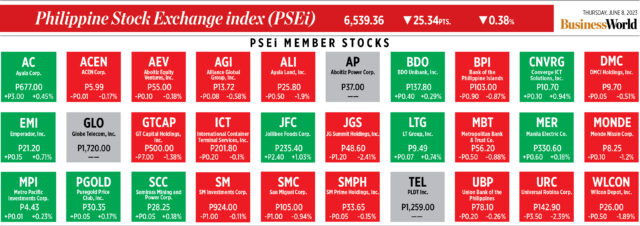
How PSEi member stocks performed — June 8, 2023

Here’s a quick glance at how PSEi stocks fared on Thursday, June 8, 2023.


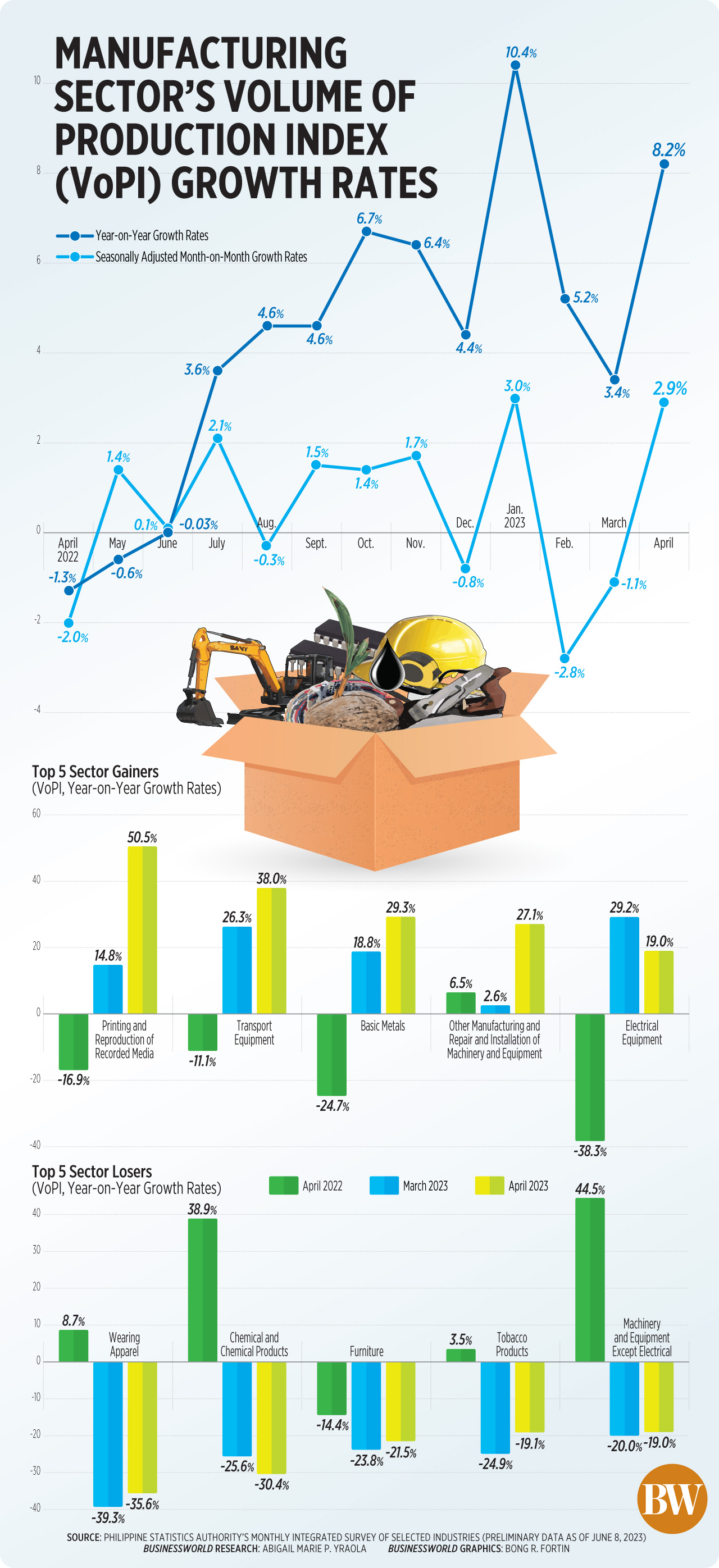
Manufacturing sector’s Volume of Production Index (VoPI) growth rates

MANUFACTURING OUTPUT in the Philippines rose to a three-month high in April amid strong domestic demand. Read the full story.

Manufacturing sector’s Volume of Production Index (TOPI) growth rates

PSE index drops as investors wait for fresh leads

PHILIPPINE STAR/KRIZ JOHN ROSALES

LOCAL EQUITIES declined on Thursday as investors stayed on the sidelines amid a lack of leads and before the US Federal Reserve’s policy meeting next week.

The benchmark Philippine Stock Exchange index (PSEi) fell by 25.34 points or 0.38% to end at 6,539.36 on Thursday, while the broader all shares index went down by 10.94 points or 0.31% to close at 3,484.71.

“The index closed at 6,539.36, holding above the 6,500 level. Investors are still on the sidelines awaiting the Fed decision next week,” Mercantile Securities Corp. Head Trader Jeff Radley C. See said in a Viber message.

“We think that the index will be dry moving forward until we see some positive news globally,” Mr. See added.

The Fed will meet to review policy on June 13-14.

The US central bank last month raised its benchmark rates by 25 basis points (bps), bringing its target interest rate to the 5%-5.25% range.

It has hiked borrowing costs by 500 bps since March 2022.

Regina Capital Development Corp. Head of Sales Luis A. Limlingan likewise said in a Viber message that investors stayed on the sidelines as they await the release of economic data here and in the United States. These include reports on weekly US jobless claims and wholesale inventories, as well as Philippine labor and trade data.

“The local bourse slipped by 25.34 points to 6,539.36 due to lack of catalysts. Investors, both at home and overseas, were still digesting recent economic data while waiting for fresh leads to move the market,” Philstocks Financial, Inc. Research Analyst Claire T. Alviar said in a Viber message.

“On the economic data front, the decline in the Philippines’ gross international reserves weighed on sentiment as well. Many investors were on the sidelines,” Ms. Alviar added.

Value turnover fell to P3.86 billion on Thursday with 626.14 million shares changing hands from the P4.14 billion with 801.79 million issues traded on Wednesday.

The country’s gross international reserves slid by 0.5% to $101.3 billion from April. Year on year, the reserves declined by 2.3%, the Bangko Sentral ng Pilipinas reported on Wednesday.

All sectoral indices fell on Thursday. Property dropped by 17.98 points or 0.66% to 2,685.08; mining and oil slid by 55.89 points or 0.55% to 10,068.34; holding firms declined by 24.70 points or 0.37% to 6,520.26; financials went down by 5.41 points or 0.29% to 1,828.35; industrials shed 25.16 points or 0.27% to close at 9,286.84; and services decreased by 2.52 points or 0.16% to 1,538.25.

Decliners outnumbered advancers, 105 versus 69, while 51 names closed unchanged.

Net foreign selling stood at P416.92 million on Thursday versus the P155.14 million in net buying seen on Wednesday. — A.H. Halili

Peso inches lower on renewed Fed hike bets

BW FILE PHOTO

THE PESO weakened slightly against the dollar on Thursday on expectations of a rate hike from the US Federal Reserve next week after increases from other central banks.

The local currency closed at P56.11 versus the dollar on Thursday, inching down by 1.20 centavos from Wednesday’s P56.098 finish, data from the Bankers Association of the Philippines’ website showed.

The local unit opened Thursday’s session at P56.12 per dollar. Its weakest showing was at P56.21, while its intraday best was at P56.08 against the greenback.

Dollars traded rose to $957 million on Thursday from the $841.55 million seen on Wednesday.

The peso inched down on expectations of further tightening by the Fed next week after the Bank of Canada fired off a surprise hike, Rizal Commercial Banking Corp. Chief Economist Michael L. Ricafort said in a Viber message.

The Bank of Canada on Wednesday hiked its overnight rate to a 22-year high of 4.75%, and markets and analysts immediately forecast yet another increase next month to ratchet down an overheating economy and stubbornly high inflation, Reuters reported.

The central bank had been on hold since January to assess the impact of previous hikes after raising borrowing costs eight times since March 2022 to a 15-year high of 4.50% — the fastest tightening cycle in the bank’s history.

The move suggested that other central banks, including the Fed, may have more work to do to combat inflation.

The Fed will hold its policy meeting on June 13-14.

The US central bank raised borrowing costs by 25 basis points (bps) last month, bringing the Fed funds rate to 5% to 5.25%.

It has hiked borrowing costs by 500 bps since March 2022.

For Friday, Mr. Ricafort sees the peso trading between P56.05 and P56.25 against the dollar. — with Reuters

Nurses awaiting licensing eyed for gov’t hospital work

PHILIPPINE STAR/ MIGUEL DE GUZMAN

THE Department of Health (DoH) will consider allowing nursing graduates still awaiting licensing to work in government hospitals, the new Health Secretary said on Thursday.

“We have several nurses that haven’t passed the board examinations and don’t have a licenses. In the government, you cannot work without a license, but I’m willing to take them if they have a diploma,” newly appointed Health Secretary Teodoro J. Herbosa told ABS-CBN News Channel. 

Under the proposal, nursing graduates will be given time — possibly five years — to take and pass the licensure examination while employed, Mr. Herbosa said.

“I’ll make them eligible so if you have a diploma from an accredited school, I’ll give you a period of time to pass it. This is same in the US, (which accepts) board-eligible nursing graduates. They give them five years to pass the exam,” he said.

He said that the DoH might even invest in mentoring graduates to pass the board exam.

Mr. Herbosa said he still needs to consult with the Professional Regulation Commission whether the law needs to be revised before unlicensed nursing graduates can be employed.

Government hospitals have a shortage of about 4,000 nurses, Mr. Herbosa noted.

“Board-eligible (nursing graduates find work) as flight attendants in big airlines, I see them in call centers,” he said. “They should be… taking care of sick people, they should be (practicing in) rural areas.”

About 40% to 50% of nurses in private hospitals have quit in the past two years due to dissatisfaction with salaries, the Private Hospitals Association of the Philippines, Inc. has said.

While acknowledging the right of health workers to leave the country to pursue opportunity, Mr. Herbosa said the government should address their concerns to encourage them to stay.

“The right to a better life is embodied in our Constitution. If a nurse wants to go abroad to get a salary that I cannot give, I shouldn’t stop that person because I should look at why I cannot pay the same amount,” he said. “I will (pursue solutions) to make them stay.”

As of December, the monthly salary for nurses in private hospitals averaged P12,000, while those working in the public sector were receiving an average of P35,097, according to Filipino Nurses United. — Kyle Aristophere T. Atienza

Proposal to NEDA will serve as ‘baseline’ for privatizing NAIA; meeting with unsolicited proponents due next week

NINOY AQUINO INTERNATIONAL AIRPORT (NAIA) Terminal 3 — PHILIPPINE STAR/MIGUEL DE GUZMAN

THE Department of Transportation (DoTr) said the proposal to privatize the Ninoy Aquino International Airport (NAIA) currently with the National Economic and Development Authority (NEDA) will serve as the “baseline” for the levels of investment the government expects to be sunk into the international gateway.

Transport Undersecretary for Aviation and Airports Roberto C.O. Lim said in a briefing on Thursday that the government could issue a bid invitation by September should NEDA approve, adding that an unsolicited proposal for NAIA submitted by a consortium has yet to be evaluated.

“We are just about to start studying the unsolicited proposal, as it is a very comprehensive proposal and it also needs to comply with the requirements stipulated in the Build-Operate-Transfer law,” he said.

“We will be meeting (the consortium behind the unsolicited proposal) next week with some preliminary questions …. Clearly, the unsolicited proposal is not identical to the basic terms and conditions that we have submitted to NEDA, (which sets) a baseline for what we believe are the investments needed for the public-private partnership for NAIA,” he added.

In April, the Manila International Airport Consortium, consisting of six Philippine conglomerates and Global Infrastructure Partners (GIP), submitted an unsolicited proposal valued at P100 billion.

The consortium is composed of Aboitiz Infracapital, Inc., AC Infrastructure Holdings Corp., Asia’s Emerging Dragon Corp., Alliance Global – Infracorp Development, Inc., Filinvest Development Corp., JG Summit Infrastructure Holdings Corp. and GIP, an investment fund.

The DoTr and the Manila International Airport Authority also submitted a solicited proposal to privatize the airport last week which will involve capital investment of P141 billion.

Once NEDA approval is obtained, Mr. Lim said, the government could publish the invitation to bid and participate in the privatization exercise by September.

“If we get NEDA approval, let’s say in a month or in a month and a half, by September we can publish the invitation and those who want to participate can acquire the kit that will define what (they will) need to do and to submit,” Mr. Lim said.

Mr. Lim said on Wednesday that the privatization of the NAIA could kick off by the first quarter of next year.

“If we are to use an aggressive timeline, I think we can have a result announced, the selection of winning bidder, by the first quarter of next year,” he said.

“Remember, there is a long process of selection; there is a tech assessment and there will be negotiations. This is an estimate we believe is doable,” he added.

Mr. Lim said that the DoTr has yet to talk with any private group for the solicited proposal as it is still waiting for the approval of NEDA.

“For the solicited mode, we have not yet talked to anybody because we are waiting for the NEDA to give its approval so that we can prepare the comprehensive kit that will be available when we publish in the newspaper an invitation for public bid for the concession of NAIA,” he said.

The public-private partnership project will make operations at the airport more efficient, said Mr. Lim.

“It can lead to a faster rate of investment in modernizing the facility so that we can really introduce the innovations and the technology that are needed just for NAIA to level up along with our neighbors’ airports,” he said. — Justine Irish D. Tabile

Tuna industry fears freeze on vessel monitoring could trigger European sanctions

BW FILE PHOTO

THE tuna industry said the government needs to lift the suspension of an order requiring monitoring devices on commercial vessels, in order to avert a ban on Philippine tuna by the European Union (EU).

In a statement, the Philippines Tuna Handline Partnership (PTHP) said that the suspension order may affect the status of Philippine tuna, after the industry was recently awarded the Marine Stewardship Council (MSC) certification.

“Ours are the first ever fishery in the Philippines to be certified under the MSC standard, an achievement that is in line with President Marcos’ goal of bringing prosperity and self-sufficiency to our nation,” Atenogenes B. Reaso, chairman of the Gulf of Lagonoy Tuna Fishers Federation, Inc., said.

“We are worried that the suspension of vessel monitoring measures to ensure transparency in fisheries will put our tuna exports at risk,” he added.

The EU requires preferred trading partners to comply with a number of international treaties, including one restricting Illegal, Unreported, and Unrestricted Fishing.

The PTHP earned its first MSC certification in October 2021 after a decade of compliance with international best practices.

In March, the Palace suspended the Vessel Monitoring Measures (VVM) for commercial fishing vessels under Fisheries Administrative Order (FAO) No. 266 in a memorandum signed by Executive Secretary Lucas Bersamin.

The memo directed the Department of Agriculture’s Bureau of Fisheries and Aquatic Resources (BFAR) “to hold in abeyance the implementation of FAO No. 266 nationwide, pending the final resolution over its constitutionality by the Supreme Court.”

FAO No. 266 requires that no fishing activity take place without complying with the vessel monitoring measures set by BFAR and local government units.

“This issue is very concerning. Our exports and those of other fish processors will be affected should the Philippines be red or yellow carded once again,”according to Jinky Rabano of the Philippine Association of Tuna Processors, Inc.

Environmental group Oceana reiterated its concern that the Philippines may face another yellow card warning from the EU, the country’s biggest market for fish and seafood products.

“VMM is also a tool specifically required to be established in our country to ensure the sustainable use of our marine resources,” Oceana Acting Vice-President Rose Liza Osorio said.

“This recent move by the government suspending the vessel monitoring rules contravenes not just our own law but even our commitments under various international agreements to ensure transparency and traceability,” she added.

The Philippines was issued a yellow card by the EU in 2014, which was lifted after the passage of Republic Act No. 10654 or the Amended Fisheries Code. — Sheldeen Joy Talavera

ADVERTISEMENT
ADVERTISEMENT