Home Blog Page 474

Philippine startups face tighter funding in 2026

FREEPIK/ATLASCOMPANY

By Beatriz Marie D. Cruz, Reporter

PHILIPPINE STARTUPS face tighter funding conditions this year amid macroeconomic uncertainty, as investors demand clearer revenue models and growth strategies, analysts said.

“The Philippine startup landscape in 2026 will reward discipline, not hype,” Dan I. Siazon, managing partner and co-founder at Kickstart Ventures, said in an e-mailed reply to questions.

Investors are becoming more selective, prioritizing startups that show strong fundamentals, proven customer demand, recurring revenue, sound governance, and a clear path to scale, he added.

“There’s tighter funding for early-stage valuations, and late-stage capital could remain scarce, especially in the Philippines, where there have been no recent late-stage deals,” Mr. Siazon said.

Paulo Campos III, founding managing general partner at Kaya Founders, said startup funding may remain “broadly stable” but uneven this year.

“Our outlook for 2026 is cautiously optimistic,” he said in a Viber message. “We expect a selective but constructive funding environment, rather than a broad-based rebound.”

Mr. Siazon said startups expected to attract investor interest include those in health technology, business-to-business services, climate and energy solutions, and financial technology platforms.

However, political uncertainty in the Philippines could weigh on economic activity and pose challenges for both large industries and startups, he said.

“This adds to the necessity for startups to be built to last and have strong fundamentals,” Mr. Siazon said.

Mr. Campos said macroeconomic uncertainty and heightened governance scrutiny mean investors will continue to set a high bar for capital efficiency, unit economics and credible paths to profitability.

For startups, this translates into longer fundraising cycles and greater pressure to show discipline early, he said.

Alewijn Aidan K. Ong, assistant general manager for business development at state-run National Development Corp., said startups tied to construction technology could be affected by slower infrastructure spending linked to a corruption scandal.

“With the biggest infrastructure spender, the government, toning down expenditure due to the corruption scandal, some startups that are part of the value chain may be adversely affected,” he said in a Viber message.

Data from the Department of Budget and Management showed infrastructure spending fell 40.1% to P65.9 billion in October, amid a graft scandal involving flood control projects that has also dampened economic activity.

Gross domestic product grew 4% in the third quarter, the slowest in more than four years, weighed down by weak household consumption and reduced public infrastructure spending.

In the first half of 2025, startup equity funding in the Philippines dropped 55% to $86.4 million from a year earlier, according to a joint report by Kickstart Ventures and Singapore-based business news platform DealStreetAsia.

Of rules, rulers, and leadership in a digital age

STOCK PHOTO | Image by Macrovector from Freepik

The start of a new year has a way of slowing us down, even if briefly. It invites reflection, not in the form of resolutions that rarely survive January, but in quieter questions about direction, values, and the kind of leadership we want to practice and accept. For those of us responsible for building organizations, shaping policy, or influencing public discourse, the turn of the calendar is less about fresh starts and more about taking stock.

This year, I found myself reflecting not on what I want to achieve next, but on what truly governs our choices. Who holds power over our work and lives. What standards we use to measure success. And whether the systems we build, increasingly shaped by technology, are reinforcing good leadership or simply amplifying authority.

It is from this place of reflection that this column is written.

In every stage of our lives, we operate within systems of rules and under the influence of rulers. Some are obvious: organizational hierarchies, titles, laws, institutions, and formal authority. Others are less visible but often more powerful: the internal benchmarks we use to measure ourselves, the standards by which we judge others, and the definitions of success we quietly accept without question.

Over time, I have come to believe that leadership, success, and even fulfillment are shaped less by who rules us and more by what rules us.

This distinction matters even more today as technology accelerates decision-making, reshapes institutions, and amplifies both good and bad leadership.

LEADERSHIP IS NOT THE SAME AS AUTHORITY
Not all rulers are leaders, and many leaders do not rule anything at all.

True leadership does not rely on position. It reveals itself through behavior, especially when formal authority is absent. In business, government, and civic life, effective leaders consistently demonstrate a small set of traits that transcend industry or title.

They are competent. They understand their field and respect expertise. They are grounded in reality. They confront facts, data, and constraints rather than wish them away. They act with integrity. Trust is earned through consistency and transparency. They show empathy. They recognize that organizations and institutions are made of people, not abstractions. They allow vulnerability. They acknowledge mistakes and surround themselves with people who can challenge them.

They inspire. They understand that people decide with emotion and justify with logic, and they speak to both.

Leadership does not require a title, a budget, or a formal zone of control. It requires credibility, trust, and influence.

Rulers, by contrast, often depend on position rather than persuasion. Some rise through talent and discipline, but others through power brokering, fear, misinformation, or inheritance. When their authority is questioned, intimidation replaces inspiration.

A useful question in any organization or institution is this: if you remove the title, the ability to punish, and the symbols of office, does this person still matter? Can they still motivate, influence, and make an impact?

Leaders worry they are not enough for the challenges ahead and work to improve. Rulers often fear exposure and respond by tightening control.

THE RULERS WE CARRY WITHIN US
Beyond external authority, each of us lives under internal rulers. These are the measures by which we define success.

For some, it is financial security or scale. For others, recognition, influence, family, creativity, expertise, or peace of mind. These benchmarks shape our decisions, ambitions, and relationships, often subconsciously.

Many conflicts in business and public life do not stem from bad intent, but from misaligned definitions of success. One person optimizes for growth, another for stability. One values visibility, another values long-term impact.

When we fail to understand what drives others, or ourselves, difference is easily mistaken for opposition.

A behavioral economist once observed that if you understand someone’s incentives, you can predict their behavior. This proves true across boardrooms, bureaucracies, and even public discourse.

Three questions have proven useful in building partnerships and reducing friction:

How do you define success? How are you being measured or evaluated? How can I help you succeed without compromising shared values?

Parents influence definitions of success early. Leaders design metrics that shape behavior for better or worse. All of us must decide whether to align, negotiate, or disengage when values diverge.

Facts alone rarely change people. Stories, emotion, and example often do.

TECHNOLOGY AS AN AMPLIFIER OF INTENT
In an era shaped by artificial intelligence, blockchain, and cybersecurity, these questions take on new urgency.

Technology does not fix broken leadership. It amplifies intent.

Artificial intelligence can improve decision-making or automate bias. Blockchain can build trust or expose its absence. Cybersecurity can protect citizens or reveal institutional neglect.

Digital transformation without values simply accelerates dysfunction.

Rules embedded in code matter. Governance frameworks matter. Ethical choices matter. As systems become more automated and interconnected, leadership is no longer only about managing people. It is about designing the rules, both human and digital, that shape behavior at scale.

The leaders of the future will be judged not only by what they build, but by what they choose to automate, decentralize, secure, or ignore.

RULES THAT ENDURE
Despite rapid technological change, a few principles for a good life have endured across generations.

On health, the guidance remains simple. Sleep enough. Move regularly. Consume in a balanced and moderate way.

On money, fundamentals still apply. Spend less than you earn. Reduce expenses so you do not price yourself out of your own dreams. Diversify assets. Invest for the long term and allow compounding to work quietly over time.

On career, relationships matter. Find mentors. Celebrate connections. Commit to continuous learning. Be patient, recognizing that most careers span decades, not sprints. Align with technological trends without surrendering judgment.

On life, certain truths are unavoidable. Loss is part of living. Gratitude is a discipline. Integrity compounds. Caring more is rarely the wrong choice.

The challenge has never been knowing these rules. The challenge lies in practicing them consistently.

LEADERSHIP, MANAGEMENT IN AN UNCERTAIN 2026
As we look ahead to 2026, the Philippine business environment faces no shortage of uncertainty. Economic headwinds, geopolitical tension, rapid technological change, regulatory shifts, and evolving workforce expectations will test organizations across sectors.

In such conditions, strategy alone will not be enough. Capital alone will not be enough. Technology alone will not be enough.

How we practice management will matter more than ever.

Management is where leadership becomes real. It is where values are translated into incentives, policies, systems, and daily behavior. It is where rules are enforced or quietly ignored. It is where trust is built or slowly eroded.

In times of uncertainty, rulers tighten control. Leaders build trust.

The future will reward organizations led by people who understand that authority is temporary, but credibility endures. That power can command compliance, but only leadership earns commitment. And that the rules we choose to live by, embed in our systems, and model for others will ultimately shape the kind of economy and society we become.

As the year begins, that may be the most important reflection of all.


Dr. Donald Patrick Lim is the founding president of the Global AI Council Philippines and the Blockchain Council of the Philippines, and the founding chair of the Cybersecurity Council, whose mission is to advocate the right use of emerging technologies to propel business organizations forward. He is currently the president and COO of DITO CME Holdings Corp.


Globe eyes more secure infra investment vs scams

GLOBE.COM.PH

GLOBE TELECOM, INC. said stronger investment in secure infrastructure and artificial intelligence (AI) is needed to protect the public online as digital scams and cyberthreats become more sophisticated.

“Globe is laying the groundwork for a secure, AI-powered future by building enterprise-grade infrastructure that includes agent-based architectures and shared landing zones,” the company said in a statement on Tuesday.

The Ayala-led telecommunication firm said a stronger AI foundation is critical as cyber-risks rise alongside the wider adoption of AI technologies.

Local companies face a higher risk of AI-driven scams this year and need to strengthen intelligence-led cybersecurity measures and employee awareness to limit exposure, according to cybersecurity firm Trend Micro.

“Resilience today means more than uptime. It’s about systems that stay ethical, secure, and explainable as they scale,” said Derick Ohmar Adil, Globe head of AI and privacy governance.

Globe said scam tactics are evolving, with threat actors using tools such as fake cell towers and cross-border coordination to bypass traditional safeguards.

In response, the company said it has blocked all person-to-person SMS messages containing links — making it the only mobile operator in the country to do so — and removed links from its own text broadcasts. It also uses machine learning models to flag suspicious activity.

Globe added that public-private partnerships should be treated as essential infrastructure to expand rural connectivity while supporting broader AI readiness.

Globe shares rose 1.9% or P30 each to close at P1,611 on the Philippine Stock Exchange. — Ashley Erika O. Jose

December inflation quickens to 1.8%

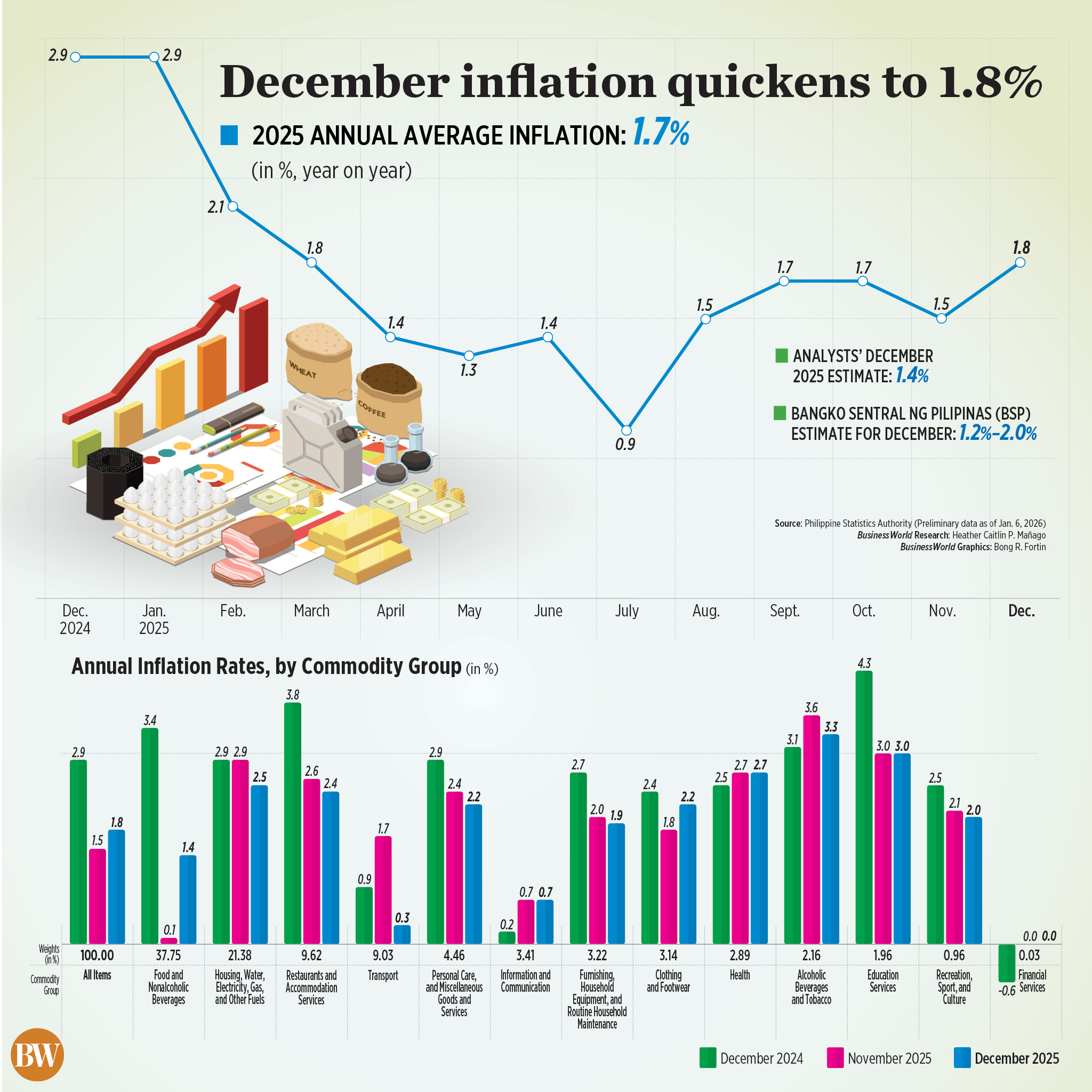
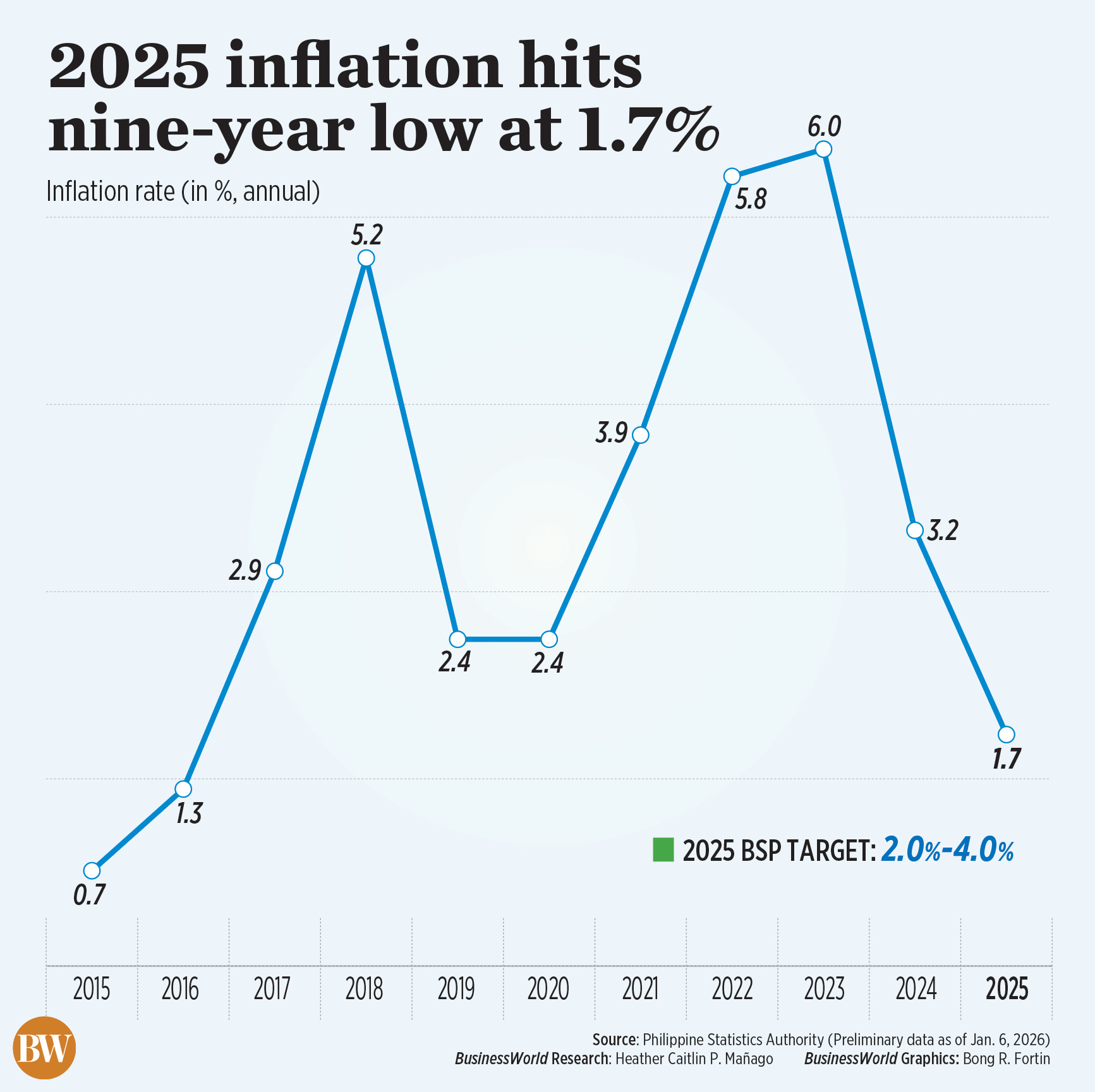
HIGHER FOOD PRICES during the holiday season lifted inflation to 1.8% in December, although the full-year average eased to 1.7% — the slowest in nearly a decade, the Philippine Statistics Authority (PSA) reported on Tuesday. Read the full story.

.

EastWest Bank partners with PayMongo for online payments acceptance

BW FILE PHOTO

EAST WEST Banking Corp. (EastWest Bank) has partnered with PayMongo Philippines, Inc. to allow the bank’s business clients to accept online payments at cheaper rates.

Under the partnership, EastWest Bank’s business clients can integrate PayMongo’s online payment gateway at “preferential” merchant discount rates, it said in a statement on Tuesday.

This will allow them to accept card, wallet and digital payments at competitive prices.

“This partnership is about giving businesses the easier eay to bank and transact. By including PayMongo’s capabilities into our ecosystem, we’re enabling easier online payments, faster settlement, and a smoother digital commerce experience, all at a cost that supports their growth,” EastWest Bank Chief Executive Officer (CEO) Jerry G. Ngo said.

“We’re pleased to partner with EastWest in broadening access to digital payment solutions for more Filipino entrepreneurs. By working together, we can offer tools that make digital transactions easier and support the operational needs of today’s entrepreneurs — all while contributing to stronger digital financial infrastructure in the Philippines,” PayMongo President and CEO Elmer M. Malolos said.

EastWest Bank said it plans to expand its collaboration with PayMongo to explore other ways to integrate emerging financial technologies into its offerings and services for entrepreneurs.

“This partnership comes at a time when the Philippine fintech ecosystem is accelerating rapidly, from the rise of embedded finance and tokenized assets to open-banking models and next-generation payment rails. By aligning payments, settlements, and banking services, EastWest is positioning itself as a strategic innovation partner for businesses navigating a digital economy,” it added.

EastWest Bank’s attributable net income rose by 6.25% year on year to P2.48 billion in the third quarter of 2025.

This brought its nine-month profit to P6.62 billion, up by 13.81% from the same period in 2024.

The bank’s shares went up by eight centavos or 0.68% to close at P11.90 each on Tuesday. — Aaron Michael C. Sy

Why is Marie Antoinette so popular? The French queen still sells

MANOLOBLAHNIK.COM

By Dana Thomas

BEFORE she was sent to the guillotine in 1793, 37-year-old Marie Antoinette couldn’t have imagined that more than two centuries later, she’d still be one of the most famous women in the world. The French queen’s jewels and furniture command record-breaking prices at auction; her porcelain and palace fabrics are reproduced and hawked by homeware brands; and her likeness is used on everything from expensive candles to throw blankets. She’s been the inspiration for a plethora of bestselling books, feature films, jazz and rap songs, and fashion shows.

If you need proof that the Biden-era embrace of quiet luxury has given way to something decidedly more ostentatious and maximal, look no further than Marie Antoinette’s renewed visibility. In the age of influencers, the Queen is a case study in spectacle and optics. “She was constantly on parade, constantly performing and being watched, and she was scrutinized far more than celebrities are today,” says Sarah Grant, a senior curator at the Victoria & Albert Museum in London, which is currently hosting a show devoted to the queen’s style and legacy.

Marie Antoinette is also, of course, a cautionary tale — a symbol of what can happen in an era of political polarization, concentrated wealth and corrosive income inequality. It is this, as much as her exuberant taste and rarified life, that makes her a potent mascot for our times.

Among the 250 treasures on display at the blockbuster V&A show (through March 22) are a pair of her tiny silk slippers; a clutch of her royal jewels, which the museum has reunited with her jewelry case, made by French cabinetmaker Martin Carlin in 1770 — the year of her marriage — on loan from Versailles; and her Sèvres dinner service from the Petit Trianon. Also in the exhibition are contemporary fashion looks inspired by her, including the shimmering gold lamé ballgown Grace Kelly wore in Alfred Hitchcock’s To Catch a Thief and a sweeping Eau de Nile silk Marquise Masquée gown, designed by John Galliano for Christian Dior’s Spring-Summer 1998 Haute Couture collection.

The doomed Queen was a pioneer of influencing even in her own day. She established herself as a tastemaker almost immediately upon her arrival at Versailles at 14, as the Austrian princess bride of 15-year-old King Louis XVI. Caroline Weber, author of the bestselling Queen of Fashion: What Marie Antoinette Wore to the Revolution, makes the case that her rocky early relationship with her young, eccentric husband made it difficult for her to do what queens were meant to do: bear heirs. “She had to come up with another way to be important at the court and that was to be a style leader,” Weber says.

Marie Antoinette allowed her likeness to be reproduced in fashion engravings, a first for the royal court. She allowed her court stylist, Rose Bertin, to sell copies of her gowns to other women a few months after she’d worn the styles herself. “She understood the power of imaging and was selling an image that the public wanted to consume and emulate,” Weber notes.

The economic power of her style — what is known at Sotheby’s auction house as the “Marie Antoinette Effect” — has continued almost unabated ever since. In 2018, Sotheby’s sold 10 pieces of her jewelry, including a diamond and natural pearl pendant for $36.2 million and a diamond bow brooch for $2.1 million (both are in the V&A show), and last year, it sold a 300-carat diamond necklace for $4.8 million. There is a particular premium on anything that hasn’t been seen since her reign.

“The curiosity that she brings is enormous,” says Andres White Correal, Sotheby’s chairman of jewelry for Europe, the Middle East and Africa. “She has these two sides that are completely different, but extremely appealing — the tragic side, because everyone can relate to her sadness when everything went wrong, and when she was the queen of style and was the most revered. Those two things make her human, like any of us.” 

In 2022, Christie’s Paris auctioned two pieces of her furniture: a commode by Pierre Macret from 1770, and a neoclassical armchair by Georges Jacob from her bedroom at Versailles. Each went for close to €1 million ($1.18 million). So did a table by Jean‑Henri Riesener, a woodworker for the queen, which the Rothschild family sold in 2019. “We find that Marie Antoinette pieces appeal more than those of Louis XVI,” says Hippolyte de La Féronnière, the head of Christie’s European Furniture Department in Paris. “People love her dramatic history. Yes, it’s the same as his, but the fact that she was a foreigner who arrived at Versailles and managed to conquer the court made for a personality bigger than that of Louis XIV, even if he was king. Her story is one of power.”

In 2023, Versailles reopened the newly restored Queen’s apartments, a suite of small rooms on the south side of the palace, with original 18th century fabric designs, such as a lush, gold-embroidered lilac taffeta and several joyful toile de Jouy cottons. Rosebuds from one toile print have been reinterpreted on paper plates and cups by Meri Meri for Ladurée. Several other patterns, including an India-style block-print featuring flowering branches and pineapples in red and mustard, have been reissued as fabric and wallpaper by Pierre Frey, the luxury French textile manufacturer.

That print also served as the design inspiration for the most recent high jewelry piece by Maison Mellerio, one of Marie Antoinette’s original purveyors, which still has a store next to the Place Vendôme. Mellerio unveiled a one-of-a-kind necklace, called Jardin des Rêves, of gumdrop-size sapphires, aquamarines, tanzanites, tourmalines, and topazes, and a gold-and-gem pineapple pendant, at a private reception at Versailles last summer. (Tagline: “Who hasn’t dreamed, for just one evening, of being a queen?”)

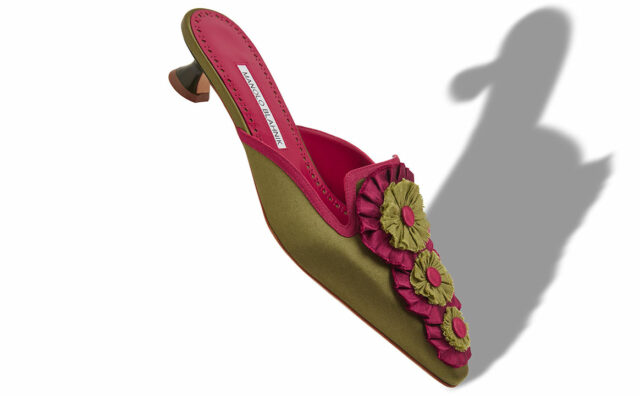
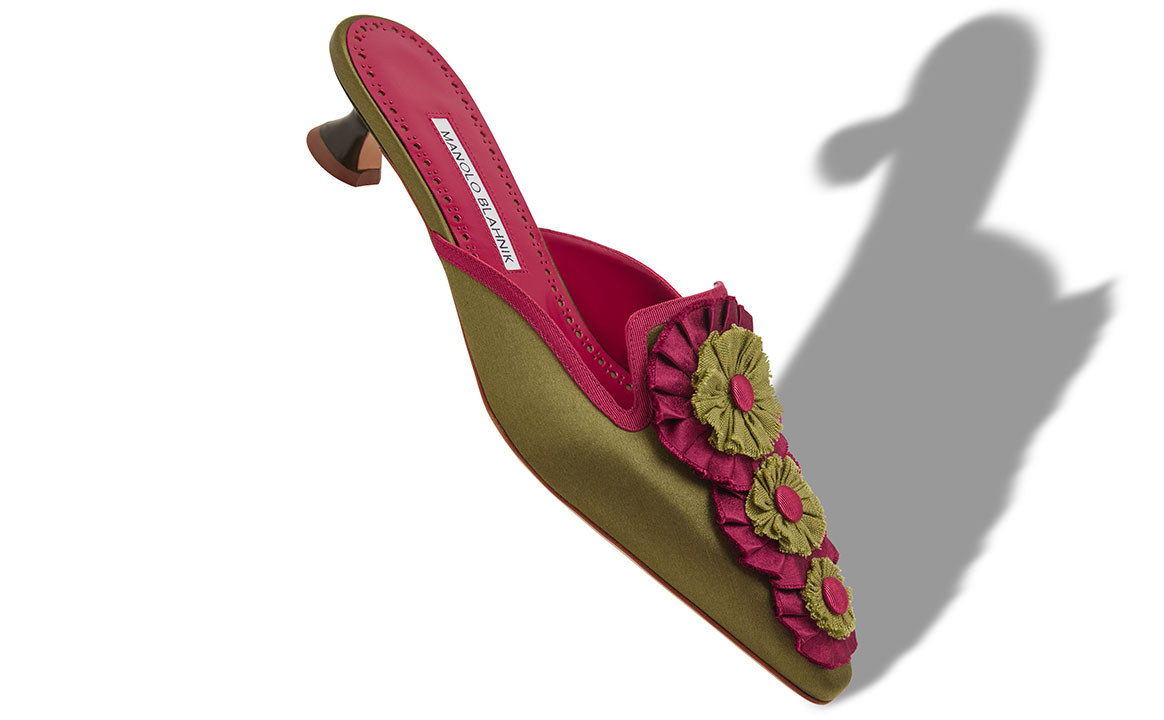
Beyond that, luxury candlemaker Cire Trudon has created a pink candle replicating the 18th century wax bust of the queen attributed to the Brachard brothers. (“I have one,” Grant admits.) London-based shoe designer Manolo Blahnik, whose company is a sponsor of the V&A show, this summer dropped a limited-edition collection of frou-frou silk pumps he designed for Sofia Coppola’s lavish 2006 movie Marie Antoinette.

“Marie Antoinette is a beacon of decadence, a style icon. People love her,” Grant says. “She’s an incredibly rich seam to mine, and because she’s a historical figure, she gives a bit of gravitas to any kind of incarnation or any kind of reference.”

Only the French — who sent her to the guillotine after all — seem to have an ambivalent relationship with her, as the world saw at the opening ceremony of the 2024 Summer Olympics in Paris. During the parade, actors in the windows of the Conciergerie, the ancient city prison where she spent her final days, depicted Marie Antoinette holding her own severed head as the French heavy‑metal band Gojira sang about revolutionary themes.

“We cut their heads off and thought it was over forever,” La Féronnière says. “How wrong we were.” — Bloomberg

Kaya Founders to invest in more early-stage startups this year

KAYAFOUNDERS.COM

LOCAL VENTURE capital firm Kaya Founders plans to invest in eight to 12 startups this year, focusing on early-stage financial technology and business-to-business (B2B) platforms.

“In 2026, we expect to invest in approximately eight to 12 startups, primarily at the pre-seed and seed stages,” Paulo Campos III, founding managing general partner at Kaya Founders, said in a Viber message.

The firm’s priority investments next year will be startups in fintech, commerce and distribution channels, he said. It will also focus on capital-light B2B platforms and frictionless business models that show early potential for regional or global expansion.

Kaya Founders is also looking at startups with embedded credit solutions and those building foundational fintech infrastructure, Mr. Campos said.

The firm invested in 10 startups last year.

Investment decisions are based on a startup’s capital efficiency, addressable market size, scalability and ability to build lean teams, he said.

Founders are also expected to demonstrate strong founder–market fit, a clear path to profitability and regulatory awareness, particularly in fintech and other regulated sectors.

Kaya Founders also evaluates realistic exit pathways and a startup’s capacity to form strategic partnerships with corporations, Mr. Campos said.

“Ultimately, we back founders who combine ambition with discipline — building companies that can scale efficiently in today’s environment while positioning themselves for meaningful outcomes over the long term,” he added.

Since its founding in 2021, Kaya Founders has increased its portfolio to about 40 startups across sectors including e-commerce, fintech, education, healthcare and software-as-a-service.

The firm ended 2025 with the close of its $25-million (P1.5 billion) fund, which will be deployed to support Filipino and regional startups.

The fund follows a two-part structure, consisting of Kaya Founders’ “Zero to One” pre-seed fund and its “One to Ten” seed-to-Series A fund, allowing the firm to support founders from the idea stage through early growth.

Investors in the fund include local and international partners such as Singapore-based Pavilion Capital, Gabriel and Geraldine Sunshine of Boston-based hedge fund Bracebridge Capital and Chicago-based Concentric Equity Partners.

The Philippine startup ecosystem raised $1.12 billion in equity funding in 2024, up 16% from a year earlier, according to the Philippine Venture Capital report by Boston Consulting Group and Foxmont Capital Partners. — Beatriz Marie D. Cruz

2025 inflation hits nine-year low at 1.7%

HIGHER FOOD PRICES during the holiday season lifted inflation to 1.8% in December, although the full-year average eased to 1.7% — the slowest in nearly a decade, the Philippine Statistics Authority (PSA) reported on Tuesday. Read the full story.

Protecting brands in cyberspace and e-commerce transactions

STOCK PHOTO | Image from Freepik

Filipinos have largely shifted to e-commerce over the past five years, driven by the widespread adoption of contactless transactions following the pandemic. Philippine e-commerce has grown exponentially into a $25-billion industry, with the average Filipino spending P16,000 a year through e-commerce.1

While online shopping is now widely preferred due to its convenience and affordability, it also exposes consumers to instances of fraud — ranging from fake listings and counterfeit goods to fake seller accounts. As a result, the brand reputation of goods offered for sale may suffer, regardless of the manufacturer’s involvement in the transaction. In this regard, how can consumers and brands protect themselves against fraudulent internet transactions, and what role does the e-commerce platform play in regulating such fraud?

Under the Intellectual Property Code, the owner of a registered trademark may take action against, and recover damages from, a person who uses any reproduction or imitation of its mark in commerce which is likely to cause confusion or deception. Persons found guilty of such acts are also subject to criminal penalties.2 Thus, brands may seek redress against infringing online sellers for the latter’s unauthorized use of their marks in e-commerce transactions. However, since the concept of secondary or contributory infringement does not apply to Philippine trademark law, brands cannot hold e-commerce platforms liable for hosting or facilitating the said transactions.

Meanwhile, consumers who are prejudiced by counterfeit goods or misleading advertisements of unauthorized sellers may seek redress under the Consumer Protection Act. Under the said law, a producer, manufacturer, supplier, or seller in a consumer transaction who commits deceptive sales acts or practices may be held civilly and criminally liable for such conduct.3 However, the Consumer Protection Act makes no mention of the liability of e-commerce platforms in online transactions.

The Internet Transactions Act of 2023 (ITA) addresses this gap in legislation to protect both brands and online consumers from fraudulent e-commerce transactions. The ITA defines the persons engaging in electronic commerce as follows:

1. Digital Platforms – ICT-enabled mechanisms that connect and integrate producers and users in online environments where goods and services are requested, developed, and sold;

2. E-marketplaces – digital platforms whose business is to connect online consumers with online merchants, facilitate the shipment of goods or provide logistics services and post-purchase support within such platforms, and otherwise retain oversight over the consummation of the transaction;

3. E-retailer – a person selling goods or services directly to online consumers through its own website, webpage, or application; and,

4. Online Merchant – a person selling goods or services to online consumers through an e-marketplace or third-party digital platform.4

Under the ITA, the e-retailer or online merchant is primarily liable to the online consumer for damages arising from internet transactions.5 The digital platform or e-marketplace may be held subsidiarily liable with the e-retailer or online merchant if it fails, after notice, to act expeditiously in removing or disabling access to goods or services that infringe on another’s intellectual property rights, among others.6

The subsidiary liability of digital platforms or e-marketplaces, however, is limited only to the extent of damages suffered by the online consumer as a direct result of the transaction.7 Hence, it appears that insofar as trademark owners are concerned, the remedies available against digital platforms or e-marketplaces under the ITA are limited to the removal of infringing material on their platforms. On the other hand, e-retailers or online merchants may be held liable by trademark owners under the provisions of the Intellectual Property Code, or by the defrauded consumer under the provisions of the ITA.

These provisions also extend to cross-border transactions. If a person engaging in e-commerce avails of the Philippine market to the extent of establishing “minimum contacts” in the country, then they shall be subject to applicable Philippine laws and regulations.8 While the ITA does not define the term “minimum contacts,” the concept has been applied in Philippine jurisprudence through test factors such as the nationality and intended governing law of the parties, the location of the goods, and the place of performance of the transaction.9

Ultimately, the ITA seeks to balance consumer protection and brand integrity in laying out the responsibilities of e-commerce platforms in fostering a safer online marketplace. n

1PaymentsCMI. (November 2024). Asia E-commerce Data Portrait 2024–2027. Americas Market Intelligence. Retrieved from https://americasmi.com/pdfs_landings/PCMI_Asia_Ecommerce_Data_Portrait.pdf

2Section 155 in relation to Section 170, Intellectual Property Code of the Philippines.

3Article 60 in relation to Article 50 of the Consumer Protection Act.

4Section 4, Internet Transactions Act of 2023.

5Section 25, Internet Transactions Act of 2023.

6Section 26, Internet Transactions Act of 2023.

7Section 40, Implementing Rules and Regulations (IRR) of Internet Transactions Act of 2023.

8Section 5, Internet Transactions Act of 2023.

9Esther Victoria Alcala Vda. de Alcañeses v. Jose S. Alcañeses, G.R. No. 187847, June 30, 2021 [Per J. Leonen, Third Division], citing Saudi Arabian Airlines v. Court of Appeals, 358 Phil. 105, 123, Oct. 8, 1998 [Per J. Quisumbing, First Division].

This article is for general informational and educational purposes only and not offered as, and does not constitute, legal advice or legal opinion.


Atty. Ninna Joyce P. Delantar is an associate of the Intellectual Property Department of Angara Abello Concepcion Regala & Cruz Law Offices (ACCRALAW).

npdelantar@accralaw.com

+632-8830-8000

Arts & Culture (01/07/26)


Kundirana presents 2026’s maiden concert

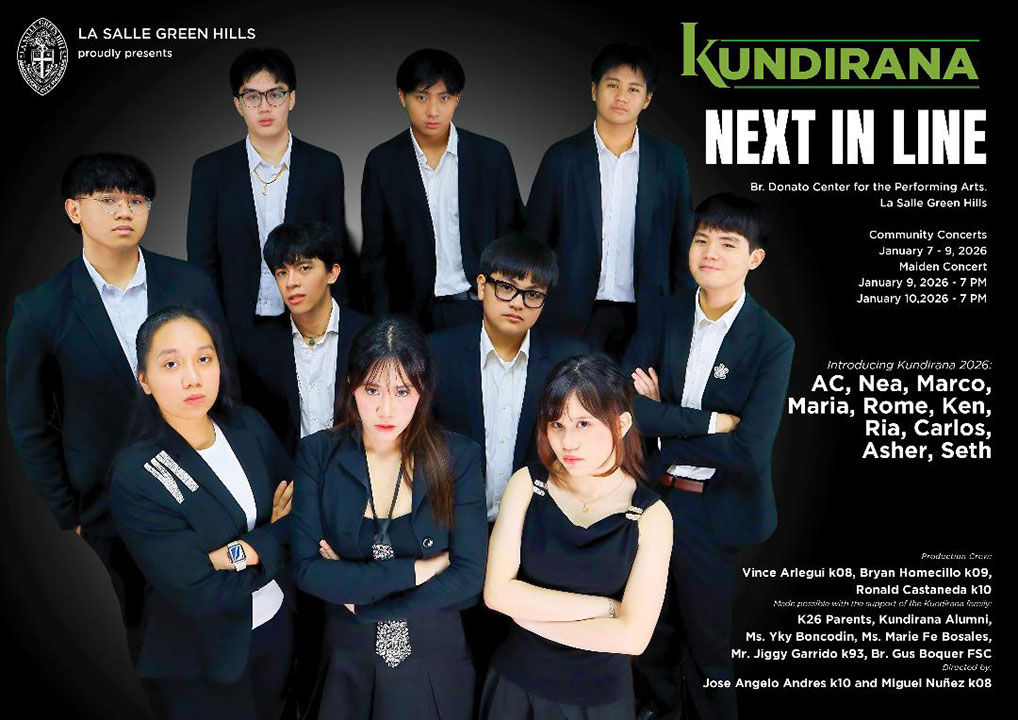
KUNDIRANA, the award-winning music ministry of La Salle Green Hills (LSGH), is set to hold its first concert for the year this week. Performances are scheduled for Jan. 9 and Jan. 10, with shows at 7 p.m. They will be held at the Br. Donato Center for Performing Arts at La Salle Green Hills, Ortigas Ave., Mandaluyong City. For ticket (P150) reservations, e-mail is.principal@lsgh.edu.ph.


West Gallery opens 4 exhibits

RUNNING from Jan. 8 to Feb. 7 at West Gallery are four new exhibits. There’s Breathe, Sigh… by Geraldine Javier; How the Frame Decides by Audrey Lukban; Manual for Making Space by Julieanne Ng; and Existence through allusions by Joanolasco. The gallery will also have on display selections from the Soler and Mona Santos Collection, which includes works by Elmer Borlongan, Roberto Chabet, and many others.


NCCA celebrates art deco with 2026 calendar

THE National Commission for Culture and the Arts (NCCA) continues its tradition of releasing an artistic calendar this year. This time, it commemorates 100 years of Art Deco in the Philippines, coinciding with the global celebration of the architectural style and highlighting its beauty and enduring impact on the country’s landscapes. Titled “A Century of Art Deco in the Philippines,” the calendar features 12 notable structures from around the country that demonstrate how Art Deco influenced civic buildings, educational institutions, residences, and cultural landmarks across the archipelago during the 20th century. The calendar was conceptualized and designed by journalist, filmmaker, and cultural researcher Roel Hoang Manipon.


Kelli Maeshiro, Veronica Peralejo at MO_Space

TWO EXHIBITIONS are running at MO_Space from Jan. 10 to Feb. 8. At the Main Gallery is Kelli Maeshiro’s Vast when you’d expect Insular, which explores liminal and negative space as sites of meaning, intimacy, and distance. It is rooted in the artist’s research on Japanese theories of perceived empty space, using the installation of repurposed everyday objects to treat the gallery as a relational volume between artist and viewer. At Gallery, 2, Veronica Peralejo’s The Poets and the Mundane marks a continuation of the artist’s clay modeling and assemblage practice. It conjures random shapes and textures, creating fundamentally familiar images and birthing repetitive variations that preserve faint memories of interesting things.

PCC rules Robinsons–Premiumbikes deal poses no competition concerns

EN.WIKIPEDIA.ORG

THE PHILIPPINE COMPETITION COMMISSION (PCC) has cleared Robinsons Supermarket Corp.’s proposed acquisition of Premiumbikes Corp., saying the transaction is unlikely to harm competition.

In a statement on Tuesday, the PCC said the deal would not result in a substantial lessening of competition in any of the relevant markets reviewed. It added that the merged entity would have limited ability or incentive to exercise market power, citing the parties’ relatively small market share and the presence of many competitors.

Robinsons Supermarket is engaged in the wholesale and retail of general merchandise through brands such as Robinsons Supermarket, Robinsons Easymart, Shopwise, The Marketplace and Uncle John’s. Its do-it-yourself retail segment is operated by Robinsons Handyman, Inc. under Handyman Do It Best and True Value.

Premiumbikes is involved in the wholesale and retail distribution of motorcycles, spare parts and accessories, operating 215 stores nationwide. It carries brands including Honda, Yamaha, Suzuki, Kawasaki, Kymco and TVS.

The PCC said its mergers and acquisitions office assessed markets in cities and municipalities where the parties operate, focusing on motorcycle accessories as well as oils and lubricants. The review drew on information from the companies and inputs from regulators, competitors and trade groups.

In July, Robinsons Retail Holdings, Inc., through Robinsons Supermarket signed an agreement to acquire 100% of Premiumbikes from Lance Y. Gokongwei for P146.4 million, or P7.27 per share.

Shares of Robinsons Retail rose 1.94% to P34.15 each on the Philippine Stock Exchange. — Alexandria Grace C. Magno

Peso nears record low as inflation picks up

PHILIPPINE STAR/MIGUEL DE GUZMAN

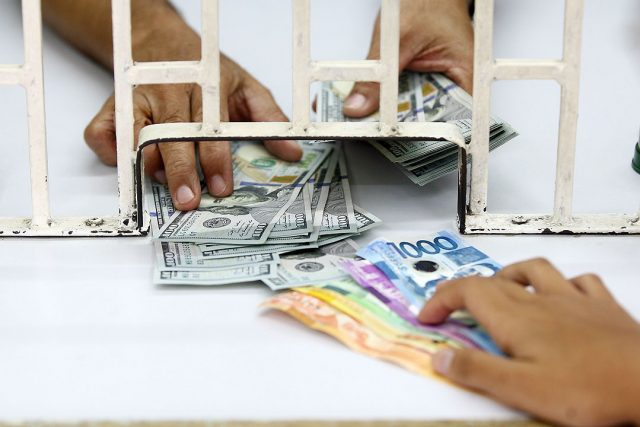
THE PESO weakened to a fresh one-month trough against the dollar on Tuesday to close just a shade higher than its record low as December inflation was faster than expected and as geopolitical concerns continued to weigh on sentiment.

The local unit closed at P59.21 versus the greenback, sliding by eight centavos from its P59.13 finish on Monday, data from the Bankers Association of the Philippines data showed.

This was its worst finish in nearly a month or since its record-low close of P59.22 on Dec. 9.

The peso opened Tuesday’s trading session stronger at P59.07 versus the dollar, which was also its intraday best. Its weakest showing was its close of P59.21 against the greenback.

Dollars traded increased to $1.386 billion from $929 million on Monday.

The peso dropped due to quicker-than-expected December inflation, Rizal Commercial Banking Corp. Chief Economist Michael L. Ricafort said in a Viber message.

Headline inflation picked up to 1.8% last month from 1.5% in November, but slowed from 2.9% in December 2024. This was within the Bangko Sentral ng Pilipinas’ (BSP) 1.2-2% forecast for the month, but was above the 1.4% median estimate in a BusinessWorld poll of 14 analysts.

“The dollar-peso traded higher on demand for safe-haven assets amid rising geopolitical tensions,” a trader said in a phone interview.

The US dollar ticked lower for a second day against major peers on Tuesday, as market jitters from US military action in Venezuela eased and stocks rallied around the world, helped by dovish comments from Federal Reserve officials, Reuters reported.

The impact of the shock US capture of Venezuelan President Nicolas Maduro over the weekend was short-lived across most asset classes with stocks around the world trading at record highs.

That also had ripple effects in currency markets.

The dollar index, which measures its strength against a basket of six currencies, was last trading at 98.25, down 0.1% and extending losses after snapping a four-day winning streak on Monday.

For Wednesday, the trader sees the peso moving between P59 and P59.30 per dollar, while Mr. Ricafort sees it ranging from P59.10 to P59.30. — A.M.C. Sy with Reuters

ADVERTISEMENT
ADVERTISEMENT